Updated my website header image with the latest warming stripes image for PEI from the University of Reading’s #ShowYourStripes.

It seems they have added new options for viewing the data that are even more striking. Look at those bars from 2000 on.
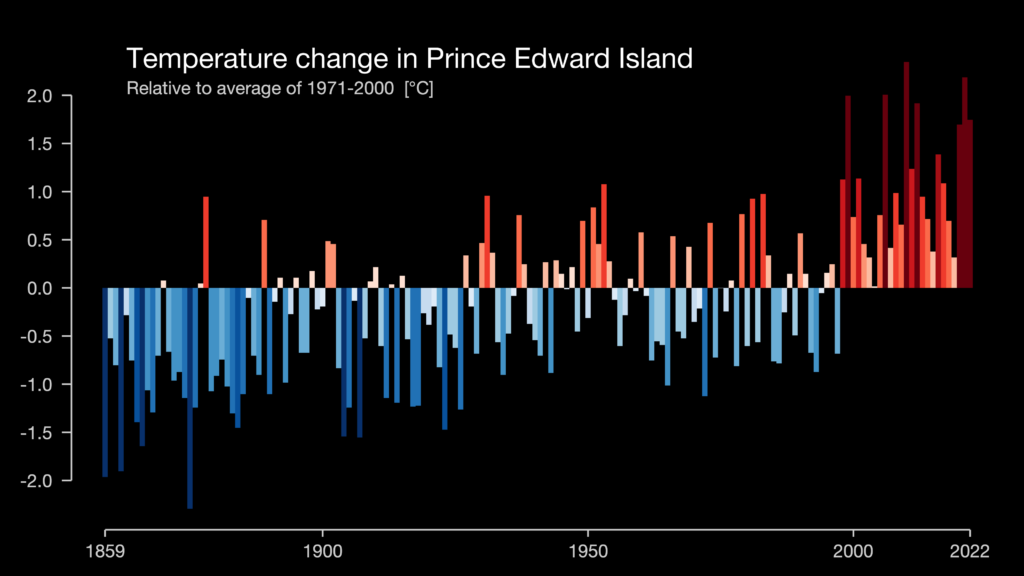

Updated my website header image with the latest warming stripes image for PEI from the University of Reading’s #ShowYourStripes.
It seems they have added new options for viewing the data that are even more striking. Look at those bars from 2000 on.
Deborah and Mike Scholes have been in Sussex, New Brunswick for weeks waiting for the right weather conditions to allow them to start their journey across the Atlantic in a hot air balloon. Today was the day, and they lifted off at about 9:45 am local time.
I checked their live tracking system and their initial path from Sussex had them heading to Moncton, then Shediac, and if they stayed on that course it looked as though they would be passing close to Tyne Valley, not far from where I live. Never one to miss the opportunity to stare at something going overhead and wave at it, I gathered my camera and zoom lens and got ready to head off just after lunch to find them.
When I checked the map one more time before I left, they had started to head slightly more to the east, which meant I had a bit further to drive than I had planned. I decided to go instead to Union Corner Provincial Park, and the tracking map later confirmed I had picked the right spot! I made good time, but arrived a few minutes too late to see them. It was also pretty cloudy.
I hopped in the car again and headed towards Summerside. As I zipped along Route 11 in St. Nicholas, I looked up and there they were, 12,896.3 feet above me, travelling at 23.5 mph!
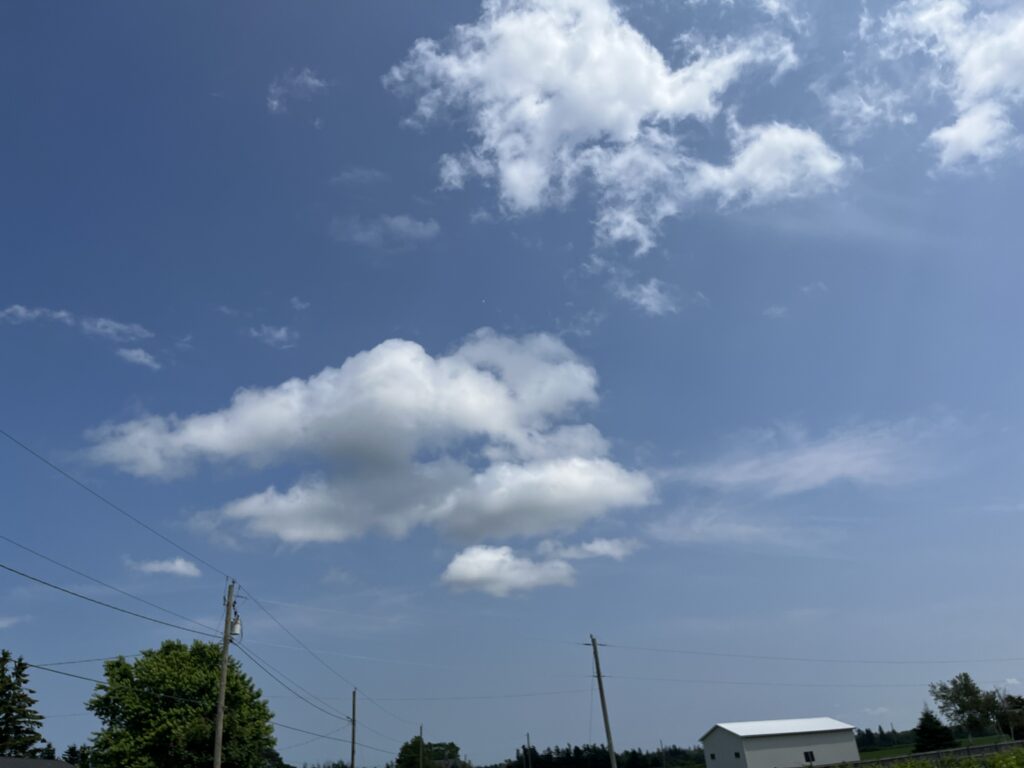


I knew the Linkletter Community Centre about 10 minutes away would have a clear view from their parking lot, so I continued on there and was able to watch the balloon for a few minutes as it floated on toward Malpeque Bay.
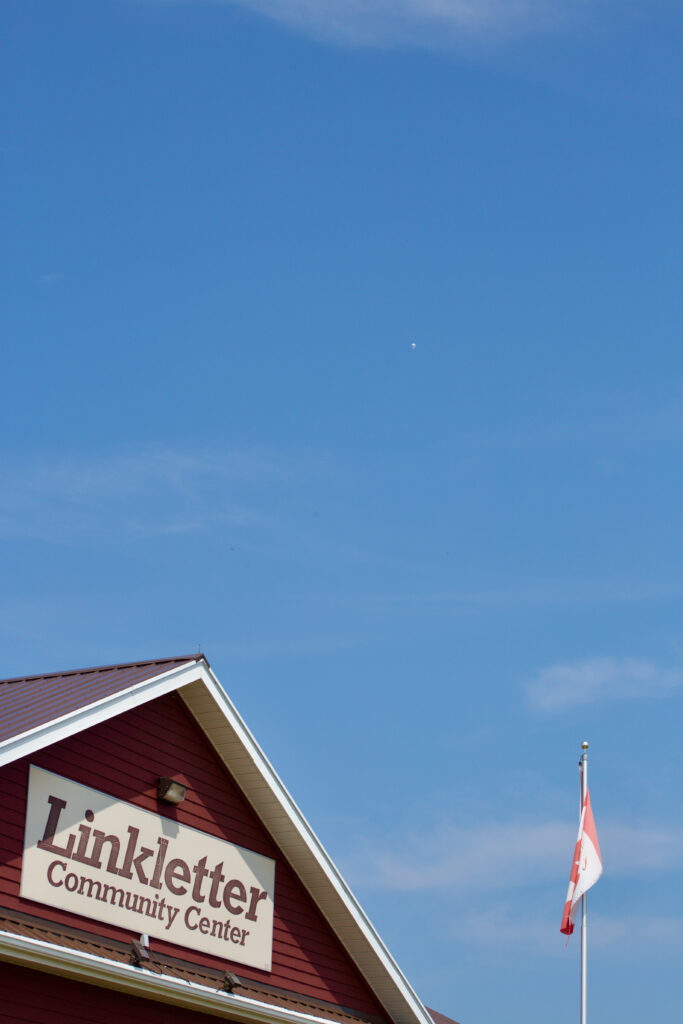
And yes, I gave a little wave, which is completely silly, but the child in me needs to emerge every so often, and young me would definitely have waved to the brave adventurers floating toward the ocean.
Update July 21, 2023 – Due to technical issues, Deborah and Mike had to land their balloon this morning near Gander, Newfoundland and Labrador. Must have been a huge disappointment for them, but I don’t doubt they will try again. And if you have seen the musical Come From Away, you know that you are guaranteed a warm welcome and safe harbour if you land in NL!
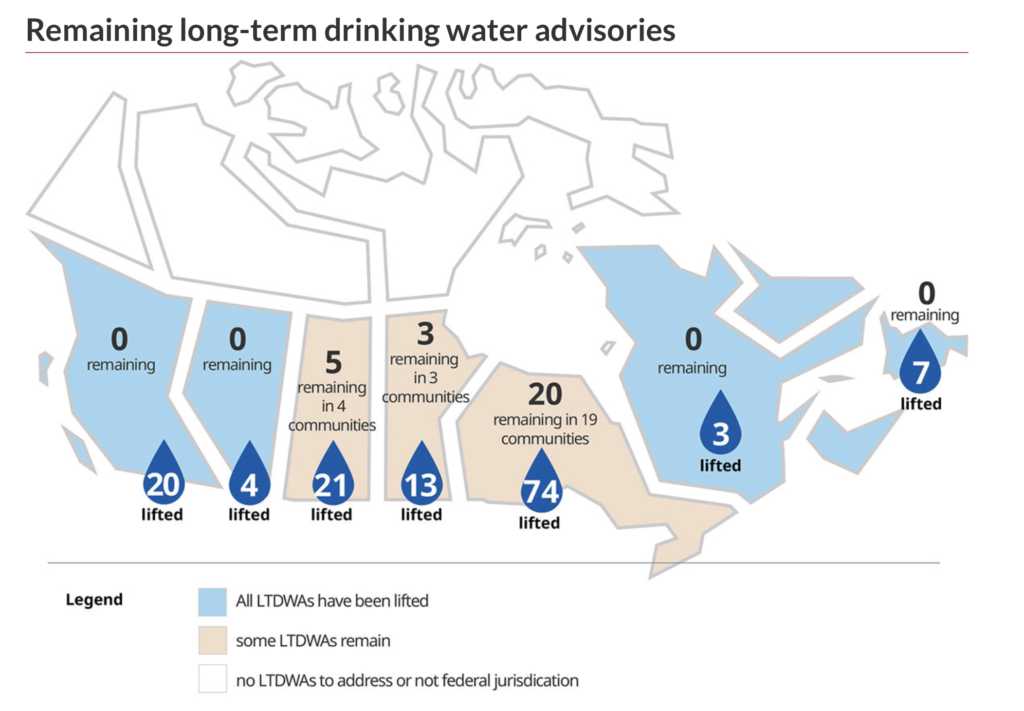
The federal government of Canada has been promising for decades to restore clean drinking water to First Nations communities. It is a basic human right Canadians expect and deserve, and it is a top priority for all municipal governments. This same concern is not extended to the First Peoples of our country.
According to the Indigenous Services Canada website, four communities had that promise fulfilled over the past year – one in Saskatchewan and three in Ontario – and 28 remain on the list.
Political leaders refer to these situations as “challenging” and “complex”, and I’m sure they are, but surely things could move faster if there was the real will to make it happen. I remember when the 2004 Indian Ocean tsunami occurred and Canada rightly sent the DART (Disaster Assistance Response Team) unit to Sri Lanka to assist their citizens. The DART were said at the time to be water restoration experts and produced 3.5 million litres of drinking water a day during that relief mission.
Perhaps the government could declare an emergency here and speed things up a bit? I’m sure if the water in downtown Ottawa was suddenly declared undrinkable, or if bathing babies in it gave them sores and rashes, something would be done pretty quickly. We can and must do better.
I loved the Search for Cosmic Dust episode of the BBC’s Seriously podcast. It is the tale of Jon Larsen, a jazz musician from Norway who found a piece of dust on his table one morning and followed his curiosity to become a hunter of urban micrometeorites and change the scientific record. An inspiring tale for all citizen scientists!
Noon today marks 150 years since Prince Edward Island joined Canada in 1873. After the overblown celebrations in 2014 to mark the 150th anniversary of the Charlottetown Conference, with the Island drenched in (coincidently?) Liberal red, I had expected something big for this year, but other than a couple of pieces on CBC Radio, this milestone hasn’t been mentioned at all. In today’s Guardian there are ads from politicians wishing everyone a happy Canada Day, but not one word about our wedding to Canada.
I suppose that’s as it should be, a tradition started by the lackluster response to the whole event at the time:
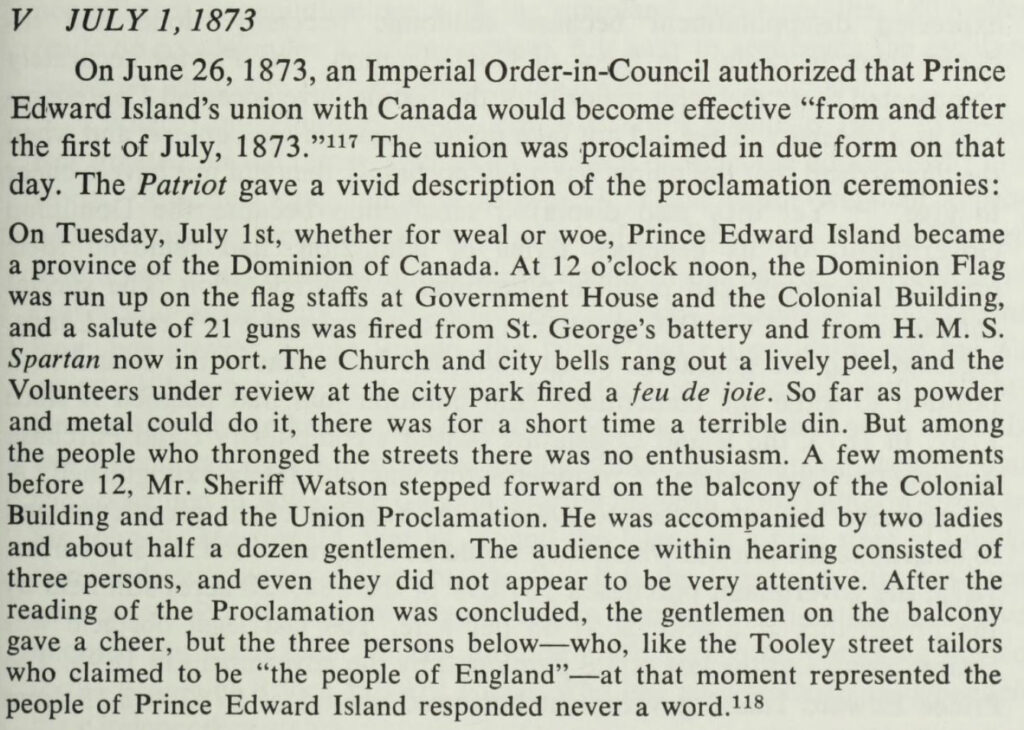
At it happens, the car ferry service that connects the eastern end of the Island to Nova Scotia resumes service today after having been completely shut down for a week due to a mechanical failure. The service had been expected to be out for almost a month, but a part was found and the boat expected to cross back and forth again, bringing relief to businesses and travelers alike. PEI joined Canada partly to ensure good transportation by train and boat, so having the ferry back might actually be the most apt symbol for the day.
I can’t easily identify my favourite band or book or movie. I could give you a top ten list of favourites, but would not be able to single out just one.
My favourite podcast of all time is easy, though: A History of the World in 100 Objects from BBC Radio 4 in collaboration with the British Museum. It was broadcast in 2010 and I downloaded every podcast episode over our 1.5 Mbps internet connection and listened while I worked outside that fall.
The idea of looking at the span of human history through 100 objects captivated me, and I started my own 100 Objects project on an earlier version of this blog, planning to write about a different object once a week. I wrote about a couple of things from my unorganized collection of stuff, but didn’t continue both because of time constraints and not being certain of what I wanted to say or even why I thought something needed to be said!
I’m going to start again, this time documenting things that will tell the story of my family, my community and me, but only when and as the spirit moves me.
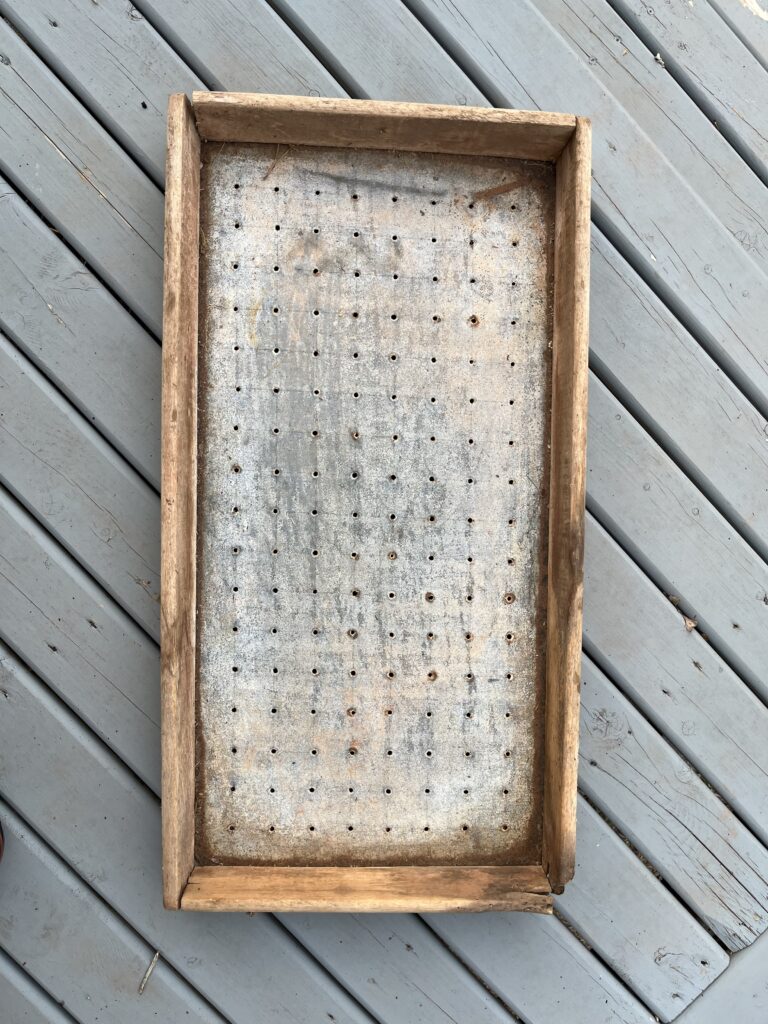
Item One is a lobster tray and it came to mind when I saw this advertisement in the April 25, 1923 Guardian.

My great grandparents, Eva and Ernest Hardy, ran a lobster canning factory on the Conway Sandhills at Hardy’s Channel off Milligan’s Wharf, PEI from 1901 until Ernest’s death in 1946. My mother spent her childhood summers at the factory, so I have her stories and even a few photos of the place, but not much of the physical elements of that bustling enterprise remain.
Some of the buildings now at Milligan’s Wharf made up part of the factory and were hauled over to the mainland of PEI in the early 1960s to be used by my mother’s uncles. Some were later repurposed for cottages, one into a snack bar, and one sadly sits abandoned by next-generation owners who have little regard for its history.
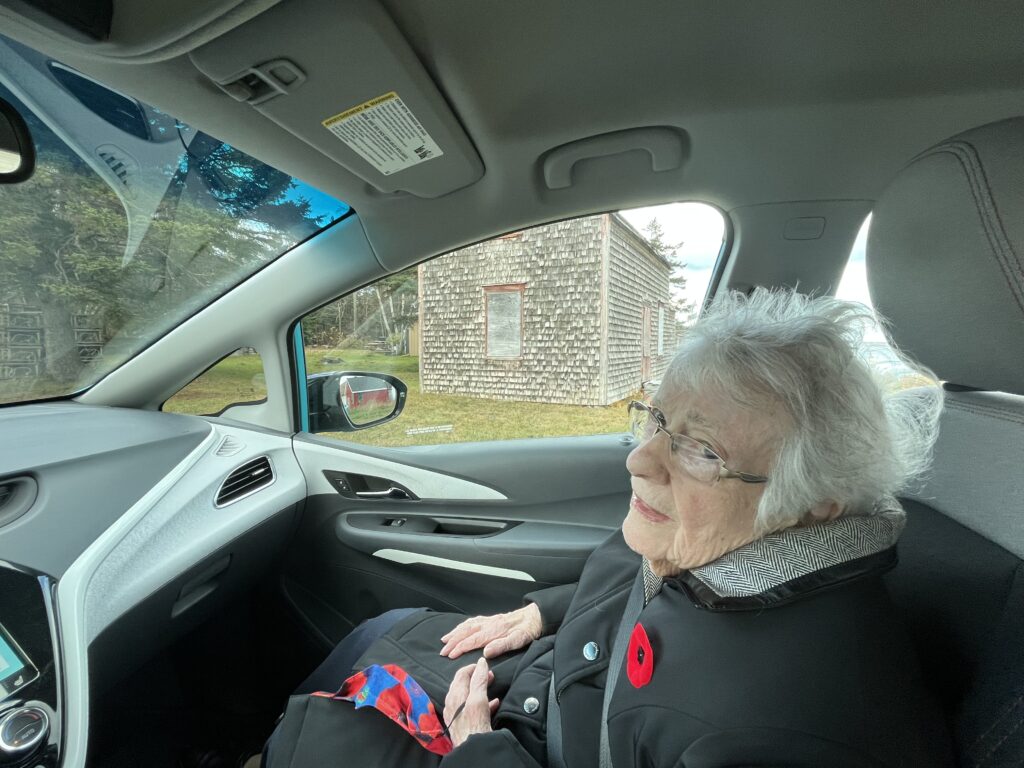

The factory equipment – boilers, tools, tables, canners, utensils – are probably all long gone, no doubt sold to others in the same business or repurposed by the family, which is why I was surprised to come across the tray in our shop building some years ago.
I’m not sure why we have the tray, though I expect it came from one of the buildings on the home property once owned by Ernest and Eva and later occupied by their son, Elmer. My mother helped Elmer in his market garden and he would often give her old things that were hanging around the place and probably in his way. She had a collectors spirit, for which I am thankful.
Until I saw Fred H. Trainor’s advertisement, I had assumed the tray had been made by someone working for Ernest, and that could still be true. Fishermen built their own lobster traps and boats, so making some rough trays wouldn’t be a big deal. My mother’s father, Wilbur Hardy, was not a fisherman but did have a small box mill that he used to make lathes and boards for crates, so he would have been well positioned to fashion the wood for a tray for his father’s business.

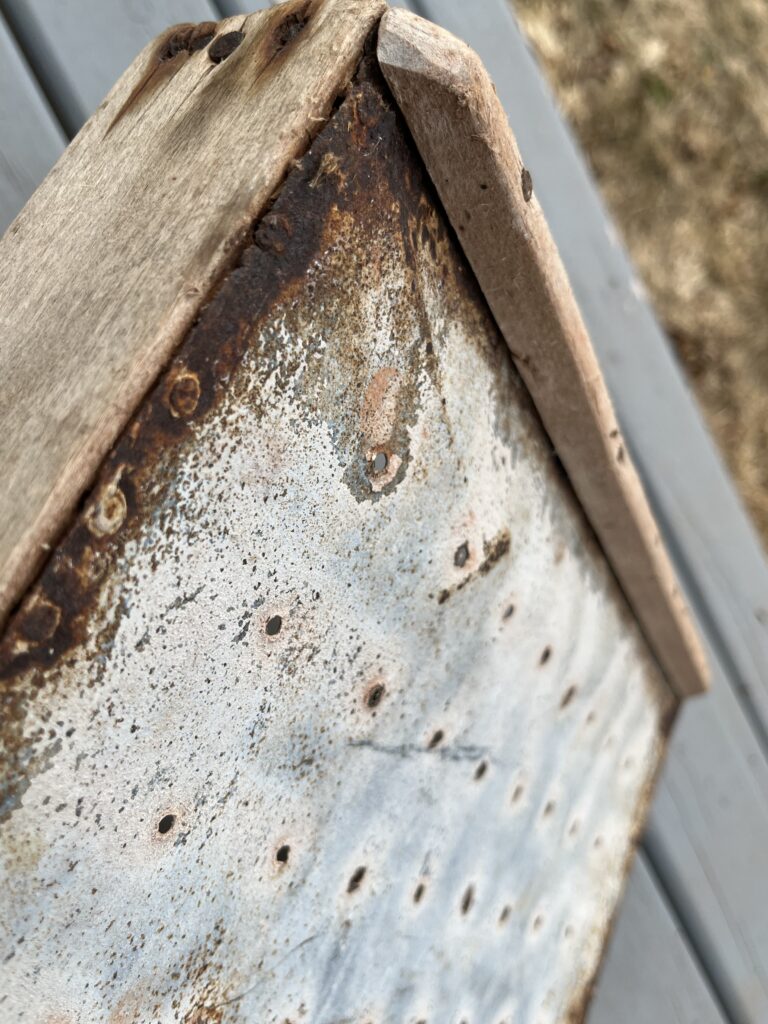
The tray is base is galvanized metal. The wooden frame is 13.5 inches wides, 26.25 inches long and 2.25 inches deep. There are small pieces of wood, tapered by rough carving on either end, on the bottom on the two shorter sides that would allow the tray to sit slightly off of a table for drainage. The drainage holes are evenly spaced 1.5 inches apart, faint grid lines directing the precise location for punching. Considering the amount of salt that would have been around the factory, it’s miraculous the nails holding the frame together are still able (barely) to do their work of holding the pieces together.
The factory was probably a difficult place to work in a challenging location: a sandbar on the north shore of PEI. There was never electricity there, though they did get a gasoline-powered stationary engine in the late 1920s, which was later rescued from a barn by my cousin. He thinks it was used to run a saw to cut up firewood, which was needed in large amounts to fire the boilers that produced hot water and steam for the factory.
Everything was done by hand, in conditions that would probably not be considered sanitary today. The boiler man drew water from a hand-dug well using a bucket and would fill the huge boiler that produced steam to cook the lobsters, keeping a hot wood fire roaring all day. Workers, both men and women, would open the cooked lobsters, first ripping off the claws and cracking them at the knuckle with large knives to extract the meat, pulling out the tail meat, and ripping the bodies apart.
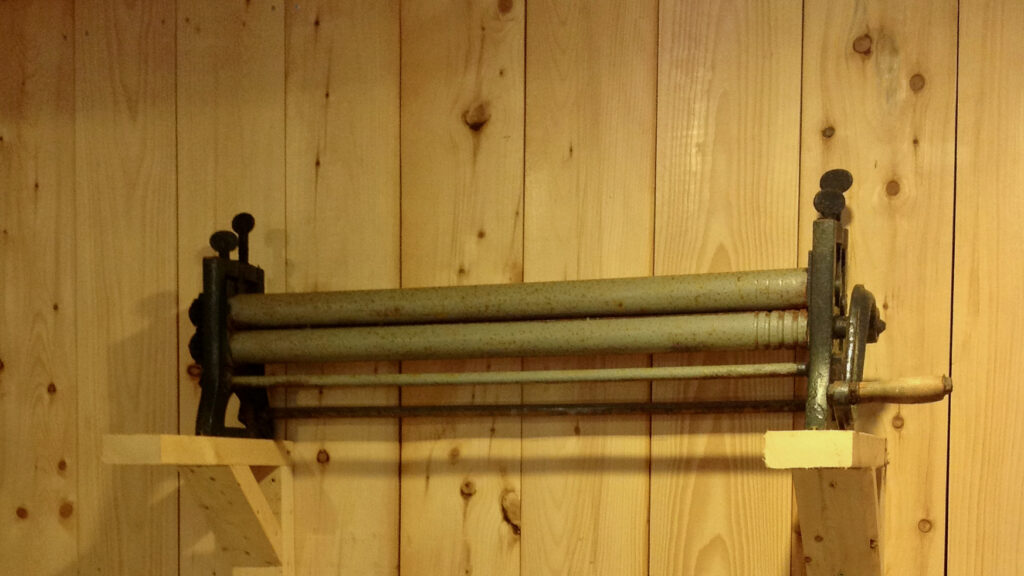
The little legs were fed through the wringer that came off a washing machine, squeezing the sweet meat out of them. My mother says this was the only job she ever did in the factory. The leg meat was added to the tomalley (“the green stuff” inside a lobster body) and roe to make lobster paste, also canned and sold. They also canned mackerel.
Leftover lobster bodies quickly become smelly, and piles of them would attract flies and wild creatures, so my mother says they were dumped back into the ocean by the fishermen or hauled to farms to be used as fertilizer. One of her uncles would fill his dory with bodies, take them back to the mainland, throw them into a wagon, and spread them on his farm fields to be disced under. They would certainly be scavenged by animals and birds when fresh, but eventually they would break down and act as a good fertilizer, or as good as a fertilizer could be before chemicals fertilizers were created. Even with all that effort of spreading lobster bodies, that uncle called his place Wild Rose Farm because that’s all the land was good for growing!
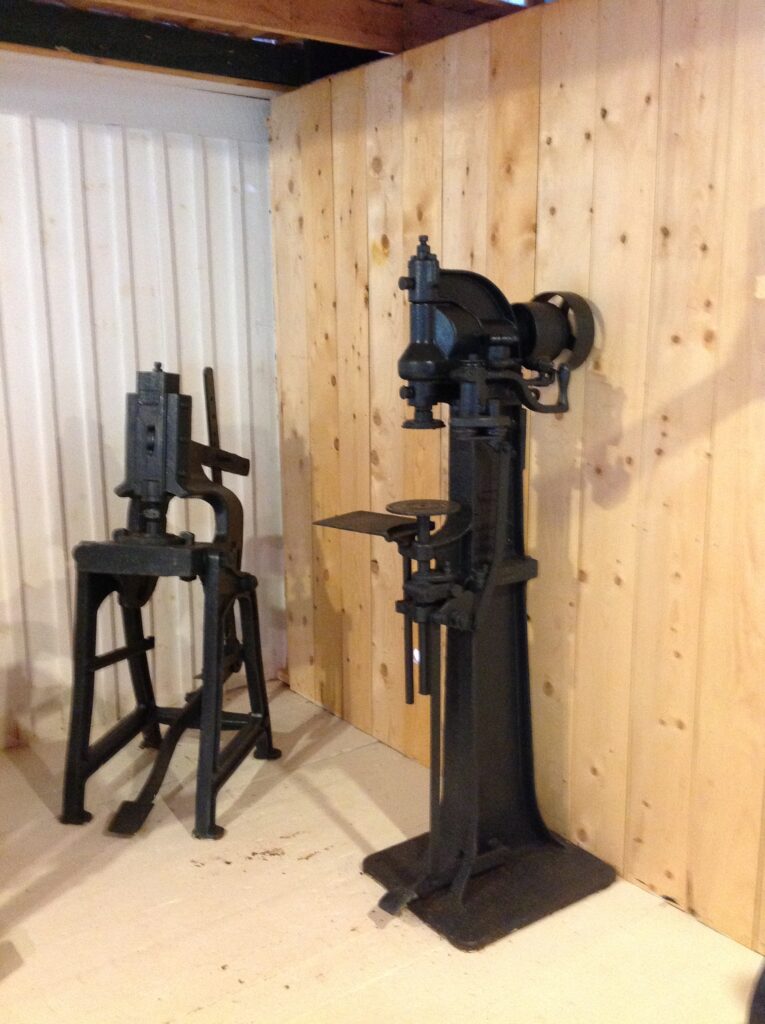
One of the canning machines, a greasy looking hand-cranked device, was in Elmer’s shop building. He raised chickens for eggs and meat, and canned chicken, beef and some fish well into the 1980s. Some people in our area still can beef, chicken and bar clams, though use glass canning jars and not the more tricky metal cans.
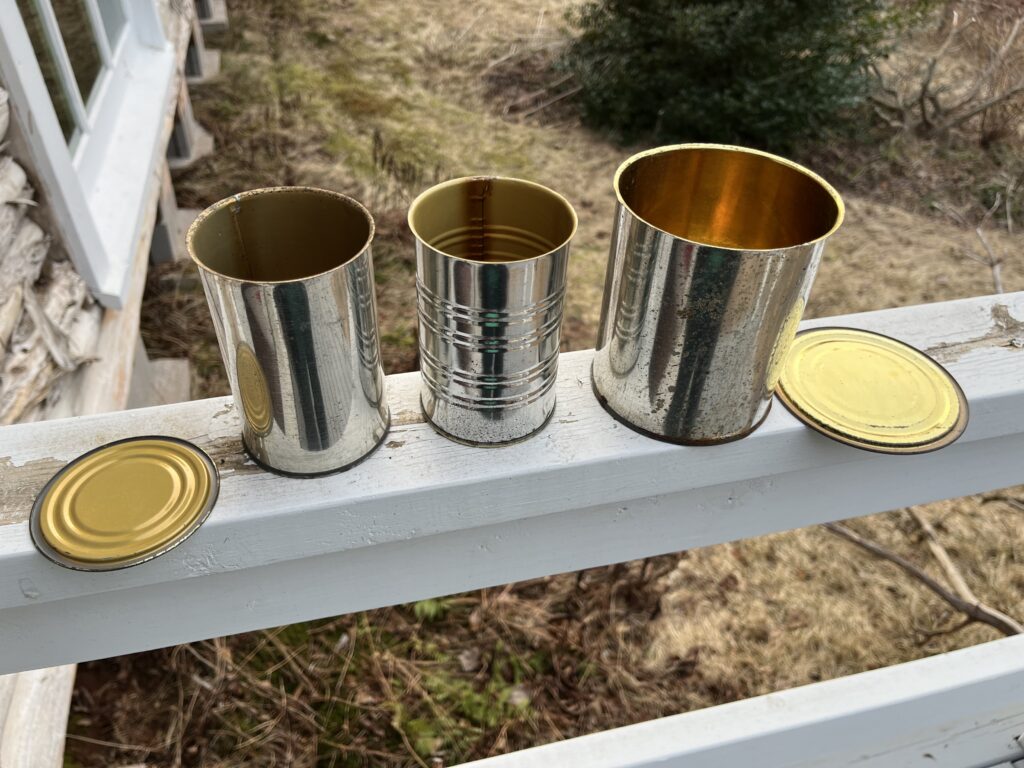
My mother says her grandmother, Eva, packed every can as she had “the knack”, and probably also wanted to make sure the weight was exact. A piece of white parchment paper was placed in the bottom of the flat, wide cans, and she would carefully fit tails, claws and bits of meat to bring it up to the correct weight. Once the cans dried and cooled after processing, a label would be affixed with glue or paste. My mother says her grandparents’ product was sold to wholesalers, so there was not an E.A. Hardy brand, but more likely they were canned for DeBlois Brothers wholesalers in Charlottetown, or maybe the large PEI retailer, Holmans.
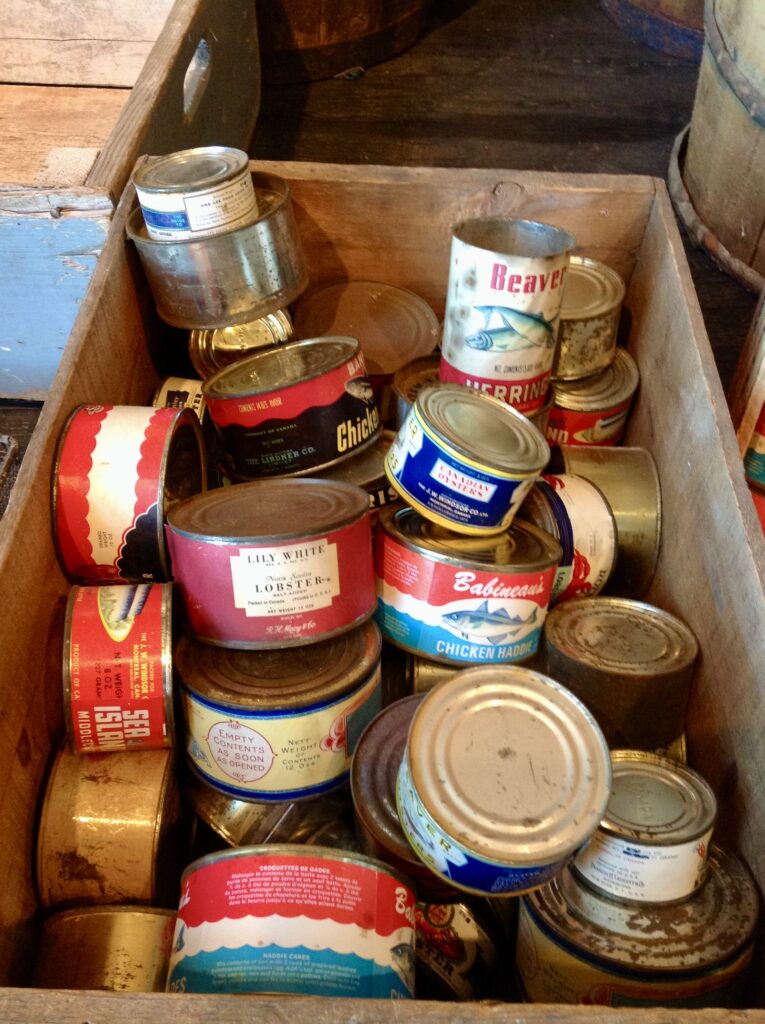
My great grandmother likely handled the tray thousands of times over the 45 years they worked each summers to make the money that would carry them over the rest of the year. “Factory owner” makes it sound like they were rich, and they definitely were not. They had a telephone, but no electricity and never had a car or truck. The furthest from PEI either of them ever got, that I know of, was when when my great grandfather went to Montreal for an operation, but I don’t think my great grandmother ever left PEI, or even went to Charlottetown! I gather they were well-respected in the community as being industrious and honest, but they had little more than anyone else.
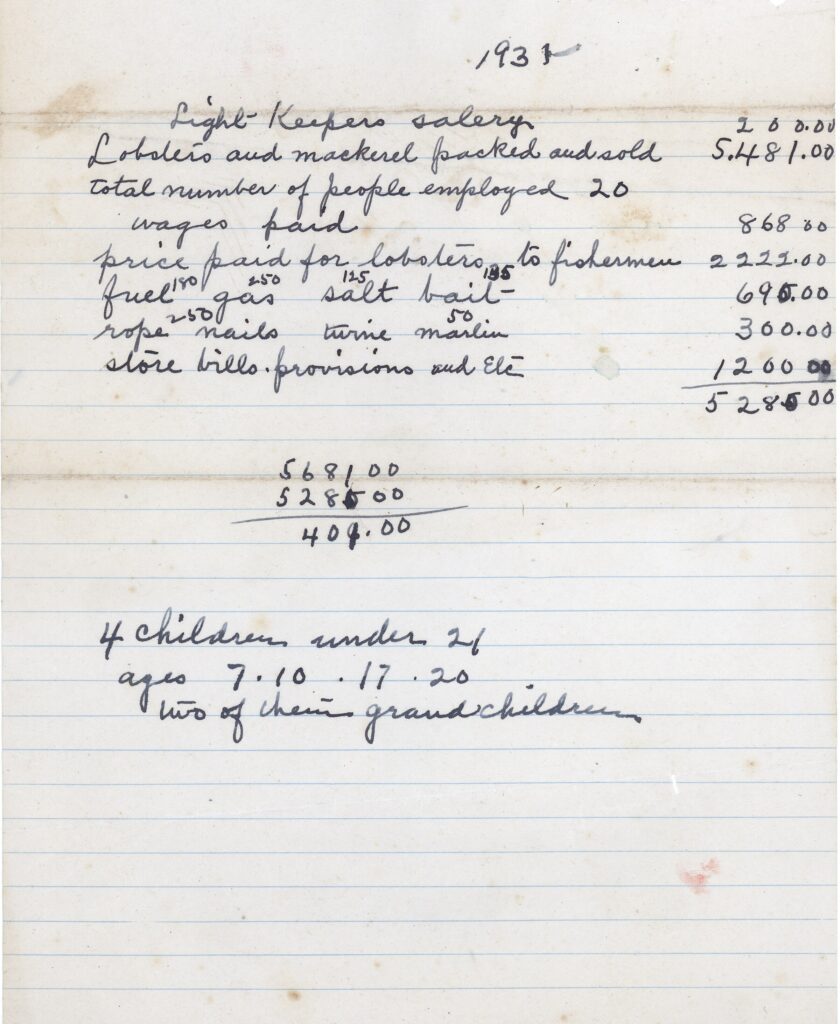
I think of the countless people who held that tray, working long hours to make a product they probably couldn’t afford to buy. That’s still the story for millions today who produce our clothing, electronics and food in hidden corners of the world. They make little, the corporations make a lot, and we get cheap things.
There are still lobster processing factories on PEI, some of it being canned but most of it frozen. Local workers became more difficult to find over time, so a large percentage of factory workers now come from places like the Philippines. Those temporary foreign workers have supported the lobster fishing industry in a way that is perhaps not acknowledged often enough, as the market for fresh lobster is limited and processing the only way to ensure there is a bigger market.
Lobster fishing and processing is still difficult, even dangerous, work. Thank the lobster, thank the fisher, thank the factory worker who holds the tray.
A friend and I went to our first Death Cafe in Summerside yesterday. I was already planning to be in town for an appointment and was able to arrange to stay a bit longer to join her, and I’m so glad I did. She and I are both very open about talking about death, so she was the perfect partner for this experience.
The Death Cafe concept started in the UK just over a decade ago and are now held around the world. They are designed to be casual events where people talk about death: your own, those you love, death in general. It is emphasized that a Death Cafe is not a grief support group, though most everyone yesterday spoke about people they loved who had died.
Hospice PEI were the sponsors and had held a few before the pandemic, but this was the first post-pandemic edition. Their staff arranged all the logistics (including chocolate cupcakes with little RIP signs on them!) and acted as facilitators. I think there were about 15 of us around three tables at Samuel’s Coffee House.
There aren’t firm rules around what is discussed at a Death Cafe, except that we not share the stories or details we heard from others. It was made clear we could speak or just listen, whatever we were comfortable doing.
After introductions, the facilitator at our table of six invited us to share what we hoped to get out of the session or what had made us attend. We all had very different reasons for being there, and the conversation flowed freely. We also used cards from The Death Deck Game, and spent an hour talking and listening. Despite the serious topic, the room was filled with laughter, but there were naturally also a few tears.
My mother is 100. She is remarkably well for her age, but is ready to die, and we talk about it often. She tells others her hope that she won’t wake up one morning, getting the death she prays for, and the reactions are mixed, of course, depending on her audience. When she started speaking so openly about this a couple of years ago, I gently suggested others might not be comfortable with it, but she continued anyway and I accepted it. Death is a very real part of her life, our lives.
My mother is a devout Christian, as was my father, and so I attended church basically from birth. Most Christian churches on PEI have a graveyard attached, and our church’s graveyard is the final resting place of many of my ancestors. I could pick out their tombstones before I could read them, would help my mother as she tended the flowers lovingly placed in front of them each spring, knew how to clean the stones with a stiff bristle brush and soapy water.
My great grandparents were the rough-surfaced white stone onto which moss stubbornly clung. We would scrub their names and dates and the simple phrase God is Love, which is also on the tombstone now in place at my father’s head, where my mother will be, where I will be.
One uncle and aunt had a polished red stone that was easy to clean, with a small tombstone next to it for the tiny baby they had who died right after he was born. That one had a little lamb sitting on top and was my favourite for that reason, but it was so sad, the little baby that never was guarded by the hard, staring lamb.
When you walk by a graveyard on your way in and out of church at least once a week, play tag and run around the tombstones when adults aren’t there to tell you to simmer down, you get a pretty good idea from a young age what life will eventually lead to. Someday it will be you in the box that is carefully carried into the church, the pump organ wheezing Abide With Me. Another little child will awkwardly carry a smelly flower arrangement and have to stand by your grave looking solemn, as you did so many times in the cold or with mosquitos biting your ankles. There will be sandwiches and tea after, and quiet words about you.
My mother taught me an old prayer to say at bedtime that she must have learned from her grandmother, who learned from her mother, and back and back:
Now I lay me down to sleep
I pray the Lord my soul to keep
If I should die before I wake
I pray the Lord my soul to take
I would then say God bless Mommy and Daddy, and recite a long list of aunts, uncles, cousins, friends and pets, including my goldfish, Henry. It was never actually the same list twice as it depended on how tired I was or who was front of mind.
Amen.
And to this day, many decades after I left behind the church and the ideas underlying that fairly creepy verse, the prayer occasionally comes back to me when I can’t sleep. I don’t say the prayer, but list off the loved ones, long-gones and still-heres, all the cats, a few chickens, and drift off.
We had family wakes in our house when I was a small child, the traditional way it had always been done. Only a wall separated two-year-old me in my crib from the dead body of my grandmother and then, a few months later, an 18-year-old cousin. They were asleep while we were asleep, they were asleep when we were awake. We waked, they slept.
Someone even took group photos next to the caskets, capturing those final moments together. That’s something I’ve never heard of anyone else doing, and which I knew from a young age was probably totally bonkers and something best kept to myself, but that’s what happened. People touched the dead hands and faces. I don’t remember any of this happening, except that I’ve seen those photos, rushing quickly past them in the photo albums. The smell of flowers must have been overwhelming in our house, and the scent of too many roses can still make me queasy.
I’m not sure if many people cried at my grandmother’s wake as she was 74 and hadn’t been well, so it would be seen as a blessing. I know many cried at my cousin’s wake because he had been killed in a motorcycle accident and was beloved by everyone. Only last week, my mother told me again that she never really got over his death, and that her life was completely changed by it. She lost her mother when she was 4, her only brother when she was 37, her father the year after I was born, her grandparents who raised her, but her young nephew being killed by a careless driver was the death that cut her life in half, the before and after.
When someone who volunteered at the charity where I worked in Toronto died, many of our staff and volunteers went to the wake and funeral. I was then in my early thirties. A colleague asked me to pick her up to go to the funeral home, and when she got in the car told me she was nervous as she had never been to a wake before and wasn’t sure what she would have to do. I was surprised she had lived into her mid-50s without attending a wake, even a family wake, but kept that to myself and told her to just follow me.
As it turned out, I was unable to model the standard PEI wake behaviour – shake hands, tell the person how sorry you are for their loss, shuffle along to the next person, shake hands, tell the person how sorry you are for their loss, shuffle along to the next person – because this volunteer had no family. None. We found out that night in the most poignant way possible that we were her family. Social services paid for the funeral, and it was pretty grim: a flimsy blue cardboard casket, only the flowers our charity had sent, no receiving line, a minister who had never met her and didn’t seem to want to be there. I, confident waker that I was, had never seen anything like it, so my coworker and I both experienced something new that evening.
That same work colleague died last week. She had been unwell for a while, but it was still a sad message to receive. After hearing the news of her death, I remembered a story she had told me about her own mother’s death.
Her mother was in the hospital and had been unresponsive for a couple of days, her breathing slowing, life draining away. Doctors said it wouldn’t be long, and my friend sat alone by her side, hour by hour, no partner or sibling to relieve her as it was just the two of them living together in Canada. Their relationship had been difficult for many complex reasons, but she was still feeling very sad that this was the end of her mother’s life.
Suddenly, her mother roused, sat up, looked at my friend and said, “You and I have a lot to talk about.” Then her mother laid back down and died.
The end. Amen.
They are planning to hold more Death Cafes on PEI, and they are also held in many places around the world. It was an entirely positive experience, very freeing and uplifting, and I hope to attend another one some time. My friend and I agreed that talking about death made us feel very alive.
Yesterday I had the odd experience of someone DMing me on Twitter to tell me that something I had tweeted wasn’t accurate. It had to do with forest fires on PEI, a topic I actually do know a little about.
It wasn’t a nasty or unpleasant message, but rather just something I realise I have experienced all my life as a woman: being told by men that what I know to be true isn’t. In the past it was sometimes done to intimidate me, but often it was just from the bold certainty that they were right.
We had a room added to our house a few years ago. The first step was to remove a deck, which was to be saved as it was still in good shape. I wasn’t watching the crew at first, but heard more power sawing than I had expected and looked out to find they had chopped the deck into small chunks so it could be hauled away.
It was too late to save it, but I wanted to know why they had destroyed a perfectly good deck. The foreman said that it had been in bad shape and we wouldn’t have wanted it, which was clearly nonsense. I asked him to show me, and he picked up a board that had been sitting on the ground and did have a bit of rot, but could have been easily replaced when it became a problem.
He had clearly made a mistake, but instead of apologizing, he expected that I knew nothing about carpentry and would believe his nonsense. He lied, but with the hope and expectation that I would not be able to challenge him. And I didn’t challenge him beyond saying I knew the deck was in good shape because I had kept it in good shape, but he still didn’t budge and continued his work.
Lies and ignorance are two different things, of course, but it’s delivery and the belief that is behind them that can rankle.
I have long been suspicious of certainty in myself and others. As a younger person I would confidently declare that I would never do something, only to find myself later doing it, so I now try to avoid such declarations. Over time I have learned to embrace the questions more than the answers. Someone who tells me they know everything has actually told me they know nothing.
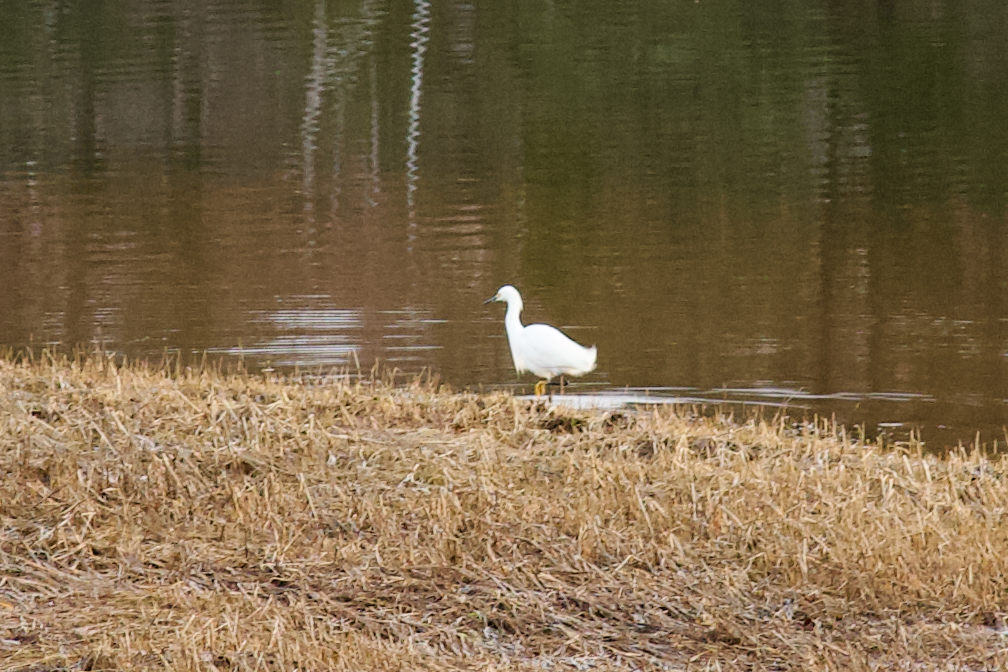
As I was preparing supper this evening, the snowy egret made a return visit! I was ready with a longer camera lens, but my limited photo skills still didn’t produce great art. At least I got something for the record.
Snowy egret now has its own page, as is only fitting for a rare and welcome majestic beast.
I was lucky enough to spot a snowy egret as it walked down our river at 6:30 this morning. I had seen them many times in Florida near where my parents used to spend the winter, but I never remembered seeing one here before.
I grabbed my camera and binoculars and ran out onto the lawn to try to record this unusual bird, looking a bit of an unusual bird myself in my red plaid flannel PJs. Our neighbours are not close enough to see what I’m wearing, so citizen science need not be thwarted by decorum!
The egret waded and fished as it travelled around the little point of land in front of our house, nabbing and swallowing little fish. My photos were not very sharp, but in person I could see this white bird’s dark legs and comically yellow feet.
I uploaded the photos to iNaturalist and was surprised to find only one other snowy egret observation on PEI. I later confirmed with a biologist friend that they are quite rare here and are not known to breed this far north. I was chuffed to bits!
I’ve looked at this river view every day for decades, know the ebb and flow of both the river and the wildlife on it intimately and, I thought, completely, but turns out I still have more to learn. Every day brings new discoveries. What joy.