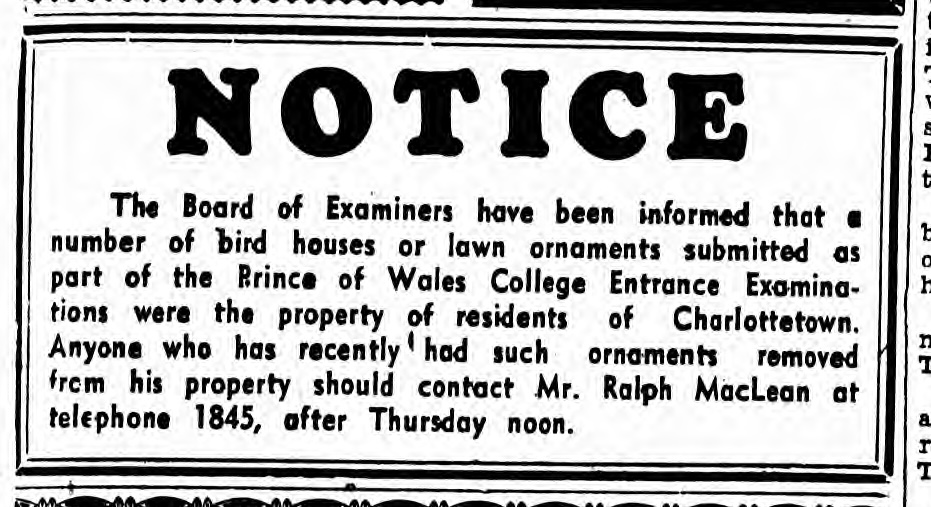
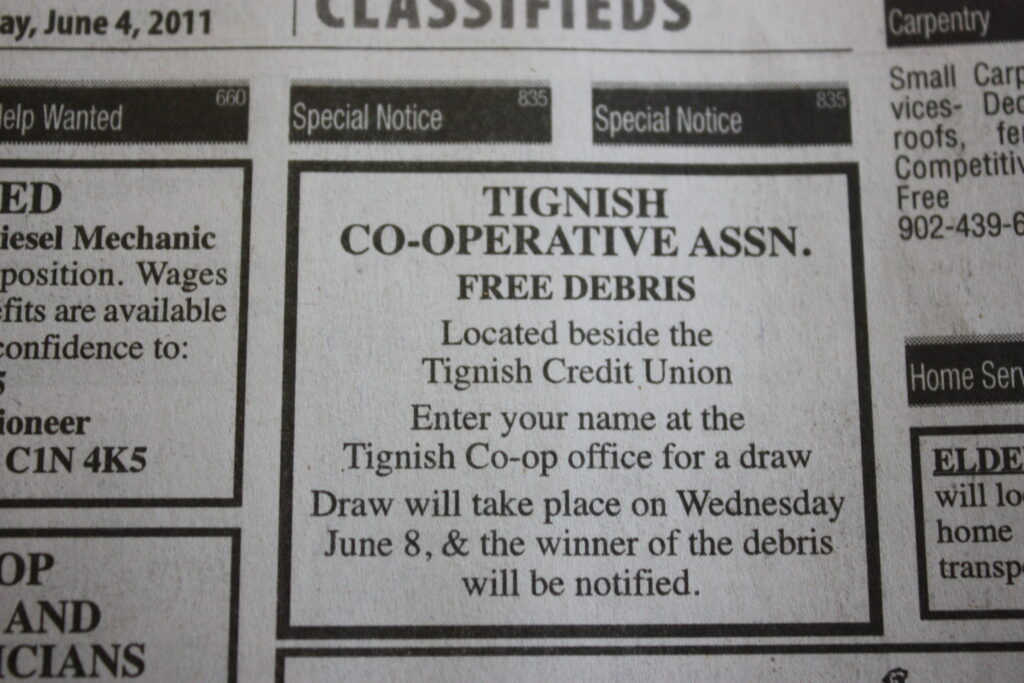
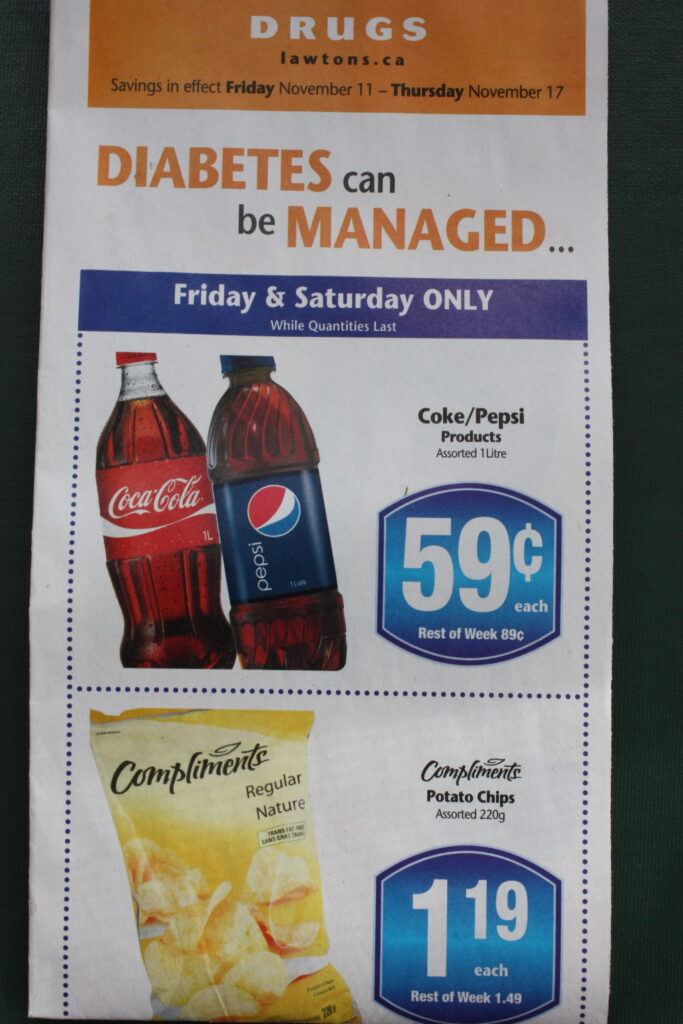
I added pages from the August 21, 1951 Charlottetown Guardian about the opening of the second building to house Prince County Hospital to my Community History page. By the time the new PCH facility opened in 2004, the 1951 building was widely regarded as old and outdated, so it is lovely to read the hope and pride the community expressed for their new, state-of-the-art hospital.
I’ve been reading old newspapers online through UPEI’s Island Newspaper site since 2014 and one of the many reasons I continue is that I love the time traveling aspect, pretending to be someone picking up the morning paper and reading about new technologies and community news. The past, in printed form, is a safe place, and I visit it knowing how things turned out, or are still turning out, like the 1951 nationalization of Iran’s oil industry (see 2026 Iran war fuel crisis). Things change, things stay the same, and on we go into the future.
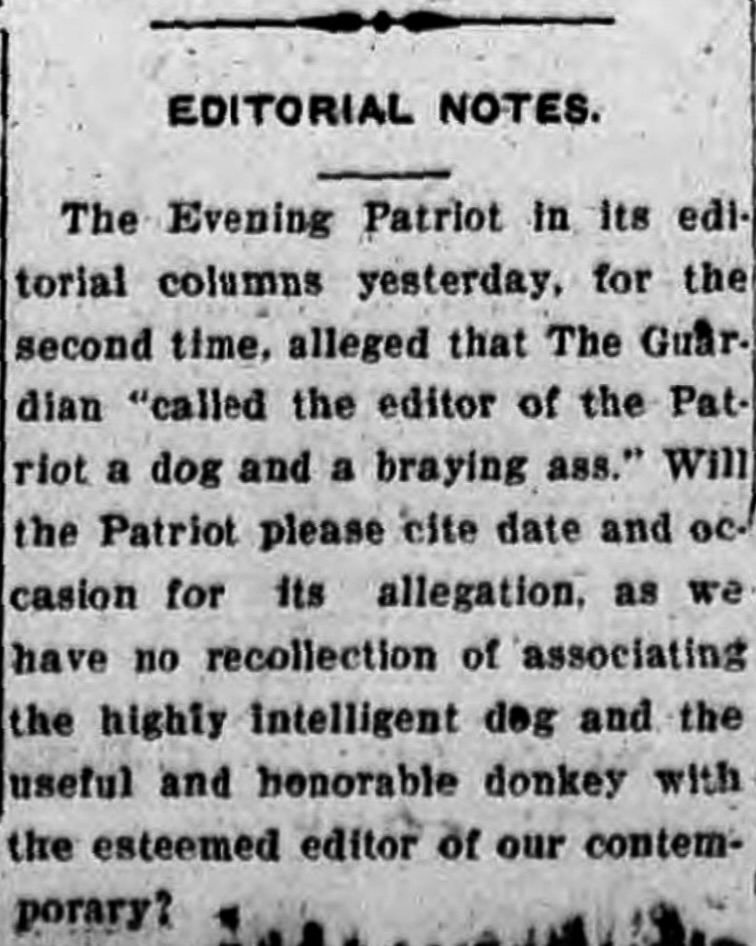
Some (hopefully) friendly tomfoolery between rival Charlottetown newspapers in 1926.
Charlottetown Guardian, September 4, 1926, p. 4
The Evening Patriot in its editorial columns yesterday, for the second time, alleged that The Guardian “called the editor of the Patriot a dog and a braying ass.” Will the Patriot please cite date and occasion for its allegation, as we have no recollection of associating the highly intelligent dog and the useful and honorable donkey with the esteemed editor of our contemporary?
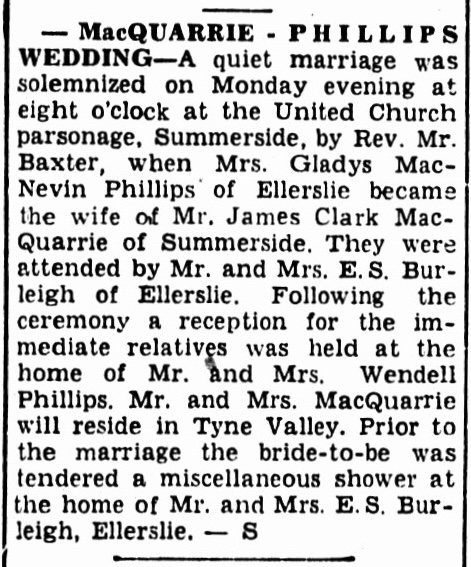
Was surprised to find my grandmother’s wedding announcement in the Guardian from this date in 1951. This was her second marriage, as my father’s father, Alvin, had died in 1936 at age 45, leaving Gladys with four sons under the age of 17 (and one only a year-and-a-half).
She had a rough time of it after Alvin’s death, trying to keep a small mixed farm going, with the help of neighbours and her eldest son, who was 23 when his father died. To make ends meet, she and her sister, Dot, cooked and lived at Shaw’s Hotel in Brackley Beach for a couple of summers. Gladys would also attend births and nurse the sick, which is how she came to know Clark MacQuarrie when she moved to Summerside to look after his first wife, Priscilla, who was ill for a couple of years before her death in 1950.
Clark and Gladys were hired as the first caretaker/janitor and cook at Stewart Memorial Hospital in Tyne Valley on June 2, 1951, so I supposed they had to get married as it was a position that came with room and board, and the chance of them being allowed to live together in such public positions without being married would have been nil. They lived in a small apartment in the hospital basement. Clark was 67 and Gladys was 57 when they were hired, for which they each got $100 a month, a great sum.
My mother’s grandmother, Eva, was one of the first patients at SMH in 1951, and at times the only patient as it cost $5 a day and was still user pay. My mother often told me how highly Eva regarded Gladys and how good her cooking was.
I don’t remember Gladys or Clark as they both died when I was very young. I didn’t even have a nickname for my grandmother until a few years ago when one of my cousins referred to her as Nan; I suppose I would have called her that as well.
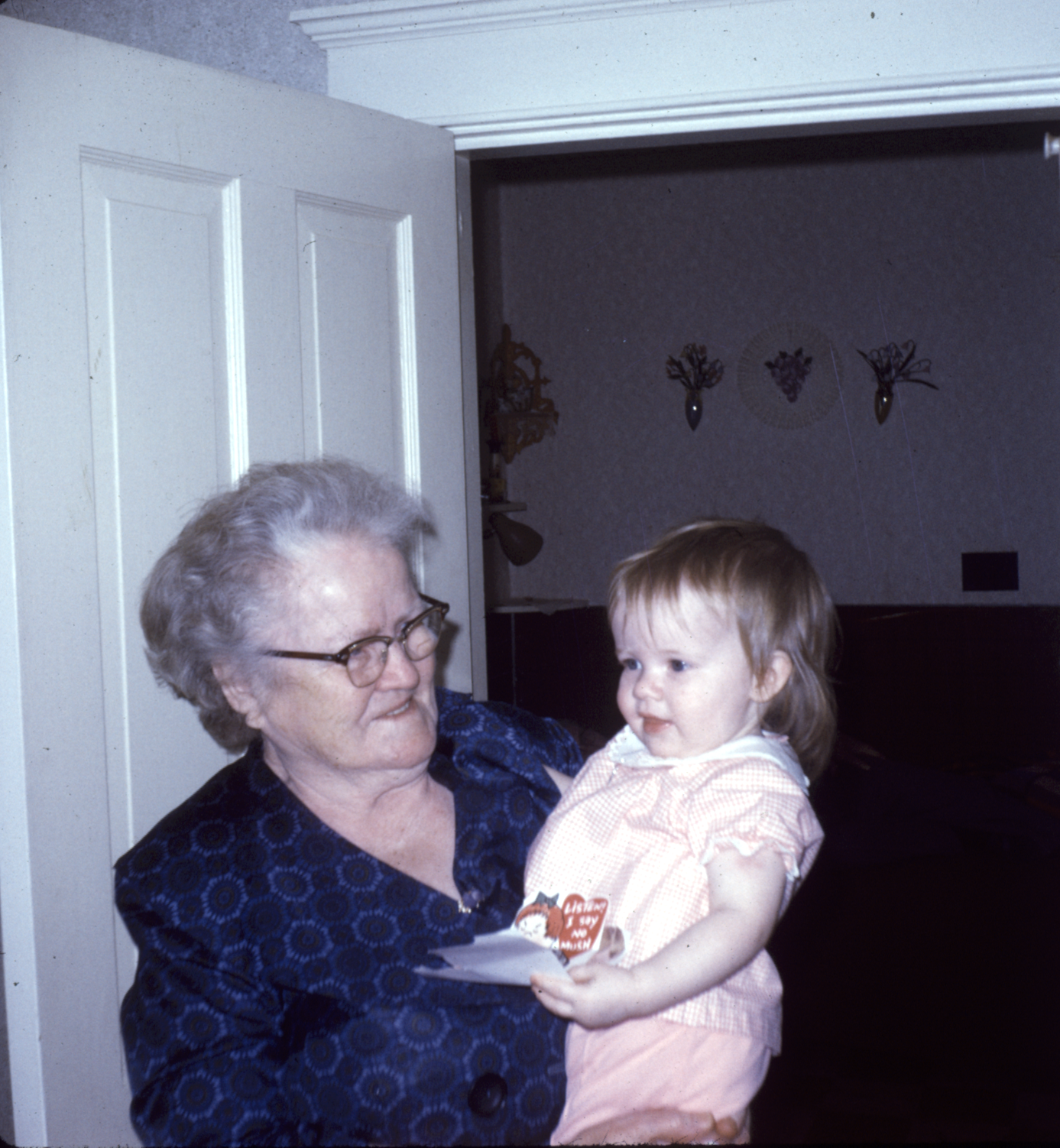
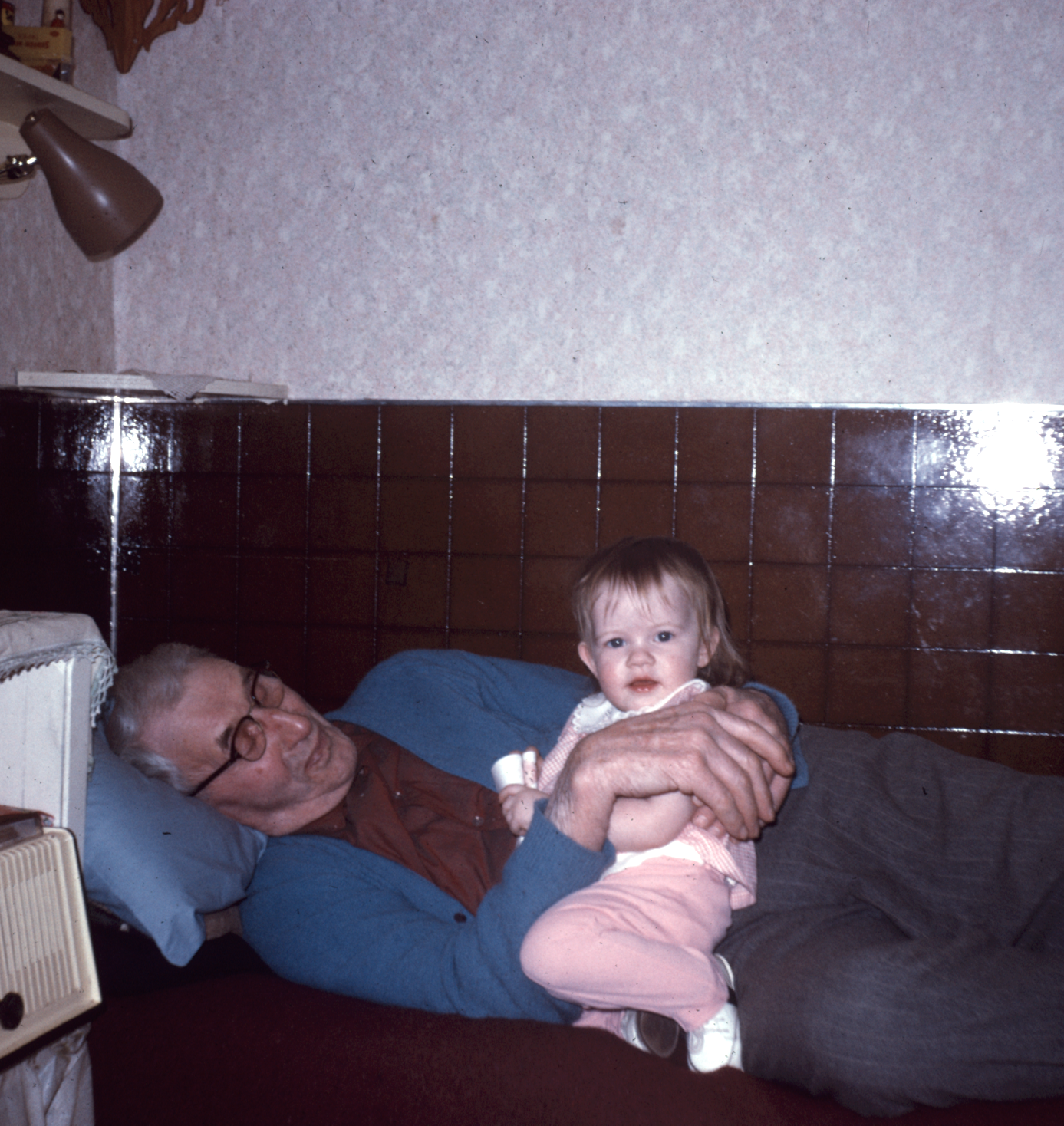
My grandmother Gladys MacQuarrie and me, Ellerslie PEI, February 1968My step-grandather Clark MacQuarrie and me, Ellerslie PEI, February 1968
Here are two stories from the Charlottetown Guardian archives about long-ago aviators with PEI connections: Patrick Peters and Frederick Tobin.
First on the runway is Patrick Peters, who was reported to have built a flying machine and took it to Maine in 1890 to put on public shows. I’ve not found the original article that was quoted in the August 26, 1950 Guardian piece I read or any other account of his time in Portland.
I located a Patrick Peters on Find a Grave who was born around 1864 and is buried in Rumford, Maine, so he could very well have been the brave flyer; his connection to PEI seems valid even if the information about his date and place of birth is a bit mixed up.
Report Tells How PEI Man Navigated Air Machine In 1890
How a Prince Edward Islander navigated a 38-pound flying machine as far back as 1890 is related in the following article reprinted from a Halifax exchange of Aug. 13 of that year. The Islander’s name was Mr. Patrick Peters and the report tells of his arrival in Portland, Maine, with his machine.
Mr. Peters said he had made up his mind in 1885 that he was going to make a machine that would navigate the air. He objected to balloons, he said, “because they were too far beyond the control of those who risked their lives in them,” but believed a machine could be constructed capable of being as much under the management of the flyer as a horse rake.
He said he “took the wings and motion of a bird for a model, believing that if he could fly like a bird it would be quite enough. Only after repeated failures did he bring his idea to a point where he could say with any degree of confidence, “I can fly”.
“At last,” the report continues, “he constructed a bird of the following dimensions: From the head to the tail, 16 feet, and from the body to the end of each wing, 3 feet. The seat was in the body and the motive power used in the propelling of the machine was obtained by a combination of wheels.”
Described Flight
The account describes Peters’ first flight.
“His first real trial of his machine was made when he passed over a forest, making about two miles in about four minutes.”
“From his description of the way things looked below it would seem possible that he went at least 2,000 feet up in the air, and perhaps more than twice that distance. He says he went up and down at will, managing his 38-pound machine without the least degree of trouble.”
Peters’ purpose in going to Portland was “to make a little money by giving a public exhibition of his machine.” “He says he is willing to give any desired test and can go any distance desired. He can keep a few feet above the ground or can go up into midair.”
Peters assured Portland people that “it is a perfectly easy thing to fly with one of his machines.”
In 1890 there was still quite an amount of suspicion towards anyone who claimed he could fly, so the story concluded: “Portland people who know Peters say he is honest and he acts that way.”
Charlottetown Guardian – August 26, 1950
Our other flyer, Frederick J. Tobin, was as famous as Peters was mysterious. The following article from the September 29, 1925 Guardian describes his first connection to 20th century airship history as a surviving crew member of the Shenandoah that crashed September 3, 1925, and includes a link to an even more notable event he was involved in some years later.
Islander Has Narrow Escape
Among the members of the crew of the ill fated United States dirigible “Shenandoah,” which crashed to earth in Ohio over three weeks ago, with a heavy loss of life, was Pilot Frederick J. Tobin. Mr. Tobin is a son of Mrs. Margaret J. Tobin, formerly Miss Margaret O’Brien, daughter of the late Mr. and Mrs. John O’Brien, of Bristol, Prince Edward Island.
Pilot Tobin had a miraculous escape from death, having fallen on the tree tops.
Letters from Mrs. Tobin to her sister Mrs. James A. O’Brien, Morell, and her brother, Mr. John O’Brien, Bristol, state that after Fred fell on the tree tops, a part of the rigging caught in his clothing and carried him off again trough the air. Once more he became disengaged from the plane and fell to the earth from an altitude of 100 feet, and was picked up by a passing plane, and at once carried to safety.
After a day of terrible suspense Mrs. Tobin was getting ready to go to Lakehurst, when she received news of her son’s safety.
Both Mr. and Mrs. O’Brien, aunt and uncle of Mr. Tobin, are very proud of his escape, and of the honor that will now be his. Prince Edward Island also has need to be proud of her grandson, as she can claim him through his mother. Mr. Tobin was next to the late Capt. Lansdowne. If there is another Shenandoah constructed Pilot Tobin may be first in command.
The Boston Post of September 11th contains a photo of Pilot Tobin, and the following notice: Frederick J. Tobin, a member of the crew of the Shenandoah who is reported safe, is well known in Arlington, where he formerly lived. He is the son of Mrs. Margaret J. Tobin of 6 Russell Terrace, Arlington. He has been in the United States navy for 11 years.
He was married two years ago, and besides his wife, who lives in Lakehurst, N. J., and his mother, in the family group are a sister Miss Mary R. Tobin and four brothers, Frank E. Tobin, a veteran of the late war, Henry L. Tobin, John L. Tobin and George W. Tobin, all of Arlington.
From a September 4, 1925 Boston Globe article on the Shenandoah crash.
Patrick J. Tobin shown third from the right ,middle row of this composite photo from the US National Archives via the NavSource Naval History website’s page about the Shenandoah: https://www.navsource.net/archives/02/99/029901.htm
Tobin remained in the US Navy after the Shenandoah crash, and was still based in Lakehurst, NJ in 1937 when the Hindenburg made its final voyage. Not only was he there when the Hindenburg came in for a landing, it seems he was standing under it when it exploded, as outlined on Dan Grossman’s excellent Airships.net:
Natural instinct caused those on the ground to run from the burning wreck as fast as they could, but Chief Petty Officer Frederick J. “Bull” Tobin, a longtime airship veteran and an enlisted airship pilot who was in charge of the Navy landing party, cried out to his sailors: “Navy men, Stand fast!!” Bull Tobin had survived the crash of USS Shenandoah, and he was not about to abandon those in peril on an airship, even if it meant his own life. And his sailors agreed. Films of the disaster clearly show sailors turning and running back toward the burning ship to rescue survivors; those films are a permanent tribute to the courage of the sailors at Lakehurst that day.
I’ve probably seen clips and stills from the famous British Pathé newsreel footage dozens of times, but I’ve never seen the original reel and heard the narration that went with it; t was jarring to see that the Hindenburg had Nazi swastikas on its tail.
Interestingly, the “Oh, the humanity!” line so often quoted from the Hindenburg disaster coverage is not from the newsreel but had been recorded by radio reporter Herbert Morrison and matched up many years later.
Tobin retired from military service in 1947 and died in Fort Worth, Texas in 1978 at age 85.
Here’s a lovely, wry letter to the editor of the Charlottetown Guardian, printed February 27, 1926, about the joys of being a mail carrier in wintery rural Prince Edward Island.
I think that “breaking a road” meant creating a path with horse and sleigh over newly-fallen snow so that it would be easier for other travellers, and I believe it was up to each landowner to do the section of road that ran in front of their property. I would guess this might have included knocking down tall banks by shovelling. People being people, not everyone would get around to breaking the road early enough after a storm, or at all, as the mail carrier finds out.
In some spots, where winds would regularly leave substantial drifts in the road, section of fencing would be taken down in late fall so folks could travel through a flat field over the winter, so when the writer talks about “going over tree tops, on the road through fields, dodging a fence here, a post there, and a barn some place else,” they weren’t exaggerating.
ONE DAY O. H. M. S.
Sir.— As I was sitting enjoying a good “home fire” this evening, I decided I would get my pen and paper, and write a few lines concerning “One day O. H. M. S.”
This winter especially we have to contend with an immense lot of snow, and storms mostly, every second day. However when the storm eases and the sun shines again, we make ready for our journey (over an unbroken road.) We wait awhile and it’s soon shovelled out, after the men go home with frozen feet, hands, etc. After going to the P.O. we bundle up the mail that has arrived the night before (or what’s left of it) and start our journey with a good, faithful horse that’s not afraid of a few feet of snow. The old horse will wade along stopping at the boxes, some are on sticks, some on snow-banks, and some on posts. Nevertheless we get along a few miles.
“Are you cold, come in, come in—rest your horse—and get warm.” You will welcome the voice of a farmer calling from his barn door.
“Thank you but I must keep on. I am not cold, since the roads are bad the travelling is slow. Good day.”
After going some distance, a man will meet you.
“Glad to see you—you must have had a bad road.”
Farther on a woman will appear.
“Isn’t it cold, if you can’t get through the rest of the way call in and have a cup of tea.”
“Thank you” but on we go. Then comes a turn to the right.
“Whoa—Hello Mr. Snowbank you are in a very convenient place, right on the middle of the road, huh.”
“A step ahead old horse—whoa wait that won’t do, can’t get through that, lay still till I get you unharnessed and the sleigh back—good job I took the shovel, old horse, comes in pretty handy sometimes—all clear come around now if you can. I’ll get you back in the sleigh again and we’ll go back to the P. O.—This won’t make our Route any shorter, old horse, although we have to turn back.”
“Oh good-day sir—yes, yes all right now—thanks—bad roads, bad roads, yes a lot of breaking done on that road this winter—well good day.”
All right, old horse we will go right back home, perhaps “Mrs—“ will be insulted for not calling for that cup of good tea, but we must get back.”
“Hello there” comes a voice like a clap of thunder. “That road broke”—
“No” then some words too numerous to mention.
“Come on old horse never mind h’m”—
“Funny for a man to drive a mile or two out of the way if that’s a passable road, and another man drive a mile or two out of his way for a Doctor if that is a passable road.”
“Too bad we Mail Couriers didn’t have Reindeers, or a few St. Bernard dogs, that could go over those “Passable Roads” then some of our box holders wuld have more time to make false statements.”
Sir.— would you consider a mile of road solid snow banks passable? I find that the individual who has the longest portion of the road to break alone, grumbles the least.
After going over tree tops, on the road through fields, dodging a fence here, a post there, and a barn some place else, we get back to the Post Office.
“Road not broke, had to turn back Post Master.” Now in the sleigh and home again where a good supper is waiting for both.
“Ahem—But its glorious too, to be On His Majestys Service.”
That green-and-white flag in the background of the photo below? It’s the flag of the City of Charlottetown, and I don’t remember ever seeing it before it was helpfully pointed out to me by Councillor Mitch Tweel in this morning’s Guardian.
It’s quite striking. Looks a bit like the diagram for the most boring, frustrating game of chess ever conceived.
Svgalbertian, Public domain, via Wikimedia Commons
But it’s a good design because even I, rural PEI mouse who obviously doesn’t spend enough time in the Capital, knew immediately what it represented: the five squares that were part of the original 18th century city plans.
From Charlottetown Heritage Squares: Conceptual Master Plans and Design Guidelines, April 2012
In my defense, I poked around Charlottetown via Google Street View and saw the flag flying outside Charlottetown City Hall, but couldn’t find it in any other prime flag-flying locations like parks. It certainly isn’t part of the City’s “Great things happen here” branding. I will keep my eyes peeled for it next time I visit.
Late summer 1925 was filled with federal election rumours, and Canadian Prime Minister William Lyon Mackenzie King eventually did call a general election for October 29 of that year. King had some housekeeping to do before the election, and one of his tasks was filling half of PEI’s seats in the Senate, which meant appointing two new senators to replace John Yeo and Patrick Murphy, who had both died during the previous year.
The August 31, 1925 Charlottetown Guardian editorial page was full of Senate news and opinion:
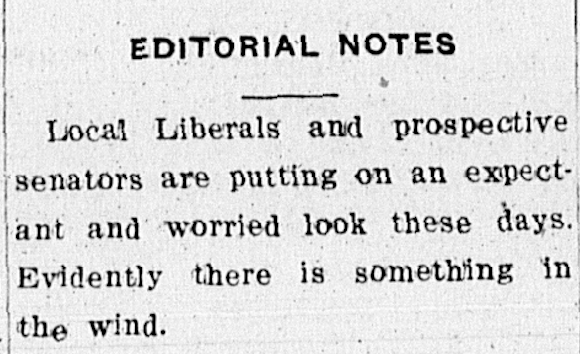
“Local Liberals and prospective senators are putting on an expectant and worried look these days. Evidently there is something in the wind.” Charlottetown Guardian August 31, 1925 p4.
Then, breaking front page news from the September 3, 1925 Guardian:
Senators Who May Or May Not Be
Rumors were rife in the city yesterday regarding appointments to the vacant senatorships, to the effect that the choice had fallen upon Mr. J. J. Hughes, M. P., and Mr. Creelman McArthur, Summerside. No confirmation of this rumor was available last night but no doubt official announcement will be forthcoming very shortly. The Liberal decks are being cleared for action and no doubt all possible appointments will be made before the Liberal conventions are held as some possibilities for a senatorship may be willing to accept nomination as second choice, if they should fail in bagging the bigger plum. Mr. Nelson Rattenbury who has been a senatorial possibility till the last minute has been eliminated from the list by a consolation prize of a seat on the C. N. R. Board of Directors. What consolation will be handed out to the remaining aspirants has not yet been divulged, but anything is possible now that appointments will be handed out promiscuously in view of the pending election. In the meantime until more definite information is to hand, Messrs J. J. Hughes and Creelman McArthur will enjoy the felicity of being senators pro tem but subject to revision.
I can confirm that the rumours about Hughes and M(a)cArthur were true, and Creel resigned his seat in the PEI Legislature on September 5. Now to fire up the time machine and go back to place a few bets!
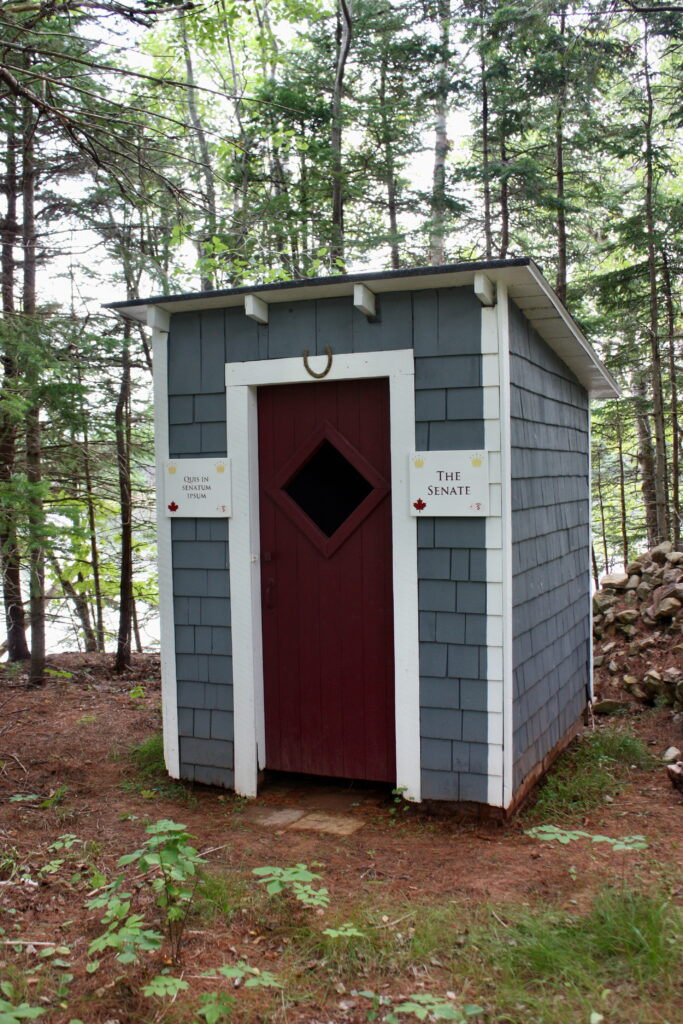
The original (non-operational) outhouse for Senator MacArthur’s Cedar Lodge built in 1933 and restored by me in 2013. We lovingly refer to it as The Senate.
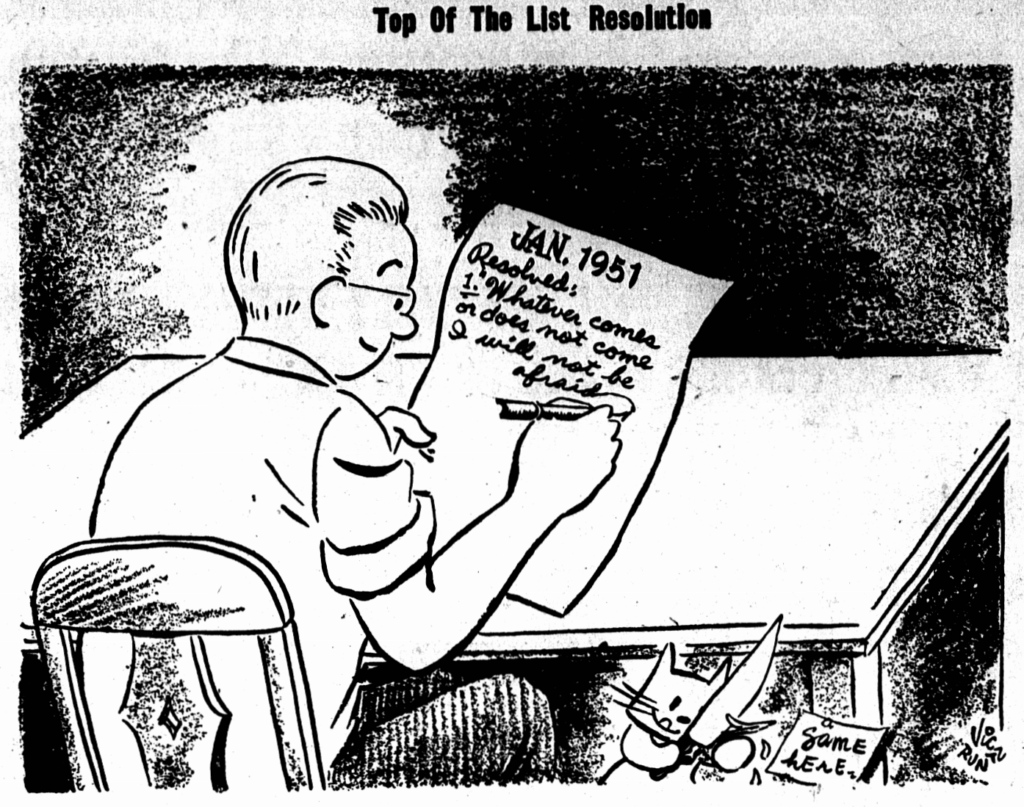
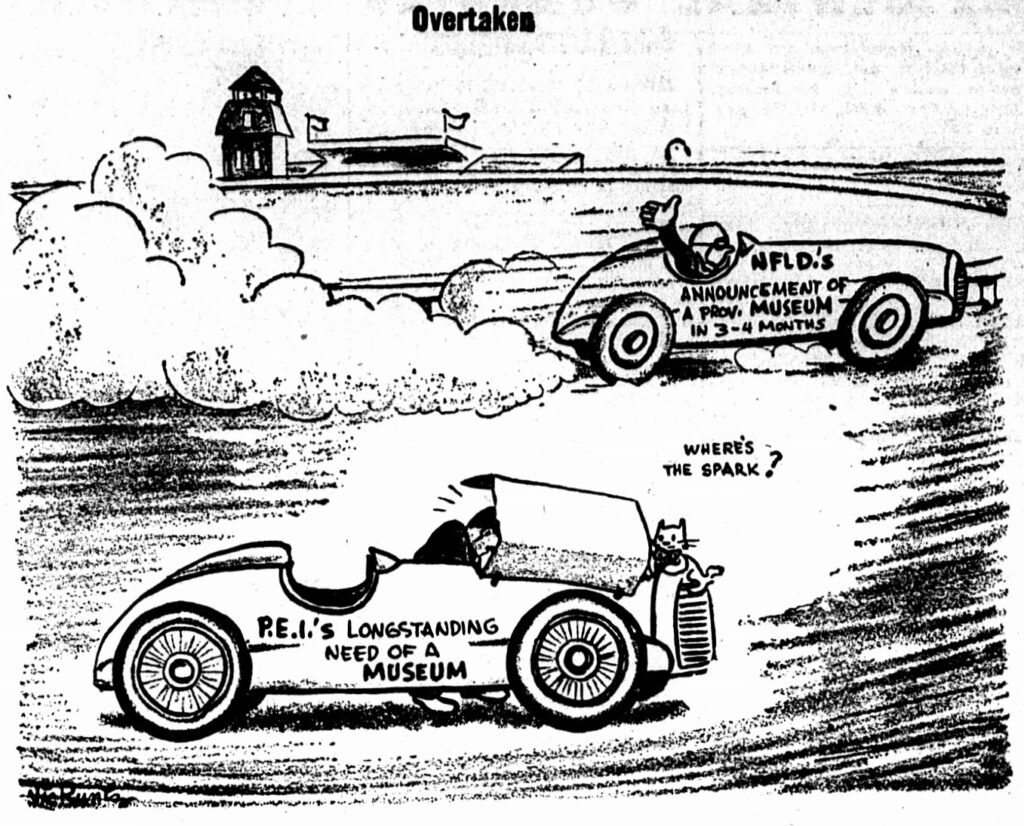
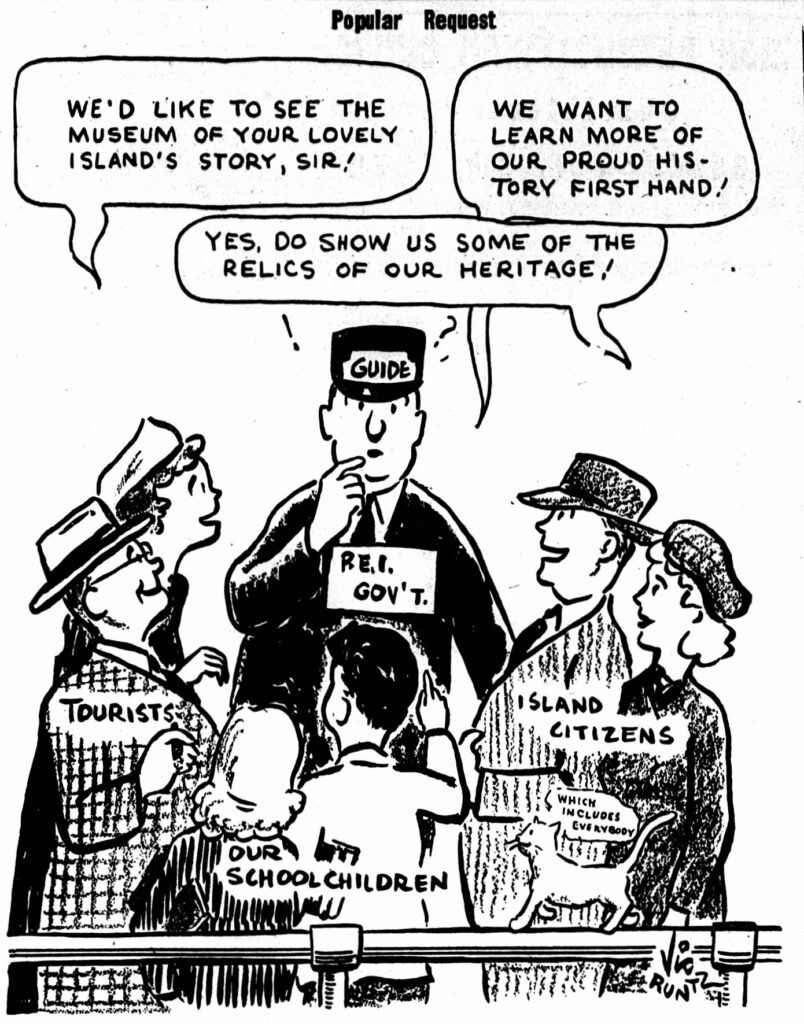
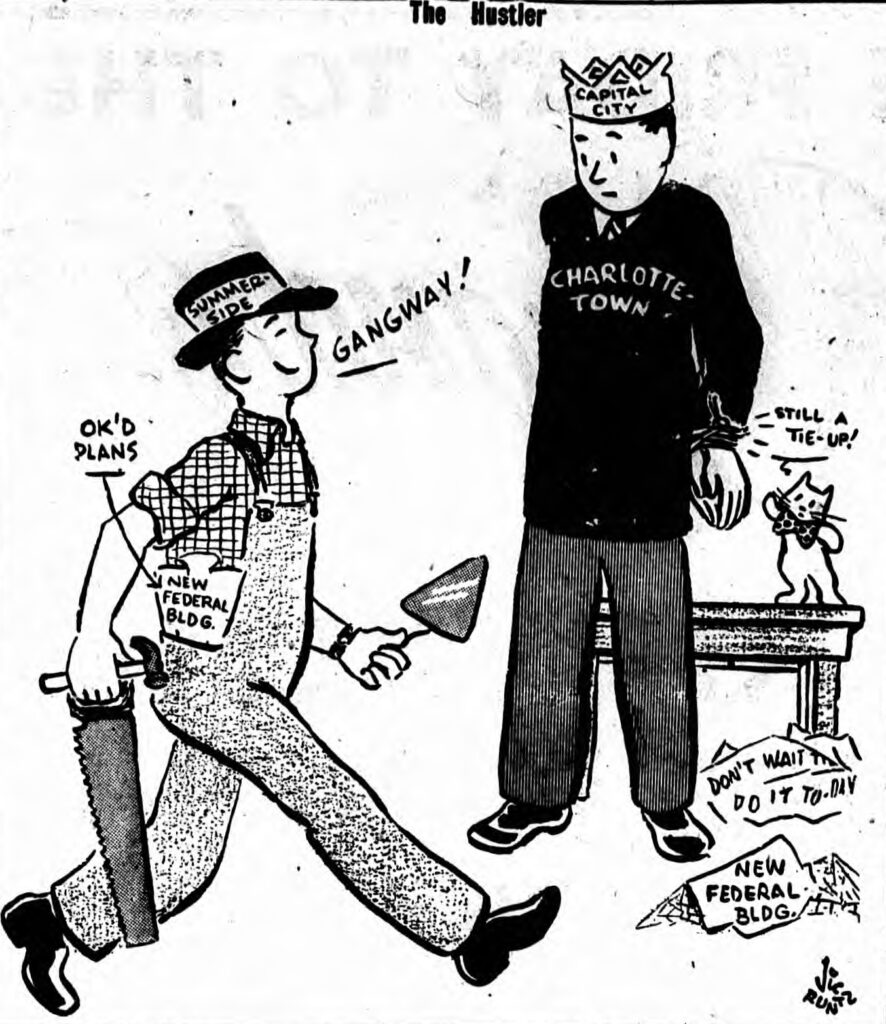
Here are some 75-year-old Vic Runtz cartoons from the Charlottetown Guardian I’ve enjoyed over the past few months. Plus ça change…
Newfoundland, a Canadian province for only one year, announced the creation of a provincial museum while PEI could never seem to get beyond the talking stage (and still can’t to this day). July 14, 1950, page 4July 8, 1950, page 4. Scrappy little Summerside’s new federal government building (now the site of the Summerside Rotary Library) was under construction while Charlottetown still waiting. April 20, 1950.