
I am descended from people who came to Prince Edward Island from England and Scotland in the 18th and 19th centuries. Most of my recent ancestry is from Devon and Dorset in the south-west of England, many coming to work in shipbuilding using the plentiful lumber old-growth forest that had stood here untouched forever. My most recent British-born ancestor, GGG grandfather Robert Phillips, came to PEI from Barnstaple, Devon, in 1832 to work as a brass fitter in one the many shipyards.
My family stories extend back only a couple of generations, so I have no accounts of what those ocean crossings were like, what their first impression was of PEI, how they felt about leaving family, friends and country behind, but I have often thought about what that experience would have been like for them.
I recently did a week-long trial membership on Newspapers.com. While it seems an excellent site and probably well worth the subscription price, I didn’t sign up as I was afraid I would do nothing else but read old newspapers for the rest of my life!
During that trial, I searched Devon newspapers from the early 1830s to see if there was any record of Robert’s departure for PEI. That search came up empty, as I had expected, but I did find a wonderful piece in the June 23, 1831 edition of The North Devon Journal and General Advertiser that gave advice to those who were thinking about moving to North America. I wonder if Robert used this article to help him plan his move, or convinced him that such an adventure could be a possibility for their family. Maybe he cut it out and carried around in his pocket.
The author wasn’t named, but they gave very specific and sound guidance, especially about the British North American climate, information that would still be pretty accurate today.
After listing practical supplies needed for the journey and setting up a new home, the author suggested the final item a young man needed to procure was “an active young wife.” As he already had a wife and five children, including two-year old twins, Robert was fine on that account!
The author outlined a plan on how to survive the ocean crossing and insisted that “by attending to these observations, I will insure you landing in good health, and better looking than when you embarked.” The idea that someone in the 1830s would be better looking after their weeks at sea than when they boarded is amusing, as it is certainly more than hinted at in the article that the living quarters on ship left much to be desired. I’m sure it was a miserable, dangerous crossing.
Young men were advised to leave their “party feeling” behind to ensure they didn’t jeopardize their chances of advancing in their new home because they had clung to old political allegiances. Knowing how party politics is deeply ingrained in the DNA of many Islanders – some families here have voted for the same party for generations – I suspect these newcomers might have left the Whigs and Tories behind, but retained the deep need to find a political home in their new country.
I visited Barnstaple 30 years ago. One evening, I walked to the River Taw and stood on a dock looking west. I thought about Robert and Mary Ann arriving with their small children, all under the age of seven, ready to board a ship into the unknown. This article goes some way in filling in the blanks in my family’s story, adding texture and depth to sterile names and dates. They are still out of reach, but I can see them over the horizon.
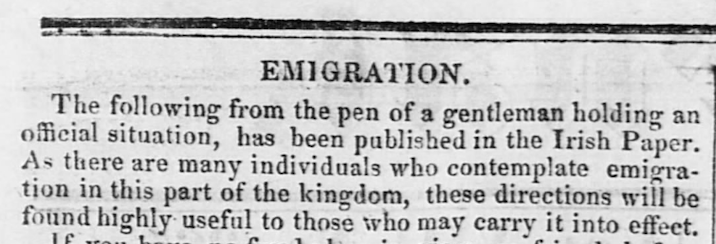
Emigration.
The following from the pen of a gentleman holding an official situation, has been published in the Irish Paper. As there are many individuals who contemplate emigration in this part of the kingdom, these directions will be found highly useful to those who may carry it into effect.
If you have no fixed place in view, or friends before you, if labour and farming be your object, and you have a family, bend your course to the Canadas; for there you will find the widest field for your exertions, and the greatest demand for labour.
In almost every part of the Middle States of America, you are subject to fever and ague, as also in some parts of Upper Canada. Lower Canada, New Brunswick, and Nova Scotia are exempt in this respect.
I would particularly recommend the months of April and May for going out, as you may then expect a favorable passage; on no account go in July or August, as, from the prevalence of the south-west winds, you will have a tedious passage. Make your bargain for the passage with the owner of the ship, or some well known respectable broker, or ship-master: avoid, by all means, those crimps that are generally found about the docks and quays, near where ships are taking in passengers. Be sure that the ship is going to the port you contract for, as much deception has been practised in this respect. It is important to select a well known captain, and a fast sailing ship, even at a higher rate.
When you arrive at the port you sail for, proceed immediately in the prosecution of your objects, and do not loiter about, or suffer yourself to be advised by designing people, who too often give their opinion unsolicited. If you want advice, and there is no official person at the port you may land at, go to some respectable person or Chief Magistrate, and be guided by his advice.
Let your baggage be put up in as small a compass as possible; get a strong deal chest of convenient size, let it be in the shape of a sailor’s box, broader at bottom than top, so that it will be more steady on board ship; good strong linen or sacking bags will be found very useful. Pack your oatmeal, or flour in a strong barrel, or flax-seed cask, (which you can purchase cheap in the spring of the year.) I would advise, in addition to the usual wood hoops, two iron ones on each cask, with a strong lid and good hinge, and a padlock, &c. Baskets or sacks are better adapted for potatoes than casks.
The following will be found a sufficient supply for a family of five persons for a voyage to North America, viz.— 48 stone of potatoes (if in season, say not after the Isl. of June,) 2cwt. and a-half of oatmeal† or flour, ½ cwt. biscuits; 20lbs. butter in a keg; 1 gallon of spirits; — a little vinegar; — When you contract with the captain for your passage, do not forget to insure a sufficient supply of good water. An adult will require 5 pints per day — children in proportion.
The foregoing will be found a sufficient supply for an emigrant family of five persons, for 60 or 70 days, and will cost about £5 in Ireland or Scotland; in England about 6 or £7; if the emigrant has the means, let him purchase about 11lbs. of tea, and 16lbs. of sugar for his wife.
The preceding statement contains the principle articles of food required, which may be varied as the taste and circumstances of the emigrant may best suit. In parting with your household furniture, &c. reserve a pot, a tea-kettle, frying-pan, feather-bed, (the Irish peasantry possess a feather-bed,) as much coarse linen as you can, and strong woollen stockings — all these will be found very useful on board ship, and at your settlement, and are not difficult to carry. Take your spade and reaping-hook with you, and as many mechanical tools as you can such as augurs, plaines, hammers, chissels, &c., thread, pins, needles, and a strong pair of shoes for winter. — In summer in Canada, very little clothing is required, for six months — only a coarse shirt and linen trowsers, and you will get cheap moccasins (Indian shoes;) you will also get cheap straw hats in the Canadas, which are better for summer than wool hats, and in winter you will require a fur or Scotch woollen cap. Take a little purgative medicine with you, and if you have young children a little suitable medicine for them. Keep your self clean on board ship, eat such food as you have been generally accustomed to, (but in moderation) keep no dirty clothes about your births, or filth of any kind. Keep on deck, and air your bedding daily, when the weather will permit; get up at five o’clock, and retire at eight; take a mug of salt water occasionally in the morning. — By attending to these observations, I will insure you landing in good health, and better looking than when you embarked.
From the great disparity of male over female population in the Canadas, I would advise every young farmer or labourer going out, (who can pay for the passage of two) to take an active young wife with him.
In Lower Canada, and New Brunswick, winter begins about the end of November, and the snow is seldom clear from the ground till the beginning of April. In Nova Scotia, and Prince Edward’s Island, from their insulated situation the winters are milder than in New Brunswick or Lower Canada, and in Upper Canada they are pretty similar to the back part of the State of New York.
The risk of a bad harvest or hay time is rarely felt in Lower Canada, and consequently farming is not attended with so much anxiety or labour as in the United Kingdom. The winters are cold but dry and bracing. I have seen men in the woods, in winter felling trees with their coats off, and otherwise light clothed. The summers are extremely hot, particularly July and August.
The new settler must consult the seasons in all his undertakings and leave nothing to chance, or to be done of another day. The farmers of Lower Canada are worthy of remark in these respects.
In conclusion, I beseech you, if you have any party feeling at home, if you wish to promote your own prosperity, or that of your family, wash your hands clear of it ere you embark. Such characters are looked upon with suspicion in the Colonies; and you could not possibly take with you a worse recommendation.
Prices of living, house rent, labour, &c. in the principal towns of Canada, with the expense of travelling on the great leading routes — In Quebec and Montreal, excellent board and lodging in the principle hotels and boarding houses, 20s. to 30s. per week. Second-rate ditto from 15s. to 20s. per week. Board and lodging for a mechanic or labourer 7s. to 9s. 6d. per week, for which he will get tea, coffee, with meat for breakfast, a good dinner, and supper at night.
• If potatoes are out of season for keeping, increase the quantity of oatmeal.
If the Emigrant has any oatmeal to spare, it will sell for more than prime cost.
From The North Devon Journal and General Advertiser – Thursday, June 23, 1831
Not sure how I arrived on this site but I appreciate your efforts. I am the 5th generation of my family in Canada residing in Ontario untill my retirement to PEI in 2017. Our family is originally from North Devon Clovelly, a number of sons emigrated to Port Union West Hill Ontario in 1840s and were working in farming and black smithing. Their time in Ontario was well documented but it took a considerable amount of time and research to gather what information I have been able to find so far pertaining to their lives in the UK. The one piece of information that I had that kicked off my ancestral search was an original parchment document dated 1832 for my GG grandfather who was living and working in Clovelly North Devon as an apprentice black smith at 14 years old. He eventually went to Canada and started his own black smith business, died and was buried there as well. During my researching I find a lot of family names and town names relating to that area of England. Thank You for the article, I found it so interesting.Regards
Thank you, Ric, glad you found my site and I appreciate you commenting. I have very little information on my ancestors’ lives before they came to North America, so finding this newspaper article was such a joy. A lot of the family and place names around me here in PEI are originally from Devon as well. Good luck with your family history research.