I added pages from the August 21, 1951 Charlottetown Guardian about the opening of the second building to house Prince County Hospital to my Community History page. By the time the new PCH facility opened in 2004, the 1951 building was widely regarded as old and outdated, so it is lovely to read the hope and pride the community expressed for their new, state-of-the-art hospital.
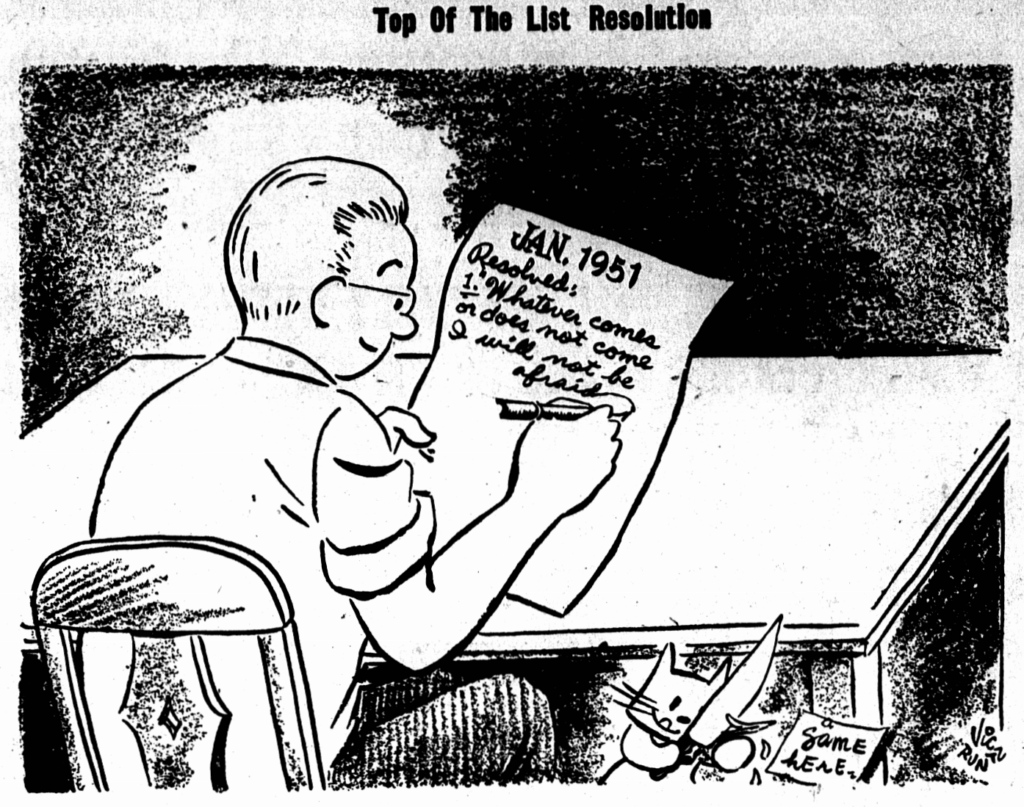
I’ve been reading old newspapers online through UPEI’s Island Newspaper site since 2014 and one of the many reasons I continue is that I love the time traveling aspect, pretending to be someone picking up the morning paper and reading about new technologies and community news. The past, in printed form, is a safe place, and I visit it knowing how things turned out, or are still turning out, like the 1951 nationalization of Iran’s oil industry (see 2026 Iran war fuel crisis). Things change, things stay the same, and on we go into the future.
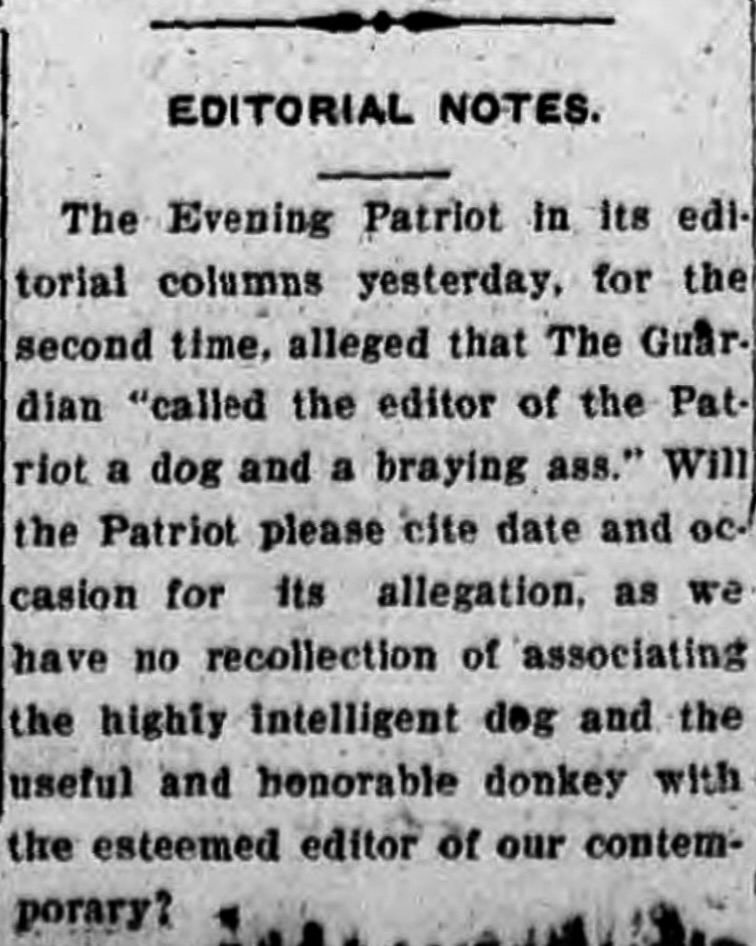
Some (hopefully) friendly tomfoolery between rival Charlottetown newspapers in 1926.
Charlottetown Guardian, September 4, 1926, p. 4
The Evening Patriot in its editorial columns yesterday, for the second time, alleged that The Guardian “called the editor of the Patriot a dog and a braying ass.” Will the Patriot please cite date and occasion for its allegation, as we have no recollection of associating the highly intelligent dog and the useful and honorable donkey with the esteemed editor of our contemporary?
A friend and I joined a walk around Holman’s Island in Bedeque Bay that was sponsored by the Bedeque Area Historical Museum and led by the always-interesting and gracious Doug Sobey, who is president of the historical society that runs the museum.
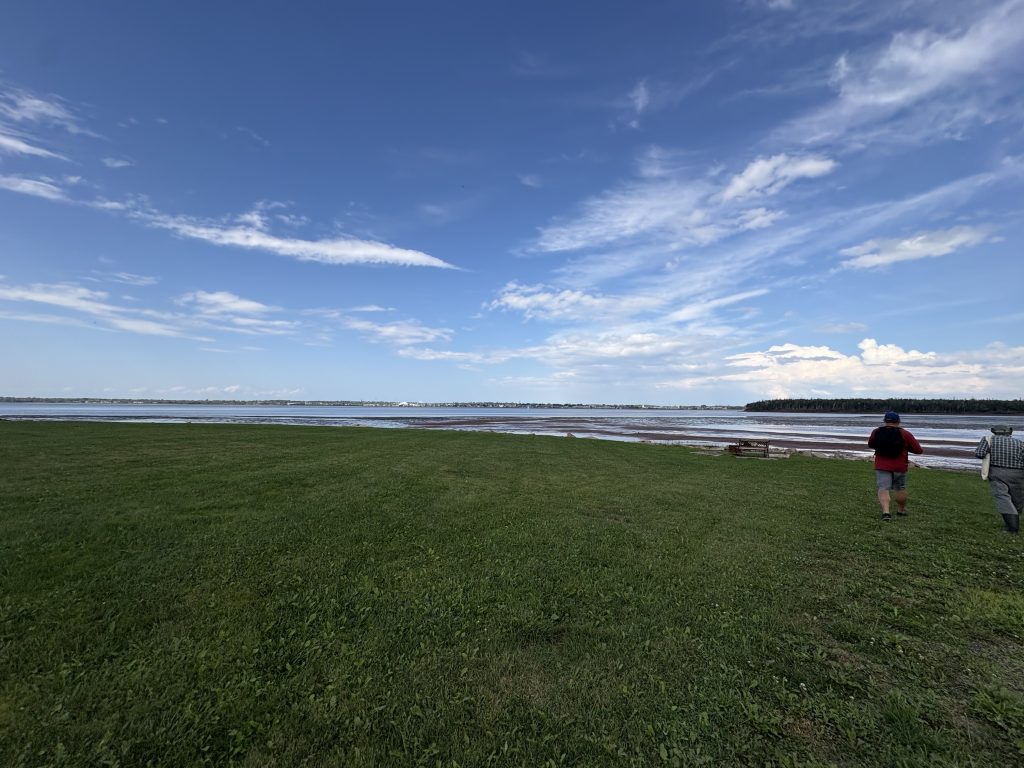
About a dozen of us met at the museum last Tuesday and drove a few kilometres to a private driveway where the museum had permission of kind cottage owners for us to cross their yard to the shore. The walks are timed to coincide with the lowest tides, so we easily waded through ankle-deep water on a sandbar to the island. Doug gave a fantastic overview of the Mi’kmaq and settler history of Bedeque Bay and the city of Summerside, and then we started our circumnavigation.
Starting the walk to Holman’s Island.
Now owned by the Nature Conservancy of Canada, Holman’s Island is most notable as the site of a 125-bed hotel that operated for five years in the 1870s and closed due to financial difficulties, the building burning in 1904. Doug said there are depressions in the ground where the hotel foundations were, but nothing else is left of the hotel and the island has reverted to forest.
We didn’t venture into the forest, but the beach walk was beautiful, though not really much different than any other PEI beach; the real delight was in finally being on this little island that had been pointed out to me since childhood but that I had never had the chance to visit.
The western and northern sides of the island have steep cliffs, while the east and south are much lower and it would be easy to walk from the beach into the forest. There were lots of empty oyster on the shore, possibly due to the die-off of oysters from two diseases, MSX and Dermo, that have crippled our oyster industry.
It has become more difficult over the years to find sea glass on PEI beaches, which, it is hoped, is mostly because we are better at recycling and properly disposing of waste, so it was fun to look for glass on this more inaccessible location. I found a few lovely bits and pieces on the east side of the island, all of it still pretty pointy as the wave action in sheltered Bedeque Bay isn’t as scouring as ocean waves.
The beach on the west side of the island, with Summerside in the background.
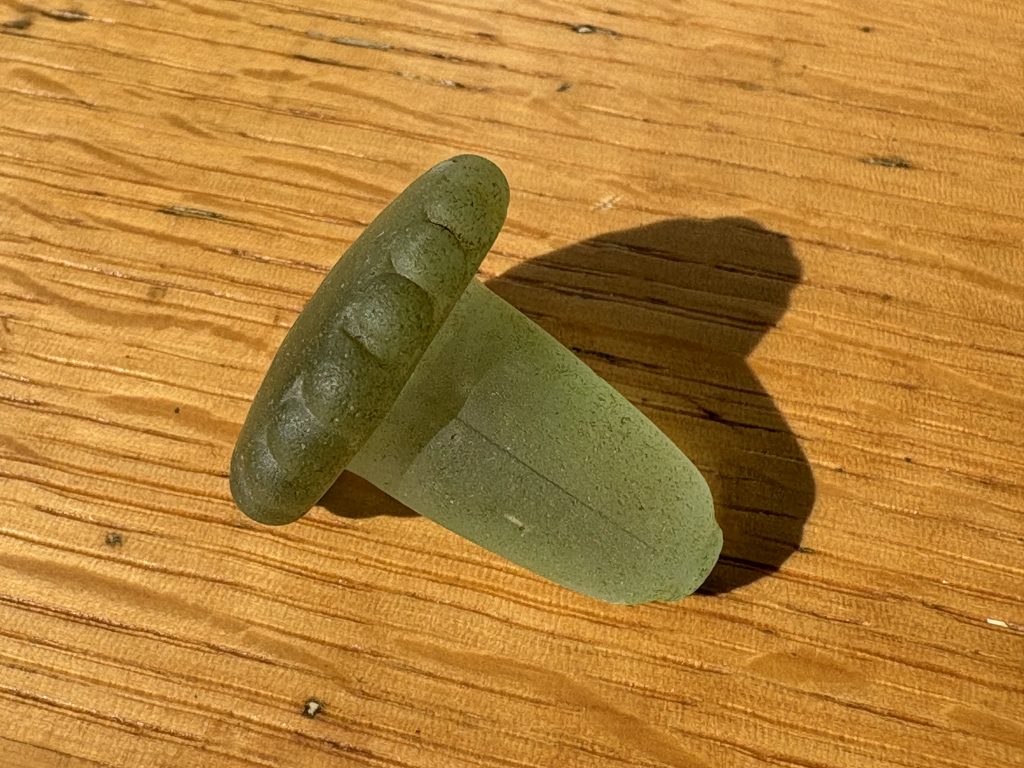
And then, sitting on a pile of rocks high up on the beach, I spotted what is likely to be the best piece of sea glass I will ever find: a light-green bottle stopper. At first I thought it had to be plastic as it was so perfect, but it gave a satisfying little tink when I tapped it against some other glass and my beach combing heart soared.
Maybe it’s the stopper from a cruet tossed from the long-gone hotel, a medicine bottle top or, heaven forfend, the stopper of a little bottle of alcohol. Hard to say, but now it sits on the windowsill next to my desk, catching the sun as it did for decades in Bedeque Bay, same sun, different view. I finally made it to Holman’s Island, and it gave me a treasure.
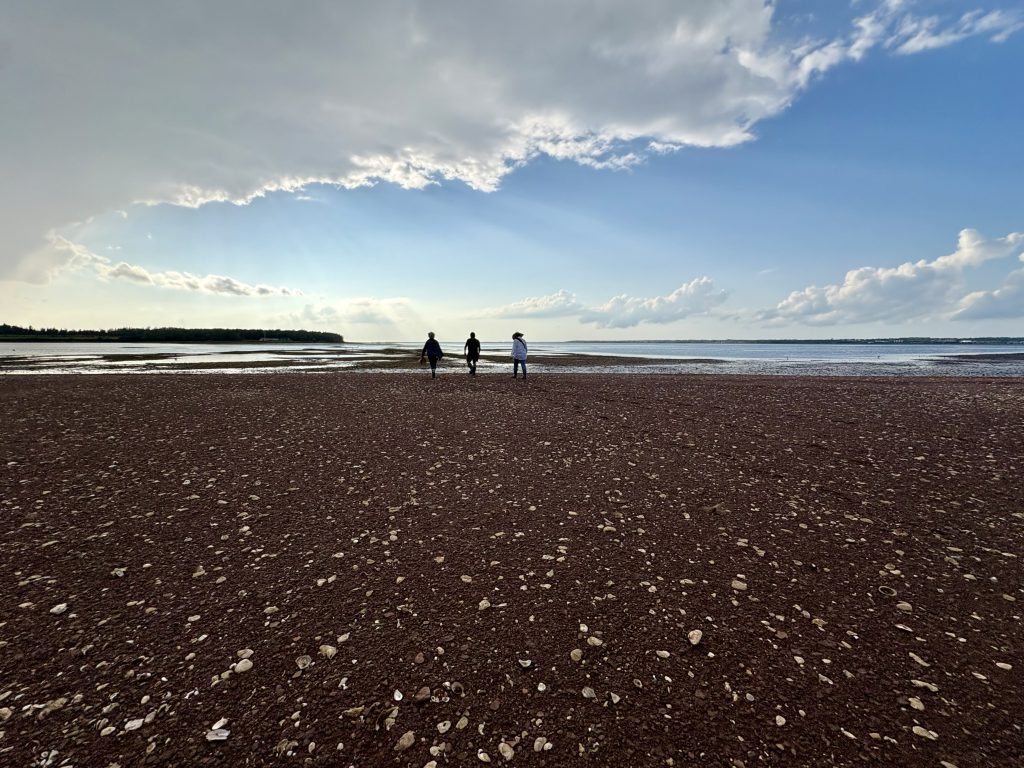
The green glass stopper.The end of the walk. We narrowly missed a big thunderstorm earlier in the day, and the lingering clouds were spectacular.
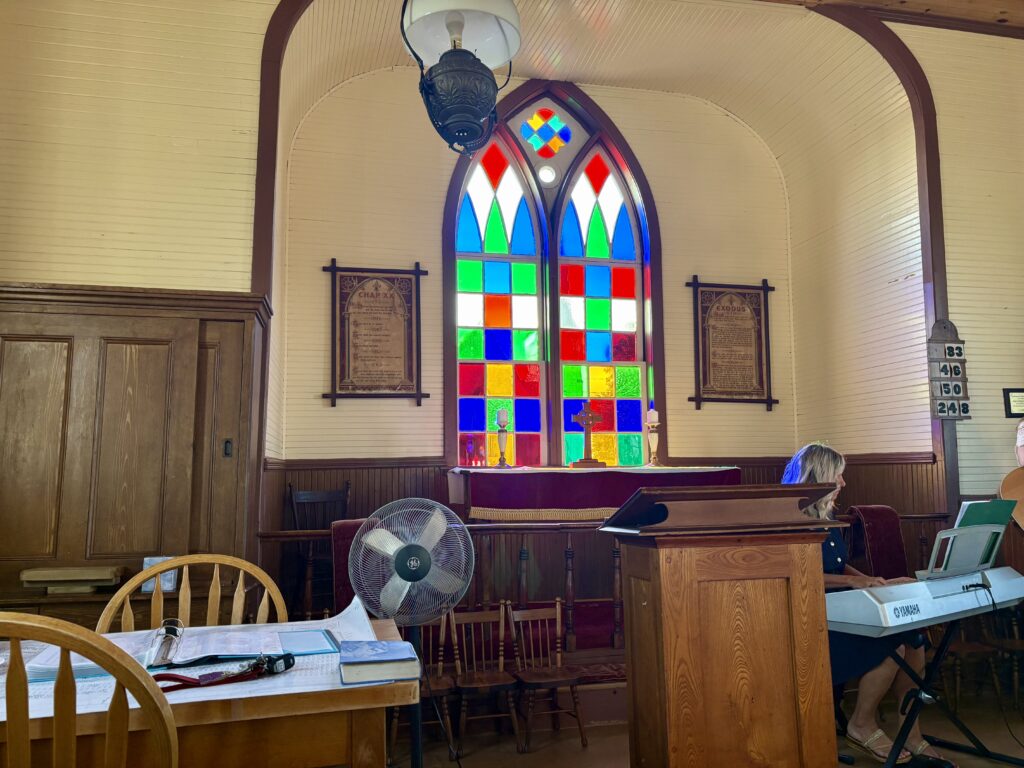
I was invited to a hymn sing yesterday morning at Old St. James church in Port Hill, a twenty minute drive from my home. A sunrise event, 7:00 am, created by someone I only met when she contacted me last week after reading something here on my blog.
Our only connection was that our ancestors embarked from the same town in England to take up work in the PEI shipyards in the mid-1800s. Our families would have worshiped together in St. James after it was built around 1841, but neither of us have a recent connection to that church or community.
Old St. James Anglican Church, Port Hill, PEI
The music was outstanding, Laura Beth and two of her friends playing electric piano, guitar and the church’s ancient pump organ, harmonizing together on an hour’s worth of classic hymns. A dozen locals, mostly parishioners, came to join them, none of us knowing these musicians but, I would guess, drawn as I was to the novelty of being invited to this sweet historic church on a soft, gentle July morning.
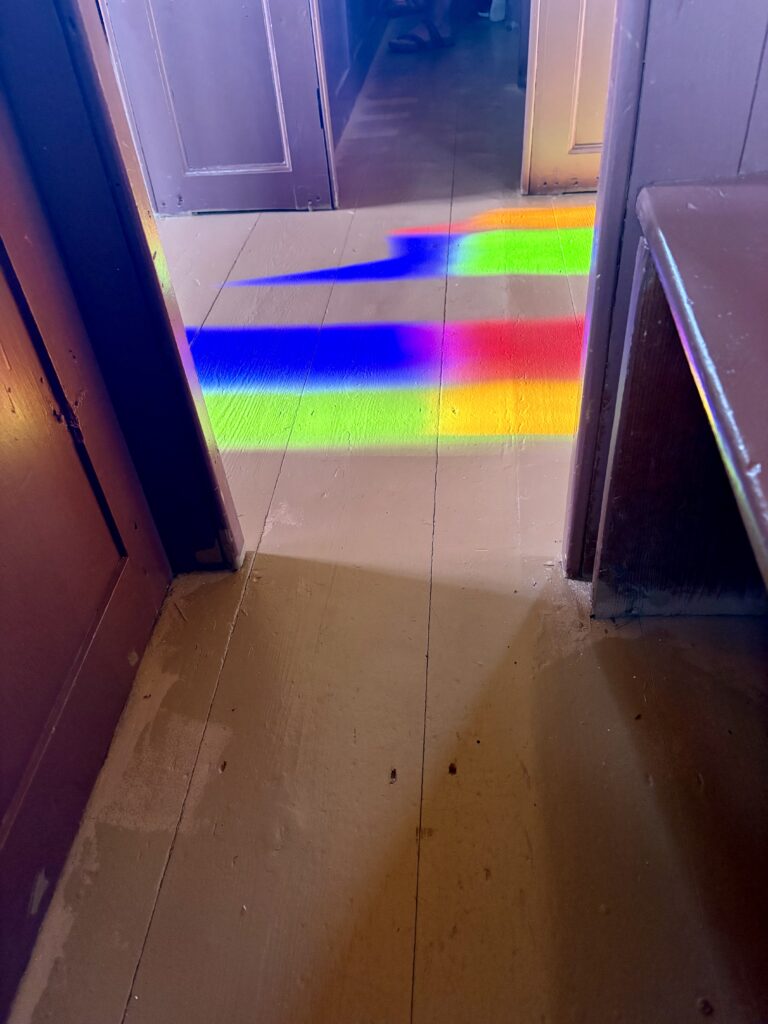
The morning sun moved through the simple coloured glass window, casting a nearly-neon glow first on the singers, then the pews, and across the floor. It was mesmerizing and poignant, moving many to tears. Brought together by strangers, parting as friends, with hugs and farewells all around. Brief but deep conversations about family history and spirit and life. I’m not a churchgoer, but this was a special, meaningful morning.
The view of the light from the windows on the church floor as seen from the front pew.
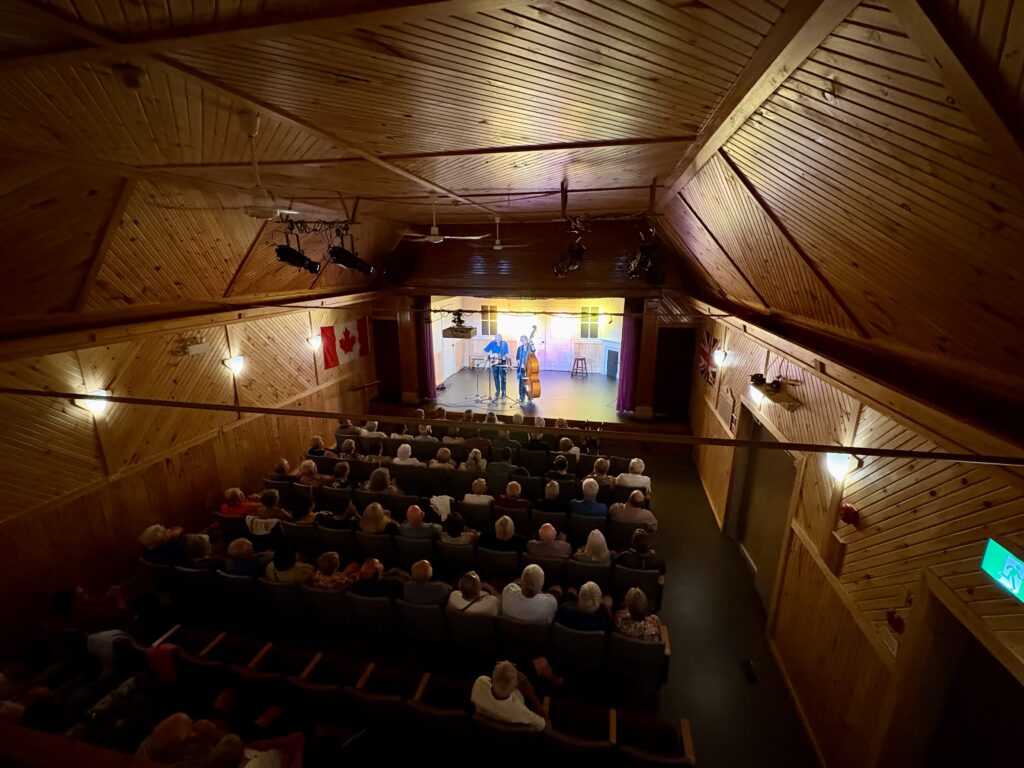
I had spent the previous evening in Britannia Hall in Tyne Valley at an evening of story telling and music. The only thing I have any real training in is technical theatre: lights, sound, stage management, stage carpentry, that sort of thing. It has been decades since I used any of those skills in a theatre, but I recently joined the hall’s volunteer committee and jumped at the chance to relearn how to run the sound and lights by assisting the technician, moving microphones around and helping with sound checks.
The view from the booth of Britannia Hall.
It was fun to see what I had remembered, to stretch that part of my brain again, and the magic of making a performance happen still makes my heart jump. I will turn 60 soon, but I felt as I did when I was 20, hurrying around the theatre, nimble and quick, dressed in theatre-technician black, to troubleshoot the various things that always go a bit sideways in live performances.
It was a weekend where centuries and decades folded in on each other, time meaning nothing. This has happened a lot since my mother died last year. Time expands and contracts so that my childhood seems like yesterday and then seems 1,000 years ago, often switching in the blink of an eye. I worried about this for a while, wondering what my grief brain was up to, but now I just let myself be pulled and pushed, giving into the swirl, the music, the ageless hymns of time.
Here are two stories from the Charlottetown Guardian archives about long-ago aviators with PEI connections: Patrick Peters and Frederick Tobin.
First on the runway is Patrick Peters, who was reported to have built a flying machine and took it to Maine in 1890 to put on public shows. I’ve not found the original article that was quoted in the August 26, 1950 Guardian piece I read or any other account of his time in Portland.
I located a Patrick Peters on Find a Grave who was born around 1864 and is buried in Rumford, Maine, so he could very well have been the brave flyer; his connection to PEI seems valid even if the information about his date and place of birth is a bit mixed up.
Report Tells How PEI Man Navigated Air Machine In 1890
How a Prince Edward Islander navigated a 38-pound flying machine as far back as 1890 is related in the following article reprinted from a Halifax exchange of Aug. 13 of that year. The Islander’s name was Mr. Patrick Peters and the report tells of his arrival in Portland, Maine, with his machine.
Mr. Peters said he had made up his mind in 1885 that he was going to make a machine that would navigate the air. He objected to balloons, he said, “because they were too far beyond the control of those who risked their lives in them,” but believed a machine could be constructed capable of being as much under the management of the flyer as a horse rake.
He said he “took the wings and motion of a bird for a model, believing that if he could fly like a bird it would be quite enough. Only after repeated failures did he bring his idea to a point where he could say with any degree of confidence, “I can fly”.
“At last,” the report continues, “he constructed a bird of the following dimensions: From the head to the tail, 16 feet, and from the body to the end of each wing, 3 feet. The seat was in the body and the motive power used in the propelling of the machine was obtained by a combination of wheels.”
Described Flight
The account describes Peters’ first flight.
“His first real trial of his machine was made when he passed over a forest, making about two miles in about four minutes.”
“From his description of the way things looked below it would seem possible that he went at least 2,000 feet up in the air, and perhaps more than twice that distance. He says he went up and down at will, managing his 38-pound machine without the least degree of trouble.”
Peters’ purpose in going to Portland was “to make a little money by giving a public exhibition of his machine.” “He says he is willing to give any desired test and can go any distance desired. He can keep a few feet above the ground or can go up into midair.”
Peters assured Portland people that “it is a perfectly easy thing to fly with one of his machines.”
In 1890 there was still quite an amount of suspicion towards anyone who claimed he could fly, so the story concluded: “Portland people who know Peters say he is honest and he acts that way.”
Charlottetown Guardian – August 26, 1950
Our other flyer, Frederick J. Tobin, was as famous as Peters was mysterious. The following article from the September 29, 1925 Guardian describes his first connection to 20th century airship history as a surviving crew member of the Shenandoah that crashed September 3, 1925, and includes a link to an even more notable event he was involved in some years later.
Islander Has Narrow Escape
Among the members of the crew of the ill fated United States dirigible “Shenandoah,” which crashed to earth in Ohio over three weeks ago, with a heavy loss of life, was Pilot Frederick J. Tobin. Mr. Tobin is a son of Mrs. Margaret J. Tobin, formerly Miss Margaret O’Brien, daughter of the late Mr. and Mrs. John O’Brien, of Bristol, Prince Edward Island.
Pilot Tobin had a miraculous escape from death, having fallen on the tree tops.
Letters from Mrs. Tobin to her sister Mrs. James A. O’Brien, Morell, and her brother, Mr. John O’Brien, Bristol, state that after Fred fell on the tree tops, a part of the rigging caught in his clothing and carried him off again trough the air. Once more he became disengaged from the plane and fell to the earth from an altitude of 100 feet, and was picked up by a passing plane, and at once carried to safety.
After a day of terrible suspense Mrs. Tobin was getting ready to go to Lakehurst, when she received news of her son’s safety.
Both Mr. and Mrs. O’Brien, aunt and uncle of Mr. Tobin, are very proud of his escape, and of the honor that will now be his. Prince Edward Island also has need to be proud of her grandson, as she can claim him through his mother. Mr. Tobin was next to the late Capt. Lansdowne. If there is another Shenandoah constructed Pilot Tobin may be first in command.
The Boston Post of September 11th contains a photo of Pilot Tobin, and the following notice: Frederick J. Tobin, a member of the crew of the Shenandoah who is reported safe, is well known in Arlington, where he formerly lived. He is the son of Mrs. Margaret J. Tobin of 6 Russell Terrace, Arlington. He has been in the United States navy for 11 years.
He was married two years ago, and besides his wife, who lives in Lakehurst, N. J., and his mother, in the family group are a sister Miss Mary R. Tobin and four brothers, Frank E. Tobin, a veteran of the late war, Henry L. Tobin, John L. Tobin and George W. Tobin, all of Arlington.
From a September 4, 1925 Boston Globe article on the Shenandoah crash.
Patrick J. Tobin shown third from the right ,middle row of this composite photo from the US National Archives via the NavSource Naval History website’s page about the Shenandoah: https://www.navsource.net/archives/02/99/029901.htm
Tobin remained in the US Navy after the Shenandoah crash, and was still based in Lakehurst, NJ in 1937 when the Hindenburg made its final voyage. Not only was he there when the Hindenburg came in for a landing, it seems he was standing under it when it exploded, as outlined on Dan Grossman’s excellent Airships.net:
Natural instinct caused those on the ground to run from the burning wreck as fast as they could, but Chief Petty Officer Frederick J. “Bull” Tobin, a longtime airship veteran and an enlisted airship pilot who was in charge of the Navy landing party, cried out to his sailors: “Navy men, Stand fast!!” Bull Tobin had survived the crash of USS Shenandoah, and he was not about to abandon those in peril on an airship, even if it meant his own life. And his sailors agreed. Films of the disaster clearly show sailors turning and running back toward the burning ship to rescue survivors; those films are a permanent tribute to the courage of the sailors at Lakehurst that day.
I’ve probably seen clips and stills from the famous British Pathé newsreel footage dozens of times, but I’ve never seen the original reel and heard the narration that went with it; t was jarring to see that the Hindenburg had Nazi swastikas on its tail.
Interestingly, the “Oh, the humanity!” line so often quoted from the Hindenburg disaster coverage is not from the newsreel but had been recorded by radio reporter Herbert Morrison and matched up many years later.
Tobin retired from military service in 1947 and died in Fort Worth, Texas in 1978 at age 85.
Here’s a lovely, wry letter to the editor of the Charlottetown Guardian, printed February 27, 1926, about the joys of being a mail carrier in wintery rural Prince Edward Island.
I think that “breaking a road” meant creating a path with horse and sleigh over newly-fallen snow so that it would be easier for other travellers, and I believe it was up to each landowner to do the section of road that ran in front of their property. I would guess this might have included knocking down tall banks by shovelling. People being people, not everyone would get around to breaking the road early enough after a storm, or at all, as the mail carrier finds out.
In some spots, where winds would regularly leave substantial drifts in the road, section of fencing would be taken down in late fall so folks could travel through a flat field over the winter, so when the writer talks about “going over tree tops, on the road through fields, dodging a fence here, a post there, and a barn some place else,” they weren’t exaggerating.
ONE DAY O. H. M. S.
Sir.— As I was sitting enjoying a good “home fire” this evening, I decided I would get my pen and paper, and write a few lines concerning “One day O. H. M. S.”
This winter especially we have to contend with an immense lot of snow, and storms mostly, every second day. However when the storm eases and the sun shines again, we make ready for our journey (over an unbroken road.) We wait awhile and it’s soon shovelled out, after the men go home with frozen feet, hands, etc. After going to the P.O. we bundle up the mail that has arrived the night before (or what’s left of it) and start our journey with a good, faithful horse that’s not afraid of a few feet of snow. The old horse will wade along stopping at the boxes, some are on sticks, some on snow-banks, and some on posts. Nevertheless we get along a few miles.
“Are you cold, come in, come in—rest your horse—and get warm.” You will welcome the voice of a farmer calling from his barn door.
“Thank you but I must keep on. I am not cold, since the roads are bad the travelling is slow. Good day.”
After going some distance, a man will meet you.
“Glad to see you—you must have had a bad road.”
Farther on a woman will appear.
“Isn’t it cold, if you can’t get through the rest of the way call in and have a cup of tea.”
“Thank you” but on we go. Then comes a turn to the right.
“Whoa—Hello Mr. Snowbank you are in a very convenient place, right on the middle of the road, huh.”
“A step ahead old horse—whoa wait that won’t do, can’t get through that, lay still till I get you unharnessed and the sleigh back—good job I took the shovel, old horse, comes in pretty handy sometimes—all clear come around now if you can. I’ll get you back in the sleigh again and we’ll go back to the P. O.—This won’t make our Route any shorter, old horse, although we have to turn back.”
“Oh good-day sir—yes, yes all right now—thanks—bad roads, bad roads, yes a lot of breaking done on that road this winter—well good day.”
All right, old horse we will go right back home, perhaps “Mrs—“ will be insulted for not calling for that cup of good tea, but we must get back.”
“Hello there” comes a voice like a clap of thunder. “That road broke”—
“No” then some words too numerous to mention.
“Come on old horse never mind h’m”—
“Funny for a man to drive a mile or two out of the way if that’s a passable road, and another man drive a mile or two out of his way for a Doctor if that is a passable road.”
“Too bad we Mail Couriers didn’t have Reindeers, or a few St. Bernard dogs, that could go over those “Passable Roads” then some of our box holders wuld have more time to make false statements.”
Sir.— would you consider a mile of road solid snow banks passable? I find that the individual who has the longest portion of the road to break alone, grumbles the least.
After going over tree tops, on the road through fields, dodging a fence here, a post there, and a barn some place else, we get back to the Post Office.
“Road not broke, had to turn back Post Master.” Now in the sleigh and home again where a good supper is waiting for both.
“Ahem—But its glorious too, to be On His Majestys Service.”
That green-and-white flag in the background of the photo below? It’s the flag of the City of Charlottetown, and I don’t remember ever seeing it before it was helpfully pointed out to me by Councillor Mitch Tweel in this morning’s Guardian.
It’s quite striking. Looks a bit like the diagram for the most boring, frustrating game of chess ever conceived.
Svgalbertian, Public domain, via Wikimedia Commons
But it’s a good design because even I, rural PEI mouse who obviously doesn’t spend enough time in the Capital, knew immediately what it represented: the five squares that were part of the original 18th century city plans.
From Charlottetown Heritage Squares: Conceptual Master Plans and Design Guidelines, April 2012
In my defense, I poked around Charlottetown via Google Street View and saw the flag flying outside Charlottetown City Hall, but couldn’t find it in any other prime flag-flying locations like parks. It certainly isn’t part of the City’s “Great things happen here” branding. I will keep my eyes peeled for it next time I visit.
When I happened upon what is said to be the last intact telegraph pole on PEI earlier this year, I searched the islandnewspapers.ca site for more PEI telegraph information and found the article reproduced below about the 1889 West Prince Forest Fire.
The information I’ve shared about the 1960 West Prince Fire is, by far, the part of my website that generates the most emails and comments, so I’ll add this article to the pile of Prince County fire info.
Note: I’ve left the term “squaw” in as it was commonly used at the time, but want to point out it is an archaic, offensive term for an Indigenous woman and best left in the past with similar racist, misogynistic language.
For some time past forest fires — many of them started for the purpose of clearing land — have been more or less prevalent in that portion of Western Prince County lying between Port Hill and Alberton. No consequences of a serious nature were anticipated from these fires, and the people generally paid but little attention to them.
However, the high wind of yesterday fanned the flames, and in an incredibly short time all that stretch of country between Conway Station and Alberton was a mass of fire. The flames spread with great rapidity, licking up almost everything in their way. The roaring of the fire as it spread was terrific. Everything possible was done to stay the progress of the flames, but without success. The fire fiend was master of the situation.
At O’Leary, Barclay’s mills were burned down. The dwelling house of Mr. White, the dwelling and office of Postmaster Frost and several unoccupied buildings met with a similar fate. It was only by the greatest exertions that the railway station house and coal shed were saved, clay having to be shovelled upon the fire to prevent its spreading in that direction.
It is feared that a squaw and her child, encamped a short distance behind the station at O’Leary, were burned to death. Rumors of other persons being burnt are also afloat, but lack confirmation. Let us hope that the rumors may prove groundless.
Between O’Leary and West Devon the fires were burning so close to the railway track that the express train, in charge of Conductor Kelly, had to be stopped several times to examine the track before proceeding.
At West Devon, Arthur’s mills were burnt down, and all his lamber was destroyed. The heat from the burning mills and lumber, as well as from the fires in the woods, burnt the sleepers and warped the rails for nearly half a mile, necessitating the stopping of the train at that place. Here Conductor Kelly took advantage of the only clear space available, and here for a time he and his men had to work hard to keep the train from being burnt up.
Besides Arthur’s mills, at West Devon, three or four dwelling houses were destroyed. It is said also that several farmhouses in the vicinity of that place succumbed to the devouring element, but we cannot vouch for the correctness of the report.
The heavy rain which began to fall between seven and eight o’clock last evening put the fires down a little and cooled the air considerably. This enabled the men to go to work and make the necessary temporary repairs to the track, in order that the train might be able to get over. By ten o’clock new sleepers and rails were put down and other work performed which enabled the train to pass over and proceed on her way.
The train had to proceed at a slow rate of speed. The sleepers in many places were burnt, and between Portage and Conway a culvert was destroyed. Here, again, the train had to stop, and temporary repairs had to be made before they could proceed. As they went along, the greatest care had to be taken to prevent an accident to the train. The line was carefully scrutinized to see that the rails and sleepers were in their places, and that the track was free from obstructions. On the way they could see the telegraph poles and trees, as they were attacked by the flames, sway to and fro finally falling — many of them across the track, necessitating further stoppages. At Portage Mr. Wallace’s dwelling house and saw mills were burned down. Several small houses between Portage and Conway also succumbed.
So great was the heat from the flames all along the route of the fire that it was with the greatest difficulty anything could be done to stay the progress of the flames. The smoke was also very troublesome. Some of the people living in the neighborhood took the first opportunity of sending their wives and families away from home, remaining behind themselves to battle with the enemy. But their efforts were largely futile.
Conductor Kelly’s train reached Summerside shortly before three o’clock this morning, where she remained until seven this morning, when she left for Charlottetown, arriving at half-past nine.
The mails and passengers by the St. Lawrence were brought to the city last evening by a special train from Summerside in charge of Station Agent Grady. As soon as the news of the delay in the arrival of the express was received here, Summerside was instructed to make up a special and forward the mails and passengers immediately on arrival of the steamer. This was done. The promptness on the part of the railway authorities is very commendable.
The western freight train, in charge of Conductor Ryan, was held at Port Hill by order of the Superintendent until daylight this morning, when she proceeded on her way. To-day all trains except the western freight above referred to are on time.
Up to the hour of going to press this afternoon there was no telegraphic communication west of Port Hill, so that no information as to the situation of affairs to-day is available.