Flapping sounds coming from a chimney usually means trouble for both the flapper and the homeowner. I heard a faint rustling noise near our fireplace two days ago, but it seemed to stop. Yesterday I heard it again, and decided to investigate.
A starling once came down the chimney, but then thankfully managed to get out on its own. A pair of them had been scouting out a nearby maple tree as a nesting spot, but I hadn’t seen them in a couple of days, so I guessed that might be our visitor.
First I hung an old bed sheet from the mantel to cover the fireplace opening because our two indoor cats would be of little help if a bird started flying around inside the house. There is a draft stopper in the fireplace to help make it less of an energy suck, so I removed that and then unscrewed the damper. It only opened a small way, and there was more fluttering, but no vocalization. I put a light in the fireplace and walked away for a while.
I returned a few minutes later and looked up inside. I could see a small beak, a rounded beak, unlike pointy song bird beaks. Could it be a small duck? A SMALL DUCK?!
The little duck seemed to be breathing hard, almost sighing, so I didn’t want to crank the damper more to see if I could open it enough to pull the duck out. The damper would have to be removed, though I had no idea if that was possible.
Turns out disassembling a screw-type damper is a pretty simple operation, with the most difficult part getting a large cotter pin unbent and removed. After I got the door free, a lot of dirt and bits of mortar and some fresh moss (for the duck nest, I assume) came raining down on me. My headlamp and gloves were quickly joined by a face mask and goggles as I tried to figure out how to get the door out of the way to grab the duck. I could now see her white stomach and tiny little webbed feet. She was wedged in.
Knowing a duck wouldn’t be able to fly much in the house, I took the sheet down and out of the way. She moved to one side of the chimney and I was able to turn the door enough to bring it down, and the duck dropped out. Before I could grab her, she took off, flying toward a window. She stopped, flew a bit further and landed on the kitchen counter. I scooped her up, quickly took her outside and she flew into the woods. I didn’t even get a photo as I just wanted her out of the house. Avian influenza is a possibility with wild birds, especially waterfowl, so I didn’t want to hang out with her.
Lots of sanitizing and bagging up of debris followed. Before reassembling the damper, I gave the opening a really good vacuuming to remove all the gritty bits, put the door back, attached the the worm gear and damper rod. It worked!
Our fireplace was a dud from the start, always producing slow, smoky fires. I asked the mason back soon after the house was built to check it out, but he said it must be the wood, must we the way we were making the fires, must be the air exchange unit, the house being too tight, and on and on. We had a fireplace and wood stove in our old cottage and I was pretty good at setting and lighting a fire, so felt confident I knew what I was doing. After a few messy and unsuccessful attempts at a crackling fire, it has mostly just sat unused.
As I tested the damper, I was surprised to find it now opens all the way where it used to only open about half way. So the smoky fires probably weren’t due to my lack of skill or wet wood or the house after all. It was poor workmanship. I think it just needed to be cleaned and the rod correctly aligned. Thanks to the wayward duck, we might be able to have proper fires!
If you haven’t seen wood ducklings jumping from their tree-cavity nest to the ground, search for a video. It’s pretty cute. Ducks are easily my favourite birds, but I never want to see one in my chimney ever again.
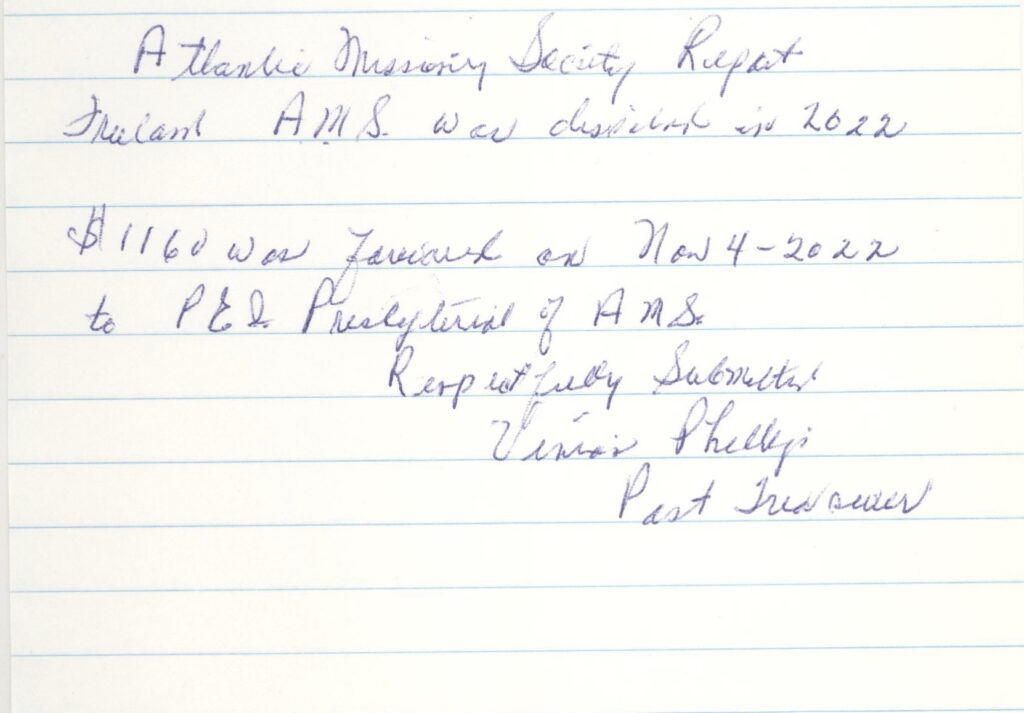
My mother has submitted her final annual financial report as treasurer of her church’s Atlantic Missionary Society group. They disbanded last year after membership dwindled to just five members all over the age of 75.
I am descended from people who came to Prince Edward Island from England and Scotland in the 18th and 19th centuries. Most of my recent ancestry is from Devon and Dorset in the south-west of England, many coming to work in shipbuilding using the plentiful lumber old-growth forest that had stood here untouched forever. My most recent British-born ancestor, GGG grandfather Robert Phillips, came to PEI from Barnstaple, Devon, in 1832 to work as a brass fitter in one the many shipyards.
My family stories extend back only a couple of generations, so I have no accounts of what those ocean crossings were like, what their first impression was of PEI, how they felt about leaving family, friends and country behind, but I have often thought about what that experience would have been like for them.
I recently did a week-long trial membership on Newspapers.com. While it seems an excellent site and probably well worth the subscription price, I didn’t sign up as I was afraid I would do nothing else but read old newspapers for the rest of my life!
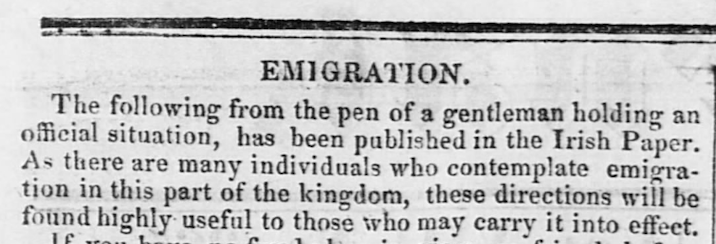
During that trial, I searched Devon newspapers from the early 1830s to see if there was any record of Robert’s departure for PEI. That search came up empty, as I had expected, but I did find a wonderful piece in the June 23, 1831 edition of The North Devon Journal and General Advertiser that gave advice to those who were thinking about moving to North America. I wonder if Robert used this article to help him plan his move, or convinced him that such an adventure could be a possibility for their family. Maybe he cut it out and carried around in his pocket.
The author wasn’t named, but they gave very specific and sound guidance, especially about the British North American climate, information that would still be pretty accurate today.
After listing practical supplies needed for the journey and setting up a new home, the author suggested the final item a young man needed to procure was “an active young wife.” As he already had a wife and five children, including two-year old twins, Robert was fine on that account!
The author outlined a plan on how to survive the ocean crossing and insisted that “by attending to these observations, I will insure you landing in good health, and better looking than when you embarked.” The idea that someone in the 1830s would be better looking after their weeks at sea than when they boarded is amusing, as it is certainly more than hinted at in the article that the living quarters on ship left much to be desired. I’m sure it was a miserable, dangerous crossing.
Young men were advised to leave their “party feeling” behind to ensure they didn’t jeopardize their chances of advancing in their new home because they had clung to old political allegiances. Knowing how party politics is deeply ingrained in the DNA of many Islanders – some families here have voted for the same party for generations – I suspect these newcomers might have left the Whigs and Tories behind, but retained the deep need to find a political home in their new country.
I visited Barnstaple 30 years ago. One evening, I walked to the River Taw and stood on a dock looking west. I thought about Robert and Mary Ann arriving with their small children, all under the age of seven, ready to board a ship into the unknown. This article goes some way in filling in the blanks in my family’s story, adding texture and depth to sterile names and dates. They are still out of reach, but I can see them over the horizon.
Emigration.
The following from the pen of a gentleman holding an official situation, has been published in the Irish Paper. As there are many individuals who contemplate emigration in this part of the kingdom, these directions will be found highly useful to those who may carry it into effect.
If you have no fixed place in view, or friends before you, if labour and farming be your object, and you have a family, bend your course to the Canadas; for there you will find the widest field for your exertions, and the greatest demand for labour.
In almost every part of the Middle States of America, you are subject to fever and ague, as also in some parts of Upper Canada. Lower Canada, New Brunswick, and Nova Scotia are exempt in this respect.
I would particularly recommend the months of April and May for going out, as you may then expect a favorable passage; on no account go in July or August, as, from the prevalence of the south-west winds, you will have a tedious passage. Make your bargain for the passage with the owner of the ship, or some well known respectable broker, or ship-master: avoid, by all means, those crimps that are generally found about the docks and quays, near where ships are taking in passengers. Be sure that the ship is going to the port you contract for, as much deception has been practised in this respect. It is important to select a well known captain, and a fast sailing ship, even at a higher rate.
When you arrive at the port you sail for, proceed immediately in the prosecution of your objects, and do not loiter about, or suffer yourself to be advised by designing people, who too often give their opinion unsolicited. If you want advice, and there is no official person at the port you may land at, go to some respectable person or Chief Magistrate, and be guided by his advice.
Let your baggage be put up in as small a compass as possible; get a strong deal chest of convenient size, let it be in the shape of a sailor’s box, broader at bottom than top, so that it will be more steady on board ship; good strong linen or sacking bags will be found very useful. Pack your oatmeal, or flour in a strong barrel, or flax-seed cask, (which you can purchase cheap in the spring of the year.) I would advise, in addition to the usual wood hoops, two iron ones on each cask, with a strong lid and good hinge, and a padlock, &c. Baskets or sacks are better adapted for potatoes than casks.
The following will be found a sufficient supply for a family of five persons for a voyage to North America, viz.— 48 stone of potatoes (if in season, say not after the Isl. of June,) 2cwt. and a-half of oatmeal† or flour, ½ cwt. biscuits; 20lbs. butter in a keg; 1 gallon of spirits; — a little vinegar; — When you contract with the captain for your passage, do not forget to insure a sufficient supply of good water. An adult will require 5 pints per day — children in proportion.
The foregoing will be found a sufficient supply for an emigrant family of five persons, for 60 or 70 days, and will cost about £5 in Ireland or Scotland; in England about 6 or £7; if the emigrant has the means, let him purchase about 11lbs. of tea, and 16lbs. of sugar for his wife.
The preceding statement contains the principle articles of food required, which may be varied as the taste and circumstances of the emigrant may best suit. In parting with your household furniture, &c. reserve a pot, a tea-kettle, frying-pan, feather-bed, (the Irish peasantry possess a feather-bed,) as much coarse linen as you can, and strong woollen stockings — all these will be found very useful on board ship, and at your settlement, and are not difficult to carry. Take your spade and reaping-hook with you, and as many mechanical tools as you can such as augurs, plaines, hammers, chissels, &c., thread, pins, needles, and a strong pair of shoes for winter. — In summer in Canada, very little clothing is required, for six months — only a coarse shirt and linen trowsers, and you will get cheap moccasins (Indian shoes;) you will also get cheap straw hats in the Canadas, which are better for summer than wool hats, and in winter you will require a fur or Scotch woollen cap. Take a little purgative medicine with you, and if you have young children a little suitable medicine for them. Keep your self clean on board ship, eat such food as you have been generally accustomed to, (but in moderation) keep no dirty clothes about your births, or filth of any kind. Keep on deck, and air your bedding daily, when the weather will permit; get up at five o’clock, and retire at eight; take a mug of salt water occasionally in the morning. — By attending to these observations, I will insure you landing in good health, and better looking than when you embarked.
From the great disparity of male over female population in the Canadas, I would advise every young farmer or labourer going out, (who can pay for the passage of two) to take an active young wife with him.
In Lower Canada, and New Brunswick, winter begins about the end of November, and the snow is seldom clear from the ground till the beginning of April. In Nova Scotia, and Prince Edward’s Island, from their insulated situation the winters are milder than in New Brunswick or Lower Canada, and in Upper Canada they are pretty similar to the back part of the State of New York.
The risk of a bad harvest or hay time is rarely felt in Lower Canada, and consequently farming is not attended with so much anxiety or labour as in the United Kingdom. The winters are cold but dry and bracing. I have seen men in the woods, in winter felling trees with their coats off, and otherwise light clothed. The summers are extremely hot, particularly July and August.
The new settler must consult the seasons in all his undertakings and leave nothing to chance, or to be done of another day. The farmers of Lower Canada are worthy of remark in these respects.
In conclusion, I beseech you, if you have any party feeling at home, if you wish to promote your own prosperity, or that of your family, wash your hands clear of it ere you embark. Such characters are looked upon with suspicion in the Colonies; and you could not possibly take with you a worse recommendation.
Prices of living, house rent, labour, &c. in the principal towns of Canada, with the expense of travelling on the great leading routes — In Quebec and Montreal, excellent board and lodging in the principle hotels and boarding houses, 20s. to 30s. per week. Second-rate ditto from 15s. to 20s. per week. Board and lodging for a mechanic or labourer 7s. to 9s. 6d. per week, for which he will get tea, coffee, with meat for breakfast, a good dinner, and supper at night.
• If potatoes are out of season for keeping, increase the quantity of oatmeal.
If the Emigrant has any oatmeal to spare, it will sell for more than prime cost.
From The North Devon Journal and General Advertiser – Thursday, June 23, 1831
I live in a rural area where fishing and farming are still major economic activities, so when the cold and snow of winter turns to the warmth and mud of spring, our community comes alive.
Dories on trailers sit in yards waiting for the ice to move out of the coves and bays so oyster fishers can resume their work. Large lobster boats, perched on their huge stands, are being cleaned and stocked, engines and pumps tested, so they will be ready for the boat hauler to back in, hoist them up on their trailer, and carry them to the local wharf for the start of the lobster fishing season in May.
Snow blowers are removed from farm tractors, and scrapers installed to smooth muddy, rutted lanes. Manure that piled up next to barns all winter has been hauled and spread on fields that remain frozen in the mornings. It’s a bit too early and the ground too soft to plow most fields, and way to early to plant grain or potatoes, but supplies are being readied.
A friend and I walked a back road near her house this afternoon, and saw pickup trucks stopped on bridges, people looking over the railings to gauge how ready brooks or streams will be for the start of angling season in a couple of days. Birds are returning: robins, red-winged blackbirds, ducks, grackles, and Canada geese flying north. Crows fly by with sticks in their beaks for their nests.
As we walked, we waved at every vehicle that passed. Some we knew, some we didn’t, some we weren’t sure, but we waved anyway because that’s what you do here. To not wave would seem unneighbourly and cold. We waved at the school bus driver, who we do know, twice because he dropped off some children and returned the same way. And everyone waved back.
While I was driving home from my walk, I passed some cousins of mine standing next to – you guessed it – a boat in their yard. They waved, and I saw in them at that moment their father and grandfather and great grandfather, the same turn of the head and looks and smiles. The strong genetic connection between us strengthened and solidified by hundreds of interactions, some involving meals or parties or conversations, but many just waves from yards at passing cars.
We wave as we drive as well. If you are holding your steering wheel with your hands at the 10 and 2 o’clock positions, as everyone was taught long ago (air bags make that unwise now), when you meet a vehicle driven by someone you know, you flick your right hand up, usually just the index and middle finger, in greeting. Sometimes you will wave your whole hand, maybe at someone you were just speaking to on the phone and happen to pass on the road, an acknowledgement of how funny it is that you were just talking and now, look at us, zooming down the road!
I have a cousin (it’s always a cousin with me, as I have dozens of them around here) who I always suspected waved at every car he met, whether he knew the driver or not. I never dared to ask him, because he would have probably thought it an odd thing for me to notice, or the question might have made him self conscious. I confirmed he does wave at everyone when I was driving home for the first time in my present car, with its unusual blue colour that can’t really be mistaken for any other car around here. I met said cousin in his truck and he waved, and I’m pretty sure he didn’t know it was me. He’s just a super waver.
I realise that there is a limit to where I wave. I wave at most everyone within a five kilometre radius of our house, and that can occasionally extend as far as the village of Tyne Valley 16 kilometres away if I meet someone on the road I’m sure I know. No one taught me to do all this waving. It is just the way it is.
Yesterday I finally caught up on my scrapbooks after having fallen behind during the pandemic. These are not the tasteful, fancy, currated scrapbooks of this century, but the newsprint and pot-of-glue ones from the last. It’s a habit I inherited from my mother, and from older neighbours, especially the man who lived across the road from us who had a beautiful, matching set of meticulously maintained scrapbooks that contained newspaper clippings of interest about his family and our community.
What do I save? Newspaper clippings, of course. Obituaries. Ticket stubs. Funny cartoons. Notes. Shopping lists. Articles about friends and family. Bits and pieces of paper I find shoved in books or the bottom of a box. I have a set of scrapbooks about Stewart Memorial Hospital that I started when I joined the hospital auxiliary in 2003; this series will soon be completed as the hospital was closed nearly 10 years ago and the building slated for demolition. I will turn the page.
I also find and save bits and pieces online I mean to write about here, but then digitally tuck away and forget about. Here’s one I just found about a monument to an agricultural pest:
From the Guardian December 28, 1921, page 3
I wrote here recently that I don’t have many regrets in life, but that’s not to say that I wouldn’t do some things differently if I had the chance. I guess what I really mean is that I’m fine with the way things have turned out in life. Peaceful. Grateful.
I also know there is no guarantee that making different choices would have meant my life would have turned out to be better, so looking back with curiosity rather than condemnation is probably for the best.
Oprah Winfrey popularized gratitude journals, which were heartily adopted by millions of her fans and ridiculed by those who saw it as just more New-Age fluff. The thing that Winfrey knew is that finding something to be grateful for each day is like anything else you practice or adopt as a good habit: if you do it when it’s easy, you will likely be able to do it when it is difficult.
Could I build a monument out of “profound appreciation” to my disasters and failures? Probably not immediately after they happened, as the citizens of Enterprise, Alabama did, but in a way I have, by becoming resilient, adaptable and even occasionally fearless. Things knocked me off whatever course I thought I had set for myself, but I righted and sailed on to arrive here, and here is good.
I thought I saw it all during my time as a theatre usher, but the story in today’s Guardian about a performance of The Bodyguard musical being halted after audience members refused to stop singing tops every one I have. It certainly never happened at the musical playing when I worked at Theatre Royal Drury Lane in London, nor at Roy Thomson Hall in Toronto. Most of the shows I worked at RTH were Toronto Symphony Orchestra shows and those audiences were incredibly polite and restrained; the worst thing that can happen at a symphony concert is someone clapping between movements!
Roy Thomson Hall was also rented to other artists. Nusrat Fateh Ali Khan performed a fantastic and very long show for an excited and enthusiastic audience. As part of showing their appreciation for him and his music, audience members would make their way to the stage, dance, and toss money at Khan and his musicians. There were probably people singing along, too, but that was expected in this tradition.
I was stationed in one of the upper levels of the hall for the Khan show, enjoying this joyous event, when suddenly a man jumped up from his seat, overwhelmed by both the experience and probably a bit too much to drink, and started down the stairs to the front of my section, seemingly intent on jumping down to the main floor to give money to Khan. His poor wife was crying and pulling on him to stop, and a couple of us ran as fast as we could to intervene. Luckily some men grabbed him as he reached the bottom of the stairs and was getting ready to hoist himself over the railing, and someone helped him find safer passage to the stage.
There was also the evening when some Hong Kong-based pop stars performed to a full house. The audience wasn’t memorable, but it was one of the young singers who caused quite a fuss. He had been a tennis player at one time, and part of his schtick was throwing tennis balls into the audience. He didn’t just gently toss them into the first few rows, but instead lobbed them off the walls of the theatre! Most of the walls at RTH were cement at that time and the balls bounced wildly, bonking people who couldn’t follow the path of the projectiles. The management were livid, but thankfully he didn’t throw too many and no one was seriously injured.
There were always a few difficult patrons, people who weren’t happy with their seats or didn’t like the show, but most audiences were unremarkable and blur together. One audience, though, was unforgettably rude and unpleasant, and it might surprise you to find out who they were.
One December evening in the early 1990s, a religious organization held a Christmas song service for their Toronto region members. There was a delay in getting the stage set, so we couldn’t let the audience in on time, something totally out of front of house control. In my section, questions turned into huffing and puffing and heavy sighing when I denied people entry, promising them it would open soon and they wouldn’t miss anything because actually nothing was happening inside the theatre. People ripped programs out of my hands, others asked to speak to a manager, annoyance and anger tensely buzzing in the air.
After everyone was finally seated and the carol service had started, I went down to the main floor to join other ushers in preparing for intermission and everyone had the same wide-eyed look and similar stories: rudeness, people pushing past, sneering, threats. Some had worked at RTH for years and had never had an evening like it. None of us could believe that this particular group would have been so awful, and the fact that most of the Salvation Army members had been in uniform added a whole other level of strangeness to the evening. I went on to another job where I had dealings with Salvation Army groups and I can’t say anyone ever changed my first impression of them!
The hallways and rooms of Stewart Memorial Hospital in Tyne Valley had been decorated with paintings and photographs donated by community members. When the provincial government shut down hospital services in June 2013 and turned the building into a long term care facility, the mysterious figures who pull the levers from hidden corners of Health PEI deemed that anything in the building that wasn’t generic had to be removed.
You probably think I’m being dramatic, but I’m not. Down came the paintings that showed rustic local barns and familiar vistas, only to be replaced by made-in-China blandness. The reasoning? It was some vague idea that the facility was the residents’ home and…well, honestly, I never understood it. The place ended up looking like a forgotten corner of an airport lounge.
I documented all the original artwork in the hospital before it was removed, and they are in this Flickr album.
Most of the hospital rooms had been sponsored by groups or families, and all the plaques by the doors acknowledging these contributions had to come down. Photos of past staff, items donated to thank staff, all dismantled. The place had to look like everywhere and nowhere. You can guess I wasn’t a big fan of this move to strip away the long community history of this building.
A new building was built a few years later and now the old hospital building that has stood on a Tyne Valley hill since 1951 will be demolished. What was left in the old building has to be removed.
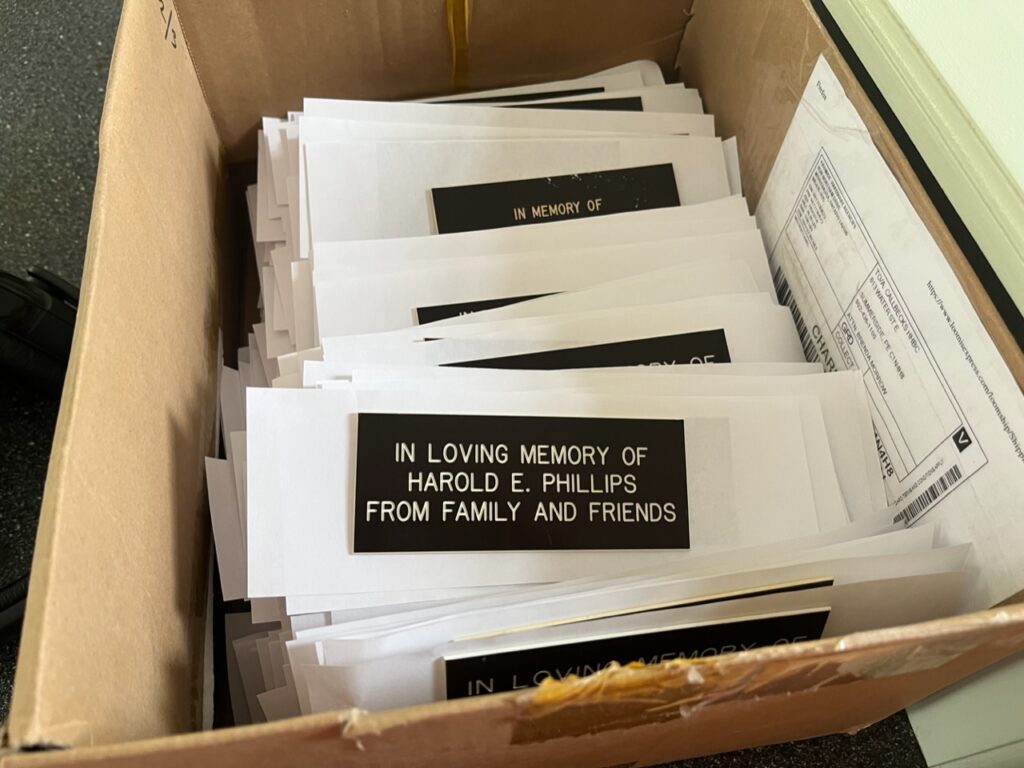
I received a call to see if our SMH Foundation wanted some memorial plaques. When someone died, and donations were made to the Foundation in their memory, a small plaque would be put up in a beautiful display case that was very visible in a hospital hallway. We had so many donations over the years that we had to build another case to house them all. Of course, as had happened with the artwork, when hospital services were discontinued, the cases had to be moved to an unused ambulance bay, and with them the memory of a community that had cared enough to support the hospital.
So, my mother and I went to pick up the box of plaques at the new long term care facility, which is a beautiful building appropriately devoid of much local character. I picked up the little box of plaques and carried it back to my car. It felt like a funeral and I was carrying the ashes of all that we had worked so hard to maintain.
I put the box on a table when I got home, but didn’t feel up to going through the plaques. The next day, I decided to have a look, and near the top was the plaque with my father’s name from when he died at Stewart Memorial in 2008 after having resided there for a couple of years. I flipped through a couple more names and started to cry. I knew them all, related to many.
The loss of our hospital still stings, and I think it always will. Soon the building will be gone, and younger people will never really know what we had and what we lost. They can knock the place down, but I will never stop talking about it, the remarkable achievement of building and maintaining a small rural hospital for over six decades.
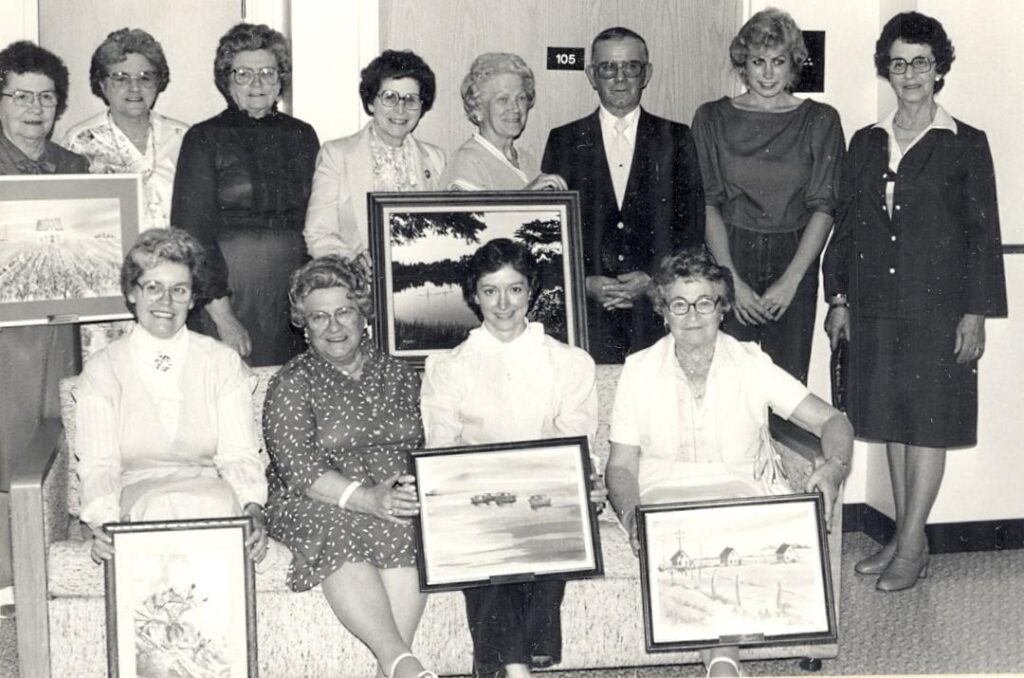
Some of the artists who donated their artwork to the new wing of Stewart Memorial Hospital in 1983.
Our provincial election, called six months early of the October fixed election date, limped to a close yesterday. We had the lowest voter turnout in my lifetime, just under 70%, which would be seen as a great result in other jurisdictions but is considered pretty dismal here. The Progressive Conservative party strengthened their majority, and the Green party lost their official opposition status to the Liberals. No NDP candidates were elected.
Here are my tepid election takes:
I knew nothing about the NDP leader, Michelle Neill, before the election, but thought she was extremely relatable and well prepared for the televised leaders’ debate. Her concession speech last night was sincere, positive and classy. I hope she sticks around. Only the NDP and PCs fielded a full slate of candidates, and I’m sure her presence will help build the party over the next four years.
There was much consternation on Twitter about why the MLA for my riding, Ernie Hudson, was reelected. He has been the Minster of Health and Wellness for the past couple of years, a time of extreme stress on our health care system. #PEIpoli folks couldn’t understand how anyone would vote for him as everyone seems to think he has done a terrible job in the health portfolio, but I challenge anyone to name one PEI health minster who has ever been well liked or thought to be doing a good job. I can’t think of one, and I’ve met them all in the past 20 years of fighting for access to health care for our area. It’s a cursed position, and I think given to people with very thick skin or someone the premier dislikes. Our health system should be run by those hired to do so, and the politicians made to keep their unskilled hands out of it, but the meddling continues and health ministers rightly pilloried. The people in Hudson’s riding are afraid their small hospital in Alberton will be eliminated, so voting for the candidate from the party almost guaranteed to form government only made sense. He’s a good constituency politician, having worked as a political aide before running himself, and he’s a nice guy to boot.
Left-leaning votes keep splitting between the NDP and Greens, and I wish the two parties would work together. I would like to see proportional representation finally come to PEI, and a temporary Green/NDP alliance might make that happen. Both parties have difficulty finding strong candidates, and we desperately need more progressive voices in the legislature. I doubt if there would be much support for this idea in the two parties, but politics is a game, with teams and players and colours and logos, and the old parties play it very well. To win you have to think and move strategically, and use what resources you have to your advantage.
I imagine many people in urban PEI don’t realise there are still patronage jobs being handed out in rural parts of the province, thinking that practice died out with the Ghiz government. It did, for the most part, but there are still some seasonal jobs that are “influenced” by MLAs. They expect your loyalty (ie. vote) in return for your job, and if you don’t show up to the polls in a timely manner, you will be reminded and a car will be dispatched to give you a ride to the polls. Politicians will deny this, of course. At least there isn’t someone standing outside the polls with bottles of rum and $20 bills as in the misty days of yore (or maybe there are, but no one offers them to me!)
Health care, lack of affordable housing and the high cost of living were the main election issues, while the climate crisis barely got a mention. I understand those who are living in poverty and struggling to make ends meet might not have the climate at the top of their list, but there are many on this island who are doing alright, and don’t seem at all concerned that their children and grandchildren will be inheriting a world that will be challenging at best and unlivable at worst. It is a disconnect I will never understand.
Found water sitting at the bottom of the boot of our 2002 Maytag Neptune front load washer this morning. This has happened before when I had barn clothes to wash during my milkmaid career and straw would make its way into the drain.
It’s an easy fix on our machine: undo the two screws that hold the door and two on the other side, and then remove the front panel. Inside you’ll find a cute little drain held on by two spring clamps.
Using pliers, or your fingers if you are strong, undo the clamps and remove the drain. I usually slide the clamps onto the drain so I don’t lose them!
Inside the top of the drain I found a little piece of plastic. Once that was removed, I put the drain in the sink and ran some water through it, which dislodged some disgusting slime. Yuck.
A little troublemaker
I put the drain back on, reinstalled the clamp and poured a little water into the boot to ensure I had the clamps snugly attached. Front panel and door reinstalled, a five minute fix!
What began this afternoon as a quick confirmation of a name turned into a startling and slightly overwhelming discovery, one that still has me feeling a bit stunned.
I was looking up Kay Jelley, my mother’s lifelong friend and former childhood neighbour in Freeland. I knew Kay had been interviewed by historian Dutch Thompson as she is often included in his regular CBC PEI radio pieces. While looking her up on the Island Voices website, which has some of Thompson’s interviews, I decided to put “Freeland” into the search box and see who else might be there, and a few other interviews popped up.
The last result was not recorded by Thompson but by someone from the Benevolent Irish Society, who seemed to have travelled around PEI in the 1980s recording the descendants of Irish immigrants. It was an interview with Kevin and Margaret Kilbride, our neighbours here in Foxley River. Kevin died just over a decade ago, but Margaret has been gone since 1991.
Never in my wildest dreams did I ever think I would hear her voice again.
Margaret was unique, funny, smart, lovable. She was a registered nurse, and had been a lieutenant in the Royal Canadian Army Medical Corps in the Second World War stationed in France and Belgium. She was the head nurse at our little Stewart Memorial Hospital in Tyne Valley, and while full of fun, people who had worked with her have told me she could also be quite exacting. She was a smart dresser, and always drove a snazzy car.
Margaret at a Stewart Memorial Health Centre staff outing…not sure where or when, but likely 1960s or early 70s by the look of that outfit and car!
Kevin, on the other hand, was exactly how I imagine Matthew Cuthbert from Anne of Green Gables to be: quiet and soft spoken, wise and kind. Their house, a classic PEI farmhouse that had been built by his grandfather in the 1890s, even looked a bit like Green Gables. Where she favoured tailored pantsuits when she wasn’t in her crisp nursing whites, Kevin was almost always in his overalls when at home, working in the barn or yard.
The interview is probably not particularly interesting to someone outside our community, and some of it unfortunately doesn’t age well, but to be able to hear them again, in their 60s and 70s, still vital, the way they interact, mentioning names I had forgotten, has been a delight. Margaret’s distinct way of speaking. Kevin’s thoughtful pauses. And the background noises: a small plane flying over (I might have been out in our yard across the river waving at it!), cows mooing, a crow calling, Margaret lighting a cigarette.
I was a like a moth to a flame when it came to Margaret. I was fascinated by her, as she was unlike any other woman I knew, outspoken and bubbly in a way that wasn’t the norm. She visited our house often when I was a child, usually on her way home from work at the hospital. She was a great friend to my mother, and a wonderful medical resource as I rolled through childhood illnesses and incidents. Margaret would always know what to do, and she would dispense sound advice with a laugh and a big hug. I have a couple of bottles with her distinctive hand writing on them, creams and lotions to sooth some long-forgotten condition. When I went through a brief anxious period as a child when I imagined my heart was stopping, she gave me a stethoscope and helped me understand how the heart worked in rest and action.
One summer day when I was five, I saw Margaret’s car pull into their yard from the front lawn of our cottage. I somehow got our little dingy into the water and rowed across the river, clambered up the bank, and knocked on their door to say hello. I wasn’t supposed to have taken the boat by myself, and Margaret knew it. She called my mother right away to tell her where I was – Hi, Viv, guess who I have here?! (the only person to ever give my mother a nickname) – and then we had a great visit, she with a cup of milky, sugary tea and her ever-present cigarette, and me with a glass of milk, probably from Kevin’s cows, and a few molasses cookies. I have no idea what we talked about, but I am sure we had fun. Then we hopped in her car and she drove me home, the boat later retrieved by my father.
The Kilbride House as seen from our lawn one summer morning in 1968
I fell and split my forehead open at my boisterous seventh birthday party, and although my great-aunt Lois was at the party, and she had nursed in New York City for forty years, it was Margaret I asked for as I sobbed, blood running down my face, and she quickly came from across the river to assess me and send me to the hospital for stitches. The party continued as I was sewn up, and I came back looking like Frankenstein’s monster, making it a party to remember!
I am lucky to have few regrets in life, but not having been more attentive to Margaret in her later years is one of them. I didn’t visit her when I would return home from university, expecting her to be around forever, I suppose, and after she died, I soon realised what I had lost. It has always bothered me.
I feel like I got a tiny message from Margaret today that it was all ok, and if I close my eyes, I am still in her kitchen having a cookie and a chat. Nostalgia is the child of memory and imagination, a potent salve for psychic wounds.
Margaret and me in her kitchen, 1967. You’ll notice Margaret is missing a finger on her right hand, and I understood this happened during her war service.