The title of this notice in the January issue of The Buzz, PEI’s arts and culture magazine, caught my eye:
Meet and squeak? Yes, please!
I played the trumpet in concert and jazz bands throughout junior high and high school, as well as a marching band for a few summers, and the pinnacle of my six-year career was playing for a couple of seasons with the PEI Symphony. I completely stopped playing trumpet when I went to university, and though I continued to play the guitar and a bit of piano, my music making has waned in the past few years.
My silver Stradivarius Bach trumpet sat mostly untouched in our basement for four decades until this past summer, when I saw it on a shelf and wondered if I could still play it. I gave it a good cleaning and oiling, pulled out some music, and it turned out I could still play, and with some regular practice, my range, tone and endurance improved.
Practicing on my own is fine, but the real fun is playing with others; I wasn’t sure that would be possible where I live, so the idea of a new community band is exciting. My caregiving duties make committing to joining a band 45 kilometres from my house probably impractical, but I’m determined to at least make that inaugural meeting just to have the chance to squeak along with other former band nerds.
Our internet connection was upgraded from dial-up to 1.5 Mbps at the very end of 2009, and we could finally stream audio and video. I immediately moved my radio listening habit from CBC to BBC, mostly Radio 4 and Radio 2.
I was doing the dishes at the kitchen sink one night in January 2010, listening to a BBC Radio 2 music show. The host was reading out messages from listeners across the UK, and it was thrilling magic to be able to hear this live from so far away.
I looked at the window in front of me, my own reflection staring back in the black window, blurry in the steamed-up window. There are no outside lights or houses close enough to see, so at night there is only inky darkness beyond.
For a few seconds, I was the me who had stayed in England, who never returned to Canada after I lived in London for a while in the mid-1980s. That version of me wasn’t any clearer than that, just as murky and dark as the view out that nighttime window, but she was there, somewhere in England, doing the dishes, listening to the BBC. And then she was gone, and I was where I was.
It wasn’t a sad or happy feeling, more a neutral “hello, you” acknowledgment of the choice I had made to return to Canada, the alternative path I hadn’t taken. I went on to move many more times around Canada, making new friends, living new lives, looking out new windows, until now finding myself back exactly where I started.
The “what if” game is almost always a dangerous and pointless pursuit, and I used to do it a lot. If I edge toward it now, I try to look back and see my younger self moving through the world, equipped only with the information I had at the time, and marvel that I made as many good decisions as I did. I have become kinder to past me than I used to be, and that is freeing.
Forgiveness is giving up all hope of a better past.
(Origin of quote unclear, and attributed to nearly everyone on the internet.)
I’m a couple of weeks late marking the 50th wedding anniversary of Tom Connors and Lena Welsh, and not even sure now how that milestone came into my mind. Tom was a singer/songwriter known as Stompin’ Tom. He was born in Saint John, New Brunswick and adopted by a couple who lived in Skinner’s Pond, PEI, where there is now an interpretive centre to showcase his musical talents and life. Tom died in 2013, but Lena is still alive, as far as I know.
He wrote and sang, in the classic country and western style, about working people and places he visited while criss-crossing Canada numerous times. Every Prince Edward Islander who attended elementary school in the 1970s and 80s probably sang in choir and can still remember every word to the song of his that is most connected with PEI: “Bud the Spud”.
Why do I remember when he got married? Because we watched it on television in school. I was in second grade, and we sat on the floor, gathered around what was probably a black and white television, on Friday, November 2 to watch Tom and Lena get married on the CBC Television program Elwood Glover’s Luncheon Date. I don’t remember Glover, and only have dim memories of watching the wedding, but I knew it was a Big Deal because television was still viewed as slightly unedifying in 1973, Sesame Street be damned, and wasn’t used in our primary education, with only a few exceptions.
Original Toronto Star caption: Happiest moment of my life, says Stompin’ Tom Connors as he weds Lena Welsh, 26, Magdalen Islands barmaid, on Elwood Glover’s TV show, Luncheon Date, today. Here, Glover, left, congratulates bride and groom after an estimated 2 million viewers tuned in on the formal, 12-minute ceremony. The 36-year-old folk singer is from Skinner’s Pond, P.E.I. Wedding was a first for TV in Canada. (From Toronto Public Library Digital Archive. Copyright Toronto Star, photographer Frank Lennon.)
When you are seven years old, experiencing things for the first time is commonplace, so I had no idea that famous people didn’t get married on television all the time. The only other non-royal person who had their wedding televised, that I can think of, was Tiny Tim and Miss Vicki, but I was only three when that occurred, we wouldn’t have received the US station it was broadcast on, and Tiny Tim terrified me, so I would have avoided it: if you want me to give up state secrets, just play him singing “Tiptoe Through The Tulips” and I’ll tell you everything.
Stompin’ Tom possibly wasn’t everyone’s cup of tea, but Islanders LOVED him to bits. When Queen Elizabeth and Prince Philip visited PEI in the summer of 1973 to mark the 100th anniversary of our province joining Canada, a concert was held in Charlottetown to mark the auspicious occasion. Family friends were visiting us from Toronto, and one of our guests was a woman who had recently moved to Canada and had grown up in a unionist household in Northern Ireland. She loved the Queen, and was thrilled we would be able to watch the concert live on television.
I don’t remember watching this show, but the family lore is that the broadcast began with the usual pomp that accompanies the arrival of a royal. The audience, in all their Charlottetown finery, politely applauded to welcome the royal couple. There were speeches, and I would bet Anne of Green Gables made an appearance. Our Irish friend watched with great interest.
And then Stompin’ Tom took to the stage with his guitar, undoubtably in his trademark black outfit and cowboy hat. Don’t know what he sang, but it would have been something twangy and foot stompin’. The crowd, who had given the royal couple a suitably dignified and muted welcome, erupted into hoots and hollers and thunderous applause for this tall skinny fellow who looked like a bad guy from a Hollywood western. Our friend couldn’t understand how he could get a bigger reaction from the audience than the queen did, and my mother said she watched the rest of the broadcast with a slightly bristly reserve.
I met Tom once backstage at the famed Toronto music venue, Massey Hall. The Stompin’ part of his stage name came from his habit of stomping his left foot so hard he would make a hole in the stage, to the displeasure of venue owners, so he started using a small piece of plywood to stomp upon, holding it up at the end of the performance to let the particles he dislodged with his heel drift to the stage.
At some point he started auctioning off the boards for charity. In September 1999, he decided the Daily Bread Food Bank would get the money from the board auction at his Massey Hall concert and although I wasn’t the PR person for our organization, I was the token PE Islander on the staff (an exotic creature!) and given the opportunity to attend the show and accept the donation.
It was fantastic to finally see Tom live and even more wonderful to be in an audience of true fans, many of whom were also originally from Atlantic Canada. We sang along, and cried with him as he became overcome with emotion while singing “Confederation Bridge” and couldn’t continue the song: “And it’s calling, calling me over, the blue water’s rolling and soon I’ll be strolling out there. Down by the ocean, where the Island devotion to friendship is found everywhere.”
Illegal and very poor quality flash photography by me (a former theatre usher and stage manager who knew better), Massey Hall, Toronto, September 18, 1999. I swear that’s Tom.
The board auction was held during the show, and the winner was able to meet Tom after the show to get his board signed, and I was present to arrange to get the money, a very generous $5,000. I first met Lena, who was lovely when I told her I was from PEI (she’d likely met everyone from PEI by that point), an elegant, quiet lady. Then Tom came into the green room, bigger than life, holding a beer in one hand and a cigarette in another, greeting each person one by one.
When it was my turn to speak to Tom, I thanked him for supporting DBFB and then told him my father often spoke of the night sometime in the 1960s at our local community festival when the organizers heard that Tom was in the audience. My father, acting as emcee for the evening, asked Tom up on stage to sing a few songs, which he agreed to do. The roof nearly came off the rink with the audience response, and as he headed out into the night, they gave him a big feed of cooked lobsters. He slapped me on the back and said he remembered that night, though I wonder if he really did.
Hugh Gillis, the man who bought the board that night at Massey Hall, drove to PEI four years ago to donate it and two others he bought over the years to the Stompin’ Tom Centre. He apparently has no connection to PEI, even though he has a classic Island name, but just seems to be a wonderfully generous man.
The other reason I remember September 18, 1999 was that when I got home from the concert, there was a message on my telephone answering machine from a fellow I had met at a birthday party the week before, asking if I wanted to go out on a date some time. I did, and we did, and now we are married, like Lena and Tom.
Stompin’ Tom celebrates the $5,000 his Stompin’ Board Auction bought for Daily Bread Food Bank from bidder Hugh Gillis. Here Hugh (on left) and a friend enjoy a laugh with Tom. Taken backstage at the Stompin’ Tom Connors “Meet and Greet” after his show at Massey Hall in Toronto on September 18, 1999. (Photographer: Barry Roden – Credit: Library and Archives Canada)
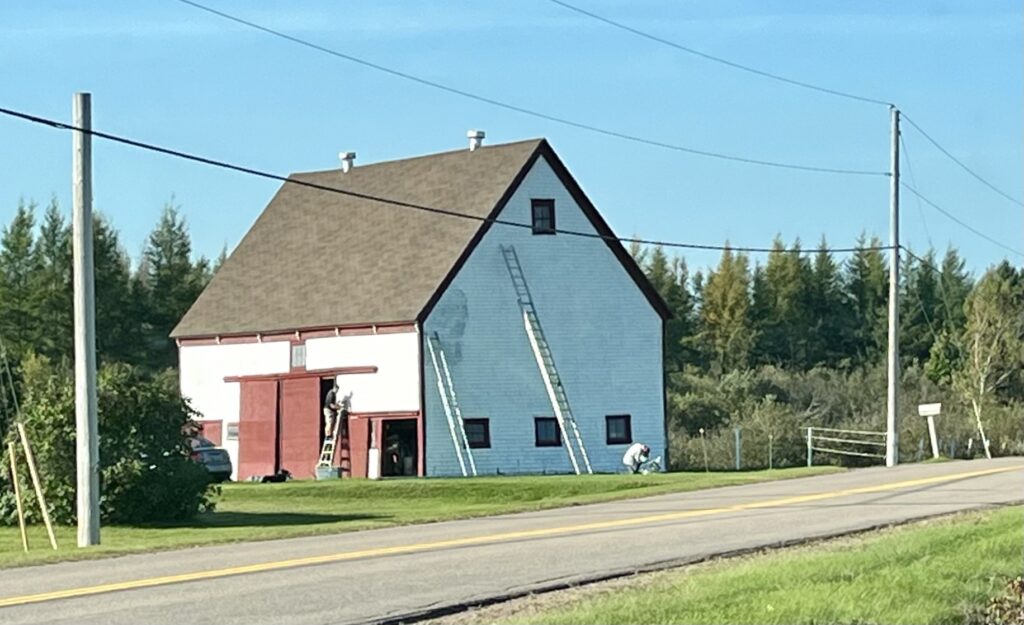
I happened upon an historic moment while driving home the other day: the painting of the Williams barn in Poplar Grove. Built around 1865, it is certainly one of the oldest barns in our area, if not the province. It was built by my great-great grandfather, Robert Williams, and is owned by his great-grandson Robert, known as Robbie. Robbie and his wife, Sandra, have taken loving care of both the original house and the barn.
While the survival of the barn is notable, the fact that it is still being used for more or less the same purpose as when it was constructed is a miracle. Robbie has harness racing horses, at least two at present, and also keeps chickens, and it is almost certain old Robert would have had both types of animals as well, and probably also a cow and pig. Many old barns and outbuildings are no longer used for animal husbandry, so it is lovely to see the barn still proudly fulfilling its original purpose, and it shines now with the new coat of paint.
Perhaps I should have stopped closer to the barn to take the photo, but I like the idea of seeing this from afar, through time. Take away the light poles, wires and pavement and you could almost imagine this was 100 years ago.
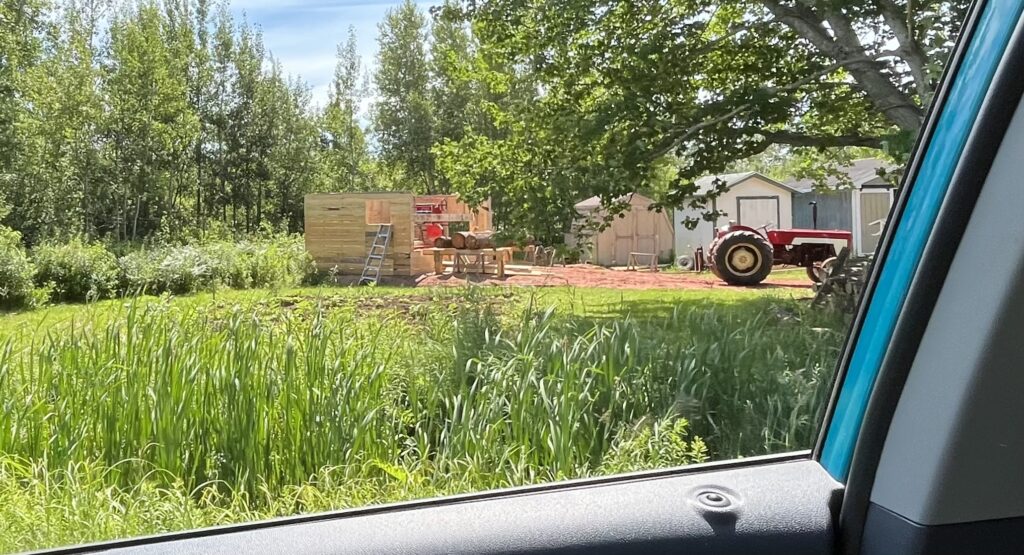
Another recent project in the area caught my eye a couple of years ago, and led to another from-the-car photo. An industrious man who lives not far from us builds small hip-roofed baby barns to sell, and nearly always has one on the go in his front yard. In 2022, I noticed a concrete pad had been poured near his vegetable garden and wondered what he was going to build. A portable saw mill arrived and was placed on the pad a few weeks later, and soon he began sawing logs into lumber.
A mill is better preserved and more useable under cover, so how do you build a building for a sawmill? You saw the logs yourself, of course, and build it around the mill.
The building soon had a roof, an opening at the front to roll the logs through from the stand you see in the photo, and a door for the operator to use. The baby barns are now being built using some of his own lumber, in the old way. The family sadly had a fire in their house and have been under reconstruction for the past year, so no doubt the sawmill has come in very handy for that project as well.
When did people start carrying cups of coffee around with them all the time? I can’t remember, though I know it happened in my lifetime. It certainly wasn’t something my parents did. I started drinking coffee in my early twenties, so in the late-1980s, but don’t remember walking around carrying a coffee cup everywhere, and never really got in the habit of doing so.
I’ve thought about this a lot: when did we go from being people who drank coffee at home, and in coffee shops or restaurants, to people who move through the world tethered to coffee shops like Tarzan swung through the jungle, swinging from shop to shop? Visiting Tim Horton’s has become a quasi-religious act in Canada, the doughnut and double-double the Eucharist. Father, son and honey crueller. If you don’t drink Timmie’s and watch hockey, are you really Canadian?
In the “Things Have Change But I Can’t Remember When” category is the impression I have that the Christmas season starts earlier and earlier each year. I think that when I was a child, people were sensible and talk of Christmas only started on December 1, but I realise that’s probably a false memory, or wishful thinking that we could revert to living only in the season we are in: enjoying the present, not anticipating the presents!
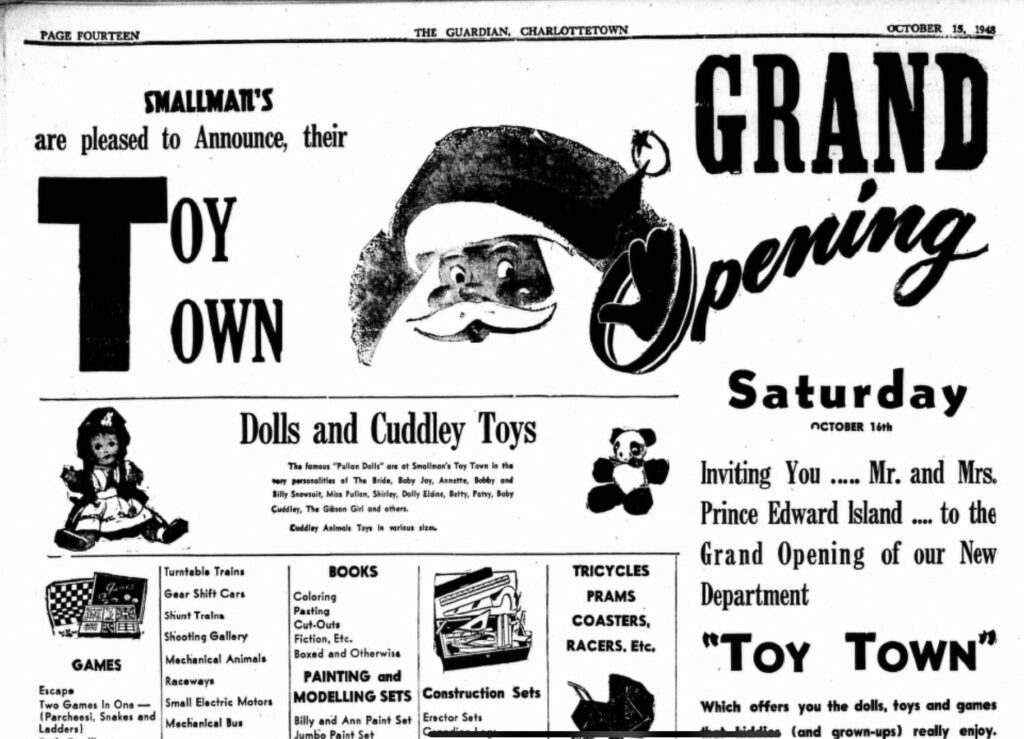
Proof of my false memory is found in an October 15, 1948 ad heralding the opening of Toy Town at the Summerside department store, Smallman’s. They couldn’t resist sticking Santa on there, his happy grin silently but powerfully sanctioning the quality of the store’s offerings.
Smallman’s was still in business when I was a child. We shopped mostly at their larger rival, Holman’s, just down Water Street, but sometimes we ventured into Smallman’s for sales or to visit their lunch counter. My father had worked in their warehouse before the Second World War when it was called Sinclair and Stewarts, so he especially liked going back.
Their main floor was one huge room, with office windows overlooking the sales floor. When you wanted to purchase something, a handwritten bill of sale was created, you gave the sales clerk your money, and a copy of the bill, along with your cash, was put into a small box that was put on a little railway-type system that took the money up to the cash office. Any change required was put back into the box, along with a receipt marked paid, and it clattered back down to the clerk. The fun of watching the little boxes zipping up pillars and along the ceiling was endlessly fascinating, really the best part of going there.
My 2020 Chevrolet Bolt EV was part of an August 2021 recall by General Motors to address battery fires. I waited patiently for my new battery only for GM to announce in June 2023 they were ending the battery replacements and would instead be installing enhanced monitoring software in vehicles that hadn’t yet had the replacement completed.
I’d heard George Iny from the Automobile Protection Association on the local CBC Radio noontime show many times, so I wrote to the APA after hearing about the change in recall and was surprised to have a response from Iny himself, who asked if he could use my email as part of an article on the subject, which I said would be fine. I sort of forgot about that part of our exchange until I did a search tonight for the latest information on the recall and found the email (attributed to T.B., cough cough) as the basis of a MoneySense article.
One thing I thought of after I emailed the APA was the potential hit in resale value I could incur. There seems to have been no rhyme or reason as to which cars did or didn’t get the battery replacement, so other 2020 Bolt EV owners did get the new battery and the 8-year warranty that came with it, while I get nothing but software. When it comes time to sell or trade my car, I would expect it to be worth less than a 2020 that had the new battery and warranty, and there will be no compensation from GM for that loss.
I’ve gone from being impressed by GM promising to look after all their Bolt EV customers to being pretty sour. I had only owned one other GM product in my life: an ancient quarter ton pickup I bought from my car-dealer cousin, Warren, to use while our house was being built, handy to pick up supplies for the carpenters and keep construction moving forward, but in constant need of repair so a short-lived possession. Unless GM have a change of heart (which would mean they would have to first acquire a heart), I can’t imagine I will ever buy a General Motors product again. I’m sure Mary Barra won’t be losing sleep over that, though, because I’m old and like to keep cars for a long time, so probably another couple of cars will see me out.
I still like the Bolt EV, think it is well built and have enjoyed driving it, but GM’s absolute disregard for customers stinks like the tailpipe of their stupid Hummers.
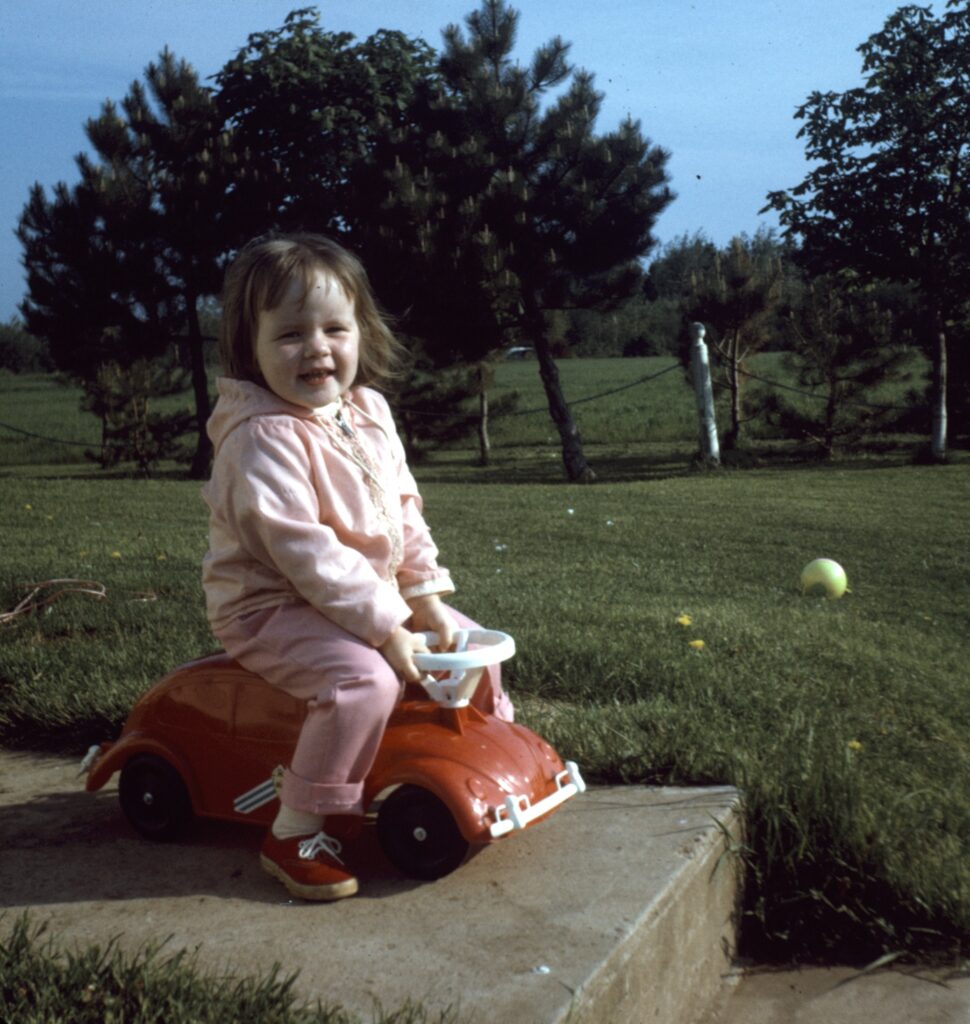
Me driving my first zero-emission car, a gift from one of the toy salesman who used to visit to my parents’ general store, 1969. I assume someone stopped me from driving off the step, or was this the inspiration for the final scene in Thelma and Louise?
I had the pleasure of attending a presentation this morning on the progress of a written history of the village of Tyne Valley. My friend Carolyn McKillop, who grew up in Tyne Valley, has been doing research for years, and has amassed a jaw-dropping collection of photographs and information. It was a nerdy delight to see her incredibly well-organized records.
She has joined forces with Gary MacDougall, another Tyne Valley native and former editor of The Guardian, Charlottetown’s daily newspaper. The meeting was as well organized as Carolyn’s research, and both of them gave an excellent overview on what they have accomplished.
Item Five on the agenda, “Dreaming of time”, had Gary’s name next to it. He said he had been thinking a lot about time recently, perhaps because he is getting older. He admitted what he was going to say might sound a bit “out there”, but he went on anyway, as he was amongst family and friends, and said he feels that the people and events from the past are still here with us somehow. He called it the Cosmic Filing Cabinet, how the memories and events of the past are just filed away, waiting there for us to discover them. In the midst of a meeting of the practicalities of creating a community history, he offered a short, beautifully poetic aside about trying to understand his place in time.
Now, Gary is my second cousin, so perhaps there is some genetic resonance at play here, but I’ve also been thinking about time a lot as well, and in a similar way. I find myself time travelling, almost forgetting that those I love who are no longer physically here actually are. I’m not seeing ghosts, nor am I lost or having delusions (I hope!). Time is bending, and I find myself pulled from it, suspended and observing it, and then dropping back down into the stream of time.
It started one winter night a couple of years ago while I was driving home from another meeting in Tyne Valley, as it happens. Warm light was glowing through house windows, and it struck me that the light I was seeing was more or less the same kind of light I would have seen 50 years ago when I was a child being driven along the same road. The houses had memories, were doing the same things as they always had, looked the same way. Different people inside, in most cases, but that wasn’t evident from the road. It could be 50 years ago, it could be now, it could be 75 years in the future. Time didn’t matter.
I passed a house that had belonged to one of my great-uncles and pictured him sitting inside it watching television. I passed the store and house that had belonged to my parents and could see them in both, quick flashes of them as young people. Then our immediate neighbours doing their evening chores in their barns and kitchens. There were no figures in the windows, but the light was timeless and transported me away.
If I’m feeling out of sorts, discouraged or overwhelmed, I have learned to open what I guess I’ll have to start calling my Cosmic Filing Cabinet and pull out a good, warm memory. I can put myself back in my childhood bedroom, all Barbie pink and filled with stuffed toys, my ginger cat asleep at the foot of my bed, listening to adults murmuring and laughing in the living room after a dinner party. I know where every light switch is in that house, what was in every drawer, how the basement smelled, what could be seen from every window. I can go back and be there and find the security and comfort I was so fortunate to have as a child, no worries or concerns.
As Gary said, a human lifetime is but a blip in the history of the universe, but it matters. We are creatures who are bedevilled by the knowledge that our time is limited, but who look for meaning in spite of that knowledge. We just need the key for that filing cabinet.
Freeland Presbyterian Church, December 24, 2021. Generations of my family have worshipped here, their prayers and songs clinging to the fine polished wood interior.
Earlier this week I changed the tagline for my blog to Always looking for connections. When I’ve been asked what I write about on my website, I’ve said it’s about community and family history, a bit of DIY, anything that has caught my interest, really, everything and nothing.
But I realized recently that what I get most from writing here is figuring out how I’m connected to other people, both alive and dead, how the past is connected to the present, how one thought leads to another. Writing this blog helps me find my place in the midst of churn and the passage of time.
News is spreading across, well, the world of the death of Leo Cheverie, a widely-known and hugely loved Islander. I met Leo 7 years ago when I was working on an outdoor theatre show. He had volunteered to help park cars, cheerfully donning a safety vest and capably Tetrising vehicles to make the best use of the space available. We got chatting and quickly we connected the dots: he knew my neighbour’s nephew, perhaps a vague connection, but that’s enough here. I know you. We are connected.
When I asked Leo if he was going to stay to see the show, the only real perk of volunteering for a sold-out show, he said he wished he could, but he had just come from volunteering at another event and had promised to sell 50/50 tickets at a concert later that evening. Three volunteer roles in one day was probably not unusual for Leo, which is how he was known everywhere.
I bumped into Leo a few times since then: at a rally, at a meeting, and on social media. The last time I saw him was in December 2021, when he and I joined a mutual friend who was visiting PEI and staying at a beautiful Summerside inn. The heritage home was decorated for Christmas, and we had a lovely time talking, drinking tea and eating Christmas cookies in the inn’s parlour.
The afternoon slipped away, snow started to fall and I had to start for home. I hugged Leo and made him promise to visit me during his summer solstice trip, when he and a friend would start their day at the East Point lighthouse and drive across the province to end up in North Cape, stopping to visit folks along the way. I’m not sure he was ever able to make that longest-day pilgrimage again as he was diagnosed with cancer in spring 2022.
I can’t claim any deeper connection to Leo than what I’ve written here, but I admired and liked him so much, and his example makes me want to do more, do it cheerfully, do it tirelessly. To nurture old connections and find new.
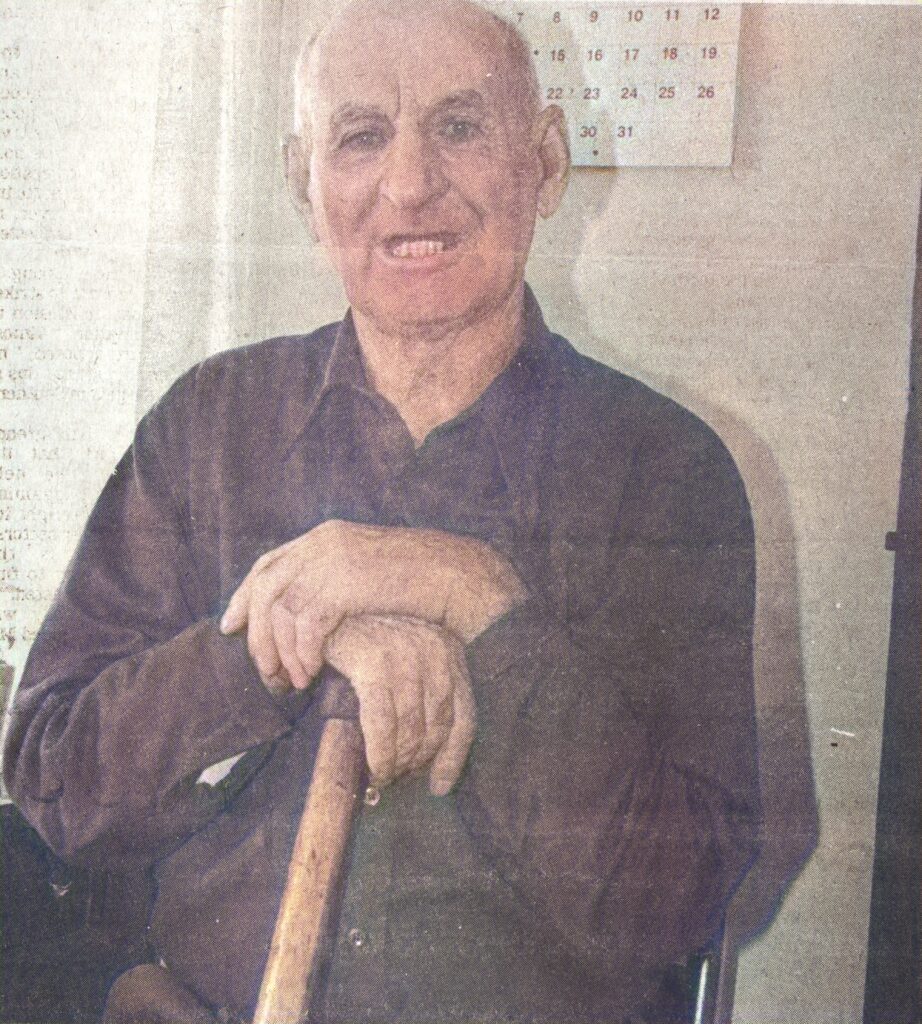
Was digging through our archives (a grand word for the loosely-organized piles of boxes in our basement!) and found this article about my great-uncle Everett Hardy. He was a lovely fellow who was able to rhyme off stories, facts and figures nearly to the end of his 94 years. He was from another age, steeped in stories of the sea, both tales of his own escapades and from the books and National Geographic magazines that he read.
My mother says the local doctor of her youth, John Stewart, said that if Everett had been able to have a good education, he could have been a lawyer (high praise in a time when lawyers were still mostly universally respected). As his parents aged, Everett gradually took over much of the business side of their cannery. He had a head for numbers, and remembered lobster prices and catch sizes decades after the fact.
The reporter who captured Uncle Everett’s tales was Debbie Horne of the West Prince Graphic weekly newspaper. She left the paper quite a few years ago, but was a fixture in West Prince for a long time. If something was happening in our area in the 1980s and 90s, you could be sure Debbie would be there, along with the West Prince reporter for the (then) daily Journal Pioneer, Eric McCarthy. How lucky we were to have that amount of coverage of our small communities. They had to cover everything, from fishing and farming to crime and human interest, and they both did it well.
I have a poor recording of Uncle Everett from about a decade after this interview, which I transcribed a few years ago. He used phrases and pronunciations that have died out of common usage today, as does my mother. He mentions a type of ship called a schooner in this article, but he never pronounced to rhyme with “tuner”, more like “gunner”…it’s difficult to describe. Ask me sometime and I’ll say it fer ye!
His deep interest in the natural world filled him up to the brim, so much so that in his later years, his love of the world and all that was in it would choke him up as he spoke. No gentler, kinder man has ever lived, and I’m glad someone took the time in 1983 to record his tales.
The photo of Uncle Everett from the newspaper article, colourised with PhotosRevived, also part of Setapp. Uncle Everett usually wore dark work clothes, so the colour of the shirt and homemade walking stick is remarkably accurate. As this photo was taken in March, I see his long-sleeved undershirt peeking through his sleeve, though the house was always boiling hot from a wood furnace!He was sitting in his bedroom, where he spent many hours in a rocking chair looking out at Freeland Creek below his house. On top of the dresser to his left was a globe, and he kept Wrigley’s chewing gum in a drawer to give to us children.
A technical note for anyone who transcribes newspaper clippings: I’ve been using TextSniper for the past few weeks to capture text from PDFs and photos, and it is a helpful little app that sits patiently in my menu bar waiting to be triggered. I recently found the toggle to prevent it from adding line breaks, which has saved me a lot of editing when copying text from newspaper columns, and now I love it even more! It’s part of Setapp, a subscription plan I ignored for years but decided to try when RapidWeaver came up for renewal and I realised it was part of Setapp. There are 240+ fun and useful tools that all seem to work really well. I’m just sharing my Setapp experience – I don’t monetize anything on my website, so you won’t make or break me if you do-or-don’t click!
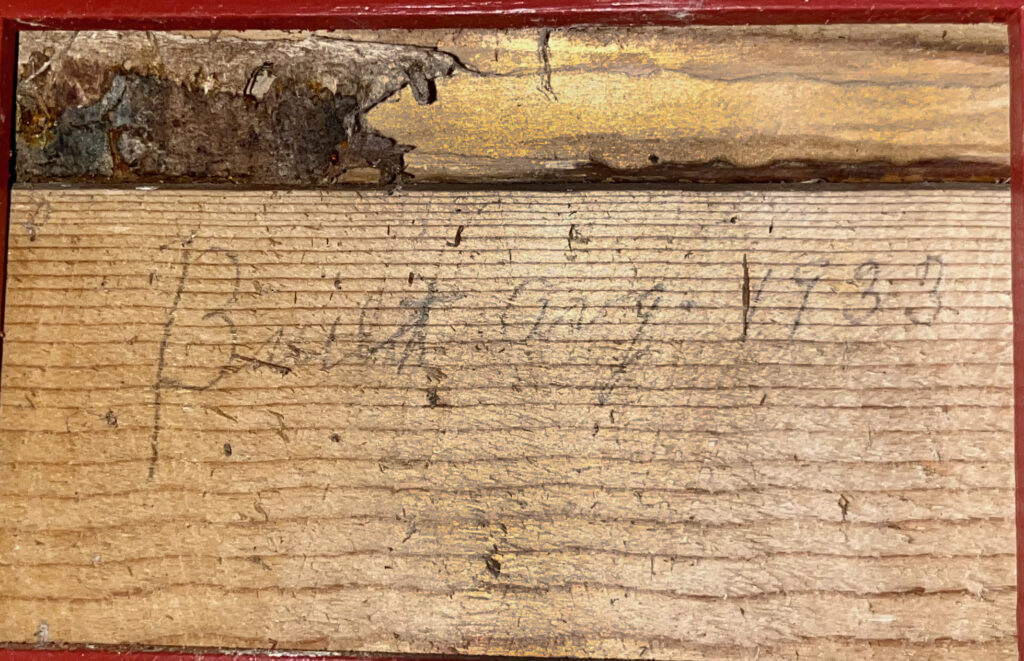
I’ve spent the past few days immersed in the history of Cedar Lodge, the log cabin that sits next to our house. The man who had it built, Senator Creelman MacArthur, marked the grand opening 90 years ago today with a big party.
Someone put the date on the outhouse wall!
Almost everything I’ve been reading, including the newspaper report of the opening I’ll add to this post, talked almost exclusively about men: the various owners of the land, those who built the cabin, those who participated in the opening day event.
To be fair, a rustic log cabin designed to be a hunting and fishing lodge had manliness baked into it. I’m not sure what furnishings and decorations were in Cedar Lodge on August 30, 1933, but when my parents acquired it there was a stuffed moose and deer head leering down from the wall, rifles and fishing rods on racks in the corner. The pine floor was pretty beaten up by the time I came along 33 years later, so it probably had become a fair target to spit tobacco juice on during the years it was rented out to hunters and fishers. The huge stone fireplace was a perfect spot to gather around and tell tall tales, kerosene or gas lamps pushing out moody, flickering light. A man cave for men in flannel and rubber boots and wool caps.
The Cedar Lodge grand opening activities had been scheduled to kick off at 3 pm with the ladies from nearby St. Peter’s Anglican church catering a tea. Had my mother’s mother, Thelma Hardy, lived a few more years, she would have been one of those ladies, and no doubt my 11-year-old mother, Vivian, would have been there, but that wasn’t to be.
So at about a quarter to three this afternoon, my mother and I talked what would have been going on in the kitchen 90 years ago. We imagined the efficient bustle of the women who would be pumping water, stoking the wood burning range, moving dishes and setting up tables. We guessed they served sandwiches and sweets, rather than a meal, but can’t really know.
One thing I would bet money on is that just before 3:00 there would have been a pause in the preparations. A big pot or urn, filled to the brim with the sweet water that came out of the hand-dug well, would have been the first thing placed on the stove when the women had arrived and started the fire in the stove. Once boiled, it would have received a homemade cotton bag filled with loose black tea.
When it had steeped for a while, one of the women would have ladled a bit of tea into a china cup, and the women would have stopped what they were doing and gathered around to look in the cup.
Is it too weak? Too strong? Opinions would be offered, and if it looked okay, a dash of milk would have been added and the cup reexamined to see how the brew held up to the milk. If thought to be the right colour, the woman holding the cup would have had a sip, declare it to be fine, and the tea bags promptly pulled from the pot.
How can I be certain of this one detail, as sure as if I’d been sitting in the corner watching this take place? Because every church supper, tea or reception I’ve ever helped with in my 56 years has had the same ritual. It is a holy rite, an echo of the eucharist, the priestess drinking the remaining tea with a tip of her head, washing the cup, wiping it dry to use for the main event.
So hooray for Cedar Lodge, and the men who built it. My family have enjoyed taking care of this unique structure for 67 years, and have made so many lovely memories sheltered within its cosy walls. I’m in it now, typing by candlelight, as heavy rain pours loudly onto the uninsulated roof while the thunder roars.
And hooray for the unnamed women who fed the crowd that day, who were quietly in the kitchen performing secret, holy rites.
Three of our friends doing dishes after a party in the Cedar Lodge kitchen, 1965
From The Charlottetown Guardian September 7, 1933, page 2
The historical old home of Hon. James Warburton at Freeland, Lot 11, was the scene of a happy gathering on Wednesday afternoon and evening for the opening of Senator Creelman MacArthur’s new Lodge.
This beautiful estate once the scene of great activity in the old shipping days once more rang with the laughter of a happy care free throng enjoying the many pleasures provided by the Senator.
In the old days when ships would be launched at the very spot where the Senator has his Lodge, no doubt the villagers enjoyed themselves in just such a fashion.
One old gentleman, Mr. Thomas L. Murphy, recalled that on one occasion, when Charles McKinnon, a large shipbuilder, was in such a hurry to get a ship named Silver finished and ready for its ocean voyage to the old country, that he had her full rigged on land and when the ice broke and she was launched, she proved to be top heavy and toppled over and about a hundred people were nearly drowned. This was a three masted schooner, one of many schooners built at Foxley River in those days, rigged on sea and loaded with produce for England. Upon their arrival in the old country they were sold. Many old tales were told, by the old inhabitants of the district, of the activities in those days. The old store kept by Michael Kilbride in 1843, which was later moved down the ice to John Yeo’s place at Port Hill, and which is still standing in the yard of Roy Ing’s, was mentioned. Records in the books of the store have the names of many of the first settlers of that vicinity. Among the records is an account of articles purchased for the Officers Mess of the Rifle Brigade of P.E.I. amounting to £4, 7. 4 1-2.
Mrs. William Palmer, daughter of Alexander McKay who ran the mill on the Warburton estate, is the only person now living who was born on the estate. She told how when a little girl she would sit on the shore and herd the cattle for her father.
This old place presented a pretty scene at twilight with the sun setting over the water and the Lodge, decorated with spruce and fir, lit up with many coloured lanterns.
At seven o’clock a dance officially opened the lodge and the visitors to the strains of a fox trot enjoyed the hospitality of Senator McArthur and his daughters, who extended a cordial greeting to all. During the afternoon the visitors strolled about enjoying and admiring the beautiful scenery. Many took advantage of the boats placed at their disposal, and went for a sail on the river.
The ladies of St. Peter’s Anglican Church served tea on the grounds.
After the opening dance at seven, Mr. James McLean, of Freeland, the Senator’s right hand man, called for speeches.
Among those speaking was Mrs. Oscar W. McCallum, of Saskatoon, daughter of the late Donald Nicholson of Charlottetown, who said it was a great pleasure for her to be asked to speak at this historical place, one of the beauty spots of her native land.
Other speakers were Mr. Herman Bryan, former owner of the property; Mr. A.. E. McLean, MP.; Mr. A. J. Matheson, O’Leary; Judge Inman, Judge of the County Court of Prince County; Mr. J. F. Arnett, Summerside; Mr. A. A. Ramsay, a native of Freeland; Mr. Reginal Bell of Charlottetown, and Mr. Thomas L. Murphy of Freeland.
All spoke of the generosity of Senator McArthur, who had shown a very cosmopolitan spirit in throwing open their lovely grounds to the public; which in these times of depression is the right example to set, to any one who has the means and opportunity to do so.
Senator McArthur in response to the three cheers and tiger that went up from the crowd when he came forward, said that he had purchased the property for the benefit of the community and not for any commercial gain.
He intended to stock the waters with trout so that trout fishing could once more be enjoyed as in days gone by.
The grounds would be at the disposal of any community or church of any denomination to hold picnics and social gathering at any time. He wanted all his neighbours in Freeland to feel that they could come and enjoy the quiet walks and bathe or dig clams whenever they chose, and he added, that he especially wanted the mothers and children to come and spend many happy afternoons in his spacious grounds.
This concluded the formal part of the program.
A huge bonfire was now set on fire which lighted up the country side for miles around.
The crowd then gave themselves up to the entertainment of the evening and dancing in the lodge was in full swing.
About 11 o’clock when the harvest moon was shining over the waters, another bonfire built like a haystack in the stream was set going and made a never to be forgotten sight. The dancers paused as if fascinated, the moon on the water with the reflection from the fire lighting up the woods in the background, making an enchanting scene. The merriment was kept up until quite late and closed with singing “For He’s a Jolly Good Fellow.”
Besides the people of the surrounding districts, friends from Charlottetown and Summerside were among the visitors. —S.
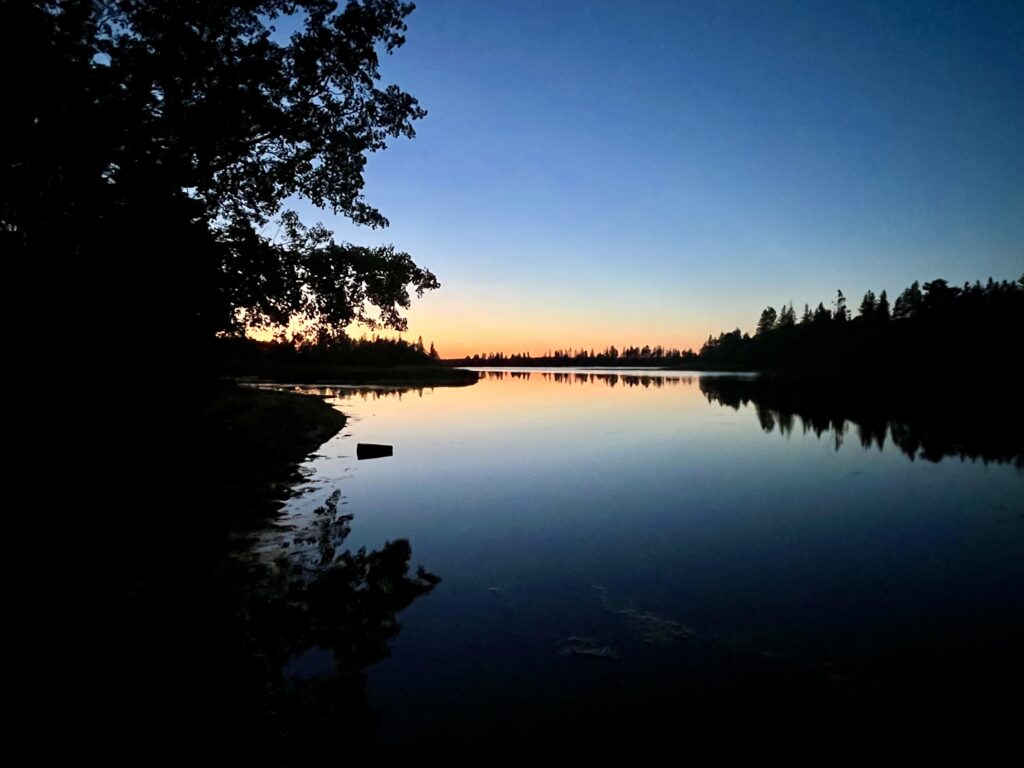
Sunset view on the shore next to Cedar Lodge, August 28, 2023