Noon today marks 150 years since Prince Edward Island joined Canada in 1873. After the overblown celebrations in 2014 to mark the 150th anniversary of the Charlottetown Conference, with the Island drenched in (coincidently?) Liberal red, I had expected something big for this year, but other than a couple of pieces on CBC Radio, this milestone hasn’t been mentioned at all. In today’s Guardian there are ads from politicians wishing everyone a happy Canada Day, but not one word about our wedding to Canada.
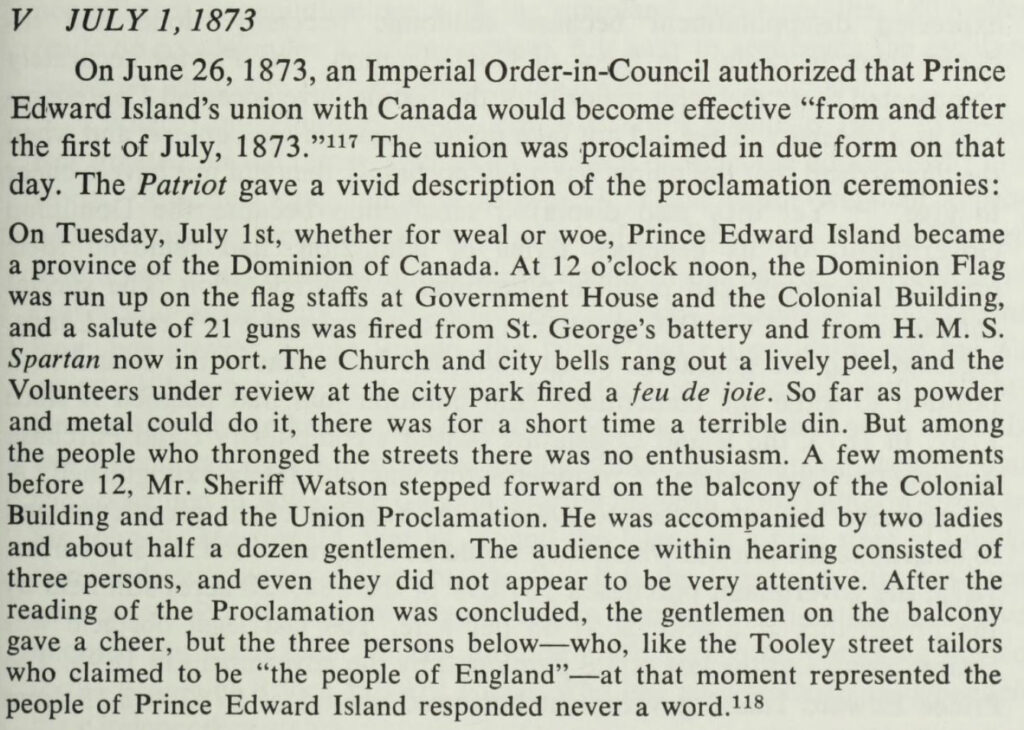
I suppose that’s as it should be, a tradition started by the lackluster response to the whole event at the time:
At it happens, the car ferry service that connects the eastern end of the Island to Nova Scotia resumes service today after having been completely shut down for a week due to a mechanical failure. The service had been expected to be out for almost a month, but a part was found and the boat expected to cross back and forth again, bringing relief to businesses and travelers alike. PEI joined Canada partly to ensure good transportation by train and boat, so having the ferry back might actually be the most apt symbol for the day.
A 1973 license plate digitally altered for the sesquicentennial!
I can’t easily identify my favourite band or book or movie. I could give you a top ten list of favourites, but would not be able to single out just one.
My favourite podcast of all time is easy, though: A History of the World in 100 Objects from BBC Radio 4 in collaboration with the British Museum. It was broadcast in 2010 and I downloaded every podcast episode over our 1.5 Mbps internet connection and listened while I worked outside that fall.
The idea of looking at the span of human history through 100 objects captivated me, and I started my own 100 Objects project on an earlier version of this blog, planning to write about a different object once a week. I wrote about a couple of things from my unorganized collection of stuff, but didn’t continue both because of time constraints and not being certain of what I wanted to say or even why I thought something needed to be said!
I’m going to start again, this time documenting things that will tell the story of my family, my community and me, but only when and as the spirit moves me.
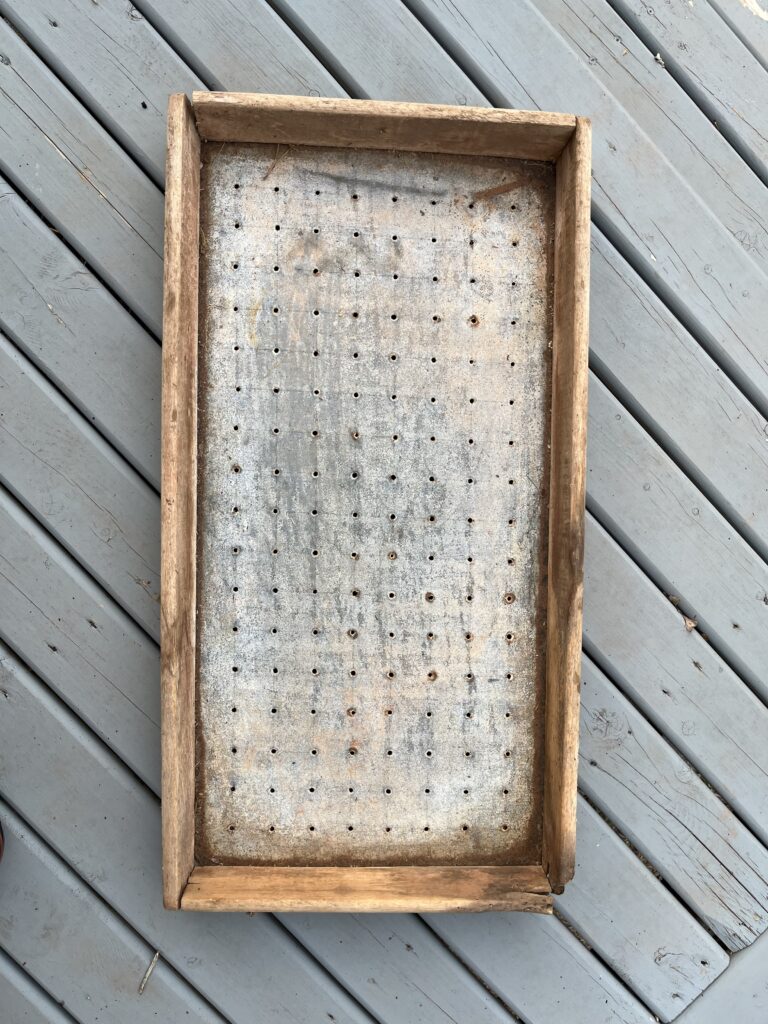
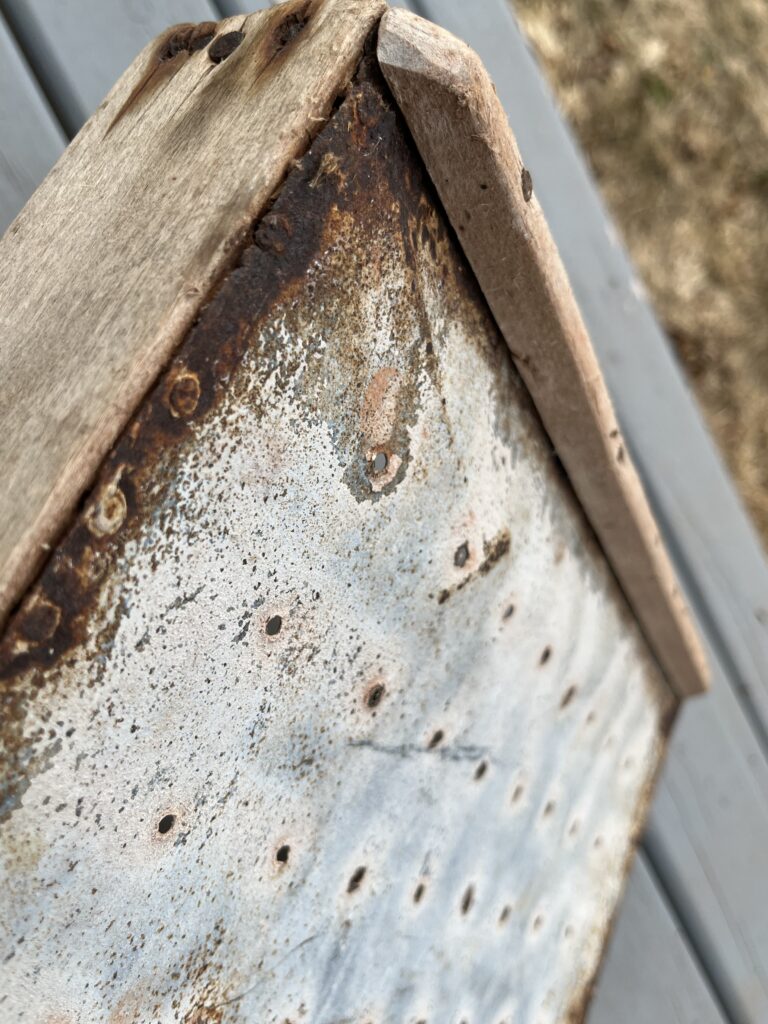
Lobster tray from the Ernest Hardy cannery. Difficult to date, but the cannery operated seasonally from 1901-46
Item One is a lobster tray and it came to mind when I saw this advertisement in the April 25, 1923 Guardian.
April 26, 1923 Guardian, p.6
My great grandparents, Eva and Ernest Hardy, ran a lobster canning factory on the Conway Sandhills at Hardy’s Channel off Milligan’s Wharf, PEI from 1901 until Ernest’s death in 1946. My mother spent her childhood summers at the factory, so I have her stories and even a few photos of the place, but not much of the physical elements of that bustling enterprise remain.
Some of the buildings now at Milligan’s Wharf made up part of the factory and were hauled over to the mainland of PEI in the early 1960s to be used by my mother’s uncles. Some were later repurposed for cottages, one into a snack bar, and one sadly sits abandoned by next-generation owners who have little regard for its history.
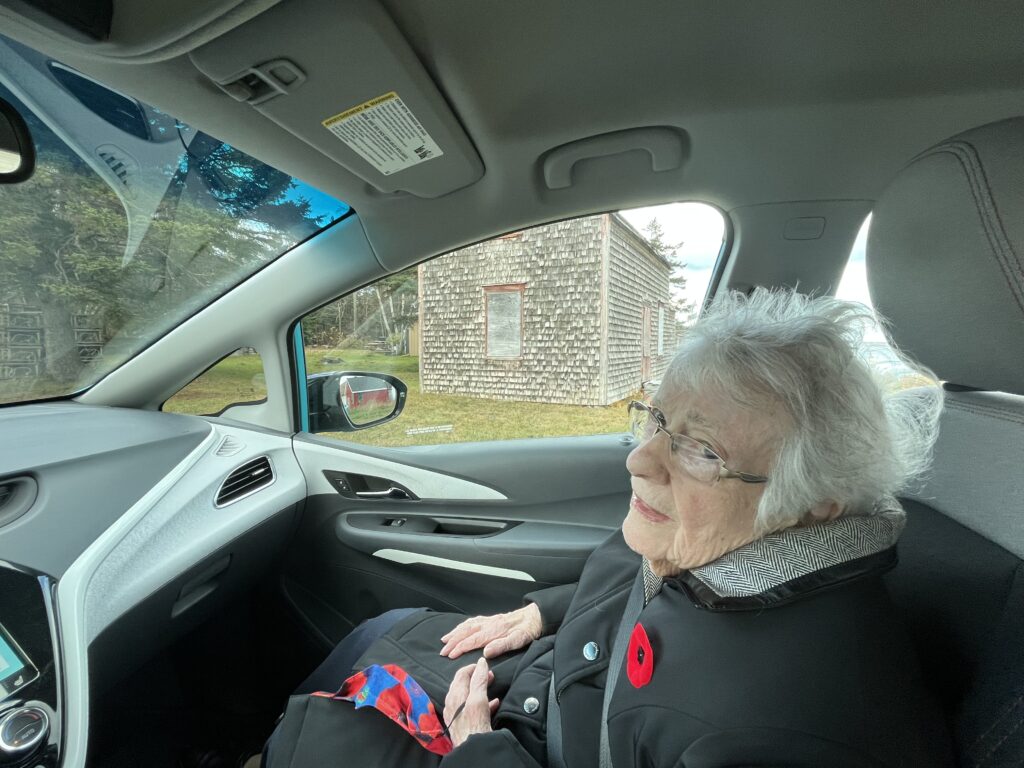
My mother, Vivian Phillips, visiting the old cookhouse from her grandparent’s lobster cannery, Milligan’s Wharf, November 2021. She and her brother would sleep upstairs in the colder months to take advantage of the warmth from the cook stove below.
Ella Oatway and Eva Hardy on cookhouse steps, Conway Sandhills, 1940s. There is a small roof behind them that connected the cookhouse to the separate dining building.
The factory equipment – boilers, tools, tables, canners, utensils – are probably all long gone, no doubt sold to others in the same business or repurposed by the family, which is why I was surprised to come across the tray in our shop building some years ago.
I’m not sure why we have the tray, though I expect it came from one of the buildings on the home property once owned by Ernest and Eva and later occupied by their son, Elmer. My mother helped Elmer in his market garden and he would often give her old things that were hanging around the place and probably in his way. She had a collectors spirit, for which I am thankful.
Until I saw Fred H. Trainor’s advertisement, I had assumed the tray had been made by someone working for Ernest, and that could still be true. Fishermen built their own lobster traps and boats, so making some rough trays wouldn’t be a big deal. My mother’s father, Wilbur Hardy, was not a fisherman but did have a small box mill that he used to make lathes and boards for crates, so he would have been well positioned to fashion the wood for a tray for his father’s business.
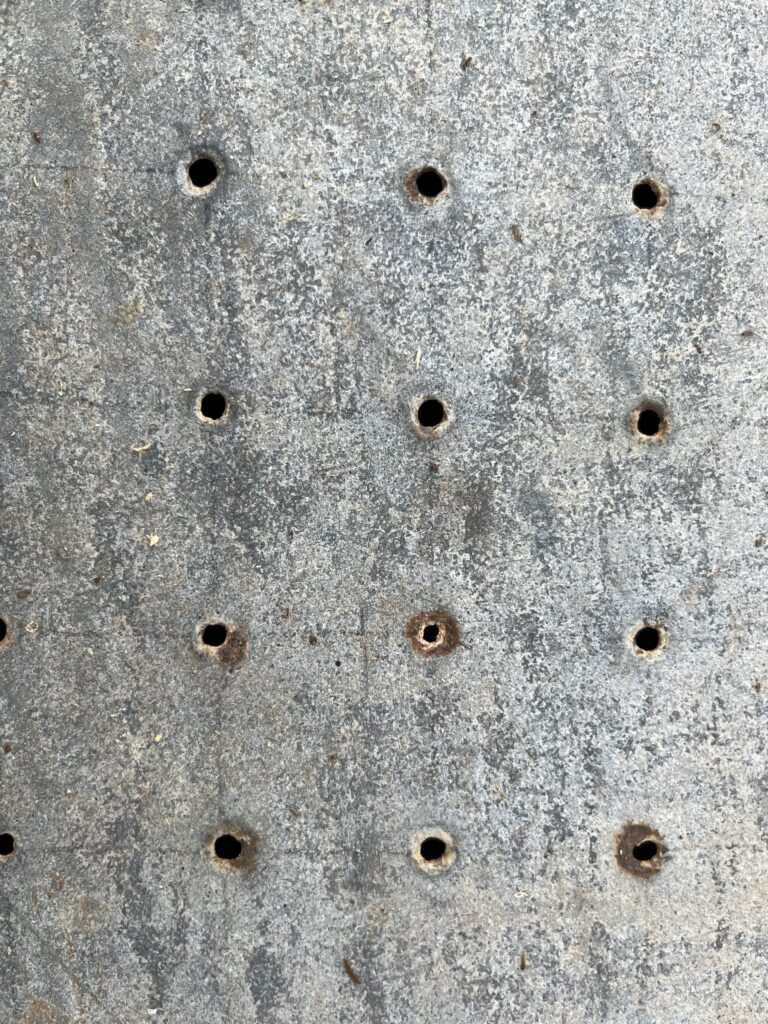
Tray holes spaced 1.5 inches apart
The tray is base is galvanized metal. The wooden frame is 13.5 inches wides, 26.25 inches long and 2.25 inches deep. There are small pieces of wood, tapered by rough carving on either end, on the bottom on the two shorter sides that would allow the tray to sit slightly off of a table for drainage. The drainage holes are evenly spaced 1.5 inches apart, faint grid lines directing the precise location for punching. Considering the amount of salt that would have been around the factory, it’s miraculous the nails holding the frame together are still able (barely) to do their work of holding the pieces together.
The factory was probably a difficult place to work in a challenging location: a sandbar on the north shore of PEI. There was never electricity there, though they did get a gasoline-powered stationary engine in the late 1920s, which was later rescued from a barn by my cousin. He thinks it was used to run a saw to cut up firewood, which was needed in large amounts to fire the boilers that produced hot water and steam for the factory.
Everything was done by hand, in conditions that would probably not be considered sanitary today. The boiler man drew water from a hand-dug well using a bucket and would fill the huge boiler that produced steam to cook the lobsters, keeping a hot wood fire roaring all day. Workers, both men and women, would open the cooked lobsters, first ripping off the claws and cracking them at the knuckle with large knives to extract the meat, pulling out the tail meat, and ripping the bodies apart.
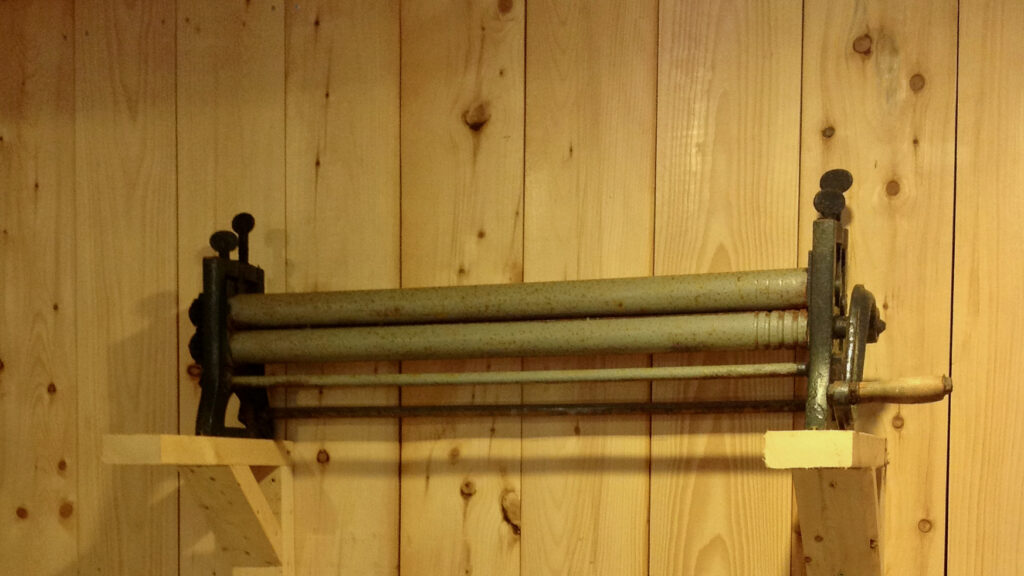
The little legs were fed through the wringer that came off a washing machine, squeezing the sweet meat out of them. My mother says this was the only job she ever did in the factory. The leg meat was added to the tomalley (“the green stuff” inside a lobster body) and roe to make lobster paste, also canned and sold. They also canned mackerel.
Wringer for squeezing out lobster meat, Basin Head Fisheries Museum, PEI, 2014
Leftover lobster bodies quickly become smelly, and piles of them would attract flies and wild creatures, so my mother says they were dumped back into the ocean by the fishermen or hauled to farms to be used as fertilizer. One of her uncles would fill his dory with bodies, take them back to the mainland, throw them into a wagon, and spread them on his farm fields to be disced under. They would certainly be scavenged by animals and birds when fresh, but eventually they would break down and act as a good fertilizer, or as good as a fertilizer could be before chemicals fertilizers were created. Even with all that effort of spreading lobster bodies, that uncle called his place Wild Rose Farm because that’s all the land was good for growing!
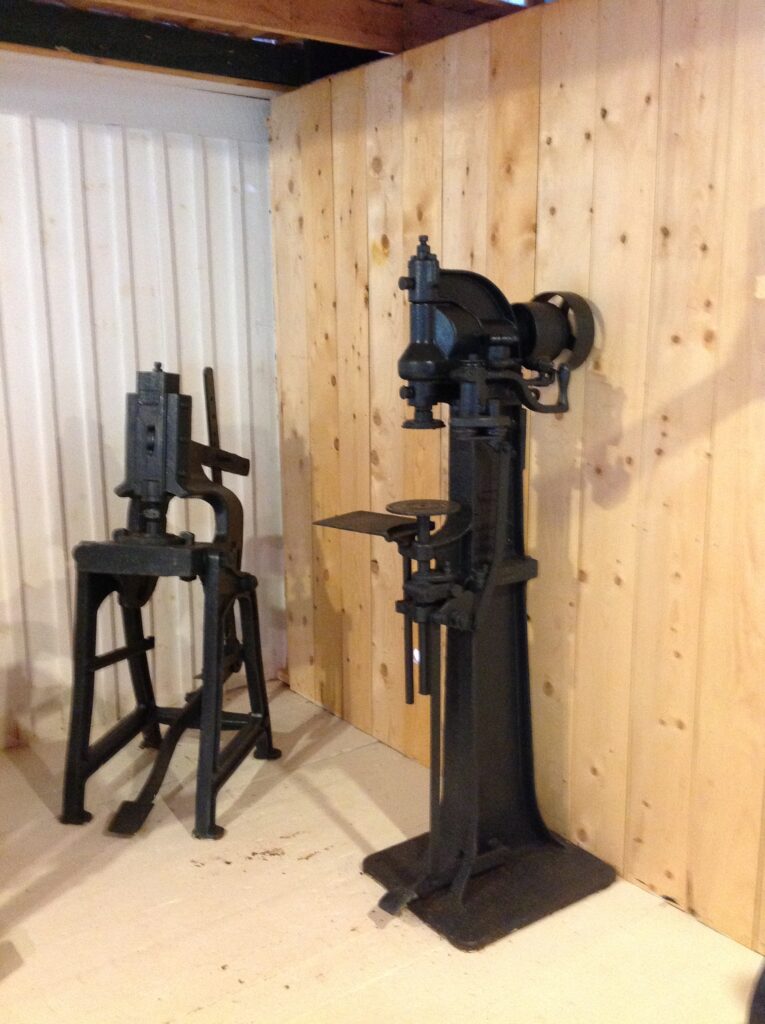
Can sealers, Basin Head Fisheries Museum, PEI, 2014. The one used by Elmer Hardy was similar to the one on the right, but smaller and attached to a work bench in his shop.
One of the canning machines, a greasy looking hand-cranked device, was in Elmer’s shop building. He raised chickens for eggs and meat, and canned chicken, beef and some fish well into the 1980s. Some people in our area still can beef, chicken and bar clams, though use glass canning jars and not the more tricky metal cans.
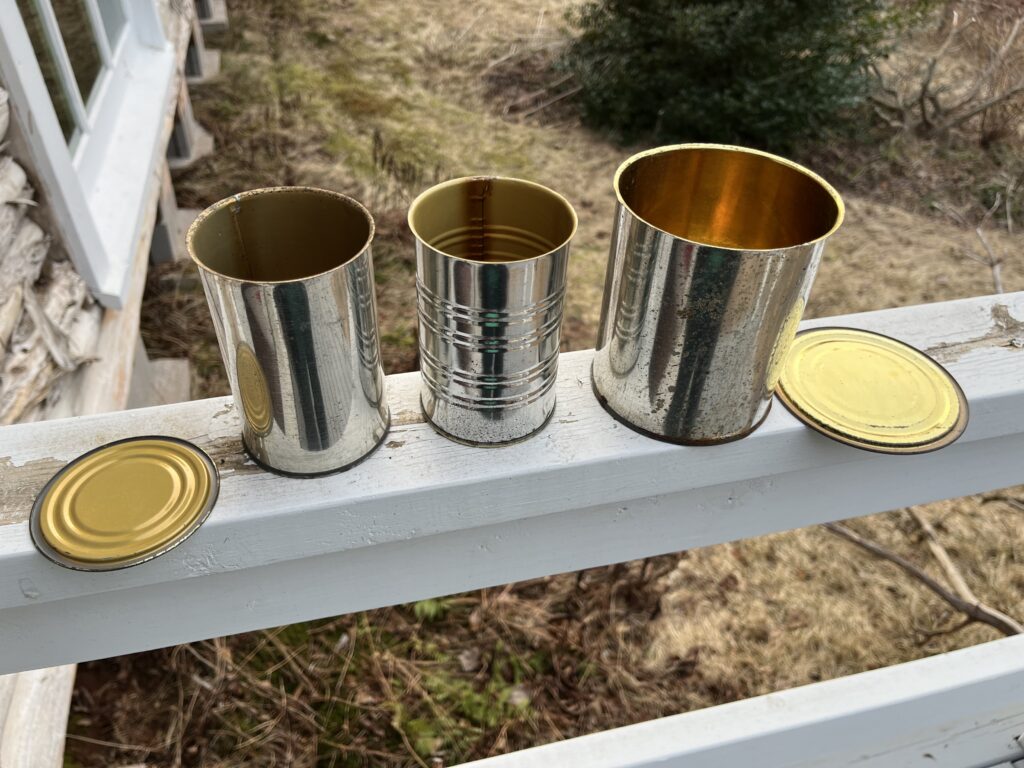
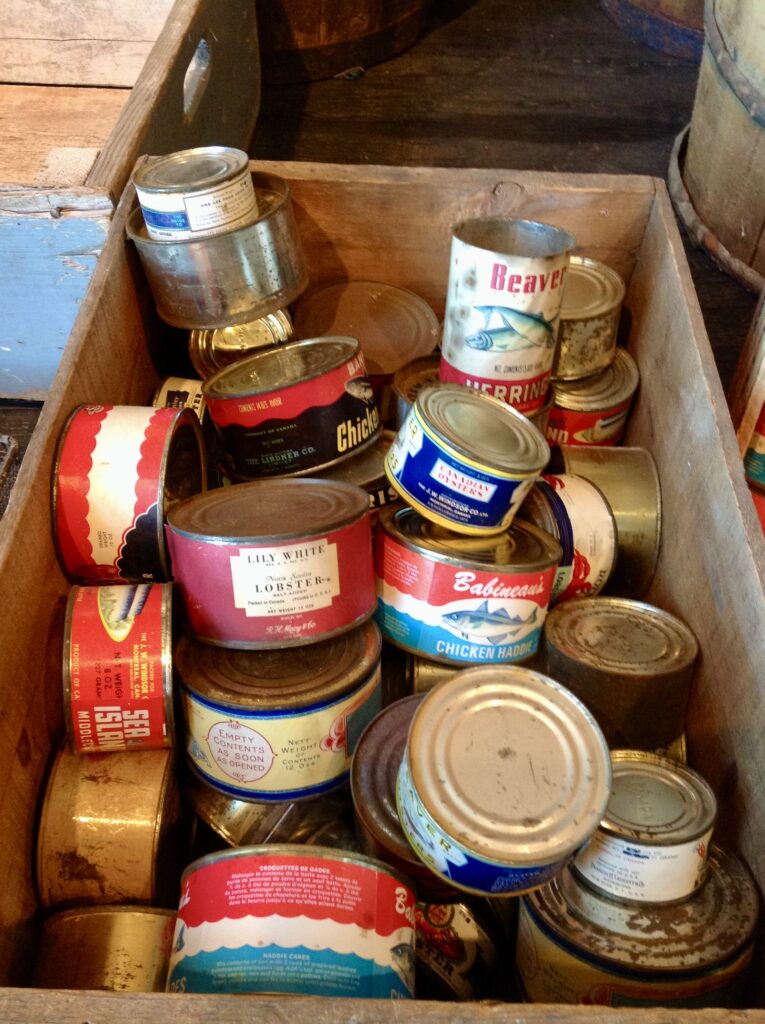
Unused cans and lids from two cases my mother had, which she would have purchased to give to her Uncle Elmer to have him can chicken for her. He probably stopped canning by the 1990s.
My mother says her grandmother, Eva, packed every can as she had “the knack”, and probably also wanted to make sure the weight was exact. A piece of white parchment paper was placed in the bottom of the flat, wide cans, and she would carefully fit tails, claws and bits of meat to bring it up to the correct weight. Once the cans dried and cooled after processing, a label would be affixed with glue or paste. My mother says her grandparents’ product was sold to wholesalers, so there was not an E.A. Hardy brand, but more likely they were canned for DeBlois Brothers wholesalers in Charlottetown, or maybe the large PEI retailer, Holmans.
Lobster and other fish cans at Basin Head Fisheries Museum, PEI, 2014
My great grandmother likely handled the tray thousands of times over the 45 years they worked each summers to make the money that would carry them over the rest of the year. “Factory owner” makes it sound like they were rich, and they definitely were not. They had a telephone, but no electricity and never had a car or truck. The furthest from PEI either of them ever got, that I know of, was when when my great grandfather went to Montreal for an operation, but I don’t think my great grandmother ever left PEI, or even went to Charlottetown! I gather they were well-respected in the community as being industrious and honest, but they had little more than anyone else.
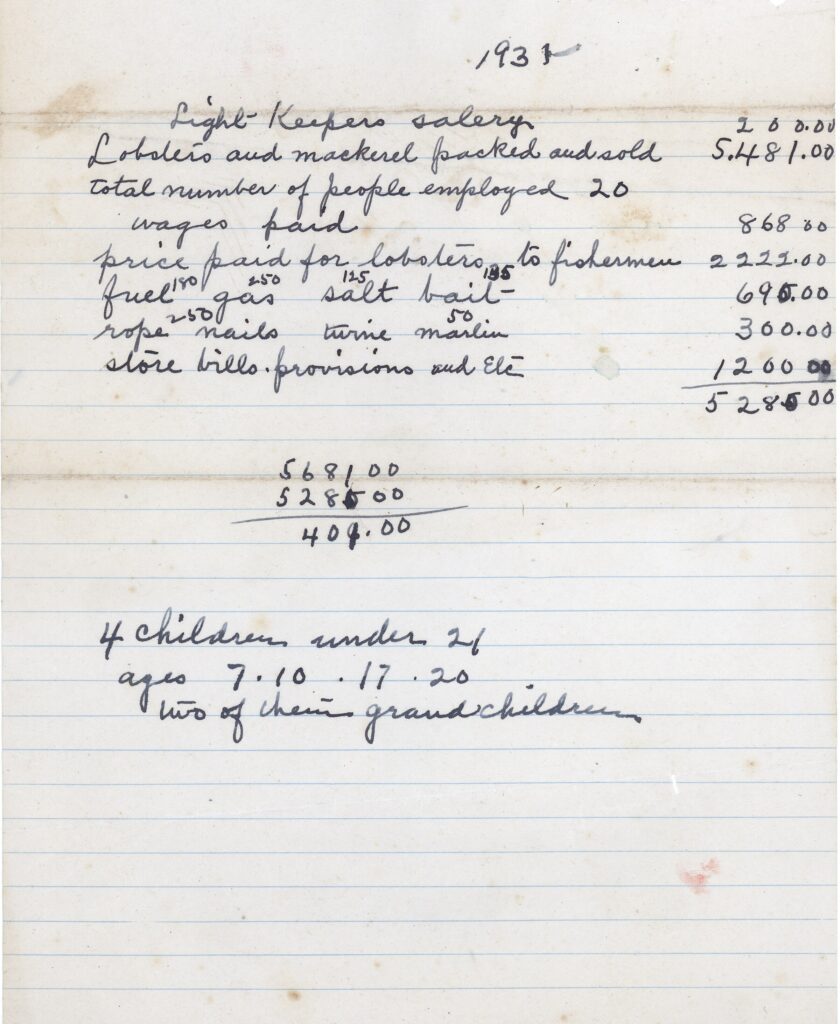
Income statement for Ernest Hardy, 1931. His lighthouse keeper’s income from the Canadian government was incredibly important to the family, making up half of their net income that year.
I think of the countless people who held that tray, working long hours to make a product they probably couldn’t afford to buy. That’s still the story for millions today who produce our clothing, electronics and food in hidden corners of the world. They make little, the corporations make a lot, and we get cheap things.
There are still lobster processing factories on PEI, some of it being canned but most of it frozen. Local workers became more difficult to find over time, so a large percentage of factory workers now come from places like the Philippines. Those temporary foreign workers have supported the lobster fishing industry in a way that is perhaps not acknowledged often enough, as the market for fresh lobster is limited and processing the only way to ensure there is a bigger market.
Lobster fishing and processing is still difficult, even dangerous, work. Thank the lobster, thank the fisher, thank the factory worker who holds the tray.
Yesterday I had the odd experience of someone DMing me on Twitter to tell me that something I had tweeted wasn’t accurate. It had to do with forest fires on PEI, a topic I actually do know a little about.
It wasn’t a nasty or unpleasant message, but rather just something I realise I have experienced all my life as a woman: being told by men that what I know to be true isn’t. In the past it was sometimes done to intimidate me, but often it was just from the bold certainty that they were right.
We had a room added to our house a few years ago. The first step was to remove a deck, which was to be saved as it was still in good shape. I wasn’t watching the crew at first, but heard more power sawing than I had expected and looked out to find they had chopped the deck into small chunks so it could be hauled away.
It was too late to save it, but I wanted to know why they had destroyed a perfectly good deck. The foreman said that it had been in bad shape and we wouldn’t have wanted it, which was clearly nonsense. I asked him to show me, and he picked up a board that had been sitting on the ground and did have a bit of rot, but could have been easily replaced when it became a problem.
He had clearly made a mistake, but instead of apologizing, he expected that I knew nothing about carpentry and would believe his nonsense. He lied, but with the hope and expectation that I would not be able to challenge him. And I didn’t challenge him beyond saying I knew the deck was in good shape because I had kept it in good shape, but he still didn’t budge and continued his work.
Lies and ignorance are two different things, of course, but it’s delivery and the belief that is behind them that can rankle.
I have long been suspicious of certainty in myself and others. As a younger person I would confidently declare that I would never do something, only to find myself later doing it, so I now try to avoid such declarations. Over time I have learned to embrace the questions more than the answers. Someone who tells me they know everything has actually told me they know nothing.
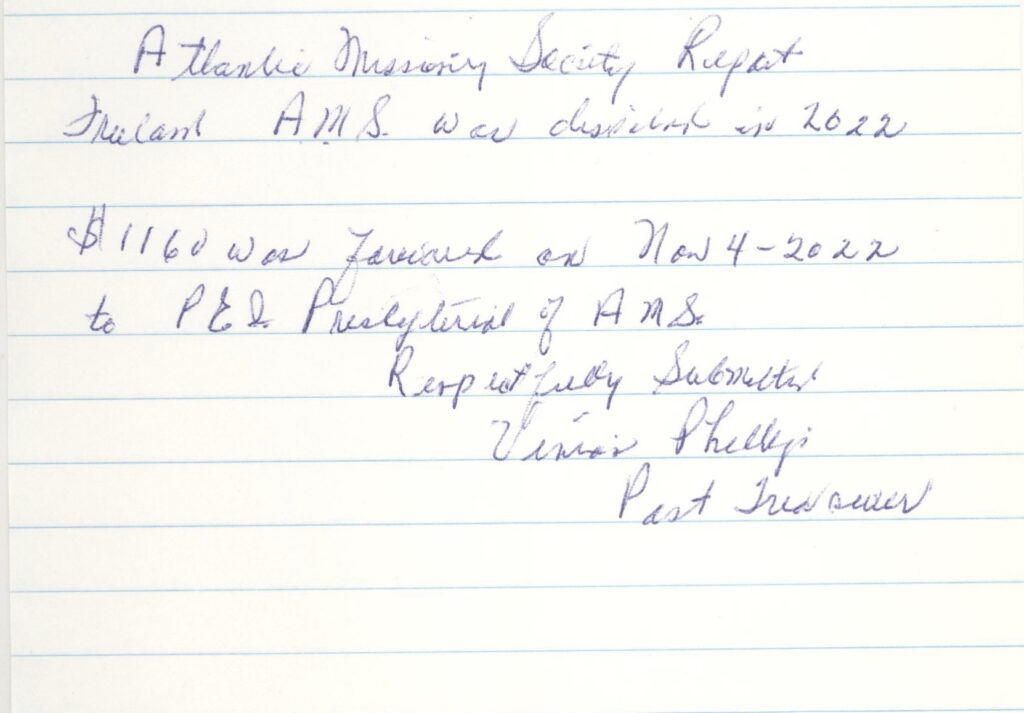
My mother has submitted her final annual financial report as treasurer of her church’s Atlantic Missionary Society group. They disbanded last year after membership dwindled to just five members all over the age of 75.
I am descended from people who came to Prince Edward Island from England and Scotland in the 18th and 19th centuries. Most of my recent ancestry is from Devon and Dorset in the south-west of England, many coming to work in shipbuilding using the plentiful lumber old-growth forest that had stood here untouched forever. My most recent British-born ancestor, GGG grandfather Robert Phillips, came to PEI from Barnstaple, Devon, in 1832 to work as a brass fitter in one the many shipyards.
My family stories extend back only a couple of generations, so I have no accounts of what those ocean crossings were like, what their first impression was of PEI, how they felt about leaving family, friends and country behind, but I have often thought about what that experience would have been like for them.
I recently did a week-long trial membership on Newspapers.com. While it seems an excellent site and probably well worth the subscription price, I didn’t sign up as I was afraid I would do nothing else but read old newspapers for the rest of my life!
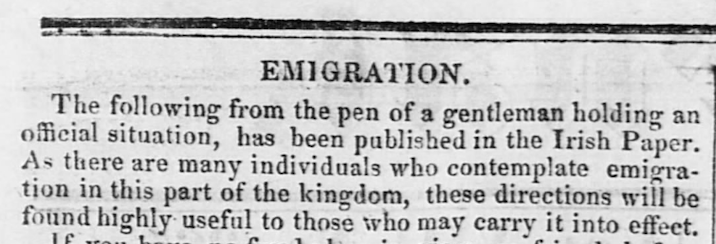
During that trial, I searched Devon newspapers from the early 1830s to see if there was any record of Robert’s departure for PEI. That search came up empty, as I had expected, but I did find a wonderful piece in the June 23, 1831 edition of The North Devon Journal and General Advertiser that gave advice to those who were thinking about moving to North America. I wonder if Robert used this article to help him plan his move, or convinced him that such an adventure could be a possibility for their family. Maybe he cut it out and carried around in his pocket.
The author wasn’t named, but they gave very specific and sound guidance, especially about the British North American climate, information that would still be pretty accurate today.
After listing practical supplies needed for the journey and setting up a new home, the author suggested the final item a young man needed to procure was “an active young wife.” As he already had a wife and five children, including two-year old twins, Robert was fine on that account!
The author outlined a plan on how to survive the ocean crossing and insisted that “by attending to these observations, I will insure you landing in good health, and better looking than when you embarked.” The idea that someone in the 1830s would be better looking after their weeks at sea than when they boarded is amusing, as it is certainly more than hinted at in the article that the living quarters on ship left much to be desired. I’m sure it was a miserable, dangerous crossing.
Young men were advised to leave their “party feeling” behind to ensure they didn’t jeopardize their chances of advancing in their new home because they had clung to old political allegiances. Knowing how party politics is deeply ingrained in the DNA of many Islanders – some families here have voted for the same party for generations – I suspect these newcomers might have left the Whigs and Tories behind, but retained the deep need to find a political home in their new country.
I visited Barnstaple 30 years ago. One evening, I walked to the River Taw and stood on a dock looking west. I thought about Robert and Mary Ann arriving with their small children, all under the age of seven, ready to board a ship into the unknown. This article goes some way in filling in the blanks in my family’s story, adding texture and depth to sterile names and dates. They are still out of reach, but I can see them over the horizon.
Emigration.
The following from the pen of a gentleman holding an official situation, has been published in the Irish Paper. As there are many individuals who contemplate emigration in this part of the kingdom, these directions will be found highly useful to those who may carry it into effect.
If you have no fixed place in view, or friends before you, if labour and farming be your object, and you have a family, bend your course to the Canadas; for there you will find the widest field for your exertions, and the greatest demand for labour.
In almost every part of the Middle States of America, you are subject to fever and ague, as also in some parts of Upper Canada. Lower Canada, New Brunswick, and Nova Scotia are exempt in this respect.
I would particularly recommend the months of April and May for going out, as you may then expect a favorable passage; on no account go in July or August, as, from the prevalence of the south-west winds, you will have a tedious passage. Make your bargain for the passage with the owner of the ship, or some well known respectable broker, or ship-master: avoid, by all means, those crimps that are generally found about the docks and quays, near where ships are taking in passengers. Be sure that the ship is going to the port you contract for, as much deception has been practised in this respect. It is important to select a well known captain, and a fast sailing ship, even at a higher rate.
When you arrive at the port you sail for, proceed immediately in the prosecution of your objects, and do not loiter about, or suffer yourself to be advised by designing people, who too often give their opinion unsolicited. If you want advice, and there is no official person at the port you may land at, go to some respectable person or Chief Magistrate, and be guided by his advice.
Let your baggage be put up in as small a compass as possible; get a strong deal chest of convenient size, let it be in the shape of a sailor’s box, broader at bottom than top, so that it will be more steady on board ship; good strong linen or sacking bags will be found very useful. Pack your oatmeal, or flour in a strong barrel, or flax-seed cask, (which you can purchase cheap in the spring of the year.) I would advise, in addition to the usual wood hoops, two iron ones on each cask, with a strong lid and good hinge, and a padlock, &c. Baskets or sacks are better adapted for potatoes than casks.
The following will be found a sufficient supply for a family of five persons for a voyage to North America, viz.— 48 stone of potatoes (if in season, say not after the Isl. of June,) 2cwt. and a-half of oatmeal† or flour, ½ cwt. biscuits; 20lbs. butter in a keg; 1 gallon of spirits; — a little vinegar; — When you contract with the captain for your passage, do not forget to insure a sufficient supply of good water. An adult will require 5 pints per day — children in proportion.
The foregoing will be found a sufficient supply for an emigrant family of five persons, for 60 or 70 days, and will cost about £5 in Ireland or Scotland; in England about 6 or £7; if the emigrant has the means, let him purchase about 11lbs. of tea, and 16lbs. of sugar for his wife.
The preceding statement contains the principle articles of food required, which may be varied as the taste and circumstances of the emigrant may best suit. In parting with your household furniture, &c. reserve a pot, a tea-kettle, frying-pan, feather-bed, (the Irish peasantry possess a feather-bed,) as much coarse linen as you can, and strong woollen stockings — all these will be found very useful on board ship, and at your settlement, and are not difficult to carry. Take your spade and reaping-hook with you, and as many mechanical tools as you can such as augurs, plaines, hammers, chissels, &c., thread, pins, needles, and a strong pair of shoes for winter. — In summer in Canada, very little clothing is required, for six months — only a coarse shirt and linen trowsers, and you will get cheap moccasins (Indian shoes;) you will also get cheap straw hats in the Canadas, which are better for summer than wool hats, and in winter you will require a fur or Scotch woollen cap. Take a little purgative medicine with you, and if you have young children a little suitable medicine for them. Keep your self clean on board ship, eat such food as you have been generally accustomed to, (but in moderation) keep no dirty clothes about your births, or filth of any kind. Keep on deck, and air your bedding daily, when the weather will permit; get up at five o’clock, and retire at eight; take a mug of salt water occasionally in the morning. — By attending to these observations, I will insure you landing in good health, and better looking than when you embarked.
From the great disparity of male over female population in the Canadas, I would advise every young farmer or labourer going out, (who can pay for the passage of two) to take an active young wife with him.
In Lower Canada, and New Brunswick, winter begins about the end of November, and the snow is seldom clear from the ground till the beginning of April. In Nova Scotia, and Prince Edward’s Island, from their insulated situation the winters are milder than in New Brunswick or Lower Canada, and in Upper Canada they are pretty similar to the back part of the State of New York.
The risk of a bad harvest or hay time is rarely felt in Lower Canada, and consequently farming is not attended with so much anxiety or labour as in the United Kingdom. The winters are cold but dry and bracing. I have seen men in the woods, in winter felling trees with their coats off, and otherwise light clothed. The summers are extremely hot, particularly July and August.
The new settler must consult the seasons in all his undertakings and leave nothing to chance, or to be done of another day. The farmers of Lower Canada are worthy of remark in these respects.
In conclusion, I beseech you, if you have any party feeling at home, if you wish to promote your own prosperity, or that of your family, wash your hands clear of it ere you embark. Such characters are looked upon with suspicion in the Colonies; and you could not possibly take with you a worse recommendation.
Prices of living, house rent, labour, &c. in the principal towns of Canada, with the expense of travelling on the great leading routes — In Quebec and Montreal, excellent board and lodging in the principle hotels and boarding houses, 20s. to 30s. per week. Second-rate ditto from 15s. to 20s. per week. Board and lodging for a mechanic or labourer 7s. to 9s. 6d. per week, for which he will get tea, coffee, with meat for breakfast, a good dinner, and supper at night.
• If potatoes are out of season for keeping, increase the quantity of oatmeal.
If the Emigrant has any oatmeal to spare, it will sell for more than prime cost.
From The North Devon Journal and General Advertiser – Thursday, June 23, 1831
I live in a rural area where fishing and farming are still major economic activities, so when the cold and snow of winter turns to the warmth and mud of spring, our community comes alive.
Dories on trailers sit in yards waiting for the ice to move out of the coves and bays so oyster fishers can resume their work. Large lobster boats, perched on their huge stands, are being cleaned and stocked, engines and pumps tested, so they will be ready for the boat hauler to back in, hoist them up on their trailer, and carry them to the local wharf for the start of the lobster fishing season in May.
Snow blowers are removed from farm tractors, and scrapers installed to smooth muddy, rutted lanes. Manure that piled up next to barns all winter has been hauled and spread on fields that remain frozen in the mornings. It’s a bit too early and the ground too soft to plow most fields, and way to early to plant grain or potatoes, but supplies are being readied.
A friend and I walked a back road near her house this afternoon, and saw pickup trucks stopped on bridges, people looking over the railings to gauge how ready brooks or streams will be for the start of angling season in a couple of days. Birds are returning: robins, red-winged blackbirds, ducks, grackles, and Canada geese flying north. Crows fly by with sticks in their beaks for their nests.
As we walked, we waved at every vehicle that passed. Some we knew, some we didn’t, some we weren’t sure, but we waved anyway because that’s what you do here. To not wave would seem unneighbourly and cold. We waved at the school bus driver, who we do know, twice because he dropped off some children and returned the same way. And everyone waved back.
While I was driving home from my walk, I passed some cousins of mine standing next to – you guessed it – a boat in their yard. They waved, and I saw in them at that moment their father and grandfather and great grandfather, the same turn of the head and looks and smiles. The strong genetic connection between us strengthened and solidified by hundreds of interactions, some involving meals or parties or conversations, but many just waves from yards at passing cars.
We wave as we drive as well. If you are holding your steering wheel with your hands at the 10 and 2 o’clock positions, as everyone was taught long ago (air bags make that unwise now), when you meet a vehicle driven by someone you know, you flick your right hand up, usually just the index and middle finger, in greeting. Sometimes you will wave your whole hand, maybe at someone you were just speaking to on the phone and happen to pass on the road, an acknowledgement of how funny it is that you were just talking and now, look at us, zooming down the road!
I have a cousin (it’s always a cousin with me, as I have dozens of them around here) who I always suspected waved at every car he met, whether he knew the driver or not. I never dared to ask him, because he would have probably thought it an odd thing for me to notice, or the question might have made him self conscious. I confirmed he does wave at everyone when I was driving home for the first time in my present car, with its unusual blue colour that can’t really be mistaken for any other car around here. I met said cousin in his truck and he waved, and I’m pretty sure he didn’t know it was me. He’s just a super waver.
I realise that there is a limit to where I wave. I wave at most everyone within a five kilometre radius of our house, and that can occasionally extend as far as the village of Tyne Valley 16 kilometres away if I meet someone on the road I’m sure I know. No one taught me to do all this waving. It is just the way it is.
The hallways and rooms of Stewart Memorial Hospital in Tyne Valley had been decorated with paintings and photographs donated by community members. When the provincial government shut down hospital services in June 2013 and turned the building into a long term care facility, the mysterious figures who pull the levers from hidden corners of Health PEI deemed that anything in the building that wasn’t generic had to be removed.
You probably think I’m being dramatic, but I’m not. Down came the paintings that showed rustic local barns and familiar vistas, only to be replaced by made-in-China blandness. The reasoning? It was some vague idea that the facility was the residents’ home and…well, honestly, I never understood it. The place ended up looking like a forgotten corner of an airport lounge.
I documented all the original artwork in the hospital before it was removed, and they are in this Flickr album.
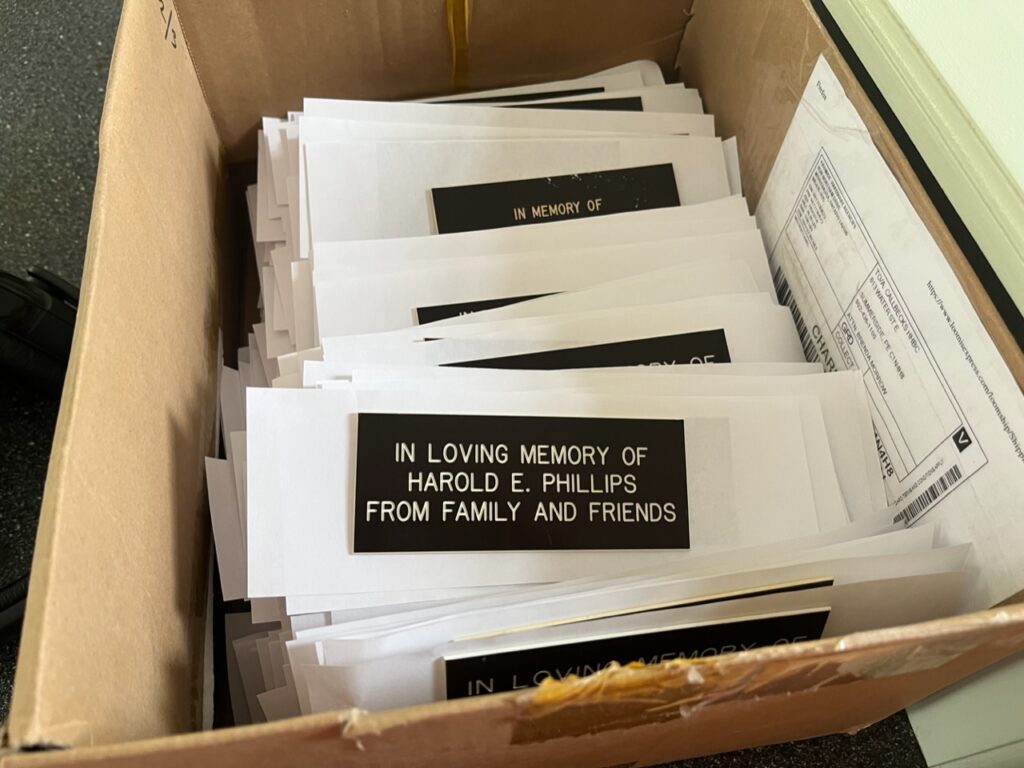
Most of the hospital rooms had been sponsored by groups or families, and all the plaques by the doors acknowledging these contributions had to come down. Photos of past staff, items donated to thank staff, all dismantled. The place had to look like everywhere and nowhere. You can guess I wasn’t a big fan of this move to strip away the long community history of this building.
A new building was built a few years later and now the old hospital building that has stood on a Tyne Valley hill since 1951 will be demolished. What was left in the old building has to be removed.
I received a call to see if our SMH Foundation wanted some memorial plaques. When someone died, and donations were made to the Foundation in their memory, a small plaque would be put up in a beautiful display case that was very visible in a hospital hallway. We had so many donations over the years that we had to build another case to house them all. Of course, as had happened with the artwork, when hospital services were discontinued, the cases had to be moved to an unused ambulance bay, and with them the memory of a community that had cared enough to support the hospital.
So, my mother and I went to pick up the box of plaques at the new long term care facility, which is a beautiful building appropriately devoid of much local character. I picked up the little box of plaques and carried it back to my car. It felt like a funeral and I was carrying the ashes of all that we had worked so hard to maintain.
I put the box on a table when I got home, but didn’t feel up to going through the plaques. The next day, I decided to have a look, and near the top was the plaque with my father’s name from when he died at Stewart Memorial in 2008 after having resided there for a couple of years. I flipped through a couple more names and started to cry. I knew them all, related to many.
The loss of our hospital still stings, and I think it always will. Soon the building will be gone, and younger people will never really know what we had and what we lost. They can knock the place down, but I will never stop talking about it, the remarkable achievement of building and maintaining a small rural hospital for over six decades.
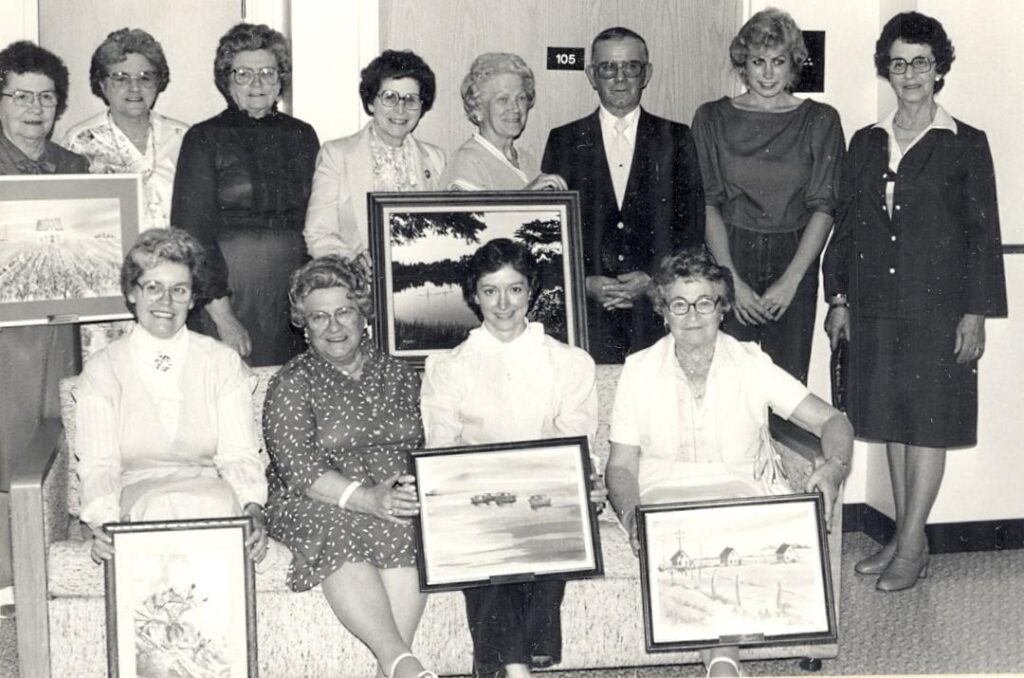
Some of the artists who donated their artwork to the new wing of Stewart Memorial Hospital in 1983.
What began this afternoon as a quick confirmation of a name turned into a startling and slightly overwhelming discovery, one that still has me feeling a bit stunned.
I was looking up Kay Jelley, my mother’s lifelong friend and former childhood neighbour in Freeland. I knew Kay had been interviewed by historian Dutch Thompson as she is often included in his regular CBC PEI radio pieces. While looking her up on the Island Voices website, which has some of Thompson’s interviews, I decided to put “Freeland” into the search box and see who else might be there, and a few other interviews popped up.
The last result was not recorded by Thompson but by someone from the Benevolent Irish Society, who seemed to have travelled around PEI in the 1980s recording the descendants of Irish immigrants. It was an interview with Kevin and Margaret Kilbride, our neighbours here in Foxley River. Kevin died just over a decade ago, but Margaret has been gone since 1991.
Never in my wildest dreams did I ever think I would hear her voice again.
Margaret was unique, funny, smart, lovable. She was a registered nurse, and had been a lieutenant in the Royal Canadian Army Medical Corps in the Second World War stationed in France and Belgium. She was the head nurse at our little Stewart Memorial Hospital in Tyne Valley, and while full of fun, people who had worked with her have told me she could also be quite exacting. She was a smart dresser, and always drove a snazzy car.
Margaret at a Stewart Memorial Health Centre staff outing…not sure where or when, but likely 1960s or early 70s by the look of that outfit and car!
Kevin, on the other hand, was exactly how I imagine Matthew Cuthbert from Anne of Green Gables to be: quiet and soft spoken, wise and kind. Their house, a classic PEI farmhouse that had been built by his grandfather in the 1890s, even looked a bit like Green Gables. Where she favoured tailored pantsuits when she wasn’t in her crisp nursing whites, Kevin was almost always in his overalls when at home, working in the barn or yard.
The interview is probably not particularly interesting to someone outside our community, and some of it unfortunately doesn’t age well, but to be able to hear them again, in their 60s and 70s, still vital, the way they interact, mentioning names I had forgotten, has been a delight. Margaret’s distinct way of speaking. Kevin’s thoughtful pauses. And the background noises: a small plane flying over (I might have been out in our yard across the river waving at it!), cows mooing, a crow calling, Margaret lighting a cigarette.
I was a like a moth to a flame when it came to Margaret. I was fascinated by her, as she was unlike any other woman I knew, outspoken and bubbly in a way that wasn’t the norm. She visited our house often when I was a child, usually on her way home from work at the hospital. She was a great friend to my mother, and a wonderful medical resource as I rolled through childhood illnesses and incidents. Margaret would always know what to do, and she would dispense sound advice with a laugh and a big hug. I have a couple of bottles with her distinctive hand writing on them, creams and lotions to sooth some long-forgotten condition. When I went through a brief anxious period as a child when I imagined my heart was stopping, she gave me a stethoscope and helped me understand how the heart worked in rest and action.
One summer day when I was five, I saw Margaret’s car pull into their yard from the front lawn of our cottage. I somehow got our little dingy into the water and rowed across the river, clambered up the bank, and knocked on their door to say hello. I wasn’t supposed to have taken the boat by myself, and Margaret knew it. She called my mother right away to tell her where I was – Hi, Viv, guess who I have here?! (the only person to ever give my mother a nickname) – and then we had a great visit, she with a cup of milky, sugary tea and her ever-present cigarette, and me with a glass of milk, probably from Kevin’s cows, and a few molasses cookies. I have no idea what we talked about, but I am sure we had fun. Then we hopped in her car and she drove me home, the boat later retrieved by my father.
The Kilbride House as seen from our lawn one summer morning in 1968
I fell and split my forehead open at my boisterous seventh birthday party, and although my great-aunt Lois was at the party, and she had nursed in New York City for forty years, it was Margaret I asked for as I sobbed, blood running down my face, and she quickly came from across the river to assess me and send me to the hospital for stitches. The party continued as I was sewn up, and I came back looking like Frankenstein’s monster, making it a party to remember!
I am lucky to have few regrets in life, but not having been more attentive to Margaret in her later years is one of them. I didn’t visit her when I would return home from university, expecting her to be around forever, I suppose, and after she died, I soon realised what I had lost. It has always bothered me.
I feel like I got a tiny message from Margaret today that it was all ok, and if I close my eyes, I am still in her kitchen having a cookie and a chat. Nostalgia is the child of memory and imagination, a potent salve for psychic wounds.
Margaret and me in her kitchen, 1967. You’ll notice Margaret is missing a finger on her right hand, and I understood this happened during her war service.
Land use and foreign ownership has been much discussed on PEI recently, but this is certainly not a new preoccupation in this province. When my ancestors arrived from England and Scotland in the 18th and 19th centuries, they would have paid rent to landowners back in Britain, people who probably never set foot on PEI. That system ended in the 1870s, allowing people to buy the land where they lived, but Islanders seem to have been touchy about who can own land here ever since.
Someone showed me a post from a Facebook group that referred to certain recent land purchases as “land grabbing.” It’s the perfect phrase to stir people up on social media, but those of us who are not Indigenous Canadians need to be mindful of the history of land grabbing on this continent.
There is plenty of talk about who should own land on PEI, who should be allowed to build structures and where they can be situated, but very little, if any, discussion about how we recognize and reconcile the fact that every inch of this island is unceded Mi’kmaq territory. How must the “land grabbing” discussion sound to Mi’kmaq people?
The elementary school I attended celebrates its 50th anniversary today. 22 smaller, mostly one-room schools, were closed at the end of the 1971-72 school year and all students then bussed in September 1972 to a new facility that had been built in Ellerslie.
I don’t remember the official opening ceremony, though I know I was there, as were my parents. Premier Alex Campbell and other dignitaries made speeches, laid a cornerstone, unveiled a plaque, and then everyone enjoyed sandwiches, sweets, juice and tea provided by a couple of local Women’s Institute groups. WIs were heavily involved in supporting the schools in their individual communities, so they were primed and ready to support this new facility.
The school was a modern, clean building, replacing old wooden facilities that had been well maintained, but were certainly from a different time. A few people were against the amalgamation, some fearing the loss of their individual community’s identity or concerned about the length of time that children would spend on buses, and others who predictably thought that “what was good enough for us should be good enough for them!” With most of PEI marching happily along to the Alex Campbell government’s drumbeat of development, modernity and prosperity, those few who were not in favour were ignored and, as happens with all change, within a few years most forgot there had ever been a school in their community, the buildings either being repurposed as community halls, turned into homes or sheds, or demolished.
The new school had an open concept plan, with sliding accordion dividers between most of the classrooms. This “one big classroom” design was well received at first, but didn’t remain popular for long, and Ellerslie Elementary now has cinderblock walls between classrooms to keep noise and distractions down. There was a large gymnasium, music room, art room, a windowless room that we seemed to only use to watch NFB films, and a large central library space. There were water fountains, banks of trays by the entrance to put your muddy or snowy footwear, and everything was bright, airy and clean.
I remember very little about my first year at school, but I do recall that some of the furniture hadn’t arrived for the first day of classes, so we little ones in first grade sat on the floor. I remember loving my young and energetic homeroom teacher, Mrs. Jelley. I remember how big the grade six children looked, and because children could fail to pass a grade in those days and be kept back to repeat it, there might have been a couple of teenagers in grade six.
Checking out my new school summer 1972
As an only child, I was excited to meet new children, though I did have some neighbours, Sunday school pals and cousins with me, which was a comfort. I remember a new friend helping me tie my shoelace when I couldn’t remember how it was done. As the oldest in her family, she was used to helping her younger siblings with this task and was a good little teacher. And I remember being told to stop talking, and that happened more than once!
Tiny me off to school on what looks like a chilly September day in 1972
The school had some odd features beyond the lack of walls. The gym was carpeted, and this led to nasty rug burns when you tripped and slid (and six year olds trip often!). Much of the rest of the school was also carpeted, making the dry winter months one long string of shocks as children shuffled their feet to electrify themselves and then tapped another kid as they walked by.
Mrs. Jelley was a newly-graduated teacher and full of modern ideas, but some of the other teachers seemed to struggle a bit with the new regime. Teaching in a one room school meant they had been able to run their school pretty much as they wanted, within the curriculum set by the province, and only overseen by occasional visits from school inspectors. Now these teachers had a principal as their onsite boss, had to work collaboratively with other teachers, and had relinquished some of their instructional roles – physical education, library, music – to specialists. Some teachers got along fine and finished out their careers at the school, and others probably retired earlier than they might have had they remained in the one room school setting.
One thing that changed immediately in the new school was the use of corporal punishment. I remember one of the older teachers trying to deal with a little classmate who was talking when he should have been listening. The teacher told him to be quiet and continued with the lesson. The boy didn’t obey, so the teacher called him to the front of the class, told him to hold out his hand, and slapped his palm hard with a ruler. I don’t know for a fact, but I’m pretty certain the teacher was spoken to by the principal, and that was the last time such a thing occurred.
At that time we were not far removed from the days of children being strapped by their teachers, and it would have been the rare parent who wouldn’t have backed up such an action by a teacher, so while it was startling and scary to see someone get their hand slapped with a ruler, it was not really unexpected because older children had warned us about such things. We had been prepared for it, but luckily that would not happen at Ellerslie again.
I was in the fortunate position of attending basically brand new schools for all of my twelve school years: Ellerslie Elementary, Hernewood (grades 7-9) and Westisle (grades 10-12). I had some great teachers, lots of opportunity for extracurricular activities that expanded my world, and met some lovely classmates who are still my friends.
I scanned articles and documents my mother saved from the school’s opening for the 40th anniversary in 2012, when some of us who started grade one in 1972 attended a ceremony and planted a tree at the school, so I’m sharing them here for reference and remembrance. 50 years, gone in a blink.
Part 1 of front page article about new Ellerslie schoolSecond part of articleLetter to parents about official openingList of Ellerslie staff 1972Official Opening Program CoverOfficial Opening Program Page OneOfficial Opening Program Page Two