We started getting early morning spam phone calls on our landlines a few years ago (our house has an apartment for my mother). Early as in 6:30 a.m. early. My mother was not usually out of bed or, if she was, she was getting dressed or in the bathroom, and she would rush to answer the phone. As her mobility decreased, I was afraid this would all end in a fall.
To prevent a possible tumble, I started taking her kitchen phone off the hook every morning when I got up. I’d hear a dial tone followed by a ring noise and then a voice telling me to hang up and try my call again (apparently known as an intercept message). After the message was repeated twice, a rapid busy signal would start and eventually would go dead after a long period.
My mother would replace the handset when she was in the kitchen and ready for her day, and if someone called to tell her that her Windows machine was acting up or she had won a cruise, she was awake and ready to hang up on them. This was an easy solution to an annoying problem.
We have two phone lines in our house. Our copper line was replaced in 2021 by a fibre optic cable that gives us internet, television and telephone. As my mother doesn’t use the internet, and we are able to wirelessly bounce a television signal from the Bell Home Hub modem to give her television, we decided at that time to leave her copper telephone line as it was.
Until Bell Aliant sent out letters earlier this year. The first informed us that if my mother’s copper line broke, they wouldn’t fix it and my mother would have to get a fibre line, which was fair enough, I suppose. That was followed a month later by another letter saying they would be cancelling her phone service by August if she didn’t switch to their fibre service. A classic Bell passive-aggressive move.
As we already had the fibre line and Home Hub in our house, it was an easy matter of some magic person left over from Island Tel days doing some programming at the Bell Aliant office in Charlottetown and rerouting my mother’s phone number to our modem (each of the Home Hubs has room for two phone lines). We lucked out again and had a tech come to our house (another Island Tel vet nearing retirement) who was able to make things work in our basement to easily route from our modem to my mother’s phone.
The morning following the switch, I picked up my mother’s handset expecting to hear the regular pattern. As I moved around her kitchen, I heard the dial tone followed by the signal to warn that the phone was off the hook, but no gentle, helpful voice.
I thought that was the end of the voice, but a couple of weeks later I was looking after a friend’s house while she was away and remembered she still had her copper line service, so I had one last visit with the Bell Aliant voice:
Anyone know who recorded this message? It certainly sounds like an Atlantic Canadian voice, maybe PEI but could be Newfoundland or Cape Breton, too. Recorded on tape? A copy of a copy of a copy? Let me know what you know, and please try your call again.
When I heard that a restored Canso airplane was going to be visiting the former air force base in Summerside, I switched a few things around so I could take my mother to see it.
My mother was a clerk in the Royal Canadian Air Force (Women’s Division) during the Second World War, serving from April 1943 to January 1945. She was posted to the RCAF base at Torbay, Newfoundland for 13 months and would have been there at this exact time 80 years ago.
Seeing a Canso, loaded with bombs and depth charges to hunt German U-boats, would have been an everyday thing for her then, nothing special, but today was certainly remarkable. She was interested to see one again, and thought it was smaller than she remembered. This Canso looked very different as it was painted as a water bomber, which was its last role as a working aircraft, and not as a military plane. She found it difficult to believe that 80 years had passed, thought a lot about all the friends she had made, now all gone.
It was windy with rain threatening as I pushed her wheelchair across the tarmac towards the plane. She learned to march on a similar runway in Ottawa, marching back and forth, back and forth. They issued the women shoes that were one size too big because all the marching would swell even the daintiest of WD feet.
It was to that very Summerside runway that she had been headed one day, probably also in 1944, when the plane she had hitched a ride from Torbay to visit her family on PEI spotted a U-boat surface in the Gulf of Saint Lawrence. They scrambled to get out of the area and radio the submarine’s position so bombers could be dispatched. She had been sitting in the co-pilot’s seat, so hopped out pretty quickly and the plane returned to Torbay. She never heard, or has forgotten, if that U-boat was sunk.
The Canso we saw today is one of only 13 remaining of the 3,600 built. My mother, once one of 17,000 WDs, is probably one of only a few still alive. Possibly one of the last people who saw a U-boat. My mother is still very much who she has always been – independent, generous, jolly, disciplined – but she has also morphed into being a living historical artefact, still able to tell her story at nearly 102. Rare birds indeed.
My parents’ grocery store was part of the Lucky Dollar brand. They were independent owners but benefited by being able to purchase stock through the Lucky Dollar centralized system, giving them more favourable wholesale prices, and being included in the Lucky Dollar advertising, which was mostly limited to a large one or two page ad in the local papers that showed the weekly specials.
My mother or father would tear that ad out from the paper and it would hang over their cash register so they could refer to it as they rang up customer orders.
Here’s one they probably didn’t bother to put over the register, although they might well have stuck it up somewhere else in the store so people could get a chuckle. The regular Lucky Dollar ads were usually pretty dry, so this is zany stuff!
When I wrote about discovering an audio recording of our neighbours Margaret and Kevin Kilbride, I said I was sorry I hadn’t spent more time with Margaret in her later years, wished I had asked her more questions about her nursing career and military service. I knew a little bit, but not much, and didn’t know a way to find out more.
So imagine my delight when I was contacted by a woman who grew up in Foxley River and had interviewed Margaret in 1985. Susan Bulger Maynard was a neighbour of the Kilbrides, and of ours, and her parents, Roger and Norma Bulger, were close friends and great supports to both Kevin and Margaret.
Susan’s interview with Margaret was for an assignment for one of her university courses, and thankfully she saved the paper, kindly sent a copy to me, and has generously allowed me to share it here on my website. It is an absolute treasure and helped to fill in so many blanks about Margaret’s life.
All I had previously known about Margaret’s Second World War service was that she had been a nurse in Europe and somehow lost a finger during that time, but Susan’s interview uncovered many more details, including that Margaret had been a lieutenant in the Royal Canadian Army Medical Corps (Nursing Division) in charge of operating rooms in Belgium and France, and had been night supervisor of a 1,500 bed military hospital in England.
I can’t even begin to imagine what Margaret saw during her years with No. 10 Canadian General Hospital, and what she had to live with for the rest of her life. Her time as the head nurse of our little 13-bed Stewart Memorial Hospital in Tyne Valley would certainly have been a very different experience, and there probably wasn’t much that could rattle her.
Margaret would often drop in to our house on her way home from work for a quick visit, sometimes still in her white uniform, so I was surprised to learn from Susan’s paper that after Margaret married Kevin in 1954 and moved to Foxley River, she took a few years off from nursing and worked at home. I expect that after having nursed full time for 22 years, 5 of those her service in the RCAMC, those few years of home life were a very welcome and necessary break.
While I went to school with some of Susan’s younger siblings, she and I have not often crossed paths, but we both feel that Margaret had a hand in bringing us together; if anyone can make things happen from beyond, it would be Margaret!
Margaret Kilbride, RN, in the kitchen at Stewart Memorial Hospital, 1970s
I’m a couple of weeks late marking the 50th wedding anniversary of Tom Connors and Lena Welsh, and not even sure now how that milestone came into my mind. Tom was a singer/songwriter known as Stompin’ Tom. He was born in Saint John, New Brunswick and adopted by a couple who lived in Skinner’s Pond, PEI, where there is now an interpretive centre to showcase his musical talents and life. Tom died in 2013, but Lena is still alive, as far as I know.
He wrote and sang, in the classic country and western style, about working people and places he visited while criss-crossing Canada numerous times. Every Prince Edward Islander who attended elementary school in the 1970s and 80s probably sang in choir and can still remember every word to the song of his that is most connected with PEI: “Bud the Spud”.
Why do I remember when he got married? Because we watched it on television in school. I was in second grade, and we sat on the floor, gathered around what was probably a black and white television, on Friday, November 2 to watch Tom and Lena get married on the CBC Television program Elwood Glover’s Luncheon Date. I don’t remember Glover, and only have dim memories of watching the wedding, but I knew it was a Big Deal because television was still viewed as slightly unedifying in 1973, Sesame Street be damned, and wasn’t used in our primary education, with only a few exceptions.
Original Toronto Star caption: Happiest moment of my life, says Stompin’ Tom Connors as he weds Lena Welsh, 26, Magdalen Islands barmaid, on Elwood Glover’s TV show, Luncheon Date, today. Here, Glover, left, congratulates bride and groom after an estimated 2 million viewers tuned in on the formal, 12-minute ceremony. The 36-year-old folk singer is from Skinner’s Pond, P.E.I. Wedding was a first for TV in Canada. (From Toronto Public Library Digital Archive. Copyright Toronto Star, photographer Frank Lennon.)
When you are seven years old, experiencing things for the first time is commonplace, so I had no idea that famous people didn’t get married on television all the time. The only other non-royal person who had their wedding televised, that I can think of, was Tiny Tim and Miss Vicki, but I was only three when that occurred, we wouldn’t have received the US station it was broadcast on, and Tiny Tim terrified me, so I would have avoided it: if you want me to give up state secrets, just play him singing “Tiptoe Through The Tulips” and I’ll tell you everything.
Stompin’ Tom possibly wasn’t everyone’s cup of tea, but Islanders LOVED him to bits. When Queen Elizabeth and Prince Philip visited PEI in the summer of 1973 to mark the 100th anniversary of our province joining Canada, a concert was held in Charlottetown to mark the auspicious occasion. Family friends were visiting us from Toronto, and one of our guests was a woman who had recently moved to Canada and had grown up in a unionist household in Northern Ireland. She loved the Queen, and was thrilled we would be able to watch the concert live on television.
I don’t remember watching this show, but the family lore is that the broadcast began with the usual pomp that accompanies the arrival of a royal. The audience, in all their Charlottetown finery, politely applauded to welcome the royal couple. There were speeches, and I would bet Anne of Green Gables made an appearance. Our Irish friend watched with great interest.
And then Stompin’ Tom took to the stage with his guitar, undoubtably in his trademark black outfit and cowboy hat. Don’t know what he sang, but it would have been something twangy and foot stompin’. The crowd, who had given the royal couple a suitably dignified and muted welcome, erupted into hoots and hollers and thunderous applause for this tall skinny fellow who looked like a bad guy from a Hollywood western. Our friend couldn’t understand how he could get a bigger reaction from the audience than the queen did, and my mother said she watched the rest of the broadcast with a slightly bristly reserve.
I met Tom once backstage at the famed Toronto music venue, Massey Hall. The Stompin’ part of his stage name came from his habit of stomping his left foot so hard he would make a hole in the stage, to the displeasure of venue owners, so he started using a small piece of plywood to stomp upon, holding it up at the end of the performance to let the particles he dislodged with his heel drift to the stage.
At some point he started auctioning off the boards for charity. In September 1999, he decided the Daily Bread Food Bank would get the money from the board auction at his Massey Hall concert and although I wasn’t the PR person for our organization, I was the token PE Islander on the staff (an exotic creature!) and given the opportunity to attend the show and accept the donation.
It was fantastic to finally see Tom live and even more wonderful to be in an audience of true fans, many of whom were also originally from Atlantic Canada. We sang along, and cried with him as he became overcome with emotion while singing “Confederation Bridge” and couldn’t continue the song: “And it’s calling, calling me over, the blue water’s rolling and soon I’ll be strolling out there. Down by the ocean, where the Island devotion to friendship is found everywhere.”
Illegal and very poor quality flash photography by me (a former theatre usher and stage manager who knew better), Massey Hall, Toronto, September 18, 1999. I swear that’s Tom.
The board auction was held during the show, and the winner was able to meet Tom after the show to get his board signed, and I was present to arrange to get the money, a very generous $5,000. I first met Lena, who was lovely when I told her I was from PEI (she’d likely met everyone from PEI by that point), an elegant, quiet lady. Then Tom came into the green room, bigger than life, holding a beer in one hand and a cigarette in another, greeting each person one by one.
When it was my turn to speak to Tom, I thanked him for supporting DBFB and then told him my father often spoke of the night sometime in the 1960s at our local community festival when the organizers heard that Tom was in the audience. My father, acting as emcee for the evening, asked Tom up on stage to sing a few songs, which he agreed to do. The roof nearly came off the rink with the audience response, and as he headed out into the night, they gave him a big feed of cooked lobsters. He slapped me on the back and said he remembered that night, though I wonder if he really did.
Hugh Gillis, the man who bought the board that night at Massey Hall, drove to PEI four years ago to donate it and two others he bought over the years to the Stompin’ Tom Centre. He apparently has no connection to PEI, even though he has a classic Island name, but just seems to be a wonderfully generous man.
The other reason I remember September 18, 1999 was that when I got home from the concert, there was a message on my telephone answering machine from a fellow I had met at a birthday party the week before, asking if I wanted to go out on a date some time. I did, and we did, and now we are married, like Lena and Tom.
Stompin’ Tom celebrates the $5,000 his Stompin’ Board Auction bought for Daily Bread Food Bank from bidder Hugh Gillis. Here Hugh (on left) and a friend enjoy a laugh with Tom. Taken backstage at the Stompin’ Tom Connors “Meet and Greet” after his show at Massey Hall in Toronto on September 18, 1999. (Photographer: Barry Roden – Credit: Library and Archives Canada)
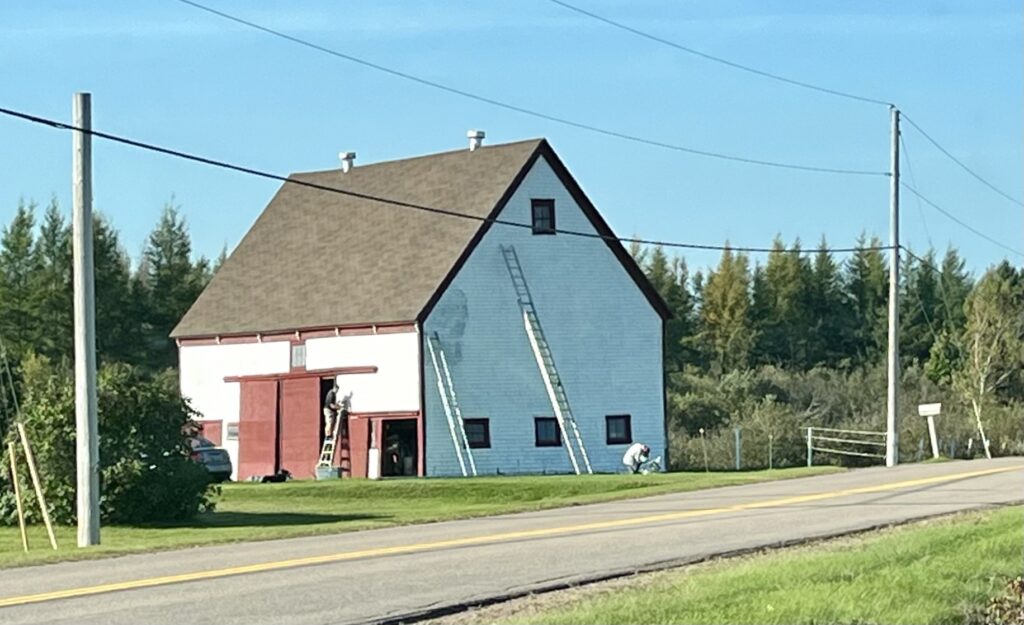
I happened upon an historic moment while driving home the other day: the painting of the Williams barn in Poplar Grove. Built around 1865, it is certainly one of the oldest barns in our area, if not the province. It was built by my great-great grandfather, Robert Williams, and is owned by his great-grandson Robert, known as Robbie. Robbie and his wife, Sandra, have taken loving care of both the original house and the barn.
While the survival of the barn is notable, the fact that it is still being used for more or less the same purpose as when it was constructed is a miracle. Robbie has harness racing horses, at least two at present, and also keeps chickens, and it is almost certain old Robert would have had both types of animals as well, and probably also a cow and pig. Many old barns and outbuildings are no longer used for animal husbandry, so it is lovely to see the barn still proudly fulfilling its original purpose, and it shines now with the new coat of paint.
Perhaps I should have stopped closer to the barn to take the photo, but I like the idea of seeing this from afar, through time. Take away the light poles, wires and pavement and you could almost imagine this was 100 years ago.
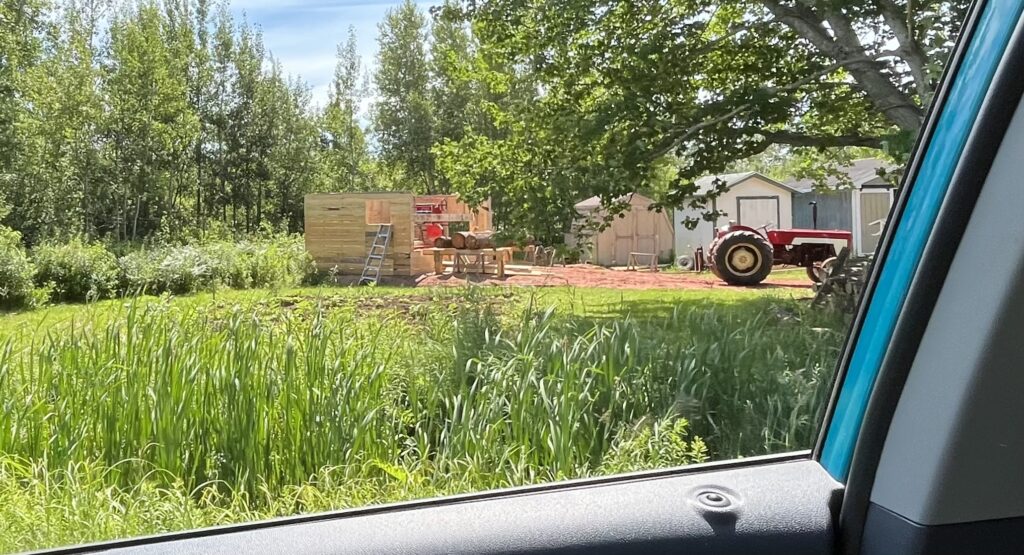
Another recent project in the area caught my eye a couple of years ago, and led to another from-the-car photo. An industrious man who lives not far from us builds small hip-roofed baby barns to sell, and nearly always has one on the go in his front yard. In 2022, I noticed a concrete pad had been poured near his vegetable garden and wondered what he was going to build. A portable saw mill arrived and was placed on the pad a few weeks later, and soon he began sawing logs into lumber.
A mill is better preserved and more useable under cover, so how do you build a building for a sawmill? You saw the logs yourself, of course, and build it around the mill.
The building soon had a roof, an opening at the front to roll the logs through from the stand you see in the photo, and a door for the operator to use. The baby barns are now being built using some of his own lumber, in the old way. The family sadly had a fire in their house and have been under reconstruction for the past year, so no doubt the sawmill has come in very handy for that project as well.
When did people start carrying cups of coffee around with them all the time? I can’t remember, though I know it happened in my lifetime. It certainly wasn’t something my parents did. I started drinking coffee in my early twenties, so in the late-1980s, but don’t remember walking around carrying a coffee cup everywhere, and never really got in the habit of doing so.
I’ve thought about this a lot: when did we go from being people who drank coffee at home, and in coffee shops or restaurants, to people who move through the world tethered to coffee shops like Tarzan swung through the jungle, swinging from shop to shop? Visiting Tim Horton’s has become a quasi-religious act in Canada, the doughnut and double-double the Eucharist. Father, son and honey crueller. If you don’t drink Timmie’s and watch hockey, are you really Canadian?
In the “Things Have Change But I Can’t Remember When” category is the impression I have that the Christmas season starts earlier and earlier each year. I think that when I was a child, people were sensible and talk of Christmas only started on December 1, but I realise that’s probably a false memory, or wishful thinking that we could revert to living only in the season we are in: enjoying the present, not anticipating the presents!
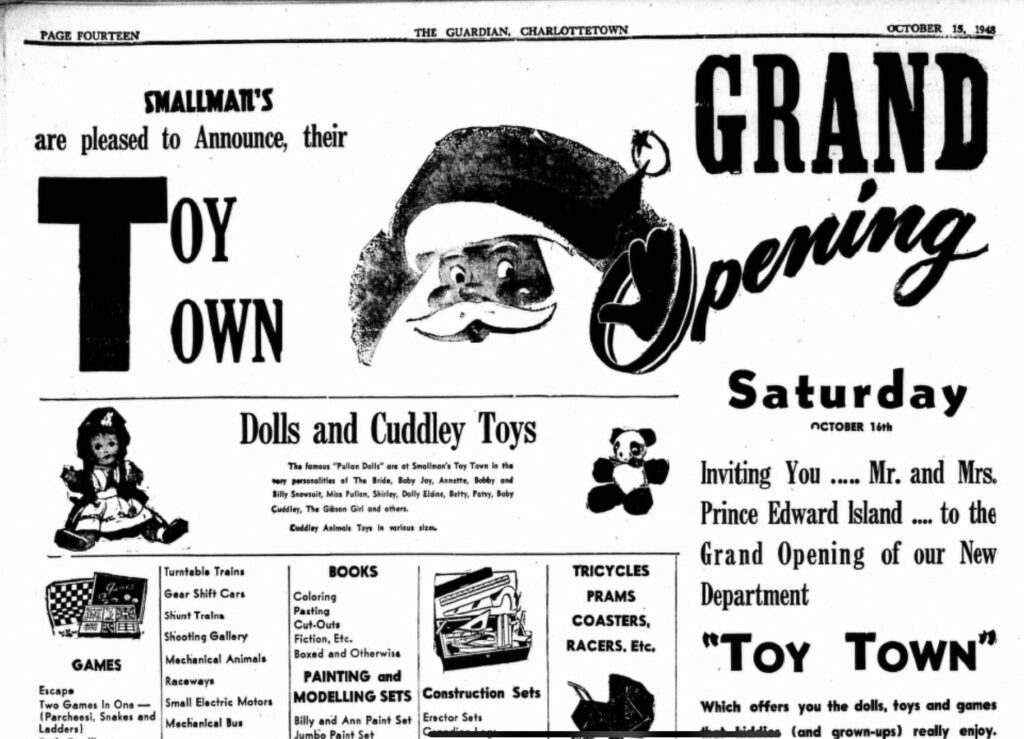
Proof of my false memory is found in an October 15, 1948 ad heralding the opening of Toy Town at the Summerside department store, Smallman’s. They couldn’t resist sticking Santa on there, his happy grin silently but powerfully sanctioning the quality of the store’s offerings.
Smallman’s was still in business when I was a child. We shopped mostly at their larger rival, Holman’s, just down Water Street, but sometimes we ventured into Smallman’s for sales or to visit their lunch counter. My father had worked in their warehouse before the Second World War when it was called Sinclair and Stewarts, so he especially liked going back.
Their main floor was one huge room, with office windows overlooking the sales floor. When you wanted to purchase something, a handwritten bill of sale was created, you gave the sales clerk your money, and a copy of the bill, along with your cash, was put into a small box that was put on a little railway-type system that took the money up to the cash office. Any change required was put back into the box, along with a receipt marked paid, and it clattered back down to the clerk. The fun of watching the little boxes zipping up pillars and along the ceiling was endlessly fascinating, really the best part of going there.
I had the pleasure of attending a presentation this morning on the progress of a written history of the village of Tyne Valley. My friend Carolyn McKillop, who grew up in Tyne Valley, has been doing research for years, and has amassed a jaw-dropping collection of photographs and information. It was a nerdy delight to see her incredibly well-organized records.
She has joined forces with Gary MacDougall, another Tyne Valley native and former editor of The Guardian, Charlottetown’s daily newspaper. The meeting was as well organized as Carolyn’s research, and both of them gave an excellent overview on what they have accomplished.
Item Five on the agenda, “Dreaming of time”, had Gary’s name next to it. He said he had been thinking a lot about time recently, perhaps because he is getting older. He admitted what he was going to say might sound a bit “out there”, but he went on anyway, as he was amongst family and friends, and said he feels that the people and events from the past are still here with us somehow. He called it the Cosmic Filing Cabinet, how the memories and events of the past are just filed away, waiting there for us to discover them. In the midst of a meeting of the practicalities of creating a community history, he offered a short, beautifully poetic aside about trying to understand his place in time.
Now, Gary is my second cousin, so perhaps there is some genetic resonance at play here, but I’ve also been thinking about time a lot as well, and in a similar way. I find myself time travelling, almost forgetting that those I love who are no longer physically here actually are. I’m not seeing ghosts, nor am I lost or having delusions (I hope!). Time is bending, and I find myself pulled from it, suspended and observing it, and then dropping back down into the stream of time.
It started one winter night a couple of years ago while I was driving home from another meeting in Tyne Valley, as it happens. Warm light was glowing through house windows, and it struck me that the light I was seeing was more or less the same kind of light I would have seen 50 years ago when I was a child being driven along the same road. The houses had memories, were doing the same things as they always had, looked the same way. Different people inside, in most cases, but that wasn’t evident from the road. It could be 50 years ago, it could be now, it could be 75 years in the future. Time didn’t matter.
I passed a house that had belonged to one of my great-uncles and pictured him sitting inside it watching television. I passed the store and house that had belonged to my parents and could see them in both, quick flashes of them as young people. Then our immediate neighbours doing their evening chores in their barns and kitchens. There were no figures in the windows, but the light was timeless and transported me away.
If I’m feeling out of sorts, discouraged or overwhelmed, I have learned to open what I guess I’ll have to start calling my Cosmic Filing Cabinet and pull out a good, warm memory. I can put myself back in my childhood bedroom, all Barbie pink and filled with stuffed toys, my ginger cat asleep at the foot of my bed, listening to adults murmuring and laughing in the living room after a dinner party. I know where every light switch is in that house, what was in every drawer, how the basement smelled, what could be seen from every window. I can go back and be there and find the security and comfort I was so fortunate to have as a child, no worries or concerns.
As Gary said, a human lifetime is but a blip in the history of the universe, but it matters. We are creatures who are bedevilled by the knowledge that our time is limited, but who look for meaning in spite of that knowledge. We just need the key for that filing cabinet.
Freeland Presbyterian Church, December 24, 2021. Generations of my family have worshipped here, their prayers and songs clinging to the fine polished wood interior.
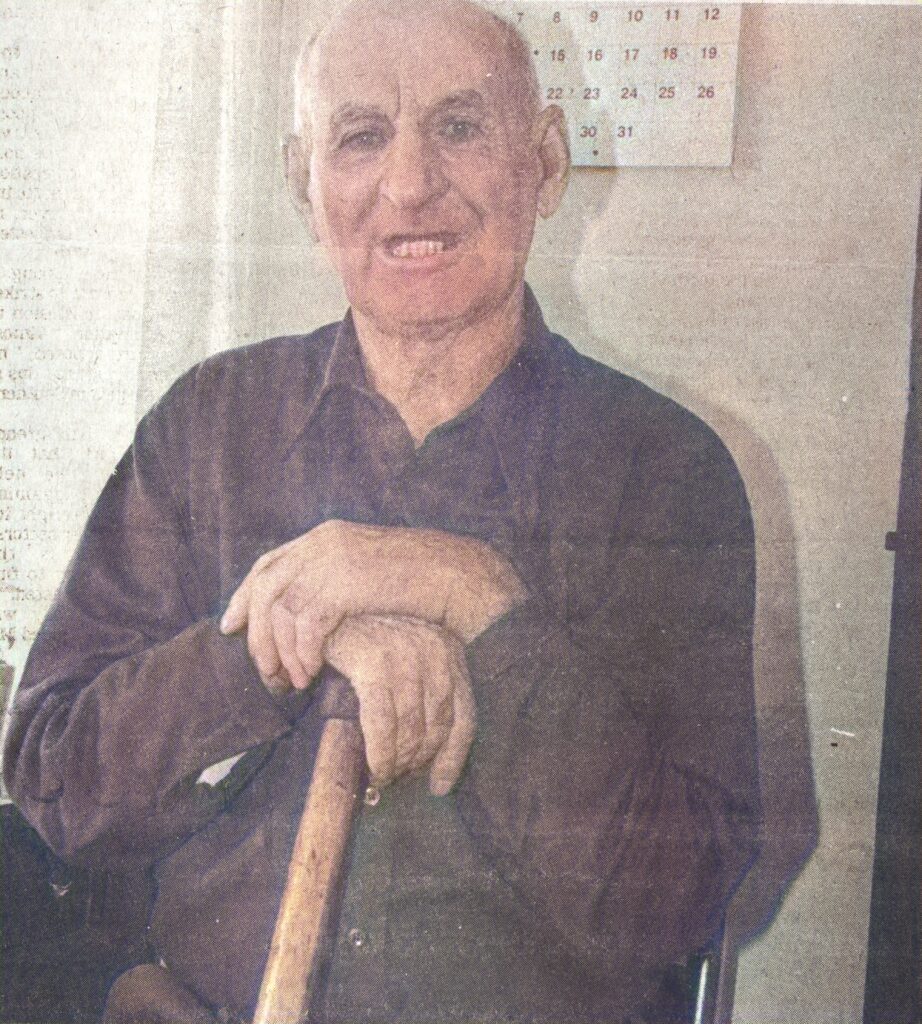
Was digging through our archives (a grand word for the loosely-organized piles of boxes in our basement!) and found this article about my great-uncle Everett Hardy. He was a lovely fellow who was able to rhyme off stories, facts and figures nearly to the end of his 94 years. He was from another age, steeped in stories of the sea, both tales of his own escapades and from the books and National Geographic magazines that he read.
My mother says the local doctor of her youth, John Stewart, said that if Everett had been able to have a good education, he could have been a lawyer (high praise in a time when lawyers were still mostly universally respected). As his parents aged, Everett gradually took over much of the business side of their cannery. He had a head for numbers, and remembered lobster prices and catch sizes decades after the fact.
The reporter who captured Uncle Everett’s tales was Debbie Horne of the West Prince Graphic weekly newspaper. She left the paper quite a few years ago, but was a fixture in West Prince for a long time. If something was happening in our area in the 1980s and 90s, you could be sure Debbie would be there, along with the West Prince reporter for the (then) daily Journal Pioneer, Eric McCarthy. How lucky we were to have that amount of coverage of our small communities. They had to cover everything, from fishing and farming to crime and human interest, and they both did it well.
I have a poor recording of Uncle Everett from about a decade after this interview, which I transcribed a few years ago. He used phrases and pronunciations that have died out of common usage today, as does my mother. He mentions a type of ship called a schooner in this article, but he never pronounced to rhyme with “tuner”, more like “gunner”…it’s difficult to describe. Ask me sometime and I’ll say it fer ye!
His deep interest in the natural world filled him up to the brim, so much so that in his later years, his love of the world and all that was in it would choke him up as he spoke. No gentler, kinder man has ever lived, and I’m glad someone took the time in 1983 to record his tales.
The photo of Uncle Everett from the newspaper article, colourised with PhotosRevived, also part of Setapp. Uncle Everett usually wore dark work clothes, so the colour of the shirt and homemade walking stick is remarkably accurate. As this photo was taken in March, I see his long-sleeved undershirt peeking through his sleeve, though the house was always boiling hot from a wood furnace!He was sitting in his bedroom, where he spent many hours in a rocking chair looking out at Freeland Creek below his house. On top of the dresser to his left was a globe, and he kept Wrigley’s chewing gum in a drawer to give to us children.
A technical note for anyone who transcribes newspaper clippings: I’ve been using TextSniper for the past few weeks to capture text from PDFs and photos, and it is a helpful little app that sits patiently in my menu bar waiting to be triggered. I recently found the toggle to prevent it from adding line breaks, which has saved me a lot of editing when copying text from newspaper columns, and now I love it even more! It’s part of Setapp, a subscription plan I ignored for years but decided to try when RapidWeaver came up for renewal and I realised it was part of Setapp. There are 240+ fun and useful tools that all seem to work really well. I’m just sharing my Setapp experience – I don’t monetize anything on my website, so you won’t make or break me if you do-or-don’t click!
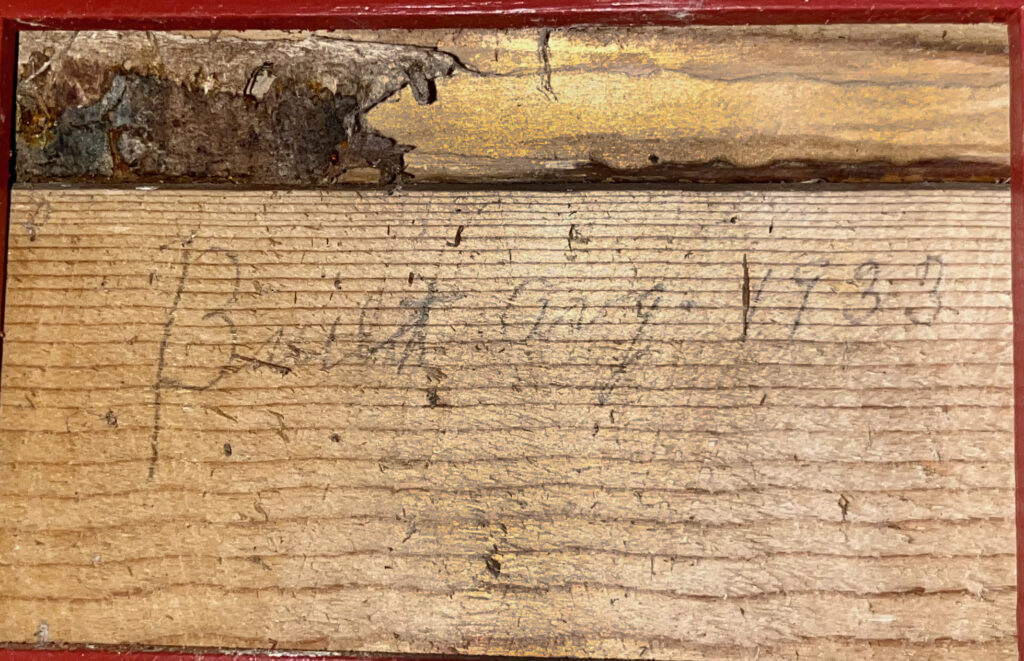
I’ve spent the past few days immersed in the history of Cedar Lodge, the log cabin that sits next to our house. The man who had it built, Senator Creelman MacArthur, marked the grand opening 90 years ago today with a big party.
Someone put the date on the outhouse wall!
Almost everything I’ve been reading, including the newspaper report of the opening I’ll add to this post, talked almost exclusively about men: the various owners of the land, those who built the cabin, those who participated in the opening day event.
To be fair, a rustic log cabin designed to be a hunting and fishing lodge had manliness baked into it. I’m not sure what furnishings and decorations were in Cedar Lodge on August 30, 1933, but when my parents acquired it there was a stuffed moose and deer head leering down from the wall, rifles and fishing rods on racks in the corner. The pine floor was pretty beaten up by the time I came along 33 years later, so it probably had become a fair target to spit tobacco juice on during the years it was rented out to hunters and fishers. The huge stone fireplace was a perfect spot to gather around and tell tall tales, kerosene or gas lamps pushing out moody, flickering light. A man cave for men in flannel and rubber boots and wool caps.
The Cedar Lodge grand opening activities had been scheduled to kick off at 3 pm with the ladies from nearby St. Peter’s Anglican church catering a tea. Had my mother’s mother, Thelma Hardy, lived a few more years, she would have been one of those ladies, and no doubt my 11-year-old mother, Vivian, would have been there, but that wasn’t to be.
So at about a quarter to three this afternoon, my mother and I talked what would have been going on in the kitchen 90 years ago. We imagined the efficient bustle of the women who would be pumping water, stoking the wood burning range, moving dishes and setting up tables. We guessed they served sandwiches and sweets, rather than a meal, but can’t really know.
One thing I would bet money on is that just before 3:00 there would have been a pause in the preparations. A big pot or urn, filled to the brim with the sweet water that came out of the hand-dug well, would have been the first thing placed on the stove when the women had arrived and started the fire in the stove. Once boiled, it would have received a homemade cotton bag filled with loose black tea.
When it had steeped for a while, one of the women would have ladled a bit of tea into a china cup, and the women would have stopped what they were doing and gathered around to look in the cup.
Is it too weak? Too strong? Opinions would be offered, and if it looked okay, a dash of milk would have been added and the cup reexamined to see how the brew held up to the milk. If thought to be the right colour, the woman holding the cup would have had a sip, declare it to be fine, and the tea bags promptly pulled from the pot.
How can I be certain of this one detail, as sure as if I’d been sitting in the corner watching this take place? Because every church supper, tea or reception I’ve ever helped with in my 56 years has had the same ritual. It is a holy rite, an echo of the eucharist, the priestess drinking the remaining tea with a tip of her head, washing the cup, wiping it dry to use for the main event.
So hooray for Cedar Lodge, and the men who built it. My family have enjoyed taking care of this unique structure for 67 years, and have made so many lovely memories sheltered within its cosy walls. I’m in it now, typing by candlelight, as heavy rain pours loudly onto the uninsulated roof while the thunder roars.
And hooray for the unnamed women who fed the crowd that day, who were quietly in the kitchen performing secret, holy rites.
Three of our friends doing dishes after a party in the Cedar Lodge kitchen, 1965
From The Charlottetown Guardian September 7, 1933, page 2
The historical old home of Hon. James Warburton at Freeland, Lot 11, was the scene of a happy gathering on Wednesday afternoon and evening for the opening of Senator Creelman MacArthur’s new Lodge.
This beautiful estate once the scene of great activity in the old shipping days once more rang with the laughter of a happy care free throng enjoying the many pleasures provided by the Senator.
In the old days when ships would be launched at the very spot where the Senator has his Lodge, no doubt the villagers enjoyed themselves in just such a fashion.
One old gentleman, Mr. Thomas L. Murphy, recalled that on one occasion, when Charles McKinnon, a large shipbuilder, was in such a hurry to get a ship named Silver finished and ready for its ocean voyage to the old country, that he had her full rigged on land and when the ice broke and she was launched, she proved to be top heavy and toppled over and about a hundred people were nearly drowned. This was a three masted schooner, one of many schooners built at Foxley River in those days, rigged on sea and loaded with produce for England. Upon their arrival in the old country they were sold. Many old tales were told, by the old inhabitants of the district, of the activities in those days. The old store kept by Michael Kilbride in 1843, which was later moved down the ice to John Yeo’s place at Port Hill, and which is still standing in the yard of Roy Ing’s, was mentioned. Records in the books of the store have the names of many of the first settlers of that vicinity. Among the records is an account of articles purchased for the Officers Mess of the Rifle Brigade of P.E.I. amounting to £4, 7. 4 1-2.
Mrs. William Palmer, daughter of Alexander McKay who ran the mill on the Warburton estate, is the only person now living who was born on the estate. She told how when a little girl she would sit on the shore and herd the cattle for her father.
This old place presented a pretty scene at twilight with the sun setting over the water and the Lodge, decorated with spruce and fir, lit up with many coloured lanterns.
At seven o’clock a dance officially opened the lodge and the visitors to the strains of a fox trot enjoyed the hospitality of Senator McArthur and his daughters, who extended a cordial greeting to all. During the afternoon the visitors strolled about enjoying and admiring the beautiful scenery. Many took advantage of the boats placed at their disposal, and went for a sail on the river.
The ladies of St. Peter’s Anglican Church served tea on the grounds.
After the opening dance at seven, Mr. James McLean, of Freeland, the Senator’s right hand man, called for speeches.
Among those speaking was Mrs. Oscar W. McCallum, of Saskatoon, daughter of the late Donald Nicholson of Charlottetown, who said it was a great pleasure for her to be asked to speak at this historical place, one of the beauty spots of her native land.
Other speakers were Mr. Herman Bryan, former owner of the property; Mr. A.. E. McLean, MP.; Mr. A. J. Matheson, O’Leary; Judge Inman, Judge of the County Court of Prince County; Mr. J. F. Arnett, Summerside; Mr. A. A. Ramsay, a native of Freeland; Mr. Reginal Bell of Charlottetown, and Mr. Thomas L. Murphy of Freeland.
All spoke of the generosity of Senator McArthur, who had shown a very cosmopolitan spirit in throwing open their lovely grounds to the public; which in these times of depression is the right example to set, to any one who has the means and opportunity to do so.
Senator McArthur in response to the three cheers and tiger that went up from the crowd when he came forward, said that he had purchased the property for the benefit of the community and not for any commercial gain.
He intended to stock the waters with trout so that trout fishing could once more be enjoyed as in days gone by.
The grounds would be at the disposal of any community or church of any denomination to hold picnics and social gathering at any time. He wanted all his neighbours in Freeland to feel that they could come and enjoy the quiet walks and bathe or dig clams whenever they chose, and he added, that he especially wanted the mothers and children to come and spend many happy afternoons in his spacious grounds.
This concluded the formal part of the program.
A huge bonfire was now set on fire which lighted up the country side for miles around.
The crowd then gave themselves up to the entertainment of the evening and dancing in the lodge was in full swing.
About 11 o’clock when the harvest moon was shining over the waters, another bonfire built like a haystack in the stream was set going and made a never to be forgotten sight. The dancers paused as if fascinated, the moon on the water with the reflection from the fire lighting up the woods in the background, making an enchanting scene. The merriment was kept up until quite late and closed with singing “For He’s a Jolly Good Fellow.”
Besides the people of the surrounding districts, friends from Charlottetown and Summerside were among the visitors. —S.
Sunset view on the shore next to Cedar Lodge, August 28, 2023