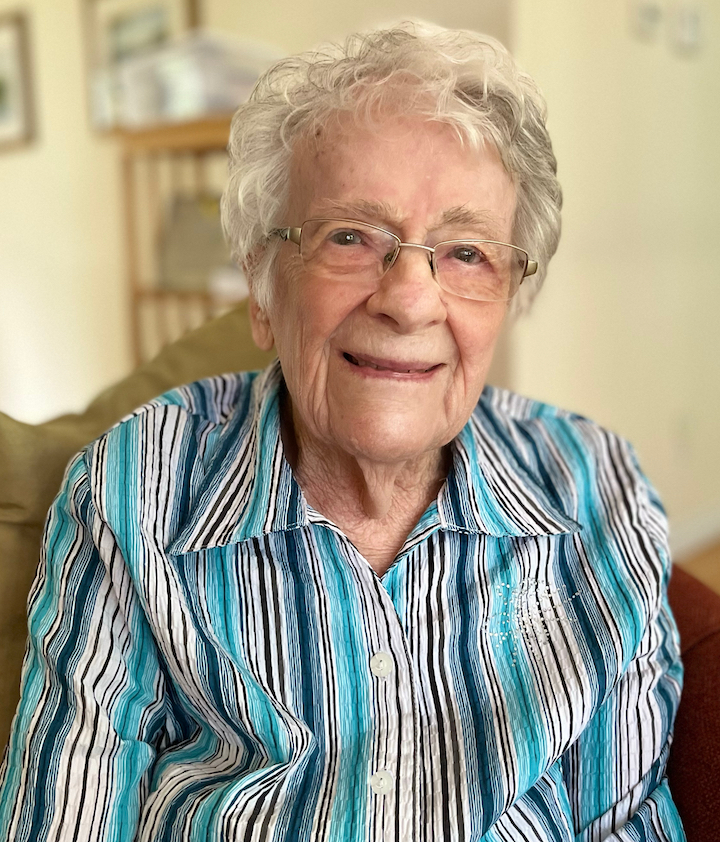
One of the joys of being my mother’s daughter is acting as the courier of her kindness, most often as the deliverer of baked goods to family and friends, and even sometimes to strangers. From a young age I was often sent to neighbours with fresh muffins or bread or whatever had emerged from her oven just because she thought they needed a treat, casseroles and dishes of soup to those unwell. She did the work, but I received the thanks and could bask in her goodness; I have slid far on her cookie diplomacy!
Last week I delivered some of my mother’s Christmas baking to a friend, who had a little card and gift waiting for me. It is a beautiful pine needle basket made by an artist from Maine called Morning Star Wolf. My friend said the basket might look empty, but it was filled with gratitude. What a gift.
Peter captured so beautifully the rollercoaster that November is for me. I always find this time of year a bit unsettling: the shorter days, the cold north wind after the tease of a warm day, the chores I should be doing and can’t get to, the looooong lead up to Christmas, the passing of another year.
It’s probably not a surprise to anyone who has read along with this blog that I am often thinking of times past, but lately the people who are long gone are gathering around me in ways I’ve not felt before. Most days I drive by the houses where generations of my family have lived and I picture them inside, or working in the barn, or standing by the road chatting with a neighbour. These houses are empty, uninhabited, so available for my imagination to fill them again. It is comforting but strange, as if something happened on All Saints’ Day this year that released them back into the world. I’m not going mad, but perhaps there are things I need to learn from these people.
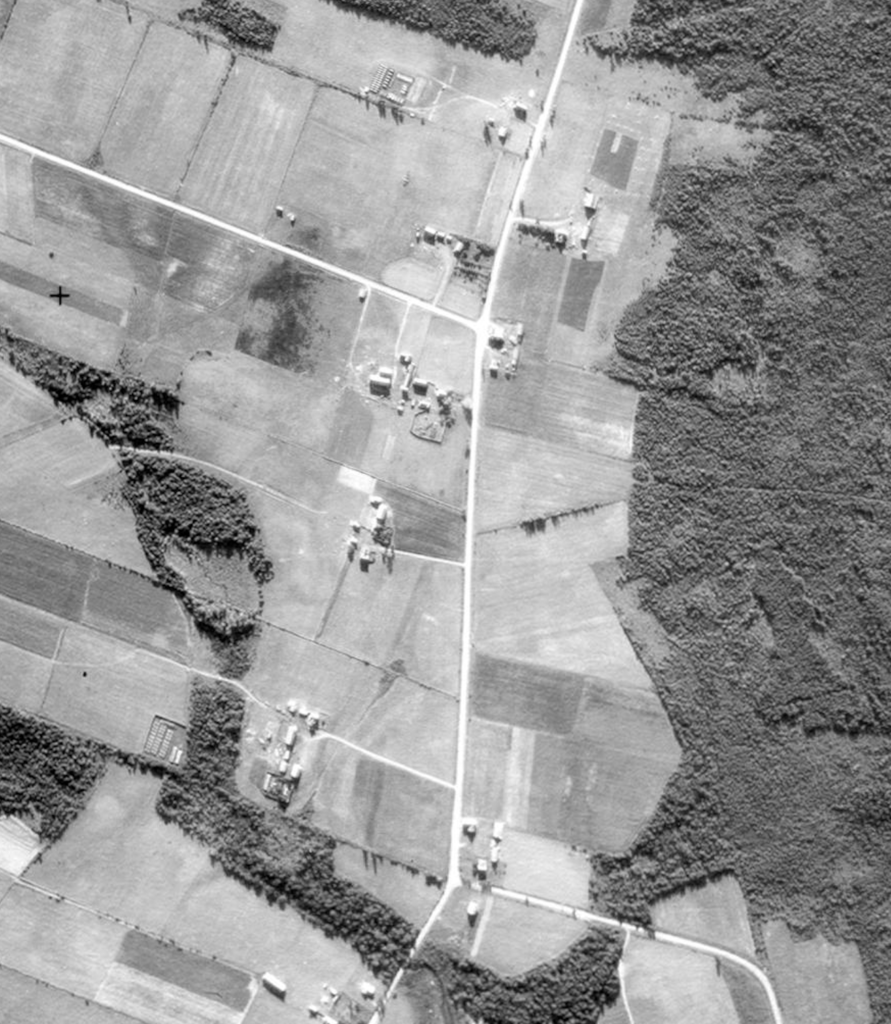
Freeland 1935. My grandfather has stooks of grain in his field at the top of the photo, and my mother is living with her grandparents at the farm in the bottom, on the corner of the Barlow and Murray roads.
Last night as I was heading to bed well past my normal bedtime, I noticed the orange crescent moon climbing up the red pine tree to the east of our house. I went closer to the window to see it better and a shooting star dashed past. I noted Jupiter and Saturn marching across the sky, and suddenly another star fell straight down, grazing the moon. I felt sucked into the night sky, away from here and now.
I imagined my grandmother, Thelma, also awake late on August 19th but in 1922, looking out her window only a couple of miles from mine, waiting for her first child to be born the next day, my own mother, Vivian. Thelma had been orphaned as a tiny girl and married my grandfather Wilbur at an age we would think young now. After one more long night, she would have a family again.
We had an open house party today at the old school in Freeland, again only a mile from where my mother was born, to mark her 100th birthday. About 150 people attended, people who have known my mother from as far back as the early 1940s and some who met her only last month. Cousins brought tiny babies, passing them from one loving set of arms to the other, held them up next to my mother to take a photo on this milestone day (“You once met a lady born in 1922, she held your hand, here’s the proof!”). I watched as people from different parts of our lives made the connection that they both knew my mother. Planets colliding, stars streaking past.
Today my mother was able to receive the good wishes and love of others, and what an overwhelming and humbling experience that was for her and me. How often have we wished that we had told someone how much they mean to us, but it is too late. Everyone had their chance today, and they arrived with full hearts and words of respect and love.
Perhaps all the unnatural separation we have endured over the course of this pandemic needed to burst today, people wanting to connect again, to have community, to love and be loved.
There were so many people at the party I couldn’t possibly talk to them all, but those who I did speak with (all the time still wearing my mask, because this party was not without risk, something I weighed over and over as I considered planning a get together during a still-active pandemic) spoke of my mother’s inherent kindness, faithfulness, goodness, industriousness. The love for her nearly lifted the roof off the old building, the vibrations of family and community connection humming and dancing through the walls and back up to the sky.
When I returned to PEI 20 years ago, someone remarked I had big shoes to fill, but I know I will never be her, never come close to having her impact, though as her only child, I have certainly tried to model my own way of being in the world on how she has lived her life. She has taught me to think of others first, and to always stay true to what I believe in. To be welcoming, warm hearted, cheerful, helpful and kind. I try to work hard and see the good in others. If I have the choice to do more or do less, I do more. Seize the day, move forward, and laugh.
My mother was tired after all the intense attention when we returned home at 4, but by late evening, reading through some of the cards she received, she remarked that it had been a good day, and she only felt 25, that we must have been wrong about the date. That, dear readers, is how you get to 100.
Great Uncle George Harris gets a mention in the June 14, 1922 The Charlottetown Guardian. Nice to know he was well-liked, and not, as you might try to decode, a salesman for the Popular milk company, or from Popular. Pretty sure he worked for himself, milking the cows and bottling the milk.
His improved home still stands on the outskirts of Summerside, the barns that held his milk cows more or less intact. That end of town is still farmland, but not for long, as businesses continue to move to the north end.
My mother stayed at George and Carrie’s house on her way to enlist in the RCAF 79 years ago (Carrie was the youngest sister of my great-grandmother, Eva Hardy). George drove my mother from his house to the Summerside train station in his horse and milk delivery wagon, where she caught the train to Moncton and then on to do her basic training in Ottawa.
Also in today’s 100-year-old paper was the obituary of my friend’s great grandmother. I knew more people in the antique edition that in the one published today!
Mrs. McKenna died just a few weeks after her son, Philip, was killed working on the railway near his home in Conway, PEI.
Reunion, the software I use to keep track of my family tree, has a handy feature that allows me to see dates of family events in Apple Calendar. I’ve added one for birthdays and one for death anniversaries, and I appreciate being reminded of those still alive, and those long gone but still part of my story.
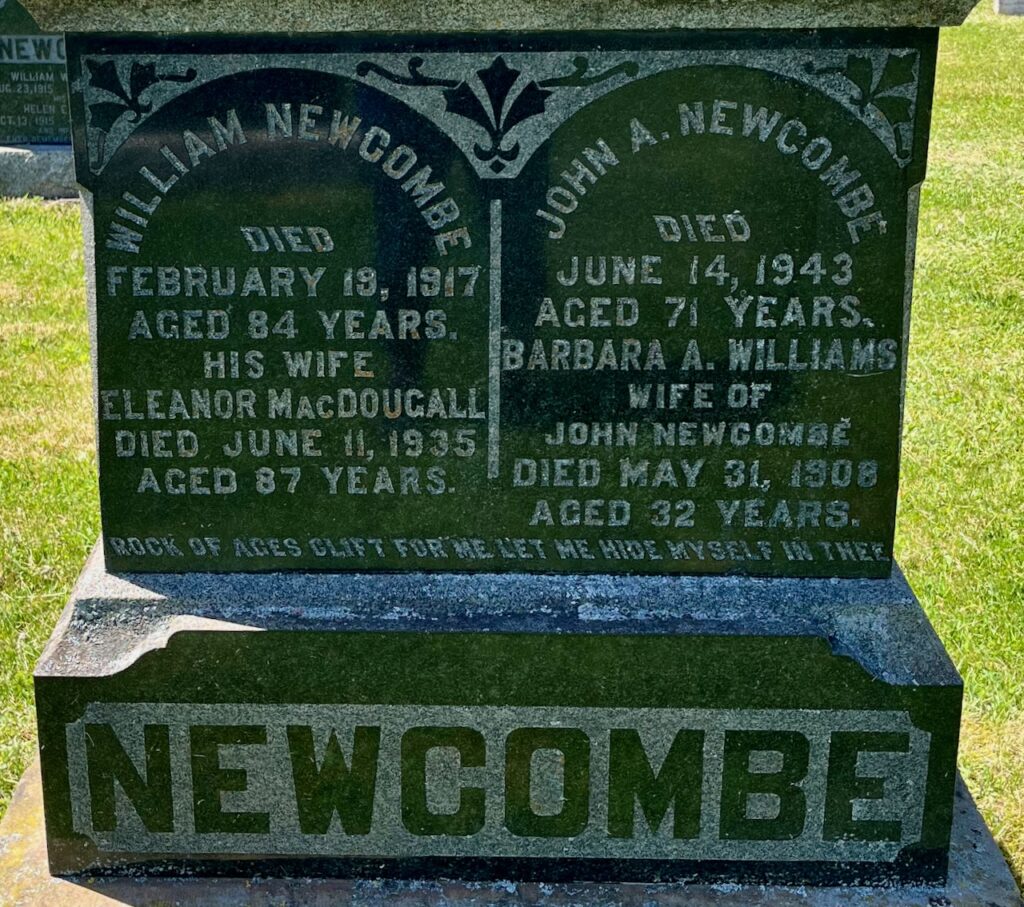
Today I was reminded that my maternal great-grandmother, Barbara Ann Williams, died on this date in 1908. She married Patterson Hutchinson in January 1900, in what is said to have been the first wedding at St. John’s Anglican in Ellerslie, a beautiful little country church built by Barbara’s brother, the renowned “Fox House” and church builder “Little” Harry Williams.
They had three children: my grandmother, Thelma, born in 1901, her brother Stanley, born in 1903, and a second boy, George, who died at birth in 1904. In 1905, Patterson died, aged 37.
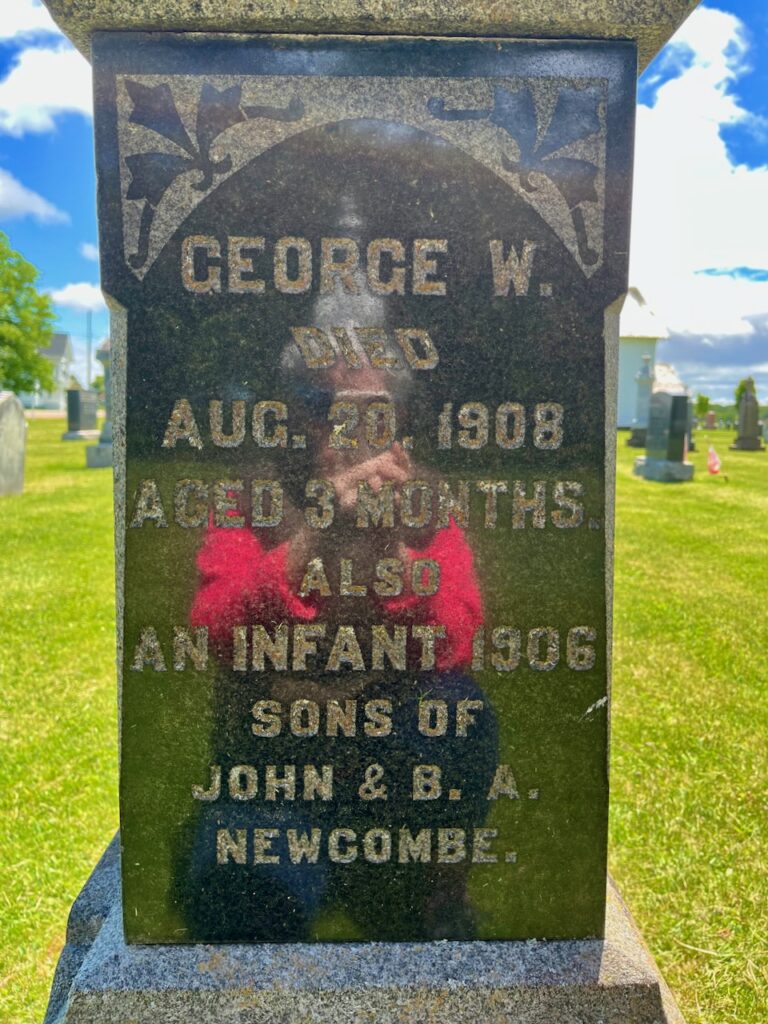
Barbara remarried eight months later to John Newcombe from Northam, just outside Tyne Valley. As far as I know, it was his first and only marriage. Barbara and John had three children: Lillian, John and George. John died at birth in 1906, and George died in August 1908, three months after his mother, who quite possibly died giving birth to him. Lillian seems to have married a Roderick MacLean from Lot 16 in 1926 and died in 1957. Lillian may also have really been Patterson’s daughter and adopted by John Newcombe, but I can’t yet confirm that.
According to 1911 census records, John Newcombe and daughter Lillian had moved back with his parents. His step-children, Thelma and Stanley, were listed in that census as living with their uncle Little Harry and his family in Poplar Grove. I have no idea if my grandmother, Thelma, kept in touch with the Newcombe family, but she died in 1927 aged 25 and, in a sad echo of her mother’s life, left behind two children under the age of 4: my mother, Vivian, and her brother, Edgar.
Genealogy is generally pretty straightforward: I had parents, who had parents, who had parents, back and back to the cave or the savannah (or the Garden of Eden, if you are so inclined). But drop down in the middle of some of these stories, and witness the happenstance that kept people alive just long enough to give birth to a child that is key to your existence, and life seems even more miraculous. All of our ancestors successfully bobbed and weaved just long enough, and here we are.
Barbara Ann Williams Hutchinson Newcombe, Saint James Anglican Church Cemetery, Port Hill, PEITwo little boys gone too soon.
A lovely home care nurse just visited, on what is generally a holiday for most people, to give my mother her second COVID-19 vaccine booster. While she waited to make sure my mother didn’t have an adverse reaction to the injection, we had a great chat about health care and the changes to home care over the years.
The PEI Home Care Program is one of those health care services that most people don’t know much about until they are thrust into a situation where they need it. They provide a wide range of services, from nursing and personal care to physiotherapy and adult day programs. My mother only started to receive visits from them last year, and it has been a wonderful help to our family.
The Summerside office has had a health equipment loan program for many years, so if you need something like a walker or commode chair on a short-term basis, you can get one free of charge from their collection. The equipment must be kept in excellent shape, so requires fairly frequent replacement, and some things are quite pricey.
Being part of a couple of groups who raise funds for health care needs, I asked how easy it was to get the funding from government to keep that equipment updated. She said they actually get a lot of the funding from something called the Hinton Fund. I asked if that was connected to former Summerside lawyer Richard Hinton, and she said it was.
After the nurse left, I explained to my mother about the Hinton Fund, and the connection to Richard Hinton. Then I thought about today’s date, and realised it was 66 years ago today that my father, Harold, bought the property where we now live. The lawyer who did up the paperwork was Richard Hinton.
Hinton’s law office was on Summer Street in Summerside, a lovely old house I have been in a few times as our current lawyer once had his office there. Only recently did I learn that the house was built by my GGG uncle, Robert W. Sharp, brother of my GG grandfather, the fabulously-named George Washington Sharp. More PEI connect-the-dots!
Steven and I moved to PEI on May 1, 2001. There was so much snow at our cottage, where we spent that first summer, that my mother had to hire my cousin to clear the lane with his tractor and snowblower. Collective amnesia and too much British pastoral poetry in our education system makes us believe that May 1 in PEI should be all spring flowers and tea on the terrace but, like this year and 2001, it’s often not.
While I’m considered to be from PEI (though regarded with slight suspicion by some because I spent nearly two decades in other places), Steven is, and always will be, “from away”, a term hated by some people who move to PEI and feel they are never really accepted. I get it, and try not to use it for fear of offending someone. I’m really from away, too, not being Miꞌkmaq, and if I was living where many of my ancestors were from, I would be having tea on a terrace in Devon or Dorset.
I heard one of the members of the band Wet Leg talking about growing up on the Isle of Wight and how people who are not born there are called overners, I suppose because they are from “over across”, as we on PEI sometimes refer to the mainland. I am an Islander with overner traits, I guess.
My father, Harold, would have turned 100 years old today. He was born at home in Ellerslie, PEI, the fourth of five sons of Alvin and Gladys (MacNevin) Phillips. He was a hardworking, honest, reliable, clever man. He spent four years in the RCAF during the Second World War, then became a successful businessman and community volunteer.
The one-room Ellerslie school only offered classes up to grade eight, but some children moved to larger communities to continue their education. This wasn’t possible for my father as Alvin died when my father was only 13, so the boys all had to find work as soon as they could. My father moved to Summerside and worked at a large store owned by his uncle, but his real dream was to go to business college. His uncle promised that if he worked hard at the store, he would help my father with the tuition for business school. Knowing my father, he would have worked very hard, and was keen to attend school.
The Second World War interrupted those plans, and my father enlisted when he was 19. When he returned to civilian life, his uncle had kept his job open (as was the law, of course), but the offer to send him to business school was no longer there, for reasons I never learned. My father worked for his uncle for a few months until the opportunity to purchase his own business came up, and he and my mother, Vivian, moved back to the community where she was raised and started their general store.
Although my father was successful in many ways, he always regretted not having a more formal education. He spent 13 years on our regional school board, and probably because of his own experience, he was driven to improve school retention rates, which were pretty dismal when he joined the board in the early 1970s. Many students, especially young men, were leaving before high school graduation because they knew they were destined for lives of farming or fishing and thought there was no need for any more education. My father was proud of having been a part of establishing a new high school that offered both academic and trade courses under one roof, and retention rates quickly improved. He wanted young people to have all the opportunities that had not been available to him, and saw education as the key that opened all doors.
My father was able to move beyond any resentment he may have had towards his uncle and made a good and purposeful life for himself, and was also able to help others. To his great surprise and delight, my father was asked by Holland College to teach a business course on Lennox Island First Nation in the early 1980s. He taught a dozen students all he knew about running a small business, knowledge he had to gain on his own, and he was so proud to have something to offer. I was in high school when he was teaching, and remember him organising the graduation dinner for the course, taking care to ensure that the students knew how special they were.
My mother and I decided to honour my father’s legacy in education by establishing an endowed bursary in his name at Holland College for students from our area who will be studying business. The first award was given out last year, and it is thrilling to know that his hard work will ensure that others will be encouraged to follow their dreams. He died in 2008, and suffered with dementia for many years before his death. It has taken a long time for us to get past the heartbreak and struggle of his final years and see again how truly remarkable he was. Time heals.
Today I decided to try out the new bus service for western PEI. There are both intercommunity routes connecting towns in West Prince, and long distance runs to Summerside and Charlottetown. I chose to go to Summerside and took a late morning bus (which ended up being a large passenger van) from the West Devon carpool parking lot to uptown Summerside. The trip took just under an hour, cost $2, was quite comfortable, and there was only one other passenger.
The main drawback to the service at this point is a distinctly user-unfriendly online schedule, which I managed to figure out with a bit of persistence. As a non-driver who has lived in rural PEI for over 20 years, and only gets to town when my wife, Thelma, is driving there, it was a novelty to be able to make the trip on my own. “On my own” for most of the way, at any rate, because the other challenge of the service is that Thelma had to drive me to the pick-up point because it is too far to walk to from where we live. But baby steps, so to speak, since PEI has no real culture of public transit.
The trip back to West Prince was a different story, with a roomier bus and more passengers being picked up at the Summerside Tax Centre and Slemon Park, workers who were on their way home at the end of their day. The driver informed me that for a relatively new service (the transit service on the eastern end of the Island has been in operation for two years and is well used), the “Up West” run was quickly being adopted, mostly by long-distance commuters.
I plan to use the transit system as much as I can and keep my fingers crossed that the powers that be get the message that rural public transit is something our Island is in dire need of, and deserves as much support as they can give
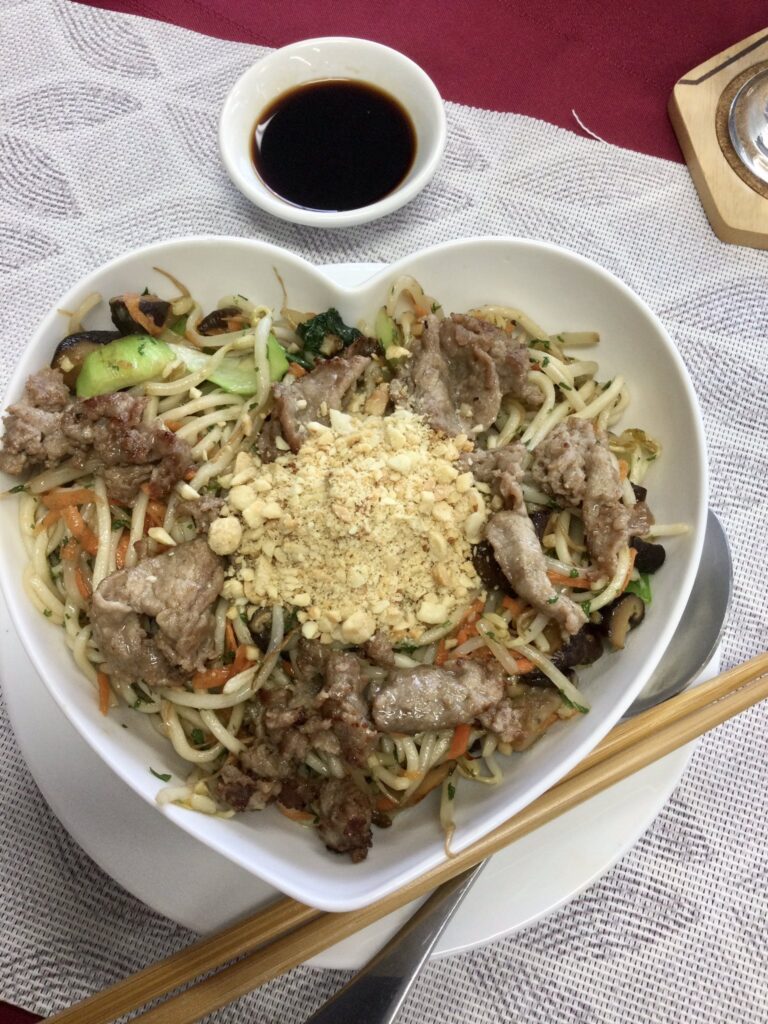
Steven’s lunch at G&T Book Cafe, 30 Spring St., Summerside.
My father always carried a notebook and pen in his shirt pocket, even after he retired. At the same time my parents were running their general store, he was also a partner (with his brother) in a garage and car dealership, and he delivered propane gas. There was a lot to keep track of.
I came across a tiny notebook of his the other day that I had never seen before. He had used it to record the sale and delivery of electrical appliances he made in 1958-59, when electricity first came to our area. Inside, in my father’s case-ignoring scrawl, are notes that seem to be for warranty purposes. My mother says he was busy for weeks as house by house was connected to the grid. He would hook up the televisions, install the aerial (I have a box of vintage cable hooks, if you need some!), and help everyone find the probably only one station available! He would explain how to set the dial on the washing machine and how to use the ice-less ice box.
My parents built both a new store and a house next to it in the early 1950s, both optimistically wired for the electricity that they expected to arrive some day. As the volts and watts inched closer through the neighbouring communities, my father was dreaming of the benefits for their store. They could get a new gas pump, so no more pumping by hand.They would be able to install better lighting, coolers and freezers. They had a gas generator to charge a bank of batteries in the store basement for a bit of lighting and to run a tiny freezer, but the generator was noisy and temperamental, so would not be missed.
They could also sell all the things a modern home owner would need: refrigerators, washing machines, televisions, radios, lamps, clocks, toasters, coffee makers, irons and kettles. Knowing my father, he was adding up the sales in his head all the time.
Unfortunately one of the local worthies wasn’t in favour of electricity. “It’s too expensive for people, they can’t afford it. We’ve always gotten along without it, we don’t need it,” he would say, and as this fellow was a Big Deal, Freeland was not going to get electricity. Ever. Or as long as he was alive.
Not one to be kept back from either progress or commerce, my father got up a petition and collected enough signatures to convince the electric company to put the lines through. My mother told me today that Mr. Big Deal was one of the first to sign up, of course! Pretty much everyone eventually hooked up to the electricity, though my parents continued to sell oil lamps, lamp wicks, and kerosene alongside the electrical items even into the 1970s, when they sold the store.
While the whole family would enjoy the televisions and radios and electric lights, and certainly there would also be improvements for both farmers and fishers, women probably derived the most benefit from rural electrification. No more cleaning and filling kerosene lamps or beating rugs. Refrigerators and freezers meant replacing the blood-pressure raising staples of salt meat and fish with healthier fresh and frozen options year round. The back-breaking labour of washing clothes would be eased with an automatic machine, and ironing became a breeze.
It was fun to look at all the familiar names in the notebook, see what they bought, and imagine the excitement when those televisions and washing machines first sprang to life. All of the people in the notebook have passed on, so I hope they’ll forgive me for publishing the serial numbers of their also long-gone Philco TVs and Firestone refrigerators for all to see.