Category Archives: Family

PhotosRevive

I’ve been a Setapp subscriber for a few months now. MacPaw, the company behind the Setapp service, are a Ukrainian company, something I only learned since the Russian invasion on February 24. MacPaw took many steps to protect their services, and are now using their apps in innovative ways to communicate to their clients and make their voices heard, like this release note for an update that basically was, really, just this note:

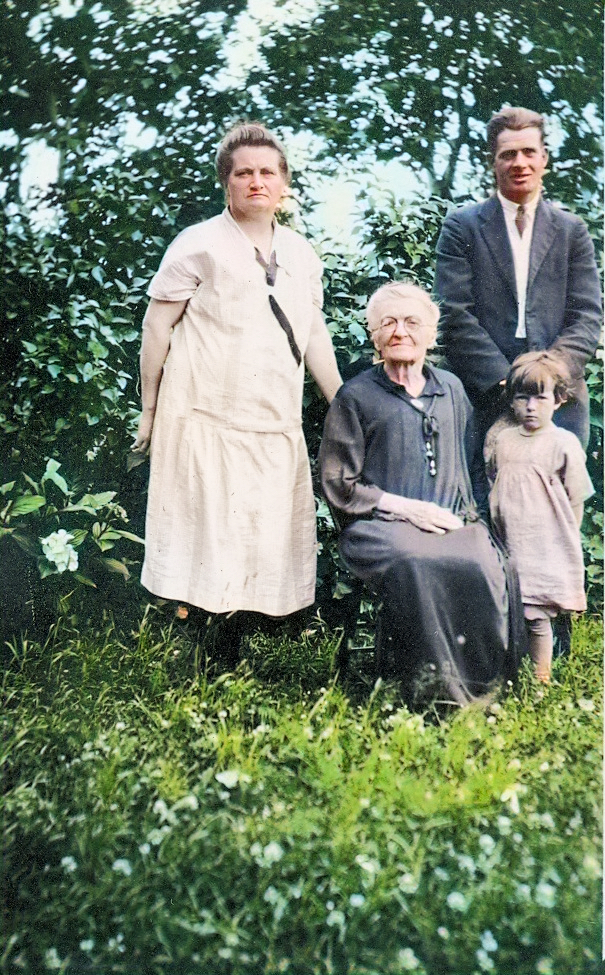
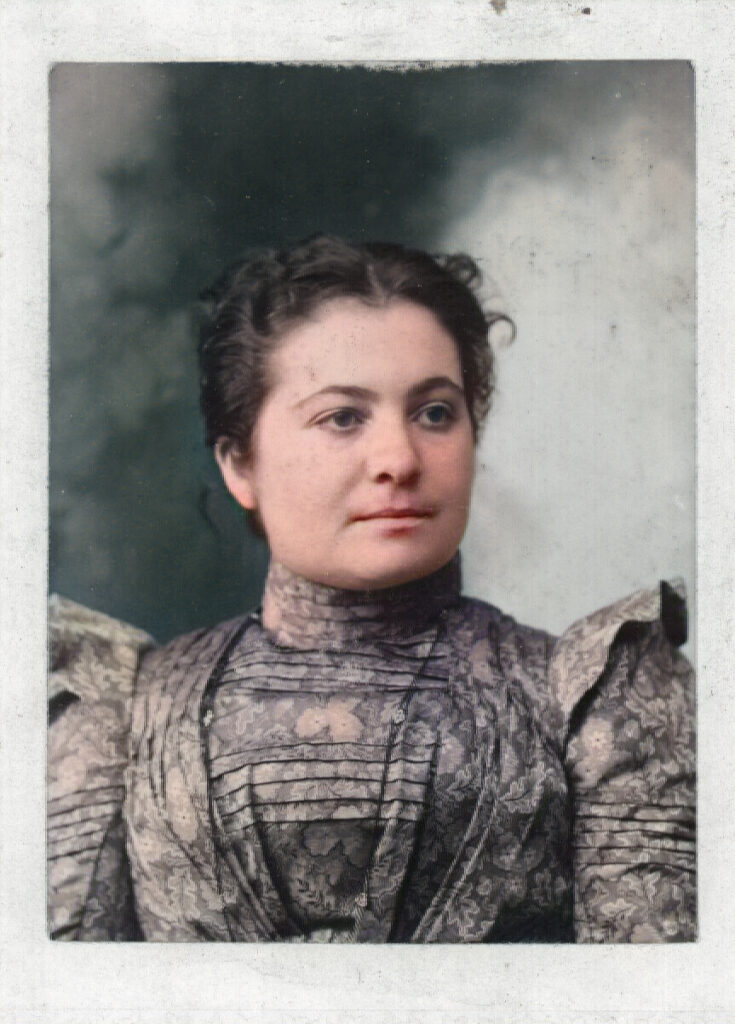
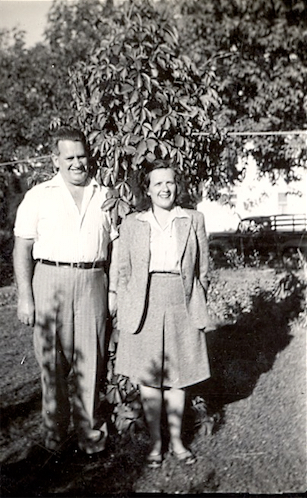
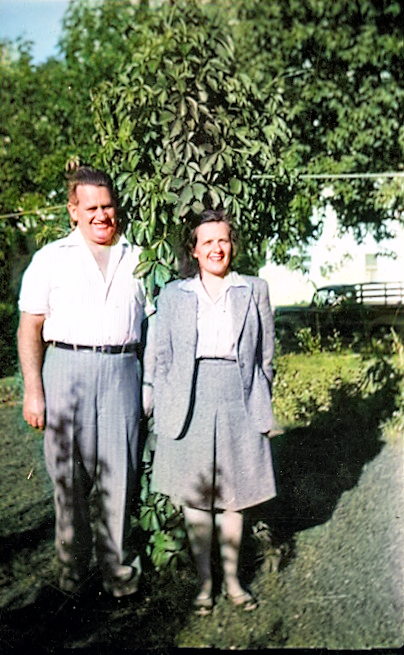
A new app showed up on the Setapp service this week, PhotosRevive. It promises to colourise black and white photos using some AI hocus pocus. I popped some photos in to see what it could do, and the results were mixed, but interesting.

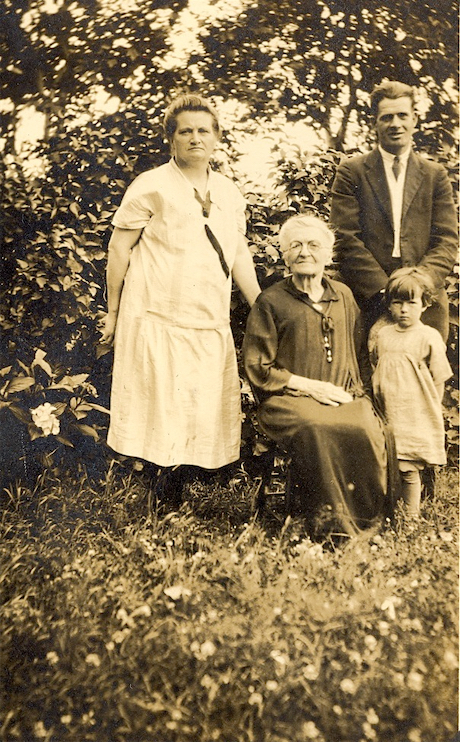
From left to right: my great-grandmother Eva Hardy, great-great grandmother Martha Sharp, grandfather Wilbur Hardy and my mother Vivian Phillips, probably taken in 1927. The older folks look pretty good, my little mother looks a bit ghostly.
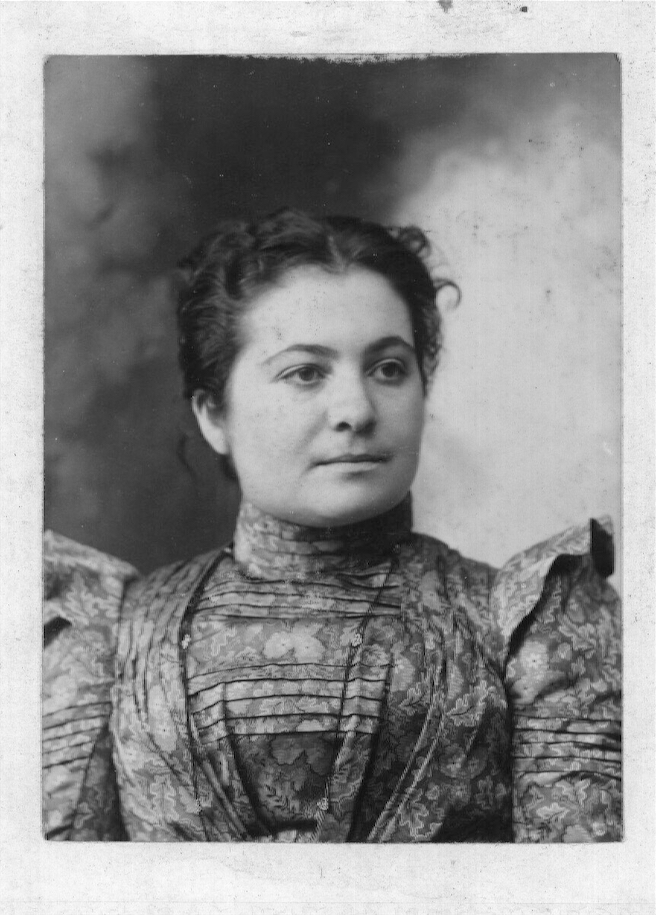
My great-great aunt Florence Arbuckle, twin sister of Eva Hardy. She was married to a doctor and quite well off, so could afford beautiful beautiful clothing like the dress she wears in this photo.
My mother Vivian and her Uncle Elmer Hardy. The app handles foliage really well.
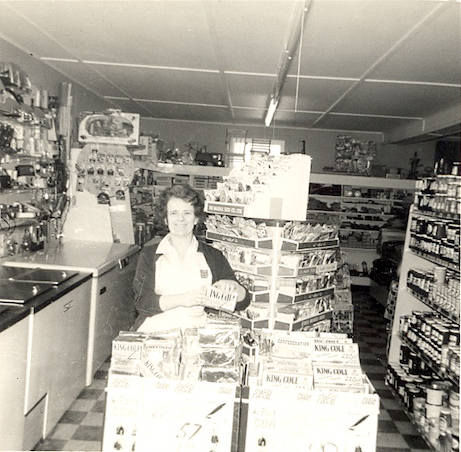
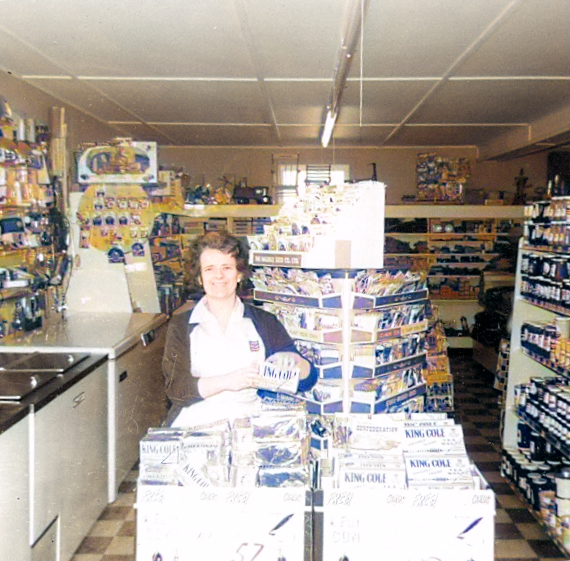
My mother in my parents’ general store in 1966. Pretty sure they didn’t just sell blue and yellow products! She’s holding a box of King Cole Tea, which has always had an orange and green theme. I think they won an award from the tea company, so this was a publicity photo.

You can tweak the PhotosRevive settings to make things look a bit better, but I’ve not had time to play with it yet. I like black and white photos, or am at least used to them, so probably wouldn’t have gone looking for this, but it’s a fun addition to the Setapp universe.

Socks and Masks

I bought a notebook not long after I moved back to PEI in 2001 and started recording the family stories and historical information my mother and others would tell me. I’ve finally had time to type up these notes and am realizing how much of it I had already forgotten.

December 17, 2014 – Mom offered to darn my socks, burgundy ones she knit for me many years ago. They were very thin. She said her grandmother would cut the feet off wool socks that were too difficult to darn and knit new ones on, ravelling back the yarn and picking up the stitches. Knitting new feet on socks was hard, but money for yarn was harder to come by.

Eva also had a manual knitting machine that, if I remember correctly, would quickly knit the leg part of a sock and she would then knit the foot onto it. That took much less time, and as she had seven sons and a husband to keep well supplied, sock manufacturing and maintenance would be an endless job. The men all worked outside, either fishing or farming, and in the winter they would spend days in the woods cutting lumber and firewood, so having warm socks were vital tools for good health and productivity.

January 6, 2015 – We were talking about someone who was just recovering from an illness. She said a family with the last name Best had once lived in Freeland. Their daughter, Lillian, got tuberculosis. They built a little house for her in the field next to the main house. Lillian lived in it, didn’t go anywhere, and when her mother went out to visit, she wore a mask. Lillian eventually recovered, married and had children. No one thought she’d ever be able to have children, but she did, and lived a long time.

Masks are nothing new, nor are pandemics. I would imagine Lillian’s story was from the 1920s when PEI was without a provincial sanatorium. When someone contracted TB, people did the best they could on their own, especially in rural areas lacking even the most basic health care. My grandmother, Thelma, died of TB in 1927, and was nursed at the end by a local woman who also was a midwife. Dr. John Stewart had an office in Tyne Valley at this time, but there really wasn’t much he could have offered beyond advice to rest – you lived or you died.

My grandmother was probably given country remedies like mustard plasters (a mixture of dry mustard, flour and water applied to the chest, still being used by some to relieve congestion when I was a child), inhaling the vapours of turpentine or kerosene, or doses of cod liver oil.

An unoccupied old house was torn down a couple of years ago not far from where we live, and my mother had been warned as a child not to go near it as it was “full of TB,” the family who lived there having lost a daughter in 1924.

January 25, 1922

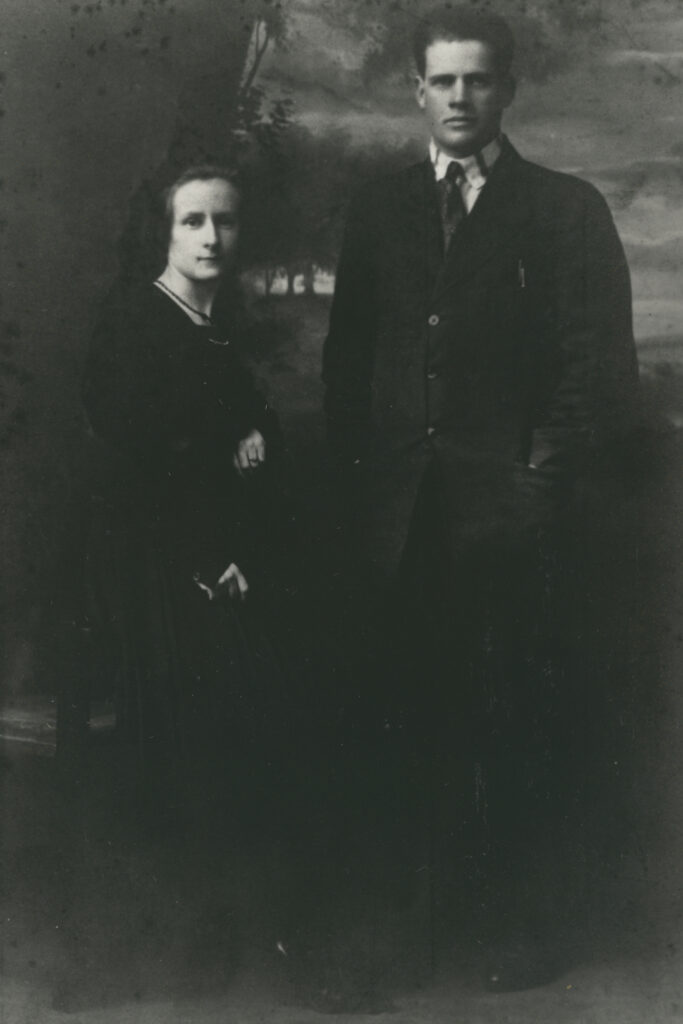
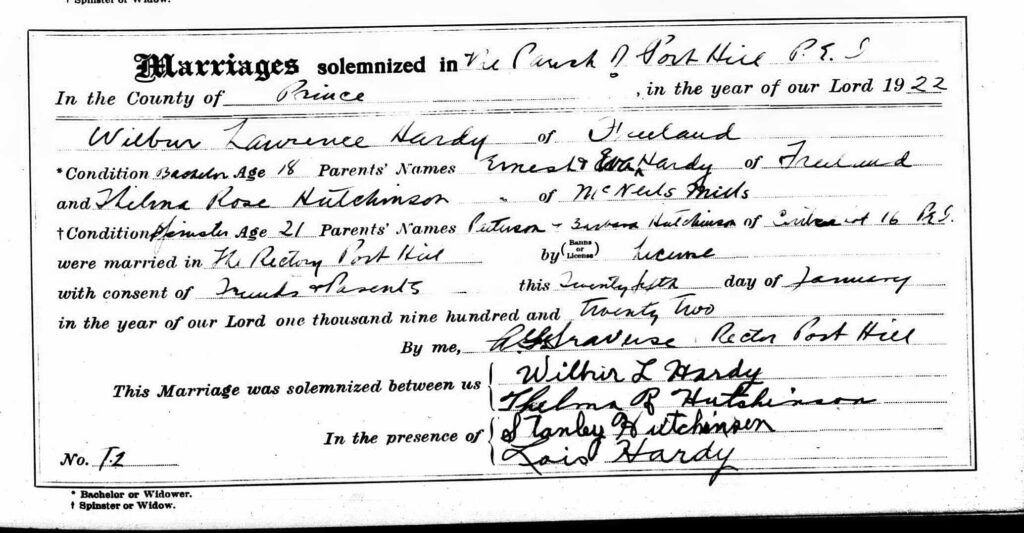
My mother’s parents were married 100 years ago today. I know almost nothing about that event as my grandmother, Thelma, died so long ago in 1927, and my grandfather, Wilbur, later remarried and died the year after I was born. My mother says that her father rarely talked about her mother, so she doesn’t know where they met or what their short life together was like. There is no one left from that time, of course, so it is a mystery that will never be solved. All we have is their marriage certificate, and a photo taken after their wedding.

Some of my family’s history is so clear to me, even events that occurred long before I was born, because I heard the stories over and over. I can hear the sleigh bells as Wilbur and his brothers head up through the Foxley River woods to cross over the ice to Cascumpec and on to Alberton, where they sold firewood in the 1930s. I can smell the tar and oil and half rotten fish of the wharves where most of my mother’s uncles spent much of their lives. I can see my great-grandmother, Eva, who fell and broke her hip while feeding her hens on the Sandhills in the 1940s, being carried by her sons on an old door to a dory, then rowed to the mainland where a truck was waiting at Brooks Wharf to take her to the doctor. All the tales carefully polished, shining, sharp, and each story helping me to find my place in my family, starting first as just a listener, and now as a keeper and recorder of the lore.

But Thelma and Wilbur are always in soft focus in my mind, just as they are in their wedding photo, and I have had to make up my own version of their story over the years from the bits and pieces I have gathered. The story ends sadly, with Thelma dying from tuberculosis, leaving Wilbur and her two small children, but this photo from the beginning – Wilbur confident and casual, hand stuffed in his jacket pocket, and Thelma next to him, finally with someone to care for her after losing both her parents by the time she was seven – this photo reminds me that the story really didn’t end sadly, for my mother is still here, I am here, my cousins are here. We are here, we were there.

Thelma and Wilbur Hardy, 1922

Living History

Vivian Phillips, Eptek Centre, Summerside, with her blue RCAF (WD) uniform and kit bag in the background, November 14, 2021

My mother had recovered enough from a recent illness to attend the third and final launch of a book, We’ll Meet Again, that features stories about PEI women who served in the Second World War. The author, Katherine Dewar, has been so lovely to my mother and the other women veterans, and she made a point of featuring my mother’s story today as she had been unable to go to the first launch with the other surviving veterans.

Although seating was very limited due to pandemic restrictions, we were still able to say hello to friends and family who attended, and my mother had the unusual experience of hearing someone reading her words out loud and seeing her uniform and other pieces of memorabilia on display. On the way home I asked her how she had found the whole thing, and she said she didn’t think she had really done much more than outlive everyone else, that her story wasn’t that special! Like most things in her life, she has just taken it all in her stride, which I’m sure is part of how you live to be 99.

Katherine has dedicated much of her historical research and writing to preserving the stories of PEI women, accomplished women who had exciting and important careers, and even had military honours, but who often lived quiet lives after the fact, who blended back into society because that was what society demanded women do. My mother’s exit interview from the RCAF, for instance, an organization that had given her opportunities for training, adventure and independence she would never had at home, suggested that she would be best suited to being a housewife. She went on to do that, and so much more. Tomorrow she plans to bake cookies to thank the hospital staff who recently cared for her, still defying expectations, looking and acting beyond herself, an inspiration to all who know and love her.

Legion

Both of my parents served in the RCAF during the Second World War, so attending Legion services on Remembrance Day has always been a part of my life.

My father joined the Ellerslie Legion Branch #22 right after the war, but women weren’t allowed to join at that time, so my mother didn’t immediately become a member. In the 1980s, the Legion helped her get the disability pension she should have received after the war for hearing loss she suffered during her service, so she must have finally joined in 1991 as she was presented with her 30-year membership pin at today’s Remembrance Day luncheon.

My mother was recently in the hospital for a couple of weeks with pneumonia, a serious condition at 99, so it was heartening that she was able to rally today. She has always been a very social person, happy and upbeat, so people were thrilled to see and speak with her, and it greatly helped her recuperation. For many there today, she’s a link to their own long-gone parents and grandparents, a walking, talking time capsule. I heard one woman, who has to be in her late sixties now, reminiscing about buying candy at my parent’s general store when she was a child, glowing with the memory of those visits.

It was a lovely afternoon with old friends and extended family, everyone glad to gather again to remember.

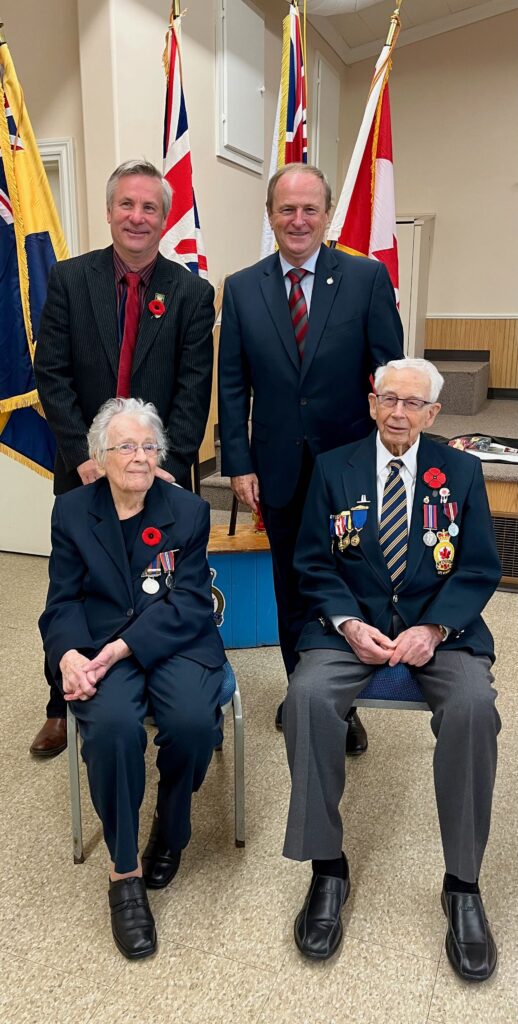
My mother, Vivian Phillips, and fellow Second World War veteran Jimmy Burleigh, with MLA Robbie Henderson (back left) and MP Bobby Morrissey. Jimmy and Bobby were on the Unit One School Board with my father, Harold, and Robbie’s father, George…we are all connected in so many ways here.

Bits and pieces

My mother was asked if her RCAF uniform could be used in a display in connection with the upcoming publication of a book by PEI historian Katherine Dewar about PEI women who served in the Second World War. Katherine and Lois Brown, who was with the Canadian Women’s Army Corps in the Second World War and is a lively 97-year-old, came up last week to take the bits and pieces my mother has.

My mother’s air force blue uniform is nearly complete, except for stockings and shoes, which she used after the war and wore completely out. Her khaki uniform has always been a bit of a mystery to me. She always called it her summer uniform, but I believe it was what she was wearing when she ended her service on January 9, 1945, as her last meal card and clearance certificate (incorrectly dated as 1944) are still in the inside jacket pocket. As she ended her military career in Halifax, in January, it would have been far from summer weather! I hope to get more information from PEI Regiment Museum curator Greg Gallant about that uniform.

I also gathered up various pins that were scattered around the house in different little boxes. She would have received or bought most of them during the war, the General Service Badge would have been worn after the war (probably by my father, but not sure), and another is one of many pins she’s been sent periodically by this or that group honouring different battles and anniversaries.

RCAF (WD) poster

I imagine Katherine’s book will touch on the fact that women who had served weren’t regarded as real veterans immediately after the war. Women had been recruited to supporting roles to free up men to assume combat roles, so their service wasn’t considered to be the same.

While both of my parents were in the RCAF during the Second World War, neither of them served in Europe, spending their time in Canada or Newfoundland, which was considered an overseas posting as a British colony. My father was always viewed as being the “real” veteran in our family, even though his role as an RCAF mechanic put him in no greater danger than my mother. They were both involved in the background of the Battle of the Atlantic during their time in Newfoundland, he at Gander and she at Torbay, and I’m sure both of those stations were on the German hit list for a possible invasion of North America, which thankfully never happened.

My father mistakenly wore my mother’s medals all his life, and it was only after his death, when I was asked to help with an award nomination for my mother, that I found out she had been given an extra medal (The Defence Medal) because of the length of time she had spent in Newfoundland, and my father’s time there hadn’t qualified.

I don’t believe for a second that my father even knew what he had done. I suppose when the medals arrived in the mail (ex-service members applied to get them after the war and they were mailed in a little box, no dramatic presentation by a senior officer as portrayed in movies), he just assumed the three were for him as he served for nearly 5 years and my mother for less than 2.

So my mother had worn my father’s two medals, never knowing the difference. When I brought this error to her attention, I didn’t think she would bother to start wearing her real ones, but she did, and still proudly wears them to Remembrance Day services and other official events. And now, because she is one of the few veterans left, people sometimes thank her for her service.

2021 is the new 1946

It didn’t say what they did at the Georgetown PO to keep the mail-seeking crowds away, but a polio outbreak meant strict public heath measures were in place across PEI 75 years ago. Vaccination has nearly eradicated polio worldwide, but there are still a few cases every year in Afghanistan and Pakistan.

I had a great-uncle who had polio, which left him with with he called a “crooked foot” and unable to do many things. He would have an interesting perspective on COVID-19 anti-vaccination protests.

Charlottetown Guardian September 12, 1946

Digging clams

Our river once had abundant soft-shelled clams, and you could dig a bucket in a few minutes. There was no fishing license required, but you could only take ones over a certain size, so we carried a homemade gauge to ensure we only took legal ones.

I wouldn’t eat them as a child, but grew to love them later, and I spent many hours swimming and playing in the water while my mother dug them. Most people dig on the beach at low tide using a garden fork, but this wasn’t my mother’s method as she said too many get broken that way, and that’s true. Another less common method was to use a homemade plunger made from a section of a car tire attached to an old broom handle, and dig them in the water, which was less destructive. But she was the only one I knew who dug them the way she did.

At our favourite spot, just a 5-minute row from our house, my mother would walk with bucket in hand in knee-deep water, looking for the holes that clams make with their siphons. She would then sit in the water and pat a hole with her hand, creating a vacuum that moved the sand and would start to excavate a larger hole. When she felt a clam, she would pull it out, examine it to see if it was alive and the right size, and then put it in the bucket beside her that was kept in place first by the volume of seawater it contained and then, little by little, by the clams.

Once her bucket was filled, we would return home, but we never ate the clams right away as they were gritty with sand. My mother would tie the bucket to the railing of the stairs that went down the bank in front of our house and leave the clams submerged in the bucket in the river overnight to clean out, expelling the sand that was in their system.

The next day the clams were placed in a large enamel pot with no water or anything else, just steamed as they were until they opened. Those that didn’t open were discarded, and the rest piled into a big bowl and placed in the middle of the dining room table. Everyone got their own bowl of melted butter, fresh homemade rolls and maybe potato salad.

We might dig a feed of clams every couple of weeks in the summer, and there never seemed to be any fear of them being overfished. Then commercial fishers started working on our river using mechanical vacuums a couple of decades ago, a similar idea as my mother’s manual method except they could dig out an entire bed in a few minutes. The last time we tried digging clams would be over 10 years ago now, and there weren’t any left, just empty shells. It will probably take decades for them to return in the numbers that existed before the commercial harvest.

You can buy clams, but they never taste as good as my memory of them. It was the whole process: rowing to the digging spot, having a swim, hearing the neighbour’s cows or dog, watching the clouds passing overhead, waving at a neighbour in a dory coming home from fishing oysters, looking back at our house, the little waves lapping the shore, the birds, the sun. The tang of our river, deeply salty and briny, alive with eels and lobsters and crabs and fish. The feeling that this harvesting had been done forever and would go on forever.

Mom and I digging clams somewhere on Foxley River, 1969

99

Not many get to decorate a cake for a 99th birthday, but I was fortunate enough to do so for my mother’s birthday today. I made the buttermilk birthday cake from Nigella Lawson’s How to Be a Domestic Goddess as it is foolproof, deliciously moist, and works well with gluten free flour.

I’m definitely not the baker that my mother, Vivian, was and still is. She is known for many culinary treats: butterscotch pie, lemon meringue pie, coconut cream pie (any pie, really!), orange chiffon cake, fudge, and lately, cookies, because they are easily made and just as easily given away. Any estimate of how many items she has produced over eight decades of baking would probably never come close to the true number. And, as we were only three in our immediate family, the majority of her baking was given away to our huge extended family, friends and neighbours, and for bake sales. At least once a week during my childhood, my mother would be baking for some charitable event or other, making sandwiches and sweets for a meeting, having people over for supper.

My mother has never complained about having to cook a meal, ever, and that’s not an exaggeration. True, she hasn’t worked outside the home for many years, but even when she and my father owned a general store, where she worked just as hard as he did, she cooked a hot noon meal for the two or three clerks they had working with them, six days a week. Dining out has never been a big thing for my mother, probably because we just never had many restaurants close by, so she has cooked most of her meals, and she prepares generally healthy things, which is probably how she has reached 99 without diabetes or high cholesterol!

She has been an effortless cook, an enthusiastic hostess, and a generous lady, even today sending a relative off with some brownies made yesterday. She baked cookies for a children’s event at her church this week, and next week has offered to make cookies for our local environmental group’s day camp.

Always looking outwards, finding a purpose for every day, never idle, always grateful, day by day by day for 99 years. It all comes back to her on days like today, with a steady stream of visitors showing her so much love, joining in the magic of a long and impactful life.

December 1875

My great-great-grandparents were Martha (Ellis) and George Washington Sharp. They had 10 children, including one set of twins, my great-grandmother Eva and her sister, Florence.

It was only this evening that I realised Martha and George had three little girls who died within a few days of each other. They also had two boys aged 7 and 2 who survived. They went on to have five more children.

I had no idea what the girls died from, but I just found a death notice for the three little girls in the December 20, 1875 The Examiner newspaper out of Charlottetown. What unbearable pain.

The Examiner December 20, 1875 p3
Martha Sharp (1848-1928) circa 1927