60 years ago tonight, Cassius Clay beat world heavyweight boxing champion Sonny Liston at a match in Miami Beach. Soon after that fight, Clay would take the name Cassius X and then Muhammad Ali.
A few days earlier, the Beatles returned to England after a successful short tour of the US, the start of Beatlemania on this continent. They appeared three times on The Ed Sullivan Show, the biggest variety program on American television, watched by tens of millions each week. Their second appearance was broadcast live from Miami Beach on February 16.
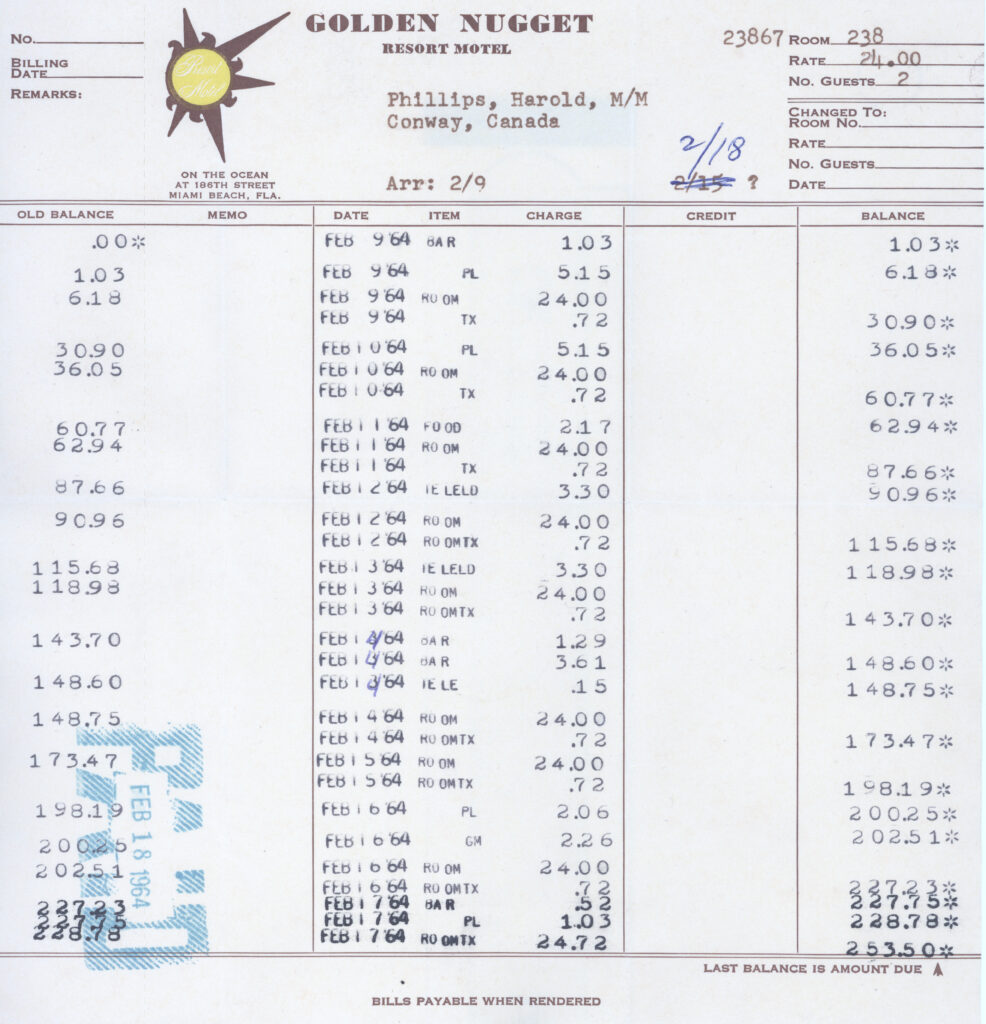
It just so happened that my parents, Harold and Vivian, took their first vacation to Florida in February 1964 and were in Miami Beach on February 16. They were both 41 and had been married for 19 years. They had worked hard to build up their general store business, so were overdue some fun and relaxation. They travelled with my mother’s cousin and her husband. By all accounts, they all had a marvellous time soaking up the sun and seeing the sights of Miami and Daytona.
Harold and Vivian Phillips, Miami Beach, February 1964. They obviously had a snazzy TV in their room, but my mother doesn’t remember if they watched the Beatles on Ed Sullivan on February 16. With few stations on the TV, my guess is they did, but she was more a Perry Como fan and never really got the Beatles.
Bill for nine nights at the Golden Nugget motel, Miami Beach, February 1964.
My father lugged his 8mm Kodak film camera with him, taking plenty of shots of palm trees, orange groves, alligators and swimming pools. He took some footage of BOAC and KLM airplanes outside a terminal somewhere along their Summerside>Moncton>Montreal>NYC>Miami route.
BOAC and KLM planes, 1964
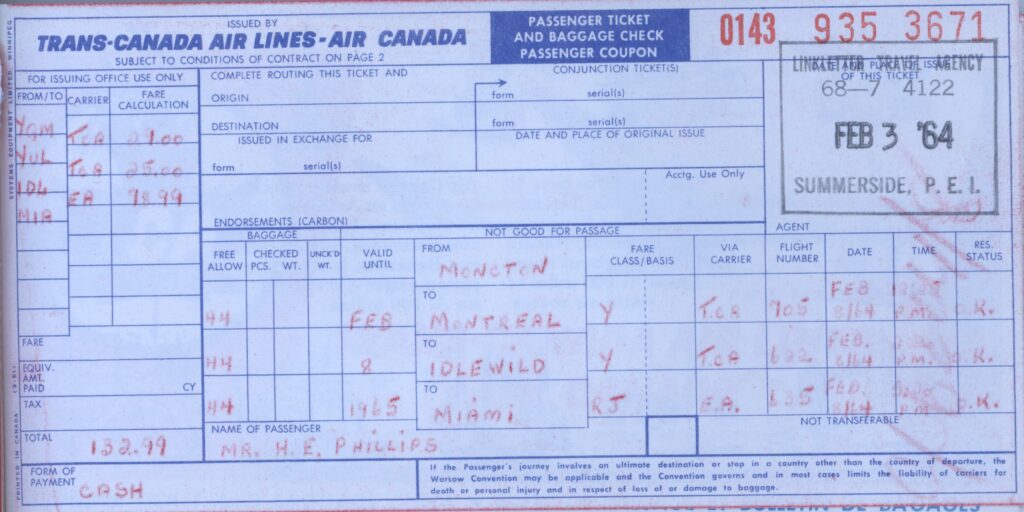
Their handwritten tickets listed their NY airport as IDL for Idlewild, except Idlewild had been renamed JFK in December 1963 just after the assassination of the US president, but obviously the change had been recent enough that no one was used to it.
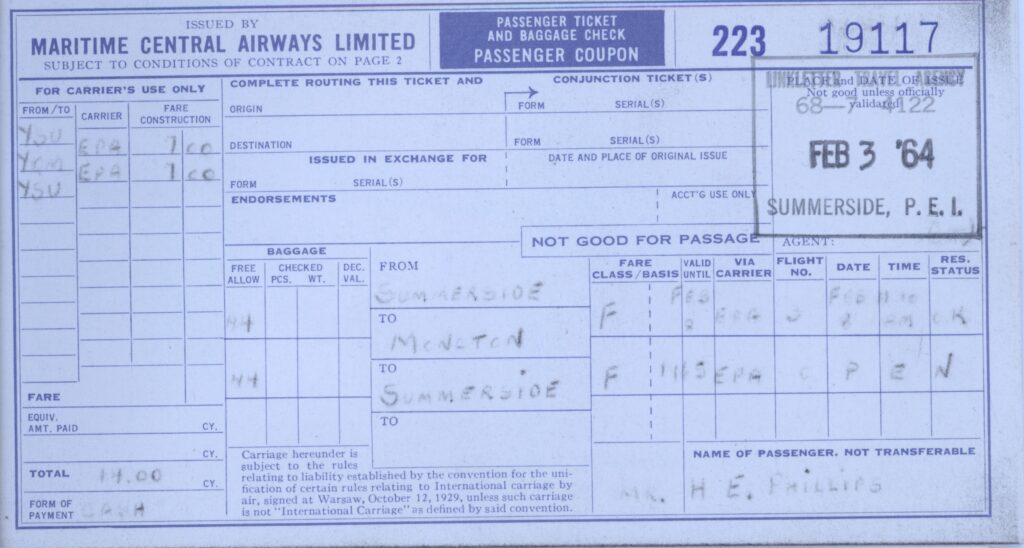
Moncton to Miami $132.99 return via Tran-Canada and Eastern airlines.YSU (Summerside) to YQM (Moncton) $14.00 return
One day, the four travellers hopped in their rented convertible and drove around the Miami area, my father aiming his camera at the passing buildings and advertising banner towing planes. When we watched this reel when I was a child, this short sequence would just slip by, but when I had the film digitized, I was able to pause it and have a better look, and quickly fell down a rabbit hole of early 1960s popular culture.
Miami Beach, February 1964, showing advertising banner towing planes, Sonny Liston’s training headquarters at Surfside, Florida, and Hotel Deauville with Mitzi Gaynor on the marquee.
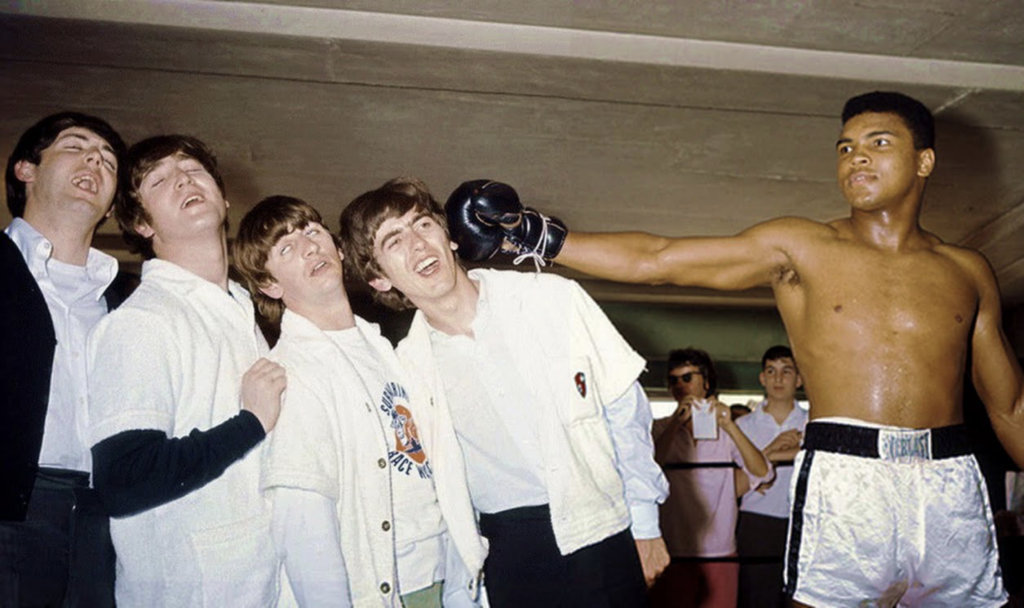
I knew who Mitzi Gaynor was from her movie roles and appearances on television variety shows when I was a child. I looked up the Hotel Deauville and learned it was where the Beatles had stayed in Miami and where their second Ed Sullivan appearance had been recorded, a show that also included Gaynor. Then I read about Sonny Liston’s training camp in Surfside, just north of Miami Beach, and of him appearing on the Ed Sullivan show the same night as the Beatles, and the Beatles also meeting Cassius Clay and posing for a famous photo, and the February 25 boxing match. So much was going on!
The Beatles meeting Cassius Clay/Muhammed Ali at the 5th St. Gym, Miami
I’ve done a few presentations about my father’s film footage to local groups and have used this little clip to encourage people to look at their own photos and videos and to save, document and share what they have. It might take many years before something becomes important or interesting, but if you haven’t saved it, you’ll never know.
What my father filmed isn’t as important as footage of the Beatles or Liston or Ali or even Mitzi Gaynor would be, certainly, but he did capture a few seconds of a time in US history when the country was still trying to come to terms with the assassination of their president only three months earlier, square old Ed Sullivan was kicking off Beatlemania using the huge influence of his television program, and Clay/Ali was on his way to becoming an important sports star as well as a towering figure in the black power, civil rights and anti-Vietnam war movements.
What do you have in that cardboard box in your attic or closet? Nothing much? Look again.
I picked up Steven at the Charlottetown airport last week. The Air Canada flight from Toronto was late. It had been deiced twice at Pearson. When it finally took off, I started my 100 km drive over snow-drifted highways, and the plane touched down just a couple of minutes after I got there.
I haven’t been in the terminal since before the pandemic. They’ve done a bit of renovating, removed the Cows Ice Cream cow that used to greet travellers in the arrivals area. A much more multicultural array of folks were waiting with me than in the past
Two children tried to find a place to hide so they could surprise the person they were meeting. A young man held a bouquet of flowers, shifting back and forth and looking at the floor, thinking hard. A Buddhist monk in orange robes and the biggest snow boots I have ever seen came in decked out in a couple of DSLR cameras. There were the pasty potato-faced people like me.
I was sitting on a bench far enough away that I couldn’t see the when the doors opened, but I knew a couple of seconds before they did because those waiting near the doors suddenly started to crane their necks to spot the person they were meeting. There are no jet bridges at Charlottetown, so people have to make their way across the tarmac through whatever weather awaits, emerging from the darkness at night.
The passengers trickled in at first, and then suddenly they burst forth, a flock of black four-wheeled suitcases with long handles, twirling and pirouetting across the bumpy tiles, click click click, a ballet of surcharge-dodging swans. Their human handlers seemed to have the most gentle of grips on them, just a couple of fingers, and that let them deftly maneuver around the people hugging babies and kissing grandmothers and out to waiting conveyances.
A few people carried those bags too tired to swivel or were reluctant to bump over the snow from the plane. A couple of my hens don’t like walking on fresh snow and will insist on being carried when they tire of the uncertainty of the puffy white, so I expect the bag owners faced the same thing.
In just a couple of minutes, the clattering cases were gone. The children were hugging a tall man, the youngest clinging to his leg so he sort of dragged her around, everyone laughing. I lost sight of the man with the flowers, so don’t know if the person he was meeting arrived. The monk was talking to a family with a young boy, no photos being taken yet. Steven grabbed his backpack off the conveyor belt and we stepped out into the drifting snow.
The Charlottetown Airport arrivals area, July 2014. The Cows cow was joined by Anne of Green Gables that summer, both patiently waiting for Matthew Cuthbert.
I’m a couple of weeks late marking the 50th wedding anniversary of Tom Connors and Lena Welsh, and not even sure now how that milestone came into my mind. Tom was a singer/songwriter known as Stompin’ Tom. He was born in Saint John, New Brunswick and adopted by a couple who lived in Skinner’s Pond, PEI, where there is now an interpretive centre to showcase his musical talents and life. Tom died in 2013, but Lena is still alive, as far as I know.
He wrote and sang, in the classic country and western style, about working people and places he visited while criss-crossing Canada numerous times. Every Prince Edward Islander who attended elementary school in the 1970s and 80s probably sang in choir and can still remember every word to the song of his that is most connected with PEI: “Bud the Spud”.
Why do I remember when he got married? Because we watched it on television in school. I was in second grade, and we sat on the floor, gathered around what was probably a black and white television, on Friday, November 2 to watch Tom and Lena get married on the CBC Television program Elwood Glover’s Luncheon Date. I don’t remember Glover, and only have dim memories of watching the wedding, but I knew it was a Big Deal because television was still viewed as slightly unedifying in 1973, Sesame Street be damned, and wasn’t used in our primary education, with only a few exceptions.
Original Toronto Star caption: Happiest moment of my life, says Stompin’ Tom Connors as he weds Lena Welsh, 26, Magdalen Islands barmaid, on Elwood Glover’s TV show, Luncheon Date, today. Here, Glover, left, congratulates bride and groom after an estimated 2 million viewers tuned in on the formal, 12-minute ceremony. The 36-year-old folk singer is from Skinner’s Pond, P.E.I. Wedding was a first for TV in Canada. (From Toronto Public Library Digital Archive. Copyright Toronto Star, photographer Frank Lennon.)
When you are seven years old, experiencing things for the first time is commonplace, so I had no idea that famous people didn’t get married on television all the time. The only other non-royal person who had their wedding televised, that I can think of, was Tiny Tim and Miss Vicki, but I was only three when that occurred, we wouldn’t have received the US station it was broadcast on, and Tiny Tim terrified me, so I would have avoided it: if you want me to give up state secrets, just play him singing “Tiptoe Through The Tulips” and I’ll tell you everything.
Stompin’ Tom possibly wasn’t everyone’s cup of tea, but Islanders LOVED him to bits. When Queen Elizabeth and Prince Philip visited PEI in the summer of 1973 to mark the 100th anniversary of our province joining Canada, a concert was held in Charlottetown to mark the auspicious occasion. Family friends were visiting us from Toronto, and one of our guests was a woman who had recently moved to Canada and had grown up in a unionist household in Northern Ireland. She loved the Queen, and was thrilled we would be able to watch the concert live on television.
I don’t remember watching this show, but the family lore is that the broadcast began with the usual pomp that accompanies the arrival of a royal. The audience, in all their Charlottetown finery, politely applauded to welcome the royal couple. There were speeches, and I would bet Anne of Green Gables made an appearance. Our Irish friend watched with great interest.
And then Stompin’ Tom took to the stage with his guitar, undoubtably in his trademark black outfit and cowboy hat. Don’t know what he sang, but it would have been something twangy and foot stompin’. The crowd, who had given the royal couple a suitably dignified and muted welcome, erupted into hoots and hollers and thunderous applause for this tall skinny fellow who looked like a bad guy from a Hollywood western. Our friend couldn’t understand how he could get a bigger reaction from the audience than the queen did, and my mother said she watched the rest of the broadcast with a slightly bristly reserve.
I met Tom once backstage at the famed Toronto music venue, Massey Hall. The Stompin’ part of his stage name came from his habit of stomping his left foot so hard he would make a hole in the stage, to the displeasure of venue owners, so he started using a small piece of plywood to stomp upon, holding it up at the end of the performance to let the particles he dislodged with his heel drift to the stage.
At some point he started auctioning off the boards for charity. In September 1999, he decided the Daily Bread Food Bank would get the money from the board auction at his Massey Hall concert and although I wasn’t the PR person for our organization, I was the token PE Islander on the staff (an exotic creature!) and given the opportunity to attend the show and accept the donation.
It was fantastic to finally see Tom live and even more wonderful to be in an audience of true fans, many of whom were also originally from Atlantic Canada. We sang along, and cried with him as he became overcome with emotion while singing “Confederation Bridge” and couldn’t continue the song: “And it’s calling, calling me over, the blue water’s rolling and soon I’ll be strolling out there. Down by the ocean, where the Island devotion to friendship is found everywhere.”
Illegal and very poor quality flash photography by me (a former theatre usher and stage manager who knew better), Massey Hall, Toronto, September 18, 1999. I swear that’s Tom.
The board auction was held during the show, and the winner was able to meet Tom after the show to get his board signed, and I was present to arrange to get the money, a very generous $5,000. I first met Lena, who was lovely when I told her I was from PEI (she’d likely met everyone from PEI by that point), an elegant, quiet lady. Then Tom came into the green room, bigger than life, holding a beer in one hand and a cigarette in another, greeting each person one by one.
When it was my turn to speak to Tom, I thanked him for supporting DBFB and then told him my father often spoke of the night sometime in the 1960s at our local community festival when the organizers heard that Tom was in the audience. My father, acting as emcee for the evening, asked Tom up on stage to sing a few songs, which he agreed to do. The roof nearly came off the rink with the audience response, and as he headed out into the night, they gave him a big feed of cooked lobsters. He slapped me on the back and said he remembered that night, though I wonder if he really did.
Hugh Gillis, the man who bought the board that night at Massey Hall, drove to PEI four years ago to donate it and two others he bought over the years to the Stompin’ Tom Centre. He apparently has no connection to PEI, even though he has a classic Island name, but just seems to be a wonderfully generous man.
The other reason I remember September 18, 1999 was that when I got home from the concert, there was a message on my telephone answering machine from a fellow I had met at a birthday party the week before, asking if I wanted to go out on a date some time. I did, and we did, and now we are married, like Lena and Tom.
Stompin’ Tom celebrates the $5,000 his Stompin’ Board Auction bought for Daily Bread Food Bank from bidder Hugh Gillis. Here Hugh (on left) and a friend enjoy a laugh with Tom. Taken backstage at the Stompin’ Tom Connors “Meet and Greet” after his show at Massey Hall in Toronto on September 18, 1999. (Photographer: Barry Roden – Credit: Library and Archives Canada)
I had the pleasure of attending a presentation this morning on the progress of a written history of the village of Tyne Valley. My friend Carolyn McKillop, who grew up in Tyne Valley, has been doing research for years, and has amassed a jaw-dropping collection of photographs and information. It was a nerdy delight to see her incredibly well-organized records.
She has joined forces with Gary MacDougall, another Tyne Valley native and former editor of The Guardian, Charlottetown’s daily newspaper. The meeting was as well organized as Carolyn’s research, and both of them gave an excellent overview on what they have accomplished.
Item Five on the agenda, “Dreaming of time”, had Gary’s name next to it. He said he had been thinking a lot about time recently, perhaps because he is getting older. He admitted what he was going to say might sound a bit “out there”, but he went on anyway, as he was amongst family and friends, and said he feels that the people and events from the past are still here with us somehow. He called it the Cosmic Filing Cabinet, how the memories and events of the past are just filed away, waiting there for us to discover them. In the midst of a meeting of the practicalities of creating a community history, he offered a short, beautifully poetic aside about trying to understand his place in time.
Now, Gary is my second cousin, so perhaps there is some genetic resonance at play here, but I’ve also been thinking about time a lot as well, and in a similar way. I find myself time travelling, almost forgetting that those I love who are no longer physically here actually are. I’m not seeing ghosts, nor am I lost or having delusions (I hope!). Time is bending, and I find myself pulled from it, suspended and observing it, and then dropping back down into the stream of time.
It started one winter night a couple of years ago while I was driving home from another meeting in Tyne Valley, as it happens. Warm light was glowing through house windows, and it struck me that the light I was seeing was more or less the same kind of light I would have seen 50 years ago when I was a child being driven along the same road. The houses had memories, were doing the same things as they always had, looked the same way. Different people inside, in most cases, but that wasn’t evident from the road. It could be 50 years ago, it could be now, it could be 75 years in the future. Time didn’t matter.
I passed a house that had belonged to one of my great-uncles and pictured him sitting inside it watching television. I passed the store and house that had belonged to my parents and could see them in both, quick flashes of them as young people. Then our immediate neighbours doing their evening chores in their barns and kitchens. There were no figures in the windows, but the light was timeless and transported me away.
If I’m feeling out of sorts, discouraged or overwhelmed, I have learned to open what I guess I’ll have to start calling my Cosmic Filing Cabinet and pull out a good, warm memory. I can put myself back in my childhood bedroom, all Barbie pink and filled with stuffed toys, my ginger cat asleep at the foot of my bed, listening to adults murmuring and laughing in the living room after a dinner party. I know where every light switch is in that house, what was in every drawer, how the basement smelled, what could be seen from every window. I can go back and be there and find the security and comfort I was so fortunate to have as a child, no worries or concerns.
As Gary said, a human lifetime is but a blip in the history of the universe, but it matters. We are creatures who are bedevilled by the knowledge that our time is limited, but who look for meaning in spite of that knowledge. We just need the key for that filing cabinet.
Freeland Presbyterian Church, December 24, 2021. Generations of my family have worshipped here, their prayers and songs clinging to the fine polished wood interior.
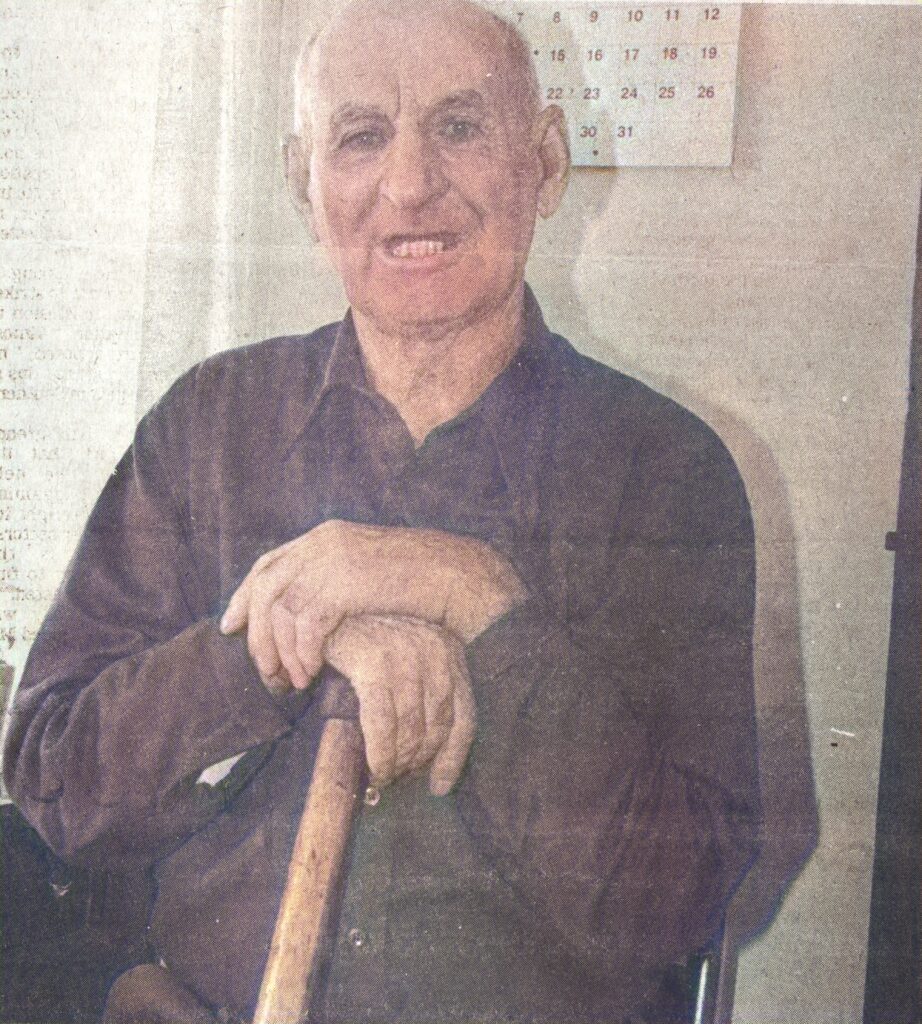
Was digging through our archives (a grand word for the loosely-organized piles of boxes in our basement!) and found this article about my great-uncle Everett Hardy. He was a lovely fellow who was able to rhyme off stories, facts and figures nearly to the end of his 94 years. He was from another age, steeped in stories of the sea, both tales of his own escapades and from the books and National Geographic magazines that he read.
My mother says the local doctor of her youth, John Stewart, said that if Everett had been able to have a good education, he could have been a lawyer (high praise in a time when lawyers were still mostly universally respected). As his parents aged, Everett gradually took over much of the business side of their cannery. He had a head for numbers, and remembered lobster prices and catch sizes decades after the fact.
The reporter who captured Uncle Everett’s tales was Debbie Horne of the West Prince Graphic weekly newspaper. She left the paper quite a few years ago, but was a fixture in West Prince for a long time. If something was happening in our area in the 1980s and 90s, you could be sure Debbie would be there, along with the West Prince reporter for the (then) daily Journal Pioneer, Eric McCarthy. How lucky we were to have that amount of coverage of our small communities. They had to cover everything, from fishing and farming to crime and human interest, and they both did it well.
I have a poor recording of Uncle Everett from about a decade after this interview, which I transcribed a few years ago. He used phrases and pronunciations that have died out of common usage today, as does my mother. He mentions a type of ship called a schooner in this article, but he never pronounced to rhyme with “tuner”, more like “gunner”…it’s difficult to describe. Ask me sometime and I’ll say it fer ye!
His deep interest in the natural world filled him up to the brim, so much so that in his later years, his love of the world and all that was in it would choke him up as he spoke. No gentler, kinder man has ever lived, and I’m glad someone took the time in 1983 to record his tales.
The photo of Uncle Everett from the newspaper article, colourised with PhotosRevived, also part of Setapp. Uncle Everett usually wore dark work clothes, so the colour of the shirt and homemade walking stick is remarkably accurate. As this photo was taken in March, I see his long-sleeved undershirt peeking through his sleeve, though the house was always boiling hot from a wood furnace!He was sitting in his bedroom, where he spent many hours in a rocking chair looking out at Freeland Creek below his house. On top of the dresser to his left was a globe, and he kept Wrigley’s chewing gum in a drawer to give to us children.
A technical note for anyone who transcribes newspaper clippings: I’ve been using TextSniper for the past few weeks to capture text from PDFs and photos, and it is a helpful little app that sits patiently in my menu bar waiting to be triggered. I recently found the toggle to prevent it from adding line breaks, which has saved me a lot of editing when copying text from newspaper columns, and now I love it even more! It’s part of Setapp, a subscription plan I ignored for years but decided to try when RapidWeaver came up for renewal and I realised it was part of Setapp. There are 240+ fun and useful tools that all seem to work really well. I’m just sharing my Setapp experience – I don’t monetize anything on my website, so you won’t make or break me if you do-or-don’t click!
I’ve spent the past few days immersed in the history of Cedar Lodge, the log cabin that sits next to our house. The man who had it built, Senator Creelman MacArthur, marked the grand opening 90 years ago today with a big party.
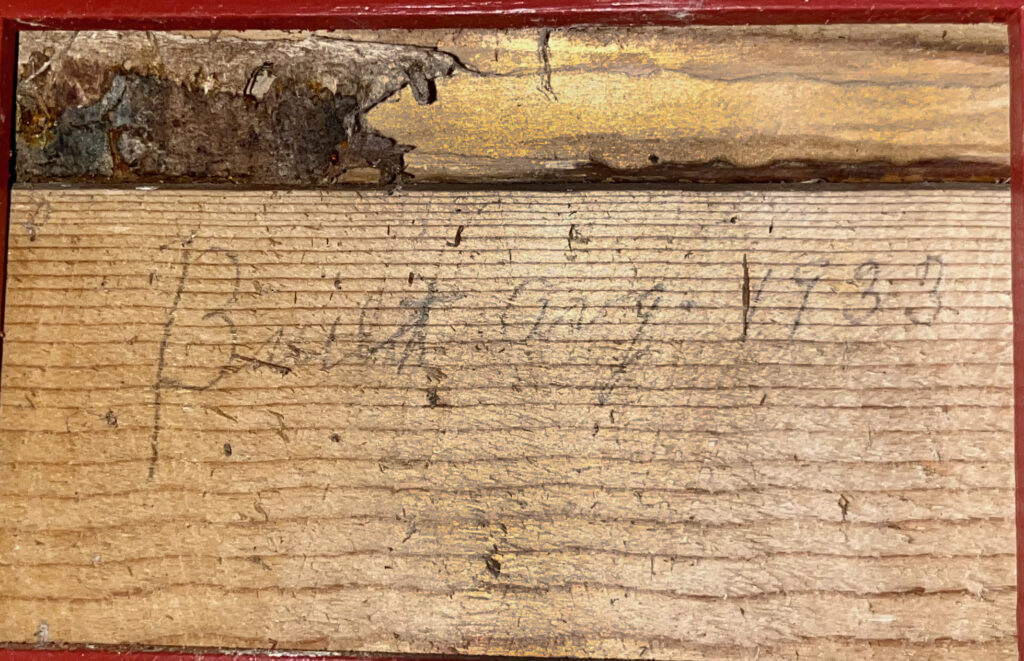
Someone put the date on the outhouse wall!
Almost everything I’ve been reading, including the newspaper report of the opening I’ll add to this post, talked almost exclusively about men: the various owners of the land, those who built the cabin, those who participated in the opening day event.
To be fair, a rustic log cabin designed to be a hunting and fishing lodge had manliness baked into it. I’m not sure what furnishings and decorations were in Cedar Lodge on August 30, 1933, but when my parents acquired it there was a stuffed moose and deer head leering down from the wall, rifles and fishing rods on racks in the corner. The pine floor was pretty beaten up by the time I came along 33 years later, so it probably had become a fair target to spit tobacco juice on during the years it was rented out to hunters and fishers. The huge stone fireplace was a perfect spot to gather around and tell tall tales, kerosene or gas lamps pushing out moody, flickering light. A man cave for men in flannel and rubber boots and wool caps.
The Cedar Lodge grand opening activities had been scheduled to kick off at 3 pm with the ladies from nearby St. Peter’s Anglican church catering a tea. Had my mother’s mother, Thelma Hardy, lived a few more years, she would have been one of those ladies, and no doubt my 11-year-old mother, Vivian, would have been there, but that wasn’t to be.
So at about a quarter to three this afternoon, my mother and I talked what would have been going on in the kitchen 90 years ago. We imagined the efficient bustle of the women who would be pumping water, stoking the wood burning range, moving dishes and setting up tables. We guessed they served sandwiches and sweets, rather than a meal, but can’t really know.
One thing I would bet money on is that just before 3:00 there would have been a pause in the preparations. A big pot or urn, filled to the brim with the sweet water that came out of the hand-dug well, would have been the first thing placed on the stove when the women had arrived and started the fire in the stove. Once boiled, it would have received a homemade cotton bag filled with loose black tea.
When it had steeped for a while, one of the women would have ladled a bit of tea into a china cup, and the women would have stopped what they were doing and gathered around to look in the cup.
Is it too weak? Too strong? Opinions would be offered, and if it looked okay, a dash of milk would have been added and the cup reexamined to see how the brew held up to the milk. If thought to be the right colour, the woman holding the cup would have had a sip, declare it to be fine, and the tea bags promptly pulled from the pot.
How can I be certain of this one detail, as sure as if I’d been sitting in the corner watching this take place? Because every church supper, tea or reception I’ve ever helped with in my 56 years has had the same ritual. It is a holy rite, an echo of the eucharist, the priestess drinking the remaining tea with a tip of her head, washing the cup, wiping it dry to use for the main event.
So hooray for Cedar Lodge, and the men who built it. My family have enjoyed taking care of this unique structure for 67 years, and have made so many lovely memories sheltered within its cosy walls. I’m in it now, typing by candlelight, as heavy rain pours loudly onto the uninsulated roof while the thunder roars.
And hooray for the unnamed women who fed the crowd that day, who were quietly in the kitchen performing secret, holy rites.
Three of our friends doing dishes after a party in the Cedar Lodge kitchen, 1965
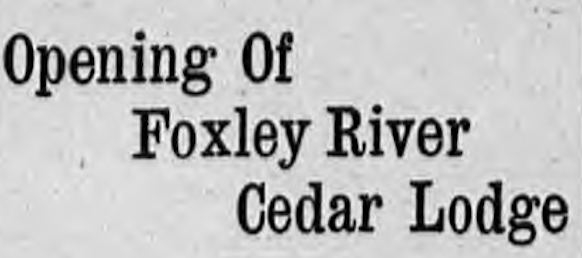
From The Charlottetown Guardian September 7, 1933, page 2
The historical old home of Hon. James Warburton at Freeland, Lot 11, was the scene of a happy gathering on Wednesday afternoon and evening for the opening of Senator Creelman MacArthur’s new Lodge.
This beautiful estate once the scene of great activity in the old shipping days once more rang with the laughter of a happy care free throng enjoying the many pleasures provided by the Senator.
In the old days when ships would be launched at the very spot where the Senator has his Lodge, no doubt the villagers enjoyed themselves in just such a fashion.
One old gentleman, Mr. Thomas L. Murphy, recalled that on one occasion, when Charles McKinnon, a large shipbuilder, was in such a hurry to get a ship named Silver finished and ready for its ocean voyage to the old country, that he had her full rigged on land and when the ice broke and she was launched, she proved to be top heavy and toppled over and about a hundred people were nearly drowned. This was a three masted schooner, one of many schooners built at Foxley River in those days, rigged on sea and loaded with produce for England. Upon their arrival in the old country they were sold. Many old tales were told, by the old inhabitants of the district, of the activities in those days. The old store kept by Michael Kilbride in 1843, which was later moved down the ice to John Yeo’s place at Port Hill, and which is still standing in the yard of Roy Ing’s, was mentioned. Records in the books of the store have the names of many of the first settlers of that vicinity. Among the records is an account of articles purchased for the Officers Mess of the Rifle Brigade of P.E.I. amounting to £4, 7. 4 1-2.
Mrs. William Palmer, daughter of Alexander McKay who ran the mill on the Warburton estate, is the only person now living who was born on the estate. She told how when a little girl she would sit on the shore and herd the cattle for her father.
This old place presented a pretty scene at twilight with the sun setting over the water and the Lodge, decorated with spruce and fir, lit up with many coloured lanterns.
At seven o’clock a dance officially opened the lodge and the visitors to the strains of a fox trot enjoyed the hospitality of Senator McArthur and his daughters, who extended a cordial greeting to all. During the afternoon the visitors strolled about enjoying and admiring the beautiful scenery. Many took advantage of the boats placed at their disposal, and went for a sail on the river.
The ladies of St. Peter’s Anglican Church served tea on the grounds.
After the opening dance at seven, Mr. James McLean, of Freeland, the Senator’s right hand man, called for speeches.
Among those speaking was Mrs. Oscar W. McCallum, of Saskatoon, daughter of the late Donald Nicholson of Charlottetown, who said it was a great pleasure for her to be asked to speak at this historical place, one of the beauty spots of her native land.
Other speakers were Mr. Herman Bryan, former owner of the property; Mr. A.. E. McLean, MP.; Mr. A. J. Matheson, O’Leary; Judge Inman, Judge of the County Court of Prince County; Mr. J. F. Arnett, Summerside; Mr. A. A. Ramsay, a native of Freeland; Mr. Reginal Bell of Charlottetown, and Mr. Thomas L. Murphy of Freeland.
All spoke of the generosity of Senator McArthur, who had shown a very cosmopolitan spirit in throwing open their lovely grounds to the public; which in these times of depression is the right example to set, to any one who has the means and opportunity to do so.
Senator McArthur in response to the three cheers and tiger that went up from the crowd when he came forward, said that he had purchased the property for the benefit of the community and not for any commercial gain.
He intended to stock the waters with trout so that trout fishing could once more be enjoyed as in days gone by.
The grounds would be at the disposal of any community or church of any denomination to hold picnics and social gathering at any time. He wanted all his neighbours in Freeland to feel that they could come and enjoy the quiet walks and bathe or dig clams whenever they chose, and he added, that he especially wanted the mothers and children to come and spend many happy afternoons in his spacious grounds.
This concluded the formal part of the program.
A huge bonfire was now set on fire which lighted up the country side for miles around.
The crowd then gave themselves up to the entertainment of the evening and dancing in the lodge was in full swing.
About 11 o’clock when the harvest moon was shining over the waters, another bonfire built like a haystack in the stream was set going and made a never to be forgotten sight. The dancers paused as if fascinated, the moon on the water with the reflection from the fire lighting up the woods in the background, making an enchanting scene. The merriment was kept up until quite late and closed with singing “For He’s a Jolly Good Fellow.”
Besides the people of the surrounding districts, friends from Charlottetown and Summerside were among the visitors. —S.
Sunset view on the shore next to Cedar Lodge, August 28, 2023
I can’t easily identify my favourite band or book or movie. I could give you a top ten list of favourites, but would not be able to single out just one.
My favourite podcast of all time is easy, though: A History of the World in 100 Objects from BBC Radio 4 in collaboration with the British Museum. It was broadcast in 2010 and I downloaded every podcast episode over our 1.5 Mbps internet connection and listened while I worked outside that fall.
The idea of looking at the span of human history through 100 objects captivated me, and I started my own 100 Objects project on an earlier version of this blog, planning to write about a different object once a week. I wrote about a couple of things from my unorganized collection of stuff, but didn’t continue both because of time constraints and not being certain of what I wanted to say or even why I thought something needed to be said!
I’m going to start again, this time documenting things that will tell the story of my family, my community and me, but only when and as the spirit moves me.
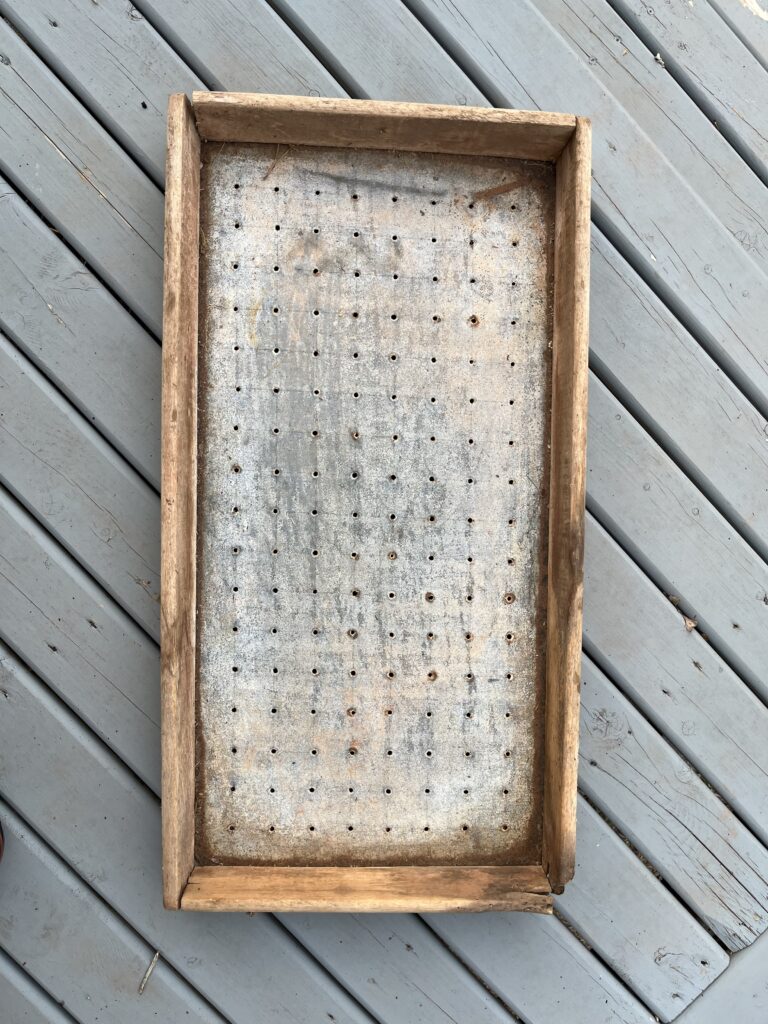
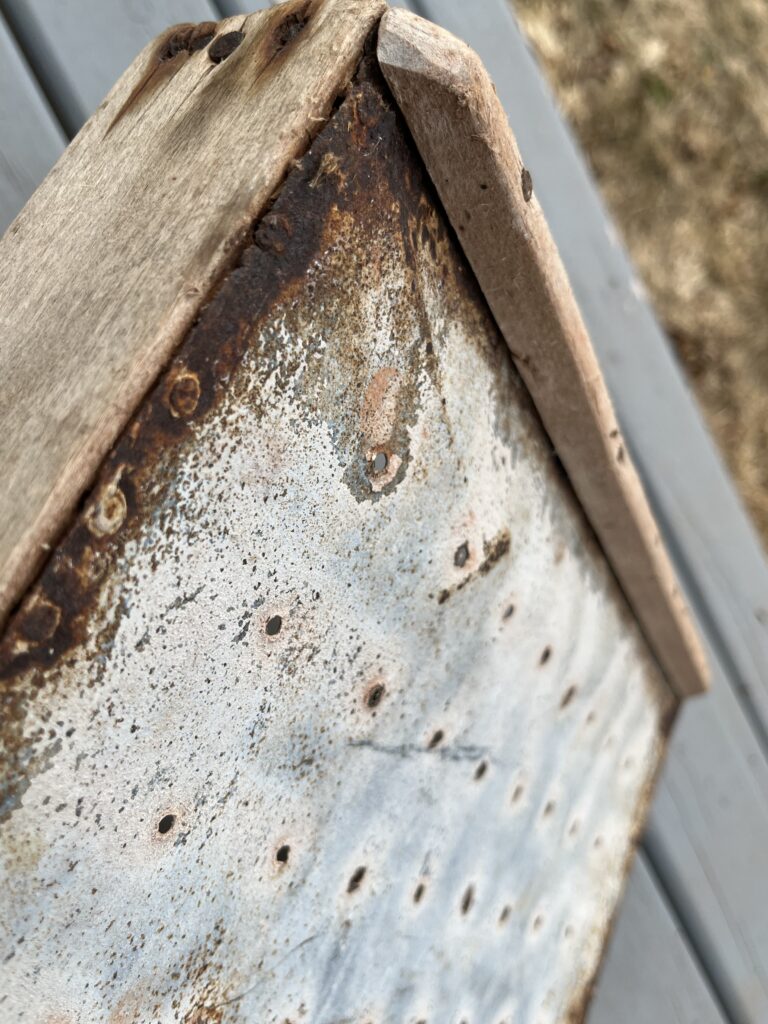
Lobster tray from the Ernest Hardy cannery. Difficult to date, but the cannery operated seasonally from 1901-46
Item One is a lobster tray and it came to mind when I saw this advertisement in the April 25, 1923 Guardian.
April 26, 1923 Guardian, p.6
My great grandparents, Eva and Ernest Hardy, ran a lobster canning factory on the Conway Sandhills at Hardy’s Channel off Milligan’s Wharf, PEI from 1901 until Ernest’s death in 1946. My mother spent her childhood summers at the factory, so I have her stories and even a few photos of the place, but not much of the physical elements of that bustling enterprise remain.
Some of the buildings now at Milligan’s Wharf made up part of the factory and were hauled over to the mainland of PEI in the early 1960s to be used by my mother’s uncles. Some were later repurposed for cottages, one into a snack bar, and one sadly sits abandoned by next-generation owners who have little regard for its history.
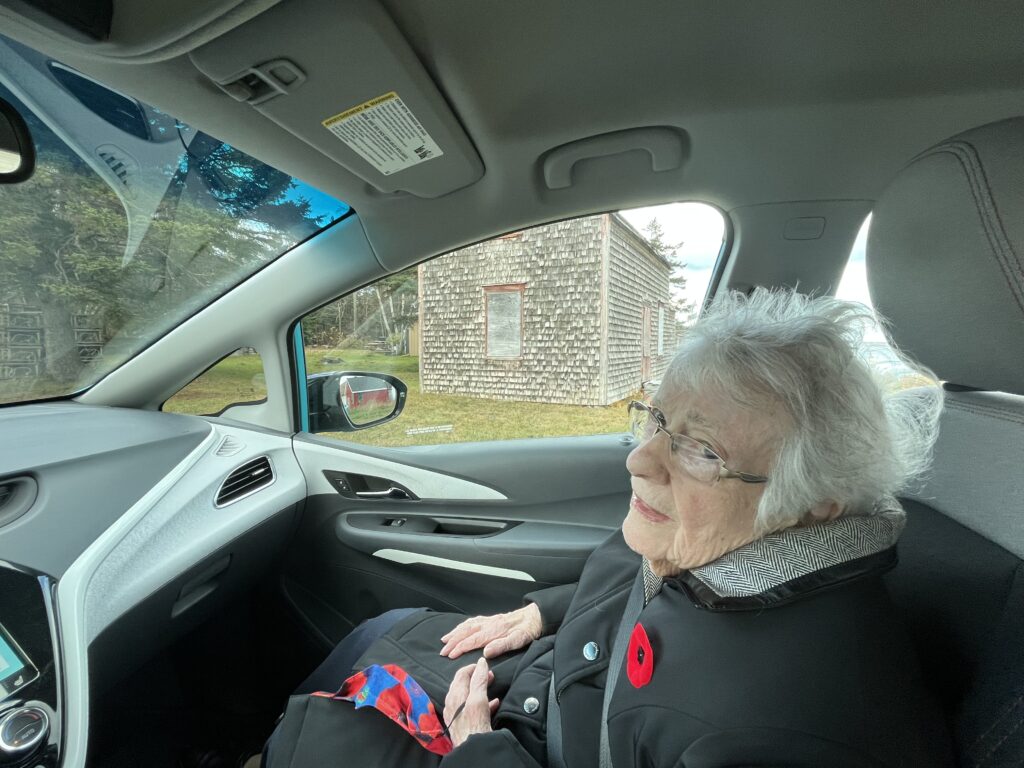
My mother, Vivian Phillips, visiting the old cookhouse from her grandparent’s lobster cannery, Milligan’s Wharf, November 2021. She and her brother would sleep upstairs in the colder months to take advantage of the warmth from the cook stove below.
Ella Oatway and Eva Hardy on cookhouse steps, Conway Sandhills, 1940s. There is a small roof behind them that connected the cookhouse to the separate dining building.
The factory equipment – boilers, tools, tables, canners, utensils – are probably all long gone, no doubt sold to others in the same business or repurposed by the family, which is why I was surprised to come across the tray in our shop building some years ago.
I’m not sure why we have the tray, though I expect it came from one of the buildings on the home property once owned by Ernest and Eva and later occupied by their son, Elmer. My mother helped Elmer in his market garden and he would often give her old things that were hanging around the place and probably in his way. She had a collectors spirit, for which I am thankful.
Until I saw Fred H. Trainor’s advertisement, I had assumed the tray had been made by someone working for Ernest, and that could still be true. Fishermen built their own lobster traps and boats, so making some rough trays wouldn’t be a big deal. My mother’s father, Wilbur Hardy, was not a fisherman but did have a small box mill that he used to make lathes and boards for crates, so he would have been well positioned to fashion the wood for a tray for his father’s business.
Tray holes spaced 1.5 inches apart
The tray is base is galvanized metal. The wooden frame is 13.5 inches wides, 26.25 inches long and 2.25 inches deep. There are small pieces of wood, tapered by rough carving on either end, on the bottom on the two shorter sides that would allow the tray to sit slightly off of a table for drainage. The drainage holes are evenly spaced 1.5 inches apart, faint grid lines directing the precise location for punching. Considering the amount of salt that would have been around the factory, it’s miraculous the nails holding the frame together are still able (barely) to do their work of holding the pieces together.
The factory was probably a difficult place to work in a challenging location: a sandbar on the north shore of PEI. There was never electricity there, though they did get a gasoline-powered stationary engine in the late 1920s, which was later rescued from a barn by my cousin. He thinks it was used to run a saw to cut up firewood, which was needed in large amounts to fire the boilers that produced hot water and steam for the factory.
Everything was done by hand, in conditions that would probably not be considered sanitary today. The boiler man drew water from a hand-dug well using a bucket and would fill the huge boiler that produced steam to cook the lobsters, keeping a hot wood fire roaring all day. Workers, both men and women, would open the cooked lobsters, first ripping off the claws and cracking them at the knuckle with large knives to extract the meat, pulling out the tail meat, and ripping the bodies apart.
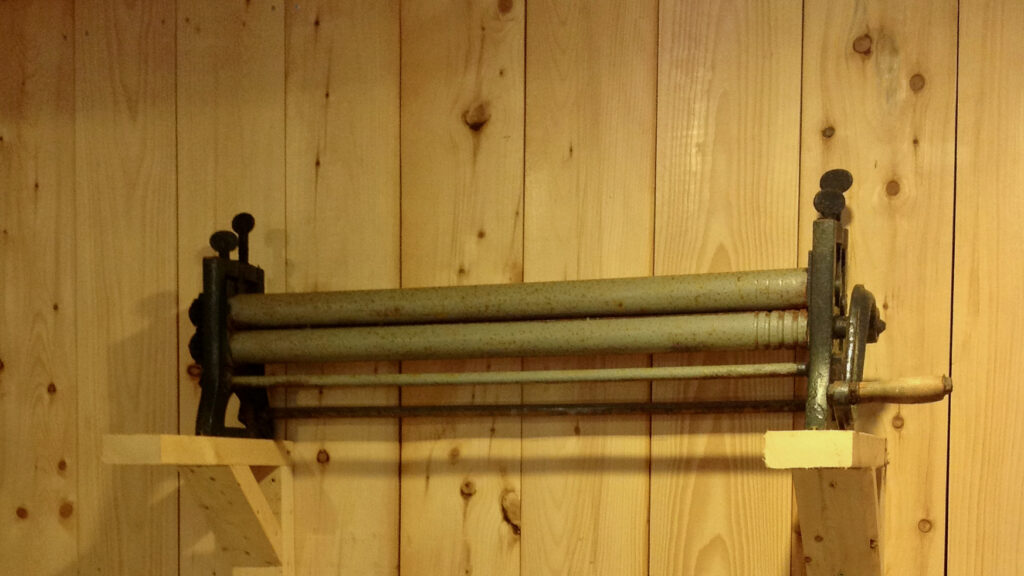
The little legs were fed through the wringer that came off a washing machine, squeezing the sweet meat out of them. My mother says this was the only job she ever did in the factory. The leg meat was added to the tomalley (“the green stuff” inside a lobster body) and roe to make lobster paste, also canned and sold. They also canned mackerel.
Wringer for squeezing out lobster meat, Basin Head Fisheries Museum, PEI, 2014
Leftover lobster bodies quickly become smelly, and piles of them would attract flies and wild creatures, so my mother says they were dumped back into the ocean by the fishermen or hauled to farms to be used as fertilizer. One of her uncles would fill his dory with bodies, take them back to the mainland, throw them into a wagon, and spread them on his farm fields to be disced under. They would certainly be scavenged by animals and birds when fresh, but eventually they would break down and act as a good fertilizer, or as good as a fertilizer could be before chemicals fertilizers were created. Even with all that effort of spreading lobster bodies, that uncle called his place Wild Rose Farm because that’s all the land was good for growing!
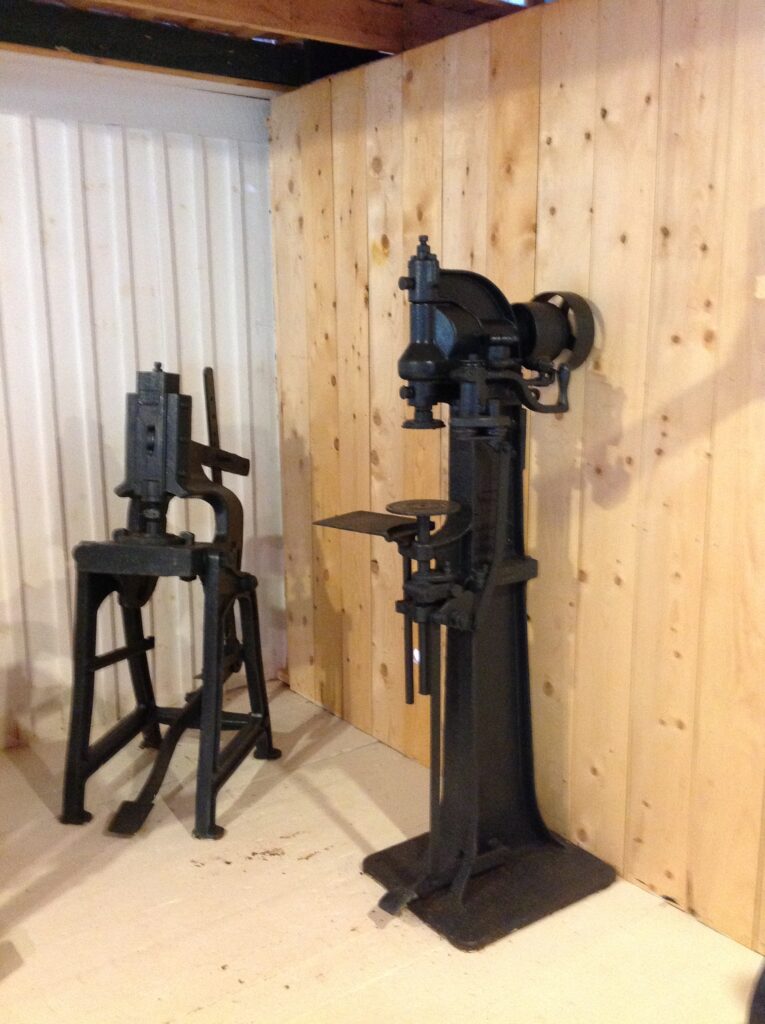
Can sealers, Basin Head Fisheries Museum, PEI, 2014. The one used by Elmer Hardy was similar to the one on the right, but smaller and attached to a work bench in his shop.
One of the canning machines, a greasy looking hand-cranked device, was in Elmer’s shop building. He raised chickens for eggs and meat, and canned chicken, beef and some fish well into the 1980s. Some people in our area still can beef, chicken and bar clams, though use glass canning jars and not the more tricky metal cans.
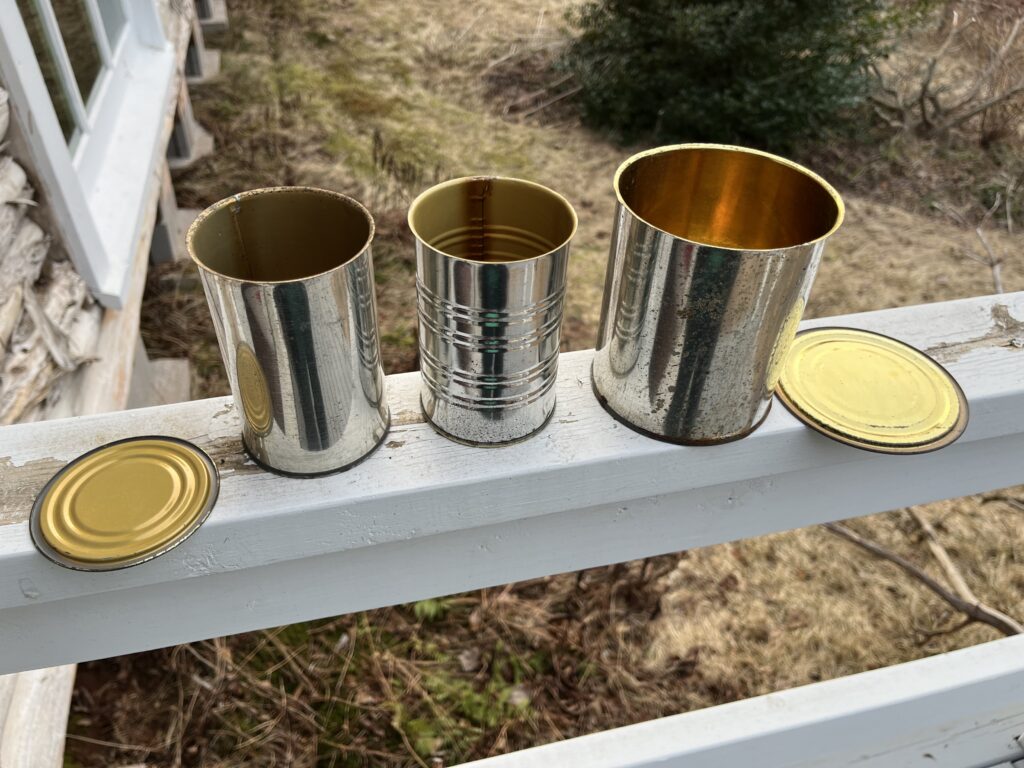
Unused cans and lids from two cases my mother had, which she would have purchased to give to her Uncle Elmer to have him can chicken for her. He probably stopped canning by the 1990s.
My mother says her grandmother, Eva, packed every can as she had “the knack”, and probably also wanted to make sure the weight was exact. A piece of white parchment paper was placed in the bottom of the flat, wide cans, and she would carefully fit tails, claws and bits of meat to bring it up to the correct weight. Once the cans dried and cooled after processing, a label would be affixed with glue or paste. My mother says her grandparents’ product was sold to wholesalers, so there was not an E.A. Hardy brand, but more likely they were canned for DeBlois Brothers wholesalers in Charlottetown, or maybe the large PEI retailer, Holmans.
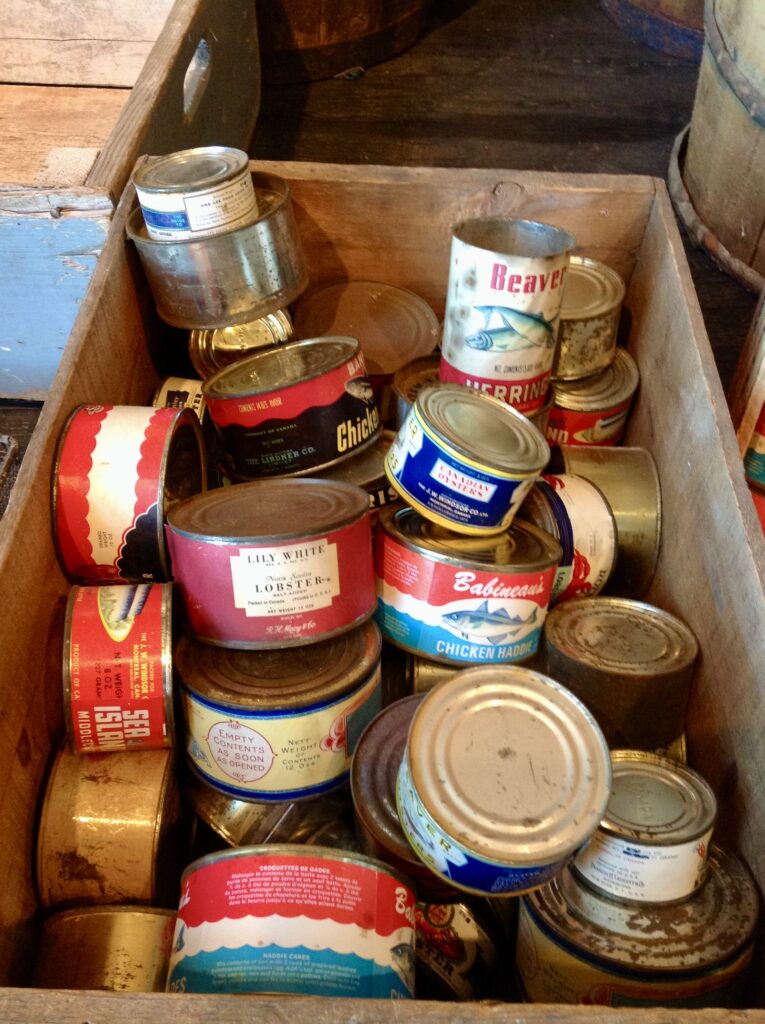
Lobster and other fish cans at Basin Head Fisheries Museum, PEI, 2014
My great grandmother likely handled the tray thousands of times over the 45 years they worked each summers to make the money that would carry them over the rest of the year. “Factory owner” makes it sound like they were rich, and they definitely were not. They had a telephone, but no electricity and never had a car or truck. The furthest from PEI either of them ever got, that I know of, was when when my great grandfather went to Montreal for an operation, but I don’t think my great grandmother ever left PEI, or even went to Charlottetown! I gather they were well-respected in the community as being industrious and honest, but they had little more than anyone else.
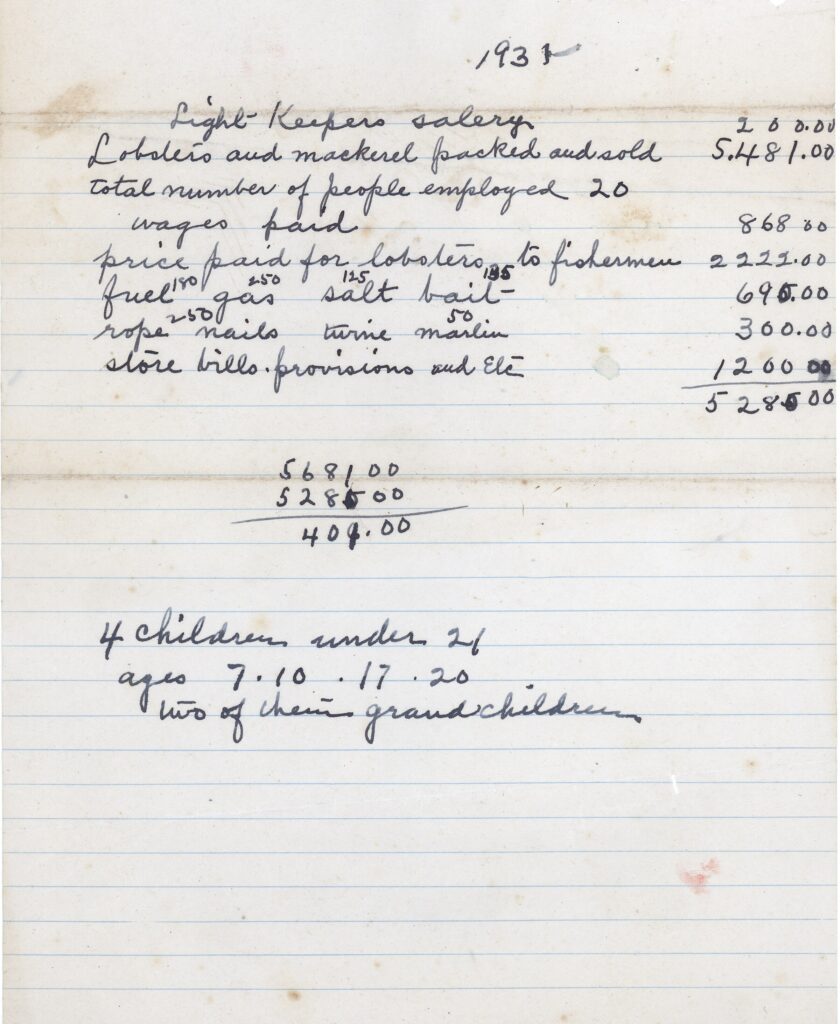
Income statement for Ernest Hardy, 1931. His lighthouse keeper’s income from the Canadian government was incredibly important to the family, making up half of their net income that year.
I think of the countless people who held that tray, working long hours to make a product they probably couldn’t afford to buy. That’s still the story for millions today who produce our clothing, electronics and food in hidden corners of the world. They make little, the corporations make a lot, and we get cheap things.
There are still lobster processing factories on PEI, some of it being canned but most of it frozen. Local workers became more difficult to find over time, so a large percentage of factory workers now come from places like the Philippines. Those temporary foreign workers have supported the lobster fishing industry in a way that is perhaps not acknowledged often enough, as the market for fresh lobster is limited and processing the only way to ensure there is a bigger market.
Lobster fishing and processing is still difficult, even dangerous, work. Thank the lobster, thank the fisher, thank the factory worker who holds the tray.
A friend and I went to our first Death Cafe in Summerside yesterday. I was already planning to be in town for an appointment and was able to arrange to stay a bit longer to join her, and I’m so glad I did. She and I are both very open about talking about death, so she was the perfect partner for this experience.
The Death Cafe concept started in the UK just over a decade ago and are now held around the world. They are designed to be casual events where people talk about death: your own, those you love, death in general. It is emphasized that a Death Cafe is not a grief support group, though most everyone yesterday spoke about people they loved who had died.
Hospice PEI were the sponsors and had held a few before the pandemic, but this was the first post-pandemic edition. Their staff arranged all the logistics (including chocolate cupcakes with little RIP signs on them!) and acted as facilitators. I think there were about 15 of us around three tables at Samuel’s Coffee House.
There aren’t firm rules around what is discussed at a Death Cafe, except that we not share the stories or details we heard from others. It was made clear we could speak or just listen, whatever we were comfortable doing.
After introductions, the facilitator at our table of six invited us to share what we hoped to get out of the session or what had made us attend. We all had very different reasons for being there, and the conversation flowed freely. We also used cards from The Death Deck Game, and spent an hour talking and listening. Despite the serious topic, the room was filled with laughter, but there were naturally also a few tears.
My mother is 100. She is remarkably well for her age, but is ready to die, and we talk about it often. She tells others her hope that she won’t wake up one morning, getting the death she prays for, and the reactions are mixed, of course, depending on her audience. When she started speaking so openly about this a couple of years ago, I gently suggested others might not be comfortable with it, but she continued anyway and I accepted it. Death is a very real part of her life, our lives.
My mother is a devout Christian, as was my father, and so I attended church basically from birth. Most Christian churches on PEI have a graveyard attached, and our church’s graveyard is the final resting place of many of my ancestors. I could pick out their tombstones before I could read them, would help my mother as she tended the flowers lovingly placed in front of them each spring, knew how to clean the stones with a stiff bristle brush and soapy water.
My great grandparents were the rough-surfaced white stone onto which moss stubbornly clung. We would scrub their names and dates and the simple phrase God is Love, which is also on the tombstone now in place at my father’s head, where my mother will be, where I will be.
One uncle and aunt had a polished red stone that was easy to clean, with a small tombstone next to it for the tiny baby they had who died right after he was born. That one had a little lamb sitting on top and was my favourite for that reason, but it was so sad, the little baby that never was guarded by the hard, staring lamb.
When you walk by a graveyard on your way in and out of church at least once a week, play tag and run around the tombstones when adults aren’t there to tell you to simmer down, you get a pretty good idea from a young age what life will eventually lead to. Someday it will be you in the box that is carefully carried into the church, the pump organ wheezing Abide With Me. Another little child will awkwardly carry a smelly flower arrangement and have to stand by your grave looking solemn, as you did so many times in the cold or with mosquitos biting your ankles. There will be sandwiches and tea after, and quiet words about you.
My mother taught me an old prayer to say at bedtime that she must have learned from her grandmother, who learned from her mother, and back and back:
Now I lay me down to sleep
I pray the Lord my soul to keep
If I should die before I wake
I pray the Lord my soul to take
I would then say God bless Mommy and Daddy, and recite a long list of aunts, uncles, cousins, friends and pets, including my goldfish, Henry. It was never actually the same list twice as it depended on how tired I was or who was front of mind.
Amen.
And to this day, many decades after I left behind the church and the ideas underlying that fairly creepy verse, the prayer occasionally comes back to me when I can’t sleep. I don’t say the prayer, but list off the loved ones, long-gones and still-heres, all the cats, a few chickens, and drift off.
We had family wakes in our house when I was a small child, the traditional way it had always been done. Only a wall separated two-year-old me in my crib from the dead body of my grandmother and then, a few months later, an 18-year-old cousin. They were asleep while we were asleep, they were asleep when we were awake. We waked, they slept.
Someone even took group photos next to the caskets, capturing those final moments together. That’s something I’ve never heard of anyone else doing, and which I knew from a young age was probably totally bonkers and something best kept to myself, but that’s what happened. People touched the dead hands and faces. I don’t remember any of this happening, except that I’ve seen those photos, rushing quickly past them in the photo albums. The smell of flowers must have been overwhelming in our house, and the scent of too many roses can still make me queasy.
I’m not sure if many people cried at my grandmother’s wake as she was 74 and hadn’t been well, so it would be seen as a blessing. I know many cried at my cousin’s wake because he had been killed in a motorcycle accident and was beloved by everyone. Only last week, my mother told me again that she never really got over his death, and that her life was completely changed by it. She lost her mother when she was 4, her only brother when she was 37, her father the year after I was born, her grandparents who raised her, but her young nephew being killed by a careless driver was the death that cut her life in half, the before and after.
When someone who volunteered at the charity where I worked in Toronto died, many of our staff and volunteers went to the wake and funeral. I was then in my early thirties. A colleague asked me to pick her up to go to the funeral home, and when she got in the car told me she was nervous as she had never been to a wake before and wasn’t sure what she would have to do. I was surprised she had lived into her mid-50s without attending a wake, even a family wake, but kept that to myself and told her to just follow me.
As it turned out, I was unable to model the standard PEI wake behaviour – shake hands, tell the person how sorry you are for their loss, shuffle along to the next person, shake hands, tell the person how sorry you are for their loss, shuffle along to the next person – because this volunteer had no family. None. We found out that night in the most poignant way possible that we were her family. Social services paid for the funeral, and it was pretty grim: a flimsy blue cardboard casket, only the flowers our charity had sent, no receiving line, a minister who had never met her and didn’t seem to want to be there. I, confident waker that I was, had never seen anything like it, so my coworker and I both experienced something new that evening.
That same work colleague died last week. She had been unwell for a while, but it was still a sad message to receive. After hearing the news of her death, I remembered a story she had told me about her own mother’s death.
Her mother was in the hospital and had been unresponsive for a couple of days, her breathing slowing, life draining away. Doctors said it wouldn’t be long, and my friend sat alone by her side, hour by hour, no partner or sibling to relieve her as it was just the two of them living together in Canada. Their relationship had been difficult for many complex reasons, but she was still feeling very sad that this was the end of her mother’s life.
Suddenly, her mother roused, sat up, looked at my friend and said, “You and I have a lot to talk about.” Then her mother laid back down and died.
The end. Amen.
They are planning to hold more Death Cafes on PEI, and they are also held in many places around the world. It was an entirely positive experience, very freeing and uplifting, and I hope to attend another one some time. My friend and I agreed that talking about death made us feel very alive.
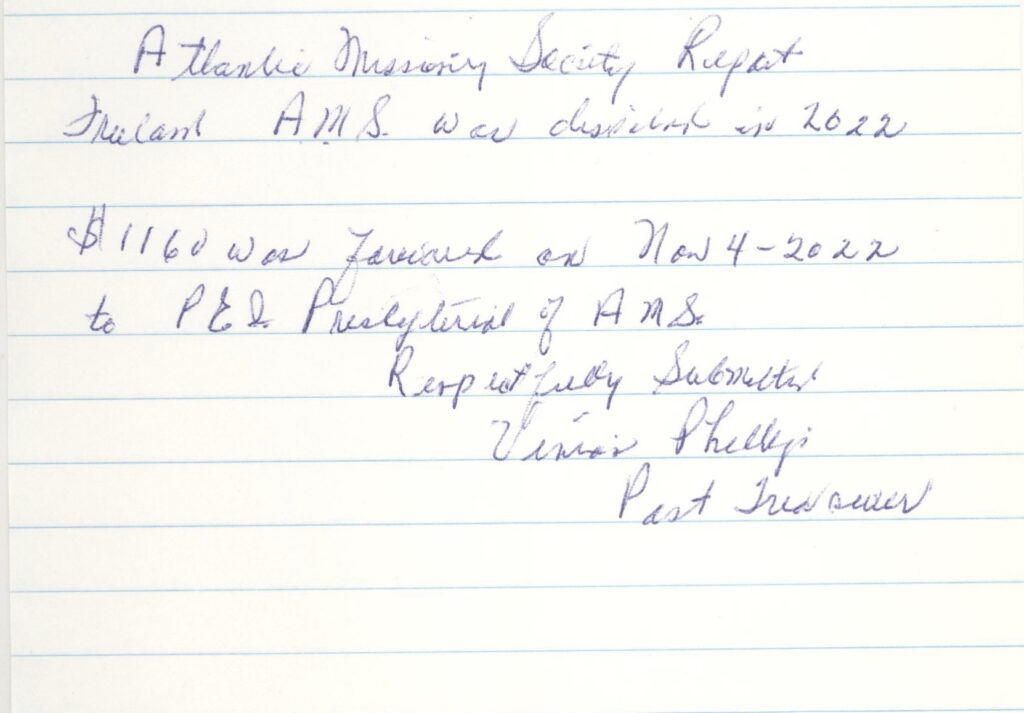
My mother has submitted her final annual financial report as treasurer of her church’s Atlantic Missionary Society group. They disbanded last year after membership dwindled to just five members all over the age of 75.
I am descended from people who came to Prince Edward Island from England and Scotland in the 18th and 19th centuries. Most of my recent ancestry is from Devon and Dorset in the south-west of England, many coming to work in shipbuilding using the plentiful lumber old-growth forest that had stood here untouched forever. My most recent British-born ancestor, GGG grandfather Robert Phillips, came to PEI from Barnstaple, Devon, in 1832 to work as a brass fitter in one the many shipyards.
My family stories extend back only a couple of generations, so I have no accounts of what those ocean crossings were like, what their first impression was of PEI, how they felt about leaving family, friends and country behind, but I have often thought about what that experience would have been like for them.
I recently did a week-long trial membership on Newspapers.com. While it seems an excellent site and probably well worth the subscription price, I didn’t sign up as I was afraid I would do nothing else but read old newspapers for the rest of my life!
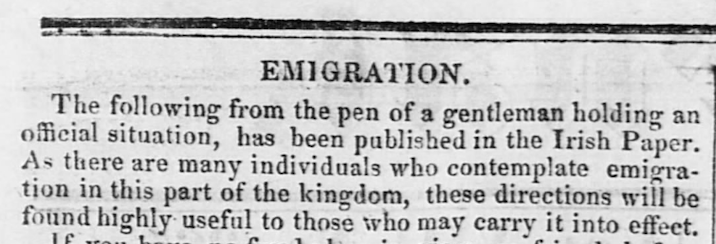
During that trial, I searched Devon newspapers from the early 1830s to see if there was any record of Robert’s departure for PEI. That search came up empty, as I had expected, but I did find a wonderful piece in the June 23, 1831 edition of The North Devon Journal and General Advertiser that gave advice to those who were thinking about moving to North America. I wonder if Robert used this article to help him plan his move, or convinced him that such an adventure could be a possibility for their family. Maybe he cut it out and carried around in his pocket.
The author wasn’t named, but they gave very specific and sound guidance, especially about the British North American climate, information that would still be pretty accurate today.
After listing practical supplies needed for the journey and setting up a new home, the author suggested the final item a young man needed to procure was “an active young wife.” As he already had a wife and five children, including two-year old twins, Robert was fine on that account!
The author outlined a plan on how to survive the ocean crossing and insisted that “by attending to these observations, I will insure you landing in good health, and better looking than when you embarked.” The idea that someone in the 1830s would be better looking after their weeks at sea than when they boarded is amusing, as it is certainly more than hinted at in the article that the living quarters on ship left much to be desired. I’m sure it was a miserable, dangerous crossing.
Young men were advised to leave their “party feeling” behind to ensure they didn’t jeopardize their chances of advancing in their new home because they had clung to old political allegiances. Knowing how party politics is deeply ingrained in the DNA of many Islanders – some families here have voted for the same party for generations – I suspect these newcomers might have left the Whigs and Tories behind, but retained the deep need to find a political home in their new country.
I visited Barnstaple 30 years ago. One evening, I walked to the River Taw and stood on a dock looking west. I thought about Robert and Mary Ann arriving with their small children, all under the age of seven, ready to board a ship into the unknown. This article goes some way in filling in the blanks in my family’s story, adding texture and depth to sterile names and dates. They are still out of reach, but I can see them over the horizon.
Emigration.
The following from the pen of a gentleman holding an official situation, has been published in the Irish Paper. As there are many individuals who contemplate emigration in this part of the kingdom, these directions will be found highly useful to those who may carry it into effect.
If you have no fixed place in view, or friends before you, if labour and farming be your object, and you have a family, bend your course to the Canadas; for there you will find the widest field for your exertions, and the greatest demand for labour.
In almost every part of the Middle States of America, you are subject to fever and ague, as also in some parts of Upper Canada. Lower Canada, New Brunswick, and Nova Scotia are exempt in this respect.
I would particularly recommend the months of April and May for going out, as you may then expect a favorable passage; on no account go in July or August, as, from the prevalence of the south-west winds, you will have a tedious passage. Make your bargain for the passage with the owner of the ship, or some well known respectable broker, or ship-master: avoid, by all means, those crimps that are generally found about the docks and quays, near where ships are taking in passengers. Be sure that the ship is going to the port you contract for, as much deception has been practised in this respect. It is important to select a well known captain, and a fast sailing ship, even at a higher rate.
When you arrive at the port you sail for, proceed immediately in the prosecution of your objects, and do not loiter about, or suffer yourself to be advised by designing people, who too often give their opinion unsolicited. If you want advice, and there is no official person at the port you may land at, go to some respectable person or Chief Magistrate, and be guided by his advice.
Let your baggage be put up in as small a compass as possible; get a strong deal chest of convenient size, let it be in the shape of a sailor’s box, broader at bottom than top, so that it will be more steady on board ship; good strong linen or sacking bags will be found very useful. Pack your oatmeal, or flour in a strong barrel, or flax-seed cask, (which you can purchase cheap in the spring of the year.) I would advise, in addition to the usual wood hoops, two iron ones on each cask, with a strong lid and good hinge, and a padlock, &c. Baskets or sacks are better adapted for potatoes than casks.
The following will be found a sufficient supply for a family of five persons for a voyage to North America, viz.— 48 stone of potatoes (if in season, say not after the Isl. of June,) 2cwt. and a-half of oatmeal† or flour, ½ cwt. biscuits; 20lbs. butter in a keg; 1 gallon of spirits; — a little vinegar; — When you contract with the captain for your passage, do not forget to insure a sufficient supply of good water. An adult will require 5 pints per day — children in proportion.
The foregoing will be found a sufficient supply for an emigrant family of five persons, for 60 or 70 days, and will cost about £5 in Ireland or Scotland; in England about 6 or £7; if the emigrant has the means, let him purchase about 11lbs. of tea, and 16lbs. of sugar for his wife.
The preceding statement contains the principle articles of food required, which may be varied as the taste and circumstances of the emigrant may best suit. In parting with your household furniture, &c. reserve a pot, a tea-kettle, frying-pan, feather-bed, (the Irish peasantry possess a feather-bed,) as much coarse linen as you can, and strong woollen stockings — all these will be found very useful on board ship, and at your settlement, and are not difficult to carry. Take your spade and reaping-hook with you, and as many mechanical tools as you can such as augurs, plaines, hammers, chissels, &c., thread, pins, needles, and a strong pair of shoes for winter. — In summer in Canada, very little clothing is required, for six months — only a coarse shirt and linen trowsers, and you will get cheap moccasins (Indian shoes;) you will also get cheap straw hats in the Canadas, which are better for summer than wool hats, and in winter you will require a fur or Scotch woollen cap. Take a little purgative medicine with you, and if you have young children a little suitable medicine for them. Keep your self clean on board ship, eat such food as you have been generally accustomed to, (but in moderation) keep no dirty clothes about your births, or filth of any kind. Keep on deck, and air your bedding daily, when the weather will permit; get up at five o’clock, and retire at eight; take a mug of salt water occasionally in the morning. — By attending to these observations, I will insure you landing in good health, and better looking than when you embarked.
From the great disparity of male over female population in the Canadas, I would advise every young farmer or labourer going out, (who can pay for the passage of two) to take an active young wife with him.
In Lower Canada, and New Brunswick, winter begins about the end of November, and the snow is seldom clear from the ground till the beginning of April. In Nova Scotia, and Prince Edward’s Island, from their insulated situation the winters are milder than in New Brunswick or Lower Canada, and in Upper Canada they are pretty similar to the back part of the State of New York.
The risk of a bad harvest or hay time is rarely felt in Lower Canada, and consequently farming is not attended with so much anxiety or labour as in the United Kingdom. The winters are cold but dry and bracing. I have seen men in the woods, in winter felling trees with their coats off, and otherwise light clothed. The summers are extremely hot, particularly July and August.
The new settler must consult the seasons in all his undertakings and leave nothing to chance, or to be done of another day. The farmers of Lower Canada are worthy of remark in these respects.
In conclusion, I beseech you, if you have any party feeling at home, if you wish to promote your own prosperity, or that of your family, wash your hands clear of it ere you embark. Such characters are looked upon with suspicion in the Colonies; and you could not possibly take with you a worse recommendation.
Prices of living, house rent, labour, &c. in the principal towns of Canada, with the expense of travelling on the great leading routes — In Quebec and Montreal, excellent board and lodging in the principle hotels and boarding houses, 20s. to 30s. per week. Second-rate ditto from 15s. to 20s. per week. Board and lodging for a mechanic or labourer 7s. to 9s. 6d. per week, for which he will get tea, coffee, with meat for breakfast, a good dinner, and supper at night.
• If potatoes are out of season for keeping, increase the quantity of oatmeal.
If the Emigrant has any oatmeal to spare, it will sell for more than prime cost.
From The North Devon Journal and General Advertiser – Thursday, June 23, 1831