Just now, as I was looking out the living room window trying to decide how to spend this day, a flock of robins bounced down our lane. Two, then three, leapfrogging over each other. Moving from the red dirt road to the green grass, all of it covered with leaves from the white birch, the maskwi.
I counted seven in all, running and hopping, turning over leaves that were nearly the same colour as their beautiful rusty breasts. They were finding little earthworms and the ancient sowbugs, tiny crustaceans that walk on earth.
As the last robin hopped out of my view, I was still undecided as to what I should do with the rest of this day, still fresh and new, but my robin friends certainly reminded me to walk lightly on the earth and appreciate whatever I find. The sun is finally up and the maskwi are glowing in its light.
Modern Stoicism are offering their ”live like a Stoic” week again this year starting October 24, and you can still sign up. I’ve been participating in this free program for many years, and while I probably couldn’t call myself a devoted Stoic, Stoic Week has given me tools that I believe help me feel more balanced and happier. It is now a rare morning when I don’t think upon waking: “Today I will encounter things I can control and things I can’t control, and I will try to deal with both calmly.”
I have not yet written about my family’s experience with post tropical storm Fiona, but I was surprised at how I was able to emerge from our house after the storm, faced with weeks worth of cleanup and an altered landscape, and just look at it all but not pass judgement. It was what it was. I have said many times over the past three weeks: ”At least a tree can only fall once.”
For someone who has always predicted, planned and prepared to try to stay ahead of problems, this calm and, dare I say, Stoic outlook was proof that at least some of what I’ve been studying these past few years has worked. Stoicism is not at all about becoming emotionless or robotic; it is about finding balance and perspective, and learning how to ride out the storms of life, both literal and figurative.
It’s sort of remarkable that I’ve reached this point in my blogging life and not really talked much about decluttering or minimalism. I am not a minimalist – far from it – but love the idea of it, and aspire to live with fewer things cluttering my house and mind.
Just as life is too short to eat terrible bread, it is also to short to use a terrible pen. Once upon a time I would pick up free pens wherever I saw one, and they were almost all terrible. The ink never runs freely and smoothly, they don’t last, and generally tend to be better advertisements than writing utensils.
The result of all this was that I used to have a drawer full of pens, but as most of them didn’t work or worked poorly, I usually grabbed the same one every day, most often a blue ink retractable Papermate Flexgrip, which I bought by the box.
I finally came to the conclusion that keeping things I would never use was silly and a waste of resources. If someone else can use it, then pass it along or, better yet, don’t acquire something I will never use or never really enjoy.
So the obvious first step was easy: stop taking free pens! Next, I took the pens I didn’t want and that worked ok to meetings with me, where someone usually forgot to take a pen and wanted to borrow mine. “Here, take this one, and keep it,” I would say, like Daddy Warbucks. Little did they know they were helping me out more than I was helping them.
Over the dozen or so years of this whittling down, I’ve made myself use pens that worked well but didn’t like until they finally ran out of ink. Now I can take the dead pens and throw them in a recycling bin at Staples, where I am optimistic they actually make something with them and not just greenwash them into the local landfill.
This morning the last Flexgrip I have gave up the ghost. I am left with a Bic Round Stic that Steven got at a conference. When it wears out, I have the Sheaffer pen someone gave me when I graduated high school in 1984. I was able to buy a new cartridge for it, and it will likely be the only ballpoint I will own.
News out of Sackville, New Brunswick that Mel’s Tea Room is closing, sending Mount Allison University alumni into fits of nostalgia. Generations of Mount Allison University students ate, socialised and studied at Mel’s, and I was certainly one of them. It was like something out of a movie: green walls, counter with stools, hard booths, great diner food and strong coffee. Always someone coming and going. When I attended Mount A in the late 80s, their magazine section was second to none.
Town residents and students had an uneasy relationship at times, similar to the way people who live in a touristy city feel about those who crowd their streets. While residents knew that the university was good for the economy of the town, we students could certainly be a pain. At Mel’s, though, everyone sort of just got along on common ground. Even as thoughtless youth, we knew it was a place to revere and appreciate. Everyone loved Mel’s
I have only been there a few times since I graduated in 1989, the last being in 2013 when Steven wrote the lyrics for an opera presented by students of the Mt. A music faculty. I grabbed some shots on my last visit, the diner eerily sort of empty that night. I had my usual club sandwich and fries and soaked the place in, remembering all the fun I had there, all my pals, the thrill of being one in a long conveyor belt of students who felt at home at Mel’s, knowing I would eventually be replaced, but loving the smoke and coffee and fries and friends and laughter.
Rainy night on Bridge StreetThe booths, the floor, those green wallsJukebox and fabulous speakers
Sit a while
Club sandwich and fries, pleaseVeggie burger?Booth wall, complete with names carved on trim
The elementary school I attended celebrates its 50th anniversary today. 22 smaller, mostly one-room schools, were closed at the end of the 1971-72 school year and all students then bussed in September 1972 to a new facility that had been built in Ellerslie.
I don’t remember the official opening ceremony, though I know I was there, as were my parents. Premier Alex Campbell and other dignitaries made speeches, laid a cornerstone, unveiled a plaque, and then everyone enjoyed sandwiches, sweets, juice and tea provided by a couple of local Women’s Institute groups. WIs were heavily involved in supporting the schools in their individual communities, so they were primed and ready to support this new facility.
The school was a modern, clean building, replacing old wooden facilities that had been well maintained, but were certainly from a different time. A few people were against the amalgamation, some fearing the loss of their individual community’s identity or concerned about the length of time that children would spend on buses, and others who predictably thought that “what was good enough for us should be good enough for them!” With most of PEI marching happily along to the Alex Campbell government’s drumbeat of development, modernity and prosperity, those few who were not in favour were ignored and, as happens with all change, within a few years most forgot there had ever been a school in their community, the buildings either being repurposed as community halls, turned into homes or sheds, or demolished.
The new school had an open concept plan, with sliding accordion dividers between most of the classrooms. This “one big classroom” design was well received at first, but didn’t remain popular for long, and Ellerslie Elementary now has cinderblock walls between classrooms to keep noise and distractions down. There was a large gymnasium, music room, art room, a windowless room that we seemed to only use to watch NFB films, and a large central library space. There were water fountains, banks of trays by the entrance to put your muddy or snowy footwear, and everything was bright, airy and clean.
I remember very little about my first year at school, but I do recall that some of the furniture hadn’t arrived for the first day of classes, so we little ones in first grade sat on the floor. I remember loving my young and energetic homeroom teacher, Mrs. Jelley. I remember how big the grade six children looked, and because children could fail to pass a grade in those days and be kept back to repeat it, there might have been a couple of teenagers in grade six.
Checking out my new school summer 1972
As an only child, I was excited to meet new children, though I did have some neighbours, Sunday school pals and cousins with me, which was a comfort. I remember a new friend helping me tie my shoelace when I couldn’t remember how it was done. As the oldest in her family, she was used to helping her younger siblings with this task and was a good little teacher. And I remember being told to stop talking, and that happened more than once!
Tiny me off to school on what looks like a chilly September day in 1972
The school had some odd features beyond the lack of walls. The gym was carpeted, and this led to nasty rug burns when you tripped and slid (and six year olds trip often!). Much of the rest of the school was also carpeted, making the dry winter months one long string of shocks as children shuffled their feet to electrify themselves and then tapped another kid as they walked by.
Mrs. Jelley was a newly-graduated teacher and full of modern ideas, but some of the other teachers seemed to struggle a bit with the new regime. Teaching in a one room school meant they had been able to run their school pretty much as they wanted, within the curriculum set by the province, and only overseen by occasional visits from school inspectors. Now these teachers had a principal as their onsite boss, had to work collaboratively with other teachers, and had relinquished some of their instructional roles – physical education, library, music – to specialists. Some teachers got along fine and finished out their careers at the school, and others probably retired earlier than they might have had they remained in the one room school setting.
One thing that changed immediately in the new school was the use of corporal punishment. I remember one of the older teachers trying to deal with a little classmate who was talking when he should have been listening. The teacher told him to be quiet and continued with the lesson. The boy didn’t obey, so the teacher called him to the front of the class, told him to hold out his hand, and slapped his palm hard with a ruler. I don’t know for a fact, but I’m pretty certain the teacher was spoken to by the principal, and that was the last time such a thing occurred.
At that time we were not far removed from the days of children being strapped by their teachers, and it would have been the rare parent who wouldn’t have backed up such an action by a teacher, so while it was startling and scary to see someone get their hand slapped with a ruler, it was not really unexpected because older children had warned us about such things. We had been prepared for it, but luckily that would not happen at Ellerslie again.
I was in the fortunate position of attending basically brand new schools for all of my twelve school years: Ellerslie Elementary, Hernewood (grades 7-9) and Westisle (grades 10-12). I had some great teachers, lots of opportunity for extracurricular activities that expanded my world, and met some lovely classmates who are still my friends.
I scanned articles and documents my mother saved from the school’s opening for the 40th anniversary in 2012, when some of us who started grade one in 1972 attended a ceremony and planted a tree at the school, so I’m sharing them here for reference and remembrance. 50 years, gone in a blink.
Part 1 of front page article about new Ellerslie schoolSecond part of articleLetter to parents about official openingList of Ellerslie staff 1972Official Opening Program CoverOfficial Opening Program Page OneOfficial Opening Program Page Two
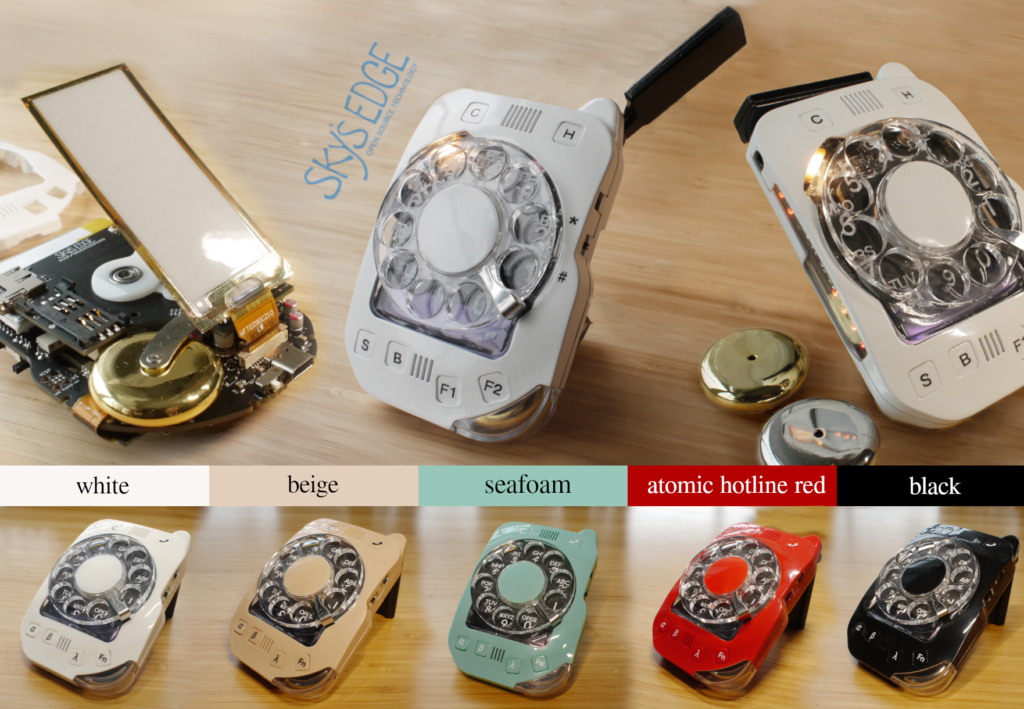
Justine Haupt has started taking preorders for rotary cellphone kits and has released a video explaining the whole thing (it includes a great Contact Easter egg!). I don’t need a rotary cellphone, but love that this wildly intelligent and creative person has created it just because she wanted one. The combination of an ePaper display, rotary dial and real ringer bell is so steam-punk exciting!
If you need a break from whatever is pushing down on the top of your head and bending your back, and would like to feel as though you are bouncing along a little French road in an open-top sports car with a picnic hamper on the back, find a recording of Basia singing Waters of March and float away.
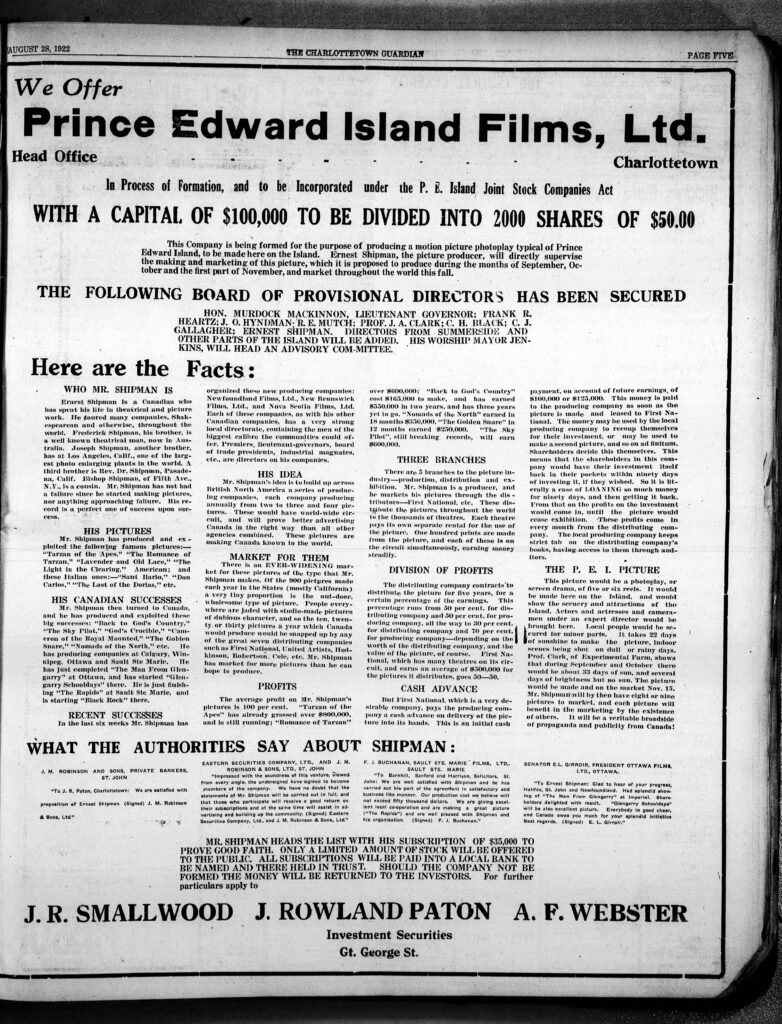
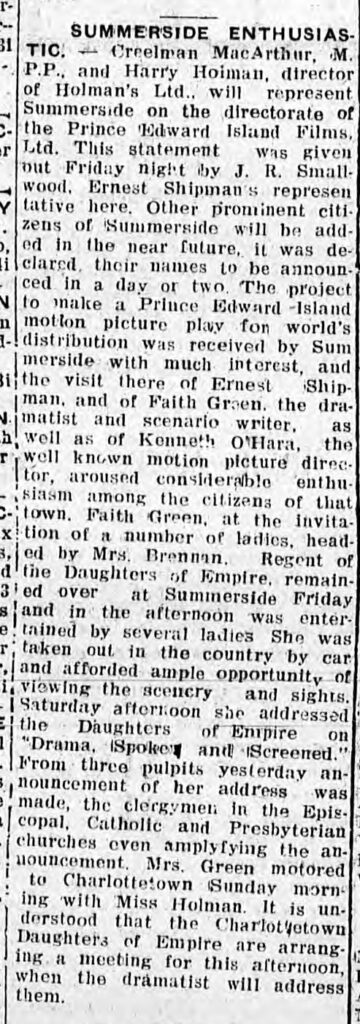
A smooth-talkin’ fella named Ernest Shipman spent a few days on PEI 100 years ago trying to convince the great and the good to back his Prince Edward Island Films, Inc. scheme. “Ten Percent Ernie” went across Canada setting up similar production companies, and I’m not certain if his PEI venture ever took off.
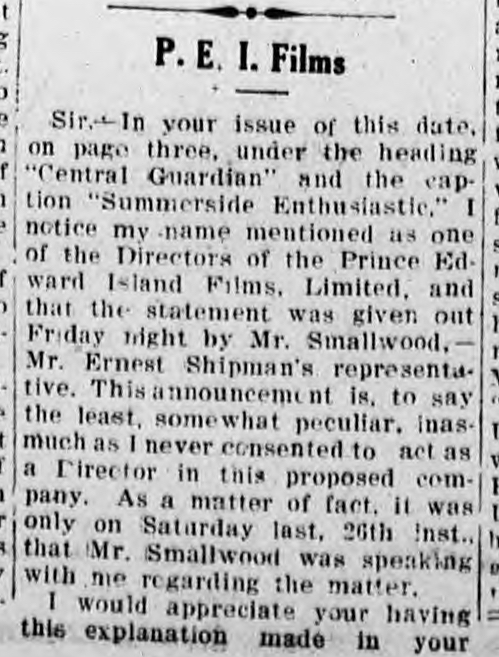
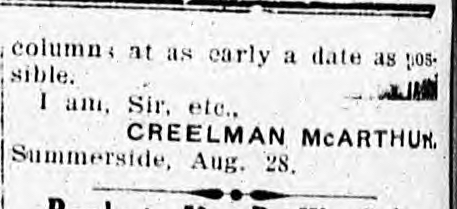
One worthy who wasn’t enticed was Creelman MacArthur, a former owner of the land where our house is situated. He had a letter printed in the Guardian on September 1, 1922 requesting they correct an earlier story:
The welcome mat certainly seemed to have been rolled out across PEI for Shipman and company, as it probably was in every little place they landed and sprinkled their tinsel-town stardust. We can still be a trusting and welcoming bunch here on PEI, and that means being taken in by big promises on occasion (Michael Jackson tribute concert in Summerside starring Beyonce, anyone?), but we still manage to mostly give people a chance to prove they are who they say they are, an admirable quality to retain in an often-cynical world.
Last night as I was heading to bed well past my normal bedtime, I noticed the orange crescent moon climbing up the red pine tree to the east of our house. I went closer to the window to see it better and a shooting star dashed past. I noted Jupiter and Saturn marching across the sky, and suddenly another star fell straight down, grazing the moon. I felt sucked into the night sky, away from here and now.
I imagined my grandmother, Thelma, also awake late on August 19th but in 1922, looking out her window only a couple of miles from mine, waiting for her first child to be born the next day, my own mother, Vivian. Thelma had been orphaned as a tiny girl and married my grandfather Wilbur at an age we would think young now. After one more long night, she would have a family again.
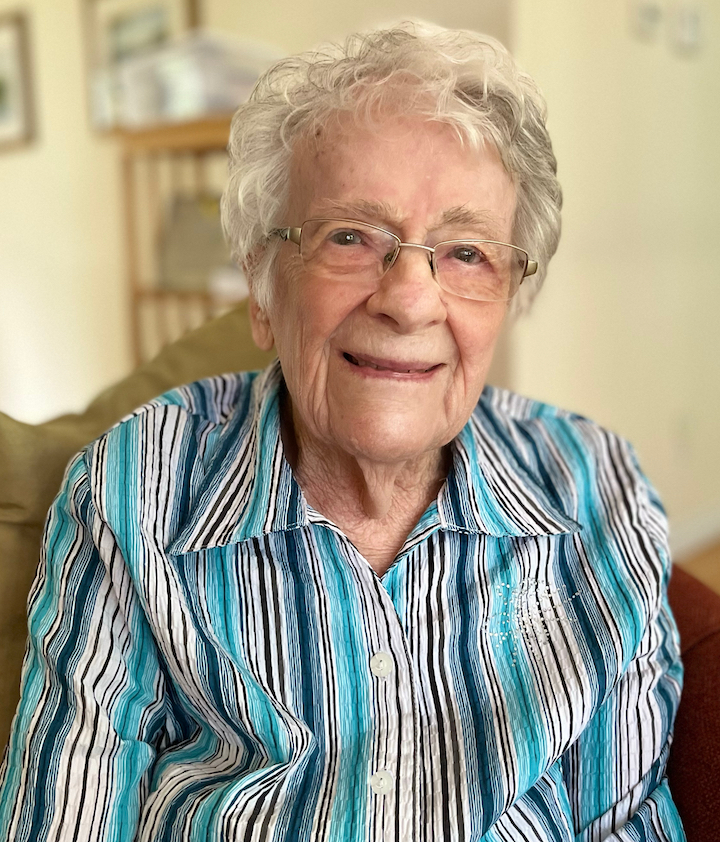
We had an open house party today at the old school in Freeland, again only a mile from where my mother was born, to mark her 100th birthday. About 150 people attended, people who have known my mother from as far back as the early 1940s and some who met her only last month. Cousins brought tiny babies, passing them from one loving set of arms to the other, held them up next to my mother to take a photo on this milestone day (“You once met a lady born in 1922, she held your hand, here’s the proof!”). I watched as people from different parts of our lives made the connection that they both knew my mother. Planets colliding, stars streaking past.
Today my mother was able to receive the good wishes and love of others, and what an overwhelming and humbling experience that was for her and me. How often have we wished that we had told someone how much they mean to us, but it is too late. Everyone had their chance today, and they arrived with full hearts and words of respect and love.
Perhaps all the unnatural separation we have endured over the course of this pandemic needed to burst today, people wanting to connect again, to have community, to love and be loved.
There were so many people at the party I couldn’t possibly talk to them all, but those who I did speak with (all the time still wearing my mask, because this party was not without risk, something I weighed over and over as I considered planning a get together during a still-active pandemic) spoke of my mother’s inherent kindness, faithfulness, goodness, industriousness. The love for her nearly lifted the roof off the old building, the vibrations of family and community connection humming and dancing through the walls and back up to the sky.
When I returned to PEI 20 years ago, someone remarked I had big shoes to fill, but I know I will never be her, never come close to having her impact, though as her only child, I have certainly tried to model my own way of being in the world on how she has lived her life. She has taught me to think of others first, and to always stay true to what I believe in. To be welcoming, warm hearted, cheerful, helpful and kind. I try to work hard and see the good in others. If I have the choice to do more or do less, I do more. Seize the day, move forward, and laugh.
My mother was tired after all the intense attention when we returned home at 4, but by late evening, reading through some of the cards she received, she remarked that it had been a good day, and she only felt 25, that we must have been wrong about the date. That, dear readers, is how you get to 100.
Had a stubborn stain on a white shirt today, so did what I have always done: grabbed a piece of homemade soap and a washboard and gave it a good scrub. The soap was made by my mother’s uncle, Elmer Hardy, mostly likely with chicken fat as he raised hens for meat and eggs. Not sure what else went in the soap, but it certainly contains lots of lye and is hard on your hands if you do a lot of washing with it. Red knuckles will result if you are out of the habit, as I am, and you scrub too vigorously for too long.
Add soap to board, not to the piece of clothing.
In case you’ve never done it but find yourself in a rustic backwoods cabin with dirty clothes, you place the washboard in a laundry tub with some hot water, rub the soap over the washboard, leaving some behind in the grooves, and then scrub the piece of clothing over it. I use our modern plastic laundry tub, run a couple of inches of water in the bottom and a bucket for rinsing, and wash and rinse and wash and rinse until clean. Hang your cleaned item out on the line and the sun will do the rest of the bleaching!
Uncle Elmer died in 2002 at age 92, and I can’t remember when he last kept hens or made soap, but it was many years before that, so that soap could be over 30 years old and is still hard and perfect. He didn’t use individual moulds but instead poured the mixture into a big pan and cut it before it set too hard, so some of the pieces have rounded bottoms. I laugh when I see bougie soap makers now going for a similar raw look to their hand and body soaps, rough and misshapen bars wrapped up in brown paper and twine.
Who taught me how to wash clothes this way? My mother, I suppose, though I don’t remember her showing me, I just picked it up from watching her, as she watched her grandmother, and on and on back in time. My hands hold old knowledge.