On the front page of this morning’s newspaper was a story about a new ferry arriving to fill in for theMV Holiday Island, which will be out of service for an indefinite period of time following an engine room fire a couple of weeks ago.
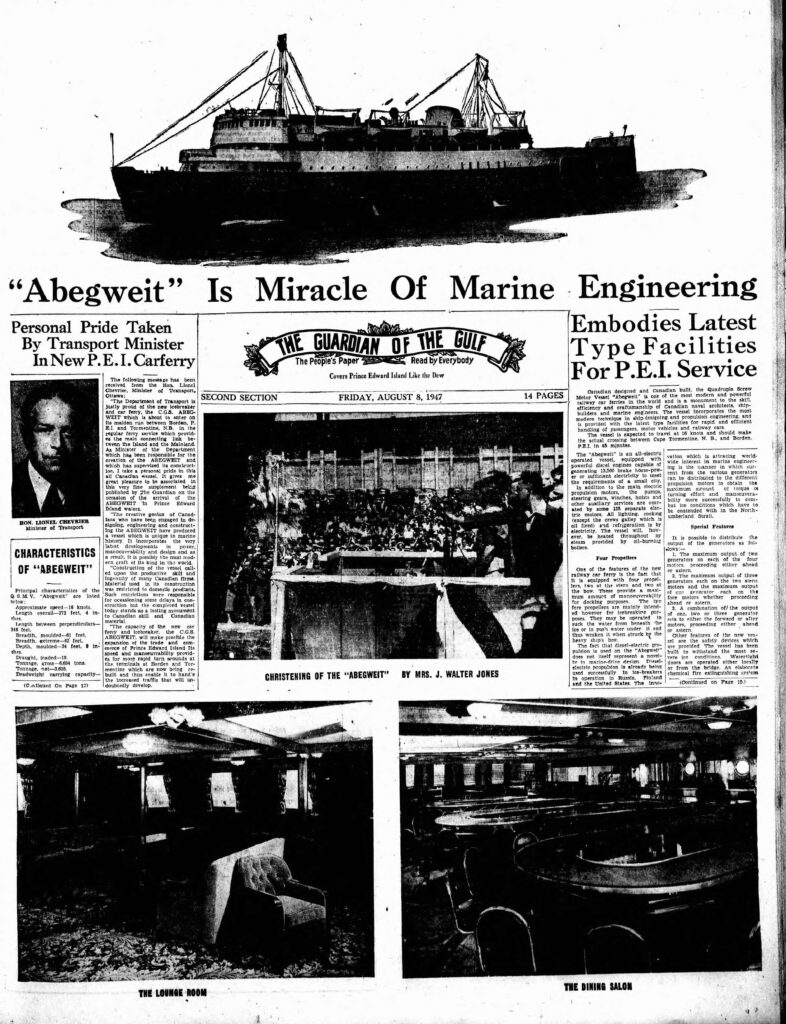
And here’s the front page of the same publication 75 years ago to the day, what looks to be a special section celebrating the arrival of the new MV Abegweit ferry, a vessel so mythologized and beloved by Islanders that a set of doors from the ship currently feature in an exhibition about the PEI tourism trade at the Confederation Centre of the Arts in Charlottetown.
When I was a child, the Holiday Island and sister ship, MVVacationland, were sometimes referred to as the “hot dog boats” because the Abegweit (almost always just called The Abby) had a lovely dining room, while the two smaller summer-only ships only had snack bars and were not as luxuriously equipped. Everyone wanted to catch The Abby!
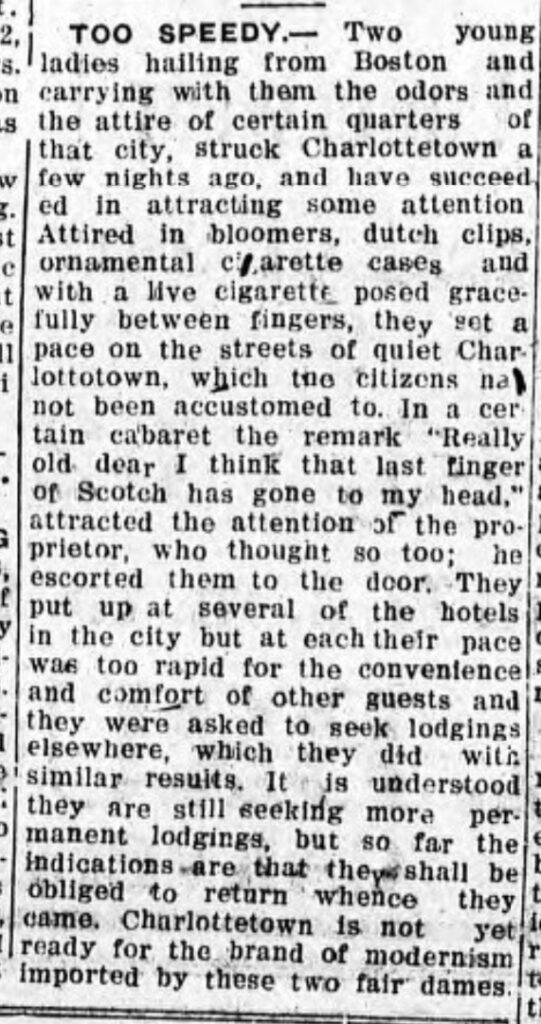
I started to read this piece from the August 3, 1922 Charlottetown Guardian thinking it would be one of many that tut-tut about young fellows racing automobiles through city streets and being a general menace, but this tale of two gals from Boston is about a different procession entirely. The tut-tutting from the city’s great and good about these two racy ladies would have been more deafening than any automobile.
I know basically nothing about fashion, current or historical, but I think the ”dutch clip” could be describing their short hair style, as in the illustration below, but let me know if I’m wrong. Flappers gonna flap, but not in Charlottetown.
Arrows, Xs and masks will certainly be the most memorable symbols of the COVID-19 pandemic for me, but so will these little official-looking squares found in many disposable mask packages. 65%, 35%, 85%…better wear two.
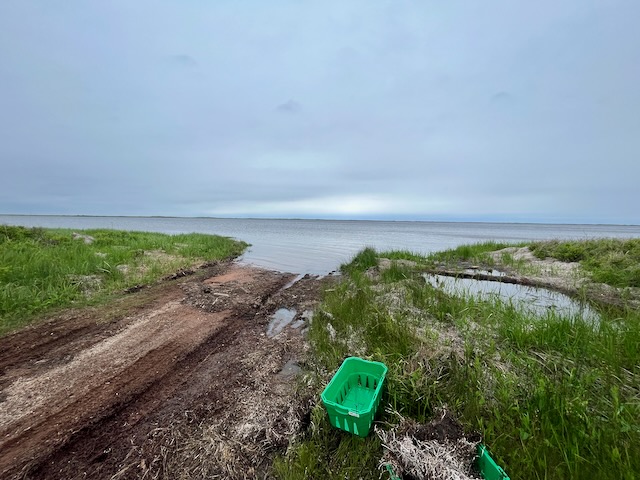
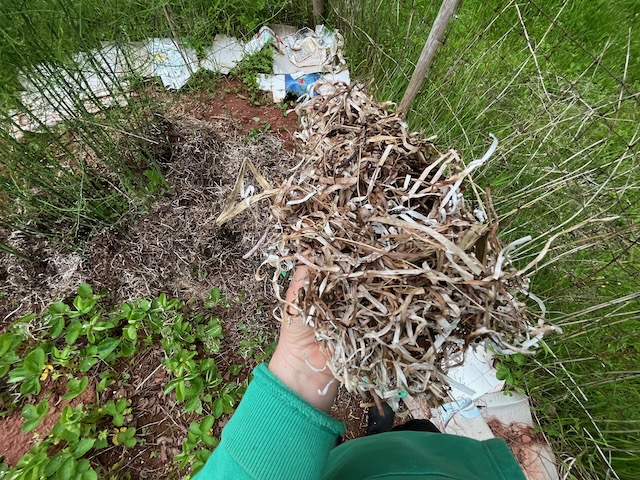
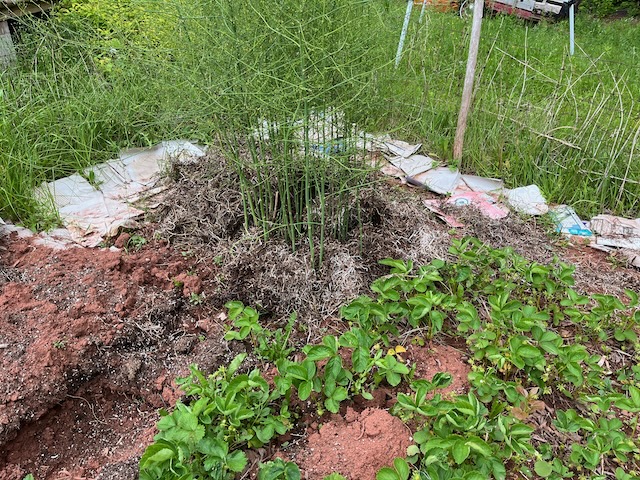
My mother and I took a short detour on our way home after a recent appointment. I wanted to pick eelgrass from the shore to place around my tiny asparagus bed, a trick I learned from local master organic gardener Paul Offer, who generously taught an organic gardening course at our community school for many years. He said asparagus likes a little salt – it’s probably one of the few cultivated plants that does, I imagine – so some eelgrass scattered around suppresses weeds both by blocking light and from the trace of salt from the seawater in which it grows.
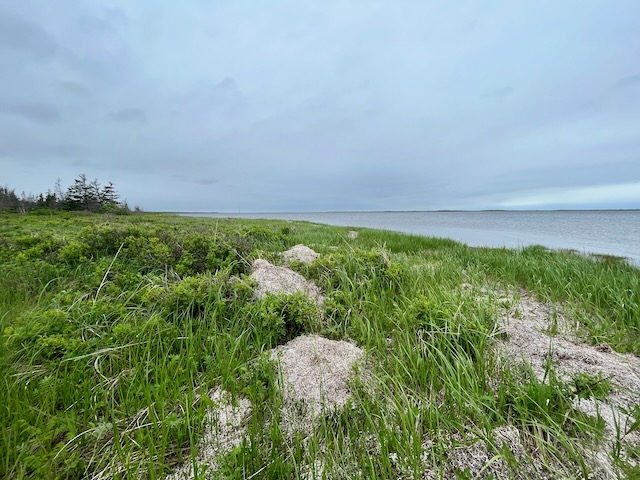
We drove down one of the many dirt roads that lead to the Conway Narrows, the body of water separating the mainland of PEI from the Conway Sandhills. I have written many times about the Sandhills, and my mother’s connection to them as possibly one of the last people to have lived there when, as a child in the 1920s and 30s, she spent every summer with her grandparents at their lobster cannery at Hardy’s Channel.
There are not many remote, wild places on PEI, but this is one of them. It is rare to see another human, except maybe an oyster fisher in a boat. During spring and fall migration it is common to see large flocks of geese and ducks as they move north or south.
I had forgotten to bring buckets with me, so I grabbed two grocery bins from my trunk and quickly filled them with the dried grass that a high tide had helpfully deposited on some wild rose bushes, so it had been well rinsed in the rain and then dried well in the sun and wind.
The quiet and calm of this place, the undulating dunes on the horizon, the absence of motorized anything, is a portal to another time. I was there at high tide, which prevents a walk as the beach is completely submerged, but at low tide you can walk a long way and see cranberry bogs and peatmoss hanging off the low bank, seabirds and shells and all sorts of treasures.
It is possible, in a couple of places, to walk through the water over to the Sandhills at low tide, but you really need to be aware of the weather and tides to do so, and it isn’t recommended unless you know what your doing. I’ve actually only done it once – we always boated over when I was a child – and it was a bit too wild, even for me!
There was no time for wading or strolling anyway as my mother wanted to go see “Jimmy Mick’s place” while we were out that way. Jimmy MacDonald was a customer of my parent’s, a veteran of the First World War, long gone now. The electricity lines end at the intersection of the Luke and Murray Roads, and you keep following the later road, which is only really one lane at that point, to a turn the bend and there is Jimmy’s old house. It is in remarkably good shape for something that hasn’t been lived full-time in for decades, the roof line still straight, windows and doors intact. Someone has kept the grass cut around it. With the over-inflated PEI real estate market, even this ancient abode could now likely fetch more money than Jimmy ever made in his entire life.
We used to go out to Jimmy’s place to pick blueberries in the shrubby fields. The fields are all woodland now, and I doubt you could pick a cup of blueberries where once people could fill buckets. One of my mother’s great loves was picking wild berries, spending hours each summer gathering strawberries, raspberries and blueberries. I did not inherit the love of berry picking, and would dutifully accompany her and various great aunts when I was a child, but would only pick for a few minutes before wandering off to explore or head back to the car to read.
Our visit to the land of Jimmy Mick complete, we headed back home. The roads out there in the Black Banks (the blackness because of deposits of dark peat moss) are narrow and muddy in a few spots, and in a couple of swales I closed my eyes and gunned the car to get through, my mother and I laughing each time, well aware we could get stuck and relieved when we didn’t. We turned onto the Luke Road, a much better-kept route, but still narrow and muddy in places. We soon reached the pavement and drove in modern comfort the kilometer or so to our house.
You can still see a few older houses in our area ”banked” with dried eelgrass each fall. People collect truckloads of it and put it around the outside of the bottom of their house to keep out cold drafts in the winter, using stakes to keep it in place. Eelgrass was also used as insulation inside house walls a long time ago, which wasn’t really that effective, but better than nothing. My mother used to sleep on a straw tick mattress at the lobster cannery, and I bet you could throw some dry eelgrass in there, too, if it your mattress flattened and needed some bulk.
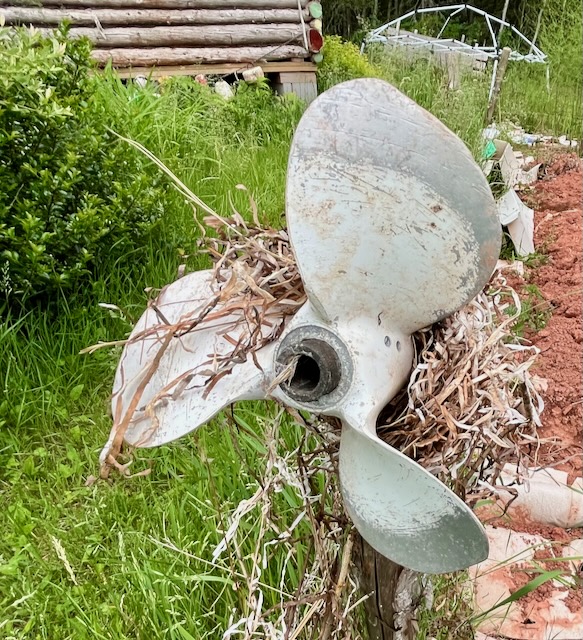
I remember learning to operate a dory with an outboard motor when I was about 8 and the feeling of the motor bogging down when I would steer into a shallow area and eelgrass wrapped around the propeller. I’d have to stop the boat, tip the motor up slightly, and then run it in reverse to clear the blades to continue on my way.
Reenactment of propeller-stopping eel grass.
And yes, eelgrass is long and slithery like an eel, but there are also eels in eelgrass. When you learn to swim in a muddy-bottomed river, as I did, you get used to the silky feel of eelgrass brushing your legs as you move through it, and you sometimes feel an eel rush by, too, if you set your feet down in the wrong place. People who learned to swim in concrete pools or oceans usually find the river swimming experience unpleasant because of these encounters, and it probably is.
Lobsters live in eelgrass, too, and I would sometimes come face to face with them when I played Jacques Cousteau in the river as a child, each of us surprised to see the other, and both retreating in opposite directions. I never caught a lobster, as that’s both illegal without a license and pretty tricky with bare hands, but it was always fun to see them.
Eelgrass is under threat in some areas of the world, which is astonishing to me as it is such a ubiquitous part of my seascape, lots of it in the water just steps from our house. I will gather it as long as I can.
Hail to the 5-gallon bucket, the ubiquitous hold-all and do-all. Preppers seems to have a million uses for them, so look for them on the coat of arms of some future post-apocalyptic government. I am not a prepper, but I like to be prepared, and have many empty 5-gallon bucket, so I reserve the right to some day become a prepper. I’m ready!
I love using these buckets in the garden for weeding, but have always wished I could get the handle to stand up to make the bucket easier to grab and go. This week I cracked it. Bucket, meet bungee cord.
The handle stays up, so I won’t be grabbing the side of the bucket to move it when I’m on my hands and knees in a flower bed, which has always meant eventually breaking chips off the side of the bucket. And it’s easily reversible if I want to let the handle fold back down.
The bucket handles are mostly made of metal with a plastic piece that you hold. That plastic piece seems to break down long before the bucket does, and carrying a heavy bucket while only grabbing the thin metal bit is uncomfortable, so I take a piece of old water hose, cut off a suitable length, split it lengthways, and tape it over the handle. Ready for a few more years of puttering.
Electrical tape, because my father used electrical tape to mend everything, and I have many vintage rolls to get through.
The land where I live in Foxley River remains the unceded territory of the Miꞌkmaq people, who have occupied this island for over 12,000 years. Since European settlers arrived, the piece of land where my house is has been claimed by six people, as far as I can figure, including me.
It was once owned by Creelman MacArthur from Summerside, a businessman and politician. As far as I know, he never lived in Foxley River, and I suspect he bought the place solely as an investment. He had hoped the property would be designated as Prince Edward Island’s national park, as he mentioned when he spoke to a National Parks Amendment Bill in the Senate on June 17, 1938:
Hon. CREELMAN MacARTHUR: … Five years ago I acquired the old Warburton estate of 655 acres, only to realize that it was a white elephant. I built a lodge and a concrete and steel dam and put in some 50,000 trout. In a word, I did everything that I thought might appeal to the Commission when selecting in the province an area for a national park which would be attractive to tourists. But it seems the outstanding requirement was surf bathing, and my property had only sheltered stretches of river. It is a very beautiful area and its waters are well stocked with trout, lobster and oysters.
Right Hon. Mr. GRAHAM: What a place!
Hon. Mr. MacARTHUR: The property cost me some $15,000.I offered it to the Government as a gift, free of restrictions of any kind. I thought in that way a greater service would be rendered to this country, and to visitors in this country, than could be rendered byme as an individual.
However, it was deemed the part of wisdom to select an area in Queen’s county, of which the honourable senator from Queen’s (Hon. Mr. Sinclair) can speak in more detail than I can. Mr. Cromarty and another gentleman from the Parks Branch went down and after looking at four or five sites selected the one referred to in the Bill. Unfortunately, there was some difficulty with three or four landowners with regard to the expropriation, and for a year or more there has been some contention. This difficulty has now been removed, and the purpose of this Bill is to describe the area. We are now looking forward to having a park which will be the equal of anything in any other province in Canada.
And so the PEI National Park did not end up in Foxley River, but in Cavendish, in the heart of the area made popular by author Lucy Maud Montgomery and her Anne of Green Gables books. Just as well, but I’m sure Senator MacArthur had hoped to recoup part of his $15,000 investment, even if he did say (after the fact) that he had intended to give the property to the government as a gift. I don’t say that to be mean, and I never met the man, or his family, but I’m sure there would have been some way for him to make a little money on the deal. Business is business.
Mr. MacArthur died in 1943, and his Foxley River estate eventually broken up into smaller parcels, 23 acres of which we now inhabit. Part of the lodge he had built in 1933 is still here, as well as the dam and the descendants of those 50,000 trout!
I found a postcard online years ago that was probably taken in the 1930s or 40s of the view from the shore in front of our house looking northward up Foxley River. I wondered when I found it if MacArthur had the photo taken to advertise the beauty of his property, perhaps as something he could hand out to sway the opinion of the decision makers at the Ottawa Parks Branch. There really isn’t any other reason why this photo was taken, being so far from the beaten track as we were and still are.
I have many times tried to recreate this postcard photos, capture some mountainous clouds, but never have I caught a similar sky. It is startlingly the same vista, though, despite the massive forest fire that ravaged this area in 1960 and the many decades that have passed. The building in the centre is long gone, but the trees on the far shore look almost the same, with the same breaks in the treeline.
Yesterday a neighbour was making hay on that far field, as has been done for nearly two centuries on that piece of land. This area dodged becoming a tourist mecca 90 years ago, but how long before that field becomes cottage lots is anyone’s guess, so I am thankful for its timeless beauty every day. A miracle, really.
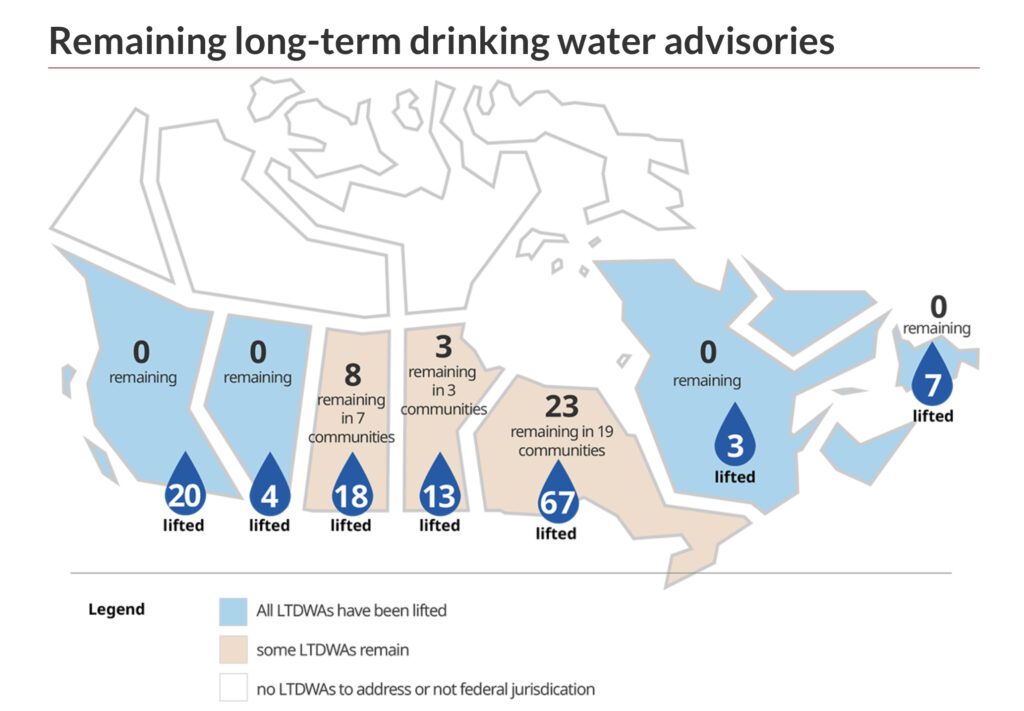
Saving this screen shot from the Indigenous Services Canada’s page that tracks the progress of getting clean drinking water to First Nations communities in Canada, a long-standing promise of our federal government that never seems to be fulfilled.
A friend asked me what I’ve been up to lately. I said I’ve been in my shop fixing an old school desk that was wiggly because the glue holding it together had dried out. She asked me to send a picture, so I did.
I was going to delete the photo, but then decided it is possibly the best portrait I could ever make of my brain: quite messy but also reasonably organized, full of stuff I probably should have gotten rid of ages ago, practical, a mix of old and new, slightly scattered, but all mine.
I am the cleaner
called by the housekeeper
who got a text from the valet
that a Reagan china plate
had been smashed in the President’s Dining Room.

As I swept up the red and gold shards
I thought of all who had slept there when it was a bedroom,
ate there after Jackie turned it into a dining room.
I remember the Bush twins
flicking cereal at each other
when they visited their grandparents.
I was new then, and they were naughty, but polite,
raised in privilege, but with humility, too.

The last family ate healthy meals together.
Laughing teasing sharing.
Phones banned from the table.
In awe of this place.
Grateful and light.
Always my first name.
Hello and please and thank you.

As I try to carefully remove the ketchup from the white woodwork
	The blue and cream rug
	The handmade gold wallpaper
	The delicate vases
	(it went everywhere)
I realize we will need experts
To do restoration work.

The conservators will need to dig deep
into their tool chests
to find something
to remove the stain that
the man-child has left.
Thumbs constantly rubbing his glass and metal soother,
rage and rudeness.
He doesn’t know my name.
No hello, just grunts and discontent.
It’s January 5.
Just a few more days.
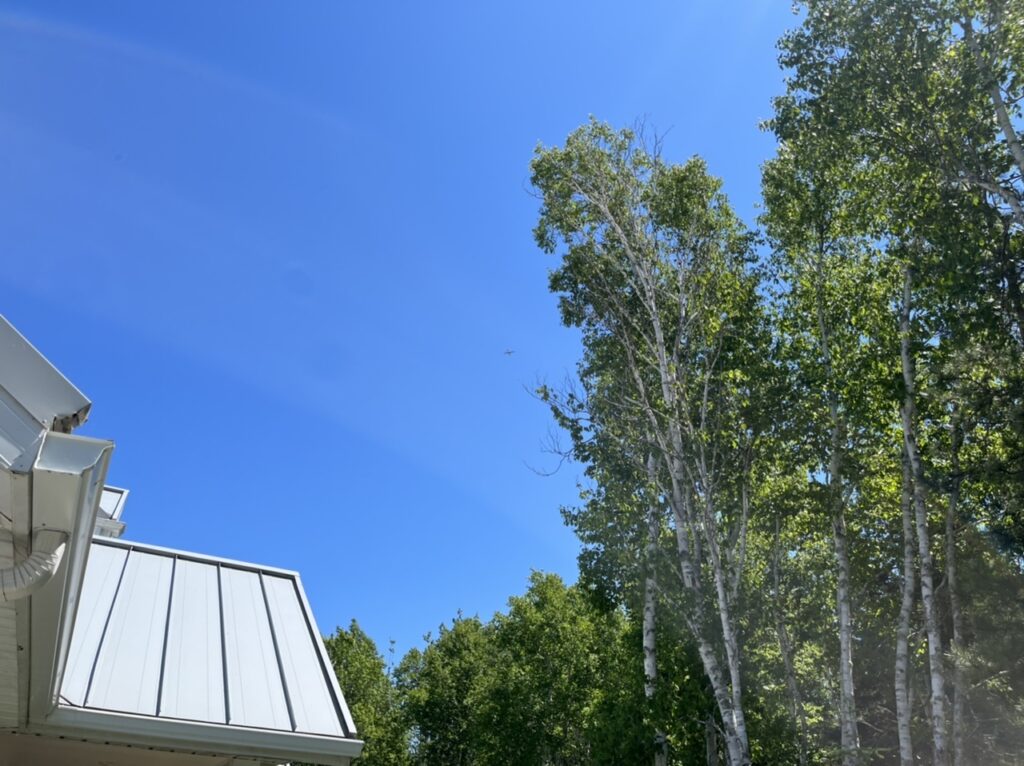
When I hear a small plane or helicopter approaching our house, I run outside and give them a big wave. I’ve been doing this my entire life, but the little plane that flew over our house just now is the first one that clearly waggled its wings back at me. Never give up.