Category Archives: PEI History

Thomas Phillips Family Reunion

My great grandparents, Thomas and Agnes Phillips, lived on a farm on the Ellerslie Road. Agnes died in 1920 at age 66 and Thomas four years later, aged 72. Their youngest son, my grandfather Alvin, married my grandmother, Gladys, in 1912, and I assume they lived with Thomas and Agnes as Alvin eventually took ownership of the farm.

On September 30, 1925, all nine of Thomas and Agnes’ children returned to Ellerslie for a reunion. The rapidly growing clan would meet regularly over the following decades, into my lifetime. The last Phillips picnic I can remember was held at the West Point Lighthouse, 10 years or more ago.

My father knew most of his 38 Phillips first cousins quite well, though I could never keep them straight. Using a genealogy app (the reliable and powerful Reunion) for the past twenty years has definitely helped me with the “who’s yer father” game.

Those who met that September night are long gone, the last, Penzie (Martha Penrose “Penzie” Millar), in 1975. Their children are all gone now as well, the latest to die probably being my father’s brother, Sterling, in 2022, the youngest son of the youngest son. 

I attended the funeral of what I believe to be one of the last spouses of my father’s Phillips first cousins just last month, a woman I had heard about from my parents, and who I no doubt met at a long-ago picnic. She lived to be 105. I didn’t know anyone at the funeral, her children being older than me and having moved away many years ago, but I was glad I went to represent my branch of the family. May the circle be unbroken.


FAMILY REUNION

On the evening of September 30th the family of the late Mr. and Mrs. Thomas H. Phillips of Ellerslie assembled together with their husbands and wives at the old home. The family were all present namely: Mrs. Joshua Millar and Mrs. E. S. Burleigh, Ellerslie, Mrs. Leslie MacLean, Arlington, Lot 14, Mrs. Russell MacArthur, Enmore, Willard of Summerside, Sanford, Sargent and Forrest of O’Leary and Alvin on the homestead. After partaking of goose and other delicacies all gathered in the living room where the evening was pleasantly spent in games, music and singing till after midnight when all joined heartily in singing “God Be With You Till We Meet Again” after which all departed for their homes, hoping to meet again on many such occasions in one unbroken family circle.

From the Charlottetown Guardian October 7, 1925, p6.

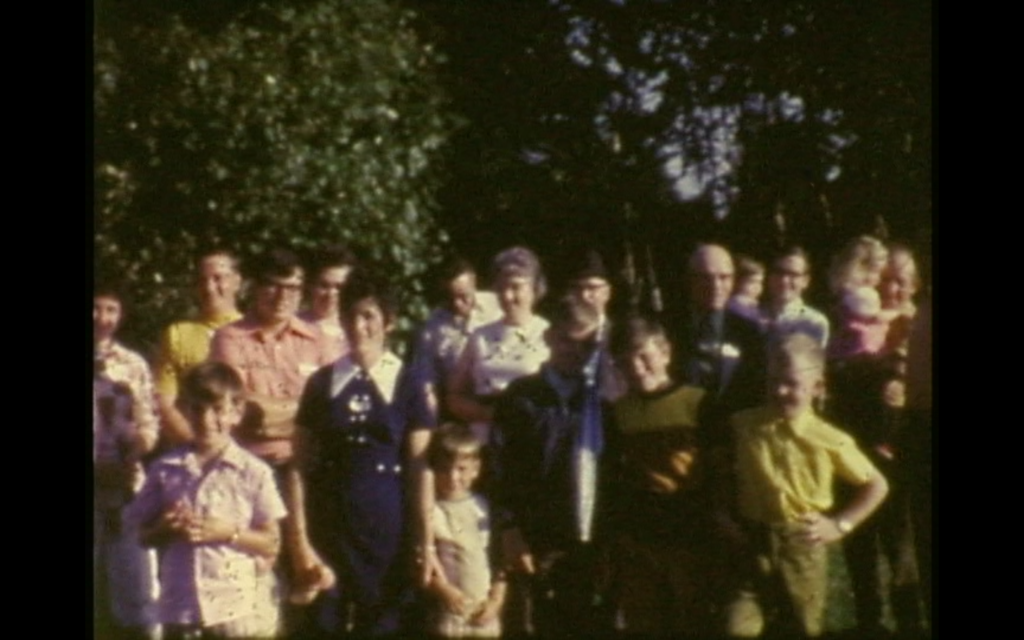
A group of people facing the camera, with trees in the background
Cousins and more cousins at a Phillips picnic at Green Park, 1971. Still from 8mm film footage.

Standing tall

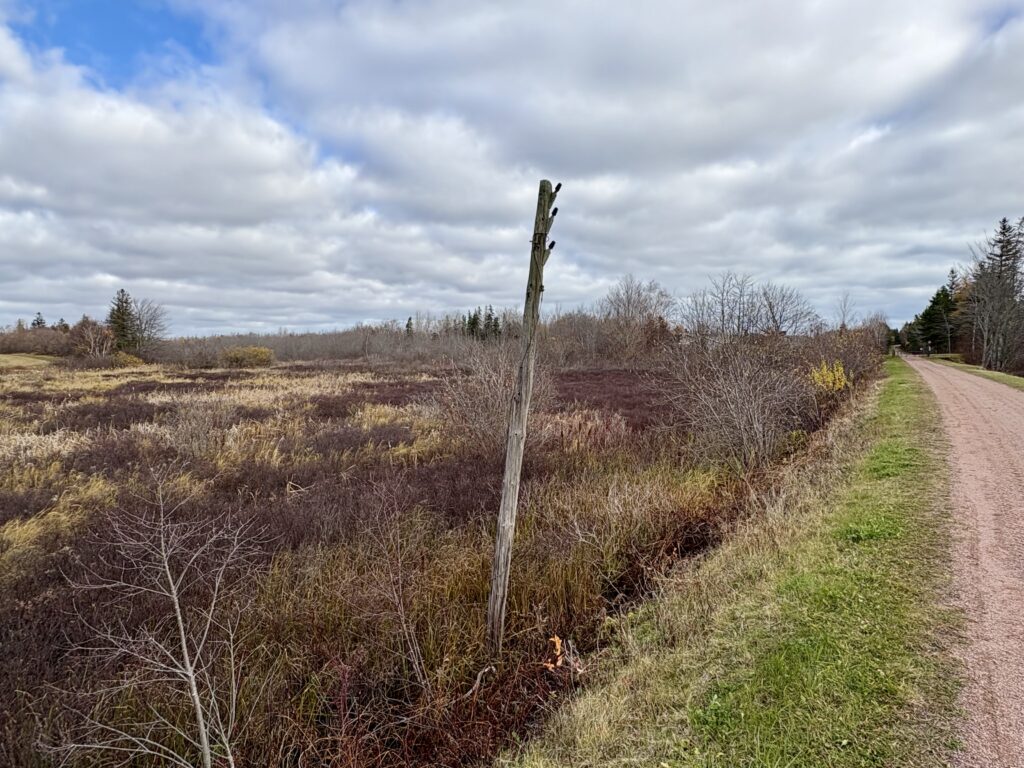
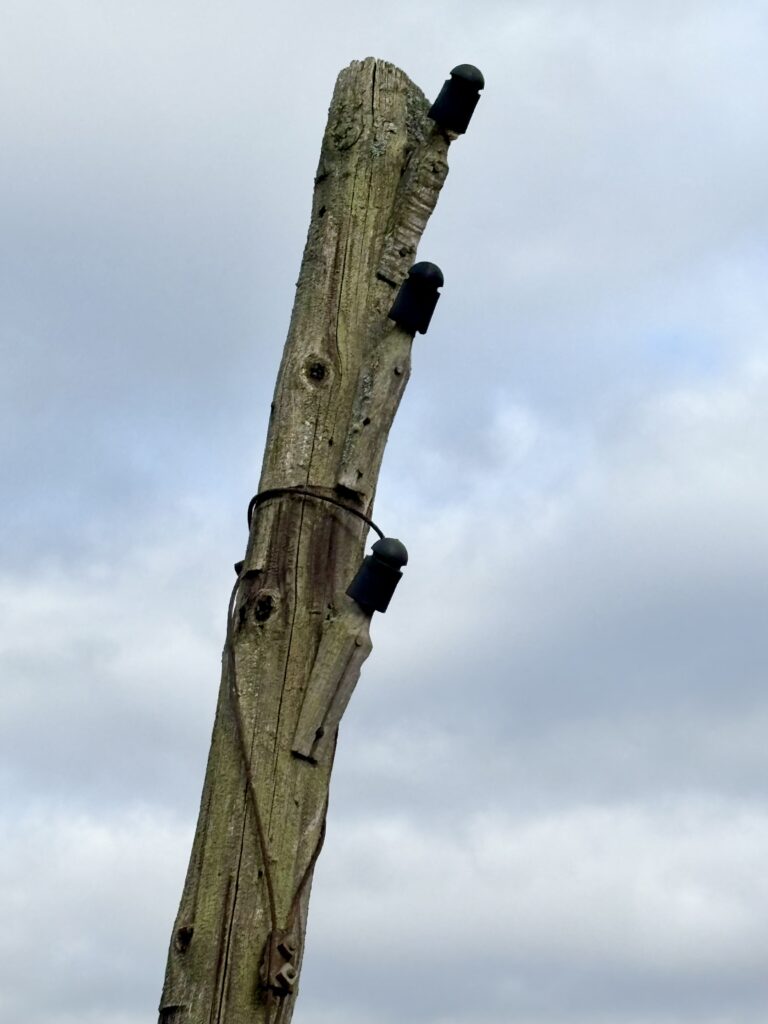
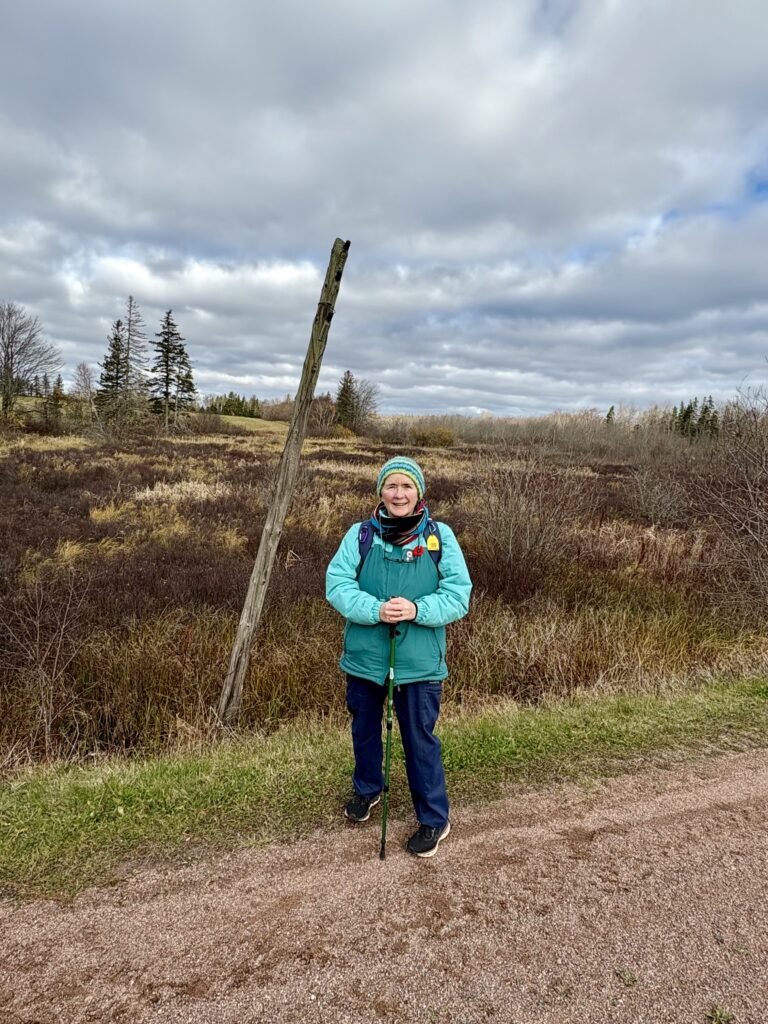
I’m happy to report that what is advertised as the last telegraph pole on Prince Edward Island does indeed still stand, insulators and all, on the Confederation Trail halfway between Elmsdale and Alberton, and it’s also easily visible from the Dock Road. The day I found out about the pole’s improbable existence, on a walk from Elmsdale towards Alberton, we had stopped just about halfway between the two communities at the beginning of a bend in the trail.

As we moved towards our previous-day’s stopping point, this time from Alberton, a couple of days later, I began to doubt we would find it still standing. Suddenly there it was, a few feet around a bend from where we had stopped and turned back.

Grey telegraph pole in the centre of photo, with cloudy sky at the top and leafless bushes and dried grass around. A gravel trail is on the right side.
Close up of three black insulators on the top of a grey telegraph pole. There is wire around the pole, and a cloudy sky in the background.

The PEI Railway opened in 1875, 150 years ago this year, 50 years after the first recorded passenger trail journey between Stockton and Darlington on September 27, 1825 (a gorgeous episode of the BBC Radio 4 Illuminated documentary series brings that event to life). Could this pole be 150 years old? If so, it has survived forest fires and ice storms, vandals and woodpeckers and rot. I suspect its survival might be due to the fact it is planted in a swampy area, replete with spiky bushes, at the bottom of a steep bank. “Let’s just leave ‘er, boys!”

As historic sites go, it’s not Green Gables, but it is a relic of an important Island story. The railway opened up commerce and travel to people in far-flung parts of PEI, and allowed farmers and fishers access to more markets. Building the railway nearly bankrupted our small island colony, so PEI finally agreed to join Canada in 1873 so the project could be finished with an influx of federal dollars.

In addition to signalling train travel, the telegraph that accompanied the railway brought news and could summon assistance in case of emergency. Imagine living in non-electrified 19th century Alberton, heating and cooking with wood, lighting with candles or newly-discovered kerosene, travelling by horse and wagon or sleigh, and then suddenly being able to send a telegram to your brother in Boston asking about work opportunities or ordering supplies from Holman’s in Summerside in the morning and then having them shipped to you by train that very afternoon? It would have felt like magic. And that pole helped make all that happen.

As much as it was a thrill to find the pole right there in the open, I wonder if someday it might be able to stand proud and straight inside a centrally-located provincial museum? Time will tell.

A person with pale skin wearing a hat and holding a walking pole standing next to a trail in front of a leaning telegraph pole. There is a cloudy sky at the top and bushes, grass and trees behind.
Happy Nerdmas (which is every day at my house)

The Last Telegraph Pole(s) on PEI

Steven and I walked the Confederation Trail from Elmsdale corner half way to Alberton and back this morning, about six kilometres round trip. We had planned to walk to Alberton and back, but the cold wind was whipping and that was far enough.

We saw a couple of lupins blooming well out of season, some daisies, lots of apples and even some grapes. As always, the trail is beautifully maintained and clean. Benches and shelters with picnic tables along the way make this entire trail an ambler’s dream.

Interpretative storyboards have added interest to each walk we’ve taken, but this one really caught my attention: the last telegraph pole on PEI? Yes please!

A storyboard called Last Pole Standing with text in English and French, with a photo of the top of a telegraph pole complete with insulators, and photos of steam locomotives in the bottom corners.

LAST POLE STANDING
The P.E.I. Railway was welcomed by communities across the province that had previously been limited to travel only via poor (often impossible) roads and coastal boats. In May 1875 people who had known isolation all their lives were suddenly able to reach any of the Island centres with comparative ease. They received mail twice a day rather than twice a week. What a change! The railway also connected rural communities with the world. The Island had an underwater telegraph cable to the mainland since 1851, but the service was only available in large urban centres. Telegraph lines now followed the tracks from Tignish to Souris, linking all railway stations. It was used for emergencies along the line but also by government and business. The entire service was operated by Canadian National Telegraph from the 1920s but previous operators included the P.E.I. Railway and Anglo-American Telegraph. The last pole standing is located about halfway between Alberton and Elmsdale.

We were halfway between Alberton and Elmsdale! I looked near the sign for a pole to match the photo, but no luck. I’m now anxious to make the trek from Alberton to where we stopped to see if that last pole complete with insulators still stands.

I did notice a couple of poles without insulators on our return walk that looked like the pole on the sign. They were shorter than most poles, and three notches were clearly visible at the top of both. They seem to be holding fibre op cable, the modern telegraph, I suppose.

In trying to (unsuccessfully)* find out what the little wooden insulator holders are called, I came across some wonderful websites, including one for the UK-based The Telegraph Pole Appreciation Society and, well, anything I clicked on after searching for “parts of Canadian telegraph poles”.

*I did some further reading and believe those little wooden pieces that held the insulators may have been called side-block brackets, as per this archived article by John Gilhen**, “Telephone and Telegraph Insulators: The End of an Era”, published in 1976 by the Nova Scotia Museum.

**John Gilhen died in April of this year. He had a 50 year career at the Nova Scotia Museum in the natural history section. His obituary noted he was “an avid collector including antique glass and insulators, hockey pins and cards.” He sounded like a marvellous, interesting person.

I swear I know how to read, and I have bookmarks to prove it

Peter’s wonderful post about Charlottetown’s venerable Bookmark (his photos of tiny details around the shop and their aerie office are delightful) made me dash pre-morning-coffee to rifle through my small bookmark collection to confirm his observation that there has never been a “the” before the bookstore’s name. Me too, Peter, me too.

I guess I had my final visit to the Queen Street location this past Wednesday, when I dashed in to pick up a book order while a friend waited in my illegally-parked car. I didn’t know to give a final nod to the place where I’ve spent many happy hours, so Peter’s post allowed me one last wistful glimpse. Looking forward to the new digs!

A series of yellow and blue bookmarks from a Charlottetown, PEI, store called Bookmark. The oldest one would likely be from the early 1980s and the most recent from a couple of years ago.
The bookmarks of Bookmark, from the early 1980s to almost today.

Something in the wind

Late summer 1925 was filled with federal election rumours, and Canadian Prime Minister William Lyon Mackenzie King eventually did call a general election for October 29 of that year. King had some housekeeping to do before the election, and one of his tasks was filling half of PEI’s seats in the Senate, which meant appointing two new senators to replace John Yeo and Patrick Murphy, who had both died during the previous year.

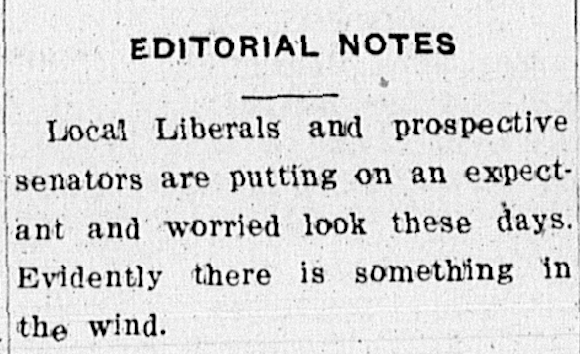
The August 31, 1925 Charlottetown Guardian editorial page was full of Senate news and opinion:

“Local Liberals and prospective senators are putting on an expectant and worried look these days. Evidently there is something in the wind.” Charlottetown Guardian August 31, 1925 p4.

Then, breaking front page news from the September 3, 1925 Guardian:

Senators Who May Or May Not Be

Rumors were rife in the city yesterday regarding appointments to the vacant senatorships, to the effect that the choice had fallen upon Mr. J. J. Hughes, M. P., and Mr. Creelman McArthur, Summerside. No confirmation of this rumor was available last night but no doubt official announcement will be forthcoming very shortly. The Liberal decks are being cleared for action and no doubt all possible appointments will be made before the Liberal conventions are held as some possibilities for a senatorship may be willing to accept nomination as second choice, if they should fail in bagging the bigger plum. Mr. Nelson Rattenbury who has been a senatorial possibility till the last minute has been eliminated from the list by a consolation prize of a seat on the C. N. R. Board of Directors. What consolation will be handed out to the remaining aspirants has not yet been divulged, but anything is possible now that appointments will be handed out promiscuously in view of the pending election. In the meantime until more definite information is to hand, Messrs J. J. Hughes and Creelman McArthur will enjoy the felicity of being senators pro tem but subject to revision.

I can confirm that the rumours about Hughes and M(a)cArthur were true, and Creel resigned his seat in the PEI Legislature on September 5. Now to fire up the time machine and go back to place a few bets!

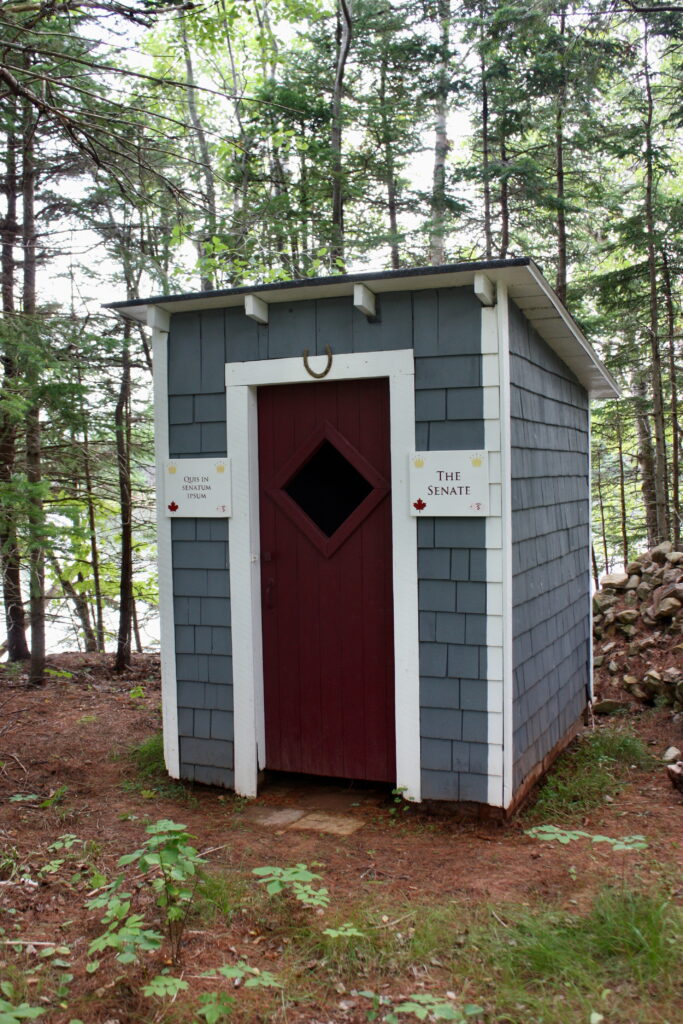
The original (non-operational) outhouse for Senator MacArthur’s Cedar Lodge built in 1933 and restored by me in 2013. We lovingly refer to it as The Senate.

Vic Runtz Collection #1

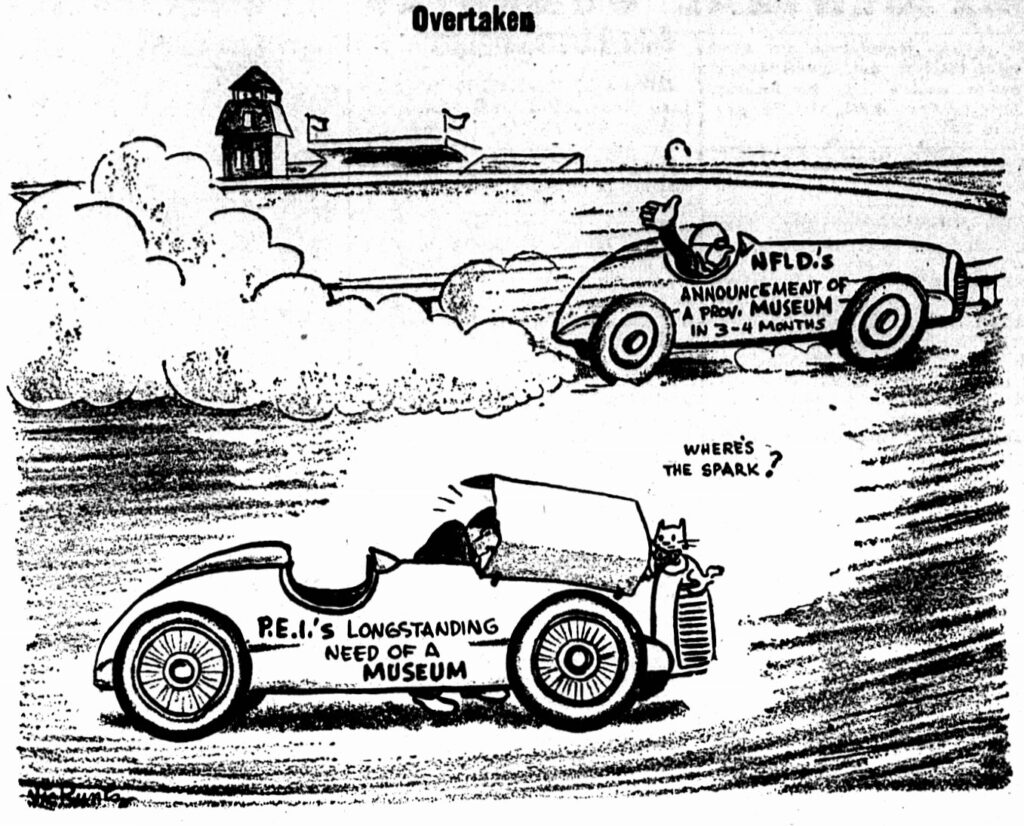
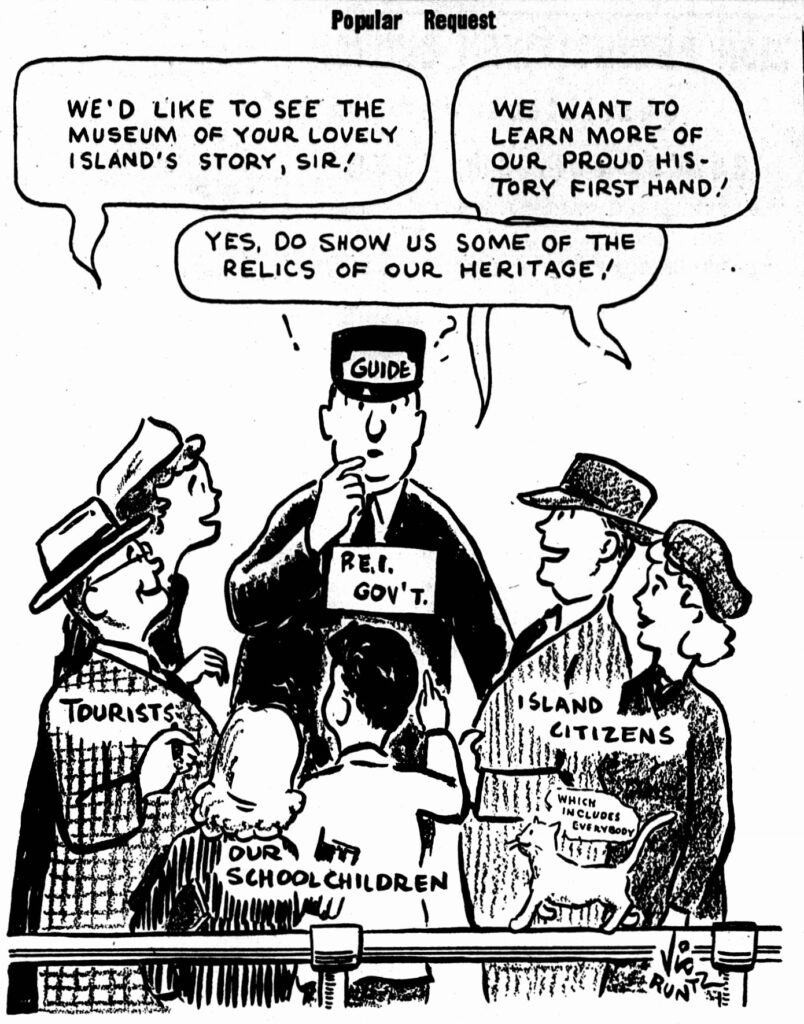
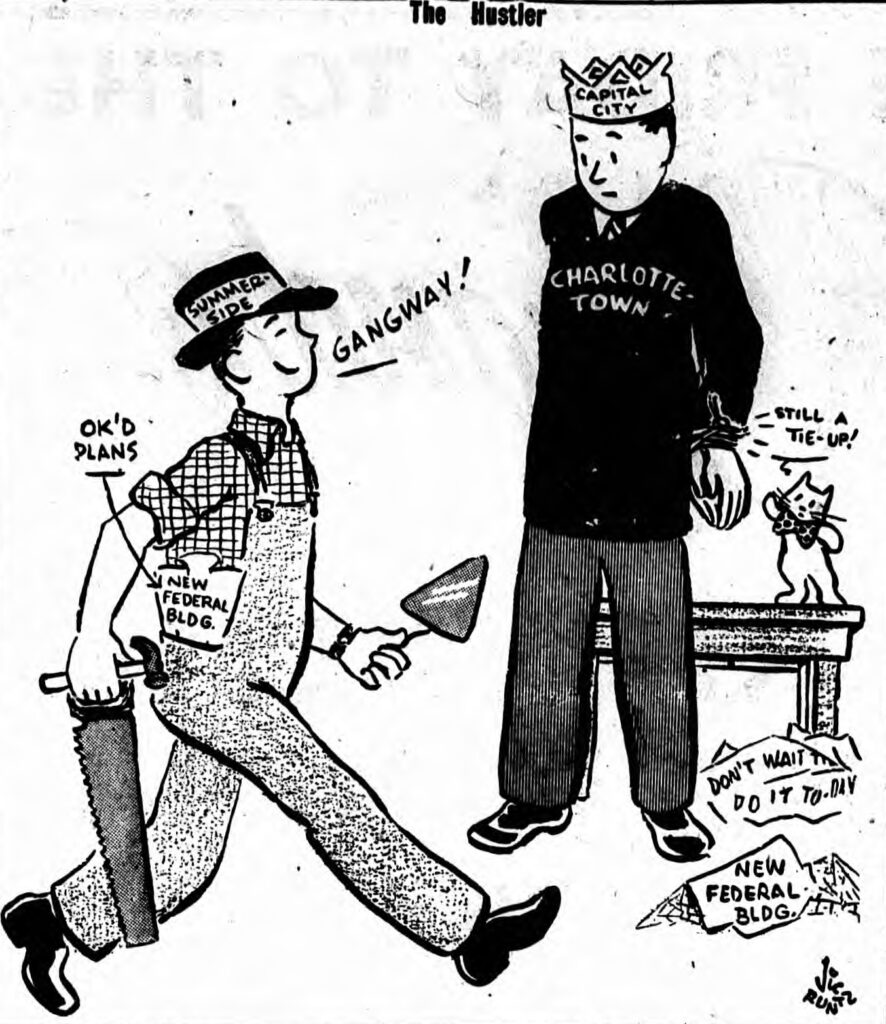
Here are some 75-year-old Vic Runtz cartoons from the Charlottetown Guardian I’ve enjoyed over the past few months. Plus ça change…

Newfoundland, a Canadian province for only one year, announced the creation of a provincial museum while PEI could never seem to get beyond the talking stage (and still can’t to this day). July 14, 1950, page 4
July 8, 1950, page 4.
Scrappy little Summerside’s new federal government building (now the site of the Summerside Rotary Library) was under construction while Charlottetown still waiting. April 20, 1950.

Roma Theresa Morgan

This tragic item on the front page of the May 19, 1925 Charlottetown Guardian left me wanting to know more about Roma Theresa Morgan. I’ve pieced together a bit of a history from a couple of census records and a baptism record for Theresa or Teresa, born May 10, 1894 probably near Fort Augustus, PEI, where she was baptized on May 27, 1894 at St. Patrick’s church, to John Morgan (born in Ireland around 1839) and Mary (Monaghan) Morgan (born Ireland August 10, 1854).

By the 1911 Census, John was dead and Mary and Theresa were living with a border at 58 Queen Street, Charlottetown. By 1931, Mary was living with her oldest child, Joseph, who was single and a farmer in Watervale, PEI.

Dear Theresa would have just turned 29 around the time of her death in faraway Brooklyn. How did a PEI girl get to New York 100 years ago and become a magazine cover model? Did Theresa send money back to her family, along with copies of the magazine covers? What must they have thought of her new life?

Charlottetown Girl Takes Poison by Mistake

(Special to the Guardian) NEW YORK, May 18 - Three years ago pretty Roma Theresa Morgan, whose mother and sister live at 58 Queen Street, Charlottetown, P. E. I., came to New York, to win fame and fortune. Today she is on her way back home in a casket, the victim of poison taken by accident.

Roma posed for several of the greatest magazine cover artists in America but a few months ago was obliged to cease working because of poor health. The other evening her landlady Mrs. Elsie Ilse, who maintained a furnished rooming house over in Brooklyn found the girl writhing on the floor of her room. She was rushed to a hospital but all efforts to save her life were in vain. The police say the girl mistook a bottle of poison for rheumatism medicine.

No notes were found which would indicate suicide and other roomers in the house knew her as a cheerful friendly person.

Grace Beattie

If you were born in the second Prince County Hospital (1951-2004) in Summerside, PEI, as I was in October 1966, you were born on Beattie Avenue, named in honour of Summerside nurse Grace Beattie. Her death announcement in the May 12, 1950 Charlottetown Guardian outlines a career and devotion to the nursing profession that would be difficult to imagine being equalled by many other people.

She left the world in the hospital she helped create, just before the old building became surplus with the opening of the new facility, Grace nor the old PCH wanting to exist without the other.


Death of Miss Grace Beattie Widely Mourned
Many old friends in this Province and abroad will regret to learn of the death in the Prince County Hospital on Wednesday night of Miss Grace Beattie at the age of 91 years. She was the first superintendent of the Prince County Hospital and during the past five and a half years she resided there, in the institution she had helped so greatly to organize.

The deceased was a daughter of the late Thomas and Margaret Howatt Beattie of Summerside and received her early education here. Taking up the nursing profession as her life’s work, she graduated from MacLean Hospital at Waverley, Mass., in 1889 and from the General Hospital in Boston in 1893. During that year she was appointed assistant superintendent of Quincy, Mass. Hospital and two years later she organized the Brockton Mass. Hospital and School of Nursing. Here she remained until 1912 when due to illness she resigned and returned to her home town where during her rest period she organized the Prince County Hospital School for Nurses, which had been officially opened about a month previous by the Duke of Connaught during his visit to the Province as Governor General of Canada.

She returned to the United States in 1912 and during the next 17 years her outstanding ability as an organizer was recognized by the leading hospital authorities throughout New England. She was, during that time, entrusted with the organizing and superintending of a number of hospitals and schools of nursing among which was the hospital at North Adams, Mass., and during the First World War she reorganized the lthaca, New York, Hospital where she remained until 1922. She was then appointed superintendent of Elliot Hospital, Manchester, N. H., and while there suffered the misfortune of a broken hip and for two years after was unable to carry on the work of her chosen profession.

After her recovery from the result of the accident, she assumed the superintendent’s position of the Johnston Memorial Hospital, Stafford Springs, Conn., which was run by graduate nurses.

She retired from hospital work in 1929, and although she had then reached the age of 70 years she went to Boston where she took a special course in religious art.

She returned to Summerside in 1940 where she lived until about five and a half years ago and then entered the Prince County Hospital and remained there until the time of her death on Wednesday night.

She is survived by one sister, Mrs. Maynard Schurman, Summerside.

The funeral will take place on Friday when the remains will be taken from the Compton Funeral Home to the Central Street Church of Christ for service at 2.30 P. M.

My great-grandfather Thomas nearly dies on Malpeque Bay

This story I found last month was a tale lost to my branch of the Phillips family.

My great-grandfather, Thomas Henry Phillips (1851-1924), was a farmer in Ellerslie, PEI. He and his wife Agnes had nine children, who all lived well into their adulthoods with the exception of my grandfather Alvin (1890-1936), who died of appendicitis. Alvin took over his father’s farm and the other four sons left Ellerslie, one to become a merchant in Summerside and three to the O’Leary area to farm and, in the case of Forrest, to eventually enter provincial politics.

The names of the other characters in this tale of 19th century perilous winter travel are still common names in our area with the exception of Price. I found a Jesse Strang Price (born Bedeque, PEI, 1831 – died Green Forest, Carroll County, Arkansas, 1916), married to Mary Ann, who had a son John born 1864, the eldest of his five children, all of whom were born in Ellerslie between 1864 and 1874

It appears that Price family moved to the US, perhaps to escape the dangerous winter weather, who knows. One genealogy website I found said John Price drowned in the Arkansas River on June 5, 1916, aged 52, and it seems Jesse died later that month on June 28 at age 84, which would be a rather heartbreaking coincidence as they both risked dying together on a frozen Canadian bay so many years earlier.

The columnist, Frank MacArthur, was a prolific contributor to the Guardian in the mid part of the 20th century and later published a book about PEI legends.


Pioneer Days In P. E. I. by F. H. MacArthur

Charlottetown Guardian, April 12, 1950

Tales of ice travel are always thrilling and the adventure which befell a party of Ellerslie and Tyne Valley folk almost one hundred years ago is one of the most exciting. It is still told from Ellerslie to Richmond Bay and no matter how often it is retold, it still grips and holds the listener.

Jesse Price and his son John, William Ford, Thomas Burleigh and Thomas Phillips of Ellerslie, with William Ellis and son, and “Billy the Duke” of Tyne Valley, and a couple of teen-aged youngsters, had loaded their sleds with timber gleaned from the surrounding forests. Their destination was Malpeque. The timber was for the shipyards. Ellerslie folk supplied a good deal of the lumber used at Malpeque, Darnley and Princetown. In return for the lumber the settlers got flour, groceries, fodder, and their spring seed – the old trade and barter system was then in use.

Our story opens on a certain day in the month of March. Their journey, a distance of twenty miles, had to be traversed by ice. The little party set out before daylight with the expectation of being back home early that same night. The party reached Malpeque without mishap, unloaded their lumber and secured a good supply of provisions for themselves and their livestock. This occupied considerable time and when they reached the ice field for their return trip one of the men, Thomas Phillips, father of F. W. Phillips, speaker of the House, had failed to join the others. After waiting on the shore for nearly an hour they decided he must have gone on to Summerside to spend the night at the home of a friend.

Already the sun had sunk to rest behind a great cloud bank, and a strong gale was sweeping across the country. There was every indication of a big storm. Now the farmers pointed to the sky, spoke of the wind, and the dangerous spring-holes that lay along their route of travel. On more than one occasion these spring-holes, often too wide for the horses to jump, had to be bridged with the bottom of their sleds or anything they come by. More than one unlucky traveller had plunged into the cold waters, and more than one valuable horse had perished in this manner during the height of a storm. Before half the distance had been covered the blizzard burst upon them in a maddening rush that promised to scatter them like Autumn leaves. “Better rope the sleds together,” advised Price, “then we can let the horses have a free rein and trust to luck.”

The animals were used to crossing the ice and their owners had the feeling that, left to themselves, they would be able to keep the trail. But they had not reckoned on such a storm, and after bravely facing it for a time, even the faithful horses became hopelessly confused, lost their way and went around in aimless circles. Not a man among them could tell one direction from another. Finally, they decided to camp where they were.

It would be sure folly to risk their lives as well as the lives of the horses on such a night. So all hands got busy. The loads were placed in such a position as to form a circle and chained together to prevent their being blown apart. Now the animals were taken from the sleds and led into the circle.

The wind meanwhile, tried to demolish them root and stem. The snow came down in great white blinding masses that fairly sucked the breath from the men’s lips and bullied the two twelve-year-old children till they cried loudly.

In spite of the barricade the party spent a hectic night of it. In order to keep the children from freezing a considerable quantity of hay was twisted into long thick ropes and put to the torch. The twisting was to keep it from burning too fast.

At last the dawn broke. Over fifteen inches of snow covered the landscape. The wind had not abated and the air was thick with its white madness. Not till noon did they get their bearings. The land which poked its head above a mound of snow they recognized as Low Point.

Towards noon the wind suddenly ceased its wild play, and the little group of adventurers were able to reach their homes in safety, though twenty-four hours late.

Thomas Phillips had not gone to Summerside as his neighbors thought. He was delayed in getting his load which happened to be seed grain, so when he came to the shore and found the others had pushed on he decided to do the same thing. Into the teeth of the storm he ventured but finally he too was obliged to give up. He decided to take refuge on one of the small islands in Richmond Bay. But unlike the others he had no shelter and after tramping around in the deep snow for a couple of hours – it was too cold to remain long in one spot – he hitched up his shivering steed and again pushed forward. Lady Luck was with him and he reached home safe and sound. But when the women-folk of the tiny settlement saw his ghost-like form approaching through the drifts their hearts skipped some beats. And no wonder, for they thought the others had perished.

This story was sent in by Sanford Phillips of O’Leary who informed your correspondent that the last survivor of that ice episode, Mr. Thomas Burleigh, passed away quite recently in his late 90’s.

History passing

I took my mother to an audiologist appointment at the mall in Summerside yesterday. She’s nearly deaf now in her right ear, with about 10% of her hearing remaining, and has been completely deaf in her left ear for over 80 years. She receives a disability pension from Veterans Affairs because her hearing loss was due to her Second World War service, so she can get an updated hearing aid every few years. The newer digital hearing aids have been life changing for my mother.

After her appointment, we took the opportunity to run a couple of errands, which meant spanning the length of the mall. Though she can walk quite well (with assistance) for short distances, we often use a transfer wheelchair for longer outings.

I’ve been following the coverage of events marking the 80th anniversary of VE Day and have found the images of the couple of dozen Canadian Second World War veterans who travelled to Europe for the commemorations very moving, probably the last trip for many.

Perhaps it was due to being awash in all this poignancy that I found myself pushing my tiny mother and overcome with the urge to call out to the people in the mall, “Look at this woman! She’s 102, she walked to a train station by herself with a little suitcase over 80 years ago to join the Royal Canadian Air Force Women’s Division! She saw a German U-boat surface in the Gulf of St. Lawrence! She lost her hearing during the war! This is history passing in front of you!”

But I didn’t yell, of course. We just kept walking and rolling by the people staring at their phones and browsing in shops, my mother just another elderly person. We stopped to talk to the niece of another veteran of that long ago war, who said her centenarian aunt was in the hospital again, having a rough time. My mother went home and wrote her veteran friend a get well card that I delivered to the hospital today.

I’m told there are fewer than 10 Second World War veterans left on PEI. History is passing.

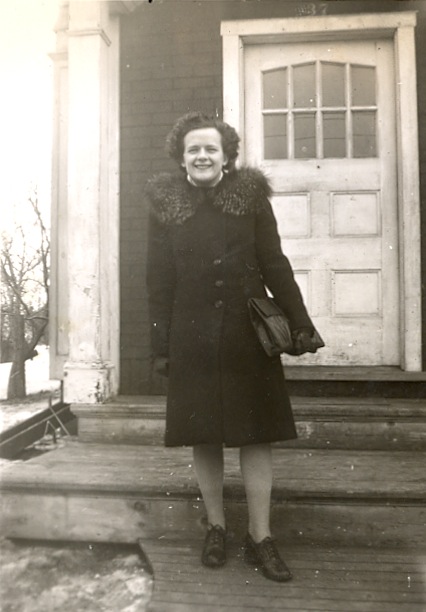
Vivian Phillips in front of my parent’s first apartment at 37 Russell Street, Summerside, 1945. Though released from her RCAF service in January of that year, she is still wearing her very serviceable military uniform shoes.