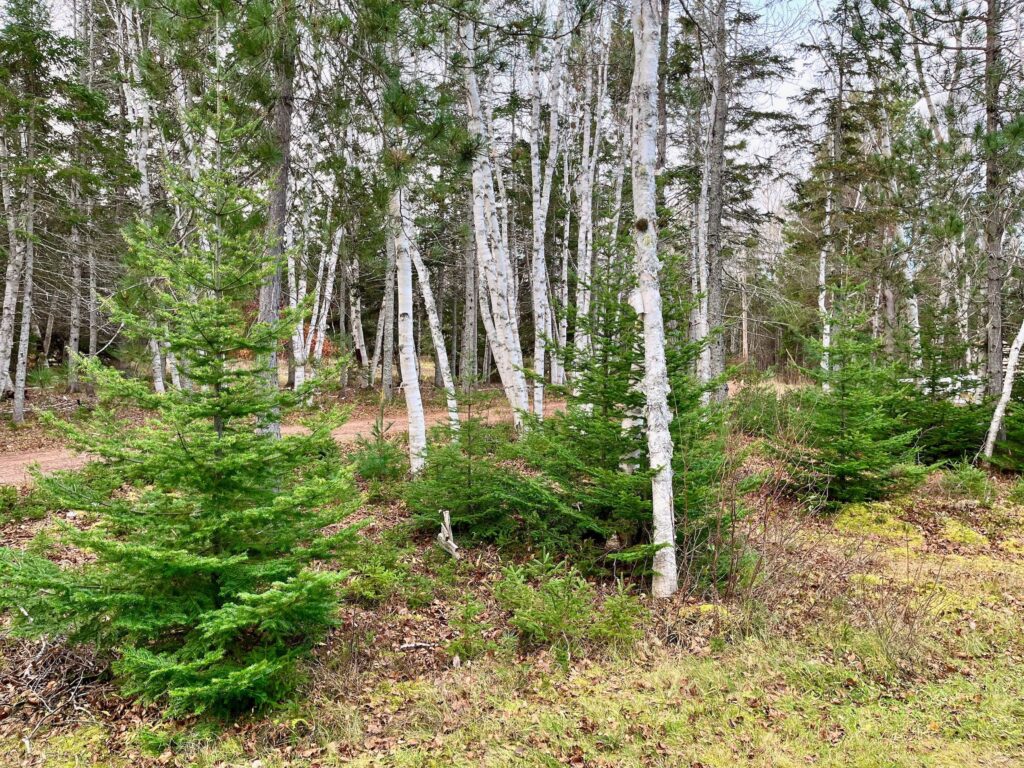
Updated my page documenting the healing journey of the maskwi (birch) trees that were first harvested in July 2021 by my friend Kay, an amazing Mi’kmaq porcupine quill artist who uses the bark as the backing for her pieces.
The trees seem to be doing very well, the dark bark starting to peel off on some of the trees revealing a lighter layer underneath.
Dark bark coming off, lighter layer underneath
Storm Fiona was not kind to parts of our woodland, but the trees I have been documenting all survived in the midst of severe damage all around them. Birch are bendy, and they seemed to whip in the wind better than the white spruce that toppled all around them. Before Fiona, the “group photo” had been easily accessible along a trail we have had for decades; this time I had to climb over and under piles of trees to get there, the trail completely buried. The devestation remains breathtaking.
It’s difficult to capture, but this was a stand of towering 60-year-old white spruce, all felled by Fiona.
If you live in Mi’kmaki and are settled on land that has white birch, I hope you will consider allowing a harvest to take place. It is a different aesthetic, to be sure, and some people who see the trees near our house think they have been damaged or vandalized. I have, unfortunately, had some uncomfortable conversations with people about why I would allow the trees to be stripped, how ugly they look now.
I think the trees look beautiful, and the ceremony used to harvest the bark is a lesson to all who take from nature. Offering tobacco and a prayer to the tree is part of the bark harvest, and a relationship is formed between the harvester and the trees. I can’t imagine someone getting ready to mow down a bunch of trees in a huge machine making an offering to the trees they are about to destroy.
Where some see vandalism, I see justice, respect, and 12 millennia of history.
Just now, as I was looking out the living room window trying to decide how to spend this day, a flock of robins bounced down our lane. Two, then three, leapfrogging over each other. Moving from the red dirt road to the green grass, all of it covered with leaves from the white birch, the maskwi.
I counted seven in all, running and hopping, turning over leaves that were nearly the same colour as their beautiful rusty breasts. They were finding little earthworms and the ancient sowbugs, tiny crustaceans that walk on earth.
As the last robin hopped out of my view, I was still undecided as to what I should do with the rest of this day, still fresh and new, but my robin friends certainly reminded me to walk lightly on the earth and appreciate whatever I find. The sun is finally up and the maskwi are glowing in its light.
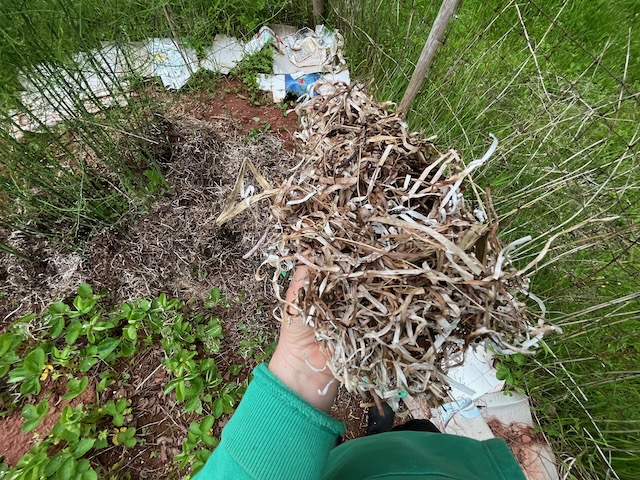
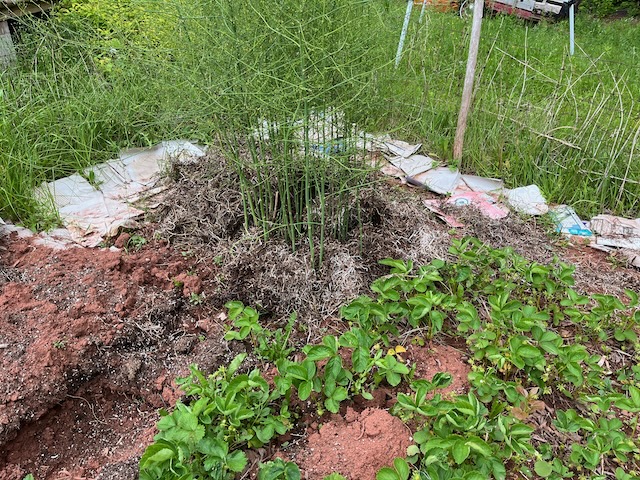
My mother and I took a short detour on our way home after a recent appointment. I wanted to pick eelgrass from the shore to place around my tiny asparagus bed, a trick I learned from local master organic gardener Paul Offer, who generously taught an organic gardening course at our community school for many years. He said asparagus likes a little salt – it’s probably one of the few cultivated plants that does, I imagine – so some eelgrass scattered around suppresses weeds both by blocking light and from the trace of salt from the seawater in which it grows.
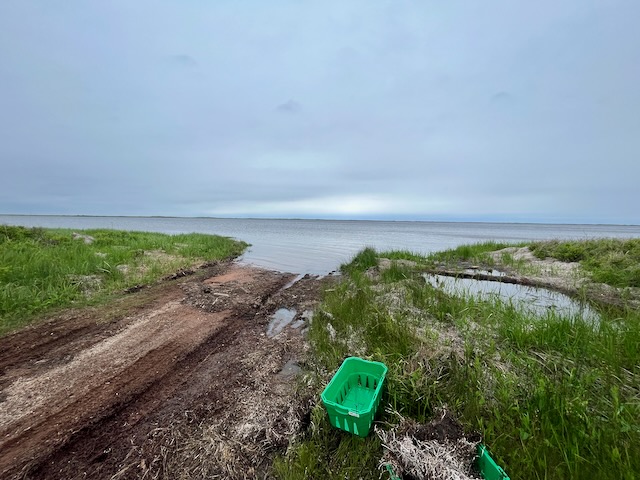
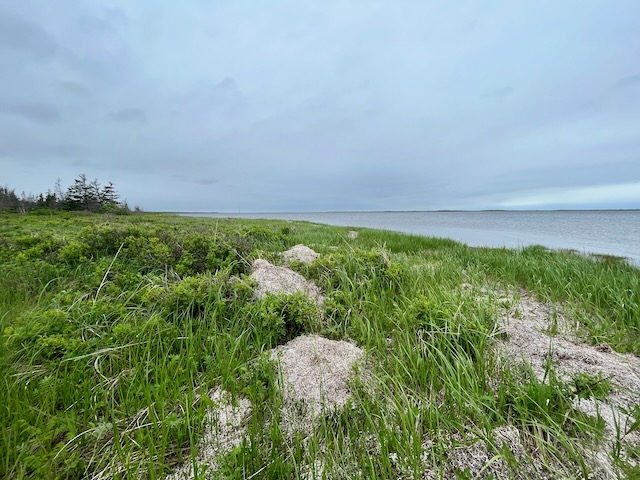
We drove down one of the many dirt roads that lead to the Conway Narrows, the body of water separating the mainland of PEI from the Conway Sandhills. I have written many times about the Sandhills, and my mother’s connection to them as possibly one of the last people to have lived there when, as a child in the 1920s and 30s, she spent every summer with her grandparents at their lobster cannery at Hardy’s Channel.
There are not many remote, wild places on PEI, but this is one of them. It is rare to see another human, except maybe an oyster fisher in a boat. During spring and fall migration it is common to see large flocks of geese and ducks as they move north or south.
I had forgotten to bring buckets with me, so I grabbed two grocery bins from my trunk and quickly filled them with the dried grass that a high tide had helpfully deposited on some wild rose bushes, so it had been well rinsed in the rain and then dried well in the sun and wind.
The quiet and calm of this place, the undulating dunes on the horizon, the absence of motorized anything, is a portal to another time. I was there at high tide, which prevents a walk as the beach is completely submerged, but at low tide you can walk a long way and see cranberry bogs and peatmoss hanging off the low bank, seabirds and shells and all sorts of treasures.
It is possible, in a couple of places, to walk through the water over to the Sandhills at low tide, but you really need to be aware of the weather and tides to do so, and it isn’t recommended unless you know what your doing. I’ve actually only done it once – we always boated over when I was a child – and it was a bit too wild, even for me!
There was no time for wading or strolling anyway as my mother wanted to go see “Jimmy Mick’s place” while we were out that way. Jimmy MacDonald was a customer of my parent’s, a veteran of the First World War, long gone now. The electricity lines end at the intersection of the Luke and Murray Roads, and you keep following the later road, which is only really one lane at that point, to a turn the bend and there is Jimmy’s old house. It is in remarkably good shape for something that hasn’t been lived full-time in for decades, the roof line still straight, windows and doors intact. Someone has kept the grass cut around it. With the over-inflated PEI real estate market, even this ancient abode could now likely fetch more money than Jimmy ever made in his entire life.
We used to go out to Jimmy’s place to pick blueberries in the shrubby fields. The fields are all woodland now, and I doubt you could pick a cup of blueberries where once people could fill buckets. One of my mother’s great loves was picking wild berries, spending hours each summer gathering strawberries, raspberries and blueberries. I did not inherit the love of berry picking, and would dutifully accompany her and various great aunts when I was a child, but would only pick for a few minutes before wandering off to explore or head back to the car to read.
Our visit to the land of Jimmy Mick complete, we headed back home. The roads out there in the Black Banks (the blackness because of deposits of dark peat moss) are narrow and muddy in a few spots, and in a couple of swales I closed my eyes and gunned the car to get through, my mother and I laughing each time, well aware we could get stuck and relieved when we didn’t. We turned onto the Luke Road, a much better-kept route, but still narrow and muddy in places. We soon reached the pavement and drove in modern comfort the kilometer or so to our house.
You can still see a few older houses in our area ”banked” with dried eelgrass each fall. People collect truckloads of it and put it around the outside of the bottom of their house to keep out cold drafts in the winter, using stakes to keep it in place. Eelgrass was also used as insulation inside house walls a long time ago, which wasn’t really that effective, but better than nothing. My mother used to sleep on a straw tick mattress at the lobster cannery, and I bet you could throw some dry eelgrass in there, too, if it your mattress flattened and needed some bulk.
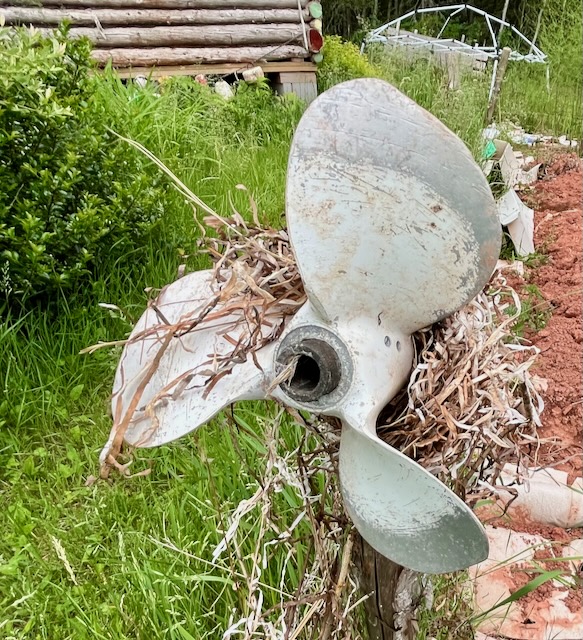
I remember learning to operate a dory with an outboard motor when I was about 8 and the feeling of the motor bogging down when I would steer into a shallow area and eelgrass wrapped around the propeller. I’d have to stop the boat, tip the motor up slightly, and then run it in reverse to clear the blades to continue on my way.
Reenactment of propeller-stopping eel grass.
And yes, eelgrass is long and slithery like an eel, but there are also eels in eelgrass. When you learn to swim in a muddy-bottomed river, as I did, you get used to the silky feel of eelgrass brushing your legs as you move through it, and you sometimes feel an eel rush by, too, if you set your feet down in the wrong place. People who learned to swim in concrete pools or oceans usually find the river swimming experience unpleasant because of these encounters, and it probably is.
Lobsters live in eelgrass, too, and I would sometimes come face to face with them when I played Jacques Cousteau in the river as a child, each of us surprised to see the other, and both retreating in opposite directions. I never caught a lobster, as that’s both illegal without a license and pretty tricky with bare hands, but it was always fun to see them.
Eelgrass is under threat in some areas of the world, which is astonishing to me as it is such a ubiquitous part of my seascape, lots of it in the water just steps from our house. I will gather it as long as I can.
Just listened to a long discussion on local radio about the staffing challenges some tourism operators on PEI are facing this summer, which are serious for businesses small and large. They touched on lack of transportation, affordable housing, having to be more flexible with lengths of shifts and contracts, and affordable and accessible child care as some of the reasons they have difficulty attracting staff for service jobs.
While this discussion was specifically about labour stresses, I think we would do well to talk more about how the climate crisis is going to change the tourism industry, which is a major economic driver on PEI. I wonder how long tourism will remain a viable business in light of drastically increased fuel prices and the climate crisis. It’s not even officially summer yet, and already over 100 million US citizens were told to stay indoors this week because of extreme heat, and that’s just the most startling of many similar articles I read this week about extreme weather.
How long will it be seen as ethical to encourage people to jet somewhere for a winter break in the sun, or a week on PEI’s sandy beaches? Will tourism become limited to where you can drive in an electric vehicle or on public transport and not round-the-world excursions?
Our ability to imagine and plan for the future is one thing that seems to set humans apart from other animals, but as a society we don’t seem to have changed much about how we balance what we do today against how it will affect the future. I don’t see much change yet, and the clock is ticking.
Our house is still on fire, and we are toasting marshmallows on the flames.
It is not uncommon to find empty mussel shells in the woods around our home, the two halves still attached to each other but usually missing one piece of one shell. Crows will pick a mussel from the shore, fly up onto a tree branch, hold the mussel with their feet while prying it open with their beak, pick out the meat, and drop the shell when they are done.
Yesterday I spotted a shell in birch and poplar leaves, probably 200 feet from the river. It will soon be completely submerged, slowly releasing calcium and other minerals into the forest floor over the next decades. Forests think and move in centuries, while humans count days and weeks and months and years. Is it any wonder humans can’t see what trees are doing, how they communicate to each other (and us)? They probably feel we need to slow down a little.
Last evening I gathered some dry grass from the shore below our house to use as mulch in my garden. It floats on the river and gathers after storms, a mixture of seaweed and terrestrial grasses. Other things can arrive, too: pieces of wood, branches, dead fish, feathers. As I gathered a few hay forkfuls, I picked out and disposed of a short piece of plastic rope, the plastic top off a coffee cup and a couple of plastic bags.
I left the mussel shells I found in the pile of grass, and they will disappear into my garden, breaking under my rubber boots, split by a hoe, freezing and thawing, rubbed by worms and microbes, catching the rain.
I appreciate more and more the riches I have around me, even if, to some, it’s just a pile of old dead grass. With an endless supply of fallen leaves and grasses, I don’t need to buy bark mulch that is trucked in from far away. The mulch I use would definitely not be welcome in a beautifully manicured neighbourhood, but that’s not where I live. It’s taken a while, but I’m getting more and more comfortable with the rougher look and letting nature move right up to my front door.
The crow and I gather from the shore, apart but together, same-same.
Canton Becker has released a 1,000,000 hour long song today for Earth Day, on cassette tape, of course! You can randomly skip to a section that no one else has heard before and name a 15 minute section. Here’s Squeaky Ducks on a Summer Evening at around hour 695,203 for your listening pleasure.
I spent part of Earth Day cleaning out a pond in the decommissioned gravel pit on the land we inhabit, gently replacing frogs I stirred up and waving at the one butterfly I saw, seagulls, crows and blue jays wheeling and calling above it all. It was warmish in the late afternoon sun, and I was content in a way I never am in any other place. Water, trees, sky…that’s really all I need.
I’ve added a page to my site to track the regeneration of birch bark trees that were first harvested in July 2021. I’m told it will take about five years for the white bark to remerge, so I intend to photograph the trees every six months to document that process.
It’s been interesting to watch the bark change from a light soft leathery feel to dark and hard. The trees did not bleed and I didn’t notice any difference in the leaf drop in autumn. While the trees probably wonder where the bark went, they seem to be just getting to work and growing more bark!
I believe some of the harvested bark is included in quillwork pieces that are part of the exhibit called Matues Revisitedthat is on until March 13, 2022 at the Mary E. Black Gallery in Kjipuktuk/Halifax, Nova Scotia. I told the trees this news, and they nodded and swayed in appreciation.
On windy days like today, I like to visit this hypnotic globe to see how the wind whipping our trees around connects to global weather patterns. You can also view lots of other data like ocean currents and temperature, auroras, and on and on. I get a weird sense of adventure watching a visualization of the ocean currents off the coast of Antarctica or the wind blowing down on PEI from Greenland.
Firs are probably my favourite type of tree. They were always the Christmas tree of choice when we went to the woods during my childhood, their soft flat needles and lovely smell the very essence of the holiday.
A few firs close to our house have grown to the point where they should probably be removed before they get much bigger. Firs seem to have a shortish life span, die quickly, rot inside and tumble down. I need to be more ruthless in keeping them cleared, but it’s difficult when they look so lovely when fresh winter snow decorates them outside our door!
I’m trying, as much as possible, to let nature do what it wants on the land I live on, so cutting down any tree is a bit uncomfortable but sometimes necessary and now always well thought out. It’s a funny balancing act, this rewilding instinct I have developed. When I started this journey I thought I was rewilding the land, but, of course, I’m really rewilding myself, uniting with nature rather than trying to change it to always suit my needs or ideals. Nature always wins, but humans consistently believe we can control nature, and we never can. We are a funny animal.
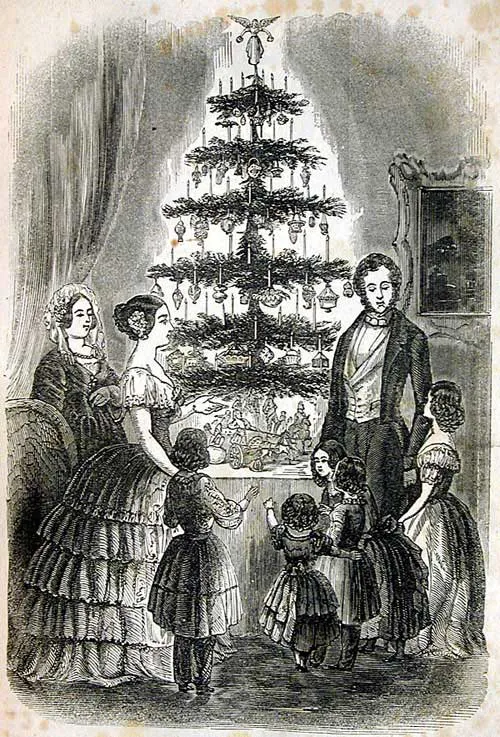
If you are on PEI and want to pick up a free tree for your holidays, I have a few between 6 and 10 feet tall and would be happy to have them be adored and adorned by you. They are a natural, unshaped tree – more Victoria and Albert odd than Disney World perfect – but will smell lovely and are chemical free. I possess many manual and motorized felling tools to assist the culling. Wear a toque, plaid shirt and wool mittens and have a real PEI heritage moment! They had a good life, I will miss their presence, but will not miss them toppling onto my house during a storm when I’m an old lady.
Victoria and Albert with one of my trees…of course not, they live too far from PEI!
Bumble bee season is winding down here. There are still a few flowers in bloom around our house, and a few bees moving between them, but most bees and other insects are bedding down and getting ready for a well-deserved rest.
I now have confirmed four bumble bee species through Bumble Bee Watch, all observed within a few feet of our house. Leaving patches of red clover, purple vetch and asters to grow in our lawn has brought many more insects to our yard. It looks a bit messy to most people, but only if you think a lawn should look like a bowling green; I think it looks like a bee buffet!