Category Archives: Nature

Silence

The audio that accompanies this article in The Guardian broke my heart, and I’m still thinking about it, especially when I hear a new seasonal visitor has returned to nest in the forest near our house. I’m not sure why we humans are continuing to ignore warnings that we have very little time to change how we live to ensure future generations of humans and other species can have a livable planet.

I think part of the problem is that the people who wield the most power in the world live in large cities. Some of them possibly have country homes as well, but they do not have a healthy relationship with nature and therefore don’t care about it beyond what it can give them; they try to control it, bend it to their will, extract from the natural world things that will make them more and more money. It is difficult to care about what you can’t see.

When I lived for a brief time in London in the mid-80s, I knew a young woman who had just moved to the UK from the Cayman Islands. Maria and I both shared much of the excitement and challenges of coming from a small place and living in a massive city, but she had a physical challenge I didn’t have: she was often uncomfortable because she had never worn shoes for any long period of time. She grew up walking on bare feet in sand, not because they were poor, because they weren’t, but because they didn’t need shoes. She found the cobbles and pavement of London hard and noisy, wearing shoes and socks constricting.

She said couldn’t get the sense of the land, couldn’t feel a part of the place without her feet in the sand, in the soil. She was homesick in part because she missed her family, but just as much because of the loss of a connection to the land and the freedom of living so closely with the natural world. To be honest, I didn’t know what she was talking about. Who wanted to live in a backwards rural setting any more? I certainly didn’t. Give me history and theatre and art and Oxford Street and pubs and life!

I lost touch with Maria, but I would bet she returned to her home, and so did I.

I hear a robin.

Lone

I was weeding a flower bed a few minutes ago, taking advantage of these sweet long evenings before the biting insects emerge. I would be outside all day long at this time of year if I could, but usually I have to steal a few minutes here and there.

A small flock of Canada geese flew down the river towards Yeo’s Bridge, probably aiming for the fresh-water pond just beyond. They were very low and close enough to me that I could hear their whistling wings. A few minutes later, I heard and saw another goose up the river, wheeling around in an unusual way. Then, as I was fully occupied with destroying some particularly stubborn weeds, a loud call came suddenly from the river just in front of me.

There was the lone goose, bobbing along in the water in the direction as the small flock had gone, calling over and over, the same call as when they are flying overhead, which I always imagine to be “here we are, stay together, don’t straggle, we can do it!”

But this was sadder, one insistent voice and no response. It cried, for that’s how it sounded to me, for at least five minutes, swimming further away. A mourning dove in the woods kept it company, coo wooo wooo wooo, you’re not alone.

And then it stopped. I will imagine it heard its friends and flew to join them in the pond.

Another Planet

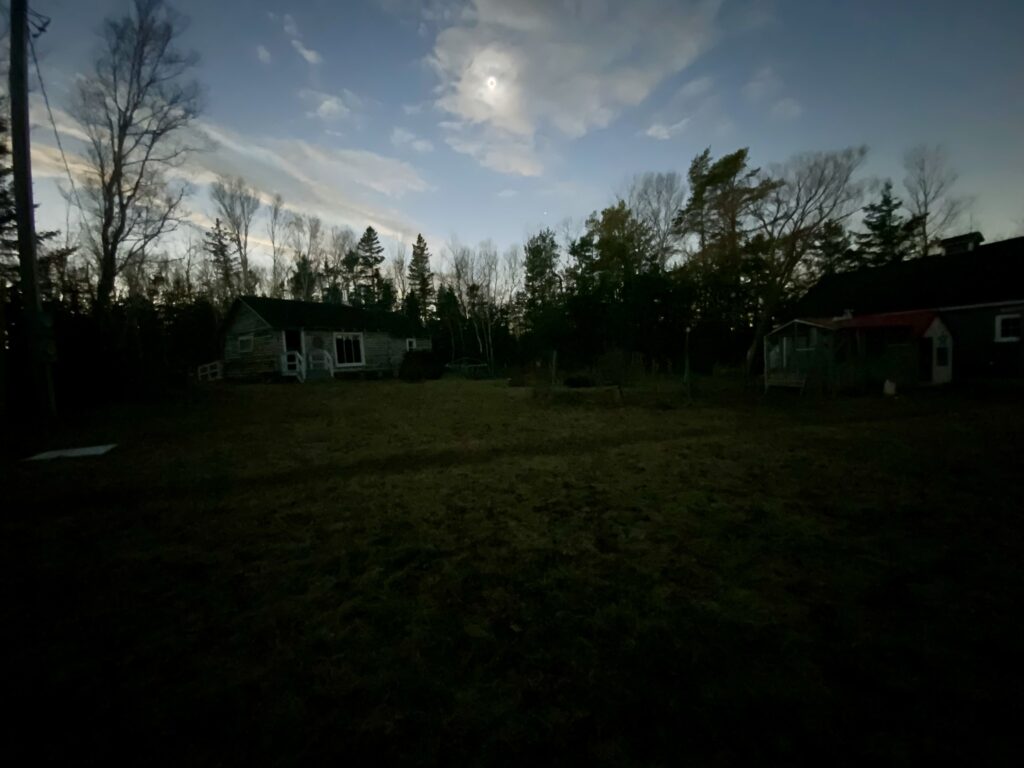
In the end, it went by so quickly. We went outside just before 3:30pm as the moon started to move in front of the sun. By 4:30 the sun was almost hidden, the temperature had dropped a few degrees, the light was odd, the birds were quiet, the wind had died down.

Then gulp, the moon ate the sun, we took off our eclipse viewing glasses, and we were on another planet, a twilight planet where a ring glowed in the sky. I had anticipated our hens would head for their coop as it darkened, which is what they do every evening, needing to get up high on a roost as their eyesight is poor in dim light. Instead they kept pecking until it was too late, and they gathered together, confused, huddled next to a shrub. They heard their automatic chicken door shut, and knew something was up. It all happened so fast.

I was anticipating pitch black, but instead the horizon glowed, there was blue sky. It felt as almost like sunrise, except we were facing west. We could see a planet, maybe Jupiter, just below the sun. The sky that had been cloudlessly clear all afternoon had wispy clouds, but that just added to the magic. We had nearly three minutes of totality, but it felt like a second.

Then the light roared back in a whoosh, the strange shadows returning, our glasses back on to see the rest of the show. I stayed outside for another hour, watching the moon move away, the hens back to their scratch scratch pick pick dance. Then I had supper, the winds picked up, the birds started to fly around again, the sun shone brightly.

4:36:39 April 8, 2024

Preclipse

It’s cool, bright and sunny here this morning. Around 3:30 this afternoon, we will step outside our house and watch the moon eat the sun. We should experience 2 minutes and 47 seconds of totality here. I bought viewing glasses months ago, signed up to do some citizen science, and now just have to wait for this once-in-many-lifetimes event.

If what I heard on CBC is true and a total solar eclipse only happens in a specific location on average every 375 years, the last time a total solar eclipse occurred where we live would have been around 1650, and this land would be have been covered by an ancient forest: beautiful tall white pine, red oak, birch, maple, spruce. The red squirrels, chickadees, blue jays, crows and ravens we see here year-round would be flying and running around, perhaps joined by a now-extirpated species, the black bear. My ancestors were still all in the UK, 100 years from even thinking about heading west, so maybe a Mi’kmaq family were on the river fishing when early night came and went.

When bidden, Perplexity “curated” a playlist for the event, but left off some obvious (to my human brain anyway) choices: Moonlight Sonata, Claire de Lune, Here Comes The Sun. And, of course, You’re So Vain, with its line about some pompous fella taking his Learjet to Nova Scotia to see the 1972 solar eclipse. Did you know Carly Simon’s daughter, Sally, now lives in Halifax? The media has truly covered every angle under the sun.

We won’t be blasting music here, but will instead watch and listen to how the birds and animals around us respond. I’m going to let our little flock of hens run around the yard and watch them head back to the safety of their coop as it starts to get dark, then wait to see if they reemerge after their shortest night ever. I will report.

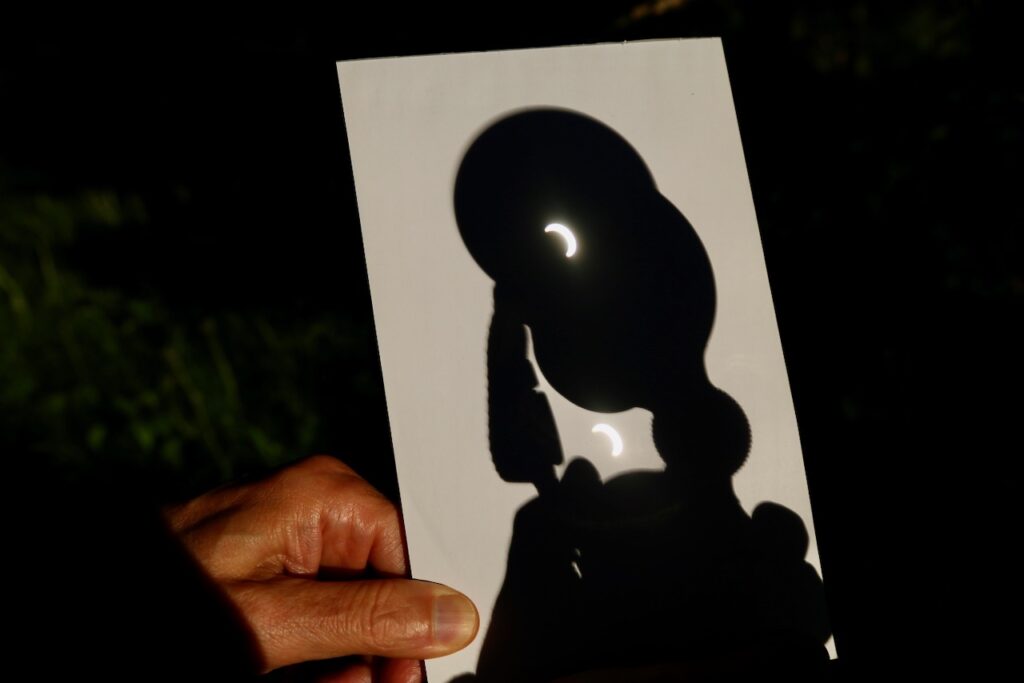
June 10, 2021 annular solar eclipse

For a total solar eclipse, Perplexity suggests:

  1. “Total Eclipse of the Heart” by Bonnie Tyler
  2. “Blinded by the Light” by Bruce Springsteen
  3. “Blinding Lights” by The Weeknd
  4. “Solar Eclipse” by YoungBoy Never Broke Again
  5. “Moon at the Window” by Joni Mitchell
  6. “Blue Moon” by Billie Holiday
  7. “Starman” by David Bowie
  8. “Space is the Place” by Sun Ra
  9. “Eclipse” by Earl Sweatshirt
  10. “Moonlight” by Jay-Z and Kali Uchis
  11. “Seven” by Taylor Swift
  12. “Moonshadow” by Cat Stevens
  13. “The Moon and the Sky” by Sade
  14. “Eclipse” by JACE Carrillo and Alyko
  15. “La Noche de Anoche” by Bad Bunny and Rosalía
  16. “Eclipse” by LOONA’s Kim Lip
  17. “Eclipse” by GOT 7
  18. “Eclipse” by MAMAMOO’s Moonbyul
  19. “Eclipse” by Pink Floyd
  20. “Gravity” by John Mayer

Lardair

I just got back from feeding the hens their supper. When I stepped outside, there it was: a weird smell, like lard, faint but clear. There is no obvious source for this, no nearby rendering plant, food processing or food disposal. I only remember smelling it a few times in my life, always faint, always brief.

This happened at about 4:00 pm. The temperature was +2C and the barometric pressure falling. There was a strong wind from the east, which the old timers always said was where the rain came from, and there is indeed rain and snow forecast for this evening. We had 27 cm of snow fall four days ago on what had been almost bare ground. The river is still completely frozen over.

I’m putting this here so the next time I smell that strange odour I can check to see if it is under similar conditions. I realise I may have just tipped over into “old timer predicts the weather” category.

Lardair. If you’ve smelled it, let me know.

What can it mean?

In The Red

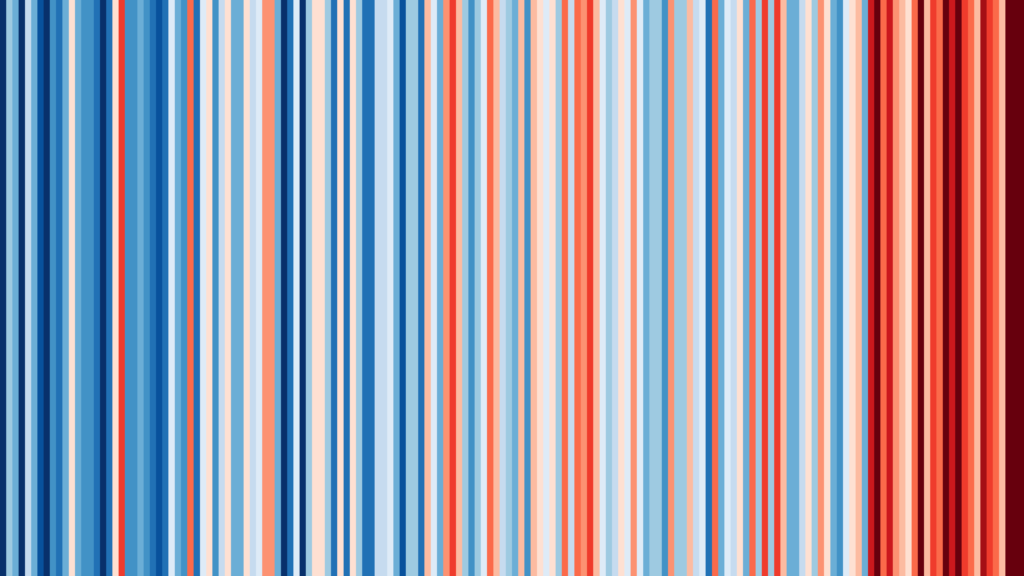
Updated my website header image with the latest warming stripes image for PEI from the University of Reading’s #ShowYourStripes.

PEI Stripes 1859-2022

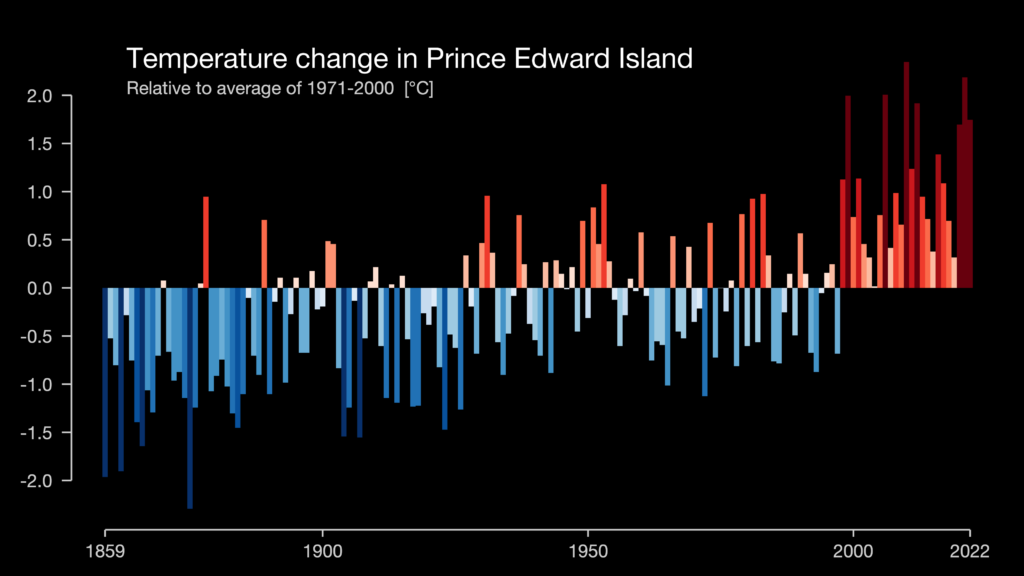
It seems they have added new options for viewing the data that are even more striking. Look at those bars from 2000 on.

Bars With Scale 1859-2022

Snowy Egret

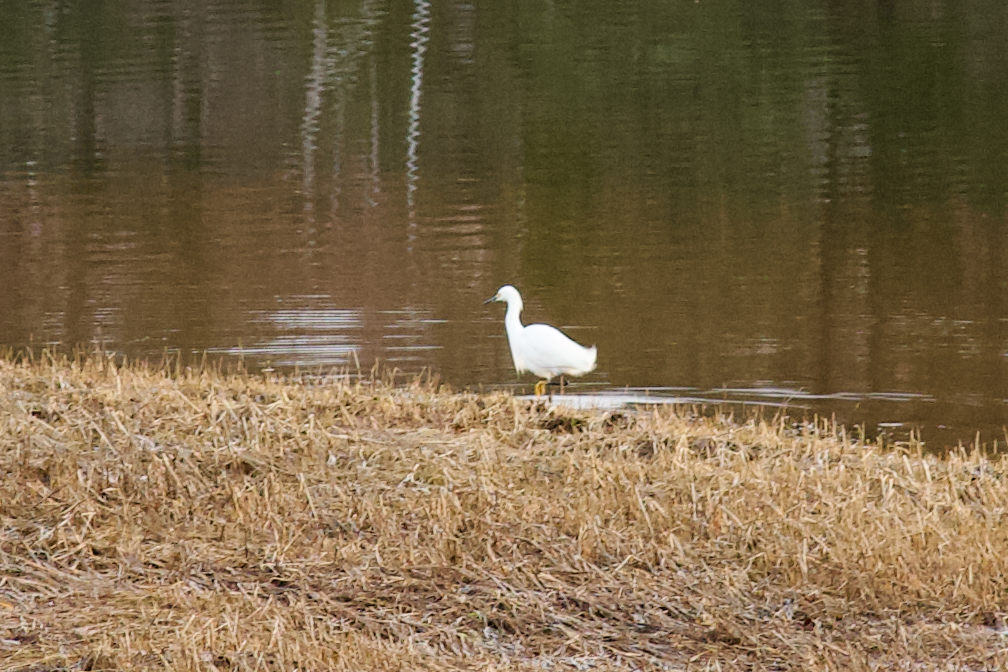
I was lucky enough to spot a snowy egret as it walked down our river at 6:30 this morning. I had seen them many times in Florida near where my parents used to spend the winter, but I never remembered seeing one here before.

I grabbed my camera and binoculars and ran out onto the lawn to try to record this unusual bird, looking a bit of an unusual bird myself in my red plaid flannel PJs. Our neighbours are not close enough to see what I’m wearing, so citizen science need not be thwarted by decorum!

The egret waded and fished as it travelled around the little point of land in front of our house, nabbing and swallowing little fish. My photos were not very sharp, but in person I could see this white bird’s dark legs and comically yellow feet.

I uploaded the photos to iNaturalist and was surprised to find only one other snowy egret observation on PEI. I later confirmed with a biologist friend that they are quite rare here and are not known to breed this far north. I was chuffed to bits!

I’ve looked at this river view every day for decades, know the ebb and flow of both the river and the wildlife on it intimately and, I thought, completely, but turns out I still have more to learn. Every day brings new discoveries. What joy.

Snowy Egret

Post-Fiona Maskwi

Updated my page documenting the healing journey of the maskwi (birch) trees that were first harvested in July 2021 by my friend Kay, an amazing Mi’kmaq porcupine quill artist who uses the bark as the backing for her pieces.

The trees seem to be doing very well, the dark bark starting to peel off on some of the trees revealing a lighter layer underneath.

Dark bark coming off, lighter layer underneath

Storm Fiona was not kind to parts of our woodland, but the trees I have been documenting all survived in the midst of severe damage all around them. Birch are bendy, and they seemed to whip in the wind better than the white spruce that toppled all around them. Before Fiona, the “group photo” had been easily accessible along a trail we have had for decades; this time I had to climb over and under piles of trees to get there, the trail completely buried. The devestation remains breathtaking.

It’s difficult to capture, but this was a stand of towering 60-year-old white spruce, all felled by Fiona.

If you live in Mi’kmaki and are settled on land that has white birch, I hope you will consider allowing a harvest to take place. It is a different aesthetic, to be sure, and some people who see the trees near our house think they have been damaged or vandalized. I have, unfortunately, had some uncomfortable conversations with people about why I would allow the trees to be stripped, how ugly they look now.

I think the trees look beautiful, and the ceremony used to harvest the bark is a lesson to all who take from nature. Offering tobacco and a prayer to the tree is part of the bark harvest, and a relationship is formed between the harvester and the trees. I can’t imagine someone getting ready to mow down a bunch of trees in a huge machine making an offering to the trees they are about to destroy.

Where some see vandalism, I see justice, respect, and 12 millennia of history.

A Flock of Robins

Just now, as I was looking out the living room window trying to decide how to spend this day, a flock of robins bounced down our lane. Two, then three, leapfrogging over each other. Moving from the red dirt road to the green grass, all of it covered with leaves from the white birch, the maskwi.

I counted seven in all, running and hopping, turning over leaves that were nearly the same colour as their beautiful rusty breasts. They were finding little earthworms and the ancient sowbugs, tiny crustaceans that walk on earth.

As the last robin hopped out of my view, I was still undecided as to what I should do with the rest of this day, still fresh and new, but my robin friends certainly reminded me to walk lightly on the earth and appreciate whatever I find. The sun is finally up and the maskwi are glowing in its light.