Tag Archives: Nerding

Standing tall

I’m happy to report that what is advertised as the last telegraph pole on Prince Edward Island does indeed still stand, insulators and all, on the Confederation Trail halfway between Elmsdale and Alberton, and it’s also easily visible from the Dock Road. The day I found out about the pole’s improbable existence, on a walk from Elmsdale towards Alberton, we had stopped just about halfway between the two communities at the beginning of a bend in the trail.

As we moved towards our previous-day’s stopping point, this time from Alberton, a couple of days later, I began to doubt we would find it still standing. Suddenly there it was, a few feet around a bend from where we had stopped and turned back.
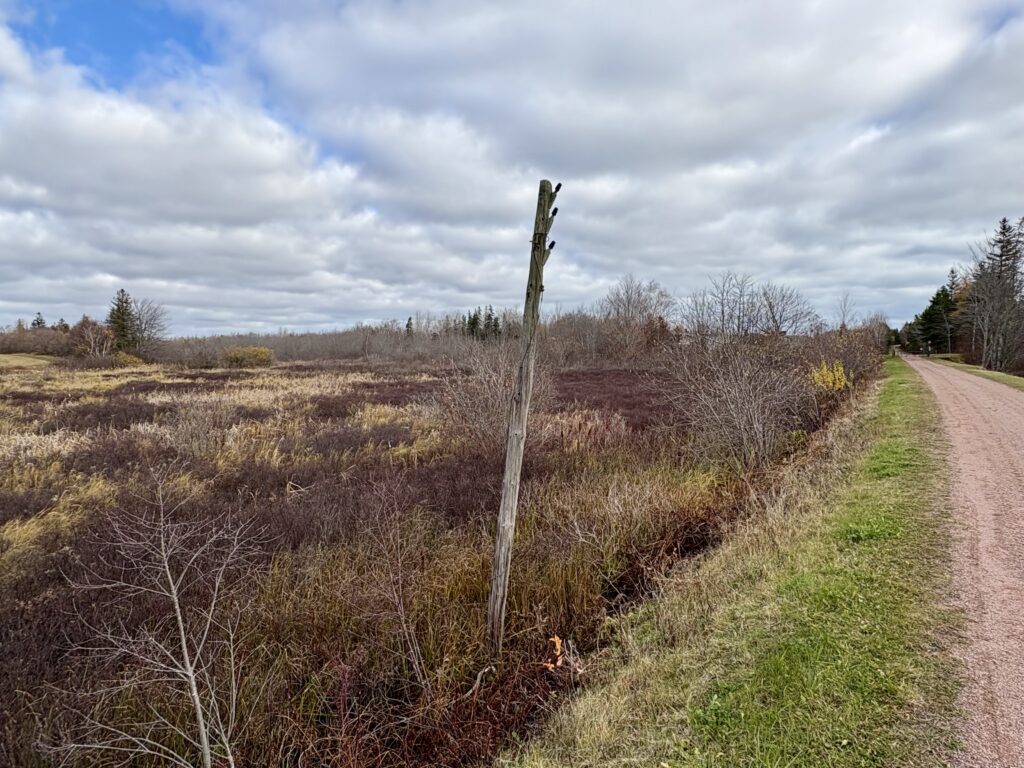
Grey telegraph pole in the centre of photo, with cloudy sky at the top and leafless bushes and dried grass around. A gravel trail is on the right side.
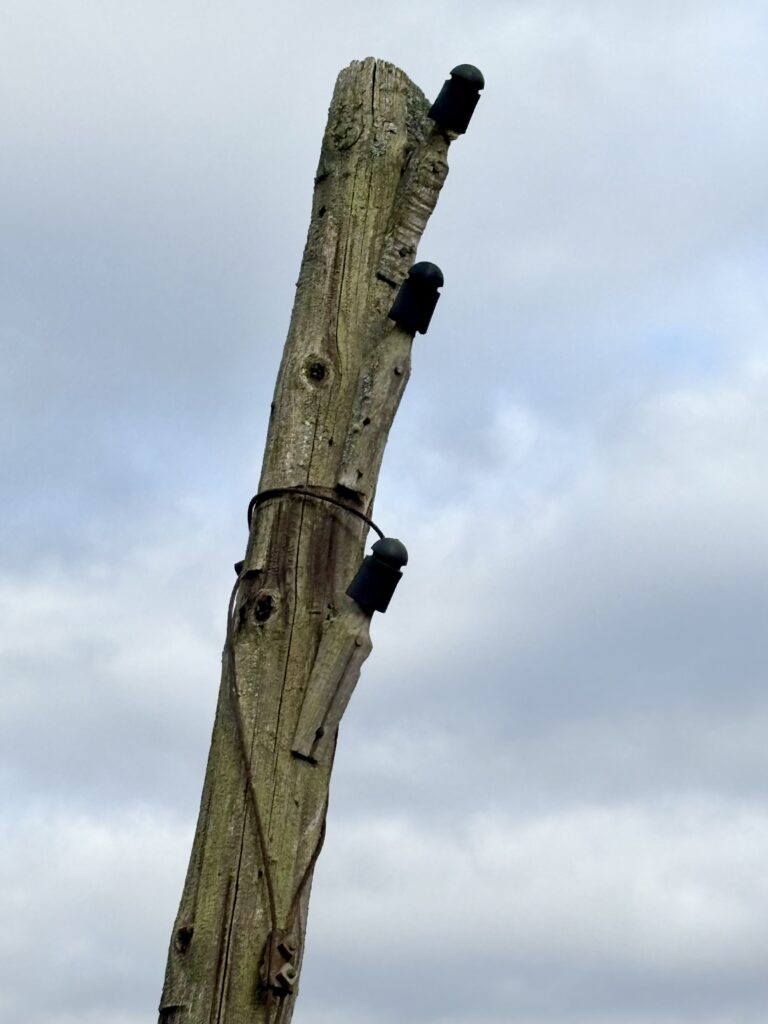
Close up of three black insulators on the top of a grey telegraph pole. There is wire around the pole, and a cloudy sky in the background.

The PEI Railway opened in 1875, 150 years ago this year, 50 years after the first recorded passenger trail journey between Stockton and Darlington on September 27, 1825 (a gorgeous episode of the BBC Radio 4 Illuminated documentary series brings that event to life). Could this pole be 150 years old? If so, it has survived forest fires and ice storms, vandals and woodpeckers and rot. I suspect its survival might be due to the fact it is planted in a swampy area, replete with spiky bushes, at the bottom of a steep bank. “Let’s just leave ‘er, boys!”

As historic sites go, it’s not Green Gables, but it is a relic of an important Island story. The railway opened up commerce and travel to people in far-flung parts of PEI, and allowed farmers and fishers access to more markets. Building the railway nearly bankrupted our small island colony, so PEI finally agreed to join Canada in 1873 so the project could be finished with an influx of federal dollars.

In addition to signalling train travel, the telegraph that accompanied the railway brought news and could summon assistance in case of emergency. Imagine living in non-electrified 19th century Alberton, heating and cooking with wood, lighting with candles or newly-discovered kerosene, travelling by horse and wagon or sleigh, and then suddenly being able to send a telegram to your brother in Boston asking about work opportunities or ordering supplies from Holman’s in Summerside in the morning and then having them shipped to you by train that very afternoon? It would have felt like magic. And that pole helped make all that happen.

As much as it was a thrill to find the pole right there in the open, I wonder if someday it might be able to stand proud and straight inside a centrally-located provincial museum? Time will tell.
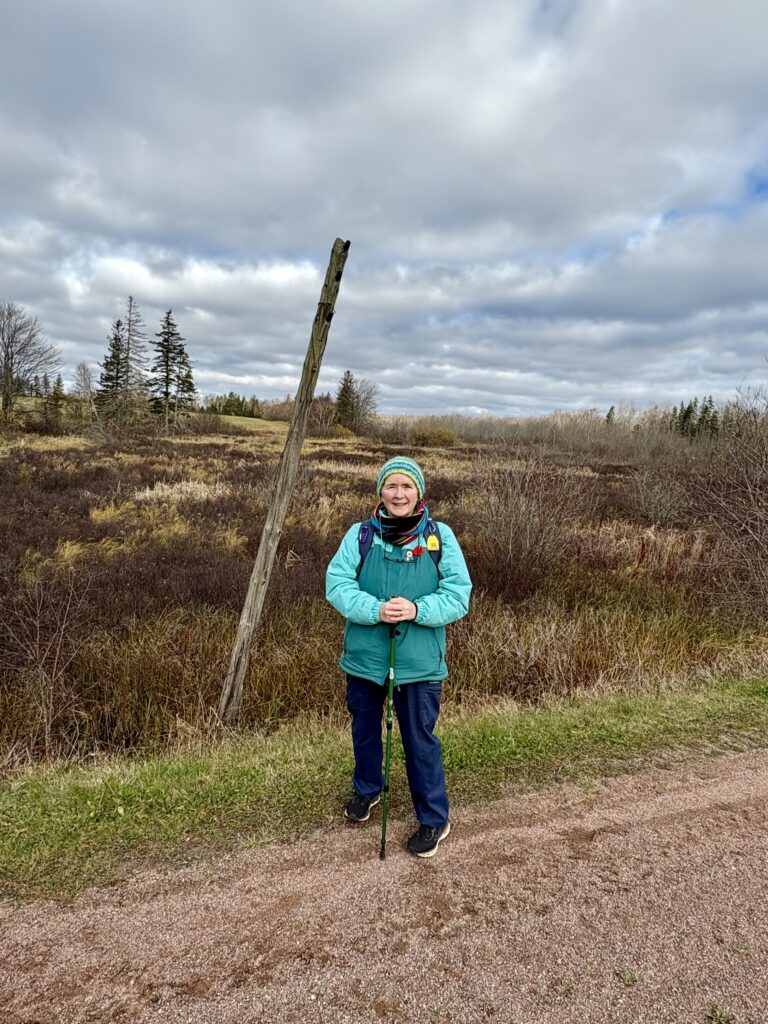
A person with pale skin wearing a hat and holding a walking pole standing next to a trail in front of a leaning telegraph pole. There is a cloudy sky at the top and bushes, grass and trees behind.
Happy Nerdmas (which is every day at my house)

Delta Airlines Flight 67

I was sitting on my shop step late this afternoon watching the hens run around the yard. The sun was shining for the first time in about a week or more, there was no wind, and everything was beautifully quiet.

I heard a strange noise that seemed to come from far away, sort of a thud. Machinery from farms or nearby bridge repairs pass by occasionally, but I didn’t hear a vehicle.

Then I heard a jet, a common enough thing where I live, but when I looked up, instead of seeing a plane flying east to Europe or west to the rest of North America, directly overhead was a plane flying south. I could see the wings glinting at an odd angle, and it looked to be lower than the usual 35,000 or whatever feet above.

Blue sky with a jet contrail in the middle and treetops at the bottom.
Ummm…

Suddenly a contrail was visible as the plane disappeared from view. When I clicked on a flight radar site, there was Delta Airlines Flight 67 from Rome to Atlanta but no longer heading to Atlanta.

Screen shot of a plane flight path.
Screenshot of Flight 67 still listed as heading to Atlanta but really heading to Halifax.

The flight track log shows the plane going over our house between 4:08:42 and 4:09:13, and I took the photo at 4:10. Their southwesterly track changed right off North Cape at 4:06 and by the time I saw it four minutes later, it had dropped from 11,582 meters (37,998 feet for you metric/imperial mixed up Gen Xers like me) to 8,854 meters (29,048 feet).

The flight’s destination changed to YHZ and I watched online as the plane went over the Minas Basin, tracked the Avon River headed for Halifax Stanfield International Airport and thankfully landed safely at 3:33. Whatever event caused the redirection seemed to be dealt with quickly, and the plane took off about three hours later and is en route to Atlanta as I write this. The passengers and crew had a long day, but now had a tale to tell of stopping in Nova Scotia. They won’t forget that flight.

Screen shot of a plane flight path on the left, with text on the right describing the flight from Halifax to Atlanta.

If I had been in our house or had my headphones on, I would have missed this little blip in transatlantic transportation, like the farmer in Brueghel‘s Landscape with the Fall of Icarus missed seeing a man who flew too close to the sun hit the water behind him as he was engrossed in plowing his field.

Would it have mattered had I not seen Flight 67? No, not in the great span of time. Is it worth sharing on the internet? Probably not. But I’m glad I shared it anyway. We all have tales to tell, sometimes the same one, just from different perspectives. Every person on that plane will be telling someone of their long day, the sun, the wings glinting as the aircraft turned, the water below.

What did you see today? Who will you tell?

The Last Telegraph Pole(s) on PEI

Steven and I walked the Confederation Trail from Elmsdale corner half way to Alberton and back this morning, about six kilometres round trip. We had planned to walk to Alberton and back, but the cold wind was whipping and that was far enough.

We saw a couple of lupins blooming well out of season, some daisies, lots of apples and even some grapes. As always, the trail is beautifully maintained and clean. Benches and shelters with picnic tables along the way make this entire trail an ambler’s dream.

Interpretative storyboards have added interest to each walk we’ve taken, but this one really caught my attention: the last telegraph pole on PEI? Yes please!

A storyboard called Last Pole Standing with text in English and French, with a photo of the top of a telegraph pole complete with insulators, and photos of steam locomotives in the bottom corners.

LAST POLE STANDING
The P.E.I. Railway was welcomed by communities across the province that had previously been limited to travel only via poor (often impossible) roads and coastal boats. In May 1875 people who had known isolation all their lives were suddenly able to reach any of the Island centres with comparative ease. They received mail twice a day rather than twice a week. What a change! The railway also connected rural communities with the world. The Island had an underwater telegraph cable to the mainland since 1851, but the service was only available in large urban centres. Telegraph lines now followed the tracks from Tignish to Souris, linking all railway stations. It was used for emergencies along the line but also by government and business. The entire service was operated by Canadian National Telegraph from the 1920s but previous operators included the P.E.I. Railway and Anglo-American Telegraph. The last pole standing is located about halfway between Alberton and Elmsdale.

We were halfway between Alberton and Elmsdale! I looked near the sign for a pole to match the photo, but no luck. I’m now anxious to make the trek from Alberton to where we stopped to see if that last pole complete with insulators still stands.

I did notice a couple of poles without insulators on our return walk that looked like the pole on the sign. They were shorter than most poles, and three notches were clearly visible at the top of both. They seem to be holding fibre op cable, the modern telegraph, I suppose.

In trying to (unsuccessfully)* find out what the little wooden insulator holders are called, I came across some wonderful websites, including one for the UK-based The Telegraph Pole Appreciation Society and, well, anything I clicked on after searching for “parts of Canadian telegraph poles”.

*I did some further reading and believe those little wooden pieces that held the insulators may have been called side-block brackets, as per this archived article by John Gilhen**, “Telephone and Telegraph Insulators: The End of an Era”, published in 1976 by the Nova Scotia Museum.

**John Gilhen died in April of this year. He had a 50 year career at the Nova Scotia Museum in the natural history section. His obituary noted he was “an avid collector including antique glass and insulators, hockey pins and cards.” He sounded like a marvellous, interesting person.

First 3D Printing

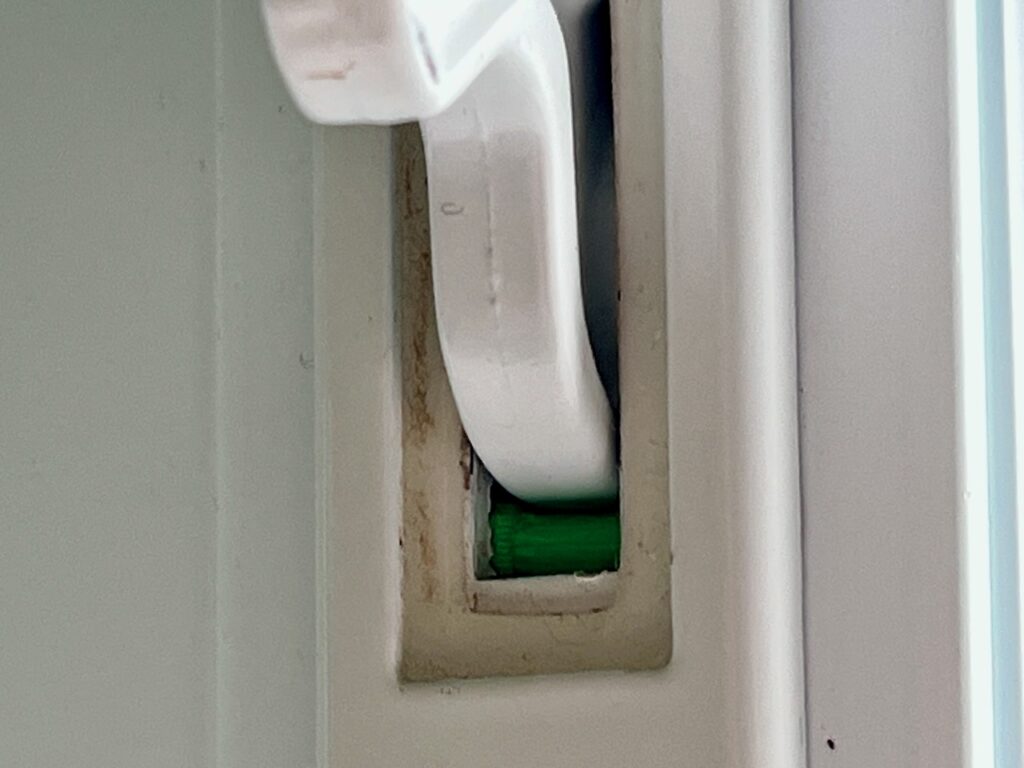
One of the locks on a 22-year-old Jeld-Wen casement window in our bedroom stopped working properly this summer. The window has a lock on either side that pulls the window sash tight against the frame when closed. The lock handle had always clicked into an open position ready to accept the tab on the sash to pull the window tight, but suddenly the handle wouldn’t stay in the open position. It was more an inconvenience than a huge problem, but seemed it should be fixable.

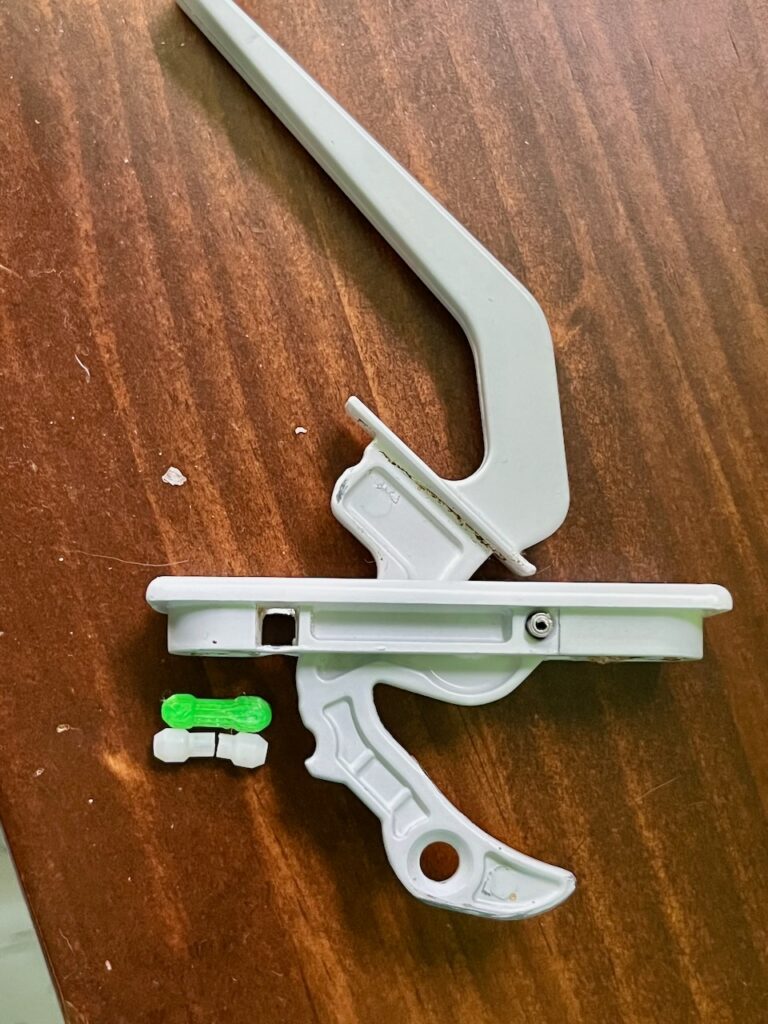
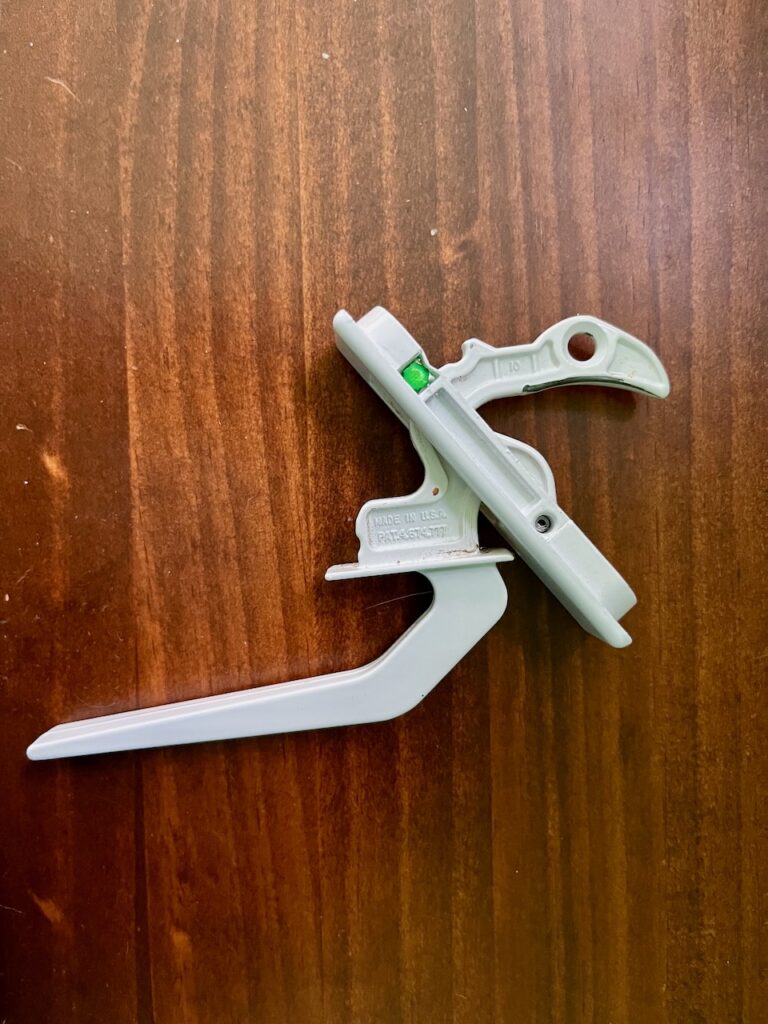
I unscrewed the handle to remove it from the frame to have a better look at it. Comparing it to the lock that still worked, I found a little plastic piece that had been holding the lock in the open position was now broken in two pieces, so the handle had nothing to grip to stay open.

I found an Instructable explaining the problem and a file to 3D print the tiny little plastic piece. Unable to justify buying a 3D printer just to print a Tic Tac sized piece, (though I tried!), I put the file on a thumb drive, filled in a request form and dropped both off to the Summerside Rotary Library with a $2 deposit. I received a phone call a week later to say the piece had been printed. The file actually prints two of the plastic pins, probably because each window has two locks. When I made the request I only needed one, but another pin broke on another window in that week, so I had all I needed for two repairs all for a toonie!

I’m not sure I’ve seen anything that had been 3D printed up close before this. The original piece was most likely injection moulded, so was smooth, but the 3D printed piece had ridges and wasn’t completely round. I couldn’t get the piece into the little slot in the lock at first, but carefully scraping a bit of a ridge off one side allowed it to slide in. Both locks now work perfectly.

Thanks to Gubutek for this nifty fix and my first satisfying dip into the future of fixing.

Original broken white pin with green 3D printed replacement
Replacement pin in position
Pin at work
Lock handle in proper position to accept tab on sash

Best batteries ever made?

Last week I popped the first disc of the third season of Succession into my DVD player (the library is my Netflix) and pushed the play button on the remote. Nothing happened.

I took the battery cover off the back of the remote and did what I’ve done often over the past few years: twirled the batteries and tried again. I don’t understand why this worked because it seems totally bonkers, but twirling the batteries would somehow revive them. This time, though, nothing happened. I put some fresh batteries in and the remote worked, so my luck extending the useful life of the original batteries that came with the remote well past what I would have thought possible for cheap AA batteries had run out.

For, you see, I purchased the DVD recorder/player on January 14, 2006 at Future Shop in Charlottetown. We used it a lot for the first five years we had it because we had dialup internet until 2010 so streaming wasn’t possible. I would say the player is still used a few times a month, but mostly the remote just sits there and waits.

I will reluctantly drop the Greencells in a recycling container, but these cheapo batteries deserve to take a bow.

A brief history of barbed wire fence telephone networks

Using barbed wire fences to create a telephone network makes so much sense, but it was new to me until I stumbled upon this fascinating article. Always enjoy reading about rural ingenuity. Favourite fact: the barbed wire networks sometimes used corn cobs, cow horns, or glass bottles as insulators!

Lori Emerson’s website seems full of interesting projects, and I especially love the table of contents from her upcoming book Other Networks: A Radical Technology Sourcebook.

New 9V Connector

I woke up the other night to a faint buzzing downstairs, looked around for the source and finally clued in it was coming from the laundry room. The little plastic water leak detector behind the washing machine was beeping away, but thankfully there was no water, so I decided it must be a low battery level warning.

The only way to stop the noise was to remove the 9 volt battery, so found a screwdriver to pry open the detector. Still half asleep, I pulled too roughly on the battery connector and left the negative terminal stuck inside the battery. A drag, but the noise stopped, so, partly victorious, I climbed back into bed.

Le sigh
Yes, I did try to push the little terminal in, and no, it didn’t just magically reconnect to the wire.

The next day I looked up how much it was going to cost to replace the wounded little detector ($23+tax!) and wondered if I could instead buy a cheap 9V battery connector and try to fix it. Lots of them out there, but only in quantities of 5 or 10, and I couldn’t see me needing that many in this lifetime.

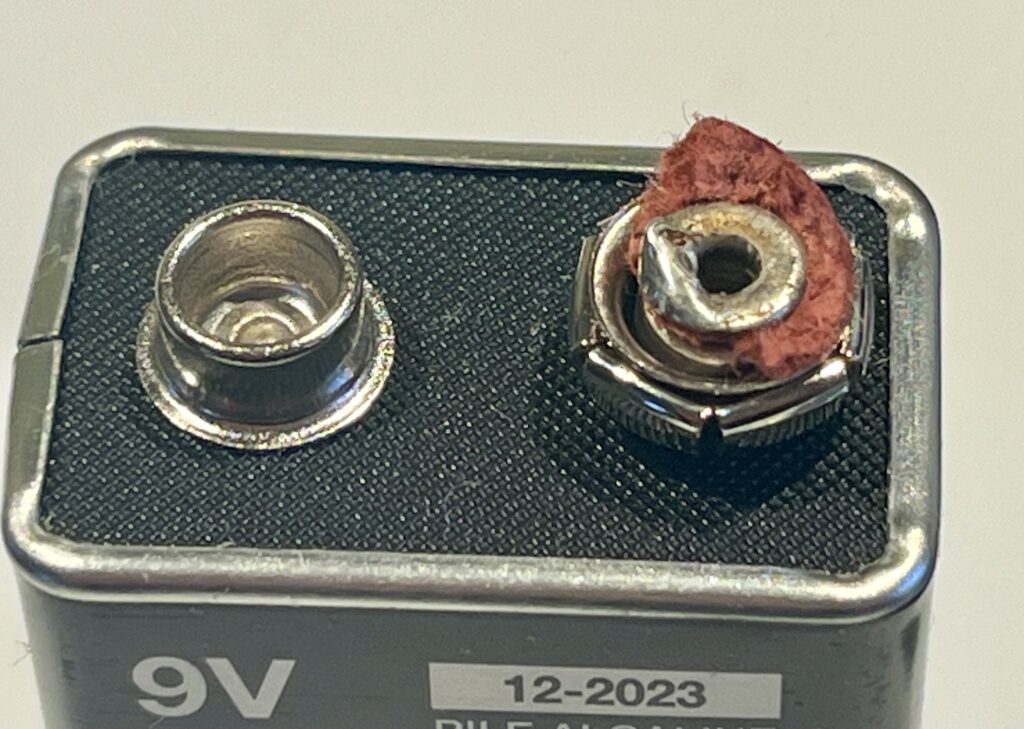
Didn’t take much internet sleuthing to discover what most of the world already knows: take the top of a dead 9V battery and use that. Hiding in plain sight.

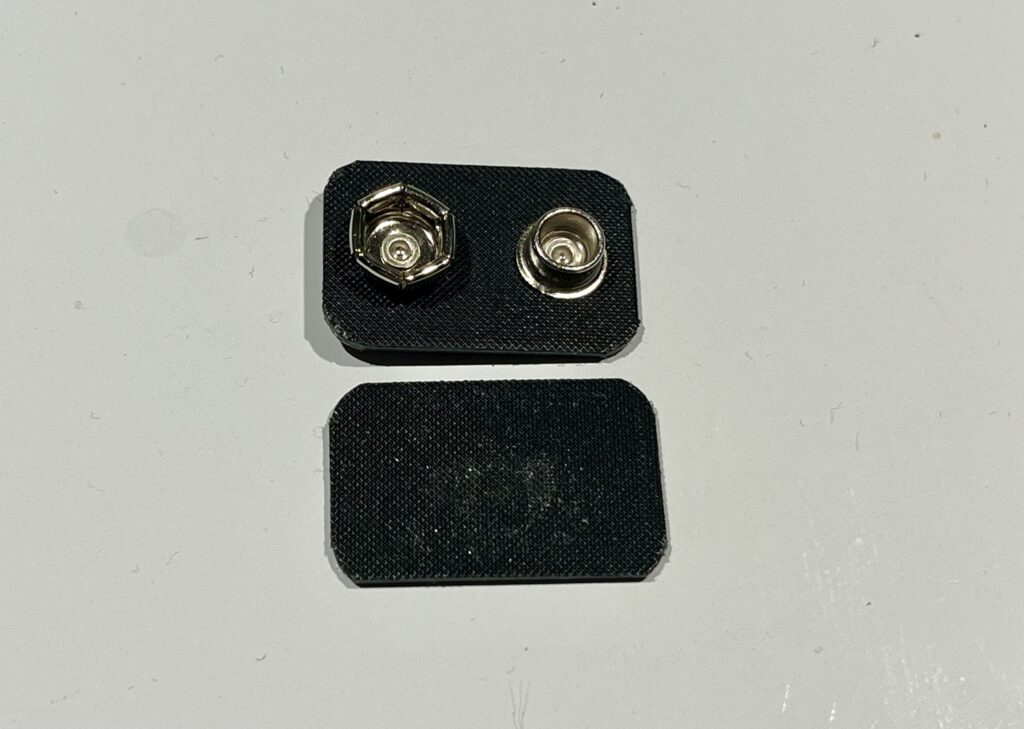
The top and bottom of a 9V battery
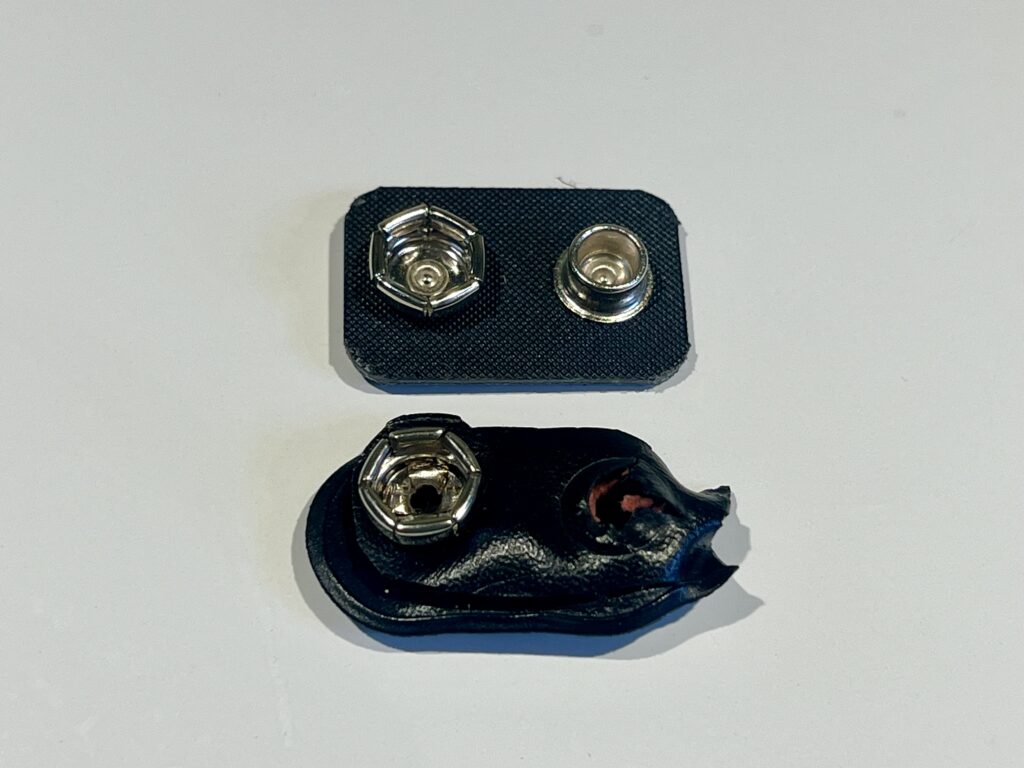
New and old
The positive wire goes to the terminal that looks like a little crown.
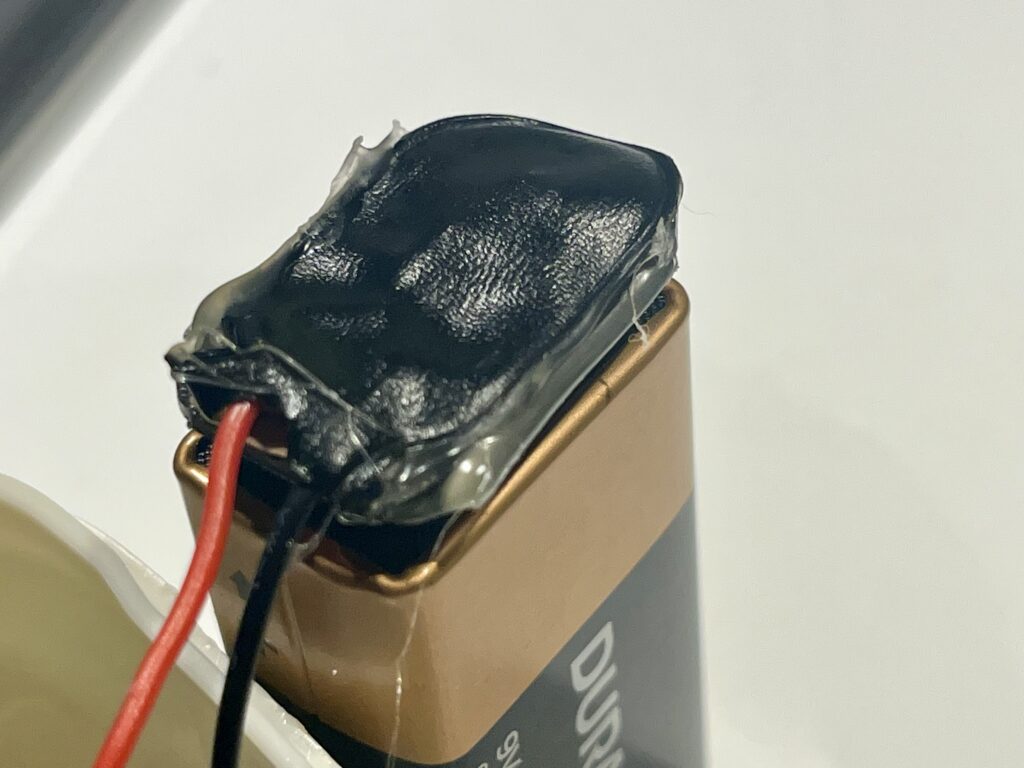
Reused the original connector top from the detector rather than the battery bottom as I liked that it was more flexible. Hot glued to the working bits of the connector.

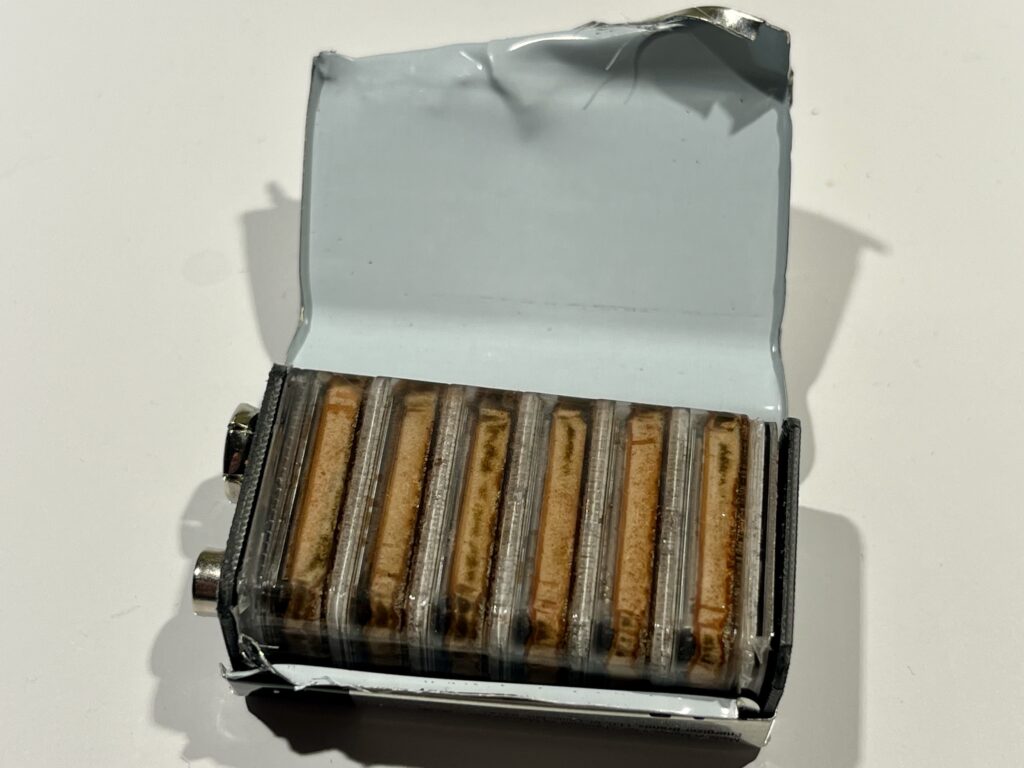
I’ve taken many things apart in my tinkering and puttering career – oh, the fizz of danger when slicing a golf ball in half and the rubber threads viciously unwound, or pulling the back off our ancient Panasonic television to see the tubes inside when I was a kid! – but it never dawned on me to carefully cut open a battery. That seemed a step too far, unnecessarily dangerous, the possibility of an explosion and/or toxic yuck oozing out and poisoning me. And possibly that can happen, so be careful.

The inside was interesting.

A couple of Instructables later and I had a fresh battery attached to the new connector on the little detector and put it back on duty. I’m a terrible solderer and it still worked, proving yet again that good enough is good enough. A very satisfying fix.

It’s easy enough to push the detector behind the washing machine, but getting it out was a hassle involving some fancy yoga moves and banging my head on the laundry tub, so the weird reused twist tie loop is my hack to give me something to hook a broom handle onto to haul it out.

“This is a recording”

We started getting early morning spam phone calls on our landlines a few years ago (our house has an apartment for my mother). Early as in 6:30 a.m. early. My mother was not usually out of bed or, if she was, she was getting dressed or in the bathroom, and she would rush to answer the phone. As her mobility decreased, I was afraid this would all end in a fall.

To prevent a possible tumble, I started taking her kitchen phone off the hook every morning when I got up. I’d hear a dial tone followed by a ring noise and then a voice telling me to hang up and try my call again (apparently known as an intercept message). After the message was repeated twice, a rapid busy signal would start and eventually would go dead after a long period.

My mother would replace the handset when she was in the kitchen and ready for her day, and if someone called to tell her that her Windows machine was acting up or she had won a cruise, she was awake and ready to hang up on them. This was an easy solution to an annoying problem.

We have two phone lines in our house. Our copper line was replaced in 2021 by a fibre optic cable that gives us internet, television and telephone. As my mother doesn’t use the internet, and we are able to wirelessly bounce a television signal from the Bell Home Hub modem to give her television, we decided at that time to leave her copper telephone line as it was.

Until Bell Aliant sent out letters earlier this year. The first informed us that if my mother’s copper line broke, they wouldn’t fix it and my mother would have to get a fibre line, which was fair enough, I suppose. That was followed a month later by another letter saying they would be cancelling her phone service by August if she didn’t switch to their fibre service. A classic Bell passive-aggressive move.

As we already had the fibre line and Home Hub in our house, it was an easy matter of some magic person left over from Island Tel days doing some programming at the Bell Aliant office in Charlottetown and rerouting my mother’s phone number to our modem (each of the Home Hubs has room for two phone lines). We lucked out again and had a tech come to our house (another Island Tel vet nearing retirement) who was able to make things work in our basement to easily route from our modem to my mother’s phone.

The morning following the switch, I picked up my mother’s handset expecting to hear the regular pattern. As I moved around her kitchen, I heard the dial tone followed by the signal to warn that the phone was off the hook, but no gentle, helpful voice.

I thought that was the end of the voice, but a couple of weeks later I was looking after a friend’s house while she was away and remembered she still had her copper line service, so I had one last visit with the Bell Aliant voice:

Anyone know who recorded this message? It certainly sounds like an Atlantic Canadian voice, maybe PEI but could be Newfoundland or Cape Breton, too. Recorded on tape? A copy of a copy of a copy? Let me know what you know, and please try your call again.

Blind luck

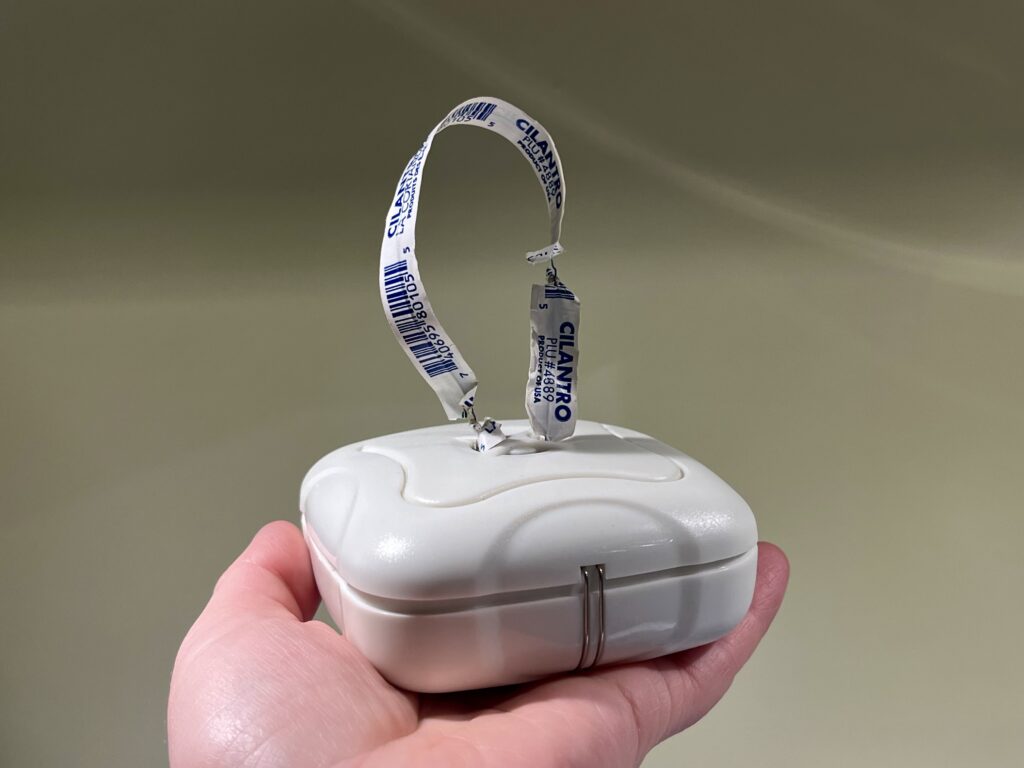
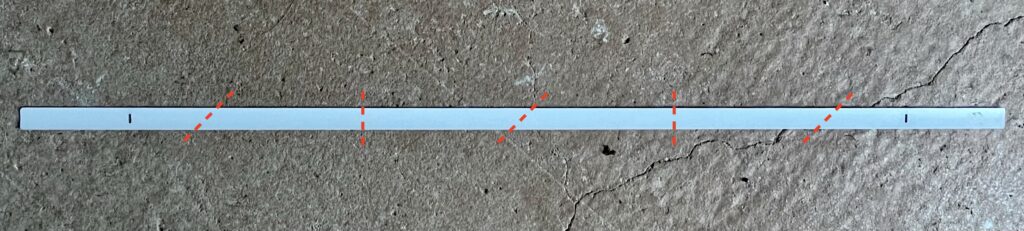
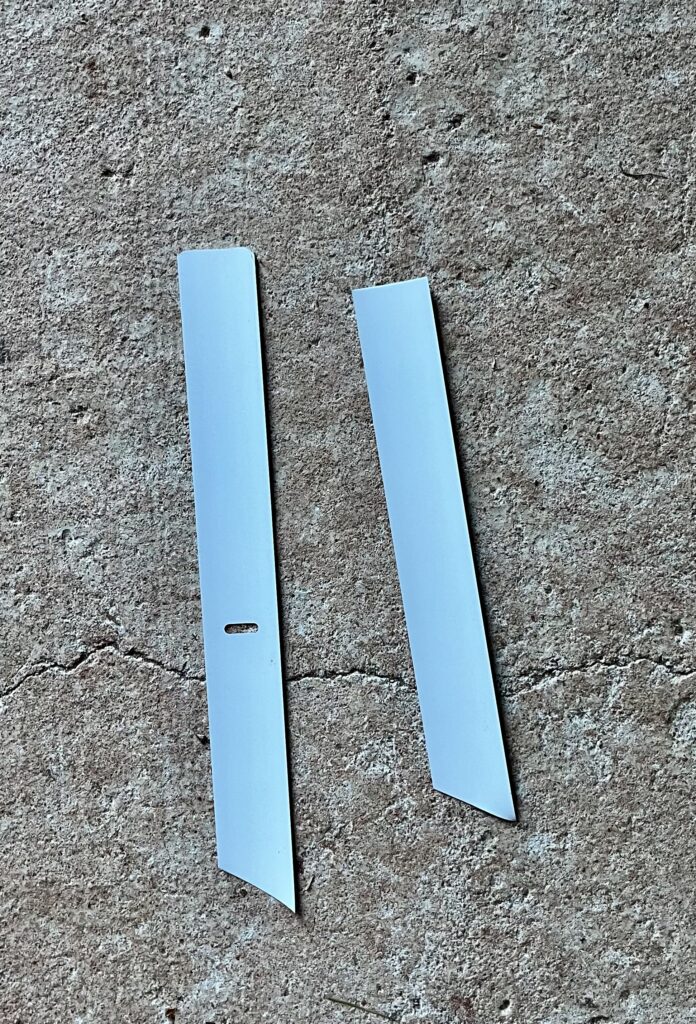
I am certainly not the first person on the internet to share the hack of using old window blind slats for garden plant markers, but here’s my preferred method for cutting them so the marker has one pointy end for sticking in soil and one square end where the plant information can be written:

I think I’ve only seen them squared off on both ends, but sometimes it’s nice to be able to shove a marker in next to something you would like to remember to move when the time is right (and that time isn’t right then) and the soil is perhaps a bit hard and unyielding.

I was lucky to get metal blinds from a friend who was replacing hers, giving me what I imagine will be a lifetime supply. I only cut a few at a time as needed as I find them easier to store in their original length; I put a shower curtain hook through the holes at one end and hang them on the wall.

Bonus content: I’ve found dozens of uses for metal shower curtain hooks in the garden. They are cheap, reusable light-duty hooks; buy a package and you will be hooked.

Food/Not Food

If you are unsure if something is a food, a good test is to put it outside and see what happens (most memorably done by Spy magazine in 1989 when they put a Twinkie cake on a NYC window ledge for four days and not even the pigeons went near it!).

I found three stale rice cakes in the back of a cupboard this morning and tossed them onto the lawn, confident some creature would eat them. The crows arrived quickly, took a few bites and passed, as did their bluejay cousins. A red squirrel triumphantly grabbed one, probably excited by how large and relatively light it was, scurried up a pine tree, took a nibble and dropped it to the ground.

I gathered up the rice cakes and presented them to the hens, who have pecked at them with little enthusiasm for four hours. They will probably finish them, but it will take a while. Their diet includes grit and small stones, so they are used to eating things without obvious (to us) nutritional value.

Not food.

Why did you give us styrofoam? We’ll eat it, of course, but…styrofoam?”