60 years ago tonight, Cassius Clay beat world heavyweight boxing champion Sonny Liston at a match in Miami Beach. Soon after that fight, Clay would take the name Cassius X and then Muhammad Ali.
A few days earlier, the Beatles returned to England after a successful short tour of the US, the start of Beatlemania on this continent. They appeared three times on The Ed Sullivan Show, the biggest variety program on American television, watched by tens of millions each week. Their second appearance was broadcast live from Miami Beach on February 16.
It just so happened that my parents, Harold and Vivian, took their first vacation to Florida in February 1964 and were in Miami Beach on February 16. They were both 41 and had been married for 19 years. They had worked hard to build up their general store business, so were overdue some fun and relaxation. They travelled with my mother’s cousin and her husband. By all accounts, they all had a marvellous time soaking up the sun and seeing the sights of Miami and Daytona.
Harold and Vivian Phillips, Miami Beach, February 1964. They obviously had a snazzy TV in their room, but my mother doesn’t remember if they watched the Beatles on Ed Sullivan on February 16. With few stations on the TV, my guess is they did, but she was more a Perry Como fan and never really got the Beatles.
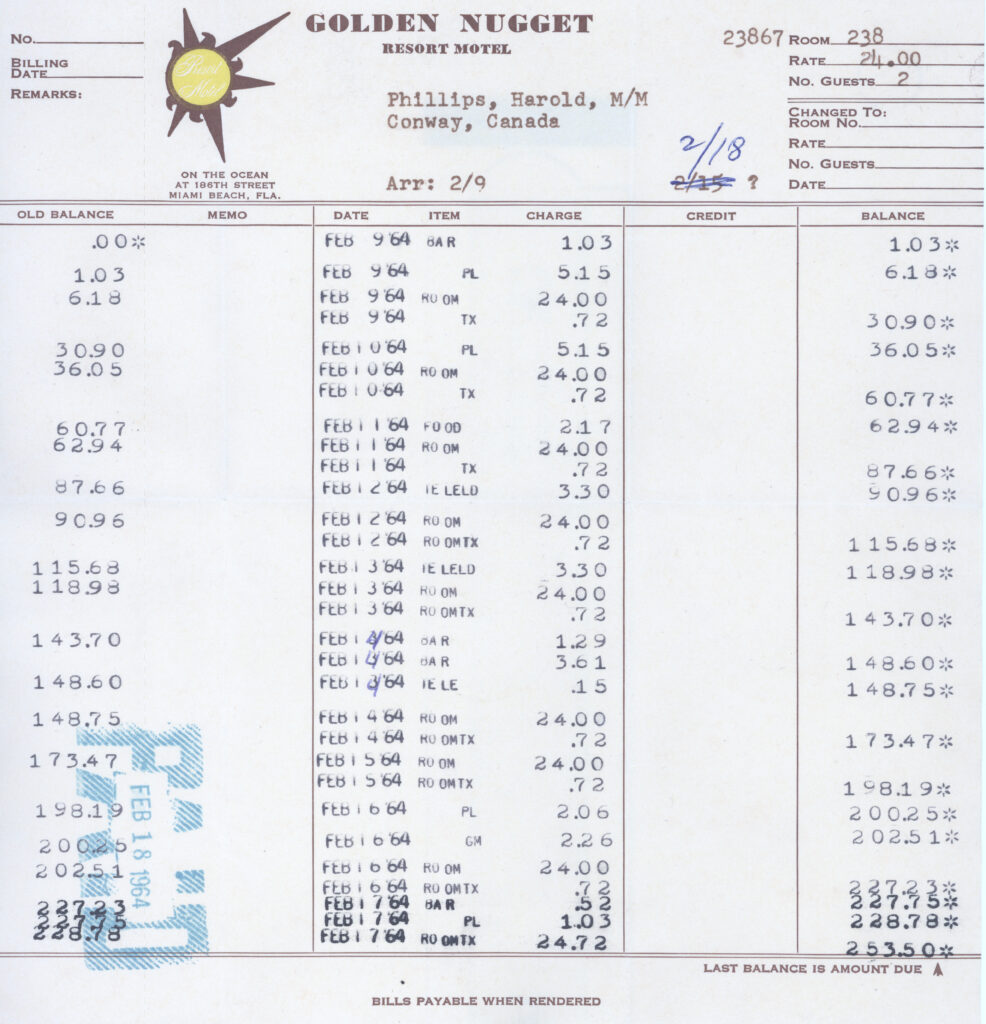
Bill for nine nights at the Golden Nugget motel, Miami Beach, February 1964.
My father lugged his 8mm Kodak film camera with him, taking plenty of shots of palm trees, orange groves, alligators and swimming pools. He took some footage of BOAC and KLM airplanes outside a terminal somewhere along their Summerside>Moncton>Montreal>NYC>Miami route.
BOAC and KLM planes, 1964
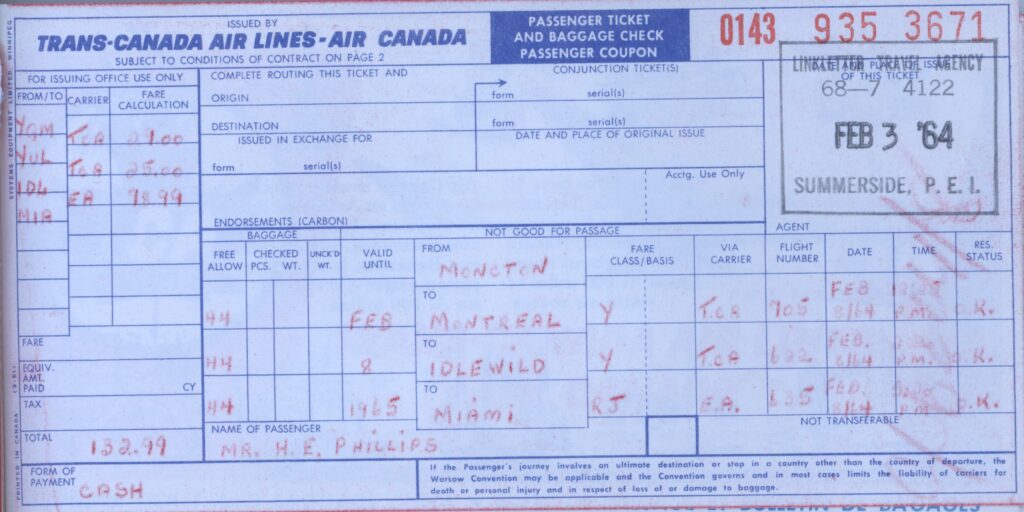
Their handwritten tickets listed their NY airport as IDL for Idlewild, except Idlewild had been renamed JFK in December 1963 just after the assassination of the US president, but obviously the change had been recent enough that no one was used to it.
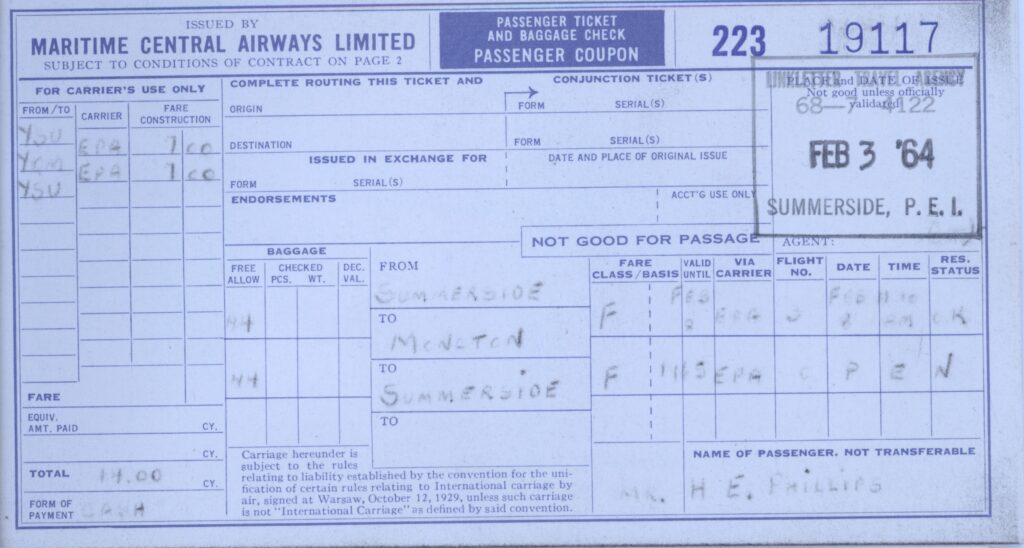
Moncton to Miami $132.99 return via Tran-Canada and Eastern airlines.YSU (Summerside) to YQM (Moncton) $14.00 return
One day, the four travellers hopped in their rented convertible and drove around the Miami area, my father aiming his camera at the passing buildings and advertising banner towing planes. When we watched this reel when I was a child, this short sequence would just slip by, but when I had the film digitized, I was able to pause it and have a better look, and quickly fell down a rabbit hole of early 1960s popular culture.
Miami Beach, February 1964, showing advertising banner towing planes, Sonny Liston’s training headquarters at Surfside, Florida, and Hotel Deauville with Mitzi Gaynor on the marquee.
I knew who Mitzi Gaynor was from her movie roles and appearances on television variety shows when I was a child. I looked up the Hotel Deauville and learned it was where the Beatles had stayed in Miami and where their second Ed Sullivan appearance had been recorded, a show that also included Gaynor. Then I read about Sonny Liston’s training camp in Surfside, just north of Miami Beach, and of him appearing on the Ed Sullivan show the same night as the Beatles, and the Beatles also meeting Cassius Clay and posing for a famous photo, and the February 25 boxing match. So much was going on!
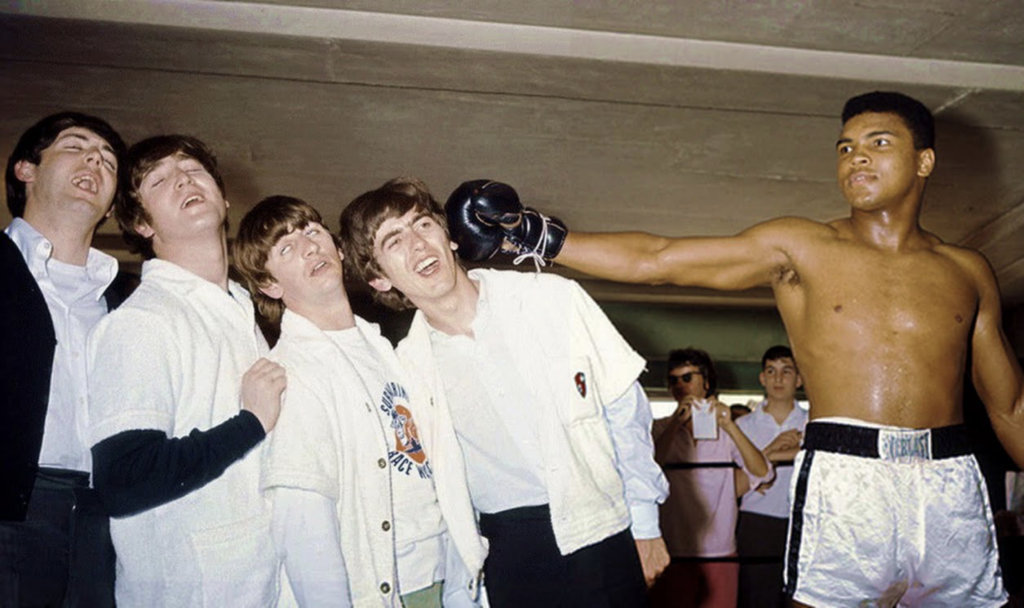
The Beatles meeting Cassius Clay/Muhammed Ali at the 5th St. Gym, Miami
I’ve done a few presentations about my father’s film footage to local groups and have used this little clip to encourage people to look at their own photos and videos and to save, document and share what they have. It might take many years before something becomes important or interesting, but if you haven’t saved it, you’ll never know.
What my father filmed isn’t as important as footage of the Beatles or Liston or Ali or even Mitzi Gaynor would be, certainly, but he did capture a few seconds of a time in US history when the country was still trying to come to terms with the assassination of their president only three months earlier, square old Ed Sullivan was kicking off Beatlemania using the huge influence of his television program, and Clay/Ali was on his way to becoming an important sports star as well as a towering figure in the black power, civil rights and anti-Vietnam war movements.
What do you have in that cardboard box in your attic or closet? Nothing much? Look again.
I’ve spent the past few days immersed in the history of Cedar Lodge, the log cabin that sits next to our house. The man who had it built, Senator Creelman MacArthur, marked the grand opening 90 years ago today with a big party.
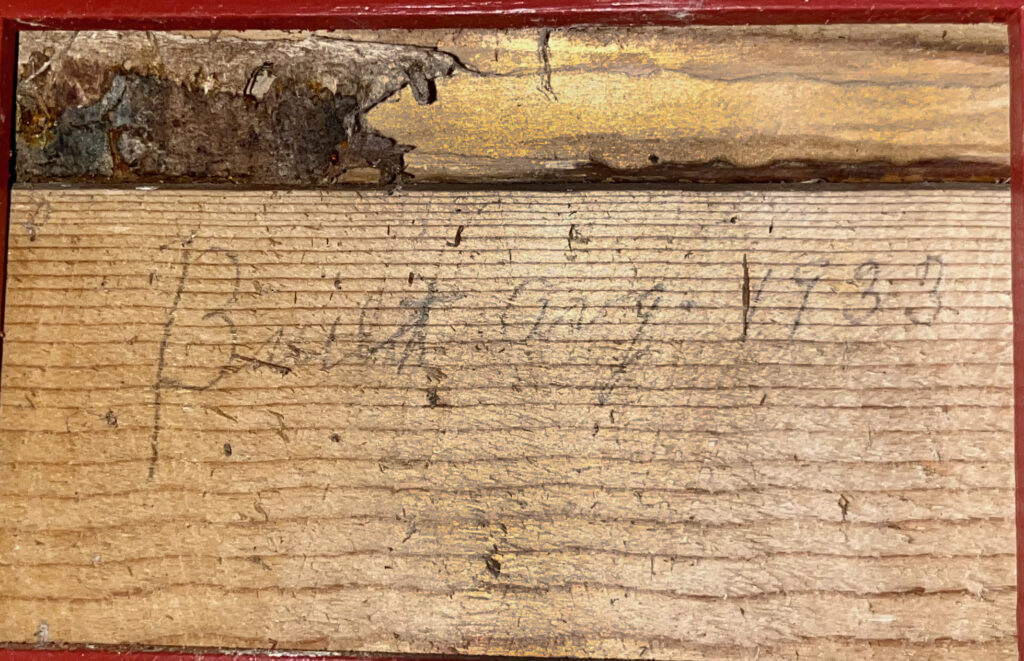
Someone put the date on the outhouse wall!
Almost everything I’ve been reading, including the newspaper report of the opening I’ll add to this post, talked almost exclusively about men: the various owners of the land, those who built the cabin, those who participated in the opening day event.
To be fair, a rustic log cabin designed to be a hunting and fishing lodge had manliness baked into it. I’m not sure what furnishings and decorations were in Cedar Lodge on August 30, 1933, but when my parents acquired it there was a stuffed moose and deer head leering down from the wall, rifles and fishing rods on racks in the corner. The pine floor was pretty beaten up by the time I came along 33 years later, so it probably had become a fair target to spit tobacco juice on during the years it was rented out to hunters and fishers. The huge stone fireplace was a perfect spot to gather around and tell tall tales, kerosene or gas lamps pushing out moody, flickering light. A man cave for men in flannel and rubber boots and wool caps.
The Cedar Lodge grand opening activities had been scheduled to kick off at 3 pm with the ladies from nearby St. Peter’s Anglican church catering a tea. Had my mother’s mother, Thelma Hardy, lived a few more years, she would have been one of those ladies, and no doubt my 11-year-old mother, Vivian, would have been there, but that wasn’t to be.
So at about a quarter to three this afternoon, my mother and I talked what would have been going on in the kitchen 90 years ago. We imagined the efficient bustle of the women who would be pumping water, stoking the wood burning range, moving dishes and setting up tables. We guessed they served sandwiches and sweets, rather than a meal, but can’t really know.
One thing I would bet money on is that just before 3:00 there would have been a pause in the preparations. A big pot or urn, filled to the brim with the sweet water that came out of the hand-dug well, would have been the first thing placed on the stove when the women had arrived and started the fire in the stove. Once boiled, it would have received a homemade cotton bag filled with loose black tea.
When it had steeped for a while, one of the women would have ladled a bit of tea into a china cup, and the women would have stopped what they were doing and gathered around to look in the cup.
Is it too weak? Too strong? Opinions would be offered, and if it looked okay, a dash of milk would have been added and the cup reexamined to see how the brew held up to the milk. If thought to be the right colour, the woman holding the cup would have had a sip, declare it to be fine, and the tea bags promptly pulled from the pot.
How can I be certain of this one detail, as sure as if I’d been sitting in the corner watching this take place? Because every church supper, tea or reception I’ve ever helped with in my 56 years has had the same ritual. It is a holy rite, an echo of the eucharist, the priestess drinking the remaining tea with a tip of her head, washing the cup, wiping it dry to use for the main event.
So hooray for Cedar Lodge, and the men who built it. My family have enjoyed taking care of this unique structure for 67 years, and have made so many lovely memories sheltered within its cosy walls. I’m in it now, typing by candlelight, as heavy rain pours loudly onto the uninsulated roof while the thunder roars.
And hooray for the unnamed women who fed the crowd that day, who were quietly in the kitchen performing secret, holy rites.
Three of our friends doing dishes after a party in the Cedar Lodge kitchen, 1965
From The Charlottetown Guardian September 7, 1933, page 2
The historical old home of Hon. James Warburton at Freeland, Lot 11, was the scene of a happy gathering on Wednesday afternoon and evening for the opening of Senator Creelman MacArthur’s new Lodge.
This beautiful estate once the scene of great activity in the old shipping days once more rang with the laughter of a happy care free throng enjoying the many pleasures provided by the Senator.
In the old days when ships would be launched at the very spot where the Senator has his Lodge, no doubt the villagers enjoyed themselves in just such a fashion.
One old gentleman, Mr. Thomas L. Murphy, recalled that on one occasion, when Charles McKinnon, a large shipbuilder, was in such a hurry to get a ship named Silver finished and ready for its ocean voyage to the old country, that he had her full rigged on land and when the ice broke and she was launched, she proved to be top heavy and toppled over and about a hundred people were nearly drowned. This was a three masted schooner, one of many schooners built at Foxley River in those days, rigged on sea and loaded with produce for England. Upon their arrival in the old country they were sold. Many old tales were told, by the old inhabitants of the district, of the activities in those days. The old store kept by Michael Kilbride in 1843, which was later moved down the ice to John Yeo’s place at Port Hill, and which is still standing in the yard of Roy Ing’s, was mentioned. Records in the books of the store have the names of many of the first settlers of that vicinity. Among the records is an account of articles purchased for the Officers Mess of the Rifle Brigade of P.E.I. amounting to £4, 7. 4 1-2.
Mrs. William Palmer, daughter of Alexander McKay who ran the mill on the Warburton estate, is the only person now living who was born on the estate. She told how when a little girl she would sit on the shore and herd the cattle for her father.
This old place presented a pretty scene at twilight with the sun setting over the water and the Lodge, decorated with spruce and fir, lit up with many coloured lanterns.
At seven o’clock a dance officially opened the lodge and the visitors to the strains of a fox trot enjoyed the hospitality of Senator McArthur and his daughters, who extended a cordial greeting to all. During the afternoon the visitors strolled about enjoying and admiring the beautiful scenery. Many took advantage of the boats placed at their disposal, and went for a sail on the river.
The ladies of St. Peter’s Anglican Church served tea on the grounds.
After the opening dance at seven, Mr. James McLean, of Freeland, the Senator’s right hand man, called for speeches.
Among those speaking was Mrs. Oscar W. McCallum, of Saskatoon, daughter of the late Donald Nicholson of Charlottetown, who said it was a great pleasure for her to be asked to speak at this historical place, one of the beauty spots of her native land.
Other speakers were Mr. Herman Bryan, former owner of the property; Mr. A.. E. McLean, MP.; Mr. A. J. Matheson, O’Leary; Judge Inman, Judge of the County Court of Prince County; Mr. J. F. Arnett, Summerside; Mr. A. A. Ramsay, a native of Freeland; Mr. Reginal Bell of Charlottetown, and Mr. Thomas L. Murphy of Freeland.
All spoke of the generosity of Senator McArthur, who had shown a very cosmopolitan spirit in throwing open their lovely grounds to the public; which in these times of depression is the right example to set, to any one who has the means and opportunity to do so.
Senator McArthur in response to the three cheers and tiger that went up from the crowd when he came forward, said that he had purchased the property for the benefit of the community and not for any commercial gain.
He intended to stock the waters with trout so that trout fishing could once more be enjoyed as in days gone by.
The grounds would be at the disposal of any community or church of any denomination to hold picnics and social gathering at any time. He wanted all his neighbours in Freeland to feel that they could come and enjoy the quiet walks and bathe or dig clams whenever they chose, and he added, that he especially wanted the mothers and children to come and spend many happy afternoons in his spacious grounds.
This concluded the formal part of the program.
A huge bonfire was now set on fire which lighted up the country side for miles around.
The crowd then gave themselves up to the entertainment of the evening and dancing in the lodge was in full swing.
About 11 o’clock when the harvest moon was shining over the waters, another bonfire built like a haystack in the stream was set going and made a never to be forgotten sight. The dancers paused as if fascinated, the moon on the water with the reflection from the fire lighting up the woods in the background, making an enchanting scene. The merriment was kept up until quite late and closed with singing “For He’s a Jolly Good Fellow.”
Besides the people of the surrounding districts, friends from Charlottetown and Summerside were among the visitors. —S.
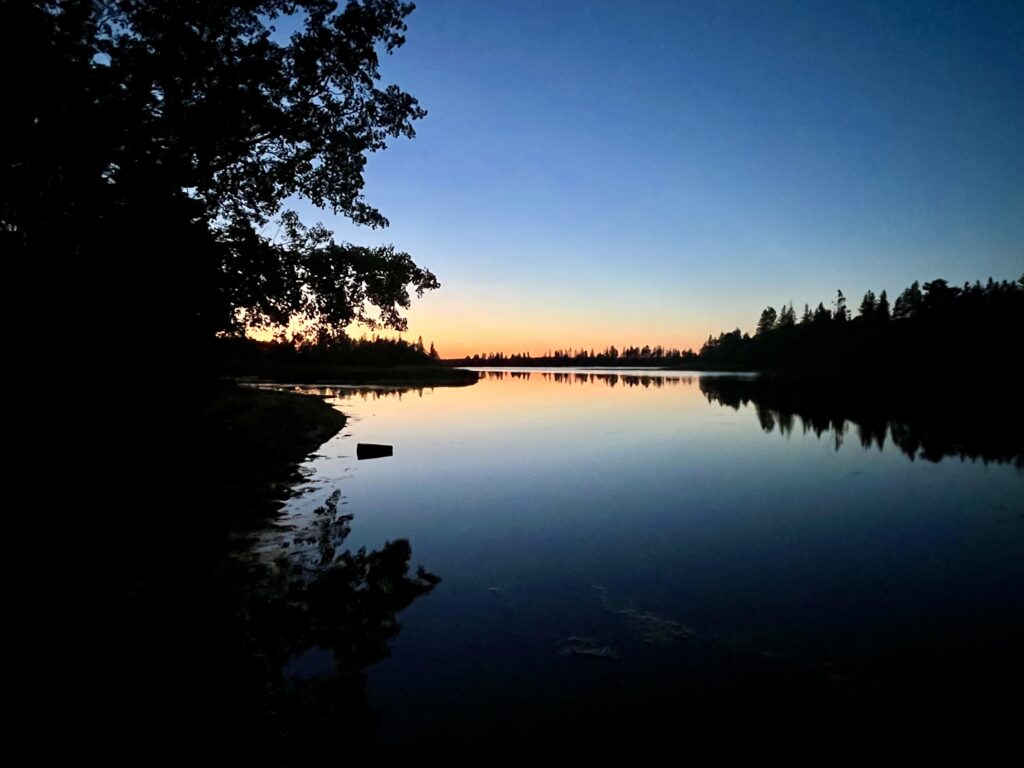
Sunset view on the shore next to Cedar Lodge, August 28, 2023
I can’t easily identify my favourite band or book or movie. I could give you a top ten list of favourites, but would not be able to single out just one.
My favourite podcast of all time is easy, though: A History of the World in 100 Objects from BBC Radio 4 in collaboration with the British Museum. It was broadcast in 2010 and I downloaded every podcast episode over our 1.5 Mbps internet connection and listened while I worked outside that fall.
The idea of looking at the span of human history through 100 objects captivated me, and I started my own 100 Objects project on an earlier version of this blog, planning to write about a different object once a week. I wrote about a couple of things from my unorganized collection of stuff, but didn’t continue both because of time constraints and not being certain of what I wanted to say or even why I thought something needed to be said!
I’m going to start again, this time documenting things that will tell the story of my family, my community and me, but only when and as the spirit moves me.
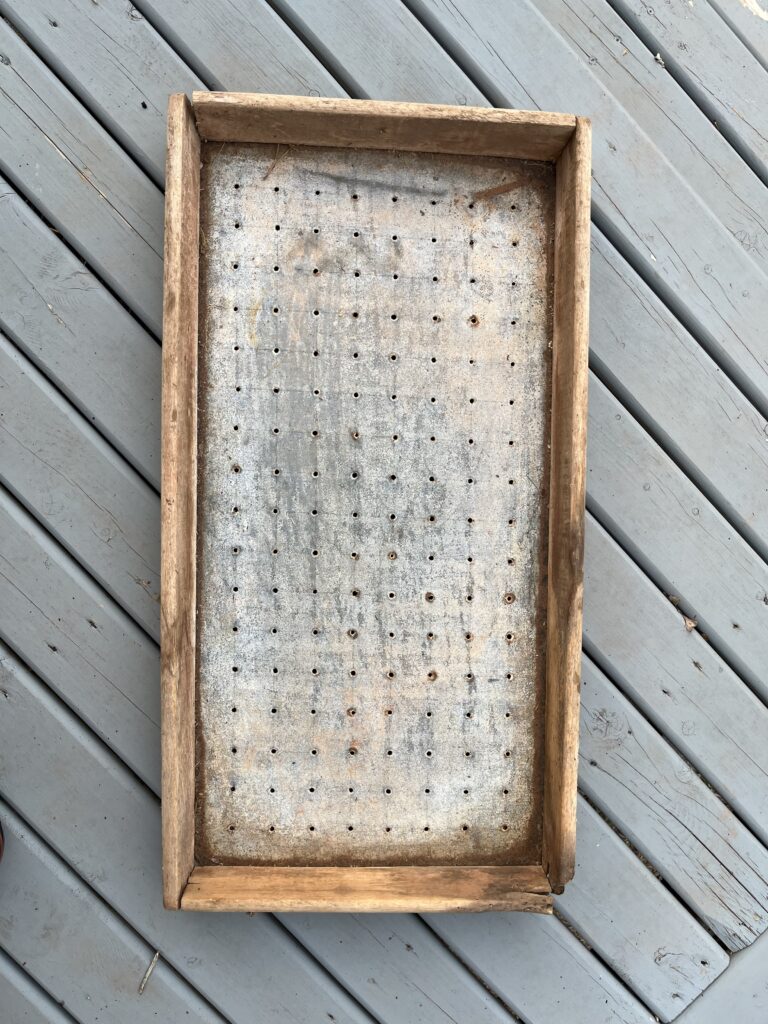
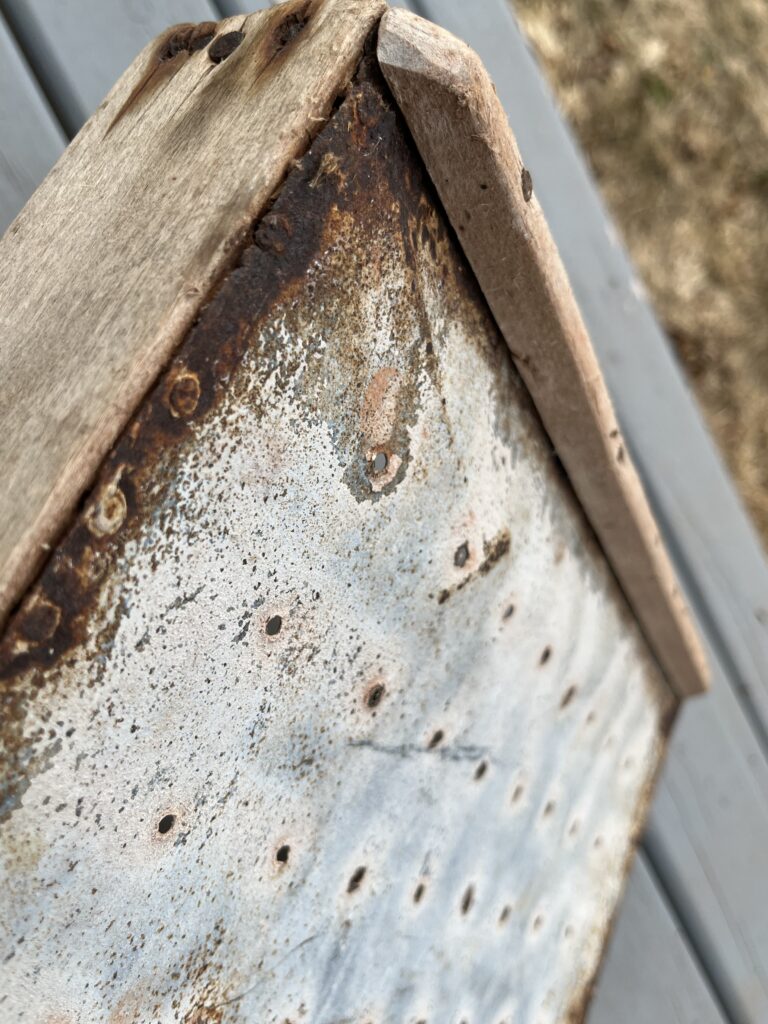
Lobster tray from the Ernest Hardy cannery. Difficult to date, but the cannery operated seasonally from 1901-46
Item One is a lobster tray and it came to mind when I saw this advertisement in the April 25, 1923 Guardian.
April 26, 1923 Guardian, p.6
My great grandparents, Eva and Ernest Hardy, ran a lobster canning factory on the Conway Sandhills at Hardy’s Channel off Milligan’s Wharf, PEI from 1901 until Ernest’s death in 1946. My mother spent her childhood summers at the factory, so I have her stories and even a few photos of the place, but not much of the physical elements of that bustling enterprise remain.
Some of the buildings now at Milligan’s Wharf made up part of the factory and were hauled over to the mainland of PEI in the early 1960s to be used by my mother’s uncles. Some were later repurposed for cottages, one into a snack bar, and one sadly sits abandoned by next-generation owners who have little regard for its history.
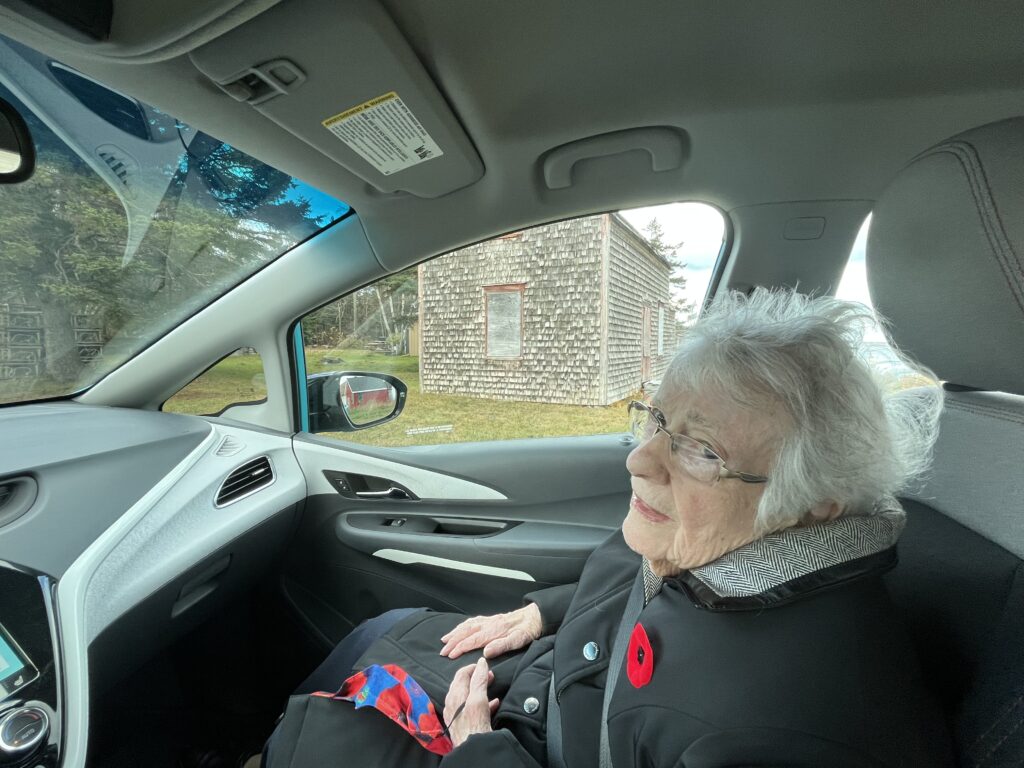
My mother, Vivian Phillips, visiting the old cookhouse from her grandparent’s lobster cannery, Milligan’s Wharf, November 2021. She and her brother would sleep upstairs in the colder months to take advantage of the warmth from the cook stove below.
Ella Oatway and Eva Hardy on cookhouse steps, Conway Sandhills, 1940s. There is a small roof behind them that connected the cookhouse to the separate dining building.
The factory equipment – boilers, tools, tables, canners, utensils – are probably all long gone, no doubt sold to others in the same business or repurposed by the family, which is why I was surprised to come across the tray in our shop building some years ago.
I’m not sure why we have the tray, though I expect it came from one of the buildings on the home property once owned by Ernest and Eva and later occupied by their son, Elmer. My mother helped Elmer in his market garden and he would often give her old things that were hanging around the place and probably in his way. She had a collectors spirit, for which I am thankful.
Until I saw Fred H. Trainor’s advertisement, I had assumed the tray had been made by someone working for Ernest, and that could still be true. Fishermen built their own lobster traps and boats, so making some rough trays wouldn’t be a big deal. My mother’s father, Wilbur Hardy, was not a fisherman but did have a small box mill that he used to make lathes and boards for crates, so he would have been well positioned to fashion the wood for a tray for his father’s business.
Tray holes spaced 1.5 inches apart
The tray is base is galvanized metal. The wooden frame is 13.5 inches wides, 26.25 inches long and 2.25 inches deep. There are small pieces of wood, tapered by rough carving on either end, on the bottom on the two shorter sides that would allow the tray to sit slightly off of a table for drainage. The drainage holes are evenly spaced 1.5 inches apart, faint grid lines directing the precise location for punching. Considering the amount of salt that would have been around the factory, it’s miraculous the nails holding the frame together are still able (barely) to do their work of holding the pieces together.
The factory was probably a difficult place to work in a challenging location: a sandbar on the north shore of PEI. There was never electricity there, though they did get a gasoline-powered stationary engine in the late 1920s, which was later rescued from a barn by my cousin. He thinks it was used to run a saw to cut up firewood, which was needed in large amounts to fire the boilers that produced hot water and steam for the factory.
Everything was done by hand, in conditions that would probably not be considered sanitary today. The boiler man drew water from a hand-dug well using a bucket and would fill the huge boiler that produced steam to cook the lobsters, keeping a hot wood fire roaring all day. Workers, both men and women, would open the cooked lobsters, first ripping off the claws and cracking them at the knuckle with large knives to extract the meat, pulling out the tail meat, and ripping the bodies apart.
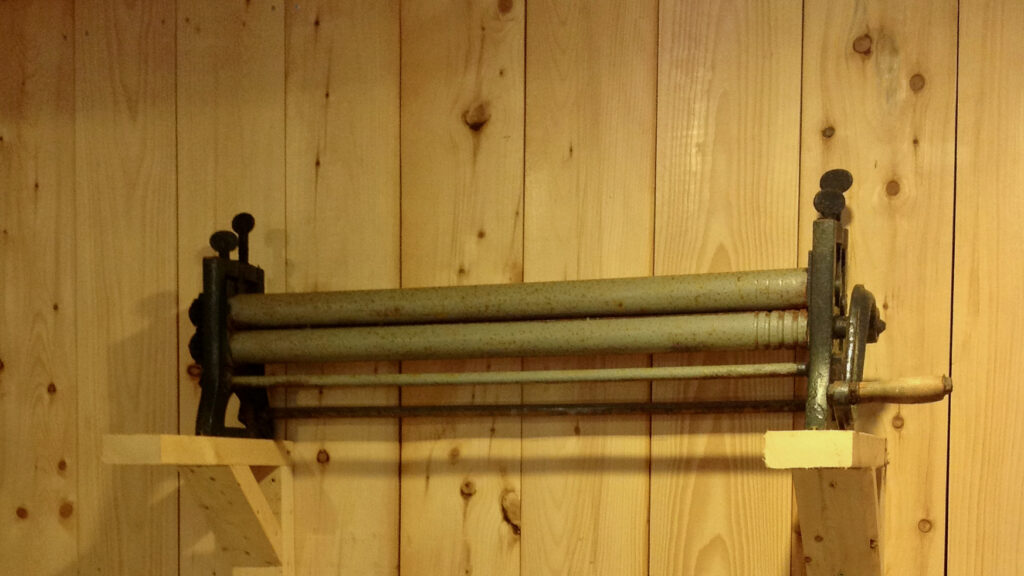
The little legs were fed through the wringer that came off a washing machine, squeezing the sweet meat out of them. My mother says this was the only job she ever did in the factory. The leg meat was added to the tomalley (“the green stuff” inside a lobster body) and roe to make lobster paste, also canned and sold. They also canned mackerel.
Wringer for squeezing out lobster meat, Basin Head Fisheries Museum, PEI, 2014
Leftover lobster bodies quickly become smelly, and piles of them would attract flies and wild creatures, so my mother says they were dumped back into the ocean by the fishermen or hauled to farms to be used as fertilizer. One of her uncles would fill his dory with bodies, take them back to the mainland, throw them into a wagon, and spread them on his farm fields to be disced under. They would certainly be scavenged by animals and birds when fresh, but eventually they would break down and act as a good fertilizer, or as good as a fertilizer could be before chemicals fertilizers were created. Even with all that effort of spreading lobster bodies, that uncle called his place Wild Rose Farm because that’s all the land was good for growing!
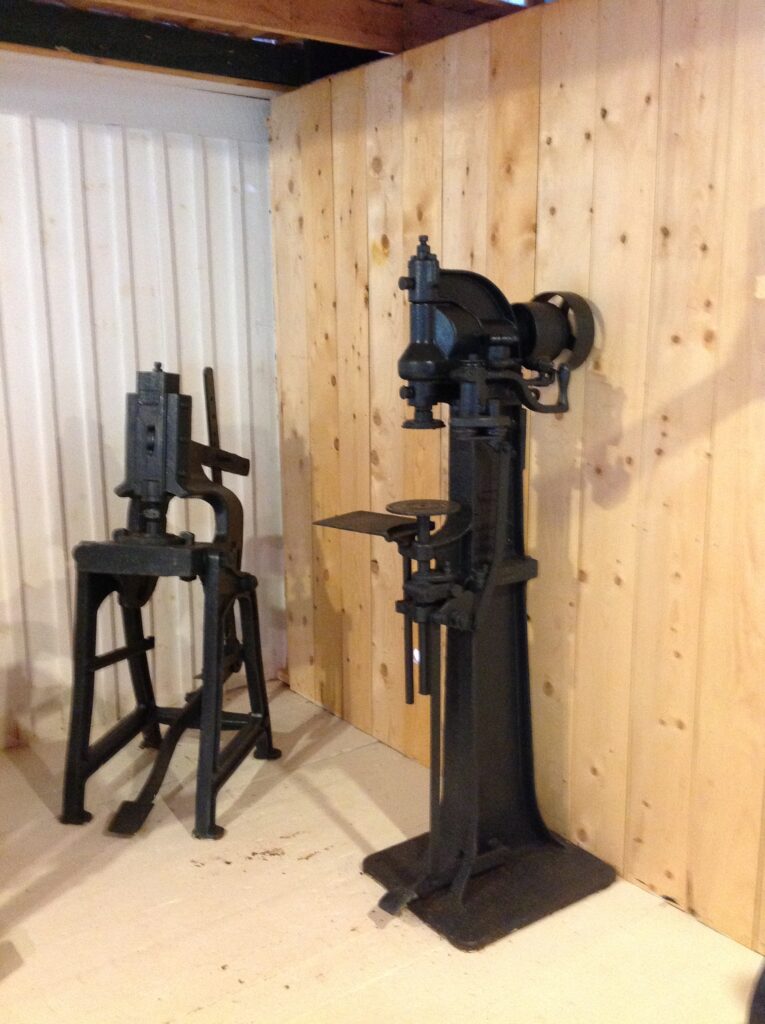
Can sealers, Basin Head Fisheries Museum, PEI, 2014. The one used by Elmer Hardy was similar to the one on the right, but smaller and attached to a work bench in his shop.
One of the canning machines, a greasy looking hand-cranked device, was in Elmer’s shop building. He raised chickens for eggs and meat, and canned chicken, beef and some fish well into the 1980s. Some people in our area still can beef, chicken and bar clams, though use glass canning jars and not the more tricky metal cans.
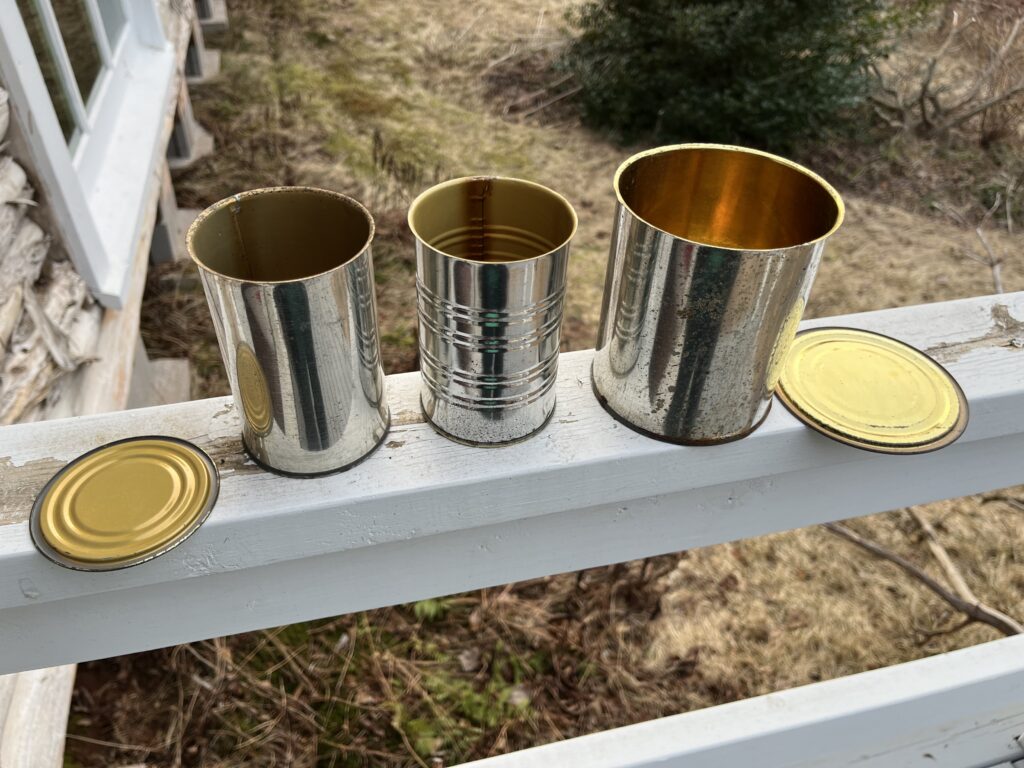
Unused cans and lids from two cases my mother had, which she would have purchased to give to her Uncle Elmer to have him can chicken for her. He probably stopped canning by the 1990s.
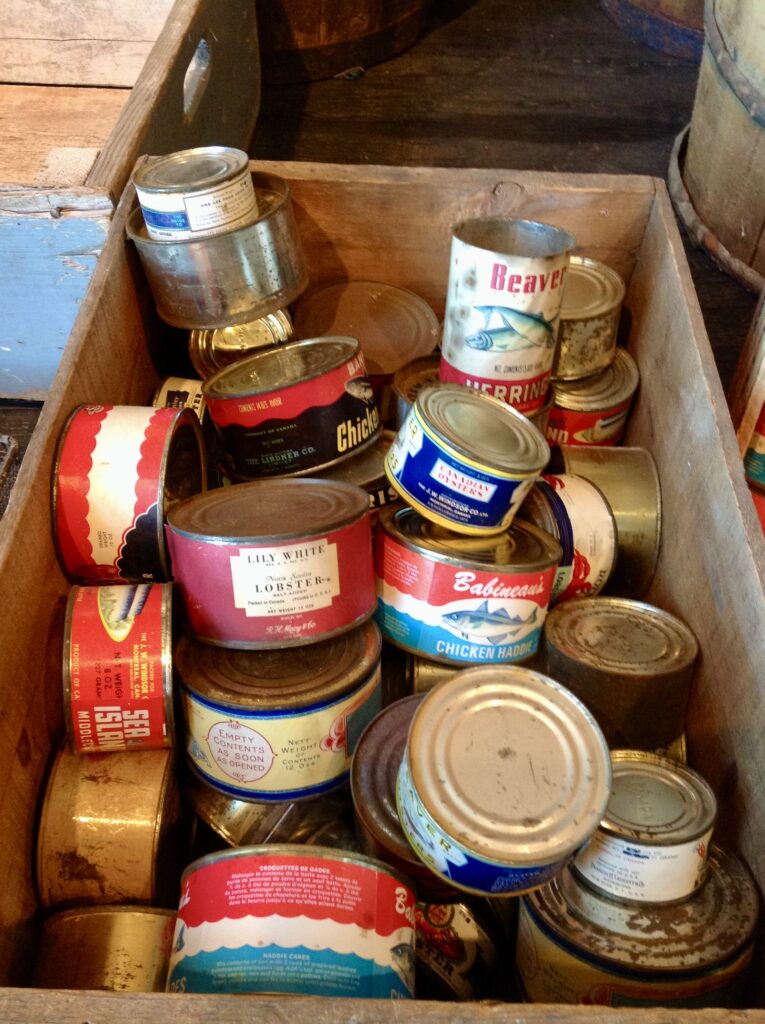
My mother says her grandmother, Eva, packed every can as she had “the knack”, and probably also wanted to make sure the weight was exact. A piece of white parchment paper was placed in the bottom of the flat, wide cans, and she would carefully fit tails, claws and bits of meat to bring it up to the correct weight. Once the cans dried and cooled after processing, a label would be affixed with glue or paste. My mother says her grandparents’ product was sold to wholesalers, so there was not an E.A. Hardy brand, but more likely they were canned for DeBlois Brothers wholesalers in Charlottetown, or maybe the large PEI retailer, Holmans.
Lobster and other fish cans at Basin Head Fisheries Museum, PEI, 2014
My great grandmother likely handled the tray thousands of times over the 45 years they worked each summers to make the money that would carry them over the rest of the year. “Factory owner” makes it sound like they were rich, and they definitely were not. They had a telephone, but no electricity and never had a car or truck. The furthest from PEI either of them ever got, that I know of, was when when my great grandfather went to Montreal for an operation, but I don’t think my great grandmother ever left PEI, or even went to Charlottetown! I gather they were well-respected in the community as being industrious and honest, but they had little more than anyone else.
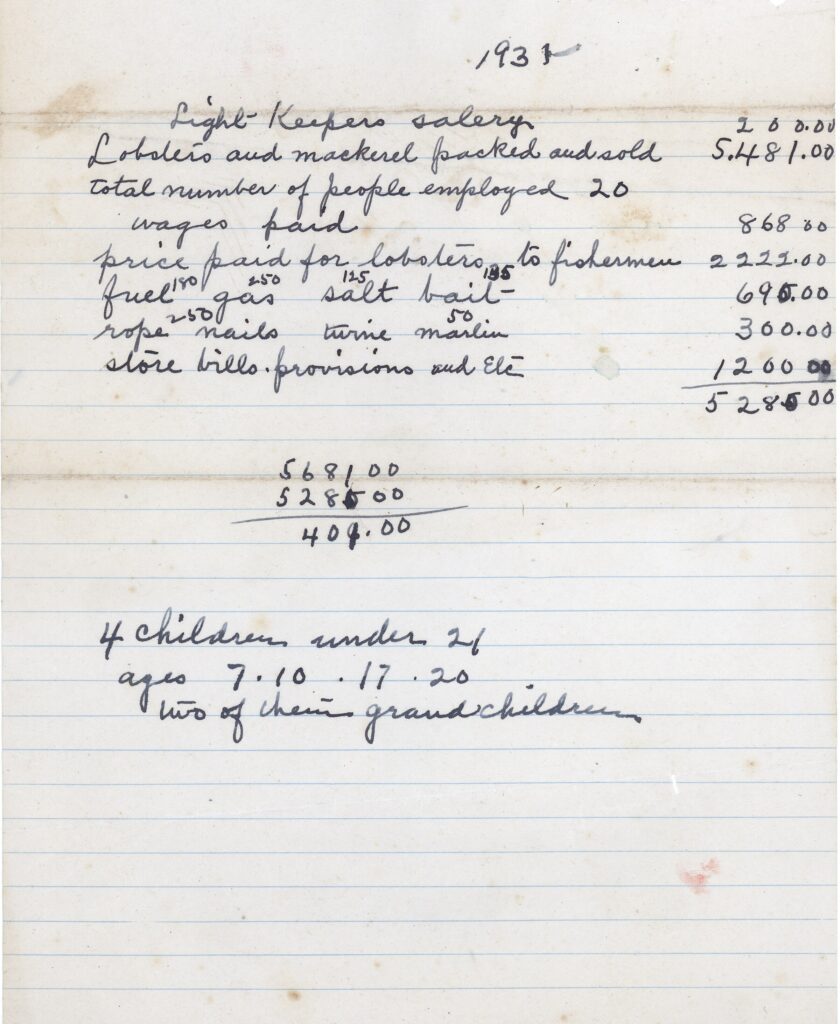
Income statement for Ernest Hardy, 1931. His lighthouse keeper’s income from the Canadian government was incredibly important to the family, making up half of their net income that year.
I think of the countless people who held that tray, working long hours to make a product they probably couldn’t afford to buy. That’s still the story for millions today who produce our clothing, electronics and food in hidden corners of the world. They make little, the corporations make a lot, and we get cheap things.
There are still lobster processing factories on PEI, some of it being canned but most of it frozen. Local workers became more difficult to find over time, so a large percentage of factory workers now come from places like the Philippines. Those temporary foreign workers have supported the lobster fishing industry in a way that is perhaps not acknowledged often enough, as the market for fresh lobster is limited and processing the only way to ensure there is a bigger market.
Lobster fishing and processing is still difficult, even dangerous, work. Thank the lobster, thank the fisher, thank the factory worker who holds the tray.
A friend and I went to our first Death Cafe in Summerside yesterday. I was already planning to be in town for an appointment and was able to arrange to stay a bit longer to join her, and I’m so glad I did. She and I are both very open about talking about death, so she was the perfect partner for this experience.
The Death Cafe concept started in the UK just over a decade ago and are now held around the world. They are designed to be casual events where people talk about death: your own, those you love, death in general. It is emphasized that a Death Cafe is not a grief support group, though most everyone yesterday spoke about people they loved who had died.
Hospice PEI were the sponsors and had held a few before the pandemic, but this was the first post-pandemic edition. Their staff arranged all the logistics (including chocolate cupcakes with little RIP signs on them!) and acted as facilitators. I think there were about 15 of us around three tables at Samuel’s Coffee House.
There aren’t firm rules around what is discussed at a Death Cafe, except that we not share the stories or details we heard from others. It was made clear we could speak or just listen, whatever we were comfortable doing.
After introductions, the facilitator at our table of six invited us to share what we hoped to get out of the session or what had made us attend. We all had very different reasons for being there, and the conversation flowed freely. We also used cards from The Death Deck Game, and spent an hour talking and listening. Despite the serious topic, the room was filled with laughter, but there were naturally also a few tears.
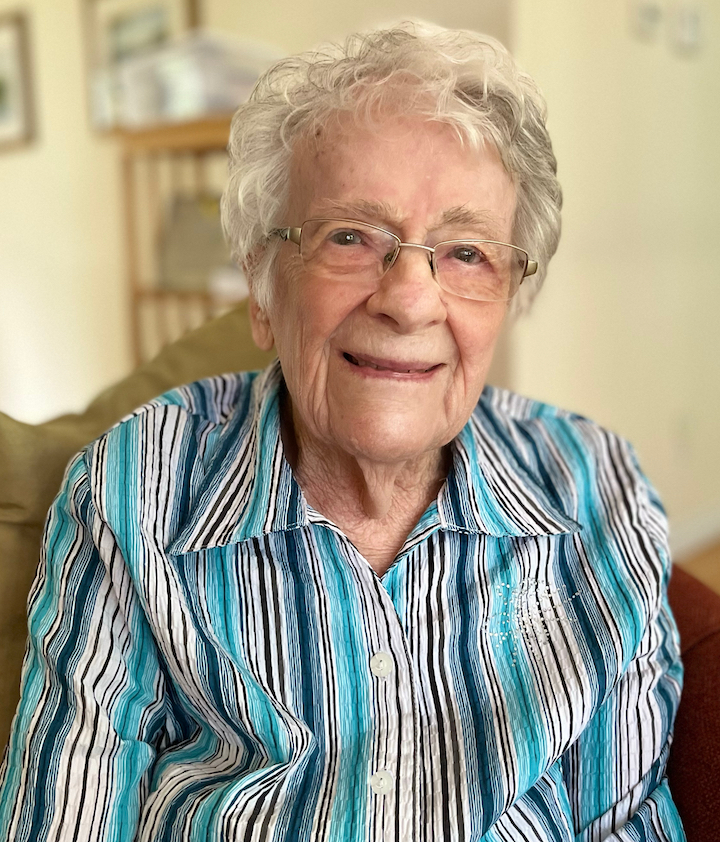
My mother is 100. She is remarkably well for her age, but is ready to die, and we talk about it often. She tells others her hope that she won’t wake up one morning, getting the death she prays for, and the reactions are mixed, of course, depending on her audience. When she started speaking so openly about this a couple of years ago, I gently suggested others might not be comfortable with it, but she continued anyway and I accepted it. Death is a very real part of her life, our lives.
My mother is a devout Christian, as was my father, and so I attended church basically from birth. Most Christian churches on PEI have a graveyard attached, and our church’s graveyard is the final resting place of many of my ancestors. I could pick out their tombstones before I could read them, would help my mother as she tended the flowers lovingly placed in front of them each spring, knew how to clean the stones with a stiff bristle brush and soapy water.
My great grandparents were the rough-surfaced white stone onto which moss stubbornly clung. We would scrub their names and dates and the simple phrase God is Love, which is also on the tombstone now in place at my father’s head, where my mother will be, where I will be.
One uncle and aunt had a polished red stone that was easy to clean, with a small tombstone next to it for the tiny baby they had who died right after he was born. That one had a little lamb sitting on top and was my favourite for that reason, but it was so sad, the little baby that never was guarded by the hard, staring lamb.
When you walk by a graveyard on your way in and out of church at least once a week, play tag and run around the tombstones when adults aren’t there to tell you to simmer down, you get a pretty good idea from a young age what life will eventually lead to. Someday it will be you in the box that is carefully carried into the church, the pump organ wheezing Abide With Me. Another little child will awkwardly carry a smelly flower arrangement and have to stand by your grave looking solemn, as you did so many times in the cold or with mosquitos biting your ankles. There will be sandwiches and tea after, and quiet words about you.
My mother taught me an old prayer to say at bedtime that she must have learned from her grandmother, who learned from her mother, and back and back:
Now I lay me down to sleep
I pray the Lord my soul to keep
If I should die before I wake
I pray the Lord my soul to take
I would then say God bless Mommy and Daddy, and recite a long list of aunts, uncles, cousins, friends and pets, including my goldfish, Henry. It was never actually the same list twice as it depended on how tired I was or who was front of mind.
Amen.
And to this day, many decades after I left behind the church and the ideas underlying that fairly creepy verse, the prayer occasionally comes back to me when I can’t sleep. I don’t say the prayer, but list off the loved ones, long-gones and still-heres, all the cats, a few chickens, and drift off.
We had family wakes in our house when I was a small child, the traditional way it had always been done. Only a wall separated two-year-old me in my crib from the dead body of my grandmother and then, a few months later, an 18-year-old cousin. They were asleep while we were asleep, they were asleep when we were awake. We waked, they slept.
Someone even took group photos next to the caskets, capturing those final moments together. That’s something I’ve never heard of anyone else doing, and which I knew from a young age was probably totally bonkers and something best kept to myself, but that’s what happened. People touched the dead hands and faces. I don’t remember any of this happening, except that I’ve seen those photos, rushing quickly past them in the photo albums. The smell of flowers must have been overwhelming in our house, and the scent of too many roses can still make me queasy.
I’m not sure if many people cried at my grandmother’s wake as she was 74 and hadn’t been well, so it would be seen as a blessing. I know many cried at my cousin’s wake because he had been killed in a motorcycle accident and was beloved by everyone. Only last week, my mother told me again that she never really got over his death, and that her life was completely changed by it. She lost her mother when she was 4, her only brother when she was 37, her father the year after I was born, her grandparents who raised her, but her young nephew being killed by a careless driver was the death that cut her life in half, the before and after.
When someone who volunteered at the charity where I worked in Toronto died, many of our staff and volunteers went to the wake and funeral. I was then in my early thirties. A colleague asked me to pick her up to go to the funeral home, and when she got in the car told me she was nervous as she had never been to a wake before and wasn’t sure what she would have to do. I was surprised she had lived into her mid-50s without attending a wake, even a family wake, but kept that to myself and told her to just follow me.
As it turned out, I was unable to model the standard PEI wake behaviour – shake hands, tell the person how sorry you are for their loss, shuffle along to the next person, shake hands, tell the person how sorry you are for their loss, shuffle along to the next person – because this volunteer had no family. None. We found out that night in the most poignant way possible that we were her family. Social services paid for the funeral, and it was pretty grim: a flimsy blue cardboard casket, only the flowers our charity had sent, no receiving line, a minister who had never met her and didn’t seem to want to be there. I, confident waker that I was, had never seen anything like it, so my coworker and I both experienced something new that evening.
That same work colleague died last week. She had been unwell for a while, but it was still a sad message to receive. After hearing the news of her death, I remembered a story she had told me about her own mother’s death.
Her mother was in the hospital and had been unresponsive for a couple of days, her breathing slowing, life draining away. Doctors said it wouldn’t be long, and my friend sat alone by her side, hour by hour, no partner or sibling to relieve her as it was just the two of them living together in Canada. Their relationship had been difficult for many complex reasons, but she was still feeling very sad that this was the end of her mother’s life.
Suddenly, her mother roused, sat up, looked at my friend and said, “You and I have a lot to talk about.” Then her mother laid back down and died.
The end. Amen.
They are planning to hold more Death Cafes on PEI, and they are also held in many places around the world. It was an entirely positive experience, very freeing and uplifting, and I hope to attend another one some time. My friend and I agreed that talking about death made us feel very alive.
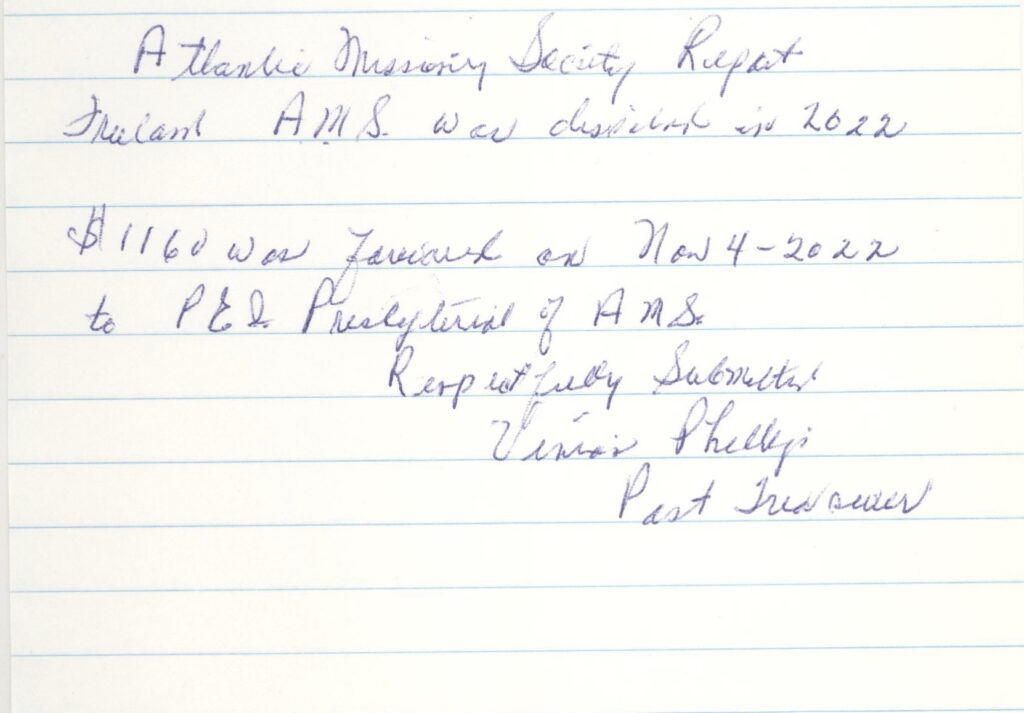
My mother has submitted her final annual financial report as treasurer of her church’s Atlantic Missionary Society group. They disbanded last year after membership dwindled to just five members all over the age of 75.
The hallways and rooms of Stewart Memorial Hospital in Tyne Valley had been decorated with paintings and photographs donated by community members. When the provincial government shut down hospital services in June 2013 and turned the building into a long term care facility, the mysterious figures who pull the levers from hidden corners of Health PEI deemed that anything in the building that wasn’t generic had to be removed.
You probably think I’m being dramatic, but I’m not. Down came the paintings that showed rustic local barns and familiar vistas, only to be replaced by made-in-China blandness. The reasoning? It was some vague idea that the facility was the residents’ home and…well, honestly, I never understood it. The place ended up looking like a forgotten corner of an airport lounge.
I documented all the original artwork in the hospital before it was removed, and they are in this Flickr album.
Most of the hospital rooms had been sponsored by groups or families, and all the plaques by the doors acknowledging these contributions had to come down. Photos of past staff, items donated to thank staff, all dismantled. The place had to look like everywhere and nowhere. You can guess I wasn’t a big fan of this move to strip away the long community history of this building.
A new building was built a few years later and now the old hospital building that has stood on a Tyne Valley hill since 1951 will be demolished. What was left in the old building has to be removed.
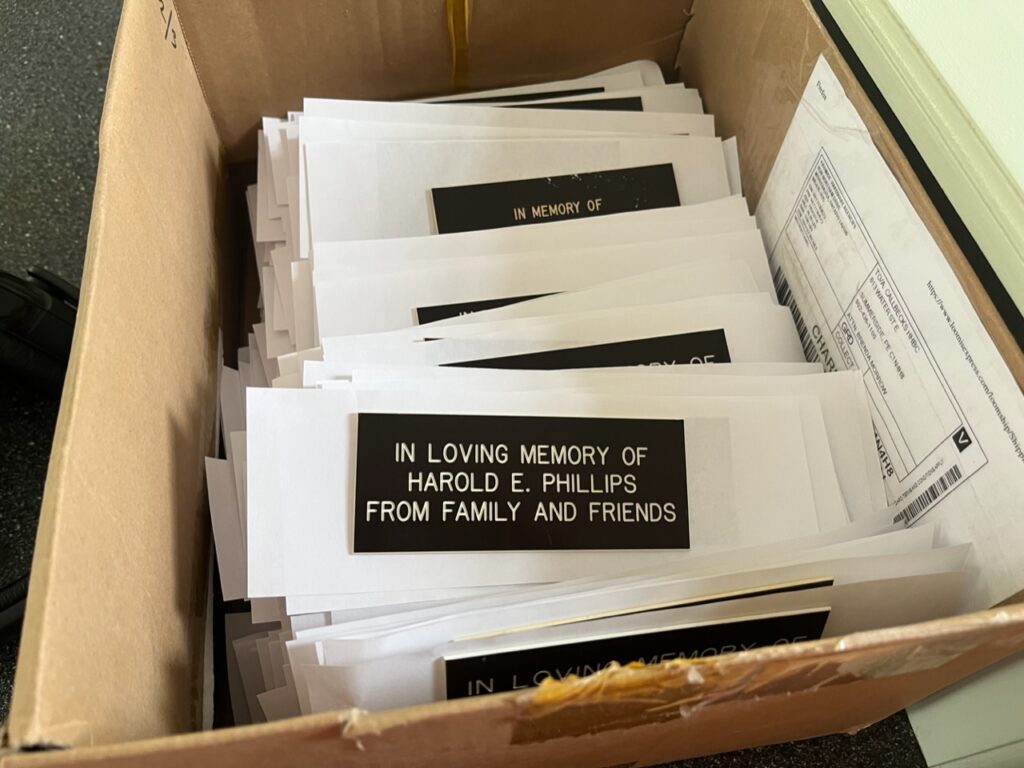
I received a call to see if our SMH Foundation wanted some memorial plaques. When someone died, and donations were made to the Foundation in their memory, a small plaque would be put up in a beautiful display case that was very visible in a hospital hallway. We had so many donations over the years that we had to build another case to house them all. Of course, as had happened with the artwork, when hospital services were discontinued, the cases had to be moved to an unused ambulance bay, and with them the memory of a community that had cared enough to support the hospital.
So, my mother and I went to pick up the box of plaques at the new long term care facility, which is a beautiful building appropriately devoid of much local character. I picked up the little box of plaques and carried it back to my car. It felt like a funeral and I was carrying the ashes of all that we had worked so hard to maintain.
I put the box on a table when I got home, but didn’t feel up to going through the plaques. The next day, I decided to have a look, and near the top was the plaque with my father’s name from when he died at Stewart Memorial in 2008 after having resided there for a couple of years. I flipped through a couple more names and started to cry. I knew them all, related to many.
The loss of our hospital still stings, and I think it always will. Soon the building will be gone, and younger people will never really know what we had and what we lost. They can knock the place down, but I will never stop talking about it, the remarkable achievement of building and maintaining a small rural hospital for over six decades.
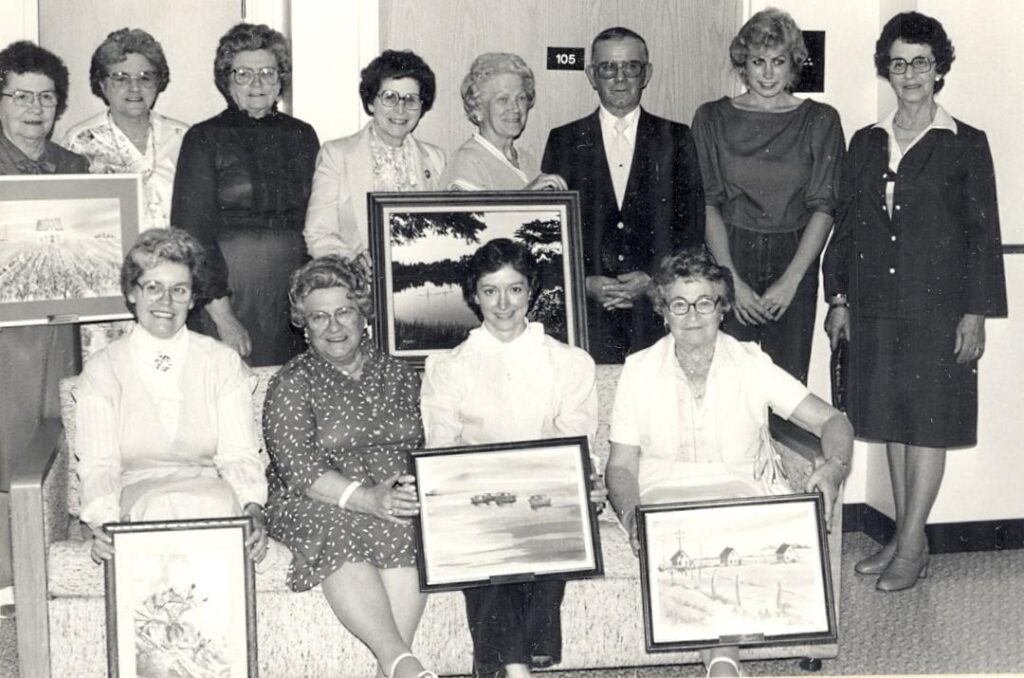
Some of the artists who donated their artwork to the new wing of Stewart Memorial Hospital in 1983.
One of the joys of being my mother’s daughter is acting as the courier of her kindness, most often as the deliverer of baked goods to family and friends, and even sometimes to strangers. From a young age I was often sent to neighbours with fresh muffins or bread or whatever had emerged from her oven just because she thought they needed a treat, casseroles and dishes of soup to those unwell. She did the work, but I received the thanks and could bask in her goodness; I have slid far on her cookie diplomacy!
Last week I delivered some of my mother’s Christmas baking to a friend, who had a little card and gift waiting for me. It is a beautiful pine needle basket made by an artist from Maine called Morning Star Wolf. My friend said the basket might look empty, but it was filled with gratitude. What a gift.
Last night as I was heading to bed well past my normal bedtime, I noticed the orange crescent moon climbing up the red pine tree to the east of our house. I went closer to the window to see it better and a shooting star dashed past. I noted Jupiter and Saturn marching across the sky, and suddenly another star fell straight down, grazing the moon. I felt sucked into the night sky, away from here and now.
I imagined my grandmother, Thelma, also awake late on August 19th but in 1922, looking out her window only a couple of miles from mine, waiting for her first child to be born the next day, my own mother, Vivian. Thelma had been orphaned as a tiny girl and married my grandfather Wilbur at an age we would think young now. After one more long night, she would have a family again.
We had an open house party today at the old school in Freeland, again only a mile from where my mother was born, to mark her 100th birthday. About 150 people attended, people who have known my mother from as far back as the early 1940s and some who met her only last month. Cousins brought tiny babies, passing them from one loving set of arms to the other, held them up next to my mother to take a photo on this milestone day (“You once met a lady born in 1922, she held your hand, here’s the proof!”). I watched as people from different parts of our lives made the connection that they both knew my mother. Planets colliding, stars streaking past.
Today my mother was able to receive the good wishes and love of others, and what an overwhelming and humbling experience that was for her and me. How often have we wished that we had told someone how much they mean to us, but it is too late. Everyone had their chance today, and they arrived with full hearts and words of respect and love.
Perhaps all the unnatural separation we have endured over the course of this pandemic needed to burst today, people wanting to connect again, to have community, to love and be loved.
There were so many people at the party I couldn’t possibly talk to them all, but those who I did speak with (all the time still wearing my mask, because this party was not without risk, something I weighed over and over as I considered planning a get together during a still-active pandemic) spoke of my mother’s inherent kindness, faithfulness, goodness, industriousness. The love for her nearly lifted the roof off the old building, the vibrations of family and community connection humming and dancing through the walls and back up to the sky.
When I returned to PEI 20 years ago, someone remarked I had big shoes to fill, but I know I will never be her, never come close to having her impact, though as her only child, I have certainly tried to model my own way of being in the world on how she has lived her life. She has taught me to think of others first, and to always stay true to what I believe in. To be welcoming, warm hearted, cheerful, helpful and kind. I try to work hard and see the good in others. If I have the choice to do more or do less, I do more. Seize the day, move forward, and laugh.
My mother was tired after all the intense attention when we returned home at 4, but by late evening, reading through some of the cards she received, she remarked that it had been a good day, and she only felt 25, that we must have been wrong about the date. That, dear readers, is how you get to 100.
Had a stubborn stain on a white shirt today, so did what I have always done: grabbed a piece of homemade soap and a washboard and gave it a good scrub. The soap was made by my mother’s uncle, Elmer Hardy, mostly likely with chicken fat as he raised hens for meat and eggs. Not sure what else went in the soap, but it certainly contains lots of lye and is hard on your hands if you do a lot of washing with it. Red knuckles will result if you are out of the habit, as I am, and you scrub too vigorously for too long.
Add soap to board, not to the piece of clothing.
In case you’ve never done it but find yourself in a rustic backwoods cabin with dirty clothes, you place the washboard in a laundry tub with some hot water, rub the soap over the washboard, leaving some behind in the grooves, and then scrub the piece of clothing over it. I use our modern plastic laundry tub, run a couple of inches of water in the bottom and a bucket for rinsing, and wash and rinse and wash and rinse until clean. Hang your cleaned item out on the line and the sun will do the rest of the bleaching!
Uncle Elmer died in 2002 at age 92, and I can’t remember when he last kept hens or made soap, but it was many years before that, so that soap could be over 30 years old and is still hard and perfect. He didn’t use individual moulds but instead poured the mixture into a big pan and cut it before it set too hard, so some of the pieces have rounded bottoms. I laugh when I see bougie soap makers now going for a similar raw look to their hand and body soaps, rough and misshapen bars wrapped up in brown paper and twine.
Who taught me how to wash clothes this way? My mother, I suppose, though I don’t remember her showing me, I just picked it up from watching her, as she watched her grandmother, and on and on back in time. My hands hold old knowledge.
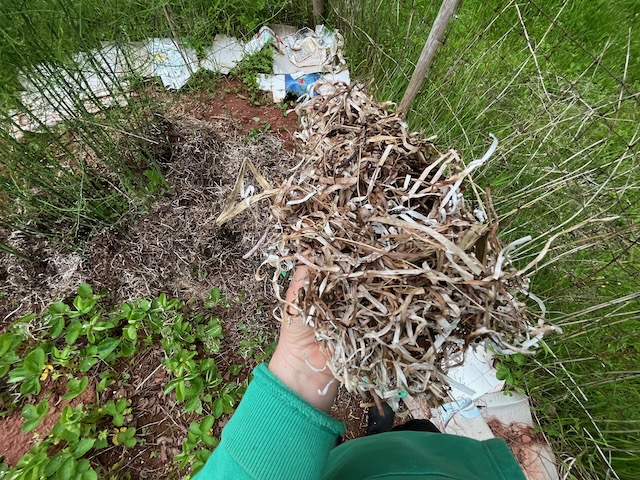
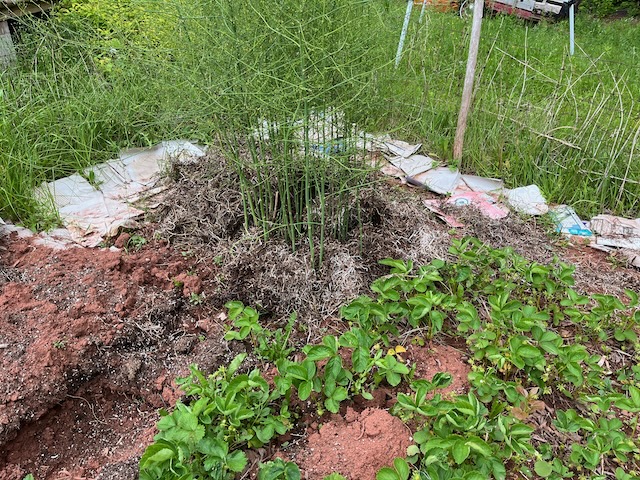
My mother and I took a short detour on our way home after a recent appointment. I wanted to pick eelgrass from the shore to place around my tiny asparagus bed, a trick I learned from local master organic gardener Paul Offer, who generously taught an organic gardening course at our community school for many years. He said asparagus likes a little salt – it’s probably one of the few cultivated plants that does, I imagine – so some eelgrass scattered around suppresses weeds both by blocking light and from the trace of salt from the seawater in which it grows.
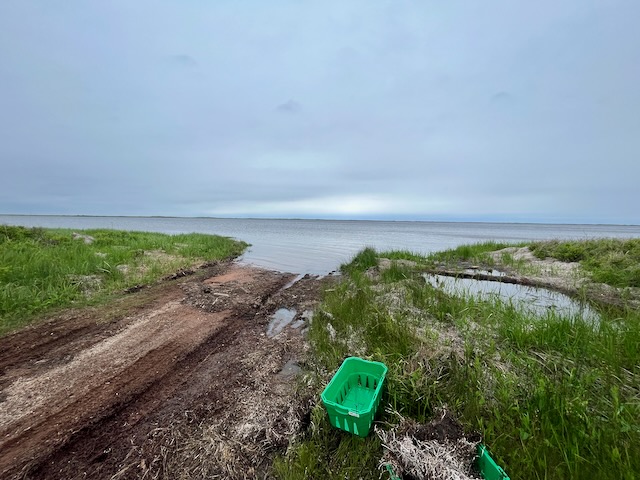
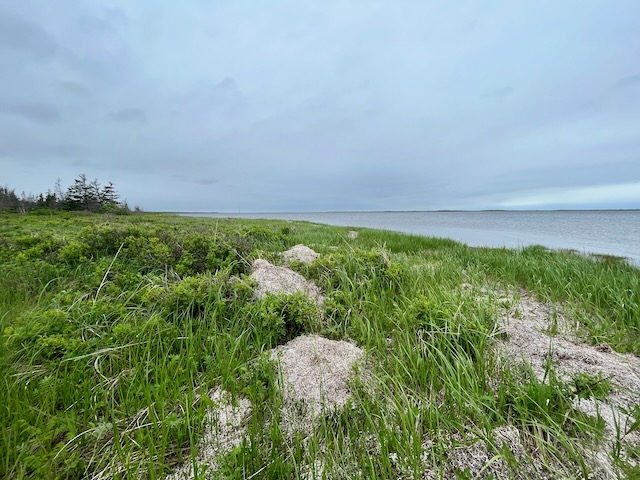
We drove down one of the many dirt roads that lead to the Conway Narrows, the body of water separating the mainland of PEI from the Conway Sandhills. I have written many times about the Sandhills, and my mother’s connection to them as possibly one of the last people to have lived there when, as a child in the 1920s and 30s, she spent every summer with her grandparents at their lobster cannery at Hardy’s Channel.
There are not many remote, wild places on PEI, but this is one of them. It is rare to see another human, except maybe an oyster fisher in a boat. During spring and fall migration it is common to see large flocks of geese and ducks as they move north or south.
I had forgotten to bring buckets with me, so I grabbed two grocery bins from my trunk and quickly filled them with the dried grass that a high tide had helpfully deposited on some wild rose bushes, so it had been well rinsed in the rain and then dried well in the sun and wind.
The quiet and calm of this place, the undulating dunes on the horizon, the absence of motorized anything, is a portal to another time. I was there at high tide, which prevents a walk as the beach is completely submerged, but at low tide you can walk a long way and see cranberry bogs and peatmoss hanging off the low bank, seabirds and shells and all sorts of treasures.
It is possible, in a couple of places, to walk through the water over to the Sandhills at low tide, but you really need to be aware of the weather and tides to do so, and it isn’t recommended unless you know what your doing. I’ve actually only done it once – we always boated over when I was a child – and it was a bit too wild, even for me!
There was no time for wading or strolling anyway as my mother wanted to go see “Jimmy Mick’s place” while we were out that way. Jimmy MacDonald was a customer of my parent’s, a veteran of the First World War, long gone now. The electricity lines end at the intersection of the Luke and Murray Roads, and you keep following the later road, which is only really one lane at that point, to a turn the bend and there is Jimmy’s old house. It is in remarkably good shape for something that hasn’t been lived full-time in for decades, the roof line still straight, windows and doors intact. Someone has kept the grass cut around it. With the over-inflated PEI real estate market, even this ancient abode could now likely fetch more money than Jimmy ever made in his entire life.
We used to go out to Jimmy’s place to pick blueberries in the shrubby fields. The fields are all woodland now, and I doubt you could pick a cup of blueberries where once people could fill buckets. One of my mother’s great loves was picking wild berries, spending hours each summer gathering strawberries, raspberries and blueberries. I did not inherit the love of berry picking, and would dutifully accompany her and various great aunts when I was a child, but would only pick for a few minutes before wandering off to explore or head back to the car to read.
Our visit to the land of Jimmy Mick complete, we headed back home. The roads out there in the Black Banks (the blackness because of deposits of dark peat moss) are narrow and muddy in a few spots, and in a couple of swales I closed my eyes and gunned the car to get through, my mother and I laughing each time, well aware we could get stuck and relieved when we didn’t. We turned onto the Luke Road, a much better-kept route, but still narrow and muddy in places. We soon reached the pavement and drove in modern comfort the kilometer or so to our house.
You can still see a few older houses in our area ”banked” with dried eelgrass each fall. People collect truckloads of it and put it around the outside of the bottom of their house to keep out cold drafts in the winter, using stakes to keep it in place. Eelgrass was also used as insulation inside house walls a long time ago, which wasn’t really that effective, but better than nothing. My mother used to sleep on a straw tick mattress at the lobster cannery, and I bet you could throw some dry eelgrass in there, too, if it your mattress flattened and needed some bulk.
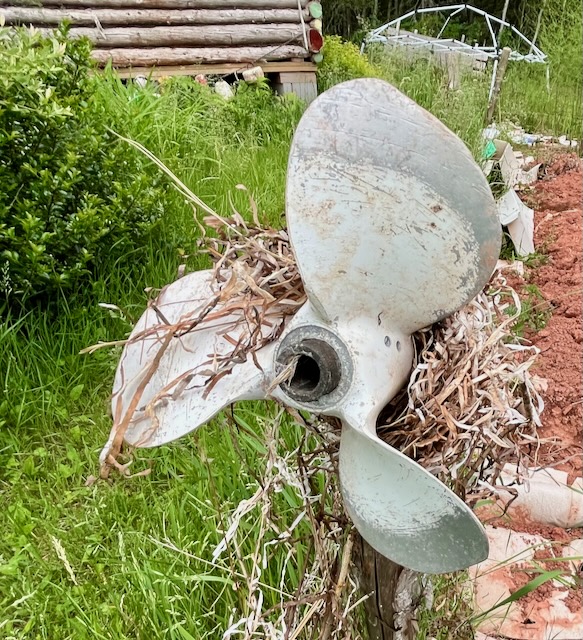
I remember learning to operate a dory with an outboard motor when I was about 8 and the feeling of the motor bogging down when I would steer into a shallow area and eelgrass wrapped around the propeller. I’d have to stop the boat, tip the motor up slightly, and then run it in reverse to clear the blades to continue on my way.
Reenactment of propeller-stopping eel grass.
And yes, eelgrass is long and slithery like an eel, but there are also eels in eelgrass. When you learn to swim in a muddy-bottomed river, as I did, you get used to the silky feel of eelgrass brushing your legs as you move through it, and you sometimes feel an eel rush by, too, if you set your feet down in the wrong place. People who learned to swim in concrete pools or oceans usually find the river swimming experience unpleasant because of these encounters, and it probably is.
Lobsters live in eelgrass, too, and I would sometimes come face to face with them when I played Jacques Cousteau in the river as a child, each of us surprised to see the other, and both retreating in opposite directions. I never caught a lobster, as that’s both illegal without a license and pretty tricky with bare hands, but it was always fun to see them.
Eelgrass is under threat in some areas of the world, which is astonishing to me as it is such a ubiquitous part of my seascape, lots of it in the water just steps from our house. I will gather it as long as I can.