Tag Archives: Charlottetown Guardian

Cosmic Filing Cabinet

I had the pleasure of attending a presentation this morning on the progress of a written history of the village of Tyne Valley. My friend Carolyn McKillop, who grew up in Tyne Valley, has been doing research for years, and has amassed a jaw-dropping collection of photographs and information. It was a nerdy delight to see her incredibly well-organized records. 

She has joined forces with Gary MacDougall, another Tyne Valley native and former editor of The Guardian, Charlottetown’s daily newspaper. The meeting was as well organized as Carolyn’s research, and both of them gave an excellent overview on what they have accomplished.

Item Five on the agenda, “Dreaming of time”, had Gary’s name next to it. He said he had been thinking a lot about time recently, perhaps because he is getting older. He admitted what he was going to say might sound a bit “out there”, but he went on anyway, as he was amongst family and friends, and said he feels that the people and events from the past are still here with us somehow. He called it the Cosmic Filing Cabinet, how the memories and events of the past are just filed away, waiting there for us to discover them. In the midst of a meeting of the practicalities of creating a community history, he offered a short, beautifully poetic aside about trying to understand his place in time. 

Now, Gary is my second cousin, so perhaps there is some genetic resonance at play here, but I’ve also been thinking about time a lot as well, and in a similar way. I find myself time travelling, almost forgetting that those I love who are no longer physically here actually are. I’m not seeing ghosts, nor am I lost or having delusions (I hope!). Time is bending, and I find myself pulled from it, suspended and observing it, and then dropping back down into the stream of time.

It started one winter night a couple of years ago while I was driving home from another meeting in Tyne Valley, as it happens. Warm light was glowing through house windows, and it struck me that the light I was seeing was more or less the same kind of light I would have seen 50 years ago when I was a child being driven along the same road. The houses had memories, were doing the same things as they always had, looked the same way. Different people inside, in most cases, but that wasn’t evident from the road. It could be 50 years ago, it could be now, it could be 75 years in the future. Time didn’t matter.

I passed a house that had belonged to one of my great-uncles and pictured him sitting inside it watching television. I passed the store and house that had belonged to my parents and could see them in both, quick flashes of them as young people. Then our immediate neighbours doing their evening chores in their barns and kitchens. There were no figures in the windows, but the light was timeless and transported me away.

If I’m feeling out of sorts, discouraged or overwhelmed, I have learned to open what I guess I’ll have to start calling my Cosmic Filing Cabinet and pull out a good, warm memory. I can put myself back in my childhood bedroom, all Barbie pink and filled with stuffed toys, my ginger cat asleep at the foot of my bed, listening to adults murmuring and laughing in the living room after a dinner party. I know where every light switch is in that house, what was in every drawer, how the basement smelled, what could be seen from every window. I can go back and be there and find the security and comfort I was so fortunate to have as a child, no worries or concerns.

As Gary said, a human lifetime is but a blip in the history of the universe, but it matters. We are creatures who are bedevilled by the knowledge that our time is limited, but who look for meaning in spite of that knowledge. We just need the key for that filing cabinet.

Freeland Presbyterian Church, December 24, 2021. Generations of my family have worshipped here, their prayers and songs clinging to the fine polished wood interior.

Sesqui

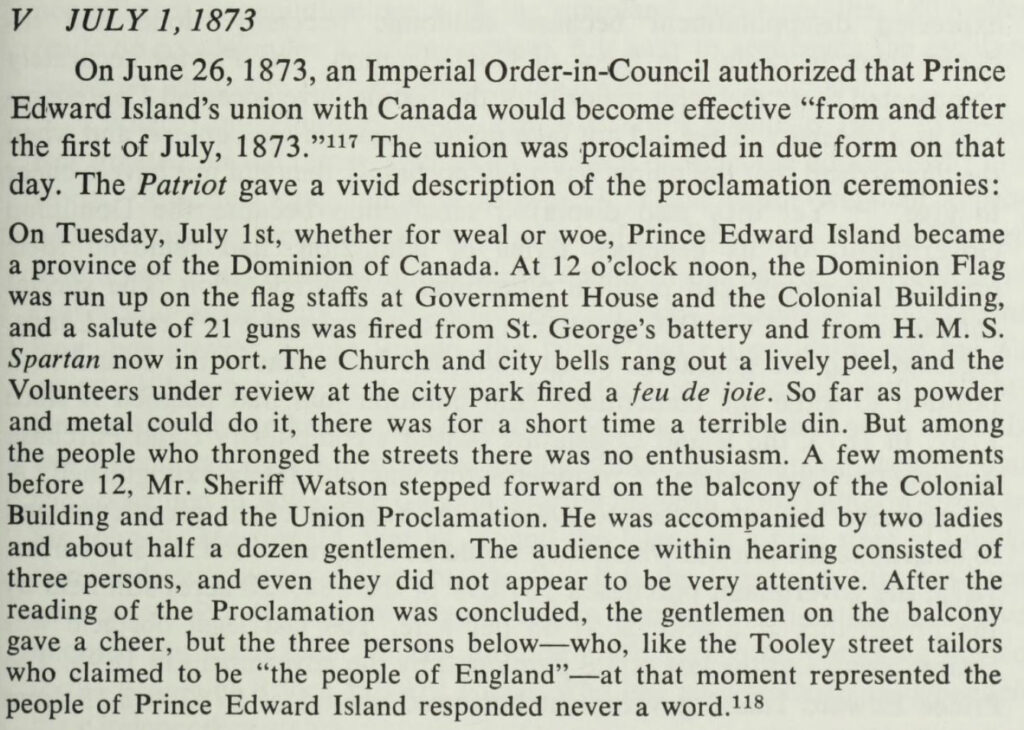
Noon today marks 150 years since Prince Edward Island joined Canada in 1873. After the overblown celebrations in 2014 to mark the 150th anniversary of the Charlottetown Conference, with the Island drenched in (coincidently?) Liberal red, I had expected something big for this year, but other than a couple of pieces on CBC Radio, this milestone hasn’t been mentioned at all. In today’s Guardian there are ads from politicians wishing everyone a happy Canada Day, but not one word about our wedding to Canada.

I suppose that’s as it should be, a tradition started by the lackluster response to the whole event at the time:

From Canada’s Smallest Province: A History of Prince Edward Island edited by Fr. Francis W. P. Bolger, 1991 p.229

At it happens, the car ferry service that connects the eastern end of the Island to Nova Scotia resumes service today after having been completely shut down for a week due to a mechanical failure. The service had been expected to be out for almost a month, but a part was found and the boat expected to cross back and forth again, bringing relief to businesses and travelers alike. PEI joined Canada partly to ensure good transportation by train and boat, so having the ferry back might actually be the most apt symbol for the day.

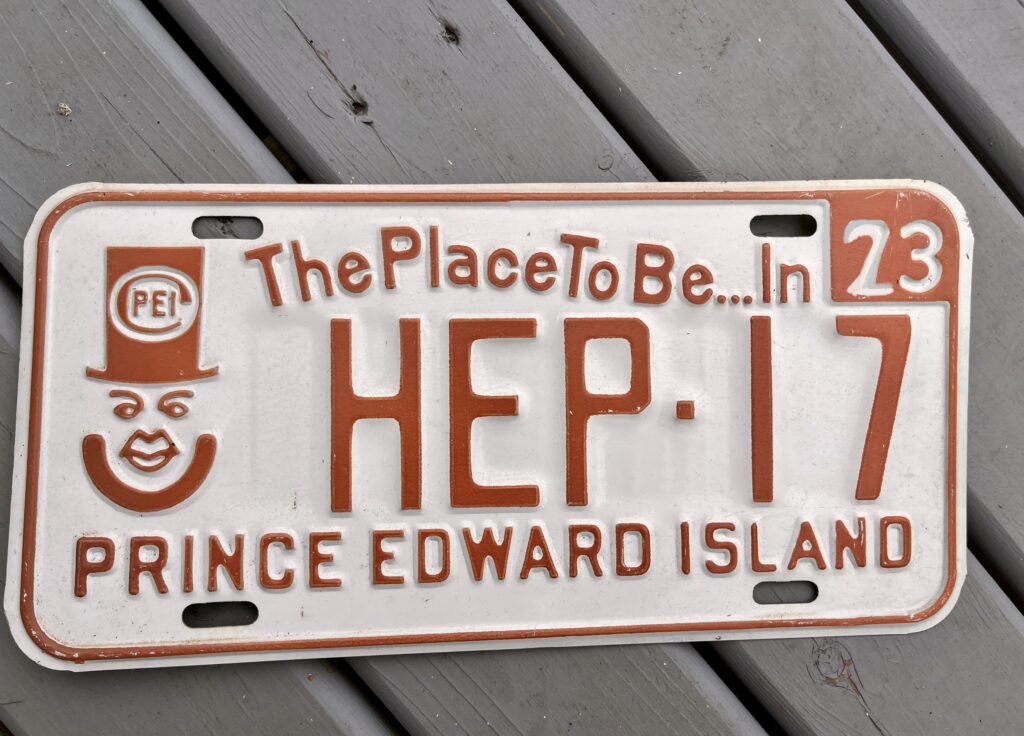
A 1973 license plate digitally altered for the sesquicentennial!

Monumental

Yesterday I finally caught up on my scrapbooks after having fallen behind during the pandemic. These are not the tasteful, fancy, currated scrapbooks of this century, but the newsprint and pot-of-glue ones from the last. It’s a habit I inherited from my mother, and from older neighbours, especially the man who lived across the road from us who had a beautiful, matching set of meticulously maintained scrapbooks that contained newspaper clippings of interest about his family and our community.

What do I save? Newspaper clippings, of course. Obituaries. Ticket stubs. Funny cartoons. Notes. Shopping lists. Articles about friends and family. Bits and pieces of paper I find shoved in books or the bottom of a box. I have a set of scrapbooks about Stewart Memorial Hospital that I started when I joined the hospital auxiliary in 2003; this series will soon be completed as the hospital was closed nearly 10 years ago and the building slated for demolition. I will turn the page.

I also find and save bits and pieces online I mean to write about here, but then digitally tuck away and forget about. Here’s one I just found about a monument to an agricultural pest:

From the Guardian December 28, 1921, page 3

I wrote here recently that I don’t have many regrets in life, but that’s not to say that I wouldn’t do some things differently if I had the chance. I guess what I really mean is that I’m fine with the way things have turned out in life. Peaceful. Grateful.

I also know there is no guarantee that making different choices would have meant my life would have turned out to be better, so looking back with curiosity rather than condemnation is probably for the best.

Oprah Winfrey popularized gratitude journals, which were heartily adopted by millions of her fans and ridiculed by those who saw it as just more New-Age fluff. The thing that Winfrey knew is that finding something to be grateful for each day is like anything else you practice or adopt as a good habit: if you do it when it’s easy, you will likely be able to do it when it is difficult.

Could I build a monument out of “profound appreciation” to my disasters and failures? Probably not immediately after they happened, as the citizens of Enterprise, Alabama did, but in a way I have, by becoming resilient, adaptable and even occasionally fearless. Things knocked me off whatever course I thought I had set for myself, but I righted and sailed on to arrive here, and here is good.

History doesn’t repeat, but it often rhymes

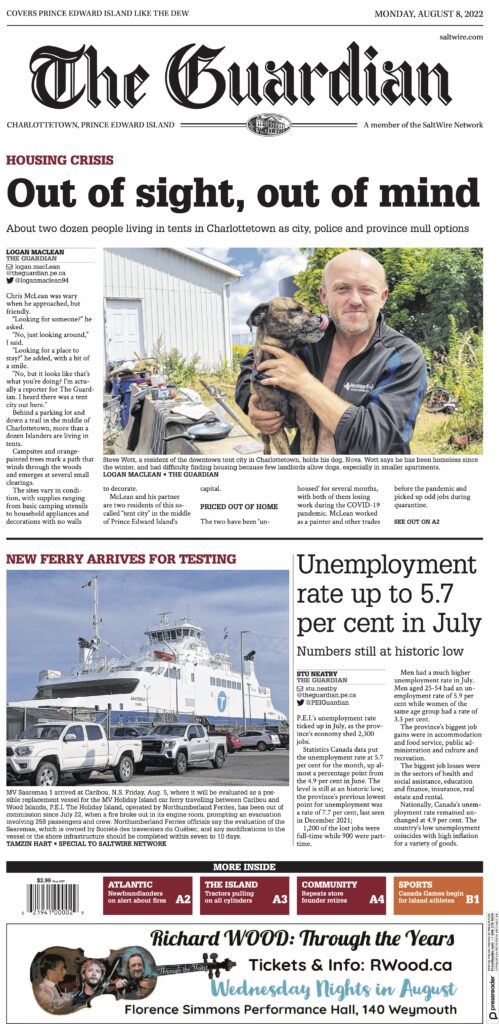
On the front page of this morning’s newspaper was a story about a new ferry arriving to fill in for the MV Holiday Island, which will be out of service for an indefinite period of time following an engine room fire a couple of weeks ago.

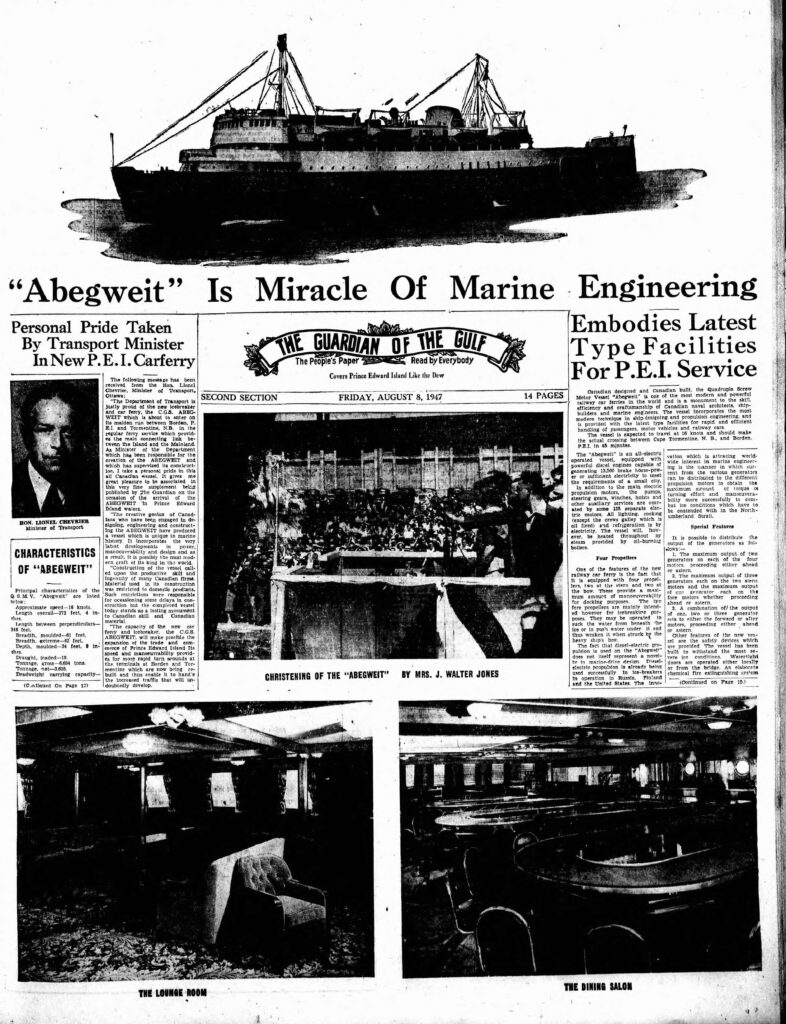
And here’s the front page of the same publication 75 years ago to the day, what looks to be a special section celebrating the arrival of the new MV Abegweit ferry, a vessel so mythologized and beloved by Islanders that a set of doors from the ship currently feature in an exhibition about the PEI tourism trade at the Confederation Centre of the Arts in Charlottetown.

When I was a child, the Holiday Island and sister ship, MV Vacationland, were sometimes referred to as the “hot dog boats” because the Abegweit (almost always just called The Abby) had a lovely dining room, while the two smaller summer-only ships only had snack bars and were not as luxuriously equipped. Everyone wanted to catch The Abby!

Too Speedy

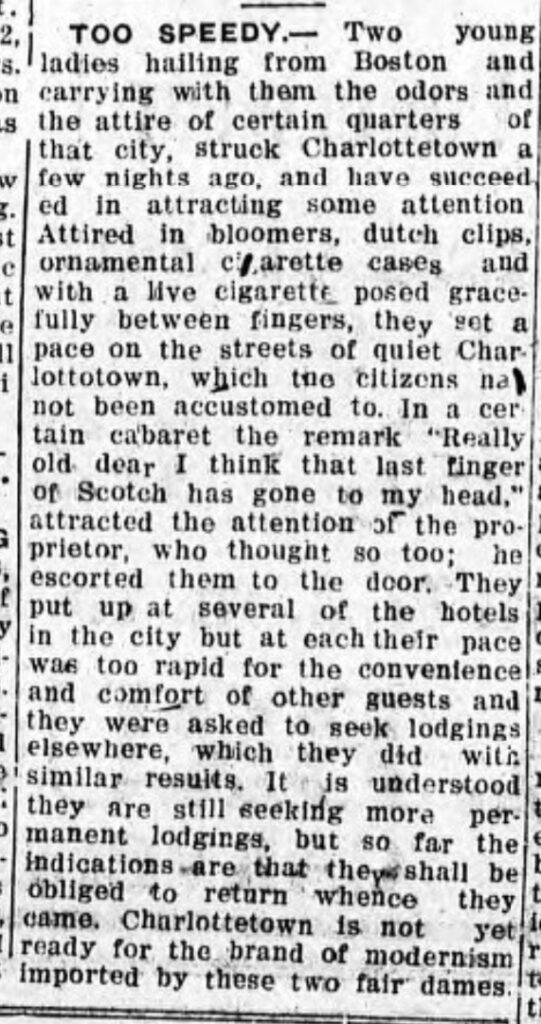
I started to read this piece from the August 3, 1922 Charlottetown Guardian thinking it would be one of many that tut-tut about young fellows racing automobiles through city streets and being a general menace, but this tale of two gals from Boston is about a different procession entirely. The tut-tutting from the city’s great and good about these two racy ladies would have been more deafening than any automobile.

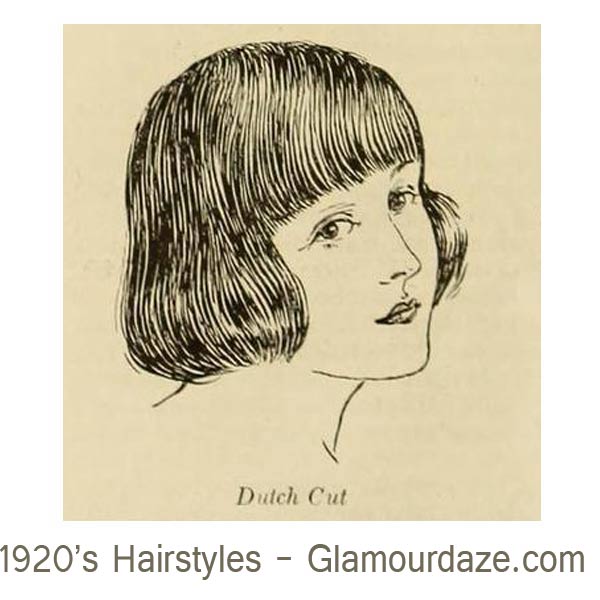
I know basically nothing about fashion, current or historical, but I think the ”dutch clip” could be describing their short hair style, as in the illustration below, but let me know if I’m wrong. Flappers gonna flap, but not in Charlottetown.

More about the Dutch Boy cut here

Popular Milkman

Great Uncle George Harris gets a mention in the June 14, 1922 The Charlottetown Guardian. Nice to know he was well-liked, and not, as you might try to decode, a salesman for the Popular milk company, or from Popular. Pretty sure he worked for himself, milking the cows and bottling the milk.

His improved home still stands on the outskirts of Summerside, the barns that held his milk cows more or less intact. That end of town is still farmland, but not for long, as businesses continue to move to the north end.

My mother stayed at George and Carrie’s house on her way to enlist in the RCAF 79 years ago (Carrie was the youngest sister of my great-grandmother, Eva Hardy). George drove my mother from his house to the Summerside train station in his horse and milk delivery wagon, where she caught the train to Moncton and then on to do her basic training in Ottawa.

Also in today’s 100-year-old paper was the obituary of my friend’s great grandmother. I knew more people in the antique edition that in the one published today!

Mrs. McKenna died just a few weeks after her son, Philip, was killed working on the railway near his home in Conway, PEI.

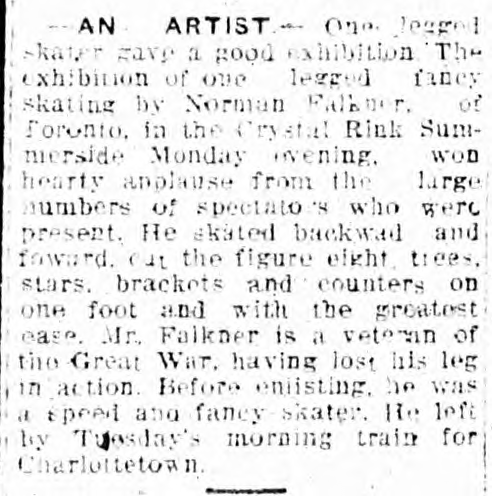
Norman Falkner, Fancy Skater

Charlottetown Guardian February 23, 1922 page 6

Thanks to the Skate Guard blog for filling in the blanks about Norman Falker, who entertained the good people of Summerside 100 years ago this week. He lost his leg fighting at Vimy in the First World War, survived a harrowing trip back to Canada, and went on to have a career as a professional skater and skating judge, living into his nineties.

Blanka and Anna

These two happy faces just caught my eye on the bottom of page 8 of the January 8, 1947 Charlottetown Guardian:

What happened to Blanka and Anna after this photo was taken? Did they ever know they were in the newspaper? Did they settle in Chicago? Where was Mr. Zwern?

In 1947 I would have just had to wonder about these two and move on, but in 2022 I can quickly fast forward this story:

  • Anna Zwern became Annie Birnbaum and donated family papers to the United States Holocaust Museum in 2019, including a clipping of this very same photo.
  • Blanka became known as Blanche and gave her testimony as a Holocaust survivor to the USC Shoah Foundation in 1996.
  • Blanche lived to be 89 and died in 2011, leaving behind Annie and her two siblings, her grandchildren and great-grandchildren. Blanche’s husband of 50 years, Simon, predeceased her.

Born to a respected Jewish family in Krakow, Poland in 1922, she outwitted Nazi roundups through unflinching courage, intelligence, cunning and agility. Married to concentration camp survivor Simon shortly after the war, they immigrated to America with an infant daughter. Hope and love allowed her to leave her hatred and anger behind and begin to create a new life. She lived and taught deep wisdom to all around her, saying “as long as you have life, you have hope” and “to find happiness, take whatever hand you are dealt and make the best of it.” She turned her devastating hand into a beautiful, productive and love-filled family.

Obituary of Blanche Zwern, published by Atlanta Journal-Constitution on November 28, 2011.


I’m glad I lingered for a few minutes with Blanka and Anna, if only to be reminded that hope is what propels us forward, and love can make all things possible.

2021 is the new 1946

It didn’t say what they did at the Georgetown PO to keep the mail-seeking crowds away, but a polio outbreak meant strict public heath measures were in place across PEI 75 years ago. Vaccination has nearly eradicated polio worldwide, but there are still a few cases every year in Afghanistan and Pakistan.

I had a great-uncle who had polio, which left him with with he called a “crooked foot” and unable to do many things. He would have an interesting perspective on COVID-19 anti-vaccination protests.

Charlottetown Guardian September 12, 1946

Fanny Brice in Charlottetown? Hmm…

The Charlottetown Guardian from August 7, 1946 contained this little item:

To my generation, Fanny Brice was just the character played by Barbra Streisand in Funny Girl, but she had been a Big Deal in American entertainment in the first half of the 1900s. According to Wikipedia, Fanny was married three times, all ending in divorce. Her third marriage was to Billy Rose, and that divorce came in 1938.

So, the gal in this news item was either Fanny Brice pretending to be “Sadie, Sadie married lady,” or some Boston lady pretending to be Fanny Brice. Hilarious either way.