Tag Archives: Charlottetown Guardian

Silly Rumor

I had always assumed the abdication crisis of 1936 was first set in motion when the Prince of Wales, later Edward VIII, met Wallis Simpson in 1931, but it seems David Windsor might have been finding the prospect of leading the British Empire too daunting a task as far back as 1924, if this gossipy bit from the November 6, 1924 Charlottetown Guardian is any indication.


Silly Rumor About Prince of Wales
LONDON, Nov. 6.- The Prince of Wales may possibly renounce his right to the throne of England. This rumor kept the Prince eager company during his trip from America on the liner Olympic last week and greeted him as it was whispered through the crowds when he arrived at Southampton, home again after his vacation.
This rumor set the whole boat buzzing before the voyage was half way done. The Prince himself scoffed at it. But one of his aides went to the trouble of issuing official denial.
Perhaps the circulation of the rumor was one reason for the extraordinary censorship on the Olympic. As soon as it was discovered that there were several newspapermen on board, orders were issued that every message must be ok’d both by the purser and Captain Lascelles, the Prince’s secretary. Very few messages passed this board of censorship, and any that did were limited to twenty words. During the voyage the prince danced chiefly with Mrs. H. P. Peabody of New York, and Miss Esme Magann, of Toronto, whom he met in Canada and who made the trip with her mother, Mrs. Plunkett Magann.


And who could blame him for wanting out? He’d had a lovely visit to North America, being feted and paraded everywhere he went. He visited his Alberta ranch to play cowboy for a bit, and generally seemed to have a “Wales” of a time golfing and dancing and looking dapper and rich. Why spoil all that fun with the boring ceremonial grind of being a constitutional monarch?

Charlottetown Guardian, November 6, 1924, page 5.

Crucial Cyrus Ching

Cyrus Ching, a renowned labour mediator in the United States, was born in Prince Edward Island, but I hadn’t heard of him before reading about him in the October 26, 1949 edition of the Charlottetown Guardian.

I am familiar with his dry wit, though, and I wonder if it came from his early PEI childhood, which sounded quite challenging. I’ve known a few farmers possessed of a dry wit, usually accompanied by the calm and goodnatured mien necessary to persevere in an occupation where you are constantly at the mercy of weather and fortune. I have benefited from being on a couple of community boards with some intelligent, dry-witted farmers, and have learned a lot from them about curbing my chatterbox tendencies and making few, brief comments after all the other chatterboxes have exhausted themselves. It is a powerful technique, and people listen.

Here’s the entire article (including, unfortunately, a bit of the casual racism of the time):

Dry Native Humor Of Islander Is Noted In Refereeing Labor Spats

Washington  D.C., Oct. 25 – One of the few reassuring sights in strike-tense Washington these days is a massive man with a shy grin and a huge pipe who lumbers in and out of the White House, the least mysterious participant to enter mysterious meetings.

If you were to point him out to a stranger and say, “That’s the man who is in the middle of one of the most crucial strikes in U.S. history,” the stranger wouldn’t believe you. Cyrus P. Ching, Director of the Federal Mediation and Conciliation Service, just doesn’t look like the “crucial” type.

Only clue to the tremendous responsibility which he has carried around for the last couple of years in the job, and which today is at peak-load, is a slight stooping of his huge frame and a minor hesitation in his step. Even stooped shoulders, however, don’t bring his six-foot, seven-inch frame down to the level of average men.

Few persons have the privilege of becoming legendary while they are still alive. Ching has that honor. There just seems to be a sort of legendary quality about the constant, semi-amused, yet quietly profound manner of the man.

Many Anecdotes

There’s almost no limit to the anecdotes involving his dry humor and the subtle devices he has used to get labor and management in a friendly mood. He calls these things “establishing better communications with people.”

Once he was having a particularly difficult time with a union man named Lee, during a tough negotiation. Lee was about to walk out when Ching said: “Maybe we’d better get out of this labor business altogether and start a little laundry.” After the moment it took for all present to catch the gag, there was a big guffaw which relaxed the tension and greased the way for a successful settlement. His favorite line to use on a negotiator who has his dander up is to ask him if he ever heard of “rule six” of the British Navy. That brings the question of what rule six is, and then Ching tells this story:

“During World War I U.S. Navy Secretary Josephus Daniels was visiting British Admiral Beatty. In their presence a captain started sounding off about how the war was being run. Beatty said to him in a sharp voice. ‘You are violating rule six of the British Navy.’ That shut him up and later Daniels asked Beatty what rule six was. Beatty replied, ‘Never take your self too damn seriously.'”

Nation’s Foremost Mediator

Ching is the nation’s No. 1 labor mediator for many more reasons than having a good collection of stories. He has had a key part in the most controversial piece of labor legislation in history, the Taft-Hartley Act, and after two years still has the confidence and friendship of both labor and management leaders.

Ching sums up his philosophy on labor relations in this way:

“Promoting proper labor relationships is nothing you can do overnight. It isn’t anything you can do by law. You can set up machinery to soften the blows of people not inclined to get along together. You can pad their gloves a little, and it may be necessary to have a referee to do that. But in the last analysis labor relations begin down in the bottom department of the plant between the foreman and employee.”

On his job as boss of the Conciliation Service he says:

“We cannot measure the efficiency of a conciliation service by the number of fires it extinguishes. We can measure it only by the machinery we build up to encourage people to settle their own disputes. In other words, the test of conciliation is how few disputes lead to strikes and how many disputes are settled directly by the parties, with whatever help we can supply. My job is to contribute to fire prevention.”

Born In P.E.I.

Ching knows the hard road of success. At 13 he took over management of the Prince Edward Island, Canada, farm on which he was born. After a stint of fur trading and commercial fishing following his farming, he went to a Canadian business school. Soon after graduation at 19, he took off for the big city of Boston. It has been written:

“All he had at the time, when he stepped off the train, was a gripsack, a copy of Bryce’s “The American Commonwealth,” which he had read at 14, and $31.”

First job was on the Boston Elevated Railway Co. Not too many years later he was assistant to the traction company’s president. He had studied law by that time and personnel matters were his specialty. Then labor relations became his sole endeavor and he wound up director of that activity for the U.S. Rubber, just before he came to Uncle Sam.

When people ask him about his Chinese-sounding name – which is Welsh – he replies: “I am three-quarters Scotch and one-quarter soda.”


The article notes that Cyrus had “a slight stooping of his huge frame and a minor hesitation in his step,” but the writer neglected to mention that Cyrus was 73 years old in 1949! According to his Wikpedia entry, he worked up until his death in 1967 at age 91. His Wikipedia entry links to a National Archives clip of Cyrus on an early US television program, and it’s worth a look to try to hear his Island roots in his speech.

Trifluvians

People from TroisRivières/Three Rivers, Quebec are known as Trifluviens/Trifluvians.

People from the recently-created municipality of Three Rivers, Prince Edward Island, are known as residents of Three Rivers.

I don’t think any of the three rivers (Cardigan, Brudenell and Montague) that make up Three Rivers count as fleuves rather than rivières, but it sure would be fun to add Trifluvians to our Island lingo. Let’s do it!

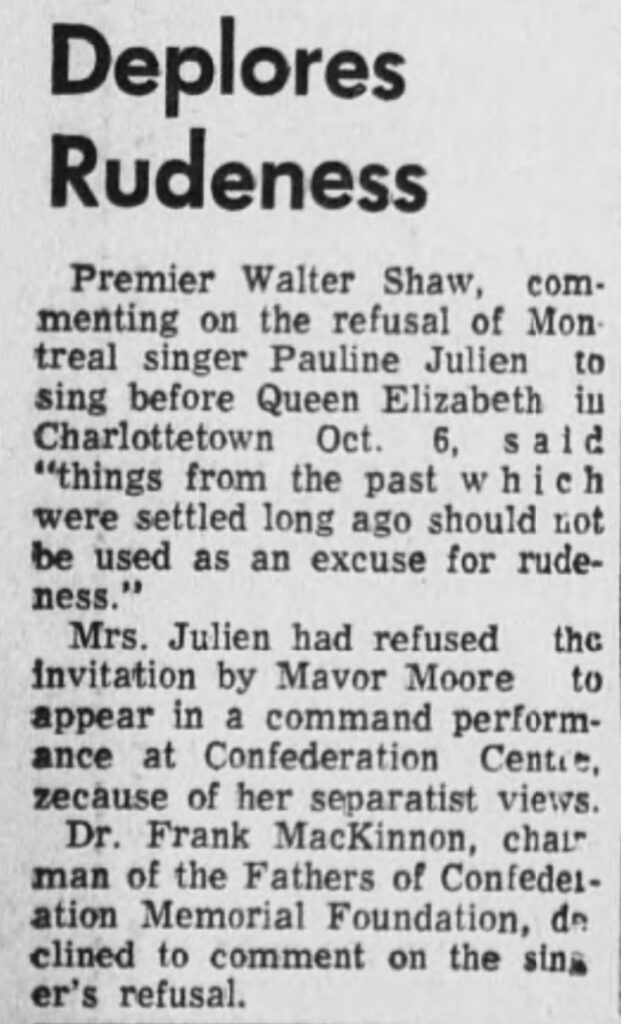
(I came to all this through a 1964 article about Quebec singer Pauline Julien declining an invitation to perform for Queen Elizabeth II during her visit to PEI in October 1964 to mark the centenary of the Charlottetown Conference. Julien’s Wikipedia entry notes she was born in TroisRivières and was “the companion of the poet and Québec provincial MLA Gérald Godin, another Trifluvian and sovereignist.” Julien and Godin were both arrested and held for eight days during the 1970 October Crisis, then released without charge. I don’t know if her refusal to sing for QEII had anything to do with her arrest under the War Measures Act, but I doubt it helped.)

The Guardian, September 21, 1964, page 2

Tremors

The Journal Pioneer is larger than The Guardian this morning, with a huge white border around each page. The Guardian is the same size as it was yesterday.

There have been a few drips of change here and there since Postmedia bought the Saltwire network in August. Yesterday the cartoons in The Guardian were in colour for the first time I can remember. The Saltwire branding has been almost completely removed from both papers.

Will Postmedia keep two papers on PEI? Only time will tell. I hope we didn’t witness the Journal supernova today.

Creel Flies to Paree

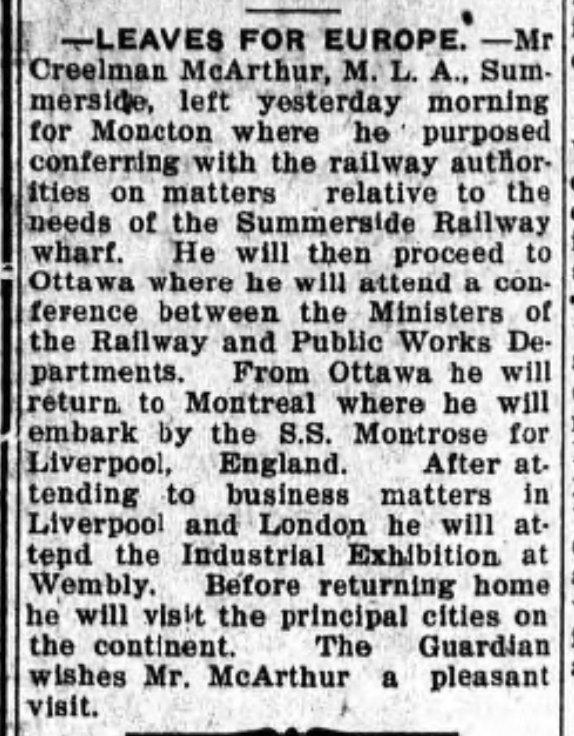
Creelman MacArthur built a vacation home in 1933, on the land where our house is located, when he was a member of the Canadian Senate. Before his time in Ottawa, he was a prominent Summerside businessman and a member of the provincial government.

In May of 1924, MLA MacArthur left on what seems to have been a business trip to Ottawa and then on to Europe.

Charlottetown Guardian, May 10, 1924

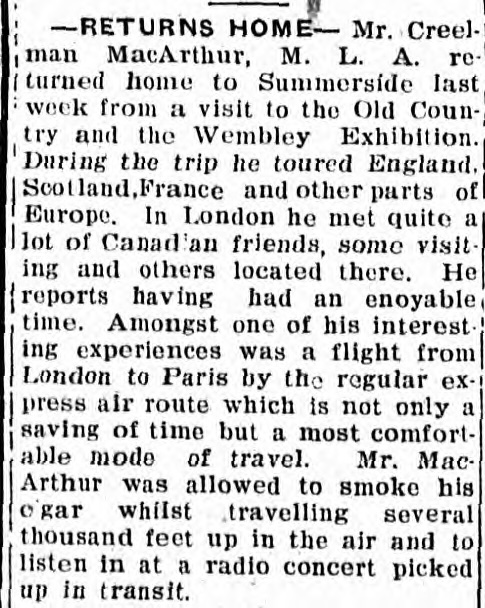
Of note is the flight he took from London to Paris. Commercial passenger air service between London and Paris started in 1919, according to a couple of sources I found. I’m fairly certain that there was no commercial passenger aviation in our part of the world at that time, so could old Creel have been the first Prince Edward Islander to take a commercial passenger flight? I’ll claim that for him and look forward to being proven wrong.

The image of him puffing away in a pokey plane cabin listening to a tinny BBC radio broadcast while looking down as the Dover cliffs give way to the English Channel is clear in my imagination. What a trip!

Charlottetown Guardian, July 15, 1924

—RETURNS HOME— Mr. Creelman MacArthur, M. L. A. returned home to Summerside last week from a visit to the Old Country and the Wembley Exhibition. During the trip he toured England. Scotland, France and other parts of Europe. In London he met quite a lot of Canadian friends, some visiting and others located there. He reports having had an enoyable time. Amongst one of his interesting experiences was a flight from London to Paris by the regular express air route which is not only a saving of time but a most comfortable mode of travel. Mr. MacArthur was allowed to smoke his cigar whilst travelling several thousand feet up in the air and to listen in at a radio concert picked up in transit.

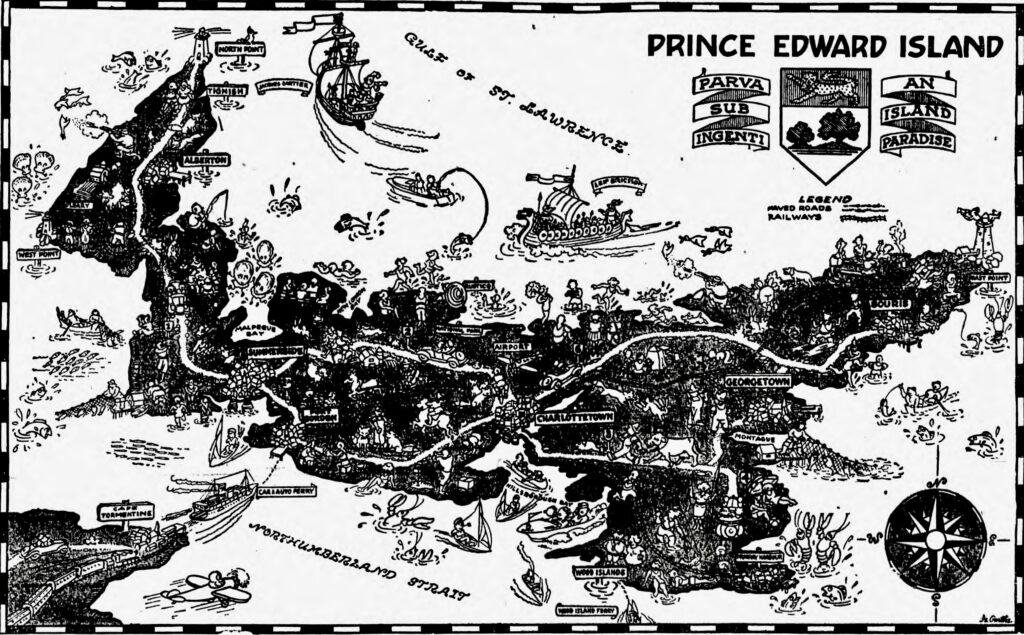
Tourism Insert August 1949

I am in love with this busy map from a special tourism section in the August 13, 1949 edition of the Charlottetown Guardian. It reminds me of picture books I had as a child, lots of busy vignettes, new details emerging with every viewing. And Vikings speeding towards PEI!

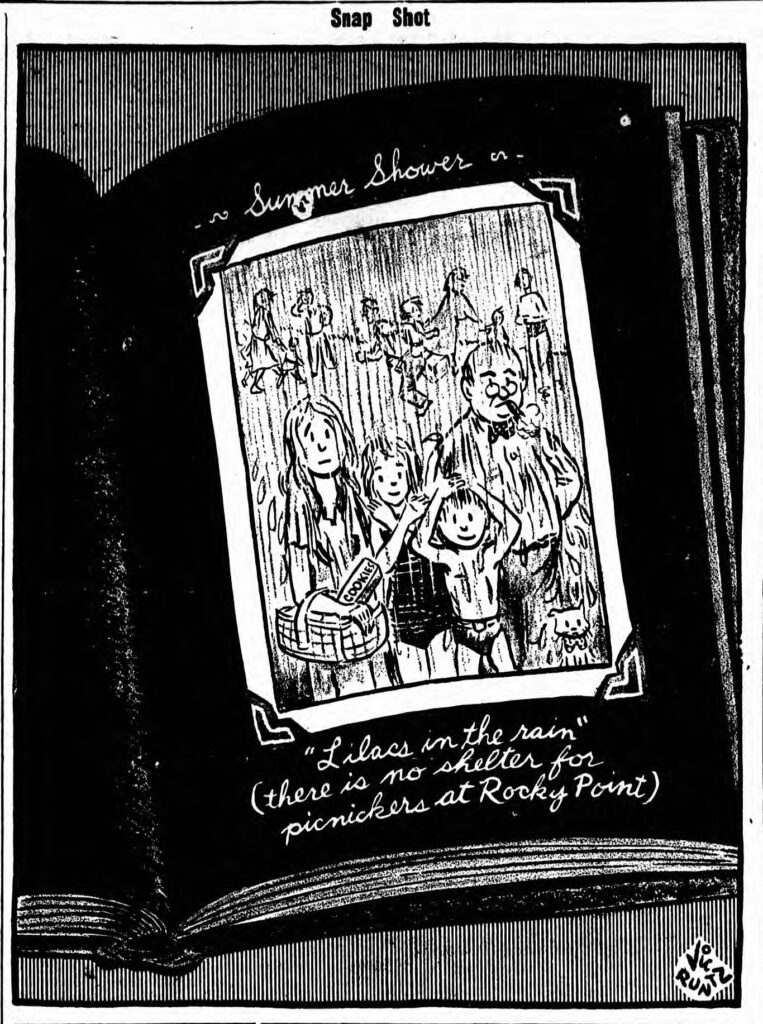
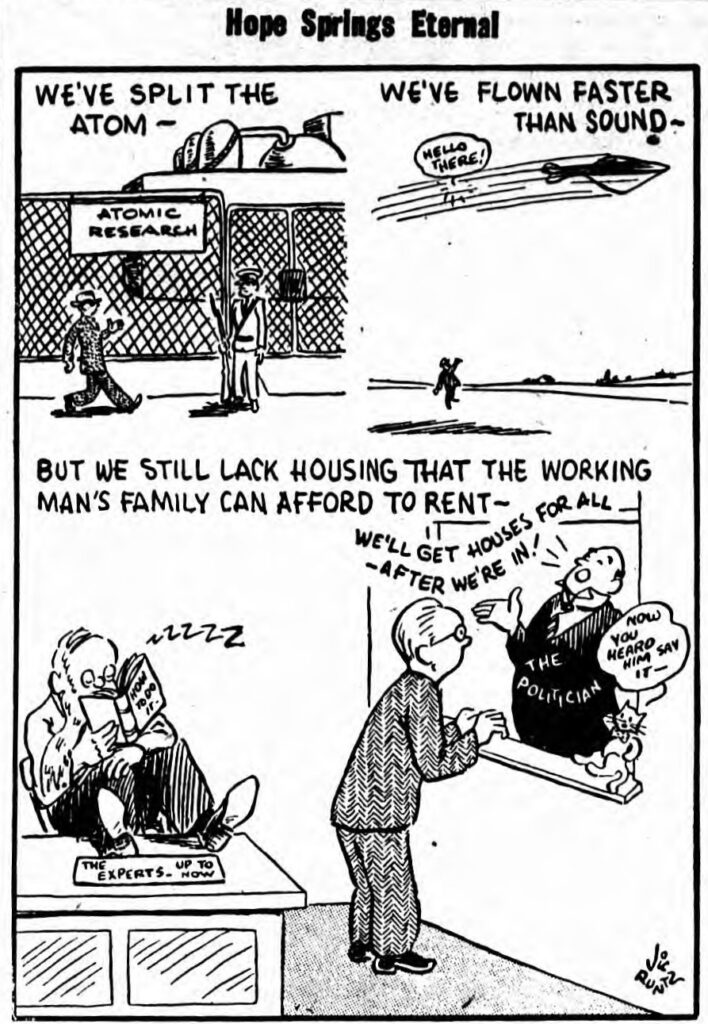
I can’t read the signature at the lower right, but it could be the work of the Guardian’s cartoonist at that time, Vic Runtz, who did sign some of the lovely drawings included in the rest of the special section. Catherine Hennessey wrote a beautiful tribute to him upon his death in 2001. He was a very fine editorial cartoonist and I hope his work has been or will be exhibited on PEI.

Vic Runtz editorial cartoon August 13, 1949 Charlottetown Guardian, including his signature cat wearing a bowtie, possibly to give some balance to the rah-rah tourism insert.
Vic Runtz editorial cartoon in the June 21,1949 Charlottetown Guardian reacting to promises being made in that year’s Canadian federal election, promises still being made (and broken) today.

Gus Peters in Hollywood

The news from the western end of the province in the Charlottetown Guardian from this date 75 years ago had an enticing and sparkly dose of Hollywood magic sprinkled over it.

Charlottetown Guardian – July 21, 1949, page 11

Thanks to the Internet Archive, I found the July 1949 issue of Modern Screen magazine and the adorable photo of Gus and Miss Stanwyck. I love that Stanwyck looks to be genuinely laughing, and Gus, then in his early sixties, seemed to be quite amused as well.

Modern Screen July 1949, page 47
Modern Screen July 1949 pages 46-47

I’ve snooped around a bit on Ancestry, the PEI Public Archives, and Libraries and Archives Canada to develop the following quick rough sketch of Gus Peters, friend to the stars:

Gus was born Augustus Morris Peters in Summerside sometime between 1886 and 1889, depending on the records. He signed up for service in the First World War on May 13, 1915 in Fredericton, NB, telling them that his birthday was May 28, 1887.

He was assigned to the 2nd Canadian Divisional Ammunition Column, regimental number 180, and was on the SS Caledonia on June 13, 1915 headed for England. Gus was knocked down by a horse in August 1915, broke his left wrist and spent 24 days in the hospital at Shorncliffe army camp.

He was sent to France on September 16, 1915, serving as part of the Second Division of the Canadian Expeditionary Force in England and France, and received his discharge in Halifax, NS on May 25, 1919.

When he signed up for service, he gave his trade as cowboy, and he also referred to himself as a rancher, not really a PEI kind of occupation to have. It seems he worked for a while in North Dakota, and his demob papers said he was headed to Hot Springs, Montana after the war.

At some point Gus moved to California and married Hattie Seligman, born in Missouri around 1886, on July 7, 1928 in Los Angeles, California.

According to the 1930 US Census records, Gus gave his birthplace as New York, for some reason, and reported that he was employed as a stage hand in moving picture. By the 1940 census, Hattie and Gus were living in a home they owned at 5431 Fulton Avenue, Van Nuys, a few minutes drive from the Paramount Studios lot where the photo with Stanwyck was likely taken.

In the 1950 census, he gave his age as 63 and said he was still working as a stage grip at a film studio. As could likely be expected in a company town like LA, also on his census sheet were silent movie actor George Burton and Citizen Kane art director Perry Ferguson.

Gus died October 16, 1957, possibly after being hit by a car, and was buried at San Fernando Mission Cemetery in LA, his obituary giving his age as 71.

I had a hunch, and Ancestry confirmed it, that Gus was the uncle of my cousin’s husband (because of course he was), and his relatives still live in the Summerside area.

Retail Humour 1964

My parents’ grocery store was part of the Lucky Dollar brand. They were independent owners but benefited by being able to purchase stock through the Lucky Dollar centralized system, giving them more favourable wholesale prices, and being included in the Lucky Dollar advertising, which was mostly limited to a large one or two page ad in the local papers that showed the weekly specials.

My mother or father would tear that ad out from the paper and it would hang over their cash register so they could refer to it as they rang up customer orders.

Here’s one they probably didn’t bother to put over the register, although they might well have stuck it up somewhere else in the store so people could get a chuckle. The regular Lucky Dollar ads were usually pretty dry, so this is zany stuff!

Charlottetown Guardian March 31, 1964

Memory fails

When did people start carrying cups of coffee around with them all the time? I can’t remember, though I know it happened in my lifetime. It certainly wasn’t something my parents did. I started drinking coffee in my early twenties, so in the late-1980s, but don’t remember walking around carrying a coffee cup everywhere, and never really got in the habit of doing so.

I’ve thought about this a lot: when did we go from being people who drank coffee at home, and in coffee shops or restaurants, to people who move through the world tethered to coffee shops like Tarzan swung through the jungle, swinging from shop to shop? Visiting Tim Horton’s has become a quasi-religious act in Canada, the doughnut and double-double the Eucharist. Father, son and honey crueller. If you don’t drink Timmie’s and watch hockey, are you really Canadian?

In the “Things Have Change But I Can’t Remember When” category is the impression I have that the Christmas season starts earlier and earlier each year. I think that when I was a child, people were sensible and talk of Christmas only started on December 1, but I realise that’s probably a false memory, or wishful thinking that we could revert to living only in the season we are in: enjoying the present, not anticipating the presents!

Proof of my false memory is found in an October 15, 1948 ad heralding the opening of Toy Town at the Summerside department store, Smallman’s. They couldn’t resist sticking Santa on there, his happy grin silently but powerfully sanctioning the quality of the store’s offerings.

Smallman’s was still in business when I was a child. We shopped mostly at their larger rival, Holman’s, just down Water Street, but sometimes we ventured into Smallman’s for sales or to visit their lunch counter. My father had worked in their warehouse before the Second World War when it was called Sinclair and Stewarts, so he especially liked going back.

Their main floor was one huge room, with office windows overlooking the sales floor. When you wanted to purchase something, a handwritten bill of sale was created, you gave the sales clerk your money, and a copy of the bill, along with your cash, was put into a small box that was put on a little railway-type system that took the money up to the cash office. Any change required was put back into the box, along with a receipt marked paid, and it clattered back down to the clerk. The fun of watching the little boxes zipping up pillars and along the ceiling was endlessly fascinating, really the best part of going there.

And when did that little railway stop?