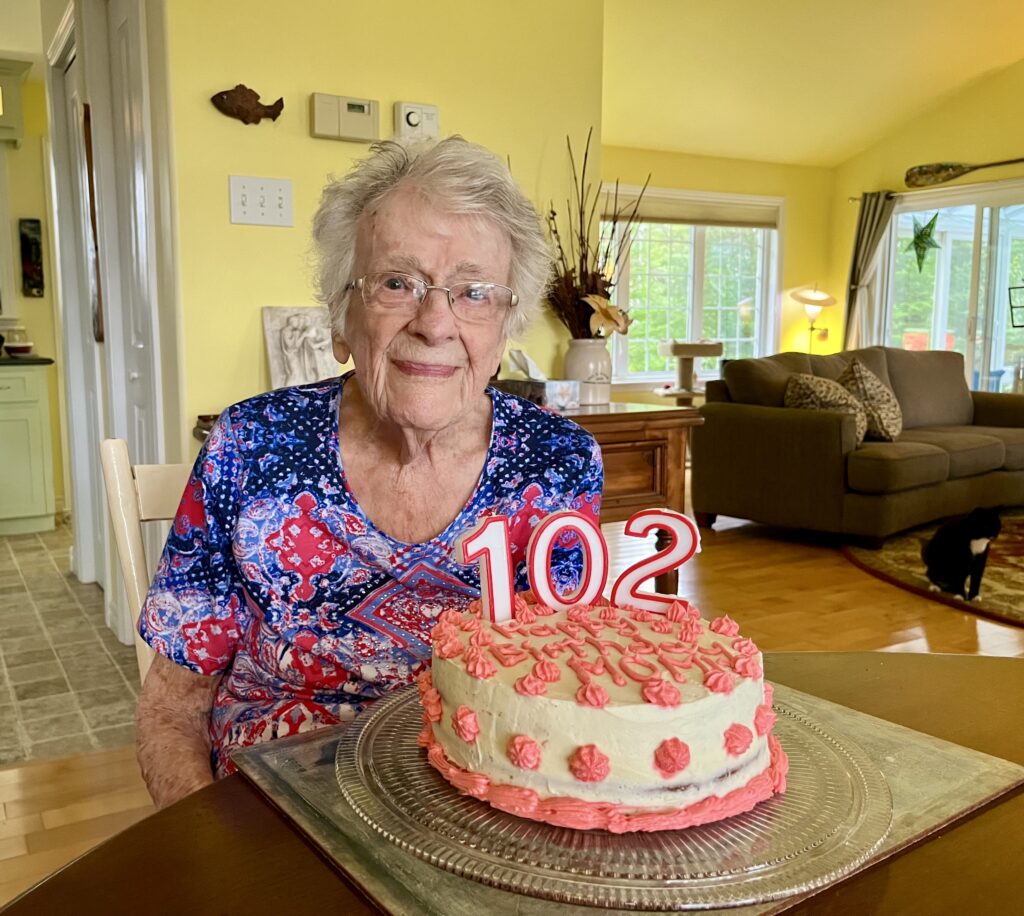
My mother, Vivian, turned 102 today. She is still very much as she has always been: disciplined, cheerful, engaged, inquisitive, generous. She lives in an apartment attached to our house, and gets herself up, makes her bed, gets dressed, and makes her own breakfast and lunch. She reads daily and weekly newspapers, cooks a little, does daily devotional readings, bakes a little, and knits a lot, giving the output of both her baking and knitting away.
If asked, she will tell you that she has lived as long as she has because she never drank, she never smoked, and she worked hard, which is all true. She also maintained strong social networks, became involved in her community, thought of others, and adapted well to change.
She is tired, though, and not sure why she is still alive, but makes the best of it and trusts that God has a plan for her. She noticed yesterday that the heliopsis outside her window turn to face the rising sun in the east and by the end of the day are facing west. She delights when the birds and butterflies pass by, notes the colour and movement of the clouds, watches the oyster fishermen speed off to their leases and arrive home for lunch. I learn something new from her every day, and helping her through this phase of her life has been rich and rewarding most of the time, frightening and exhausting some of the time, but always interesting. Towards 103.
On one of my first jaunts as I was learning to ride and getting ready to go for my motorcycle licence in 2006, I met a couple of motorcycles. As they passed, they put their left hands out and down, index and middle finger pointing outwards in a sort of casual peace sign. I hadn’t heard of the motorcycle wave, so wasn’t ready to respond, and they whizzed by without any acknowledgement from me. They were on chonky Honda Gold Wings and I was on my teeny, slow 49cc Yamaha scooter, so I just barely counted as a biker, but I had suddenly joined a club I hadn’t known existed.
The next time I met a motorcycle, I was ready and stuck my gloved hand out, receiving the low-rider’s salute in return. I was tickled to be considered a biker, even by someone with scary looking patches on their jacket!
I drove my scooter every fine day there wasn’t snow on the ground for four years while I worked at my neighbour’s dairy farm. After milking cows on a hot, humid summer evening, there was nothing nicer than peeling off my smelly overalls and rubber boots and scooting home, the wind cooling me off immediately, my sweaty t-shirt billowing from my back.
My scooter is gone, one of the many things I have put aside, for now, as a full-time caregiver (and it had a filthy 2-stroke engine, so it really wasn’t an environmentally responsible mode of transportation no matter how little gas it used). I can’t afford to dump a scooter and end up with an injury, because my mother needs me to be well and fully functioning. I’ve never been a reckless kind of person, so my risk aversion is not a new thing, but I’m now incredibly careful on stairs and ladders, on ice, on wet surfaces.
Early this morning I had the occasion to take another slow drive, 20 minutes down the road, on my little Kubota tractor, to help a friend with a landscaping project. There’s no speedometer on my tractor, so I’m not sure how fast I was going, but it’s certainly not a zippy rig. I enjoyed the slow ride, even with the diesel fumes (I will be glad to someday trade in for an electric tractor).
Neighbours waved from their yards as I passed, as did people in cars and other tractors. The smell of the briny Foxley River gave way to the pong of freshly-spread manure, then further along came the odour of sweet silage that had just been cut. White phlox that had long ago escaped from a flower garden nodded at me from a ditch, their strong lilac scent overwhelming the diesel, and that’s quite a feat.
I crossed from Foxley River to the next community, Freeland, where my mother was born and raised, where my parents had a store with our house next to it, the community where seven generations (and counting) of our family have lived. As I reached our old store, our former neighbour was out for her morning walk, and she laughed when I told her where I was headed and what my plans were. I passed the yard where my great-grandparent’s house had stood for over 125 years until it was torn down last fall. My cousin is going to have a big barn built there to hold his fishing gear. The grass is growing well over the old house site, and they have planted fruit trees in memory of our ancestors.
A couple of hours of digging and levelling and the uprooting of a couple of rotten stumps (one with a wasp nest – yikes!) and I was tootling home again. Next to the Anglican cemetery where my namesake grandmother Thelma (Hutchinson) Hardy has rested since 1927, nestled next to many other relatives, I admired the bumper crop of choke cherries growing on the side of the road in this extraordinarily good growing year.
Choke cherries
I stopped to take a photo of one of my favourite trees, a round white birch on the edge of a field, with a couple of ancient linden trees far in the background that were said to have been grown from cuttings brought from Ireland in the 1830s.
The solitary white
I’ve made so many trips along this road in my 57 years, in every kind of conveyance: car, truck, tractor, horse and sleigh, bicycle, scooter, snowmobile, school bus. I still see something new on each trip, especially a slow one. I was content and calm and exactly where I was supposed to be, moving slowly and part of everything I saw.
Our house is hidden far in the woods on the far side of Foxley River.
Don’t care about the alternative facts in the MSM: Ed Begley Jr. time travelled from the 1980s to perform in the Island Fringe Festival this year, so help me St. Eligius.
The news from the western end of the province in the Charlottetown Guardian from this date 75 years ago had an enticing and sparkly dose of Hollywood magic sprinkled over it.
Charlottetown Guardian – July 21, 1949, page 11
Thanks to the Internet Archive, I found the July 1949 issue of Modern Screen magazine and the adorable photo of Gus and Miss Stanwyck. I love that Stanwyck looks to be genuinely laughing, and Gus, then in his early sixties, seemed to be quite amused as well.
Modern Screen July 1949, page 47Modern Screen July 1949 pages 46-47
I’ve snooped around a bit on Ancestry, the PEI Public Archives, and Libraries and Archives Canada to develop the following quick rough sketch of Gus Peters, friend to the stars:
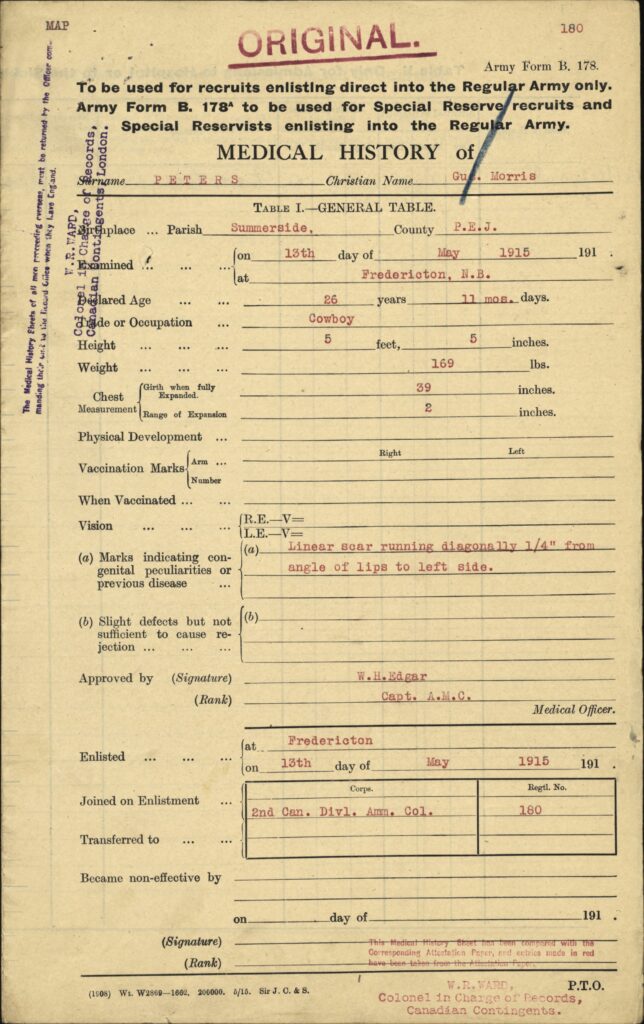
Gus was born Augustus Morris Peters in Summerside sometime between 1886 and 1889, depending on the records. He signed up for service in the First World War on May 13, 1915 in Fredericton, NB, telling them that his birthday was May 28, 1887.
He was assigned to the 2nd Canadian Divisional Ammunition Column, regimental number 180, and was on the SS Caledonia on June 13, 1915 headed for England. Gus was knocked down by a horse in August 1915, broke his left wrist and spent 24 days in the hospital at Shorncliffe army camp.
He was sent to France on September 16, 1915, serving as part of the Second Division of the Canadian Expeditionary Force in England and France, and received his discharge in Halifax, NS on May 25, 1919.
When he signed up for service, he gave his trade as cowboy, and he also referred to himself as a rancher, not really a PEI kind of occupation to have. It seems he worked for a while in North Dakota, and his demob papers said he was headed to Hot Springs, Montana after the war.
At some point Gus moved to California and married Hattie Seligman, born in Missouri around 1886, on July 7, 1928 in Los Angeles, California.
According to the 1930 US Census records, Gus gave his birthplace as New York, for some reason, and reported that he was employed as a stage hand in moving picture. By the 1940 census, Hattie and Gus were living in a home they owned at 5431 Fulton Avenue, Van Nuys, a few minutes drive from the Paramount Studios lot where the photo with Stanwyck was likely taken.
In the 1950 census, he gave his age as 63 and said he was still working as a stage grip at a film studio. As could likely be expected in a company town like LA, also on his census sheet were silent movie actor George Burton and Citizen Kane art director Perry Ferguson.
Gus died October 16, 1957, possibly after being hit by a car, and was buried at San Fernando Mission Cemetery in LA, his obituary giving his age as 71.
I had a hunch, and Ancestry confirmed it, that Gus was the uncle of my cousin’s husband (because of course he was), and his relatives still live in the Summerside area.
Like many on PEI have already done, we are having a heat pump installed next week. My mother has a 900 square foot apartment at the end of our house, and we want the unit for the air conditioning feature in the summer. It’s something we’ve resisted, mostly because we’ve never needed air conditioning here in the past and it seemed like an environmentally-unfriendly extravagance, but the heat and humidity we experience regularly in the summer now takes its toll on her at age 101 and it’s time to give in.
I was hoping the installation would have been done earlier in the year, but backordered units and a busy installer (I have learned to beware the tradesperson who is quickly available!) delayed things, so I hauled out a portable air conditioning unit today to give my mother some comfort in this latest heat wave.
I bought the a/c unit a year ago when my mother started to feel unwell during another heat wave (there are so many now). In my haste to help her to feel better, I didn’t do much research before buying and then realised when I got the unit home that the crank-out casement windows we have were a problem as the insert to hook the exhaust hose to the window were made for hung or sliding windows only. There are lots of janky looking contraptions available online to solve this problem, but I needed some way to hook it up quickly.
My first attempt, a panicked corrugated-cardboard/dollar-store-duct-tape affair, collapsed in the middle of the night and allowed swarms of insects into her bathroom, so I searched for a better solution. I found a few hacks using a piece of plexiglass to fit the window opening and cutting a hole for the hose, but I know from experience that plexiglass can be tricky to cut, especially a circle, and it’s expensive to experiment on, so that was out.
Then I thought of corrugated plastic sheets, the same stuff that is used for signs and packaging. The closest place that had any in stock was Home Depot in Charlottetown, so I ordered for pickup two of the thickest pieces they had (two in case I screwed up the first one!) and some good quality duct tape. I bundled my mother into the car for the 200 km roundtrip to give her both an outing and the benefit of the a/c in the car, a nice salesperson brought the goods out to us, and we boomeranged home so I could hack away.
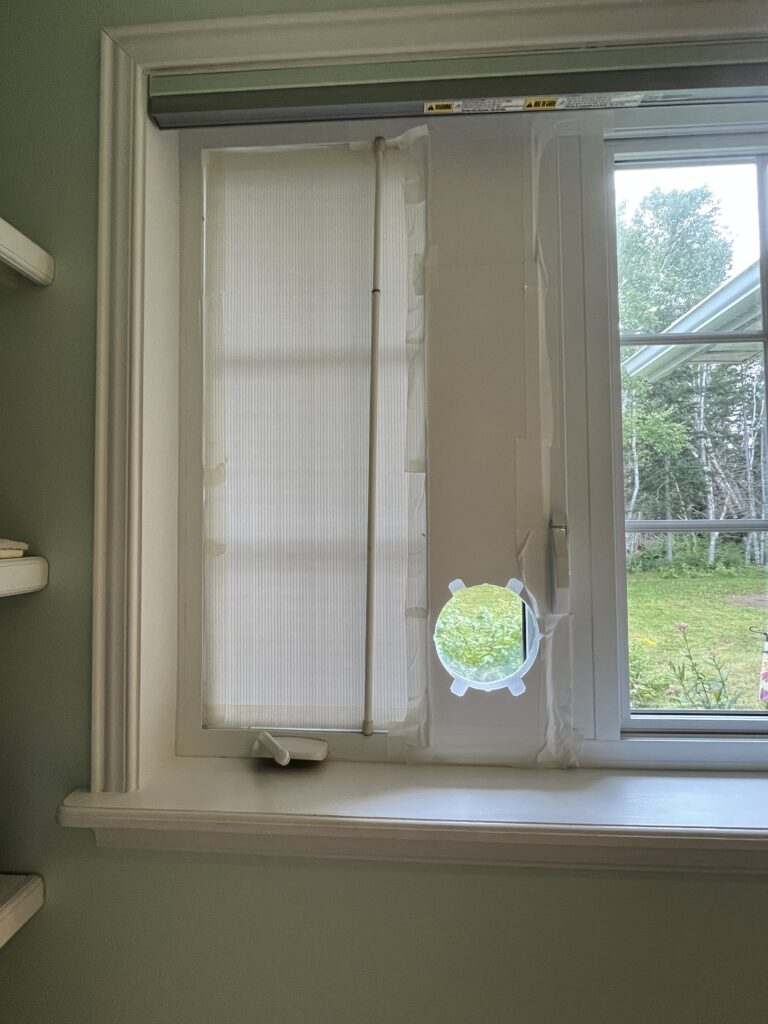
A/C hackorama 2023
I was surprised by how well my setup worked last summer. It isn’t a pretty solution, but was sturdy, relatively inexpensive and reusable. Most importantly, my mother felt better as the humidity in her apartment decreased.
Here are my tips if you find yourself in the same casement window conundrum:
Cut the plastic sheet a couple of millimetres larger than your window opening. You can pare it down to make it fit tightly, but you can’t add onto it if it’s too small, and unless you have perfect measuring and cutting skills, the plastic is tricky to cut exactly straight, and windows aren’t always perfectly straight either.
Once I had the plastic sheet fitted snugly in the window, I removed it and used the insert as a template to draw a hole at the bottom for the duct to vent through. The plastic is easy to cut, but take your time and use the smallest knife blade you have, like a #2 exacto.
I put the plastic sheet back in the window and then placed the window insert in front, and the hose hooked to that. At first I thought I could just insert the hose to the plastic sheet, but the hose is heavy and I feared the weight of it could pull the sheet away from the window. There was no way to keep the loosely-fitting insert in place without taping it to the window frame on the right side of my setup and the plastic sheet on the left, so that’s what I did.
As added support, I used a spring-loaded curtain rod to add additional support to keep the plastic sheet in place as it bowed out a bit in the heat. If I had been able to get thicker plastic, this might not have been necessary, and I’m starting this year without putting it up.
Although the plastic sheet was tight enough to stay in place on its own, I finished the setup by running duct tape around the entire window to both keep the sheet and insert in place and keep insects out.
The duct tape I used was made by 3M and though it was sticky enough to stay on all summer, it came off quite cleanly, with only a bit of cleanup. No insects came in, which is a miracle in our mosquito-filled location. Good quality duct tape is worth the extra money.
It took me an hour or so to get this fitted for the first time last year, but this year I had everything up and running in about 10 minutes.
I am unhappy we need air conditioning at all, and am conflicted by having to use precious resources such as electricity and plastics and metals in this way. It seems a step backward, and I’m thinking what I can do to make up for this. The heat pump is supposed to be more efficient to run than the portable air conditioner, and will also provide heat in colder months that will make us less dependent on heating oil. Swings and roundabouts.
I heard on the news this morning that some plant based beverages have been recalled across Canada due to possible listeria contamination. When I later walked by the empty cooler shelves at a local store, this yellow-and-red tag was next to all the price labels where the recalled products usually sit.
I know the tag must have something to do with the recall, but what is it supposed to be telling me? There was no information posted about the recall or what to do if I had already purchased product, which luckily I hadn’t. Is the tag telling me to call someone? Is it a re-call? Colour me perplexed.
We started getting early morning spam phone calls on our landlines a few years ago (our house has an apartment for my mother). Early as in 6:30 a.m. early. My mother was not usually out of bed or, if she was, she was getting dressed or in the bathroom, and she would rush to answer the phone. As her mobility decreased, I was afraid this would all end in a fall.
To prevent a possible tumble, I started taking her kitchen phone off the hook every morning when I got up. I’d hear a dial tone followed by a ring noise and then a voice telling me to hang up and try my call again (apparently known as an intercept message). After the message was repeated twice, a rapid busy signal would start and eventually would go dead after a long period.
My mother would replace the handset when she was in the kitchen and ready for her day, and if someone called to tell her that her Windows machine was acting up or she had won a cruise, she was awake and ready to hang up on them. This was an easy solution to an annoying problem.
We have two phone lines in our house. Our copper line was replaced in 2021 by a fibre optic cable that gives us internet, television and telephone. As my mother doesn’t use the internet, and we are able to wirelessly bounce a television signal from the Bell Home Hub modem to give her television, we decided at that time to leave her copper telephone line as it was.
Until Bell Aliant sent out letters earlier this year. The first informed us that if my mother’s copper line broke, they wouldn’t fix it and my mother would have to get a fibre line, which was fair enough, I suppose. That was followed a month later by another letter saying they would be cancelling her phone service by August if she didn’t switch to their fibre service. A classic Bell passive-aggressive move.
As we already had the fibre line and Home Hub in our house, it was an easy matter of some magic person left over from Island Tel days doing some programming at the Bell Aliant office in Charlottetown and rerouting my mother’s phone number to our modem (each of the Home Hubs has room for two phone lines). We lucked out again and had a tech come to our house (another Island Tel vet nearing retirement) who was able to make things work in our basement to easily route from our modem to my mother’s phone.
The morning following the switch, I picked up my mother’s handset expecting to hear the regular pattern. As I moved around her kitchen, I heard the dial tone followed by the signal to warn that the phone was off the hook, but no gentle, helpful voice.
I thought that was the end of the voice, but a couple of weeks later I was looking after a friend’s house while she was away and remembered she still had her copper line service, so I had one last visit with the Bell Aliant voice:
Anyone know who recorded this message? It certainly sounds like an Atlantic Canadian voice, maybe PEI but could be Newfoundland or Cape Breton, too. Recorded on tape? A copy of a copy of a copy? Let me know what you know, and please try your call again.
When I heard that a restored Canso airplane was going to be visiting the former air force base in Summerside, I switched a few things around so I could take my mother to see it.
My mother was a clerk in the Royal Canadian Air Force (Women’s Division) during the Second World War, serving from April 1943 to January 1945. She was posted to the RCAF base at Torbay, Newfoundland for 13 months and would have been there at this exact time 80 years ago.
Seeing a Canso, loaded with bombs and depth charges to hunt German U-boats, would have been an everyday thing for her then, nothing special, but today was certainly remarkable. She was interested to see one again, and thought it was smaller than she remembered. This Canso looked very different as it was painted as a water bomber, which was its last role as a working aircraft, and not as a military plane. She found it difficult to believe that 80 years had passed, thought a lot about all the friends she had made, now all gone.
It was windy with rain threatening as I pushed her wheelchair across the tarmac towards the plane. She learned to march on a similar runway in Ottawa, marching back and forth, back and forth. They issued the women shoes that were one size too big because all the marching would swell even the daintiest of WD feet.
It was to that very Summerside runway that she had been headed one day, probably also in 1944, when the plane she had hitched a ride from Torbay to visit her family on PEI spotted a U-boat surface in the Gulf of Saint Lawrence. They scrambled to get out of the area and radio the submarine’s position so bombers could be dispatched. She had been sitting in the co-pilot’s seat, so hopped out pretty quickly and the plane returned to Torbay. She never heard, or has forgotten, if that U-boat was sunk.
The Canso we saw today is one of only 13 remaining of the 3,600 built. My mother, once one of 17,000 WDs, is probably one of only a few still alive. Possibly one of the last people who saw a U-boat. My mother is still very much who she has always been – independent, generous, jolly, disciplined – but she has also morphed into being a living historical artefact, still able to tell her story at nearly 102. Rare birds indeed.
I’ve been making David Lebovitz’s brownies for years, and it’s a reliable and delicious recipe that just happens to be gluten free. I made them a few years ago for my pal, Emily, who is a chef, and she now sells them at her restaurant takeout counter, they are that good.
I always try to use Fair Trade chocolate and cocoa, but I needed a contribution to a meal for after a wake and didn’t have any chocolate on hand, so I raided my mother’s pantry. All my life she has had two boxes of Baker’s Chocolate on hand, a blue box of unsweetened and a red box of semi-sweet, but there was only the blue box, so I grabbed it and started baking.
Unsweetened chocolate is 100% cacao. It did not work. The chocolate Lebovitz suggested (bittersweet or semisweet) contain cocoa butter and sugar, which must have been what was missing.
Do make these brownies, and learn from my chocolate ignorance.
So, my trumpet and I made it to the Meet and Squeak on January 31. I only knew one person when I got there, another trumpeter I had played in a marching band with in the early 1980s. It was thrillingly scary to be sight reading again after 40 years, feeling the locked doors in my brain click open with every passing bar – that’s a crescendo, count four bars, mezzo piano, staccato. Breathe, take a breath, you’re running out of breath! Squeak!
I grinned through the entire evening, amazed to be once again surrounded by the blending of instruments, turning little dots on paper into coherent and lyrical sound, back in a place of comfort and belonging with all the band kids!
I wondered if I would be able to commit to the weekly rehearsals, but somehow my family and I made it work and I only missed a couple of nights due to having COVID-19 for the first time (and nursing my mother, also a first-timer, through it at the same time, which was interesting).
We are called the East Prince Community Band. It’s a lovely group of people, some extremely talented folks and others like me who are trying to find their way back through the music maze. Our conductor, Tristan Fox, is totally committed to the idea of life-long music making, encouraging and funny, everything you could want in a band leader.
We ended the first season this past Wednesday with a concert at the school where we had been rehearsing, Summerside Intermediate. We played seven songs including a Beatles medley, a snappy march, Bohemian Rhapsody and a zydeco number. It was so much fun, we sounded pretty good, and I’m looking forward to rehearsals starting again in the fall.
I’ve been practicing a half hour most days of the week and guess what I discovered? Practicing consistently improves your playing. Who knew? Oh right, all my music teachers. I wouldn’t say I’m 100% back to where I was when I last played in June 1984, but I’m not far off. My range is slowly increasing, and I can hit a clean high F most of the time. I can quickly play almost-flawless chromatic scales. My breath control is so much better, and my tone is getting cleaner.
I felt that my skills were strong enough that I volunteered to play The Last Post at a Legion funeral service today in Tyne Valley. I have vague memories of playing at outdoor Remembrance Day services, so I know I had done it before and hoped I could do it again. It was for an old family friend, a veteran and dedicated Legion member, our families woven together in a million different ways, and I wanted to honour his long life of service.
The first person I encountered when I entered the funeral home this afternoon was a man who moved to our area a few years ago. He looked quizzically at my instrument case and I told him I was going to be the bugler, and he said “Oh, I didn’t know you were a musician.” “Yes, I am,” was my immediate reply, which didn’t seem to surprise him, but certainly surprised me.
Am I a musician? Was I a musician these past 40 years, just one who didn’t play music? My rapid reentry into that identity feels natural, like I had never stopped playing. I started to read music and play piano when I was six, so I had learned another language that settled deep into my brain. I’ve always loved listening to music, singing along, dancing, but I had stopped playing, and now I had stopped stopped playing.
I made it through The Last Post, the minute of silence and Reveille without too many flubs. People were moved and appreciative of the live performance of that meaningful sequence. I was relieved to have that first behind me.