After an absence of over 40 years, I have been attending church regularly for nearly a year. The same church I had been raised in, with some of the same people who were there when I last attended regularly in my mid-teens.
My mother stopped driving in 2016, so her cousin and his wife kindly took her to and from church. When my mother’s mobility declined after three hospitalizations in the winter of 2023/24, I felt it unfair for these thoughtful older relatives to have the responsibility of looking after my mother, so I told her I would take her.
This past Sunday, the minister’s sermon was focused on the baptism of Jesus, which is part of Epiphany, the season that follows Advent. One of the scripture readings was from the third chapter of the Gospel of Luke:
When all the people were being baptized, Jesus was baptized too. And as he was praying, heaven was opened and the Holy Spirit descended on him in bodily form like a dove. And a voice came from heaven: “You are my Son, whom I love; with you I am well pleased.”
Luke 3: 21-22
The minister, a thoughtful and interesting speaker, asked the congregation if we had ever seen a dove descend from heaven, if we had ever heard God speak. There was silence, indicating that no one had, or nobody was prepared to talk about it if they had, and he went on to talk about what that might have been like to hear God (and he talked about Eric Clapton, too, which isn’t usual in the Presbyterian Church of Canada, but most welcome, at least by me).
I’ve never heard the booming bossy voice of the Christian God as described throughout the Bible. I’m pretty sure he’s not that well pleased with me, despite me taking my mother to church every week, so I’m just as happy to not hear what he has to say.
What I do hear is the voice of the eternal spirit, the beating heart of the cosmos, the kind and merciful universe. Where? In the rustle of the leaves in trees, easily one of my most favourite sounds in the entire world.
Today I was walking through a field near our house, a field surrounded by tall trees that have watched me move around this land for nearly 60 years. The sun had just come out briefly, a rare occurrence so far this year, and I heard a flock of finches in the forest, always calling to one another as they move through the trees.
Suddenly, I looked up and saw a solitary finch flying high over the field, and it had something big in its mouth. Just as I thought I’ve never seen a finch carrying something so big, it dropped its load, and as it fell I could see it was a spruce cone. The cone bounced on the snow and the bird continued on its way as if that had been the plan all along.
I hurried over to see it and it was indeed a spruce cone, complete with a couple of spruce needles stuck its base. I could smell the distinct odour of spruce sap, and realised the bird must have plucked this directly from a tree, a gift from high up in a tree, a place I could never visit.
I put the cone in my pocket and brought it home and put it in a little dish. The seeds are already dropping out of it. It still smells of sap.
I once read about an exercise where you imagine an object you desire or cherish being broken so your attachment to it isn’t so strong that you are disappointed if it breaks; of course it is broken, it was always broken, you will sagely say when your new car gets a ding in a parking lot. Sounds Buddhist, but I’ve read so much wooology it could be from just about any practice but, yes, probably Buddhist.
I have just started my third 10-year journal. I was sorry to say goodbye to the second one from Because Time Flies as it had become a powerful tool for recording things that matter to me, but the fellow who published it seems to have disappeared.
So I bought a fancy Midori one instead, smaller and beautifully designed, and I know I will make it work for me. I don’t have lovely penmanship, so this isn’t an Instagrammable pursuit. It’s a lovely book, but I’ll be using it in a utilitarian fashion, and that’s ok.
When I sat down this morning to record the events of yesterday, I automatically started writing on the page opposite yesterday’s entry, as I had for the past 10 years with the other larger book that had room for 10 years of each date per page. But this is a smaller book, and the two-page spread is for one date, so I had entered the minutiae of January 2, 2025 in January 1, 2030’s spot.
I hadn’t imagined this lovely Japanese book as already broken, but now it was, and I was happy to have that behind me, and continued on.
Freeland made the front page of the Charlottetown Guardian on this date in 1949 with the sad news that the body of Augustine “Gus” Gain had been found in the woods.
Elderly Man Perishes In Woods At Freeland
The body of Augustine Gain, 81, was found about ten o’clock on the morning of December 24th in the woods about a mile from his home. He had been missing since the previous day and an all-night search had been carried on.
An investigation was conducted by members of Summerside Detachment R.C.M.P., and the Coroner, Dr. Austine Delaney and it was decided that death was due to natural causes and exposure and that an inquest would not be necessary. The body was frozen when found.
A considerable sum of money was found in various pockets of the clothing. The elderly man had lived alone for a number of years and was last seen alive about noon the day previous when he left the store of A. Philips after procuring supplies and started for his home a mile and a half away.
The day was warm and the walking was heavy. That evening it was noticed by his nephew, James Gain, who lives nearby that there was no light in his uncle’s house and on investigation he found that he was missing. – S
I asked my mother if she remembered someone called Augustine Gain and she said, “Oh yes, Gus Gain. He used to come to our store.” Clinton Morrison’s history of Lot 11, Along the North Shore, says Gus lived in the community of Murray Road, so I asked my mother where Gain’s house was and she replied, “There by the water, you know, by Gain’s Creek.” Of course. There are no more Murrays or Gains in our area, but their names live on.
So there is a typo in the article, as the store mentioned in the article did not belong to A. Philips, but to my father H. Phillips, or rather, H.E. Phillips. Harold Edmund. He used both initials in business, and I have no idea why, except that it probably made him sound more prominent when in fact, in 1949, they were barely scraping by.
It was probably my mother who served Gus that Thursday two days before Christmas, and she could have been the last person to see him alive. The drive from our old store to where Gus lived is only about five minutes by car, but that’s a round about route if you are on foot, so he would have walked a well-worn path through the forest as a short cut. We sometimes used that same path for snowmobiling when I was a child in the 1970s, and I can still pick it out when I look at recent aerial photos. It’s swampy in places back there, would be terrible walking if the ground wasn’t completely frozen.
1935 Aerial Photo
This blog now memorializes two PEI men named Gus who died in 1949.
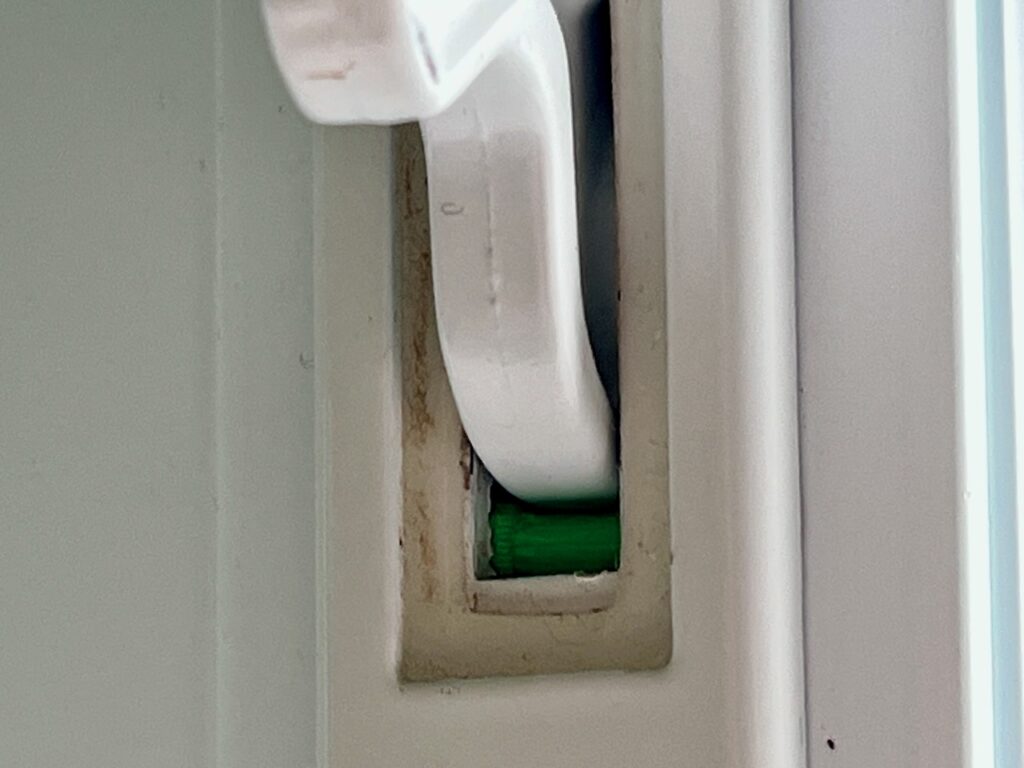
One of the locks on a 22-year-old Jeld-Wen casement window in our bedroom stopped working properly this summer. The window has a lock on either side that pulls the window sash tight against the frame when closed. The lock handle had always clicked into an open position ready to accept the tab on the sash to pull the window tight, but suddenly the handle wouldn’t stay in the open position. It was more an inconvenience than a huge problem, but seemed it should be fixable.
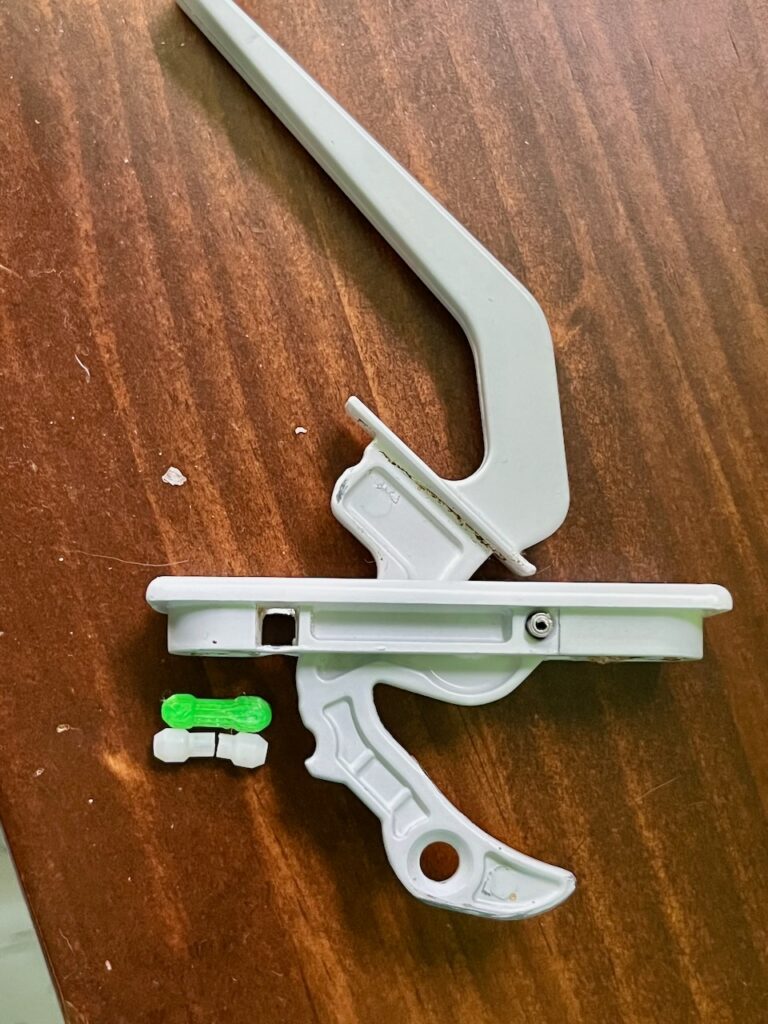
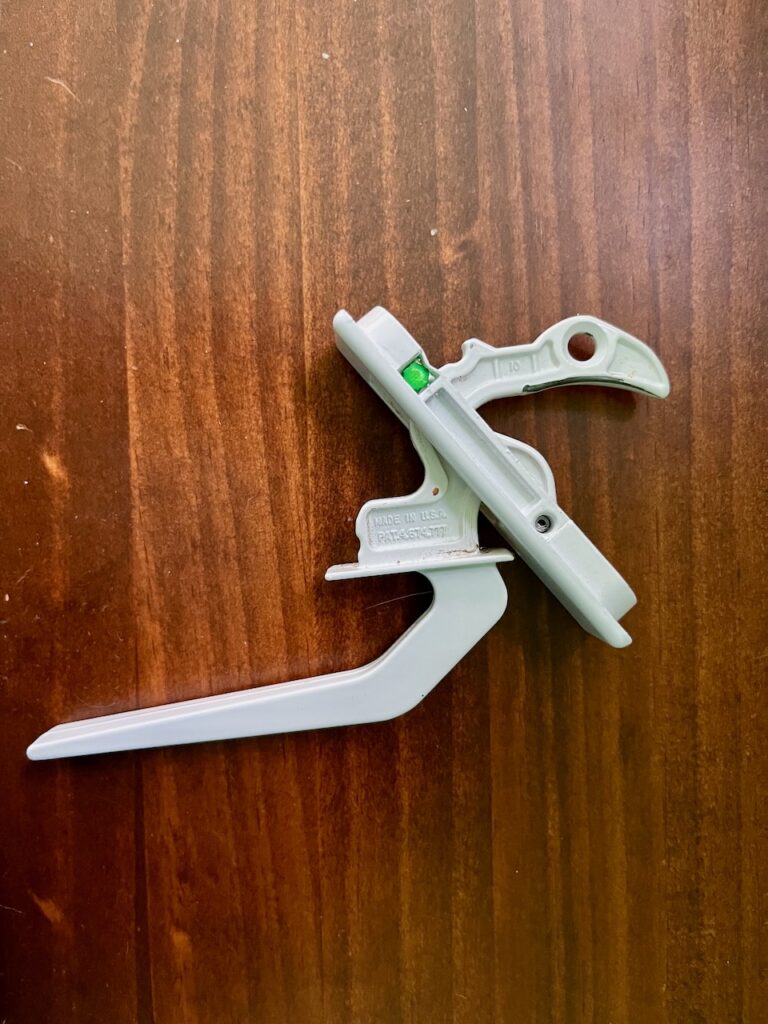
I unscrewed the handle to remove it from the frame to have a better look at it. Comparing it to the lock that still worked, I found a little plastic piece that had been holding the lock in the open position was now broken in two pieces, so the handle had nothing to grip to stay open.
I found an Instructable explaining the problem and a file to 3D print the tiny little plastic piece. Unable to justify buying a 3D printer just to print a Tic Tac sized piece, (though I tried!), I put the file on a thumb drive, filled in a request form and dropped both off to the Summerside Rotary Library with a $2 deposit. I received a phone call a week later to say the piece had been printed. The file actually prints two of the plastic pins, probably because each window has two locks. When I made the request I only needed one, but another pin broke on another window in that week, so I had all I needed for two repairs all for a toonie!
I’m not sure I’ve seen anything that had been 3D printed up close before this. The original piece was most likely injection moulded, so was smooth, but the 3D printed piece had ridges and wasn’t completely round. I couldn’t get the piece into the little slot in the lock at first, but carefully scraping a bit of a ridge off one side allowed it to slide in. Both locks now work perfectly.
Thanks to Gubutek for this nifty fix and my first satisfying dip into the future of fixing.
Original broken white pin with green 3D printed replacement
Replacement pin in position
Pin at work
Lock handle in proper position to accept tab on sash
Last week I popped the first disc of the third season of Succession into my DVD player (the library is my Netflix) and pushed the play button on the remote. Nothing happened.
I took the battery cover off the back of the remote and did what I’ve done often over the past few years: twirled the batteries and tried again. I don’t understand why this worked because it seems totally bonkers, but twirling the batteries would somehow revive them. This time, though, nothing happened. I put some fresh batteries in and the remote worked, so my luck extending the useful life of the original batteries that came with the remote well past what I would have thought possible for cheap AA batteries had run out.
For, you see, I purchased the DVD recorder/player on January 14, 2006 at Future Shop in Charlottetown. We used it a lot for the first five years we had it because we had dialup internet until 2010 so streaming wasn’t possible. I would say the player is still used a few times a month, but mostly the remote just sits there and waits.
I will reluctantly drop the Greencells in a recycling container, but these cheapo batteries deserve to take a bow.
While tidying up the basement yesterday, I pulled down an unlabelled file box that turned out to have some writing on the back.
When I left Daily Bread in 2001, I packed my personal items in this box and it ended up moving back to PEI with me.
This is a relic of Year 2000 prepping in Canada’s largest city.
I worked at the Daily Bread Food Bank in Toronto from 1994 until 2001. In January 2000, DBFB was located at 530 Lakeshore Boulevard West at the foot of Bathurst Street in the original Loblaws warehouse. Built in the 1920s, it was a massive, dusty, slightly-scary building, but as we paid no rent to our landlords, Wittington Properties, the real estate arm of the Loblaws grocery chain, to us it was home sweet home.
Part of my job was looking after the DBFB archives. We didn’t have much money, so I was always on the lookout for clean, gently-used file boxes that occasionally came in filled with donations of non-perishable food that I could reuse for storage. I plucked this beauty from a pile at the side of the loading dock after its contents had been emptied into a larger box ready for the sorting procedure we used for public donations during the first week of 2000.
The turning of the clock from December 31, 1999 to January 1, 2000 had people a little freaked out, and many started to prepare by purchasing extra food in case computer glitches caused transportation issues and the food supply ran short.
Short term businesses popped up that would deliver a pallet of food and household necessities to your home designed to get you through the complete break down of society. I even knew people who were preparing for (and looking forward to) the “end times” and the return of Jesus Christ, but who also bought a lot of extra food and water….just in case.
Governments planned well in advance for any possible issues and Daily Bread was included in that planning. Toronto was estimated to have a three day supply of food on hand at any time in grocery stores, warehouses, the Ontario Food Terminal, and the large manufacturing factories of companies like Campbell and Kraft. After those supplies were used up, well, there would be panic.
I’m probably not giving away any important secrets now to reveal that if the Y2K bug had caused widespread disruption, Daily Bread (and probably other similar organizations) would have been taken over by the government, the building protected by the military, and the food we had on hand (which could be millions of pounds) would have been distributed to the general public.
Knowing about this planning meant I not only bought some extra food and bottled water myself, but I filled my car with gas, got a few hundred dollars out of the bank, and was prepared to hightail it out of Toronto and drive to PEI as fast as I could if things went sideways. My parents always had masses of food preserved and, well, we are resilient in rural PEI in a way a major city just isn’t; I had seen how messed up Toronto could get after a big snow storm and didn’t want to white knuckle the end of the world there.
In the end, nothing much happened when the year 2000 started, except people realised they didn’t need all the Chef Boyardee and Kraft Dinner they had in their cupboards and wanted to donate it to the food bank, which was a happy bonus for us. I believe the file box I have came from one of the large office buildings in the downtown business district, where employees decided to set up their own collection bins so they could toss in their extra non-perishables on their way to work.
All the details of the impromptu Y2K food drive we launched escaped me, but I found this Globe and Mail interview with our executive director, Sue Cox, from that time that fills in the blanks. Sue was a great boss and a lot of fun, as the last sentence shows!
Y2K bust proves a boon for food banks

John Gray

Toronto

Published January 10, 2000

The Y2K bug that didn't bite has proven to be a windfall for some of the needy in the Toronto region.

The Daily Bread Food Bank estimates that about 13,500 kilograms of food have been contributed from stockpiles that nervous residents had built up in the event of a turn-of-the-century disaster.

When the possible disaster did not happen, Daily Bread issued a public appeal that the unneeded goods be dropped off at firehalls and Loblaws supermarkets in the greater Toronto region.

Sue Cox, executive director of Daily Bread, said there had been "a nice response" throughout the region.

Although not even a partial tally of donations will be completed until tomorrow, and contributions may continue for some time, Ms. Cox said preliminary estimates suggested there have been at least 30,000 pounds (13,500 kilograms) of food contributed.

She thought most of the contributions really had come from people who feared the world's computer systems would stagger, if not collapse, from complications of entering a new century and who stocked up on food as a precaution.

She cited an encounter with one woman who arrived at a firehall with about 22 kilograms of food that she had stored in her basement as a hedge against a crippled computer infrastructure.

Pronouncing herself pleased with the results, Ms. Cox said she had never conducted a millennial food drive before and did not really expect ever to conduct another.
I actually went to work on January 1, 2000 even though the food bank was closed not because I was a workaholic (though I was, a bit), but I was in charge of the computer network and telephone system and was curious to see if everything was still chugging along.
Our computer network was 30 donated 386 and 486 computers and a few printers. Our server was a 586 Compaq desktop running a Novell product. We had two fax machines. There was only one computer connected to the internet, located in our mail/fax room, and I would log onto it to send or receive the odd email, but it wasn’t connected to our internal network at all, the best firewall ever.
DBFB had a very simple website that was hosted and updated free of charge by a company with headquarters downtown. We referred to our website in our marketing, but it got very little traffic.
dailybread.ca May 10, 2000 from Internet Archive.
I spent most Saturdays in November and December 1999 testing the computers for Y2K compatibility using a disc that had been sent to us by the federal government. I can’t remember what happened if a computer failed the test, but I probably patched the Windows operating system somehow and moved on to the next computer.
We had an amazing HP printer, a LaserJet 4. It was an astonishing workhorse. It printed hundreds of pages a week in our dusty office, rarely jamming. I cleaned a mouse nest out of it once and it just kept going. I had it repaired by a technician who came to the food bank a couple of times when it stopped working, and he would replace a part and get it going again.
Somehow I found out that there was a chance the LaserJet 4 wouldn’t work properly or connect to our intranet, so the first thing I did on that January 1 was boot my computer and send a page to print on the LaserJet 4, and of course it worked. That little beauty was still chugging away when I moved back to PEI in 2001.
I’m not sure my mother has ever been interested in popular culture. I think she was a fan of Perry Como in the 1950s and 60s, but that’s about it for the extent of her fandom. She and I share few – maybe no? – popular culture references. I’m certain she doesn’t know her Paul from her John, George or Ringo; she’s more a Matthew, Mark, Luke and John kind of gal.
The last movie I remember her going to see, one of the handful of movies she went to see in a theatre in a my lifetime, was Chicago. She went with a church social group, and it was an interesting choice for them to have made. My mother was by far the oldest attendee. She had fun, as she always does, but said after that, “she now knew what Sodom and Gomorrah looked like.” Indeed.
You can imagine my surprise when I went to check on my mother after supper tonight. She was watching TV and I asked what was on. She replied, “I’m just catching up on all the Taylor Swift news.” I was beyond amused. Tay Tay hits Toronto tonight and my 102-year-old mother is here for it.
Yesterday the air temperature and wind direction stayed nearly constant throughout the day, a rare occurrence. In fact, the wind shifted to the north around noon on November 12 and remains there as I write this at 8 a.m. on November 14. Wind speeds mostly stayed between 25 and 35 km/h, though my anemometer is not placed high enough to give an accurate reading. It’s chilly.
I had always assumed the abdication crisis of 1936 was first set in motion when the Prince of Wales, later Edward VIII, met Wallis Simpson in 1931, but it seems David Windsor might have been finding the prospect of leading the British Empire too daunting a task as far back as 1924, if this gossipy bit from the November 6, 1924 CharlottetownGuardian is any indication.
Silly Rumor About Prince of Wales LONDON, Nov. 6.- The Prince of Wales may possibly renounce his right to the throne of England. This rumor kept the Prince eager company during his trip from America on the liner Olympic last week and greeted him as it was whispered through the crowds when he arrived at Southampton, home again after his vacation. This rumor set the whole boat buzzing before the voyage was half way done. The Prince himself scoffed at it. But one of his aides went to the trouble of issuing official denial. Perhaps the circulation of the rumor was one reason for the extraordinary censorship on the Olympic. As soon as it was discovered that there were several newspapermen on board, orders were issued that every message must be ok’d both by the purser and Captain Lascelles, the Prince’s secretary. Very few messages passed this board of censorship, and any that did were limited to twenty words. During the voyage the prince danced chiefly with Mrs. H. P. Peabody of New York, and Miss Esme Magann, of Toronto, whom he met in Canada and who made the trip with her mother, Mrs. Plunkett Magann.
And who could blame him for wanting out? He’d had a lovely visit to North America, being feted and paraded everywhere he went. He visited his Alberta ranch to play cowboy for a bit, and generally seemed to have a “Wales” of a time golfing and dancing and looking dapper and rich. Why spoil all that fun with the boring ceremonial grind of being a constitutional monarch?
My decades-old bookmark for the Journal Pioneer newspaper that continued to bounce me over to the Saltwire Network PEI news at https://www.saltwire.com/prince-edward-island/ for the past few years today dumped me into domain name purgatory.
UPDATE November 5, 2024, – it’s back, with another one year registration!