New music from Lisa O’Neill is cause for great celebration, and yesterday she released a moving new song that took her eight years to finish, The Wind Doesn’t Blow This Far Right (choose your preferred music service here). Well worth the wait, a song for our times.
I first heard of O’Neill a couple of years ago when I came upon her haunting song Old Note. A rare talent singing memorable, honest music.
Love this packaging design. I imagine they were satisfying to stack together.
I admire the retro colours and the identical red bowl with different coloured pasta in them, the macaroni carefully arranged so it hit the top edge of the bowl the same in each photo, and some of the pasta on its side and some with o-ends facing out.
I don’t have many memories of the general store my parents ran until I was four, but I remember being fascinated by how the slices of cake on the different varieties of Betty Crocker mixes looked exactly alike, the size and icing swirls identical only in different colours and flavours. If I was transported back into that store as it used to be right now, I could take you straight to that shelf, at four-year-old eye level, and hand you your choice (and being the daughter of two great salespeople, ask you if you needed birthday candles as well. Always be selling!).
Peter’s wonderful post about Charlottetown’s venerable Bookmark (his photos of tiny details around the shop and their aerie office are delightful) made me dash pre-morning-coffee to rifle through my small bookmark collection to confirm his observation that there has never been a “the” before the bookstore’s name. Me too, Peter, me too.
I guess I had my final visit to the Queen Street location this past Wednesday, when I dashed in to pick up a book order while a friend waited in my illegally-parked car. I didn’t know to give a final nod to the place where I’ve spent many happy hours, so Peter’s post allowed me one last wistful glimpse. Looking forward to the new digs!
The bookmarks of Bookmark, from the early 1980s to almost today.
Late summer 1925 was filled with federal election rumours, and Canadian Prime Minister William Lyon Mackenzie King eventually did call a general election for October 29 of that year. King had some housekeeping to do before the election, and one of his tasks was filling half of PEI’s seats in the Senate, which meant appointing two new senators to replace John Yeo and Patrick Murphy, who had both died during the previous year.
The August 31, 1925 Charlottetown Guardian editorial page was full of Senate news and opinion:
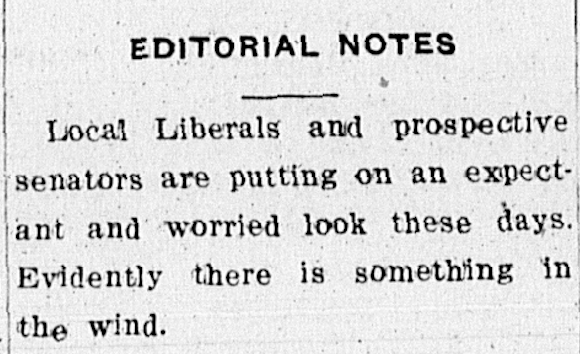
“Local Liberals and prospective senators are putting on an expectant and worried look these days. Evidently there is something in the wind.” Charlottetown Guardian August 31, 1925 p4.
Then, breaking front page news from the September 3, 1925 Guardian:
Senators Who May Or May Not Be
Rumors were rife in the city yesterday regarding appointments to the vacant senatorships, to the effect that the choice had fallen upon Mr. J. J. Hughes, M. P., and Mr. Creelman McArthur, Summerside. No confirmation of this rumor was available last night but no doubt official announcement will be forthcoming very shortly. The Liberal decks are being cleared for action and no doubt all possible appointments will be made before the Liberal conventions are held as some possibilities for a senatorship may be willing to accept nomination as second choice, if they should fail in bagging the bigger plum. Mr. Nelson Rattenbury who has been a senatorial possibility till the last minute has been eliminated from the list by a consolation prize of a seat on the C. N. R. Board of Directors. What consolation will be handed out to the remaining aspirants has not yet been divulged, but anything is possible now that appointments will be handed out promiscuously in view of the pending election. In the meantime until more definite information is to hand, Messrs J. J. Hughes and Creelman McArthur will enjoy the felicity of being senators pro tem but subject to revision.
I can confirm that the rumours about Hughes and M(a)cArthur were true, and Creel resigned his seat in the PEI Legislature on September 5. Now to fire up the time machine and go back to place a few bets!
The original (non-operational) outhouse for Senator MacArthur’s Cedar Lodge built in 1933 and restored by me in 2013. We lovingly refer to it as The Senate.
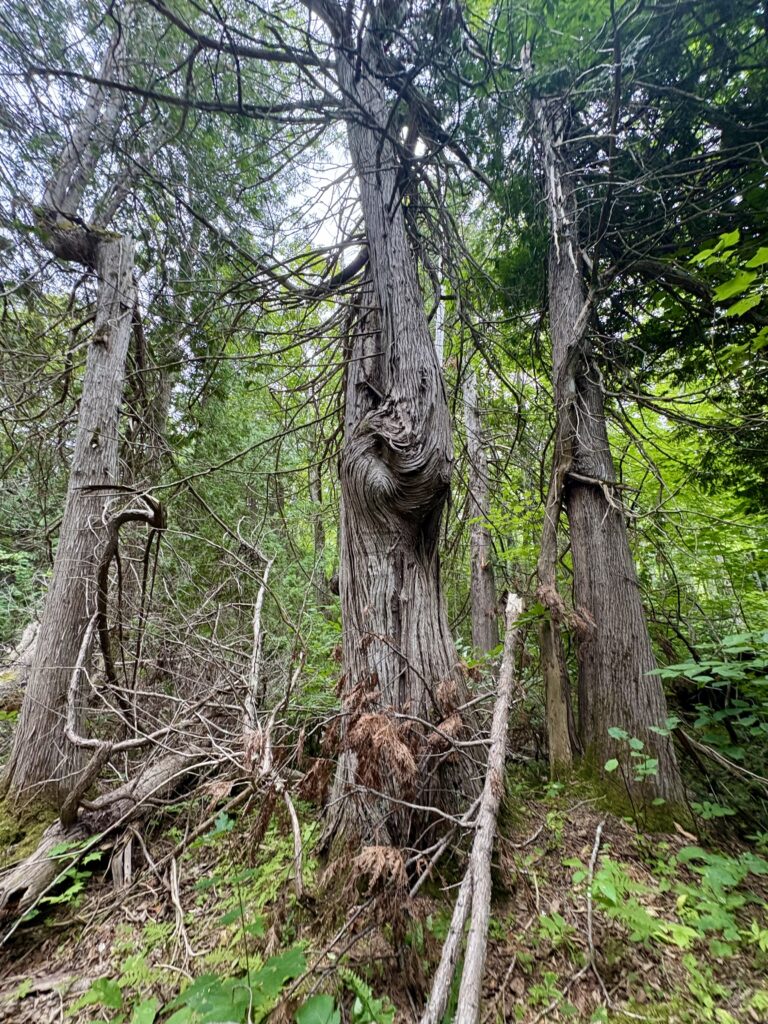
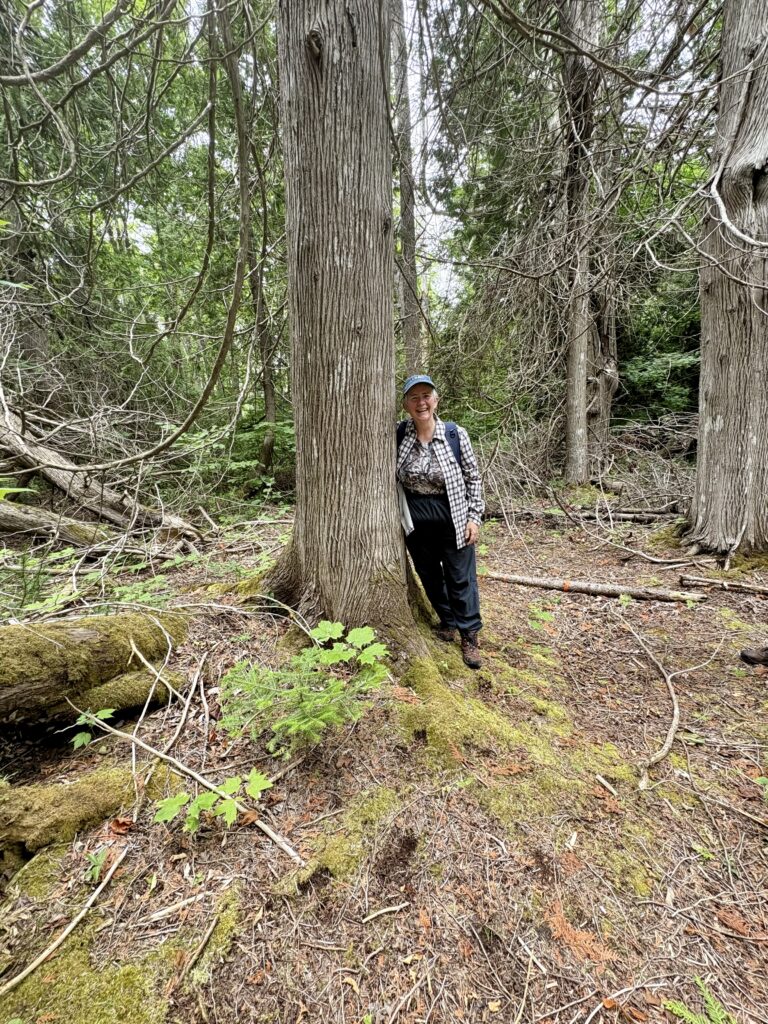
Today I joined a Nature PEI walk through Pleasant View Cedars Natural Area near Miminegash. I understood we would see some large, old eastern white cedars, but wasn’t prepared for how breathtakingly enormous the stand was! At one point in the middle, all I could see around me was cedar, something I’ve never experienced before. It is a rare landscape on our tiny Island.
I always find it difficult to photograph forests, but trust me, that’s a lot of cedar!
There is a cedar stand on the property we occupy, an area that was too wet to be farmed, and some of the trees there are very old. The walls of our log cabin are unpeeled cedar logs, a few of which probably came from that cedar stand. Some of my earliest memories are waking early from sleep and staring at the patterns on the bark. I could see faces in the knots, would pull at the stray threads of bark that were peeling off. I was partly raised in the comfort and solidity of cedar trees.
The drought we’ve been experiencing meant we were walking over dry land that should really have been quite boggy, which was good for us but possibly uncomfortable for the trees. There was very little undergrowth due to the tall canopy. It was a cloudy morning, so it was very dark and quiet as we walked through. I sort of felt like I was in a fairytale woods – Hansel and Gretel came to mind, as it was a little spooky, with odd-shaped trees all around.
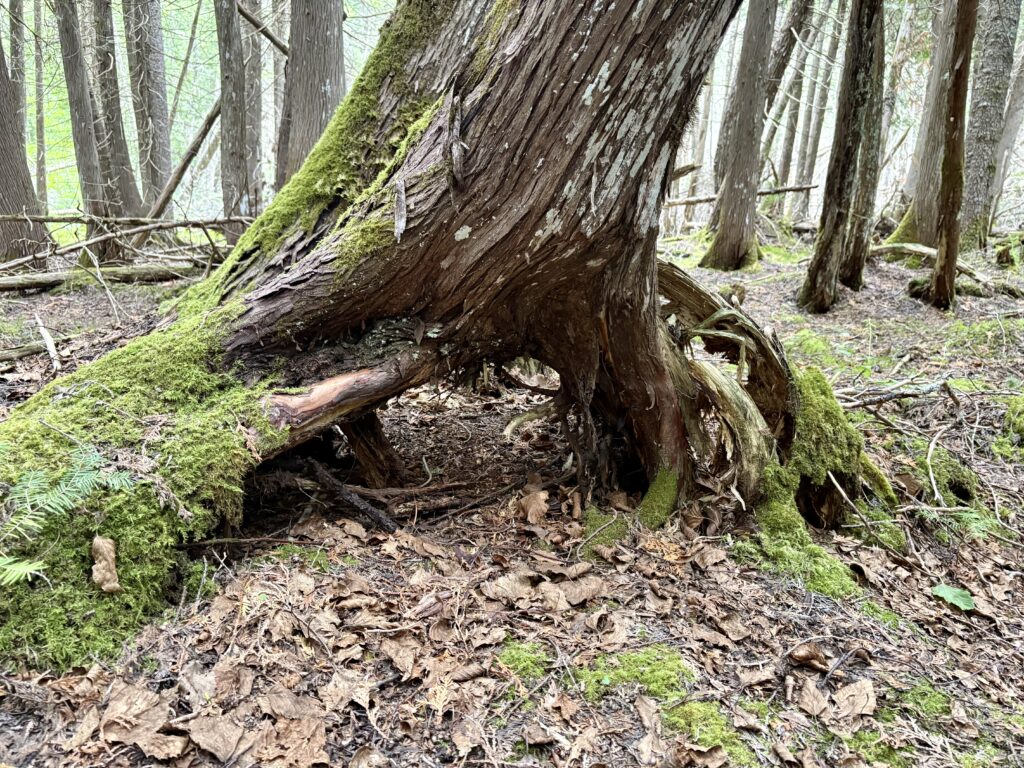
There were many trees that looked like they had legs and could walk! This perfectly-healthy cedar would have started life growing on top of a dead fallen tree, which eventually rotted away leaving this space at the bottom.
Our guides, Mark Arsenault from the provincial government forestry division, and Rosemary Curley, former provincial biologist and Nature PEI president, were genial hosts and excellent teachers. I’ve been on many walks with Rosemary, mostly scouting for mushrooms, and am constantly impressed and inspired by her vast knowledge of our province’s natural areas and her life-long passion for sharing her love of the natural world with others. I highly recommend spending time with her whenever you get a chance.
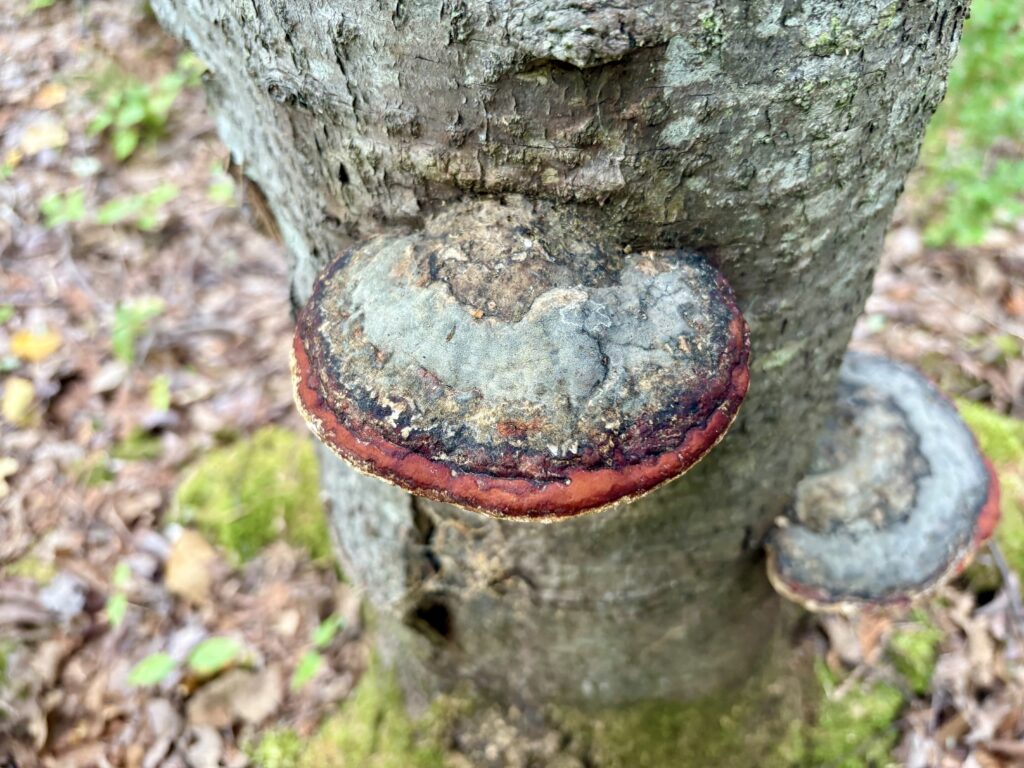
Northern red belt fungus
Nature PEI hold many field events each year, and they all seem to be free, but a membership to support their important work is only $20 a year, which includes a quarterly newsletter. This morning’s hike was easily worth 10 times this year’s fee. I’ll never forget being surrounded by those trees.
Me next to the biggest cedar I’ve ever seen on PEI. This is a rare photo of me, so enjoy.
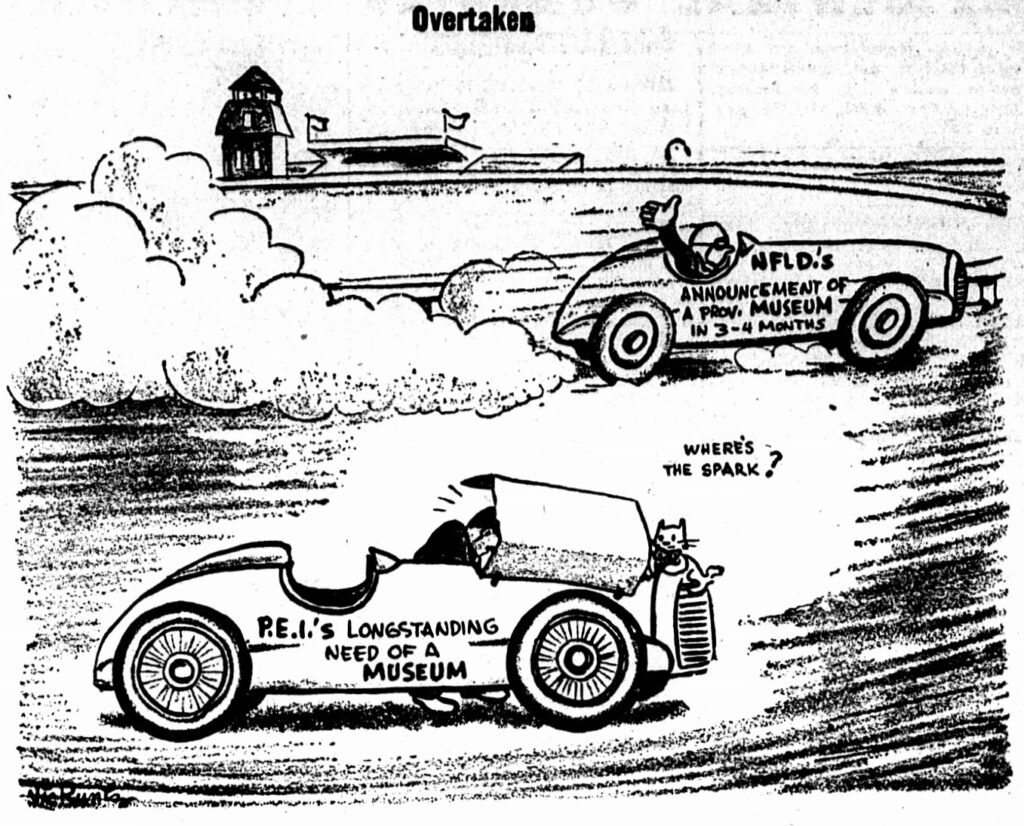
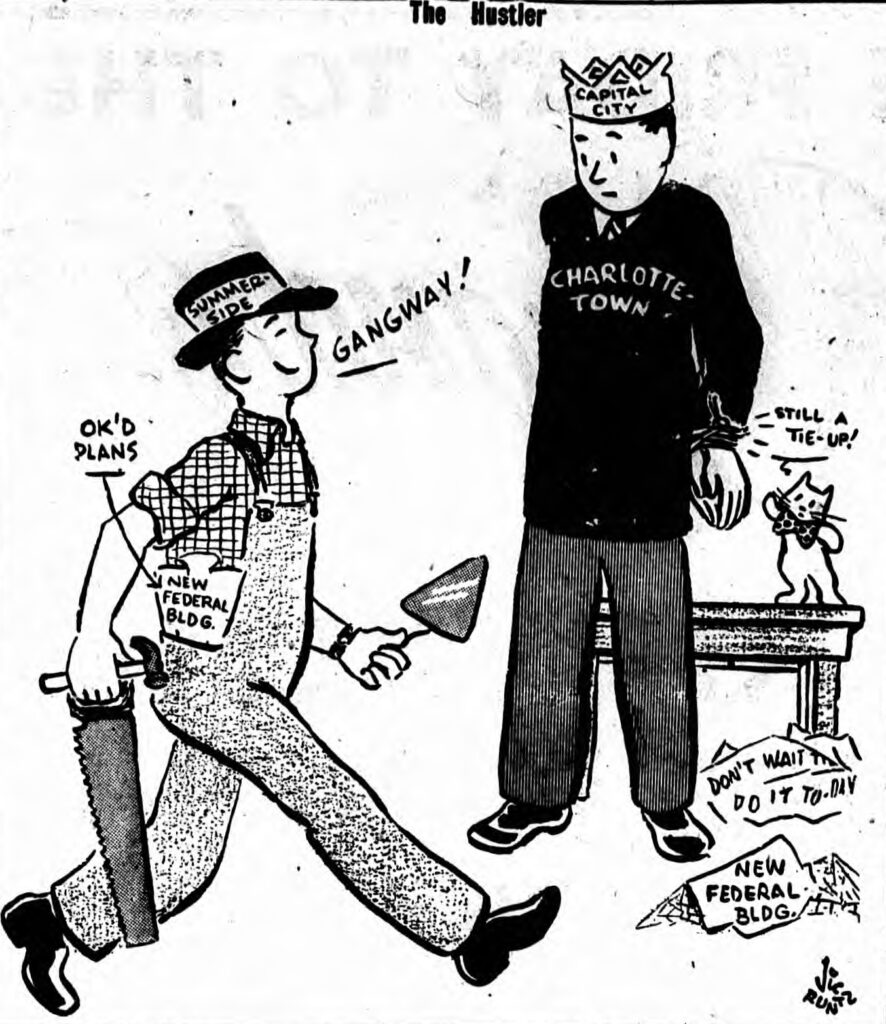
Here are some 75-year-old Vic Runtz cartoons from the Charlottetown Guardian I’ve enjoyed over the past few months. Plus ça change…
Newfoundland, a Canadian province for only one year, announced the creation of a provincial museum while PEI could never seem to get beyond the talking stage (and still can’t to this day). July 14, 1950, page 4July 8, 1950, page 4. Scrappy little Summerside’s new federal government building (now the site of the Summerside Rotary Library) was under construction while Charlottetown still waiting. April 20, 1950.
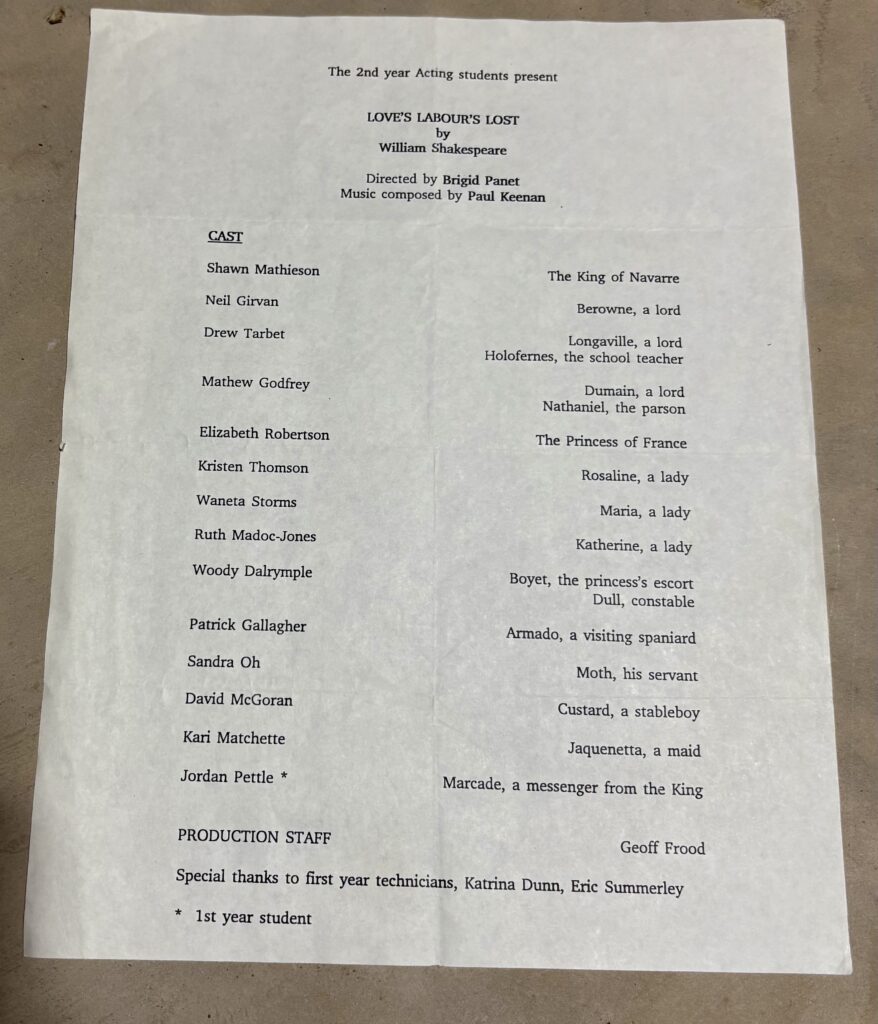
The YouTube algorithm served me some Sandra-Oh-on-a-talk-show content today and I watched her tell Seth Myers that the first Shakespeare play she did was Love’s Labour’s Lost at theatre school. Oddly enough, I had come across the program from that show a couple of weeks ago as I performed in my current production of the off-Broadway sleeper hit Oh My God, My Mother Is Dead and Why Do We Have So Much Stuff??!!, which has entered its third month of an unlimited run in our basement. I’m starring as the daughter of a woman who bought and saved a lot of stuff, but now that the mother has died, that stuff has to be sorted through and dealt with. The twist is the daughter also has stuff, like boxes of theatre programs, so now she has to deal with her dead mother’s stuff AND her stuff, but mostly she ends up just sitting in the cool basement ignoring what has to be done and looking through boxes of stuff and going “hmmm, look at that.” It’s riveting.
I have no memory of seeing LLL, which I guess was performed the fall after I graduated from the National Theatre School of Canada in May 1991 as these folks were in first year when I was in my final year (I was trained in technical production: lighting, sound, stage management, technical direction, production management, carpentry, etc. I have acted, but am not trained, which was obvious if you ever saw me act.). I remember going back to see the third year students do a show in December, so this must have been on at the same time.
This class was an especially talented group of people and many have gone on to great theatre, TV and film careers. Although I don’t know any of these folks now, it’s still fun to see them pop up in movies or on red carpets or talk shows. Weird, but fun, like my show, which you can catch from now until the basement is empty, which, at this rate, will be never, so you have lots of time, don’t rush.
My mother, Vivian Phillips, died on May 28. As she kept telling people in the hospital over the five days she was there, she was three months away from being 103.
She was there, with Steven and I, sleeping in a room, the three of us together.
And then she was gone.
I’m adrift. A lifetime of love and attention, the past couple of decades of harmoniously living together, and the past few years of constant worry, vanished. I should be relieved that the hard parts of being a caregiver are over, and part of me is, and I’m certainly more relaxed, but I don’t know what to do with myself, and time spools out before me.
The end came quickly. She went into the hospital on May 22 with sudden rectal bleeding (there is no possible gentle euphemism for that). When this happened once before in 2023, medication stopped the bleeding, she had come home and was fine. It seemed that would happen again, but her failing heart had other plans.
4 billions beats, and then the last one, and done. My vital, joyous, cheerful, industrious, kind mother had become, in an instant, a husk, empty, still.
Yes, she had a long life, never got dementia, never became incontinent (a big deal), never got diabetes or cancer, remained engaged and engaging, lived in our home able to dress and feed herself, could still walk, still go to church, visit with friends, read, write, bake, and knit knit knit, never idle.
All things she and I were grateful for.
But she could never have lived long enough for me. I’m afraid I replied a bit unthinkingly to the first person who reminded me of her longevity that yes, it was true she had a good, long life, but I would give anything to have one more day with her. I will try to remember to not say to someone in a similar position that their loved one had a long life as it really is no comfort at all. Grief is grief just as darkness is darkness.
She was ready to go. She was tired. The world and her place in it wasn’t what it had been. She felt she was holding Steven and I back, no matter how many times we protested that wasn’t true. She prayed each night to Jesus that he take her to be with him, that she not wake up in the morning. I knew this, and was hoping she got her wish.
When she started telling people a few years ago that she was ready to die, it was understandably startling to some, but she knew where she was going and didn’t fear death. She welcomed the eternal rest she hoped would be her reward for trying to walk in the footsteps of Jesus. She is now reunited with my father, her brother and father, a beloved nephew who died suddenly in his teens, the grandparents who raised her, and her mother, who died when my mother was four, 98 years ago.
She told the hospitalist of her nightly prayer on the morning of May 27, and the doctor and she and I talked, and the treatment she was receiving, that they hoped would turn things around for her but wasn’t really helping, was stopped, and comfort measures started. Oxygen and IV removed, a port inserted so she could be given pain relief to help her breathing, which had become laboured as her heart stopped working properly. She died less than 24 hours later, faster than the nurses expected.
After the doctor and my mother and I made the decision to stop treatment – Do you know what this means, Mom? Do you understand what we are saying? – I called my family. I’m an only child, and my mother’s immediate family are all gone, but she is the eldest of a group of cousins, now all in their 80s, who all live close by and made it to the hospital that afternoon to say goodbye. In fact there were three generations, one after the other, some younger cousins who work in the hospital, filling the room, laughing, crying, holding her hand, kissing her cheek. An old friend who happened to be working in the hospital gift shop that day stopped by, tears in her eyes with the sudden news, but rallying to have one last jolly quick visit. My mother was delighted to see them all, even as she was sliding into the next world, asking how they were, how the oyster fishing and lobster fishing was going.
The last visitors left, and then we three were alone, the long evening slipping into night.
She woke at 2:30 am on May 28th trying to get out of bed, over the side rails, and almost succeeding, after having been quietly resting for six hours. “I want to get up, please let me get up,” she implored. I held her and told her it was okay and the nurses came and gave her another dose of morphine.
By 5:30, as the sun was coming up, she was gone. She had turned toward the window, away from us, and now the sun was rising, the first day of my life without her in it. I opened the blinds and sat with her, holding her hand. I described the hospital courtyard to her, the sparrow that landed on the spruce tree, the tulips, and told her I was sorry she was missing it.
On discovering she had stopped breathing, I immediately cried to Steven, “Where did she go?” How could this beloved, caring person be switched off so suddenly? We still had things to do. We had to go home and continue on.
The social capital my mother built up over decades of kindness and generosity has been paid back to me a thousand times over the past few weeks. The little Presbyterian church she attended all her life, where most of her family are buried, was as full as I’ve ever seen it for her June 3 funeral service. The doors were wide open, so the fresh breeze kept everyone comfortable, chairs set up at the back after the pews had filled. The choir was full, the singing joyous, and the service filled with scripture and hope, as my mother would have wanted.
The local legion held a service before the religious service and as she was one of the last Second World War veterans on PEI, and possibly the last in Prince County, there were members from other legions in the area. I am now the bugler for our local legion and told her comrades I would play the Last Post for her service. She heard me practice it nearly every day for the past year and in her unfailingly generous way always said I sounded really good, even if I didn’t always, so I knew I could do it, for her.
When I stood to play at her service, though, my mouth was suddenly and alarmingly dry from continuous talking and being tired, and I didn’t get off to a great start. But I remembered my mother’s consistent, loving praise and continued on, because it had to be done, and I did it, counting out the two minutes of silence, which seems so long, and then the Rouse to awaken her to eternal life.
All this feels a million years ago, and at other times it feels like it just happened yesterday. Time contracts and expands: I am five years old, I’m 90, I’m my real age of 58. As I walked out to my car the day before my mother died, pushing the walker she would no longer need to make more room for the family that were making their way to the hospital, I sensed the wave that would soon wash over me, the impact my mother’s death would have on the wider community, and on Steven and I.
I felt untethered, like I would float away, like if I let go of the walker I would fall up to the sky. When I was a child, I had a fever, my hands felt just like two balloons. Now I’ve got that feeling once again…
I’m doing as well as you can, I think. That wave did hit, the most powerful force I have ever experienced, a sadness that I could feel in every cell of my body. Like a wave does, it returned out to sea, sucking me under for a time, but now I’ve popped back up and am floating along. I can see the familiar shore, and I have even touched the sandy bottom a few times, feeling like my old self, but it is hard.
I’ve lost my last parent, I’m the last one standing of my little trio family. I’ve also lost the focus of my life for the past 10 years, my job, the clock that regulated our lives, the heartbeat of our house, and the joyous kindness that my mother spread every day of her life. It is a bitter thing.
I felt sad that my mother couldn’t have one more summer here with us, to experience the fresh berries and the flowers and birds and watching the activity on the river, the fishing boats motoring up and down, the herons marching regally by, the sunsets and storms and waves upon waves.
As her life went dark, the world was getting lighter and lighter, long, green days, the bluest skies after a dark, dreary May. Spring turned to summer, the trees and shrubs all in flower, the most beautiful, fresh time of year. I moved from my own dear mother to Mother Earth. My mother knew how much solace and joy I find in being outside. Not that she chose when to leave, exactly, or maybe she did, who knows? There are mysteries upon mysteries to life and death.
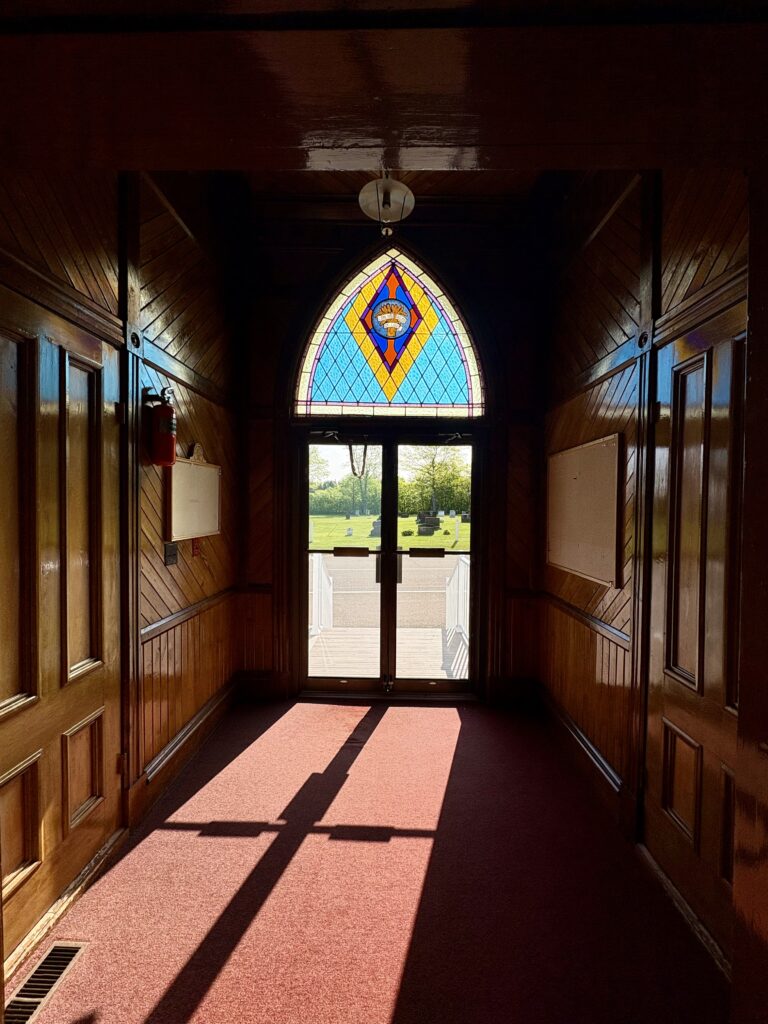
The front door of Freeland Presbyterian Church on the morning of my mother’s funeral, waiting to welcome her one last time.
This tragic item on the front page of the May 19, 1925 Charlottetown Guardian left me wanting to know more about Roma Theresa Morgan. I’ve pieced together a bit of a history from a couple of census records and a baptism record for Theresa or Teresa, born May 10, 1894 probably near Fort Augustus, PEI, where she was baptized on May 27, 1894 at St. Patrick’s church, to John Morgan (born in Ireland around 1839) and Mary (Monaghan) Morgan (born Ireland August 10, 1854).
By the 1911 Census, John was dead and Mary and Theresa were living with a border at 58 Queen Street, Charlottetown. By 1931, Mary was living with her oldest child, Joseph, who was single and a farmer in Watervale, PEI.
Dear Theresa would have just turned 29 around the time of her death in faraway Brooklyn. How did a PEI girl get to New York 100 years ago and become a magazine cover model? Did Theresa send money back to her family, along with copies of the magazine covers? What must they have thought of her new life?
Charlottetown Girl Takes Poison by Mistake

(Special to the Guardian) NEW YORK, May 18 - Three years ago pretty Roma Theresa Morgan, whose mother and sister live at 58 Queen Street, Charlottetown, P. E. I., came to New York, to win fame and fortune. Today she is on her way back home in a casket, the victim of poison taken by accident.

Roma posed for several of the greatest magazine cover artists in America but a few months ago was obliged to cease working because of poor health. The other evening her landlady Mrs. Elsie Ilse, who maintained a furnished rooming house over in Brooklyn found the girl writhing on the floor of her room. She was rushed to a hospital but all efforts to save her life were in vain. The police say the girl mistook a bottle of poison for rheumatism medicine.

No notes were found which would indicate suicide and other roomers in the house knew her as a cheerful friendly person.
Ruby-throated hummingbirds are back on PEI, and the first one arrived in our yard on May 8. They are beloved summer residents, adding zip and zing to our summers and then heading south again the first or second week of September.
I have two feeders for them (three, really, as I have an extra one to replace one that is being cleaned). The sugar water they drink also attracts ants, who motor up and down the ropes the feeders hang from, many of the little souls drowning in the feeder wells. Hanging hummingbird feeder moats that hold water can be purchased to block ants from reaching the feeder.
Or you can make your own for free from some wire and an old spray can lid or something similar. There are a million tutorials online. Poke a hole in the lid, bend a wire hanger into a hook and push it through the hole, and seal and glue the hanger in place. I made some over 10 years ago and they are still saving ants from a sugar-high death.