Author Archives: Thelma

To The Woods

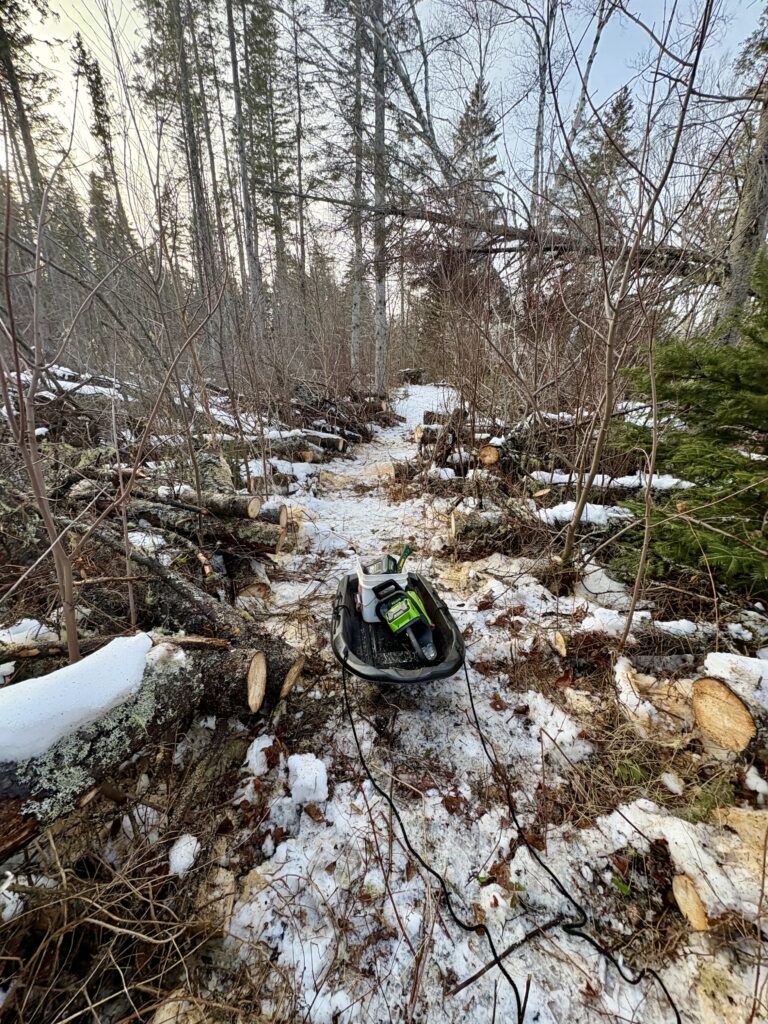
Today our weather station recorded a high of +10C, which is unusually high for January. I spent the afternoon in the forest clearing trails that were first partly blocked by trees that fell during a storm called Dorian in 2019 followed by an even more severe loss of trees from storm Fiona in 2022. Looking after my mother took priority over the past few years and I just never had much time to get out with a chainsaw.

Mild weather and little snow on the ground means I have quickly pushed through some big tangles of trees the past few days and am now making good progress.

Black sleigh holding a green chainsaw and white bucket sitting on a snow-covered forest trail with cut logs on either side and standing trees in the background.
My little sleigh with chainsaw and supplies sitting in a newly-cleared section of trail.

The fresh air was wonderful, one of the many joys of a battery-operated chainsaw, though I did fire up my ancient Stihl for a bit to tackle some bigger trees. I haven’t used it much in the past couple of years and was surprised that it sparked up pretty quickly, even using some old gas. I should be nicer to it.

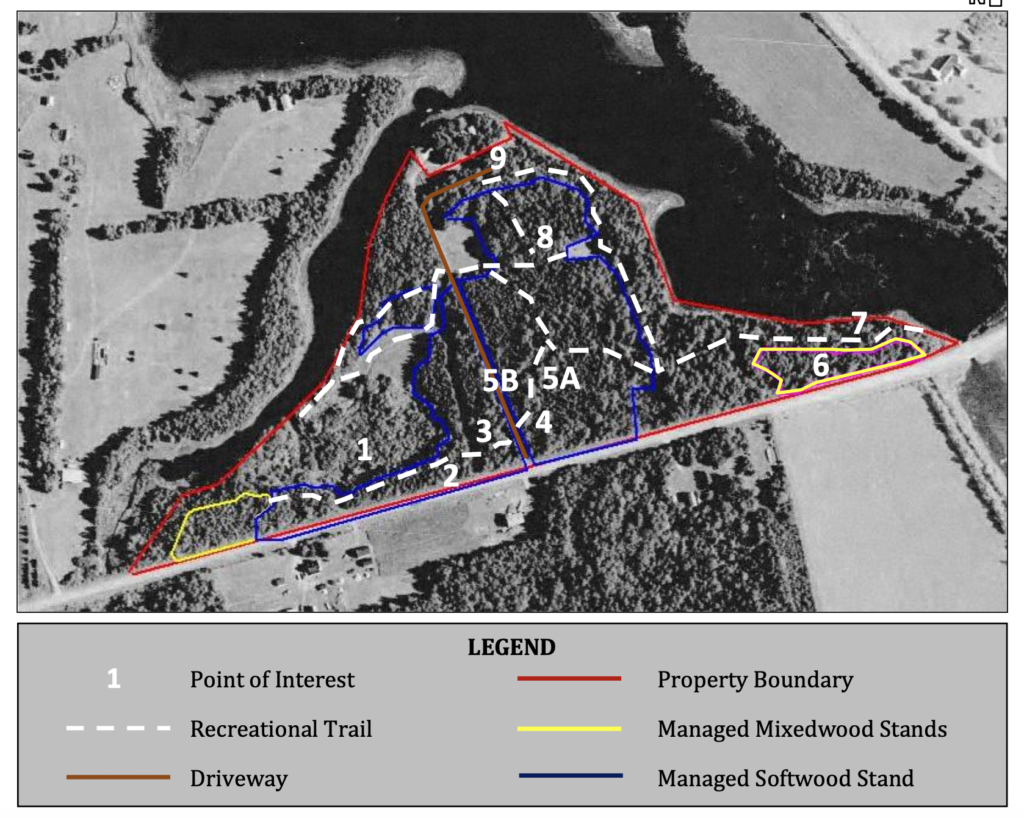
Black and white map of the land we occupy showing trails in white.
Map from a field day held here in 2009. Today I was working near #8 and then started the section halfway between 5A and 6.

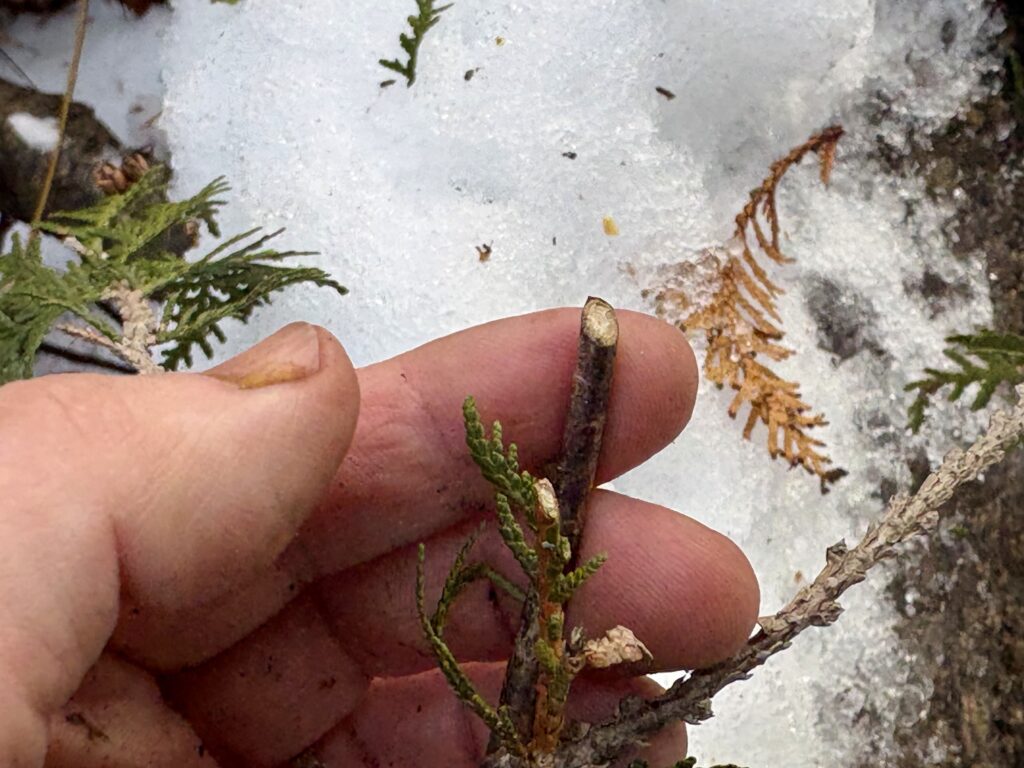
Today I found evidence that snowshoe hares somehow get onto fallen logs to get close to the tender ends of cedar trees. After many years of seeing very few hares, there has been a spike in the past couple of years and the forest is filled with tracks. I’m guessing there are more places for them to hide in all the fallen trees and brush, but I also remember old timers talking about a cycle “rabbits”, an ebb and flow of them over a decade or more. We are certainly at a peak.

The end of a cedar branch that has been eaten off by a snowshoe hair being held in the hands of a fair-skinned person with snow in the background.
Snowshoe hare food.
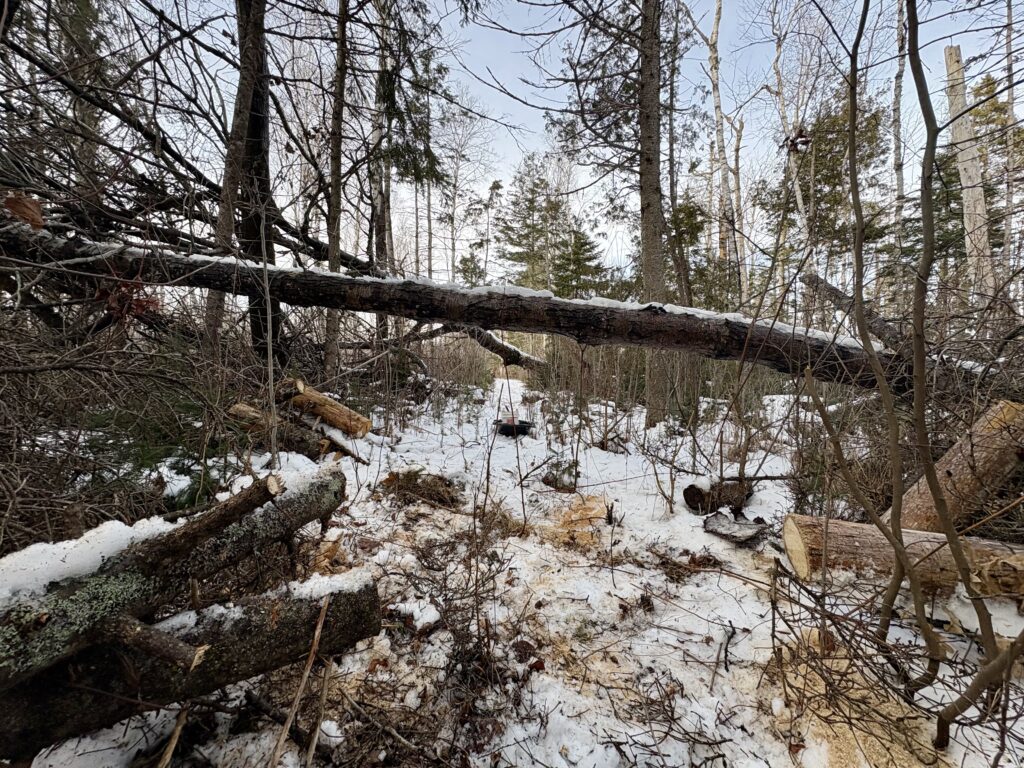
A large tree leaning across a forest path, with cut logs on either side of a snow-covered forest trail and standing trees behind.
A couple of large trembling aspen that I can easily climb under and may have to wait for someone with more nerve and a bigger chainsaw to tackle.
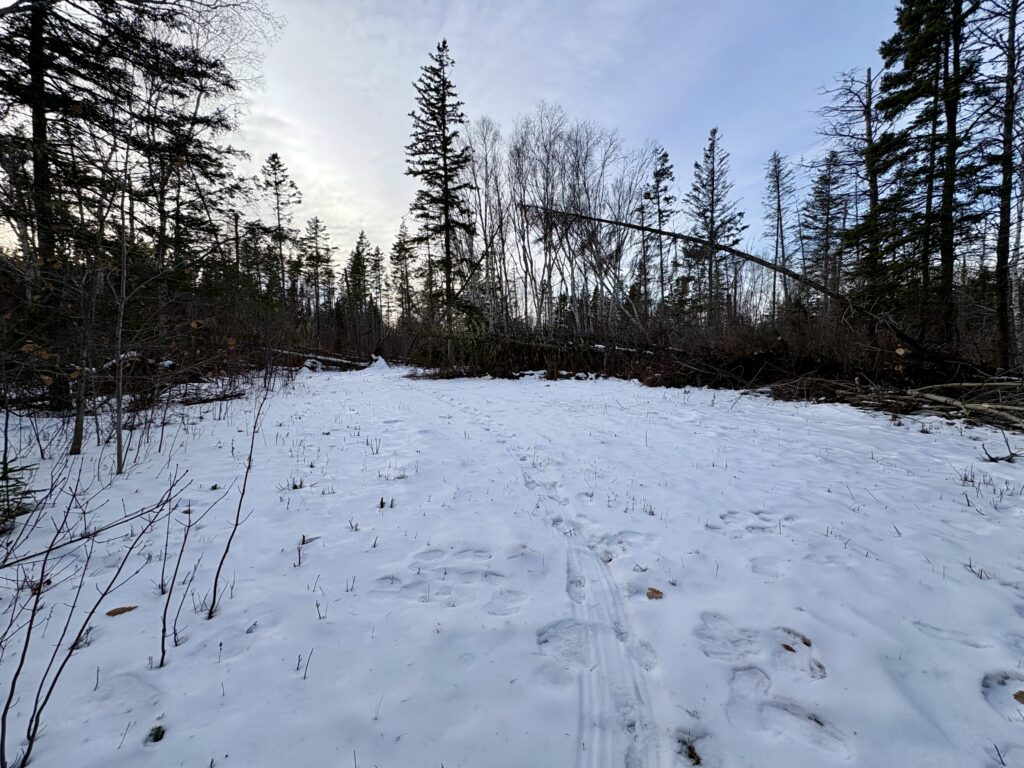
Snow in the foreground, sky in the background, and both standing and fallen trees in the middle.
Heading home. Still lots to be done.

West Prince Forest Fire 1889

When I happened upon what is said to be the last intact telegraph pole on PEI earlier this year, I searched the islandnewspapers.ca site for more PEI telegraph information and found the article reproduced below about the 1889 West Prince Forest Fire.

The information I’ve shared about the 1960 West Prince Fire is, by far, the part of my website that generates the most emails and comments, so I’ll add this article to the pile of Prince County fire info.

Note: I’ve left the term “squaw” in as it was commonly used at the time, but want to point out it is an archaic, offensive term for an Indigenous woman and best left in the past with similar racist, misogynistic language.

For some time past forest fires — many of them started for the purpose of clearing land — have been more or less prevalent in that portion of Western Prince County lying between Port Hill and Alberton. No consequences of a serious nature were anticipated from these fires, and the people generally paid but little attention to them.

However, the high wind of yesterday fanned the flames, and in an incredibly short time all that stretch of country between Conway Station and Alberton was a mass of fire. The flames spread with great rapidity, licking up almost everything in their way. The roaring of the fire as it spread was terrific. Everything possible was done to stay the progress of the flames, but without success. The fire fiend was master of the situation.

At O’Leary, Barclay’s mills were burned down. The dwelling house of Mr. White, the dwelling and office of Postmaster Frost and several unoccupied buildings met with a similar fate. It was only by the greatest exertions that the railway station house and coal shed were saved, clay having to be shovelled upon the fire to prevent its spreading in that direction.

It is feared that a squaw and her child, encamped a short distance behind the station at O’Leary, were burned to death. Rumors of other persons being burnt are also afloat, but lack confirmation. Let us hope that the rumors may prove groundless.

Between O’Leary and West Devon the fires were burning so close to the railway track that the express train, in charge of Conductor Kelly, had to be stopped several times to examine the track before proceeding.

At West Devon, Arthur’s mills were burnt down, and all his lamber was destroyed. The heat from the burning mills and lumber, as well as from the fires in the woods, burnt the sleepers and warped the rails for nearly half a mile, necessitating the stopping of the train at that place. Here Conductor Kelly took advantage of the only clear space available, and here for a time he and his men had to work hard to keep the train from being burnt up.

Besides Arthur’s mills, at West Devon, three or four dwelling houses were destroyed. It is said also that several farmhouses in the vicinity of that place succumbed to the devouring element, but we cannot vouch for the correctness of the report.

The heavy rain which began to fall between seven and eight o’clock last evening put the fires down a little and cooled the air considerably. This enabled the men to go to work and make the necessary temporary repairs to the track, in order that the train might be able to get over. By ten o’clock new sleepers and rails were put down and other work performed which enabled the train to pass over and proceed on her way.

The train had to proceed at a slow rate of speed. The sleepers in many places were burnt, and between Portage and Conway a culvert was destroyed. Here, again, the train had to stop, and temporary repairs had to be made before they could proceed. As they went along, the greatest care had to be taken to prevent an accident to the train. The line was carefully scrutinized to see that the rails and sleepers were in their places, and that the track was free from obstructions. On the way they could see the telegraph poles and trees, as they were attacked by the flames, sway to and fro finally falling — many of them across the track, necessitating further stoppages. At Portage Mr. Wallace’s dwelling house and saw mills were burned down. Several small houses between Portage and Conway also succumbed.

So great was the heat from the flames all along the route of the fire that it was with the greatest difficulty anything could be done to stay the progress of the flames. The smoke was also very troublesome. Some of the people living in the neighborhood took the first opportunity of sending their wives and families away from home, remaining behind themselves to battle with the enemy. But their efforts were largely futile.

Conductor Kelly’s train reached Summerside shortly before three o’clock this morning, where she remained until seven this morning, when she left for Charlottetown, arriving at half-past nine.

The mails and passengers by the St. Lawrence were brought to the city last evening by a special train from Summerside in charge of Station Agent Grady. As soon as the news of the delay in the arrival of the express was received here, Summerside was instructed to make up a special and forward the mails and passengers immediately on arrival of the steamer. This was done. The promptness on the part of the railway authorities is very commendable.

The western freight train, in charge of Conductor Ryan, was held at Port Hill by order of the Superintendent until daylight this morning, when she proceeded on her way. To-day all trains except the western freight above referred to are on time.

Up to the hour of going to press this afternoon there was no telegraphic communication west of Port Hill, so that no information as to the situation of affairs to-day is available.

The Daily Examiner, September 20, 1889

Classifieds

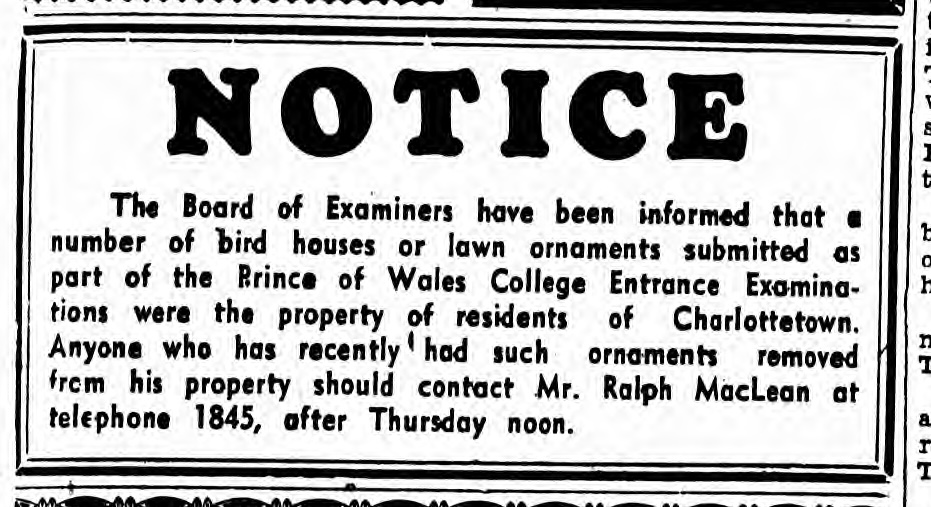
Classified newspaper ads of yore were often fairly stale and repetitive, but every so often one popped out. Here are a couple of my favourites.

Bird House Caper – Charlottetown Guardian July 21 1948 page 9
Free Debris – Journal Pioneer June 4, 2011. Never saw who won or what their prize was.

And as an added bonus, feast your eyes on this unfortunate layout in a Lawton’s weekly sales flyer from November 12, 2011.

You can manage to get diabetes from our sales items.

Cloudy with a chance of poutine

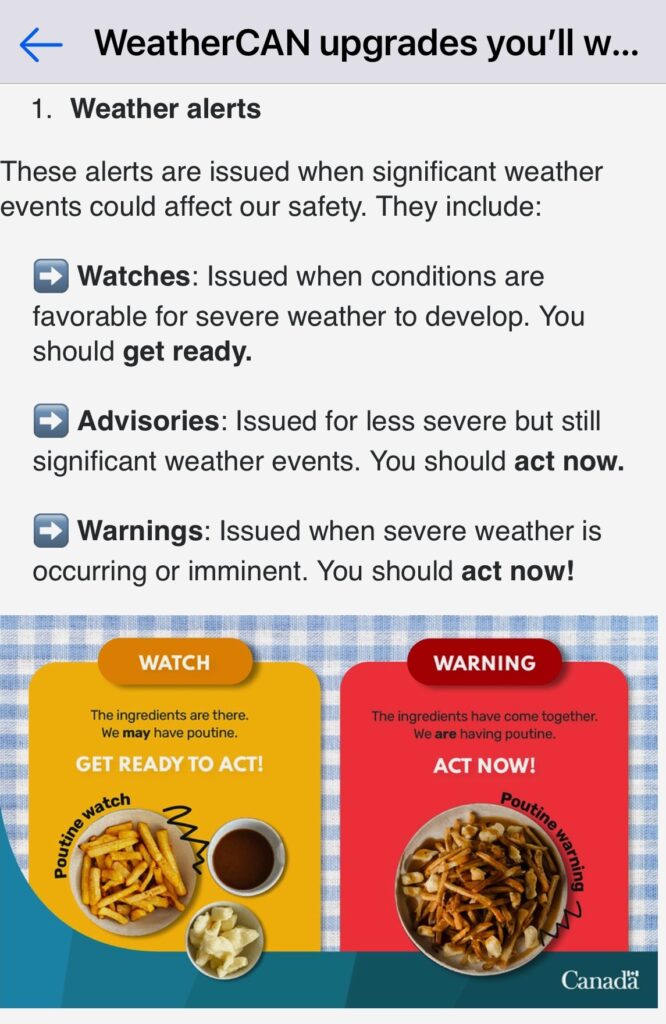
Environment and Climate Change Canada have added colour-coded weather alerts to their weather warning system, similar to what is used in the UK Met Office and many other jurisdictions.

The blurb on the WeatherCAN app explaining what the new alert systems means spoke to me as someone who once had to issue press releases saying the same thing over and over but still somehow make it original enough to catch some news desk jockey’s eye. Bravo!

Screenshot of page from a smartphone app that compares the new weather alert colour codes to making poutine. The ingredients for poutine are in the yellow watch category with the words "The ingredients are there. We may have poutine. Get ready to act", and the ingredients are combined in the red warning category with the words "The ingredients have come together. We are having poutine. Act now!"

Thomas Phillips Family Reunion

My great grandparents, Thomas and Agnes Phillips, lived on a farm on the Ellerslie Road. Agnes died in 1920 at age 66 and Thomas four years later, aged 72. Their youngest son, my grandfather Alvin, married my grandmother, Gladys, in 1912, and I assume they lived with Thomas and Agnes as Alvin eventually took ownership of the farm.

On September 30, 1925, all nine of Thomas and Agnes’ children returned to Ellerslie for a reunion. The rapidly growing clan would meet regularly over the following decades, into my lifetime. The last Phillips picnic I can remember was held at the West Point Lighthouse, 10 years or more ago.

My father knew most of his 38 Phillips first cousins quite well, though I could never keep them straight. Using a genealogy app (the reliable and powerful Reunion) for the past twenty years has definitely helped me with the “who’s yer father” game.

Those who met that September night are long gone, the last, Penzie (Martha Penrose “Penzie” Millar), in 1975. Their children are all gone now as well, the latest to die probably being my father’s brother, Sterling, in 2022, the youngest son of the youngest son. 

I attended the funeral of what I believe to be one of the last spouses of my father’s Phillips first cousins just last month, a woman I had heard about from my parents, and who I no doubt met at a long-ago picnic. She lived to be 105. I didn’t know anyone at the funeral, her children being older than me and having moved away many years ago, but I was glad I went to represent my branch of the family. May the circle be unbroken.


FAMILY REUNION

On the evening of September 30th the family of the late Mr. and Mrs. Thomas H. Phillips of Ellerslie assembled together with their husbands and wives at the old home. The family were all present namely: Mrs. Joshua Millar and Mrs. E. S. Burleigh, Ellerslie, Mrs. Leslie MacLean, Arlington, Lot 14, Mrs. Russell MacArthur, Enmore, Willard of Summerside, Sanford, Sargent and Forrest of O’Leary and Alvin on the homestead. After partaking of goose and other delicacies all gathered in the living room where the evening was pleasantly spent in games, music and singing till after midnight when all joined heartily in singing “God Be With You Till We Meet Again” after which all departed for their homes, hoping to meet again on many such occasions in one unbroken family circle.

From the Charlottetown Guardian October 7, 1925, p6.

A group of people facing the camera, with trees in the background
Cousins and more cousins at a Phillips picnic at Green Park, 1971. Still from 8mm film footage.

Standing tall

I’m happy to report that what is advertised as the last telegraph pole on Prince Edward Island does indeed still stand, insulators and all, on the Confederation Trail halfway between Elmsdale and Alberton, and it’s also easily visible from the Dock Road. The day I found out about the pole’s improbable existence, on a walk from Elmsdale towards Alberton, we had stopped just about halfway between the two communities at the beginning of a bend in the trail.

As we moved towards our previous-day’s stopping point, this time from Alberton, a couple of days later, I began to doubt we would find it still standing. Suddenly there it was, a few feet around a bend from where we had stopped and turned back.

Grey telegraph pole in the centre of photo, with cloudy sky at the top and leafless bushes and dried grass around. A gravel trail is on the right side.
Close up of three black insulators on the top of a grey telegraph pole. There is wire around the pole, and a cloudy sky in the background.

The PEI Railway opened in 1875, 150 years ago this year, 50 years after the first recorded passenger trail journey between Stockton and Darlington on September 27, 1825 (a gorgeous episode of the BBC Radio 4 Illuminated documentary series brings that event to life). Could this pole be 150 years old? If so, it has survived forest fires and ice storms, vandals and woodpeckers and rot. I suspect its survival might be due to the fact it is planted in a swampy area, replete with spiky bushes, at the bottom of a steep bank. “Let’s just leave ‘er, boys!”

As historic sites go, it’s not Green Gables, but it is a relic of an important Island story. The railway opened up commerce and travel to people in far-flung parts of PEI, and allowed farmers and fishers access to more markets. Building the railway nearly bankrupted our small island colony, so PEI finally agreed to join Canada in 1873 so the project could be finished with an influx of federal dollars.

In addition to signalling train travel, the telegraph that accompanied the railway brought news and could summon assistance in case of emergency. Imagine living in non-electrified 19th century Alberton, heating and cooking with wood, lighting with candles or newly-discovered kerosene, travelling by horse and wagon or sleigh, and then suddenly being able to send a telegram to your brother in Boston asking about work opportunities or ordering supplies from Holman’s in Summerside in the morning and then having them shipped to you by train that very afternoon? It would have felt like magic. And that pole helped make all that happen.

As much as it was a thrill to find the pole right there in the open, I wonder if someday it might be able to stand proud and straight inside a centrally-located provincial museum? Time will tell.

A person with pale skin wearing a hat and holding a walking pole standing next to a trail in front of a leaning telegraph pole. There is a cloudy sky at the top and bushes, grass and trees behind.
Happy Nerdmas (which is every day at my house)

Delta Airlines Flight 67

I was sitting on my shop step late this afternoon watching the hens run around the yard. The sun was shining for the first time in about a week or more, there was no wind, and everything was beautifully quiet.

I heard a strange noise that seemed to come from far away, sort of a thud. Machinery from farms or nearby bridge repairs pass by occasionally, but I didn’t hear a vehicle.

Then I heard a jet, a common enough thing where I live, but when I looked up, instead of seeing a plane flying east to Europe or west to the rest of North America, directly overhead was a plane flying south. I could see the wings glinting at an odd angle, and it looked to be lower than the usual 35,000 or whatever feet above.

Blue sky with a jet contrail in the middle and treetops at the bottom.
Ummm…

Suddenly a contrail was visible as the plane disappeared from view. When I clicked on a flight radar site, there was Delta Airlines Flight 67 from Rome to Atlanta but no longer heading to Atlanta.

Screen shot of a plane flight path.
Screenshot of Flight 67 still listed as heading to Atlanta but really heading to Halifax.

The flight track log shows the plane going over our house between 4:08:42 and 4:09:13, and I took the photo at 4:10. Their southwesterly track changed right off North Cape at 4:06 and by the time I saw it four minutes later, it had dropped from 11,582 meters (37,998 feet for you metric/imperial mixed up Gen Xers like me) to 8,854 meters (29,048 feet).

The flight’s destination changed to YHZ and I watched online as the plane went over the Minas Basin, tracked the Avon River headed for Halifax Stanfield International Airport and thankfully landed safely at 3:33. Whatever event caused the redirection seemed to be dealt with quickly, and the plane took off about three hours later and is en route to Atlanta as I write this. The passengers and crew had a long day, but now had a tale to tell of stopping in Nova Scotia. They won’t forget that flight.

Screen shot of a plane flight path on the left, with text on the right describing the flight from Halifax to Atlanta.

If I had been in our house or had my headphones on, I would have missed this little blip in transatlantic transportation, like the farmer in Brueghel‘s Landscape with the Fall of Icarus missed seeing a man who flew too close to the sun hit the water behind him as he was engrossed in plowing his field.

Would it have mattered had I not seen Flight 67? No, not in the great span of time. Is it worth sharing on the internet? Probably not. But I’m glad I shared it anyway. We all have tales to tell, sometimes the same one, just from different perspectives. Every person on that plane will be telling someone of their long day, the sun, the wings glinting as the aircraft turned, the water below.

What did you see today? Who will you tell?

The Last Telegraph Pole(s) on PEI

Steven and I walked the Confederation Trail from Elmsdale corner half way to Alberton and back this morning, about six kilometres round trip. We had planned to walk to Alberton and back, but the cold wind was whipping and that was far enough.

We saw a couple of lupins blooming well out of season, some daisies, lots of apples and even some grapes. As always, the trail is beautifully maintained and clean. Benches and shelters with picnic tables along the way make this entire trail an ambler’s dream.

Interpretative storyboards have added interest to each walk we’ve taken, but this one really caught my attention: the last telegraph pole on PEI? Yes please!

A storyboard called Last Pole Standing with text in English and French, with a photo of the top of a telegraph pole complete with insulators, and photos of steam locomotives in the bottom corners.

LAST POLE STANDING
The P.E.I. Railway was welcomed by communities across the province that had previously been limited to travel only via poor (often impossible) roads and coastal boats. In May 1875 people who had known isolation all their lives were suddenly able to reach any of the Island centres with comparative ease. They received mail twice a day rather than twice a week. What a change! The railway also connected rural communities with the world. The Island had an underwater telegraph cable to the mainland since 1851, but the service was only available in large urban centres. Telegraph lines now followed the tracks from Tignish to Souris, linking all railway stations. It was used for emergencies along the line but also by government and business. The entire service was operated by Canadian National Telegraph from the 1920s but previous operators included the P.E.I. Railway and Anglo-American Telegraph. The last pole standing is located about halfway between Alberton and Elmsdale.

We were halfway between Alberton and Elmsdale! I looked near the sign for a pole to match the photo, but no luck. I’m now anxious to make the trek from Alberton to where we stopped to see if that last pole complete with insulators still stands.

I did notice a couple of poles without insulators on our return walk that looked like the pole on the sign. They were shorter than most poles, and three notches were clearly visible at the top of both. They seem to be holding fibre op cable, the modern telegraph, I suppose.

In trying to (unsuccessfully)* find out what the little wooden insulator holders are called, I came across some wonderful websites, including one for the UK-based The Telegraph Pole Appreciation Society and, well, anything I clicked on after searching for “parts of Canadian telegraph poles”.

*I did some further reading and believe those little wooden pieces that held the insulators may have been called side-block brackets, as per this archived article by John Gilhen**, “Telephone and Telegraph Insulators: The End of an Era”, published in 1976 by the Nova Scotia Museum.

**John Gilhen died in April of this year. He had a 50 year career at the Nova Scotia Museum in the natural history section. His obituary noted he was “an avid collector including antique glass and insulators, hockey pins and cards.” He sounded like a marvellous, interesting person.