It was fine; I had fun with my friends when I saw it a couple of weeks ago.
But I can’t stop thinking about why a character had TWO boxes of Maldon Sea Salt on her kitchen shelf, about four feet apart. Why, set dresser, why? What does it mean?
I also still worry about what became of Sally Draper.
Today I wrote an exam to obtain my basic Canadian amateur radio operator certificate, and I passed! Within an hour of completing the in-person, on-paper exam, I received an automated email from Innovation, Science and Economic Development Canada, the government body who oversee radiocommunications in Canada, inviting me to create an online account and get my call sign.
I am now VY2VH. “VY2” is the prefix for PEI, and “VH” is in honour of my mother, Vivian Hardy, her name until she married my father, Harold Phillips, so handily the “H” if also in honour my father. Victor Yankee Two Victor Hotel.
I have never studied so hard for anything in my life, two online classes a week since the middle of February with the wonderful Al Penney (VO1NO) from Nova Scotia, who runs the course for the Radio Amateurs of Canada. There was a lot of math and formulas at the beginning and I was certain I would never get it all straight in my head, but I read and studied and it finally all came together. It’s an interesting course, Al is a patient and goodnatured teacher, and if I can pass it, anyone can. It’s only $50, about the same again for the study guide, and the radio licence is free and for life.
There is a little handheld radio tuned to the O’Leary repeater sitting on my counter. Every so often it beeps or the time is announced. I heard a couple of people saying hello to each other, talking about the rainy weather and wishing each other a good night. The examiner from the Summerside club was a kind and generous fellow and it seems like a welcoming community. Will report back when I actually get up the nerve to push the button and talk.
My mother’s initials, V.H., painted on the second floor of her grandfather’s barn in 1938, the year she turned 16 and went back to live with her father.
On an early-morning amble through the decommissioned shale pit near our house today, I noticed a cloudly icicle hanging from the cut end of a tree. The maskwi (white birch) had toppled over sometime last year and I cut it in the winter so I could use the path. I didn’t bother severing the trunk from the ground, so it was still alive. The temperatures had fallen to -5C overnight, so the sap that was rising froze as it dripped.
I broke off a piece and popped it in my mouth, and there was the faintest sweetness there. Collect enough and boil it down and a sweet syrup can be created.
I have never seen this before, a sapicle. I’ve seen lots of maskwi stumps, but it must have been the angle that the trunk was leaning that allowed this sweet phenomenon to occur.
Every time I go for a walk in the forest next to our house, I see something new. Every time. You might think that’s an exaggeration, that I can still find something new here after 60 years, but I do, and it still surprises me. Something as simple as some dripping sap can connect me to the gifts of the earth and the power of the sun and the magic of walking slowly and looking with newly-opened morning eyes.
A friend recently purchased a new top-loading GE washing machine, model number GTW491BMRWS, from a large Canadian furniture and appliance company with an outlet in Summerside. Remembering a time when appliances were much more basic, she wanted a machine that would add as much water as she likes, unlike most washers that limit water to meet energy efficiency and water conservation standards.
To allow more water to be added to wash loads, many GE models offer something called Deep Fill, a button you push to add more water, and her machine has that feature. Try as she might, though, she couldn’t get that button to work. A little LED next to the button would never light, and she read the entire manual trying to figure it out.
She contacted the store, but as more than 72 hours had elapsed since she purchased the washer (really), they wouldn’t help her and she would have to contact GE to get them to send a service person. The store folks did suggest that she try unplugging the machine to reboot it, which she did, but still no luck. She was feeling pretty disappointed.
I found the answer through some convoluted web searching, and eventually discovered GE’s explanation:
Deep Fill is available on all wash cycles except the Normal/Colors cycle due to 2016 Department of Energy regulations.
GE doesn’t add that helpful tidbit to their owner’s manuals for reasons unknown. There are detailed tables in the booklet that explain all the different cycles that can be used, and in what combination with which options (many, many knobs and buttons), but nowhere in there does it say “don’t bother using this button with the Normal soil level setting.”
This is my first post to be tagged “enshittification”, but probably not my last!
Here are two stories from the Charlottetown Guardian archives about long-ago aviators with PEI connections: Patrick Peters and Frederick Tobin.
First on the runway is Patrick Peters, who was reported to have built a flying machine and took it to Maine in 1890 to put on public shows. I’ve not found the original article that was quoted in the August 26, 1950 Guardian piece I read or any other account of his time in Portland.
I located a Patrick Peters on Find a Grave who was born around 1864 and is buried in Rumford, Maine, so he could very well have been the brave flyer; his connection to PEI seems valid even if the information about his date and place of birth is a bit mixed up.
Report Tells How PEI Man Navigated Air Machine In 1890
How a Prince Edward Islander navigated a 38-pound flying machine as far back as 1890 is related in the following article reprinted from a Halifax exchange of Aug. 13 of that year. The Islander’s name was Mr. Patrick Peters and the report tells of his arrival in Portland, Maine, with his machine.
Mr. Peters said he had made up his mind in 1885 that he was going to make a machine that would navigate the air. He objected to balloons, he said, “because they were too far beyond the control of those who risked their lives in them,” but believed a machine could be constructed capable of being as much under the management of the flyer as a horse rake.
He said he “took the wings and motion of a bird for a model, believing that if he could fly like a bird it would be quite enough. Only after repeated failures did he bring his idea to a point where he could say with any degree of confidence, “I can fly”.
“At last,” the report continues, “he constructed a bird of the following dimensions: From the head to the tail, 16 feet, and from the body to the end of each wing, 3 feet. The seat was in the body and the motive power used in the propelling of the machine was obtained by a combination of wheels.”
Described Flight
The account describes Peters’ first flight.
“His first real trial of his machine was made when he passed over a forest, making about two miles in about four minutes.”
“From his description of the way things looked below it would seem possible that he went at least 2,000 feet up in the air, and perhaps more than twice that distance. He says he went up and down at will, managing his 38-pound machine without the least degree of trouble.”
Peters’ purpose in going to Portland was “to make a little money by giving a public exhibition of his machine.” “He says he is willing to give any desired test and can go any distance desired. He can keep a few feet above the ground or can go up into midair.”
Peters assured Portland people that “it is a perfectly easy thing to fly with one of his machines.”
In 1890 there was still quite an amount of suspicion towards anyone who claimed he could fly, so the story concluded: “Portland people who know Peters say he is honest and he acts that way.”
Charlottetown Guardian – August 26, 1950
Our other flyer, Frederick J. Tobin, was as famous as Peters was mysterious. The following article from the September 29, 1925 Guardian describes his first connection to 20th century airship history as a surviving crew member of the Shenandoah that crashed September 3, 1925, and includes a link to an even more notable event he was involved in some years later.
Islander Has Narrow Escape
Among the members of the crew of the ill fated United States dirigible “Shenandoah,” which crashed to earth in Ohio over three weeks ago, with a heavy loss of life, was Pilot Frederick J. Tobin. Mr. Tobin is a son of Mrs. Margaret J. Tobin, formerly Miss Margaret O’Brien, daughter of the late Mr. and Mrs. John O’Brien, of Bristol, Prince Edward Island.
Pilot Tobin had a miraculous escape from death, having fallen on the tree tops.
Letters from Mrs. Tobin to her sister Mrs. James A. O’Brien, Morell, and her brother, Mr. John O’Brien, Bristol, state that after Fred fell on the tree tops, a part of the rigging caught in his clothing and carried him off again trough the air. Once more he became disengaged from the plane and fell to the earth from an altitude of 100 feet, and was picked up by a passing plane, and at once carried to safety.
After a day of terrible suspense Mrs. Tobin was getting ready to go to Lakehurst, when she received news of her son’s safety.
Both Mr. and Mrs. O’Brien, aunt and uncle of Mr. Tobin, are very proud of his escape, and of the honor that will now be his. Prince Edward Island also has need to be proud of her grandson, as she can claim him through his mother. Mr. Tobin was next to the late Capt. Lansdowne. If there is another Shenandoah constructed Pilot Tobin may be first in command.
The Boston Post of September 11th contains a photo of Pilot Tobin, and the following notice: Frederick J. Tobin, a member of the crew of the Shenandoah who is reported safe, is well known in Arlington, where he formerly lived. He is the son of Mrs. Margaret J. Tobin of 6 Russell Terrace, Arlington. He has been in the United States navy for 11 years.
He was married two years ago, and besides his wife, who lives in Lakehurst, N. J., and his mother, in the family group are a sister Miss Mary R. Tobin and four brothers, Frank E. Tobin, a veteran of the late war, Henry L. Tobin, John L. Tobin and George W. Tobin, all of Arlington.
From a September 4, 1925 Boston Globe article on the Shenandoah crash.
Patrick J. Tobin shown third from the right ,middle row of this composite photo from the US National Archives via the NavSource Naval History website’s page about the Shenandoah: https://www.navsource.net/archives/02/99/029901.htm
Tobin remained in the US Navy after the Shenandoah crash, and was still based in Lakehurst, NJ in 1937 when the Hindenburg made its final voyage. Not only was he there when the Hindenburg came in for a landing, it seems he was standing under it when it exploded, as outlined on Dan Grossman’s excellent Airships.net:
Natural instinct caused those on the ground to run from the burning wreck as fast as they could, but Chief Petty Officer Frederick J. “Bull” Tobin, a longtime airship veteran and an enlisted airship pilot who was in charge of the Navy landing party, cried out to his sailors: “Navy men, Stand fast!!” Bull Tobin had survived the crash of USS Shenandoah, and he was not about to abandon those in peril on an airship, even if it meant his own life. And his sailors agreed. Films of the disaster clearly show sailors turning and running back toward the burning ship to rescue survivors; those films are a permanent tribute to the courage of the sailors at Lakehurst that day.
I’ve probably seen clips and stills from the famous British Pathé newsreel footage dozens of times, but I’ve never seen the original reel and heard the narration that went with it; t was jarring to see that the Hindenburg had Nazi swastikas on its tail.
Interestingly, the “Oh, the humanity!” line so often quoted from the Hindenburg disaster coverage is not from the newsreel but had been recorded by radio reporter Herbert Morrison and matched up many years later.
Tobin retired from military service in 1947 and died in Fort Worth, Texas in 1978 at age 85.
You have until March 16 to bid Hello Weather, 1-833-79HELLO, goodbye, as the federal government announced suddenly last month that the cheerily-named phone service and its radio sibling, Weatheradio, will be discontinued.
Here’s a lovely, wry letter to the editor of the Charlottetown Guardian, printed February 27, 1926, about the joys of being a mail carrier in wintery rural Prince Edward Island.
I think that “breaking a road” meant creating a path with horse and sleigh over newly-fallen snow so that it would be easier for other travellers, and I believe it was up to each landowner to do the section of road that ran in front of their property. I would guess this might have included knocking down tall banks by shovelling. People being people, not everyone would get around to breaking the road early enough after a storm, or at all, as the mail carrier finds out.
In some spots, where winds would regularly leave substantial drifts in the road, section of fencing would be taken down in late fall so folks could travel through a flat field over the winter, so when the writer talks about “going over tree tops, on the road through fields, dodging a fence here, a post there, and a barn some place else,” they weren’t exaggerating.
ONE DAY O. H. M. S.
Sir.— As I was sitting enjoying a good “home fire” this evening, I decided I would get my pen and paper, and write a few lines concerning “One day O. H. M. S.”
This winter especially we have to contend with an immense lot of snow, and storms mostly, every second day. However when the storm eases and the sun shines again, we make ready for our journey (over an unbroken road.) We wait awhile and it’s soon shovelled out, after the men go home with frozen feet, hands, etc. After going to the P.O. we bundle up the mail that has arrived the night before (or what’s left of it) and start our journey with a good, faithful horse that’s not afraid of a few feet of snow. The old horse will wade along stopping at the boxes, some are on sticks, some on snow-banks, and some on posts. Nevertheless we get along a few miles.
“Are you cold, come in, come in—rest your horse—and get warm.” You will welcome the voice of a farmer calling from his barn door.
“Thank you but I must keep on. I am not cold, since the roads are bad the travelling is slow. Good day.”
After going some distance, a man will meet you.
“Glad to see you—you must have had a bad road.”
Farther on a woman will appear.
“Isn’t it cold, if you can’t get through the rest of the way call in and have a cup of tea.”
“Thank you” but on we go. Then comes a turn to the right.
“Whoa—Hello Mr. Snowbank you are in a very convenient place, right on the middle of the road, huh.”
“A step ahead old horse—whoa wait that won’t do, can’t get through that, lay still till I get you unharnessed and the sleigh back—good job I took the shovel, old horse, comes in pretty handy sometimes—all clear come around now if you can. I’ll get you back in the sleigh again and we’ll go back to the P. O.—This won’t make our Route any shorter, old horse, although we have to turn back.”
“Oh good-day sir—yes, yes all right now—thanks—bad roads, bad roads, yes a lot of breaking done on that road this winter—well good day.”
All right, old horse we will go right back home, perhaps “Mrs—“ will be insulted for not calling for that cup of good tea, but we must get back.”
“Hello there” comes a voice like a clap of thunder. “That road broke”—
“No” then some words too numerous to mention.
“Come on old horse never mind h’m”—
“Funny for a man to drive a mile or two out of the way if that’s a passable road, and another man drive a mile or two out of his way for a Doctor if that is a passable road.”
“Too bad we Mail Couriers didn’t have Reindeers, or a few St. Bernard dogs, that could go over those “Passable Roads” then some of our box holders wuld have more time to make false statements.”
Sir.— would you consider a mile of road solid snow banks passable? I find that the individual who has the longest portion of the road to break alone, grumbles the least.
After going over tree tops, on the road through fields, dodging a fence here, a post there, and a barn some place else, we get back to the Post Office.
“Road not broke, had to turn back Post Master.” Now in the sleigh and home again where a good supper is waiting for both.
“Ahem—But its glorious too, to be On His Majestys Service.”
That green-and-white flag in the background of the photo below? It’s the flag of the City of Charlottetown, and I don’t remember ever seeing it before it was helpfully pointed out to me by Councillor Mitch Tweel in this morning’s Guardian.
It’s quite striking. Looks a bit like the diagram for the most boring, frustrating game of chess ever conceived.
Svgalbertian, Public domain, via Wikimedia Commons
But it’s a good design because even I, rural PEI mouse who obviously doesn’t spend enough time in the Capital, knew immediately what it represented: the five squares that were part of the original 18th century city plans.
From Charlottetown Heritage Squares: Conceptual Master Plans and Design Guidelines, April 2012
In my defense, I poked around Charlottetown via Google Street View and saw the flag flying outside Charlottetown City Hall, but couldn’t find it in any other prime flag-flying locations like parks. It certainly isn’t part of the City’s “Great things happen here” branding. I will keep my eyes peeled for it next time I visit.
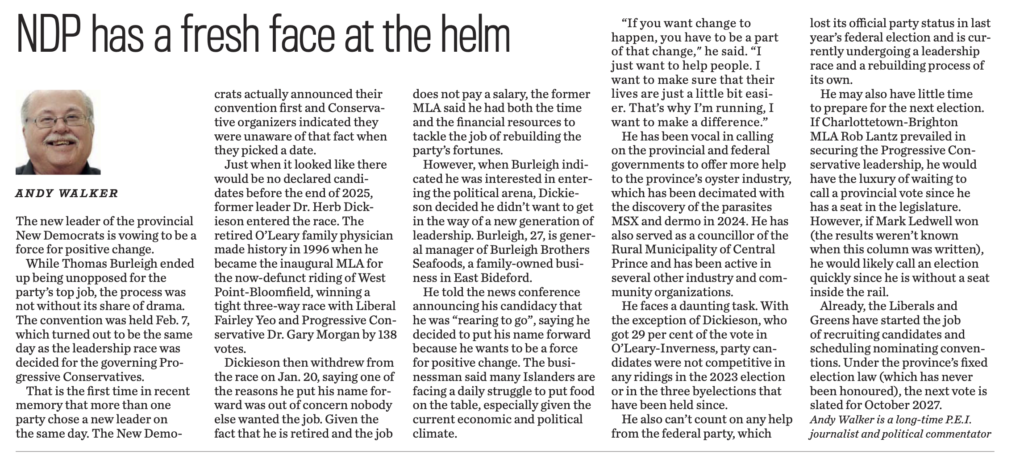
Yesterday’s online edition of the weekly Journal Pioneer newspaper featured an article from a time traveller who had the results of a party leadership vote that will be held tomorrow, February 7 (see the second paragraph of “NDP has a fresh face at the helm” from page A4). I wish they had also included tomorrow’s winning Lotto 6/49 numbers.
From page A4 of the Thursday, February 5, 2026 Journal Pioneer
While it seems likely that the new leader of the PEI New Democratic Party will be Thomas Burleigh, as I believe he is still the only declared candidate, I’m guessing it is also possible that someone could be nominated from the floor of their convention, or Thomas could even decide to drop out at the last minute.
The article goes on to point out that the results of the PEI Progressive Conservative party leadership contest, which is also being held tomorrow, “weren’t known when this column was written.” Certainly true.
I read this article early this morning and am writing this post about fourteen hours later, and I still don’t know what to make of it all.