Here are some 75-year-old Vic Runtz cartoons from the Charlottetown Guardian I’ve enjoyed over the past few months. Plus ça change…
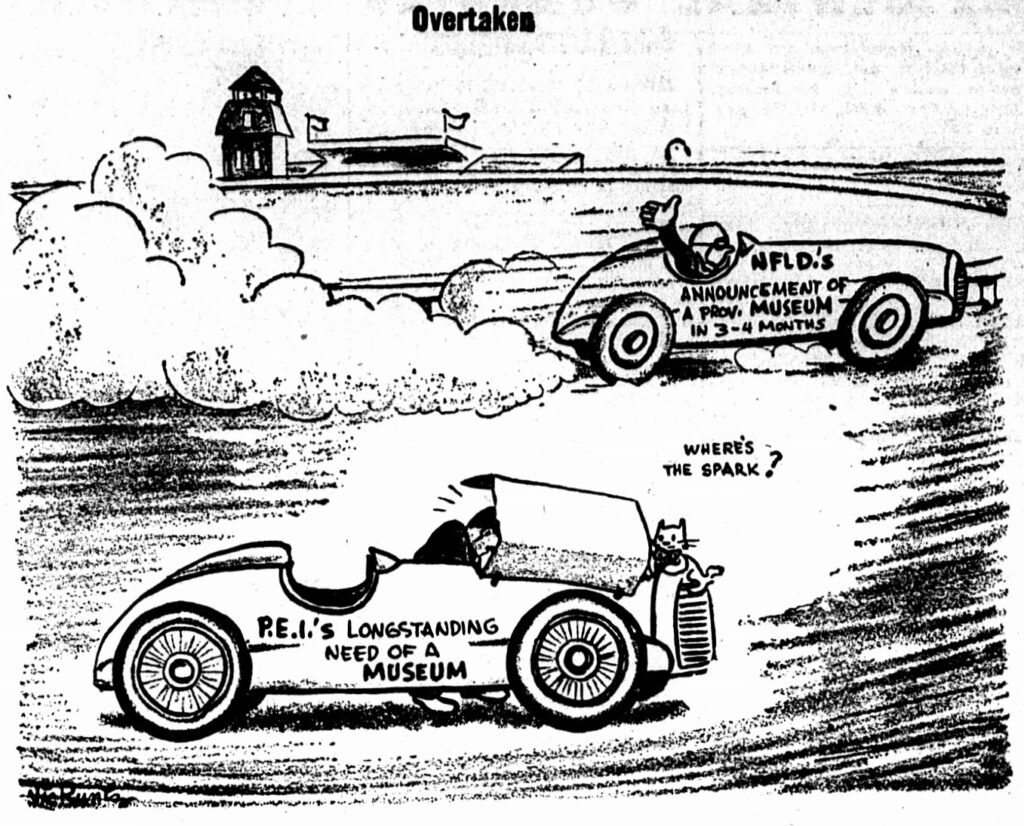

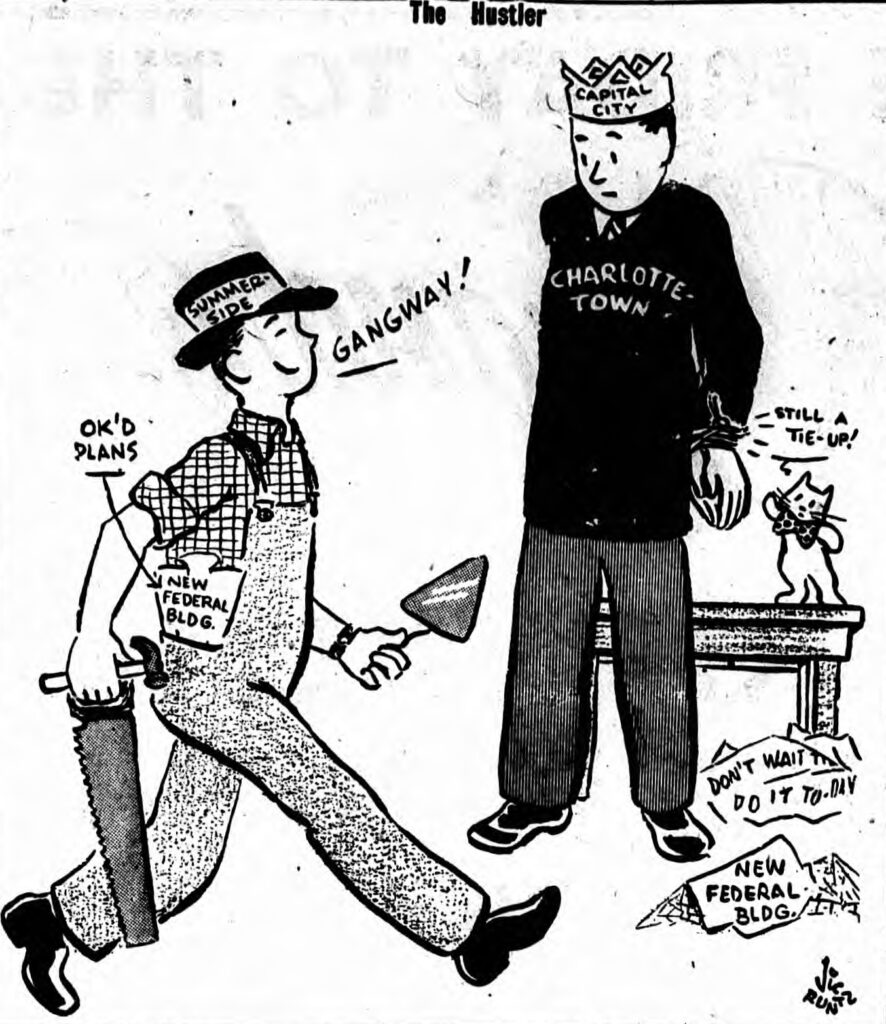

Here are some 75-year-old Vic Runtz cartoons from the Charlottetown Guardian I’ve enjoyed over the past few months. Plus ça change…
If you were born in the second Prince County Hospital (1951-2004) in Summerside, PEI, as I was in October 1966, you were born on Beattie Avenue, named in honour of Summerside nurse Grace Beattie. Her death announcement in the May 12, 1950 Charlottetown Guardian outlines a career and devotion to the nursing profession that would be difficult to imagine being equalled by many other people.
She left the world in the hospital she helped create, just before the old building became surplus with the opening of the new facility, Grace nor the old PCH wanting to exist without the other.
Death of Miss Grace Beattie Widely Mourned
Many old friends in this Province and abroad will regret to learn of the death in the Prince County Hospital on Wednesday night of Miss Grace Beattie at the age of 91 years. She was the first superintendent of the Prince County Hospital and during the past five and a half years she resided there, in the institution she had helped so greatly to organize.
The deceased was a daughter of the late Thomas and Margaret Howatt Beattie of Summerside and received her early education here. Taking up the nursing profession as her life’s work, she graduated from MacLean Hospital at Waverley, Mass., in 1889 and from the General Hospital in Boston in 1893. During that year she was appointed assistant superintendent of Quincy, Mass. Hospital and two years later she organized the Brockton Mass. Hospital and School of Nursing. Here she remained until 1912 when due to illness she resigned and returned to her home town where during her rest period she organized the Prince County Hospital School for Nurses, which had been officially opened about a month previous by the Duke of Connaught during his visit to the Province as Governor General of Canada.
She returned to the United States in 1912 and during the next 17 years her outstanding ability as an organizer was recognized by the leading hospital authorities throughout New England. She was, during that time, entrusted with the organizing and superintending of a number of hospitals and schools of nursing among which was the hospital at North Adams, Mass., and during the First World War she reorganized the lthaca, New York, Hospital where she remained until 1922. She was then appointed superintendent of Elliot Hospital, Manchester, N. H., and while there suffered the misfortune of a broken hip and for two years after was unable to carry on the work of her chosen profession.
After her recovery from the result of the accident, she assumed the superintendent’s position of the Johnston Memorial Hospital, Stafford Springs, Conn., which was run by graduate nurses.
She retired from hospital work in 1929, and although she had then reached the age of 70 years she went to Boston where she took a special course in religious art.
She returned to Summerside in 1940 where she lived until about five and a half years ago and then entered the Prince County Hospital and remained there until the time of her death on Wednesday night.
She is survived by one sister, Mrs. Maynard Schurman, Summerside.
The funeral will take place on Friday when the remains will be taken from the Compton Funeral Home to the Central Street Church of Christ for service at 2.30 P. M.

This brief item in the January 16, 1925 Charlottetown Guardian made me smile. I would expect many Summersiders today would suspect they don’t often get a better deal than Charlottetown folks, but at least on the train in 1925 there was a benefit in coming from the western capital!
The region of PEI where I live is commonly referred to as Up West. It’s more Up Northwest, really, from the rest of the island, but as the main highway through our end of PEI, Route 2, has long been referred to as the Western Road because it starts from the western end of Summerside, we are west.
Some people in central PEI can take the “up” part too literally, as if you have to climb a steep mountain to get here. There is a notion – mostly apocryphal, but a little bit true, in my experience – that when you try to organize a meeting between people in my area and folks from Charlottetown, or even sometimes Summerside, you will hear “But it’s soooo far to go to Tyne Valley/O’Leary/Alberton/Tignish!”, as if the distance would be magically shorter for us to go to them.
Maybe someone at the PEI Railway knew of this magic directional difference, perhaps similar to a magnetic hill, and that prompted the cheaper west-to-east fare to the 1925 hockey game. Mistake? Mischief? Delightful whatever the reason.
The news from the western end of the province in the Charlottetown Guardian from this date 75 years ago had an enticing and sparkly dose of Hollywood magic sprinkled over it.

Thanks to the Internet Archive, I found the July 1949 issue of Modern Screen magazine and the adorable photo of Gus and Miss Stanwyck. I love that Stanwyck looks to be genuinely laughing, and Gus, then in his early sixties, seemed to be quite amused as well.


I’ve snooped around a bit on Ancestry, the PEI Public Archives, and Libraries and Archives Canada to develop the following quick rough sketch of Gus Peters, friend to the stars:
Gus was born Augustus Morris Peters in Summerside sometime between 1886 and 1889, depending on the records. He signed up for service in the First World War on May 13, 1915 in Fredericton, NB, telling them that his birthday was May 28, 1887.
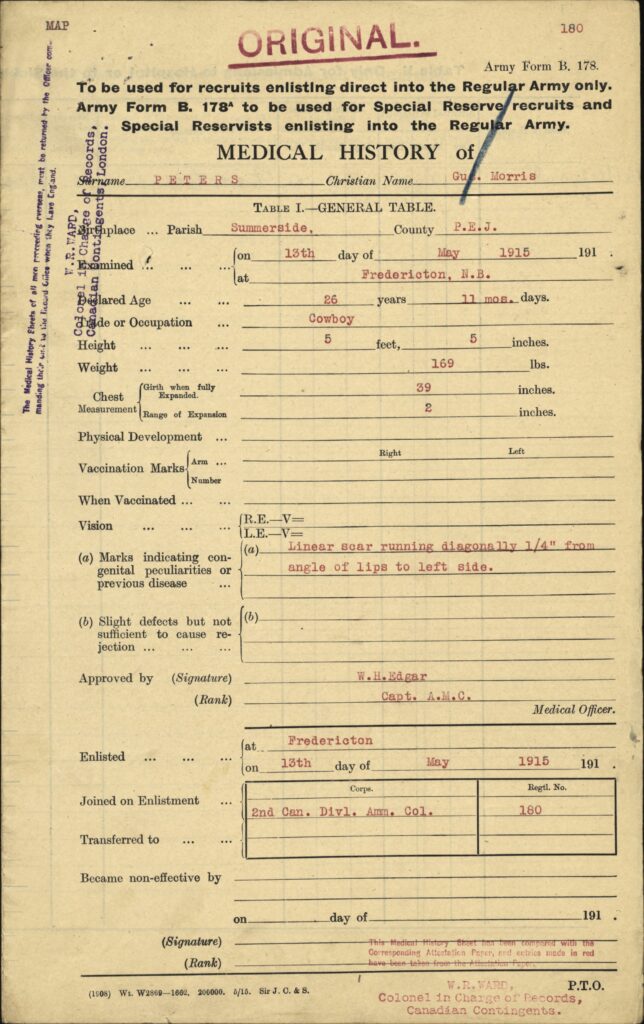
He was assigned to the 2nd Canadian Divisional Ammunition Column, regimental number 180, and was on the SS Caledonia on June 13, 1915 headed for England. Gus was knocked down by a horse in August 1915, broke his left wrist and spent 24 days in the hospital at Shorncliffe army camp.
He was sent to France on September 16, 1915, serving as part of the Second Division of the Canadian Expeditionary Force in England and France, and received his discharge in Halifax, NS on May 25, 1919.
When he signed up for service, he gave his trade as cowboy, and he also referred to himself as a rancher, not really a PEI kind of occupation to have. It seems he worked for a while in North Dakota, and his demob papers said he was headed to Hot Springs, Montana after the war.
At some point Gus moved to California and married Hattie Seligman, born in Missouri around 1886, on July 7, 1928 in Los Angeles, California.
According to the 1930 US Census records, Gus gave his birthplace as New York, for some reason, and reported that he was employed as a stage hand in moving picture. By the 1940 census, Hattie and Gus were living in a home they owned at 5431 Fulton Avenue, Van Nuys, a few minutes drive from the Paramount Studios lot where the photo with Stanwyck was likely taken.
In the 1950 census, he gave his age as 63 and said he was still working as a stage grip at a film studio. As could likely be expected in a company town like LA, also on his census sheet were silent movie actor George Burton and Citizen Kane art director Perry Ferguson.
Gus died October 16, 1957, possibly after being hit by a car, and was buried at San Fernando Mission Cemetery in LA, his obituary giving his age as 71.
I had a hunch, and Ancestry confirmed it, that Gus was the uncle of my cousin’s husband (because of course he was), and his relatives still live in the Summerside area.
When I heard that a restored Canso airplane was going to be visiting the former air force base in Summerside, I switched a few things around so I could take my mother to see it.
My mother was a clerk in the Royal Canadian Air Force (Women’s Division) during the Second World War, serving from April 1943 to January 1945. She was posted to the RCAF base at Torbay, Newfoundland for 13 months and would have been there at this exact time 80 years ago.
Seeing a Canso, loaded with bombs and depth charges to hunt German U-boats, would have been an everyday thing for her then, nothing special, but today was certainly remarkable. She was interested to see one again, and thought it was smaller than she remembered. This Canso looked very different as it was painted as a water bomber, which was its last role as a working aircraft, and not as a military plane. She found it difficult to believe that 80 years had passed, thought a lot about all the friends she had made, now all gone.
It was windy with rain threatening as I pushed her wheelchair across the tarmac towards the plane. She learned to march on a similar runway in Ottawa, marching back and forth, back and forth. They issued the women shoes that were one size too big because all the marching would swell even the daintiest of WD feet.
It was to that very Summerside runway that she had been headed one day, probably also in 1944, when the plane she had hitched a ride from Torbay to visit her family on PEI spotted a U-boat surface in the Gulf of Saint Lawrence. They scrambled to get out of the area and radio the submarine’s position so bombers could be dispatched. She had been sitting in the co-pilot’s seat, so hopped out pretty quickly and the plane returned to Torbay. She never heard, or has forgotten, if that U-boat was sunk.
The Canso we saw today is one of only 13 remaining of the 3,600 built. My mother, once one of 17,000 WDs, is probably one of only a few still alive. Possibly one of the last people who saw a U-boat. My mother is still very much who she has always been – independent, generous, jolly, disciplined – but she has also morphed into being a living historical artefact, still able to tell her story at nearly 102. Rare birds indeed.

A lovely home care nurse just visited, on what is generally a holiday for most people, to give my mother her second COVID-19 vaccine booster. While she waited to make sure my mother didn’t have an adverse reaction to the injection, we had a great chat about health care and the changes to home care over the years.
The PEI Home Care Program is one of those health care services that most people don’t know much about until they are thrust into a situation where they need it. They provide a wide range of services, from nursing and personal care to physiotherapy and adult day programs. My mother only started to receive visits from them last year, and it has been a wonderful help to our family.
The Summerside office has had a health equipment loan program for many years, so if you need something like a walker or commode chair on a short-term basis, you can get one free of charge from their collection. The equipment must be kept in excellent shape, so requires fairly frequent replacement, and some things are quite pricey.
Being part of a couple of groups who raise funds for health care needs, I asked how easy it was to get the funding from government to keep that equipment updated. She said they actually get a lot of the funding from something called the Hinton Fund. I asked if that was connected to former Summerside lawyer Richard Hinton, and she said it was.
After the nurse left, I explained to my mother about the Hinton Fund, and the connection to Richard Hinton. Then I thought about today’s date, and realised it was 66 years ago today that my father, Harold, bought the property where we now live. The lawyer who did up the paperwork was Richard Hinton.
Hinton’s law office was on Summer Street in Summerside, a lovely old house I have been in a few times as our current lawyer once had his office there. Only recently did I learn that the house was built by my GGG uncle, Robert W. Sharp, brother of my GG grandfather, the fabulously-named George Washington Sharp. More PEI connect-the-dots!

As promised, a guest post from my husband, Steven Mayoff.
Today I decided to try out the new bus service for western PEI. There are both intercommunity routes connecting towns in West Prince, and long distance runs to Summerside and Charlottetown. I chose to go to Summerside and took a late morning bus (which ended up being a large passenger van) from the West Devon carpool parking lot to uptown Summerside. The trip took just under an hour, cost $2, was quite comfortable, and there was only one other passenger.
The main drawback to the service at this point is a distinctly user-unfriendly online schedule, which I managed to figure out with a bit of persistence. As a non-driver who has lived in rural PEI for over 20 years, and only gets to town when my wife, Thelma, is driving there, it was a novelty to be able to make the trip on my own. “On my own” for most of the way, at any rate, because the other challenge of the service is that Thelma had to drive me to the pick-up point because it is too far to walk to from where we live. But baby steps, so to speak, since PEI has no real culture of public transit.
The trip back to West Prince was a different story, with a roomier bus and more passengers being picked up at the Summerside Tax Centre and Slemon Park, workers who were on their way home at the end of their day. The driver informed me that for a relatively new service (the transit service on the eastern end of the Island has been in operation for two years and is well used), the “Up West” run was quickly being adopted, mostly by long-distance commuters.
I plan to use the transit system as much as I can and keep my fingers crossed that the powers that be get the message that rural public transit is something our Island is in dire need of, and deserves as much support as they can give

.
With nothing else to do while waiting in my car yesterday, I hauled out a PEI road map and looked it over. At the west end of Summerside I saw something new to me: Shooting Gallery Shore.

I would have bet my tam-o’-shanter that area is called Green’s Shore, and there is a park with that name at the foot of Greenwood Drive. And when I think of a shooting gallery, I think of those games at amusement parks where you try to hit targets and win prizes. As far as I know, that area of Summerside was never used for that type of entertainment.
When I got home and was poking around the Island Newspapers offering for August 3, 1921, this little notice caught my attention:

A rifle range west of Summerside – bullseye!
A brief fashion horror story in the Summerside and Western Guardian section of the The Charlottetown Guardian newspaper from this date in 1921.

The new fast charger in the Summerside Canadian Tire parking lot is now working. It costs a pretty penny, but I wanted to try it out to make sure I understood how it worked. It’s easy: plug in, wave pre-loaded Flo card at station, press green button, charge. The one at the O’Leary corner Tim Horton’s is also supposed to be online.
Had the funny experience again today of describing what it is like to own a GM product to someone who sells GM products. I’m not usually an early adopter of anything, so this is a funny place to be. Good thing I like to talk!