Tag Archives: Ernest and Eva Hardy

#1 – Lobster Tray

I can’t easily identify my favourite band or book or movie. I could give you a top ten list of favourites, but would not be able to single out just one.

My favourite podcast of all time is easy, though: A History of the World in 100 Objects from BBC Radio 4 in collaboration with the British Museum. It was broadcast in 2010 and I downloaded every podcast episode over our 1.5 Mbps internet connection and listened while I worked outside that fall.

The idea of looking at the span of human history through 100 objects captivated me, and I started my own 100 Objects project on an earlier version of this blog, planning to write about a different object once a week. I wrote about a couple of things from my unorganized collection of stuff, but didn’t continue both because of time constraints and not being certain of what I wanted to say or even why I thought something needed to be said!

I’m going to start again, this time documenting things that will tell the story of my family, my community and me, but only when and as the spirit moves me.
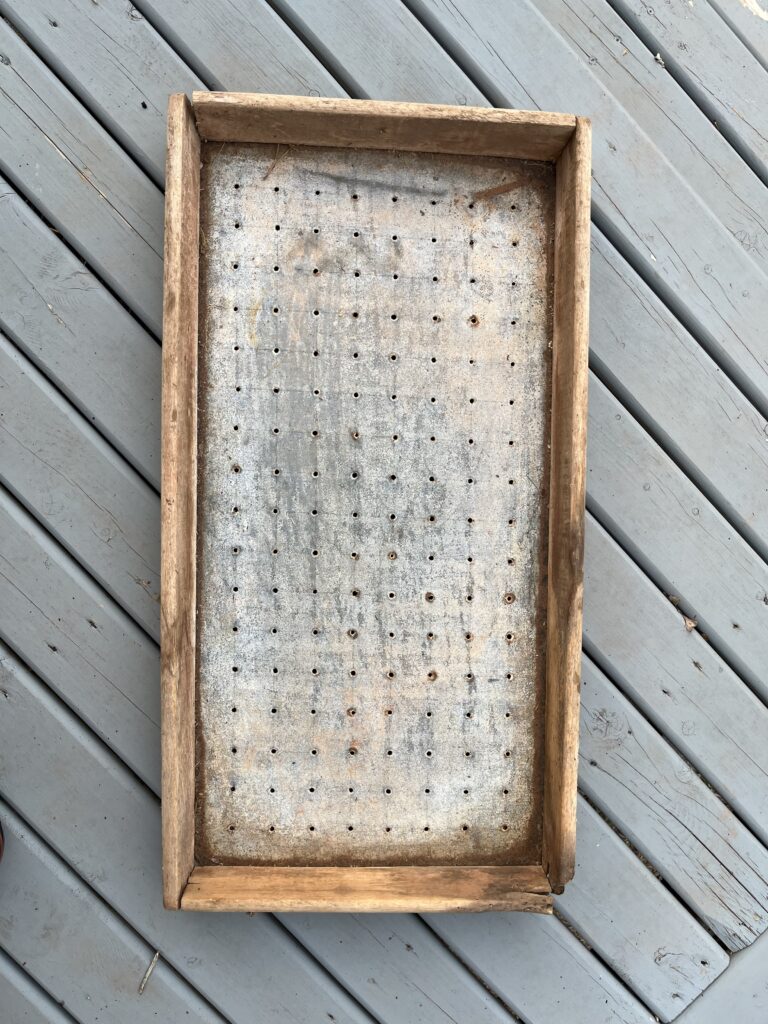

Lobster tray from the Ernest Hardy cannery. Difficult to date, but the cannery operated seasonally from 1901-46

Item One is a lobster tray and it came to mind when I saw this advertisement in the April 25, 1923 Guardian.

April 26, 1923 Guardian, p.6

My great grandparents, Eva and Ernest Hardy, ran a lobster canning factory on the Conway Sandhills at Hardy’s Channel off Milligan’s Wharf, PEI from 1901 until Ernest’s death in 1946. My mother spent her childhood summers at the factory, so I have her stories and even a few photos of the place, but not much of the physical elements of that bustling enterprise remain.

Some of the buildings now at Milligan’s Wharf made up part of the factory and were hauled over to the mainland of PEI in the early 1960s to be used by my mother’s uncles. Some were later repurposed for cottages, one into a snack bar, and one sadly sits abandoned by next-generation owners who have little regard for its history.
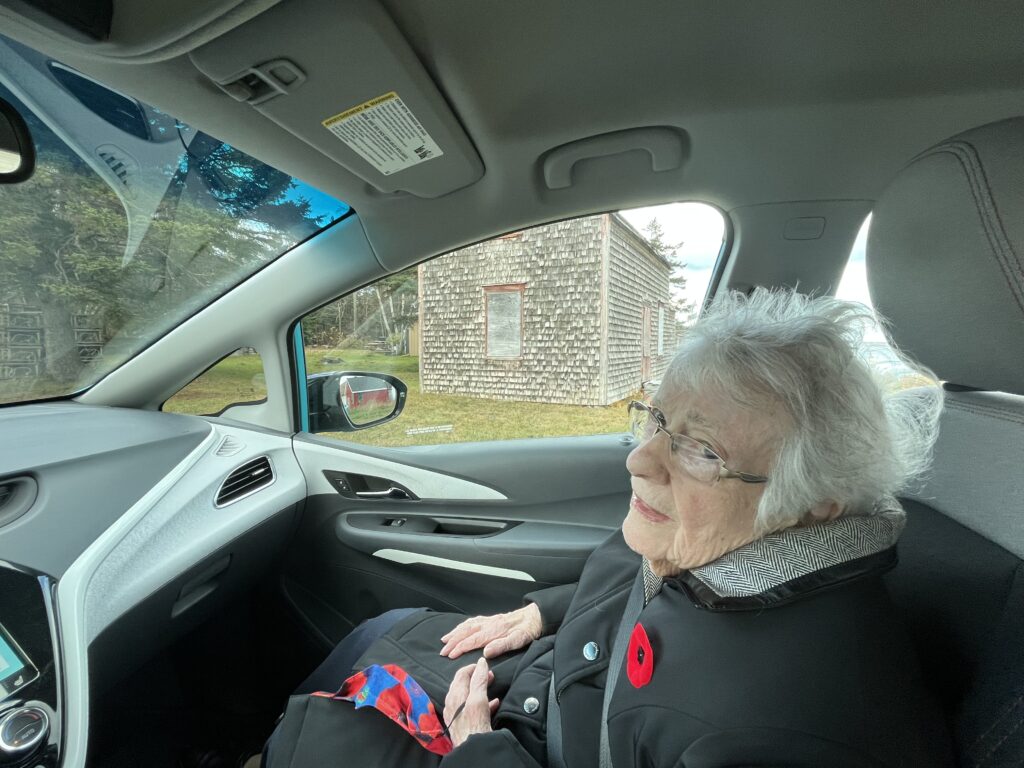
My mother, Vivian Phillips, visiting the old cookhouse from her grandparent’s lobster cannery, Milligan’s Wharf, November 2021. She and her brother would sleep upstairs in the colder months to take advantage of the warmth from the cook stove below.
Ella Oatway and Eva Hardy on cookhouse steps, Conway Sandhills, 1940s. There is a small roof behind them that connected the cookhouse to the separate dining building.

The factory equipment – boilers, tools, tables, canners, utensils – are probably all long gone, no doubt sold to others in the same business or repurposed by the family, which is why I was surprised to come across the tray in our shop building some years ago.

I’m not sure why we have the tray, though I expect it came from one of the buildings on the home property once owned by Ernest and Eva and later occupied by their son, Elmer. My mother helped Elmer in his market garden and he would often give her old things that were hanging around the place and probably in his way. She had a collectors spirit, for which I am thankful.

Until I saw Fred H. Trainor’s advertisement, I had assumed the tray had been made by someone working for Ernest, and that could still be true. Fishermen built their own lobster traps and boats, so making some rough trays wouldn’t be a big deal. My mother’s father, Wilbur Hardy, was not a fisherman but did have a small box mill that he used to make lathes and boards for crates, so he would have been well positioned to fashion the wood for a tray for his father’s business.
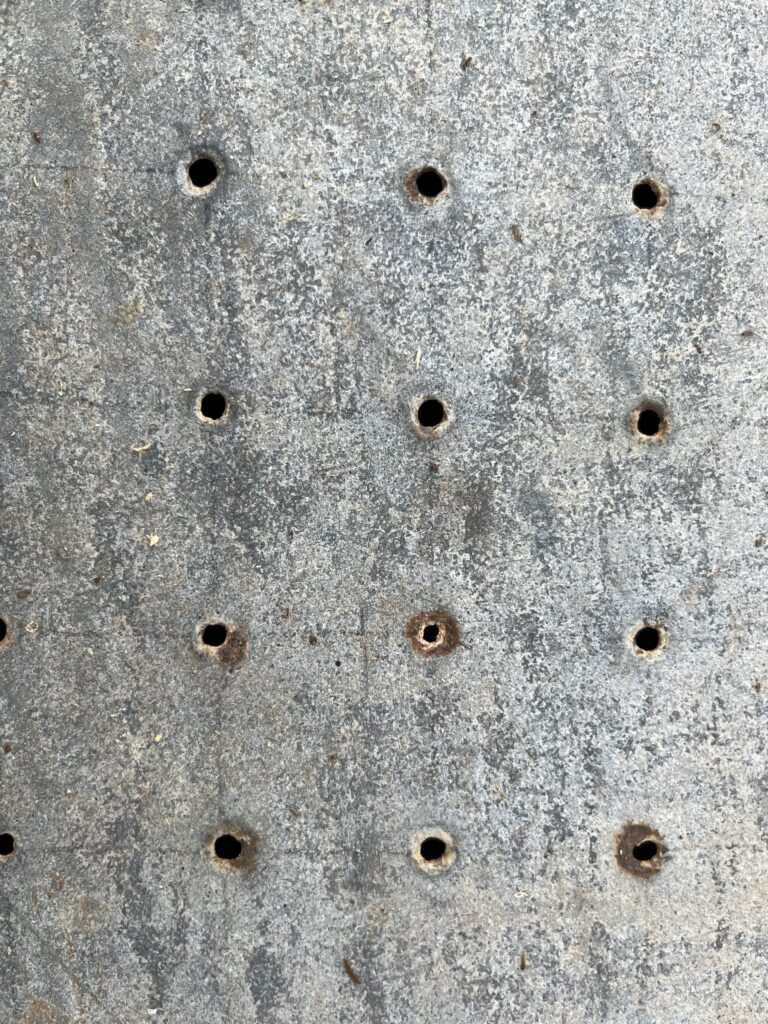
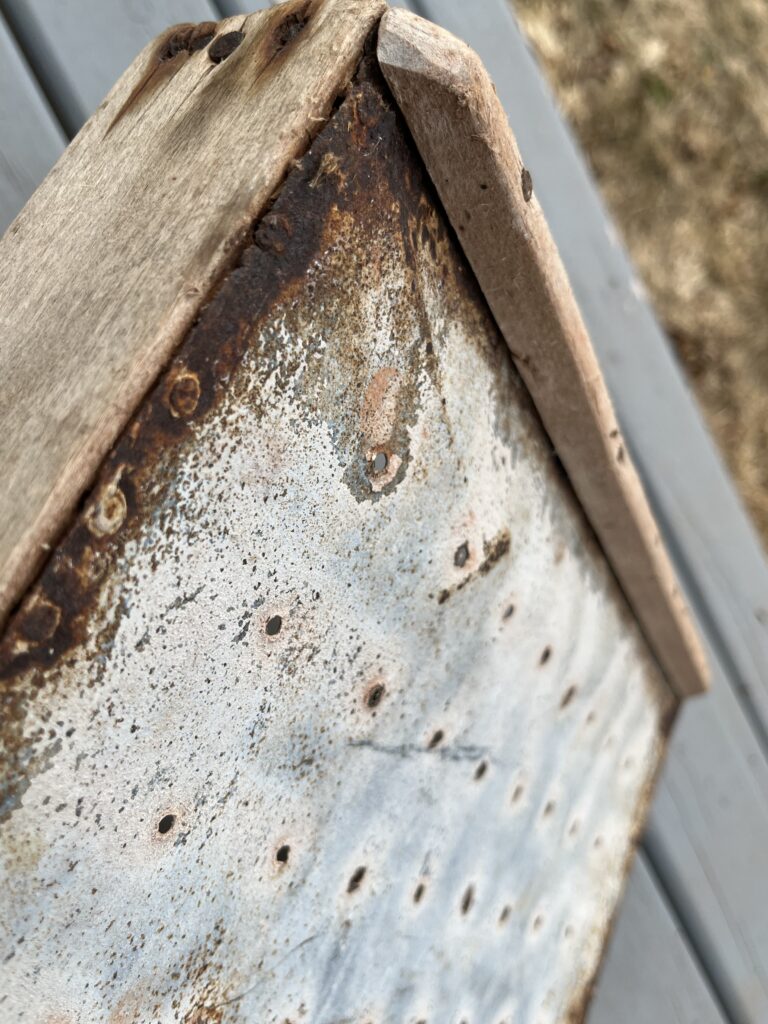
Tray holes spaced 1.5 inches apart

The tray is base is galvanized metal. The wooden frame is 13.5 inches wides, 26.25 inches long and 2.25 inches deep. There are small pieces of wood, tapered by rough carving on either end, on the bottom on the two shorter sides that would allow the tray to sit slightly off of a table for drainage. The drainage holes are evenly spaced 1.5 inches apart, faint grid lines directing the precise location for punching. Considering the amount of salt that would have been around the factory, it’s miraculous the nails holding the frame together are still able (barely) to do their work of holding the pieces together.
The factory was probably a difficult place to work in a challenging location: a sandbar on the north shore of PEI. There was never electricity there, though they did get a gasoline-powered stationary engine in the late 1920s, which was later rescued from a barn by my cousin. He thinks it was used to run a saw to cut up firewood, which was needed in large amounts to fire the boilers that produced hot water and steam for the factory.

Everything was done by hand, in conditions that would probably not be considered sanitary today. The boiler man drew water from a hand-dug well using a bucket and would fill the huge boiler that produced steam to cook the lobsters, keeping a hot wood fire roaring all day. Workers, both men and women, would open the cooked lobsters, first ripping off the claws and cracking them at the knuckle with large knives to extract the meat, pulling out the tail meat, and ripping the bodies apart.

The little legs were fed through the wringer that came off a washing machine, squeezing the sweet meat out of them. My mother says this was the only job she ever did in the factory. The leg meat was added to the tomalley (“the green stuff” inside a lobster body) and roe to make lobster paste, also canned and sold. They also canned mackerel.
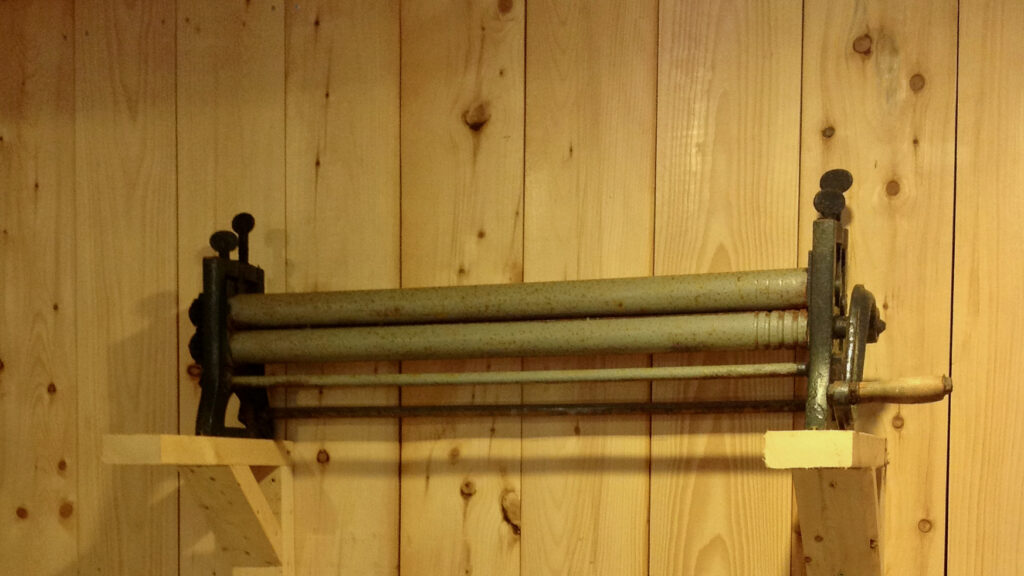
Wringer for squeezing out lobster meat, Basin Head Fisheries Museum, PEI, 2014

Leftover lobster bodies quickly become smelly, and piles of them would attract flies and wild creatures, so my mother says they were dumped back into the ocean by the fishermen or hauled to farms to be used as fertilizer. One of her uncles would fill his dory with bodies, take them back to the mainland, throw them into a wagon, and spread them on his farm fields to be disced under. They would certainly be scavenged by animals and birds when fresh, but eventually they would break down and act as a good fertilizer, or as good as a fertilizer could be before chemicals fertilizers were created. Even with all that effort of spreading lobster bodies, that uncle called his place Wild Rose Farm because that’s all the land was good for growing!
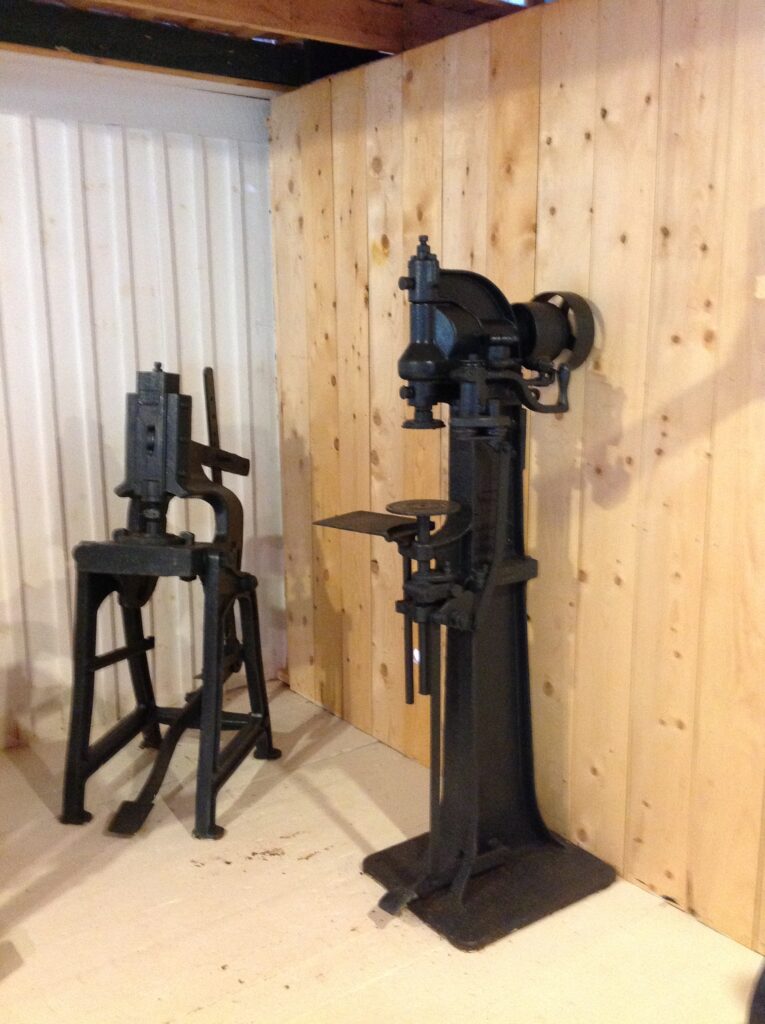
Can sealers, Basin Head Fisheries Museum, PEI, 2014. The one used by Elmer Hardy was similar to the one on the right, but smaller and attached to a work bench in his shop.

One of the canning machines, a greasy looking hand-cranked device, was in Elmer’s shop building. He raised chickens for eggs and meat, and canned chicken, beef and some fish well into the 1980s. Some people in our area still can beef, chicken and bar clams, though use glass canning jars and not the more tricky metal cans.
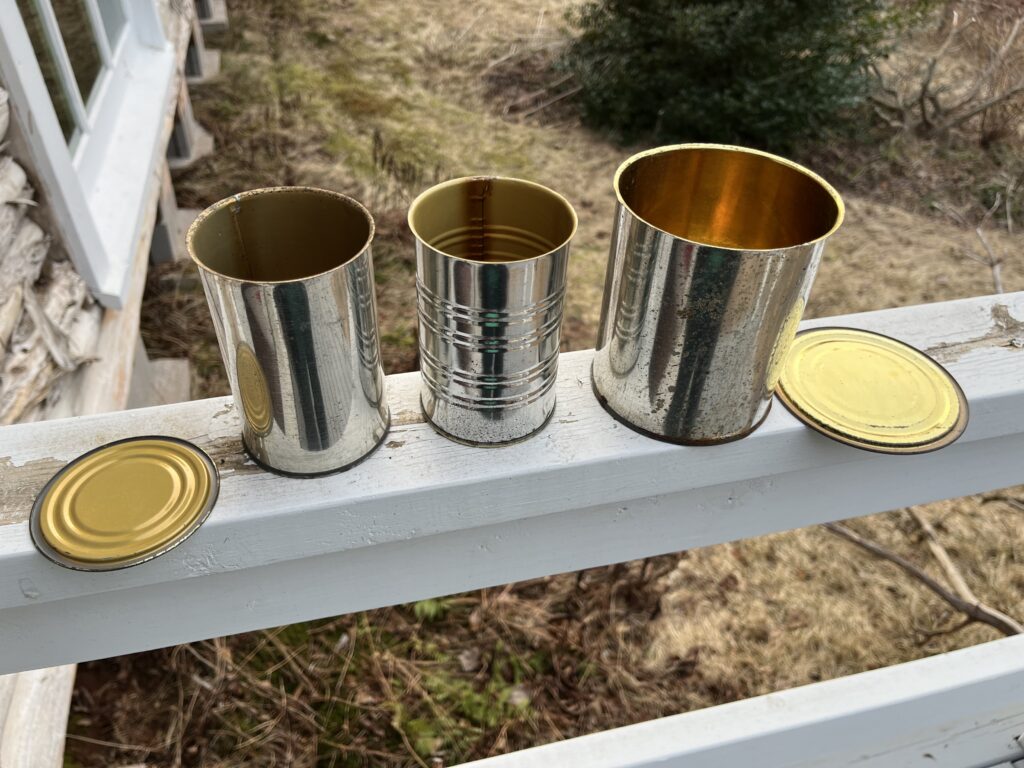
Unused cans and lids from two cases my mother had, which she would have purchased to give to her Uncle Elmer to have him can chicken for her. He probably stopped canning by the 1990s.

My mother says her grandmother, Eva, packed every can as she had “the knack”, and probably also wanted to make sure the weight was exact. A piece of white parchment paper was placed in the bottom of the flat, wide cans, and she would carefully fit tails, claws and bits of meat to bring it up to the correct weight. Once the cans dried and cooled after processing, a label would be affixed with glue or paste. My mother says her grandparents’ product was sold to wholesalers, so there was not an E.A. Hardy brand, but more likely they were canned for DeBlois Brothers wholesalers in Charlottetown, or maybe the large PEI retailer, Holmans.
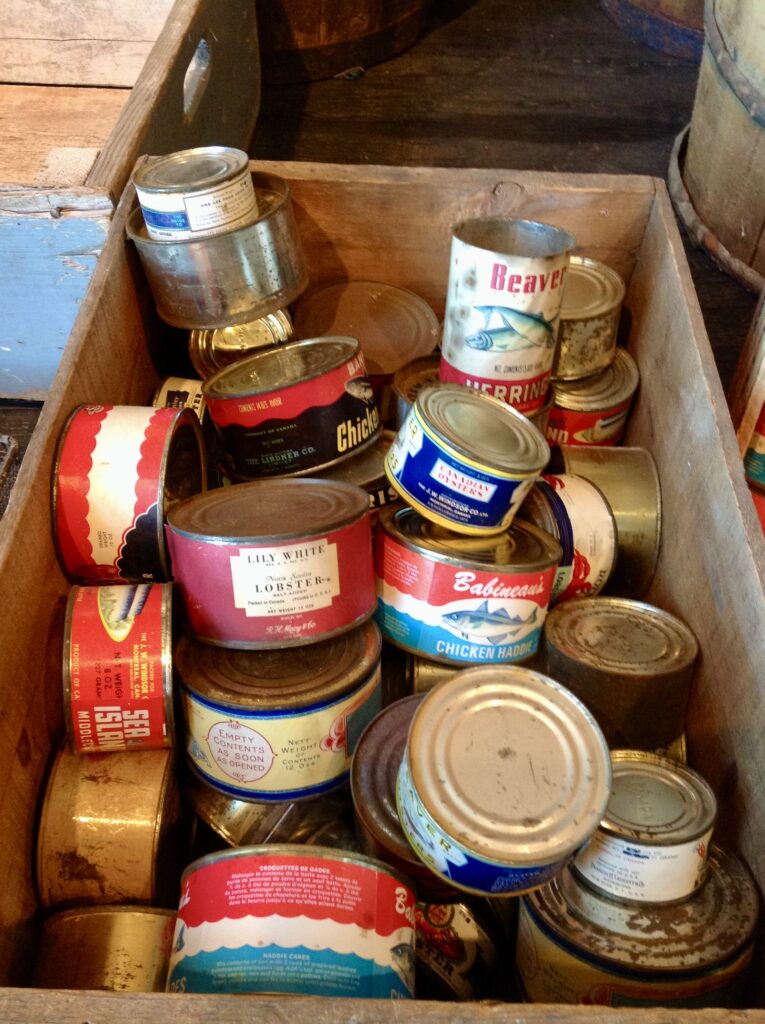
Lobster and other fish cans at Basin Head Fisheries Museum, PEI, 2014

My great grandmother likely handled the tray thousands of times over the 45 years they worked each summers to make the money that would carry them over the rest of the year. “Factory owner” makes it sound like they were rich, and they definitely were not. They had a telephone, but no electricity and never had a car or truck. The furthest from PEI either of them ever got, that I know of, was when when my great grandfather went to Montreal for an operation, but I don’t think my great grandmother ever left PEI, or even went to Charlottetown! I gather they were well-respected in the community as being industrious and honest, but they had little more than anyone else.
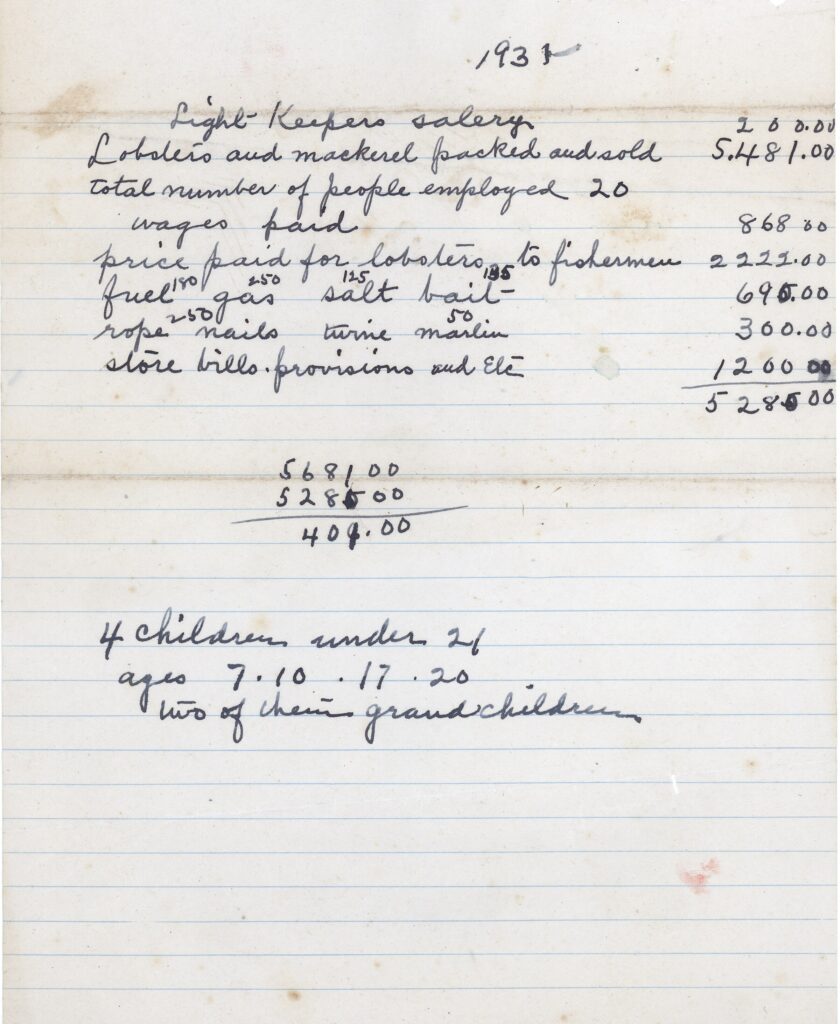
Income statement for Ernest Hardy, 1931. His lighthouse keeper’s income from the Canadian government was incredibly important to the family, making up half of their net income that year.

I think of the countless people who held that tray, working long hours to make a product they probably couldn’t afford to buy. That’s still the story for millions today who produce our clothing, electronics and food in hidden corners of the world. They make little, the corporations make a lot, and we get cheap things.

There are still lobster processing factories on PEI, some of it being canned but most of it frozen. Local workers became more difficult to find over time, so a large percentage of factory workers now come from places like the Philippines. Those temporary foreign workers have supported the lobster fishing industry in a way that is perhaps not acknowledged often enough, as the market for fresh lobster is limited and processing the only way to ensure there is a bigger market.

Lobster fishing and processing is still difficult, even dangerous, work. Thank the lobster, thank the fisher, thank the factory worker who holds the tray.

PhotosRevive

I’ve been a Setapp subscriber for a few months now. MacPaw, the company behind the Setapp service, are a Ukrainian company, something I only learned since the Russian invasion on February 24. MacPaw took many steps to protect their services, and are now using their apps in innovative ways to communicate to their clients and make their voices heard, like this release note for an update that basically was, really, just this note:

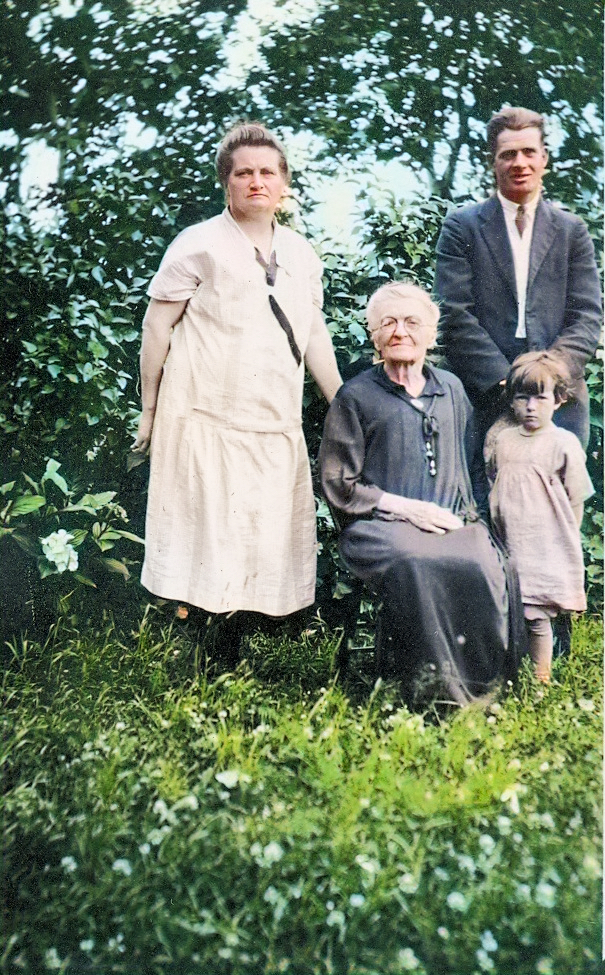
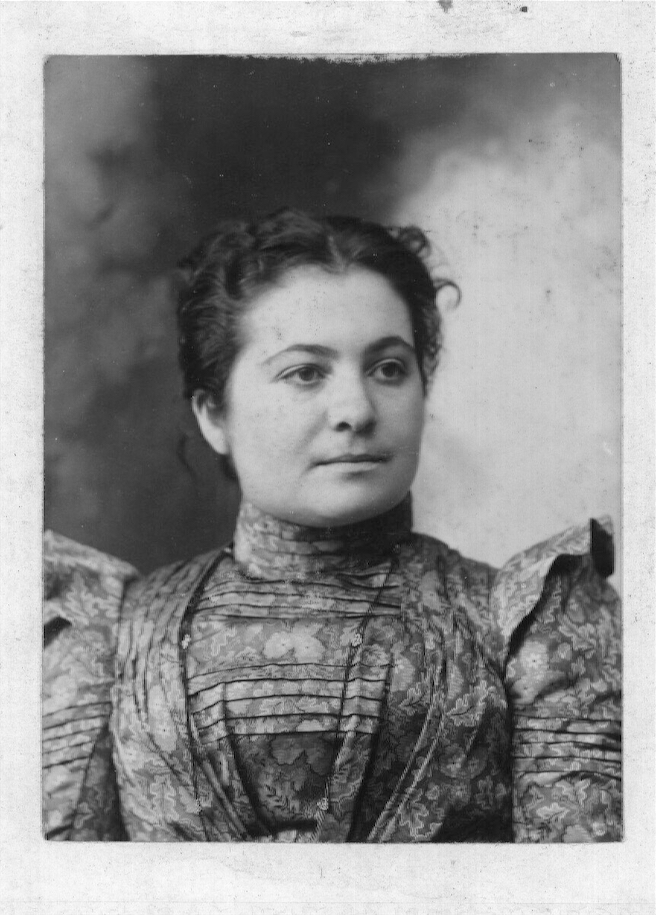
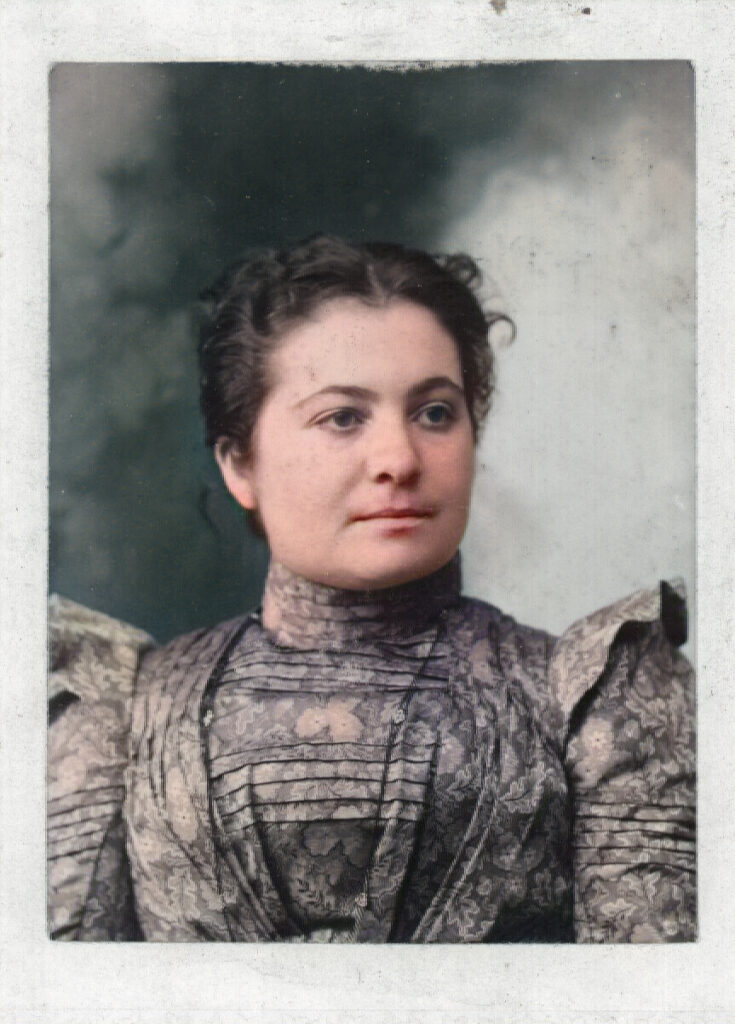
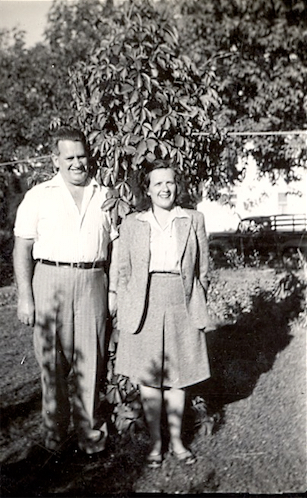
A new app showed up on the Setapp service this week, PhotosRevive. It promises to colourise black and white photos using some AI hocus pocus. I popped some photos in to see what it could do, and the results were mixed, but interesting.

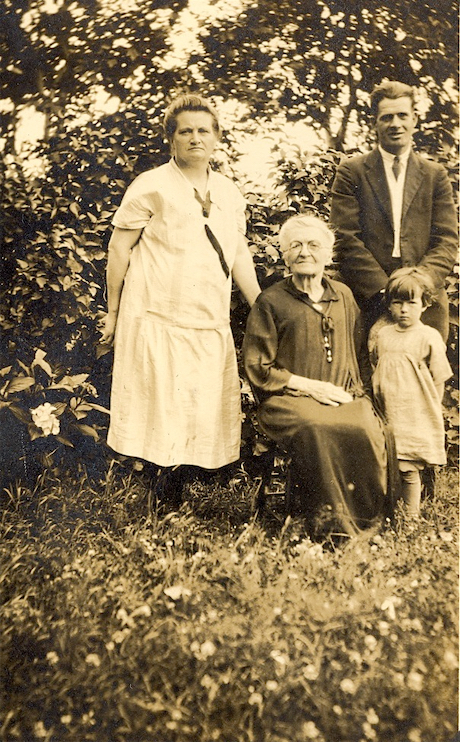
From left to right: my great-grandmother Eva Hardy, great-great grandmother Martha Sharp, grandfather Wilbur Hardy and my mother Vivian Phillips, probably taken in 1927. The older folks look pretty good, my little mother looks a bit ghostly.
My great-great aunt Florence Arbuckle, twin sister of Eva Hardy. She was married to a doctor and quite well off, so could afford beautiful beautiful clothing like the dress she wears in this photo.
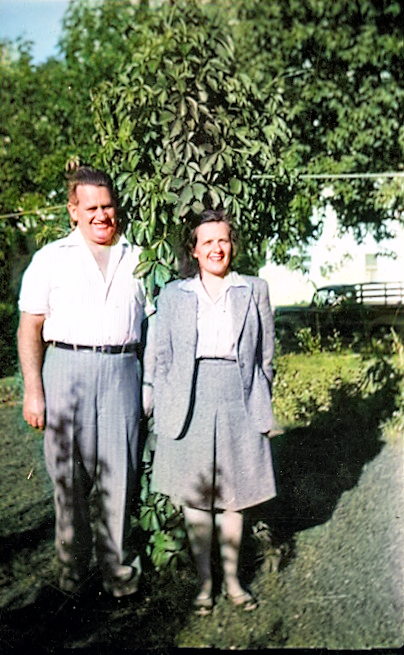
My mother Vivian and her Uncle Elmer Hardy. The app handles foliage really well.
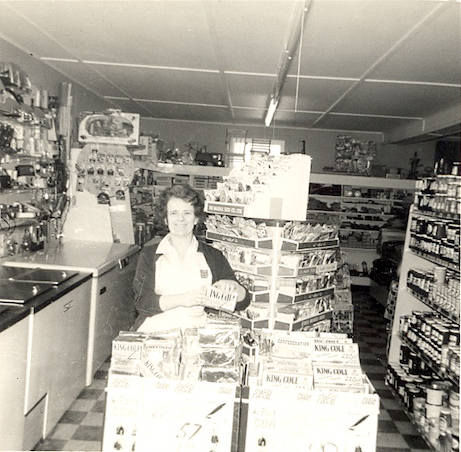
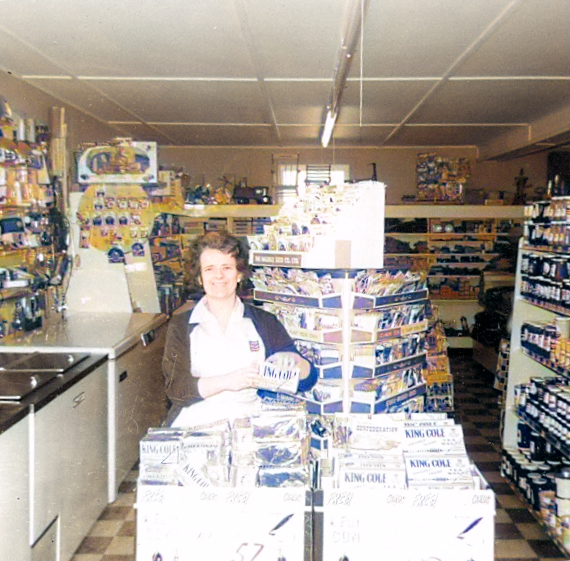
My mother in my parents’ general store in 1966. Pretty sure they didn’t just sell blue and yellow products! She’s holding a box of King Cole Tea, which has always had an orange and green theme. I think they won an award from the tea company, so this was a publicity photo.

You can tweak the PhotosRevive settings to make things look a bit better, but I’ve not had time to play with it yet. I like black and white photos, or am at least used to them, so probably wouldn’t have gone looking for this, but it’s a fun addition to the Setapp universe.

Socks and Masks

I bought a notebook not long after I moved back to PEI in 2001 and started recording the family stories and historical information my mother and others would tell me. I’ve finally had time to type up these notes and am realizing how much of it I had already forgotten.

December 17, 2014 – Mom offered to darn my socks, burgundy ones she knit for me many years ago. They were very thin. She said her grandmother would cut the feet off wool socks that were too difficult to darn and knit new ones on, ravelling back the yarn and picking up the stitches. Knitting new feet on socks was hard, but money for yarn was harder to come by.

Eva also had a manual knitting machine that, if I remember correctly, would quickly knit the leg part of a sock and she would then knit the foot onto it. That took much less time, and as she had seven sons and a husband to keep well supplied, sock manufacturing and maintenance would be an endless job. The men all worked outside, either fishing or farming, and in the winter they would spend days in the woods cutting lumber and firewood, so having warm socks were vital tools for good health and productivity.

January 6, 2015 – We were talking about someone who was just recovering from an illness. She said a family with the last name Best had once lived in Freeland. Their daughter, Lillian, got tuberculosis. They built a little house for her in the field next to the main house. Lillian lived in it, didn’t go anywhere, and when her mother went out to visit, she wore a mask. Lillian eventually recovered, married and had children. No one thought she’d ever be able to have children, but she did, and lived a long time.

Masks are nothing new, nor are pandemics. I would imagine Lillian’s story was from the 1920s when PEI was without a provincial sanatorium. When someone contracted TB, people did the best they could on their own, especially in rural areas lacking even the most basic health care. My grandmother, Thelma, died of TB in 1927, and was nursed at the end by a local woman who also was a midwife. Dr. John Stewart had an office in Tyne Valley at this time, but there really wasn’t much he could have offered beyond advice to rest – you lived or you died.

My grandmother was probably given country remedies like mustard plasters (a mixture of dry mustard, flour and water applied to the chest, still being used by some to relieve congestion when I was a child), inhaling the vapours of turpentine or kerosene, or doses of cod liver oil.

An unoccupied old house was torn down a couple of years ago not far from where we live, and my mother had been warned as a child not to go near it as it was “full of TB,” the family who lived there having lost a daughter in 1924.

January 25, 1922

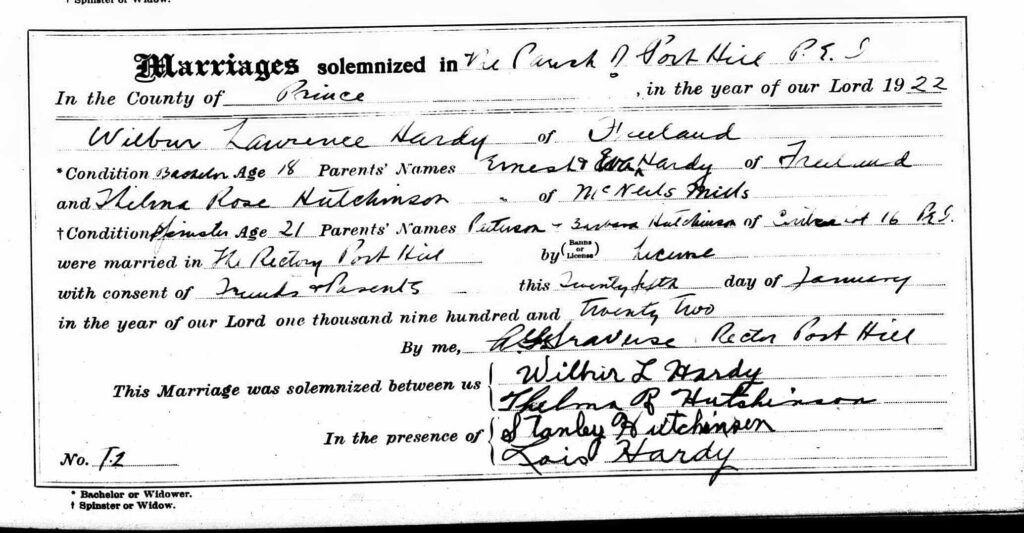
My mother’s parents were married 100 years ago today. I know almost nothing about that event as my grandmother, Thelma, died so long ago in 1927, and my grandfather, Wilbur, later remarried and died the year after I was born. My mother says that her father rarely talked about her mother, so she doesn’t know where they met or what their short life together was like. There is no one left from that time, of course, so it is a mystery that will never be solved. All we have is their marriage certificate, and a photo taken after their wedding.

Some of my family’s history is so clear to me, even events that occurred long before I was born, because I heard the stories over and over. I can hear the sleigh bells as Wilbur and his brothers head up through the Foxley River woods to cross over the ice to Cascumpec and on to Alberton, where they sold firewood in the 1930s. I can smell the tar and oil and half rotten fish of the wharves where most of my mother’s uncles spent much of their lives. I can see my great-grandmother, Eva, who fell and broke her hip while feeding her hens on the Sandhills in the 1940s, being carried by her sons on an old door to a dory, then rowed to the mainland where a truck was waiting at Brooks Wharf to take her to the doctor. All the tales carefully polished, shining, sharp, and each story helping me to find my place in my family, starting first as just a listener, and now as a keeper and recorder of the lore.

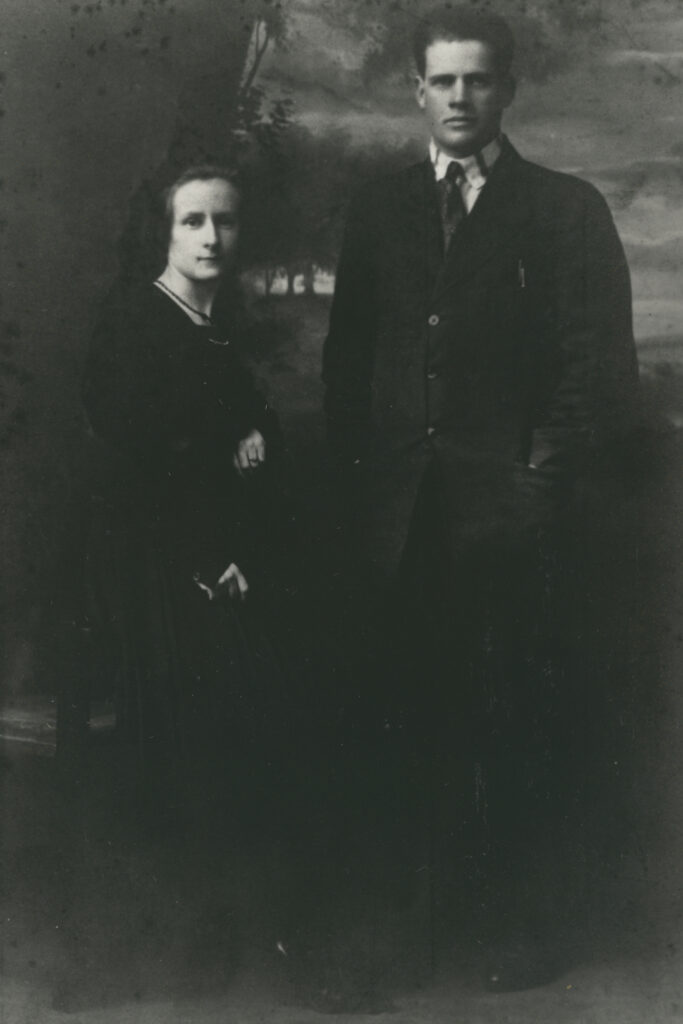
But Thelma and Wilbur are always in soft focus in my mind, just as they are in their wedding photo, and I have had to make up my own version of their story over the years from the bits and pieces I have gathered. The story ends sadly, with Thelma dying from tuberculosis, leaving Wilbur and her two small children, but this photo from the beginning – Wilbur confident and casual, hand stuffed in his jacket pocket, and Thelma next to him, finally with someone to care for her after losing both her parents by the time she was seven – this photo reminds me that the story really didn’t end sadly, for my mother is still here, I am here, my cousins are here. We are here, we were there.

Thelma and Wilbur Hardy, 1922

December 1875

My great-great-grandparents were Martha (Ellis) and George Washington Sharp. They had 10 children, including one set of twins, my great-grandmother Eva and her sister, Florence.

It was only this evening that I realised Martha and George had three little girls who died within a few days of each other. They also had two boys aged 7 and 2 who survived. They went on to have five more children.

I had no idea what the girls died from, but I just found a death notice for the three little girls in the December 20, 1875 The Examiner newspaper out of Charlottetown. What unbearable pain.

The Examiner December 20, 1875 p3
Martha Sharp (1848-1928) circa 1927

Freeland WI

My mother attended her Women’s Institute’s annual meeting last evening, and they decided to disband after 99 years of continuous service. My mother joined in 1942 when she was 20, right before she enlisted in the Royal Canadian Air Force Women’s Division for service during the Second World War. She has loved being a WI member.

I think at one time almost every school district on PEI had a Women’s Institute to support the school and community, and pretty much every rural community had a one-room school, so that was a lot of WI groups. They were both a fundraising group and a social outing at a time when most rural woman were working at home. They would fundraise to keep their school in tip-top shape, and when consolidation in the 1960s and 70s closed small rural schools, many WIs bought the buildings from the government for a dollar and turned them into community halls. There were at least 22 WIs in our area, but that number has slowly dwindled and now 2 remain, Poplar Grove/McNeills Mills and Port Hill.

I never joined the WI. I was too young when I left for university, and when I moved back 20 years ago, there were no members my age, so I just didn’t join. I now feel like I have missed out on something important.

But I fondly remember the WI meetings that were held in our home when I was a child. I would sit in the corner and watch and listen to it all, the reports from the different committees, the education program on different topics of interest to country women, the discussions on what fundraiser they would hold next: a goose supper, a variety concert, make a quilt and sell raffle tickets on it, a bake sale. There was always tea and sandwiches and sweets and lots of chitchat after the meeting ended. It was up to the hostess to make “the lunch”, and my mother was a generous and excellent cook, so it was always a good feed! I would pass the plates of sandwiches from great aunt to great aunt to neighbour to cousin, all of them calling me “Thelma dear”, smiling, laughing. They would discuss who was sick and who had died and who was taking a trip, the price of things nowadays, wasn’t it hot/cold/mild/windy/dry/rainy.

The WIs in our district banded together to prepare and serve the suppers at the Tyne Valley Oyster Festival for many years, working out of a less-than-ideal kitchen attached to the old rink. They turned out beautiful lobster suppers, complete with salads, rolls, pies and sweets. It was thrilling to be in the midst of this cyclone of competence and energy, each woman knowing exactly what to do, working quickly as if they were line cooks every day of their life (which in some cases, with the large families that were once the norm here, they were), but almost always in good cheer and with a buzzing sense of unity and camaraderie. I feel fortunate to have learned so much from these resourceful, powerful women.

I texted a friend who is a member of one of the two remaining WIs in our area and asked if my mother could join them, even if just in an honorary way. “In a heartbeat,” she texted back.

Report on a WI meeting held at my great-grandparents’ lobster cannery from The Charlottetown Guardian, September 3, 1927. My mother went to live with her grandparents in the spring of 1927, and would have turned 5 that August, so she was likely present for this meeting, lurking at the edge of it like I used to do.

Wash Day

I have had to wash my “barn” jacket after I put an egg in the pocket and then managed to squish it before I got it into the basket. I know better, but it was going to be there just for a second. A handful of slimy egg and broken shell is an unpleasant discovery, and it was -12C at the time, so it started to freeze on my hand. Yuck.

I told my mother what I had done, and said my first thought was what her grandmother, Eva, would have said if she had witnessed my folly. My mother said I would have been scolded, for an egg in February was a rare thing. Eggs were preserved in a solution called water glass in the fall, and were only used for baking over the winter. I don’t remember people preserving eggs, as by the time I was born in the mid-60s, most people had electricity and refrigerators, and mostly bought their eggs from a store.

I once visited a Second World War exhibition at a museum in Ipswich, England, and they had a section on food on the home front. Unfortunately, the egg preservation experiment hadn’t worked properly and we arrived just after they made that discovery, and the smell of rotten eggs was certainly evocative of another time.

I asked my mother if gathering the eggs was one of her chores as a child, and she said it wasn’t. The hens were Eva’s domain and she probably didn’t trust my mother to not drop the basket. Stuffing eggs in your pocket would have been bad form.

My mother said her chores were looking after her own bedroom, keeping her little brother out of trouble, and sometimes doing the dishes. On the day when The Family Herald arrived, Eva would read all afternoon so that when my mother came home from school, the dishes from the noon meal (called dinner, never lunch – lunch was a meal before bedtime!) would still be on the table waiting for her to wash them.

And how did you wash dishes in rural PEI in the 1920s? In an enamel dishpan at the kitchen table. You took the dishpan off a nail in the pantry, took it to the woodstove, and decanted hot water from the tank on the side of the stove. You would swish a bar of homemade soap in the water to make suds, wash and dry the dishes, and put most of the dishes back on the table for the next meal. The dirty dishwater would be poured down the sink in the pantry in winter, or perhaps out the back door onto a plant at other times. Nothing wasted, ever. Water was pumped by hand from a hand-dug well, so it was precious.

Homemade lye soap, made by my great-uncle Elmer Hardy in the very kitchen in which my mother used to do dishes. Hard on your hands, but cleans like the dickens!

Those water conservation methods have passed down to me through my mother. I don’t use a dishpan every day, but have used a dishpan during very dry summers and poured the dishwater on flower beds. I will throw water from washing floors on the front porch to clean it off, or onto a flowerbed. I don’t have a dishwasher, so when running water to do dishes, I usually collect the cold water that comes first in a watering can for plants, a kettle, or in a jug.

And I moved from using liquid dish detergent back to swishing a bar of soap in the water a few years ago. I don’t see much difference, except for the lack of bubbles, which I have read come from chemicals added to make you feel like the cleaning part of the soap is working. I use a vegetable glycerine soap from Bulk Barn that has no wrapping and almost no scent, and my dishes seem clean enough. I sometimes add slivers of soap from the shower or sink to the glycerine soap in soap shaker I have.

All this rambling from a broken egg.

Modern soap shaker/swisher. You can just hold a bar of soap in your hands, of course, but this makes more bubbles and has a nice rattle.

Weather or Not

I was surprised to see the precipitation observations I report every day as a CoCoRaHS volunteer being taken as gospel by Environment Canada, as per this info box in an article about the latest snowstorm in The Guardian:

The Guardian, February 9, 2021

Later I read that CoCoRaHS volunteers are “Environment Canada-trained” (we aren’t, or at least I’m not) in this CBC PEI article:

It seems the source for all this officialness is an Environment Canada daily weather summary for PEI, and there’s my 12cm in Foxley River once again:

Environment Canada does not operate CoCoRaHS, though they are able to access the data, which is free and open to all. They do say at the bottom of the report that it “may contain preliminary or unofficial information”, and that would be me, the Foxley River unofficial official.

I know that at least a couple of the PEI CoCoRaHS volunteers are highly trained, one a former military meteorologist and another a NAV Canada air traffic controller. I suspect the rest of us are just weather nerds with a little time on our hands.

The CoCoRaHS volunteer training is self-directed, a handbook, articles and videos all available on their website. To be a volunteer, you have to commit to submitting observations every day, ideally at the same time each morning, and you need to purchase a rain gauge from them. If you are going to measure snow, you need a ruler and a snow board to take the measurements from. That’s it.

I have a couple of diaries my great-grandfather Ernest Hardy used as the keeper of the Little Channel Lighthouse. He had to record the time he extinguished and lit the light each day, and he also recorded the weather. He was sort of unofficially-official, too, like me.

Moving Day

I woke before sunrise this morning. As I write this, it is calm and cool as the sky begins to glow in the east. Sometimes on such a morning, when I step out on the back step to smell the fresh air, I can hear the roar of the ocean a couple of miles away, but today it was silent.

My mother, Vivian, told me yesterday that April 15 was the day her grandparents, Eva and Ernest Hardy, would move from their home in Freeland to their lobster cannery on the sand dunes that run along part of PEI’s north shore. My mother and her younger brother, Edgar, lived with their grandparents from 1927 until 1938, after their mother, Thelma, died of tuberculosis in March 1927. Their father, Wilbur, was unable to care for two small children and operate his farm and sawmill, so his parents took them in.

My mother’s description of the “moving to the Sandhills” day is like something out of a history book. It began with a horse and wagon drive a couple of miles out the Murray Road from their Freeland home, probably through lots of mud, down the Mickie Allen Shore Road to the water. They would row across the Conway Narrows in a dory, then walk down the beach of the Sandhills to the cannery, or perhaps take another horse and wagon that would already be over there.

You can walk across the Narrows at low tide at a couple of places, so the dairy cow would be walked and, where it was deeper and her legs couldn’t touch bottom, floated across. A pig would somehow be maneuvered into a dory, and Eva’s hens would be crated up and rowed over to spend the summer pecking at the sand. Their few articles of clothes would be in steamer trunks along with bedding, everything stinking of mothballs.

I’m thinking of my mother as a tiny four year old on that first cold April morning 93 years ago, waking up next to her 20-month-old baby brother. They would hear Eva making breakfast: oatmeal porridge, beans, bread and butter, tea. Hear their grandfather and uncles in other shanties or perhaps heading out in their boats to fish for bait that would be salted and used for fishing lobster over the following months. 

Less than a month after her mother had disappeared slowly and painfully and she had to leave her father and home, my little mother was waking up on a straw-filled mattress basically right on the ocean, at sea in more ways than one.

Only one of two photos of my grandmother, Thelma Rose (Hutchinson) Hardy, taken on the Conway Sandhills, 1922.

Answered my own question

Since I sometimes digitally clip bits and pieces from old newspapers and then file them without good descriptions, I shouldn’t be surprised when I ask myself questions I could already answer.

Earlier this month I mused about my great-grandmother’s prize-winning entry to a contest in a fishing magazine. I wondered how she remembered the exact details of a fish caught by her sons long after the event and where she got the photo that accompanied the story.

Seems she had already alerted the media to this story in 1936, and I had already read it and filed it away with the very descriptive file name “Guardian_Aug24_1936_fish”. Thankfully I stumbled upon it this morning.

From page 9 of the August 24, 1936 Guardian.