I have been on a journey lately to be a better friend to myself. I have realised that I am much harder on myself than I would ever be with a friend or family member. I seem able to easily forgive others for unhelpful things they do or say, but take myself to task for even the smallest mistake. I’m trying to understand why that is, and to change my inner voice, to be as kind to myself as I try to be to others.
While practicing yoga this morning, one of the moves included placing my hands on my heart centre and focusing on it. As my hands touched each other, I thought what a physical, calming way to put being my own friend into practice, so I held my own hand for a while and said soothing words. We have all probably rubbed our hands together to warm them up, wrung them when we are nervous, even clasped them in prayer or pleading, but have we ever held our hands as we would hold the hand of another we loved?
Hold your hand and tell yourself how much you care, and you might feel the little leap in your heart that I did this morning.
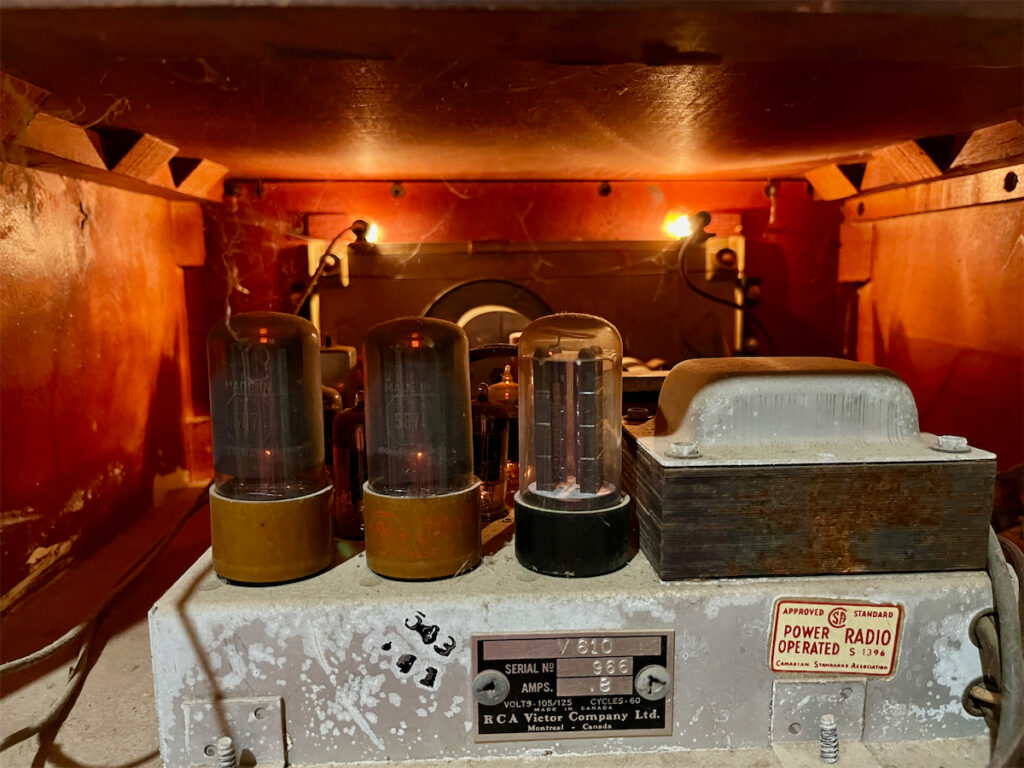
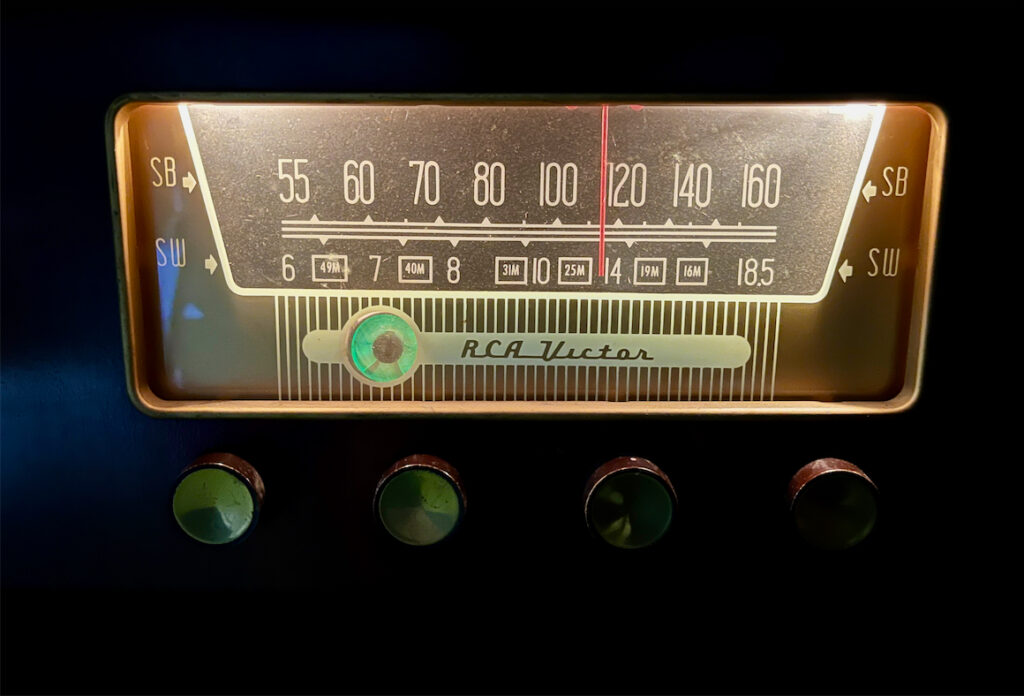
Bask in the warm glow of tubes and the radioactive-looking tuning eye of this 1950s RCA Victor radio/turntable that lives in our basement. I’m certain it is patiently waiting for the return of its original owner, my father’s friend and fellow Lucky Dollar store owner Edwin Bernard, who spent many peaceful hours sitting next to this lovely cabinet listening to sports and music while smoking and reading a big book. I hadn’t plugged it in for many years, and quickly unplugged it after taking a couple of photos as the basement started to smell like electronics, and not in a good way. Rest easy, good and faithful servant, someone will restore you one day.
Lights and tubes aglow inside…
…makes a pretty show outside.
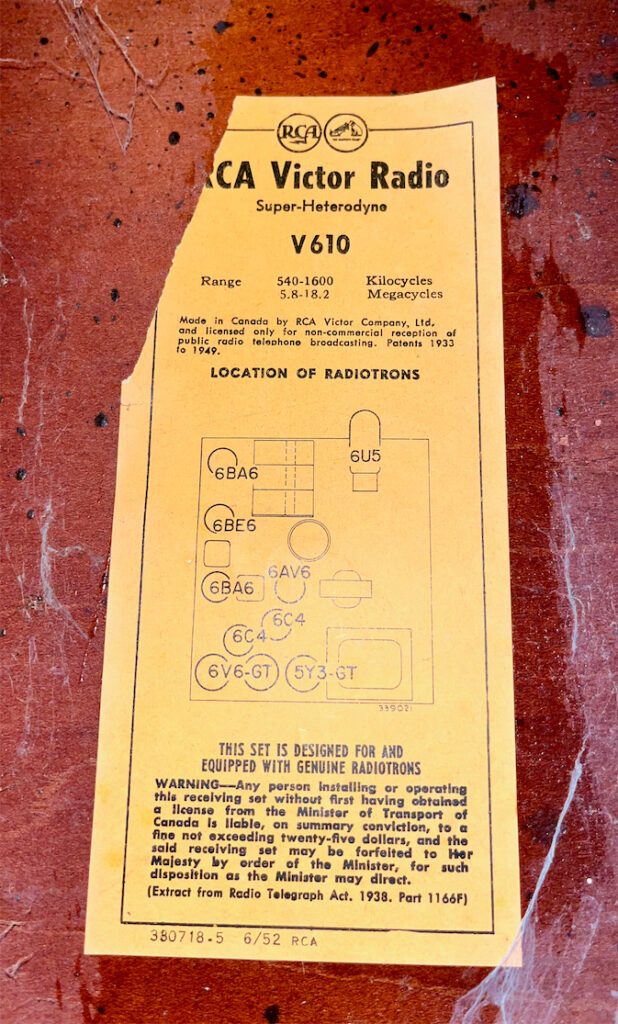
You can see this was firmly attached with paste. I’m sure I have my radio license here somewhere, officer…
Reunion, the software I use to keep track of my family tree, has a handy feature that allows me to see dates of family events in Apple Calendar. I’ve added one for birthdays and one for death anniversaries, and I appreciate being reminded of those still alive, and those long gone but still part of my story.
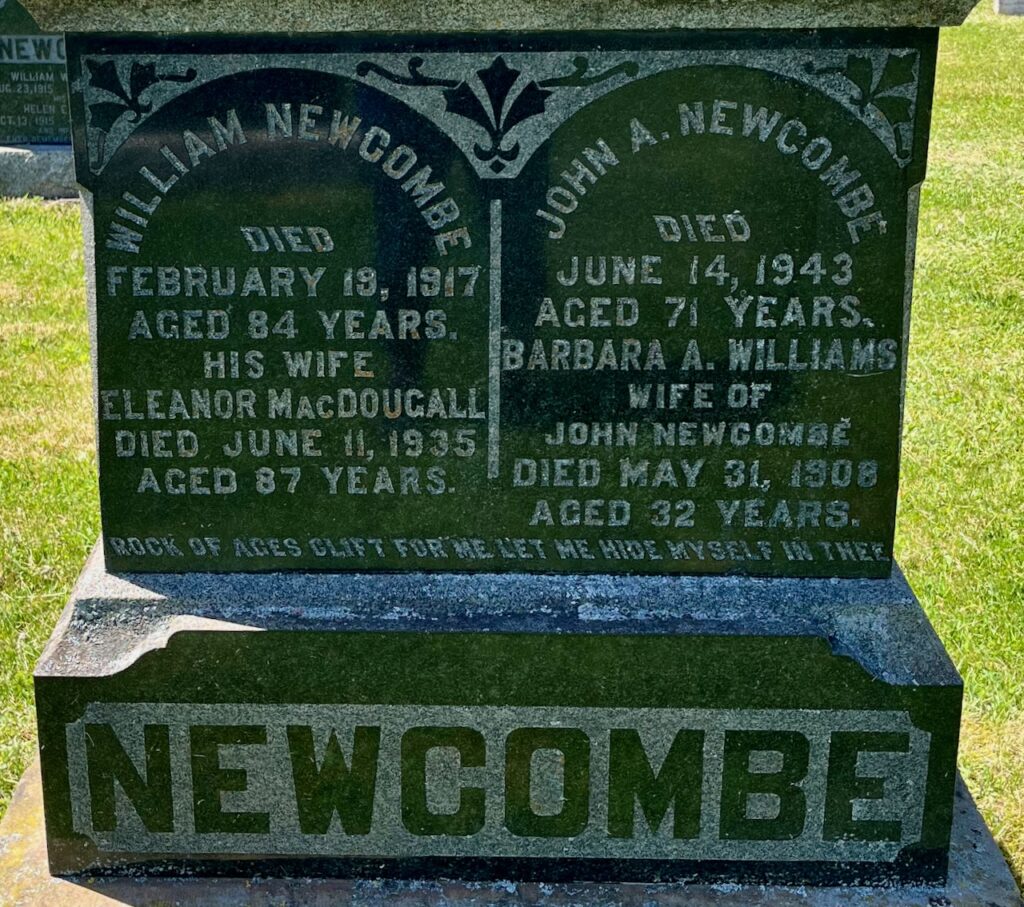
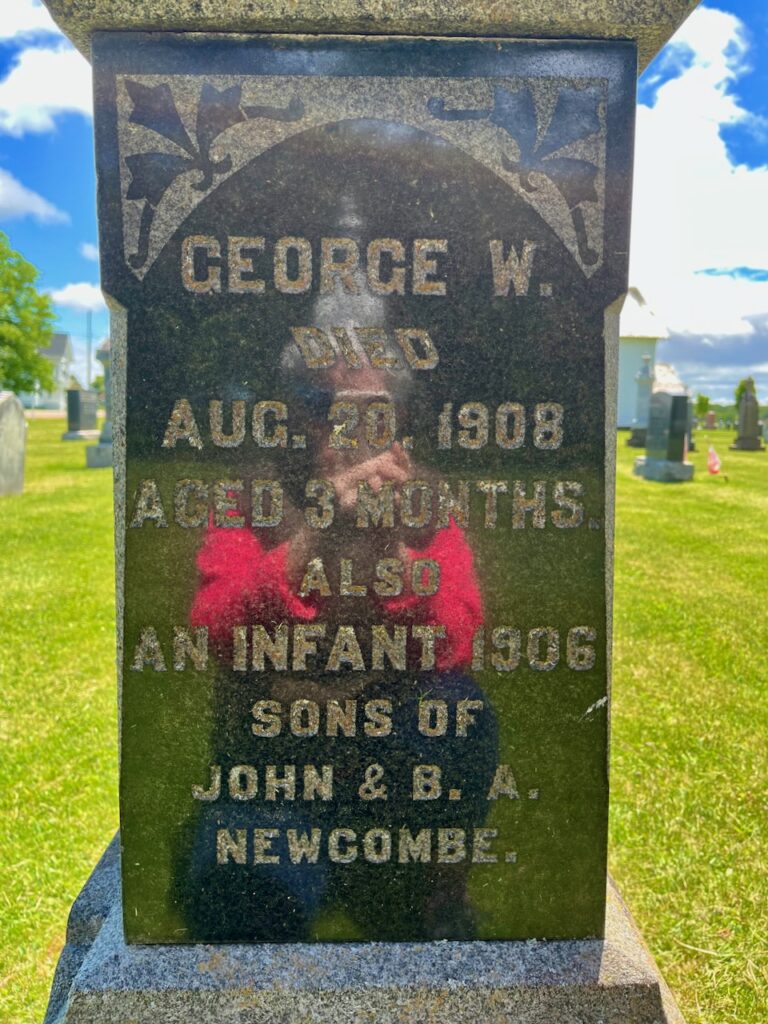
Today I was reminded that my maternal great-grandmother, Barbara Ann Williams, died on this date in 1908. She married Patterson Hutchinson in January 1900, in what is said to have been the first wedding at St. John’s Anglican in Ellerslie, a beautiful little country church built by Barbara’s brother, the renowned “Fox House” and church builder “Little” Harry Williams.
They had three children: my grandmother, Thelma, born in 1901, her brother Stanley, born in 1903, and a second boy, George, who died at birth in 1904. In 1905, Patterson died, aged 37.
Barbara remarried eight months later to John Newcombe from Northam, just outside Tyne Valley. As far as I know, it was his first and only marriage. Barbara and John had three children: Lillian, John and George. John died at birth in 1906, and George died in August 1908, three months after his mother, who quite possibly died giving birth to him. Lillian seems to have married a Roderick MacLean from Lot 16 in 1926 and died in 1957. Lillian may also have really been Patterson’s daughter and adopted by John Newcombe, but I can’t yet confirm that.
According to 1911 census records, John Newcombe and daughter Lillian had moved back with his parents. His step-children, Thelma and Stanley, were listed in that census as living with their uncle Little Harry and his family in Poplar Grove. I have no idea if my grandmother, Thelma, kept in touch with the Newcombe family, but she died in 1927 aged 25 and, in a sad echo of her mother’s life, left behind two children under the age of 4: my mother, Vivian, and her brother, Edgar.
Genealogy is generally pretty straightforward: I had parents, who had parents, who had parents, back and back to the cave or the savannah (or the Garden of Eden, if you are so inclined). But drop down in the middle of some of these stories, and witness the happenstance that kept people alive just long enough to give birth to a child that is key to your existence, and life seems even more miraculous. All of our ancestors successfully bobbed and weaved just long enough, and here we are.
Barbara Ann Williams Hutchinson Newcombe, Saint James Anglican Church Cemetery, Port Hill, PEITwo little boys gone too soon.
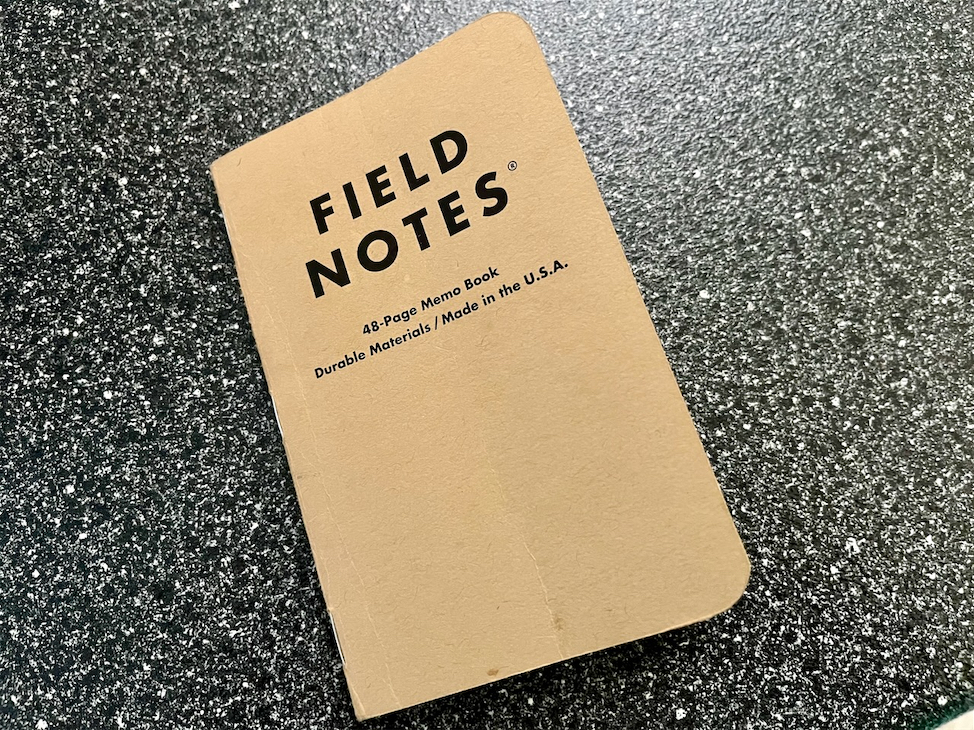
I have been recording my comings and goings for COVID-19 tracing purposes for two years, but continuing to do so seems pretty pointless now that mask and physical distancing restrictions have been mostly eliminated. With so many cases and wide community spread, it would be difficult for most people to figure out where they got COVID-19.
Unlike the beginning of the pandemic, where everything stopped so public health office press conferences could be watched, no one but the most vigilant are still keeping track of case numbers and infection rates. It feels like the pandemic is over, as the media revert to covering other disasters. People are still getting sick from COVID-19, though, and the health care system is still groaning under the pressure.
When I visited the Summerside public library last week, the librarians were pulling large yellow physical distancing stickers from the floor, not with jubilant whoops and hollers, but by rather solemn, determined effort, pulling and scraping. I remarked that it was an historical moment, and they agreed. We were all still wearing masks.
When will I stop wearing a mask? I suppose when case numbers are closer to zero than they are now, but I have no idea. Everyone in my household has been vaccinated and boosted, but we still wear masks when we go out, and keep our contacts small, all because of my mother’s advanced age.
Masks took on a symbolic role beyond their practical use during the pandemic, and their meaning seemed to morph. Before they became mandatory, they were viewed as a way to not only protect yourself but also showed that you cared enough to protect others and keep the health care system from collapsing. When they became mandatory, they became symbols of oppression and an erosion of freedoms by overreaching governments.
Now that wearing masks is a matter of choice in most public places, it will be interesting to see how people view them. I know a woman in her 50s who has lived with complex allergies and a compromised immune system for decades, and she says she has never felt safer out in public in her entire life now that wearing a mask has been normalized.
Perhaps the mask will become a symbol of acceptance, that we need to think of the needs of others, even (and perhaps especially) if they are hidden. Someone wearing a mask who looks hearty and hale might in fact be vulnerable, and they need to be treated with tenderness. I hope the tolerance and acceptance I see now of choosing to be masked or unmasked will spill over into other aspects of society, in accepting and embracing people of other racial, gender or religious identities.
Maybe the mask, most often used to hide and protect, will become a way in which we better see each other and our needs, a reminder to not rush to judgement.
So, my COVID-19 tracing logging, which admittedly got a little lax in the past couple of months, is over, and the notebook will be repurposed to remind me of the things I need to do rather than the places I’ve been and the people I’ve seen.
A lovely home care nurse just visited, on what is generally a holiday for most people, to give my mother her second COVID-19 vaccine booster. While she waited to make sure my mother didn’t have an adverse reaction to the injection, we had a great chat about health care and the changes to home care over the years.
The PEI Home Care Program is one of those health care services that most people don’t know much about until they are thrust into a situation where they need it. They provide a wide range of services, from nursing and personal care to physiotherapy and adult day programs. My mother only started to receive visits from them last year, and it has been a wonderful help to our family.
The Summerside office has had a health equipment loan program for many years, so if you need something like a walker or commode chair on a short-term basis, you can get one free of charge from their collection. The equipment must be kept in excellent shape, so requires fairly frequent replacement, and some things are quite pricey.
Being part of a couple of groups who raise funds for health care needs, I asked how easy it was to get the funding from government to keep that equipment updated. She said they actually get a lot of the funding from something called the Hinton Fund. I asked if that was connected to former Summerside lawyer Richard Hinton, and she said it was.
After the nurse left, I explained to my mother about the Hinton Fund, and the connection to Richard Hinton. Then I thought about today’s date, and realised it was 66 years ago today that my father, Harold, bought the property where we now live. The lawyer who did up the paperwork was Richard Hinton.
Hinton’s law office was on Summer Street in Summerside, a lovely old house I have been in a few times as our current lawyer once had his office there. Only recently did I learn that the house was built by my GGG uncle, Robert W. Sharp, brother of my GG grandfather, the fabulously-named George Washington Sharp. More PEI connect-the-dots!
Steven and I moved to PEI on May 1, 2001. There was so much snow at our cottage, where we spent that first summer, that my mother had to hire my cousin to clear the lane with his tractor and snowblower. Collective amnesia and too much British pastoral poetry in our education system makes us believe that May 1 in PEI should be all spring flowers and tea on the terrace but, like this year and 2001, it’s often not.
While I’m considered to be from PEI (though regarded with slight suspicion by some because I spent nearly two decades in other places), Steven is, and always will be, “from away”, a term hated by some people who move to PEI and feel they are never really accepted. I get it, and try not to use it for fear of offending someone. I’m really from away, too, not being Miꞌkmaq, and if I was living where many of my ancestors were from, I would be having tea on a terrace in Devon or Dorset.
I heard one of the members of the band Wet Leg talking about growing up on the Isle of Wight and how people who are not born there are called overners, I suppose because they are from “over across”, as we on PEI sometimes refer to the mainland. I am an Islander with overner traits, I guess.
My father, Harold, would have turned 100 years old today. He was born at home in Ellerslie, PEI, the fourth of five sons of Alvin and Gladys (MacNevin) Phillips. He was a hardworking, honest, reliable, clever man. He spent four years in the RCAF during the Second World War, then became a successful businessman and community volunteer.
The one-room Ellerslie school only offered classes up to grade eight, but some children moved to larger communities to continue their education. This wasn’t possible for my father as Alvin died when my father was only 13, so the boys all had to find work as soon as they could. My father moved to Summerside and worked at a large store owned by his uncle, but his real dream was to go to business college. His uncle promised that if he worked hard at the store, he would help my father with the tuition for business school. Knowing my father, he would have worked very hard, and was keen to attend school.
The Second World War interrupted those plans, and my father enlisted when he was 19. When he returned to civilian life, his uncle had kept his job open (as was the law, of course), but the offer to send him to business school was no longer there, for reasons I never learned. My father worked for his uncle for a few months until the opportunity to purchase his own business came up, and he and my mother, Vivian, moved back to the community where she was raised and started their general store.
Although my father was successful in many ways, he always regretted not having a more formal education. He spent 13 years on our regional school board, and probably because of his own experience, he was driven to improve school retention rates, which were pretty dismal when he joined the board in the early 1970s. Many students, especially young men, were leaving before high school graduation because they knew they were destined for lives of farming or fishing and thought there was no need for any more education. My father was proud of having been a part of establishing a new high school that offered both academic and trade courses under one roof, and retention rates quickly improved. He wanted young people to have all the opportunities that had not been available to him, and saw education as the key that opened all doors.
My father was able to move beyond any resentment he may have had towards his uncle and made a good and purposeful life for himself, and was also able to help others. To his great surprise and delight, my father was asked by Holland College to teach a business course on Lennox Island First Nation in the early 1980s. He taught a dozen students all he knew about running a small business, knowledge he had to gain on his own, and he was so proud to have something to offer. I was in high school when he was teaching, and remember him organising the graduation dinner for the course, taking care to ensure that the students knew how special they were.
My mother and I decided to honour my father’s legacy in education by establishing an endowed bursary in his name at Holland College for students from our area who will be studying business. The first award was given out last year, and it is thrilling to know that his hard work will ensure that others will be encouraged to follow their dreams. He died in 2008, and suffered with dementia for many years before his death. It has taken a long time for us to get past the heartbreak and struggle of his final years and see again how truly remarkable he was. Time heals.
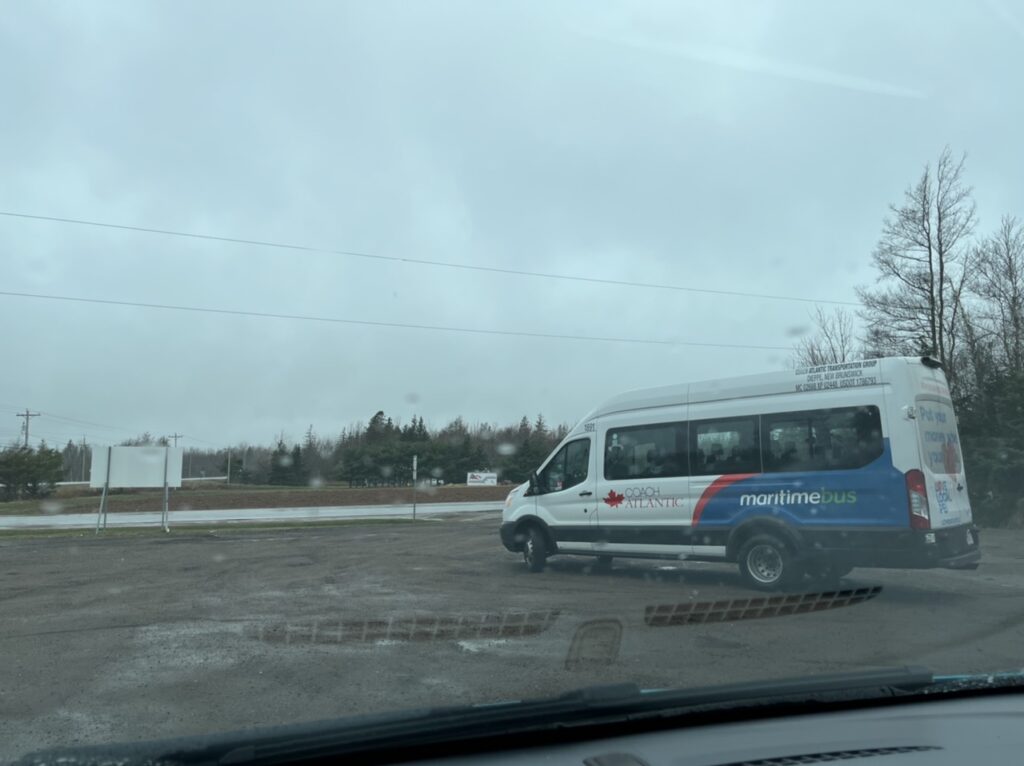
Today I decided to try out the new bus service for western PEI. There are both intercommunity routes connecting towns in West Prince, and long distance runs to Summerside and Charlottetown. I chose to go to Summerside and took a late morning bus (which ended up being a large passenger van) from the West Devon carpool parking lot to uptown Summerside. The trip took just under an hour, cost $2, was quite comfortable, and there was only one other passenger.
The main drawback to the service at this point is a distinctly user-unfriendly online schedule, which I managed to figure out with a bit of persistence. As a non-driver who has lived in rural PEI for over 20 years, and only gets to town when my wife, Thelma, is driving there, it was a novelty to be able to make the trip on my own. “On my own” for most of the way, at any rate, because the other challenge of the service is that Thelma had to drive me to the pick-up point because it is too far to walk to from where we live. But baby steps, so to speak, since PEI has no real culture of public transit.
The trip back to West Prince was a different story, with a roomier bus and more passengers being picked up at the Summerside Tax Centre and Slemon Park, workers who were on their way home at the end of their day. The driver informed me that for a relatively new service (the transit service on the eastern end of the Island has been in operation for two years and is well used), the “Up West” run was quickly being adopted, mostly by long-distance commuters.
I plan to use the transit system as much as I can and keep my fingers crossed that the powers that be get the message that rural public transit is something our Island is in dire need of, and deserves as much support as they can give
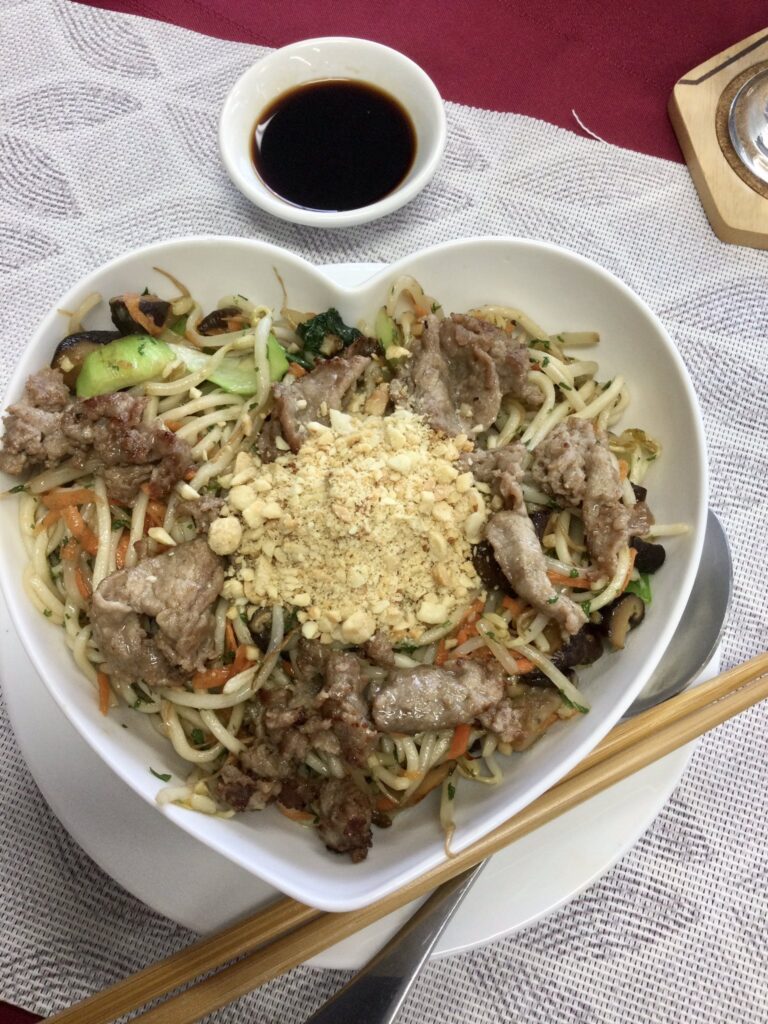
Steven’s lunch at G&T Book Cafe, 30 Spring St., Summerside.
Last week saw the start of public transit bus routes for the western end of PEI but, like so many things that seem new, this is actually something we once had that we just forgot about. There was passenger train service from the 1870s until 1969, bus service from Tignish to Summerside in the 1930s and 40s, and a short-lived bus service in the 1980s. I took the 80s-era bus with some friends exactly once to do back-to-school shopping around 1980, when I was in that sweet spot between being old enough to travel on my own and getting my driver’s licence and, soon after, a car.
I just returned from taking Steven to meet the bus at a carpool parking lot in West Devon. Steven lived in cities with public transit his entire life until we moved to PEI in 2001. He’s never learned to drive, so he relies on me or someone else to take him places. Before this, the closest thing to public transit would be calling a taxi from Summerside, which is $75 one way and so not really viable for anything but an absolute emergency.
The little bus arrived almost exactly on time, he hopped on as the lone passenger, paid his $2 (heavily subsidised by government) fare, and off they went in the direction of Summerside. He’ll do some errands, have lunch, and hop back on the bus to be back in West Devon at 5. He’s promised to pen a guest post to share his experience.
On Tuesday April 25, 1922, five people made their way to Thomas Cahill’s store in Freeland, PEI. A two-story structure that included living quarters, it was the typical general store of its day: a central aisle with two long counters on either side, the goods for sale stacked high on floor-to-ceiling shelves behind. A customer would hand their order to a clerk, who would gather the items from boxes and tins and barrels, write out a receipt, and accept payment or make note of credit. The customer would place the items in a wooden box they brought in from their wagon, or a basket they carried on their arm if they were walking.
Thomas Cahill’s Store circa 1915
While poking around in our basement earlier this month, I found two receipt books from Cahill’s store mixed in with 50-year-old receipt books from the general store operated by my parents, Harold and Vivian Phillips. They bought Cahill’s store in 1946, but from Laughlin “Lin” Murphy, who I believe bought the store from Cahill in late 1922. My parents operated and lived in the old store until 1952, when they built what they believed was the first self-serve general store in rural PEI. That new store had little shopping trollies that customers could put their items in as they made their way along the three aisles of the store. Though my parents were proud of this modern facility, some old timers refused to pick out their own groceries, so the old fashioned service always existed in some form in our store up until they sold it in 1971.
Thomas Cahill had telephone number R5-15 on the Conway line out of the Tyne Valley Exchange, but didn’t include that information on his receipts – not many of his customers had a telephone anyway.
I was familiar with the receipt books my parents used, but Cahill’s books are slightly different in that the receipt lists both the person who was buying the goods and the person who was picking them up at the store. This is double joy for a history buff, more names to make more connections!
It’s a miracle these books made it through three owners and the dismantling of the original store. Little else survives from that store except a couple of photographs, a few drawers from the counters repurposed as wonky workshop shelves by my father, and a gripper device used to quickly reach items on high shelves.
The old Cahill store before it was dismantled in 1952.The house section of the store being moved to Conway, 1952.Inside the old Cahill store when it was being dismantled in 1952. If you look closely, you can just make out the floor-to-ceiling shelves on the far wall. I think this part of the store became part of my grandfathers box mill, and burned in the 1960 West Prince forest fire.
Being spring on PEI, April 25 could have been cold and snowing or hot and sunny, or both over the course of the day! A horse and wagon might have kicked up a bit of dust on sunnier parts of the red dirt roads as they travelled, but could have also bogged down a bit in the swales. If the roads were too muddy, people would have walked or rode a horse to the store.
First to arrive was Joe Kelly, picking up an enormous amount of salt and what was probably a five pound can of baking powder for Clara Gavin. Not sure who she was, but a woman named Sis Gavin was often mentioned by one of my mother’s uncles, and she kept house for William Bryan after his wife died in 1914. Joe Kelly lived not far away from Bryan’s farm, so Clara could possibly be Sis. If I look to the north from our house, I can see the dark outline of the spruce trees that surround Joe Kelly’s house, perhaps the oldest building in Foxley River.
Next was John McArthur, though I’d bet it was really MacArthur, picking up a $4.50 bag of flour, which would have been a 100-pound bag! There was a Malcolm “Mac” MacNeill operating a lobster cannery on the Sandhills at that time, so John could have worked for Mac and the flour was destined to feed the cannery staff.
Next were neighbours and cousins Nicholas and Raymond Bulger, both born in 1902. Perhaps they travelled to the store together. In later years, both of these men followed the well-worn path to the New England states, only returning to PEI for vacations.
Looks like Nick picked up 5 pounds of sugar, some sort of pills, soap, 10 cents worth of candy and some tobacco. The soap was probably something like Sunlight soap, which was used to clean everything. Most country women usually made their own lye soap, but perhaps Mrs. Bulger had run out. Nick had 12 dozen eggs to sell, and got 26 cents a dozen. That sounds like a ridiculously low price to us, but would have been good money then, and possibly the only money the family received that week. Cahill probably took most of the eggs he bought from his customers into Conway Station and sent them on the train to be sold in Summerside.
I think Raymond bought 10 pounds of wire nails at 6-and-a-half cents a pound, 1 pound of twist chewing tobacco, and three large boxes of wooden matches. With matches, tobacco, twist and candy, the boys would have a jolly ride back to Foxley River!
The last customer recorded on that Tuesday was Ferdinand “Ferdie” Kilbride, a neighbour of the Bulger boys and one year their junior. Try as I might, I can’t for the life of me make out the two items that Ferdie bought. The first was a bottle of something or other, and the second is a big mystery. Let me know if you can read this scrawl. [Update: an eagle-eyed reader suggests that the first item is “1 bottle witch hazel”, and I agree!]
If these folks, most of them close neighbours related by birth or marriage, had bumped into each other on their trip, there would have taken plenty of time for a chat to catch up. The weather would be finely dissected, preparations for crop planting compared, updates given on family here on PEI and in far-flung Boston or Toronto. In the distance they might have heard the surf breaking on the Sandhills like I could this morning, heard the robins and chickadees calling. The young men might have been planning what fun they would be getting up to on the weekend!
Peter Bulger’s descendants still farm his land, and Bulgers and Kellys are well represented in our community. I worked for Thomas Bulger’s grandson on the same farm Thomas owned. Sadly, the last Kilbride to live in Foxley River died a few years back. The Bulger, Kelly and Kilbride families came here from Ireland in the 1830s, so the disappearance of an original settler family name is especially poignant.
I had no idea these books existed, so was pleased and excited to find them. All these people came back to life in an instant, their movements through the landscape I know so well, the challenging lives they lived in the backwoods of PEI. An enviable time, in some ways, simple and straightforward, but still before the miracles of antibiotics and electricity, and with one terrible war behind them and one lurking in the future. There is certainly no ideal time to have lived, and I’m content with the here and now, but oh how I would love to have spent five minutes in Thomas Cahill’s store catching up with my long-gone neighbours.