Category Archives: PEI History

Shooting Gallery Shore

With nothing else to do while waiting in my car yesterday, I hauled out a PEI road map and looked it over. At the west end of Summerside I saw something new to me: Shooting Gallery Shore.

Shooting Gallery Short

I would have bet my tam-o’-shanter that area is called Green’s Shore, and there is a park with that name at the foot of Greenwood Drive. And when I think of a shooting gallery, I think of those games at amusement parks where you try to hit targets and win prizes. As far as I know, that area of Summerside was never used for that type of entertainment.

When I got home and was poking around the Island Newspapers offering for August 3, 1921, this little notice caught my attention:

A rifle range west of Summerside – bullseye!

“…in the literary sense.”

The Charlottetown Guardian from this date in 1921 had many mentions of off-island visitors, including a couple of some note, Rev. and Mrs. Ewen MacDonald:

Of course, Mrs. MacDonald was only famous “in the literary sense”, not in any way that really mattered! The writer could have ended with “famous” but just couldn’t help themselves from adding a true PEI cutting down to size of someone who had, even by that time, achieved worldwide fame and admiration.

That Mrs. MacDonald was able to achieve any of what she did was an absolute miracle if you have read about her personal struggles, and in the ridiculous atmosphere that women have endured for most of human history. Case in point, an editorial from the same edition, which starts promisingly and then, well, you’ll see:

It goes on, but we get it. Dear Mrs. MacDonald. Is it any wonder she created impetuous, outspoken Anne when this was what was said of the courageous and capable women who might stand for public office? Creating an outspoken, bold girl would be a relief valve to keep from screaming, I expect.

The sounds of the land

The upcoming merger of four PEI credit unions means the new entity will need a new name. I just completed a member survey where I was asked to rate and give my response to six possible new names…or, rather, five new names and the name of one of the existing credit unions.

The first two sounded like the names of cars, the next one reminded me of John A. MacDonald and colonialism (not a favourable association), the fourth was surprisingly light and fun, the fifth just didn’t sound good to me, and the last one was that existing credit union name. Choosing the existing name would make some members angry that they lost their local credit union name in the merger while other members got to keep theirs, confirming earlier concerns raised at public meetings that the whole process felt like a centralised takeover which would weaken rural voices. I found it an odd choice after all the acrimony.

Although there wasn’t a place to offer other suggestions, I wrote into one of the response boxes that I wanted them to pick a Mi’kmaw word. It is the language of the first people of this island, the real language of this land. It is a rich, living language, unlike the Latin and Latin-derived words the (probable) branding consultants chose. I don’t have a suggestion for what the new credit union could be called, because that should be up to the Mi’kmaq.

I have just started reading Isabelle Knockwood’s 1992 book Out of the Depths about the experiences of Mi’kmaw children who were sent to the Indian Residential School in Shubenacadie, Nova Scotia. Just an hour before the survey landed in my inbox, I had read this sentence about Knockwood’s memories of listening to elders telling stories:

The stories were ancient, and the language in which they were told was even older. According to my mother, Deodis, the Mi’kmaw language evolved from the sounds of the land, the winds and the waterfalls. As far as we know, there is no other language like it spoken anywhere else in the world.

What an opportunity to have the Mi’kmaw language more visible across this island, on the side of many branches of a new credit union, something unique, truly from and of Epekwitk.

[I’ve read many explanations of the difference between Mi’kmaq and Mi’kmaw, and am struggling to use the words correctly, so I welcome corrections; I would rather try and fail than not try at all!]

December 1875

My great-great-grandparents were Martha (Ellis) and George Washington Sharp. They had 10 children, including one set of twins, my great-grandmother Eva and her sister, Florence.

It was only this evening that I realised Martha and George had three little girls who died within a few days of each other. They also had two boys aged 7 and 2 who survived. They went on to have five more children.

I had no idea what the girls died from, but I just found a death notice for the three little girls in the December 20, 1875 The Examiner newspaper out of Charlottetown. What unbearable pain.

The Examiner December 20, 1875 p3
Martha Sharp (1848-1928) circa 1927

Trap smasher

I took my mother to visit a friend of ours on an extremely windy day last week, and our journey allowed us a brief glimpse of the ocean surf pounding against the Sandhills, the barrier sand dunes the protect our coastline at this end of PEI. It was a dramatic sight, and my mother said, “That’s what they used to call a trap smasher.”

I didn’t remember hearing that phrase before, but it makes sense, as those kinds of roiling seas will tangle lobster gear and can certainly end up smashing lobster traps. T.K. Pratt’s Dictionary of Prince Edward Island English includes “trap smasher”, saying it’s a noun frequent in Egmont (the federal electoral riding where we live) and is:

In lobster fishing, a severe wind storm during the fishing season.

So, technically, trap smashers can only occur along our section of the north side of PEI between May 1 and June 30, the spring lobster fishing season here. We, of course, ignore and never discuss the weather the other 10 months of the year (lol!).

My father and I bringing in unsmashed lobster traps circa 1980.

Freeland WI

My mother attended her Women’s Institute’s annual meeting last evening, and they decided to disband after 99 years of continuous service. My mother joined in 1942 when she was 20, right before she enlisted in the Royal Canadian Air Force Women’s Division for service during the Second World War. She has loved being a WI member.

I think at one time almost every school district on PEI had a Women’s Institute to support the school and community, and pretty much every rural community had a one-room school, so that was a lot of WI groups. They were both a fundraising group and a social outing at a time when most rural woman were working at home. They would fundraise to keep their school in tip-top shape, and when consolidation in the 1960s and 70s closed small rural schools, many WIs bought the buildings from the government for a dollar and turned them into community halls. There were at least 22 WIs in our area, but that number has slowly dwindled and now 2 remain, Poplar Grove/McNeills Mills and Port Hill.

I never joined the WI. I was too young when I left for university, and when I moved back 20 years ago, there were no members my age, so I just didn’t join. I now feel like I have missed out on something important.

But I fondly remember the WI meetings that were held in our home when I was a child. I would sit in the corner and watch and listen to it all, the reports from the different committees, the education program on different topics of interest to country women, the discussions on what fundraiser they would hold next: a goose supper, a variety concert, make a quilt and sell raffle tickets on it, a bake sale. There was always tea and sandwiches and sweets and lots of chitchat after the meeting ended. It was up to the hostess to make “the lunch”, and my mother was a generous and excellent cook, so it was always a good feed! I would pass the plates of sandwiches from great aunt to great aunt to neighbour to cousin, all of them calling me “Thelma dear”, smiling, laughing. They would discuss who was sick and who had died and who was taking a trip, the price of things nowadays, wasn’t it hot/cold/mild/windy/dry/rainy.

The WIs in our district banded together to prepare and serve the suppers at the Tyne Valley Oyster Festival for many years, working out of a less-than-ideal kitchen attached to the old rink. They turned out beautiful lobster suppers, complete with salads, rolls, pies and sweets. It was thrilling to be in the midst of this cyclone of competence and energy, each woman knowing exactly what to do, working quickly as if they were line cooks every day of their life (which in some cases, with the large families that were once the norm here, they were), but almost always in good cheer and with a buzzing sense of unity and camaraderie. I feel fortunate to have learned so much from these resourceful, powerful women.

I texted a friend who is a member of one of the two remaining WIs in our area and asked if my mother could join them, even if just in an honorary way. “In a heartbeat,” she texted back.

Report on a WI meeting held at my great-grandparents’ lobster cannery from The Charlottetown Guardian, September 3, 1927. My mother went to live with her grandparents in the spring of 1927, and would have turned 5 that August, so she was likely present for this meeting, lurking at the edge of it like I used to do.

Pituamkek

A beautiful new video from L’neuy about plans to create a National Park Reserve on Pituamkek/Hog Island and the Sandhills that are just a couple of miles from my house. This initiative is important for the Miꞌkmaq and all Epekwitkewaq, because the Miꞌkmaq have lived and gathered food there for millennia and deserve the right to determine their future use. The Sandhills protect the shoreline and are important resting spots for migrating birds and nesting areas for the endangered piping plover.

Those sand dunes are the wildest place I’ve ever been on PEI, raw, stunningly gorgeous and powerful. I was lucky to visit with my parents many times as a child, and rarely would you see another person, miles and miles of beach and dunes and pounding surf. Such vivid memories of long summer days over there having picnics, playing in the cold water, beachcombing to find shells and starfish. I would always fall asleep on the boat ride home, through Cascumpec Bay and Foxley Bay, right up to the shore in front of our house, cradled on the waves, epekwitk.

My father and I in the water on the Sandhills, 1968
My father and I beachcombing on the Sandhills, 1968
Heading home with Toronto visitors after a long day on the Sandhills, 1970
Asleep in the speedboat, 1969

Take Down The Statues

Gary Younge explains in The Guardian why he thinks all statues erected to honour notable people should come down. I had started to write my thoughts on this last night after Charlottetown City Council voted yesterday to remove a statue of Canada’s first prime minster, Sir John A. MacDonald, after much debate and controversy, but Gary says it all, and far better than I ever could. Take them all down; the future hates our statues.

Caught some trout, but lost my teeth

I’m not sure who was writing the unsigned pieces for the “Summerside and Western Guardian” section of The Charlottetown Guardian during the spring of 1921, but their dispatches from the Western Capital included lots of wry commentary on the social ills of the town, and amusing microfiction like “A Fish Story” below.

The Charlottetown Guardian May 27, 1921 p8

Also in this little clipping under the “Western Personals” (i.e. the reporter met the western train and chatted to those who disembarked!) is the news that a former beau of LM Montgomery, Louis Distant (I think it’s really Dystant), had visited town. If I remember correctly, Louis was more a handy means of transportation for Maud while she lived and taught school in Bideford in 1894-95 than a real love interest, at least in her eyes. And the “AA McAull” who was also in Summerside was my great-grandmother’s brother, Anthony Alexander MacCaull.

That I manage to get anything done most days is a small miracle considering the hole I can fall down from just a small section of an eight-page 100-year-old newspaper.

70 Years

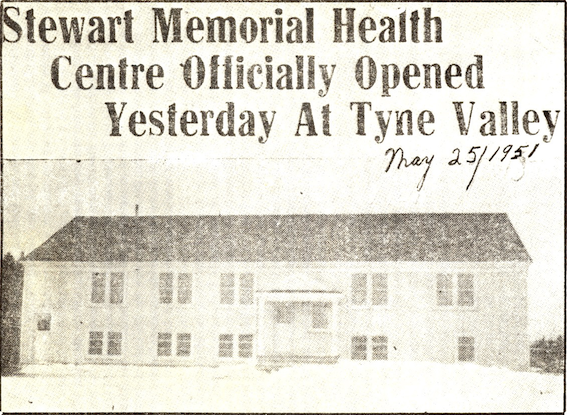
The Stewart Memorial Health Centre officially opened in Tyne Valley on this date in 1951. It rained that Victoria Day Thursday, so people sat in their cars to listen while speakers addressed them from the 7-bed hospital’s verandah. After the official ceremony, hundreds of people toured the building, and no doubt the ladies of the community provided ample and delicious refreshments.

Much of the money to build the little hospital was raised through suppers and bake sales, concerts and fundraising drives. The building was constructed by local contractors, and when we held a 60th anniversary celebration in 2011, a couple of the men who attended told me about working with their fathers to help with the initial build.

My mother tells of going to Stewart Memorial with a friend to help clean the rooms after construction was completed. The Women’s Institutes would answer their roll calls with canned goods that would be given to the hospital to provide food for patients, and they sewed curtains and johnny shirts. Farmers would donate eggs and meat, fishers would drop off trout and cod and lobsters.

Stewart Memorial had its own board until 1995, when amalgamation fever was high on PEI and regional health boards were formed. By that time, two building additions had added 16 more beds for a total of 23.

Over the years the hospital had provided almost every service except for major surgery. Many babies were born and cared for, there was an emergency room (and staff would attend accidents before there was an ambulance service), outpatient services, acute and later long term care. It provide generations of local residents with good jobs. It was the place where members of Lennox Island First Nation would come for medical care, first by boat or on a potentially hazardous trip across ice in winter, and later via the causeway built in the early 1970s.

After the regional health board was established, services at the hospital were gradually decreased until the government announced in 2013 that Stewart Memorial Hospital would close and be turned into a nursing home. Many of us fought to save our little hospital and the valuable services it provided to our area, spending thousands of hours in meetings. I’ve never really gotten over the closure, and trying to save it consumed my life for a couple of years.

Today I spent a couple of hours looking over old documents and thinking about all the people connected to our hospital. My grandmother was the first cook, my father served on the board of directors for many years. I went there to receive medical care, to volunteer, to visit sick relatives, so say goodbye to loved ones. My father lived there for a couple of years while dementia slowly took him from us, in a wing of the hospital he helped to raise the money to have built. He died there, as had his mother, his brothers, his friends and relatives, all cared for by people who knew them.

Soon there will be a generation of people who won’t know that we once had a hospital, that it was a focus of community pride and energy. I suppose it won’t matter, but I’ll never let it go, because it was important, despite what the Capital City bean counters told us. Closing Stewart Memorial didn’t fix the out-of-control health budget, it didn’t solve provincial health care staffing issues, it certainly didn’t improve health outcomes for my friends and neighbours. I’m not sure what closing it achieved, but I know what the hospital achieved while it was open, and that was life, and death, and everything in between.