Category Archives: Home

Washboard and soap

Had a stubborn stain on a white shirt today, so did what I have always done: grabbed a piece of homemade soap and a washboard and gave it a good scrub. The soap was made by my mother’s uncle, Elmer Hardy, mostly likely with chicken fat as he raised hens for meat and eggs. Not sure what else went in the soap, but it certainly contains lots of lye and is hard on your hands if you do a lot of washing with it. Red knuckles will result if you are out of the habit, as I am, and you scrub too vigorously for too long.

Add soap to board, not to the piece of clothing.

In case you’ve never done it but find yourself in a rustic backwoods cabin with dirty clothes, you place the washboard in a laundry tub with some hot water, rub the soap over the washboard, leaving some behind in the grooves, and then scrub the piece of clothing over it. I use our modern plastic laundry tub, run a couple of inches of water in the bottom and a bucket for rinsing, and wash and rinse and wash and rinse until clean. Hang your cleaned item out on the line and the sun will do the rest of the bleaching!

Uncle Elmer died in 2002 at age 92, and I can’t remember when he last kept hens or made soap, but it was many years before that, so that soap could be over 30 years old and is still hard and perfect. He didn’t use individual moulds but instead poured the mixture into a big pan and cut it before it set too hard, so some of the pieces have rounded bottoms. I laugh when I see bougie soap makers now going for a similar raw look to their hand and body soaps, rough and misshapen bars wrapped up in brown paper and twine.

Who taught me how to wash clothes this way? My mother, I suppose, though I don’t remember her showing me, I just picked it up from watching her, as she watched her grandmother, and on and on back in time. My hands hold old knowledge.

Stamp of approval, I guess

Arrows, Xs and masks will certainly be the most memorable symbols of the COVID-19 pandemic for me, but so will these little official-looking squares found in many disposable mask packages. 65%, 35%, 85%…better wear two.

The View From Here

The land where I live in Foxley River remains the unceded territory of the Miꞌkmaq people, who have occupied this island for over 12,000 years. Since European settlers arrived, the piece of land where my house is has been claimed by six people, as far as I can figure, including me.

It was once owned by Creelman MacArthur from Summerside, a businessman and politician. As far as I know, he never lived in Foxley River, and I suspect he bought the place solely as an investment. He had hoped the property would be designated as Prince Edward Island’s national park, as he mentioned when he spoke to a National Parks Amendment Bill in the Senate on June 17, 1938:

Hon. CREELMAN MacARTHUR: Five years ago I acquired the old Warburton estate of 655 acres, only to realize that it was a white elephant. I built a lodge and a concrete and steel dam and put in some 50,000 trout. In a word, I did everything that I thought might appeal to the Commission when selecting in the province an area for a national park which would be attractive to tourists. But it seems the outstanding requirement was surf bathing, and my property had only sheltered stretches of river. It is a very beautiful area and its waters are well stocked with trout, lobster and oysters.

Right Hon. Mr. GRAHAM: What a place!

Hon. Mr. MacARTHUR: The property cost me some $15,000. I offered it to the Government as a gift, free of restrictions of any kind. I thought in that way a greater service would be rendered to this country, and to visitors in this country, than could be rendered by me as an individual.

However, it was deemed the part of wisdom to select an area in Queen’s county, of which the honourable senator from Queen’s (Hon. Mr. Sinclair) can speak in more detail than I can. Mr. Cromarty and another gentleman from the Parks Branch went down and after looking at four or five sites selected the one referred to in the Bill. Unfortunately, there was some difficulty with three or four landowners with regard to the expropriation, and for a year or more there has been some contention. This difficulty has now been removed, and the purpose of this Bill is to describe the area. We are now looking forward to having a park which will be the equal of anything in any other province in Canada.

And so the PEI National Park did not end up in Foxley River, but in Cavendish, in the heart of the area made popular by author Lucy Maud Montgomery and her Anne of Green Gables books. Just as well, but I’m sure Senator MacArthur had hoped to recoup part of his $15,000 investment, even if he did say (after the fact) that he had intended to give the property to the government as a gift. I don’t say that to be mean, and I never met the man, or his family, but I’m sure there would have been some way for him to make a little money on the deal. Business is business.

Mr. MacArthur died in 1943, and his Foxley River estate eventually broken up into smaller parcels, 23 acres of which we now inhabit. Part of the lodge he had built in 1933 is still here, as well as the dam and the descendants of those 50,000 trout!

I found a postcard online years ago that was probably taken in the 1930s or 40s of the view from the shore in front of our house looking northward up Foxley River. I wondered when I found it if MacArthur had the photo taken to advertise the beauty of his property, perhaps as something he could hand out to sway the opinion of the decision makers at the Ottawa Parks Branch. There really isn’t any other reason why this photo was taken, being so far from the beaten track as we were and still are.

I have many times tried to recreate this postcard photos, capture some mountainous clouds, but never have I caught a similar sky. It is startlingly the same vista, though, despite the massive forest fire that ravaged this area in 1960 and the many decades that have passed. The building in the centre is long gone, but the trees on the far shore look almost the same, with the same breaks in the treeline.

Yesterday a neighbour was making hay on that far field, as has been done for nearly two centuries on that piece of land. This area dodged becoming a tourist mecca 90 years ago, but how long before that field becomes cottage lots is anyone’s guess, so I am thankful for its timeless beauty every day. A miracle, really.

Probably 1930s
July 13, 2022

Brain portrait

A friend asked me what I’ve been up to lately. I said I’ve been in my shop fixing an old school desk that was wiggly because the glue holding it together had dried out. She asked me to send a picture, so I did.

I was going to delete the photo, but then decided it is possibly the best portrait I could ever make of my brain: quite messy but also reasonably organized, full of stuff I probably should have gotten rid of ages ago, practical, a mix of old and new, slightly scattered, but all mine.

Yes, you wags, a bit unglued, too!

Wave

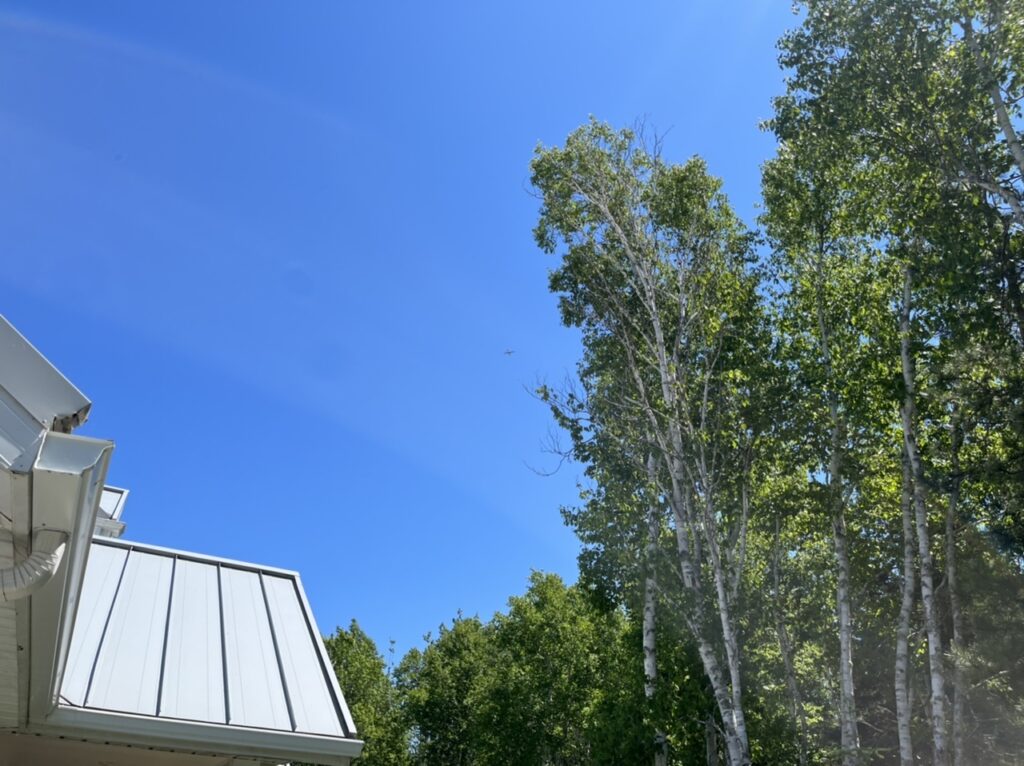
When I hear a small plane or helicopter approaching our house, I run outside and give them a big wave. I’ve been doing this my entire life, but the little plane that flew over our house just now is the first one that clearly waggled its wings back at me. Never give up.

Off it goes.

Yield

I used to spend part of each yoga practice gently encouraging Sally the tabby to move off my blanket as she joined me in the weird human thing I seemed to be doing, which often puts me in a cat petting position, but rarely results in feline adoration. Then I folded my blanket a bit differently one day, and she had a place to do the cozy cat while I did the downward dog. Sometimes the best way to get what you want is to give a little.

Bounty

It is not uncommon to find empty mussel shells in the woods around our home, the two halves still attached to each other but usually missing one piece of one shell. Crows will pick a mussel from the shore, fly up onto a tree branch, hold the mussel with their feet while prying it open with their beak, pick out the meat, and drop the shell when they are done.

Yesterday I spotted a shell in birch and poplar leaves, probably 200 feet from the river. It will soon be completely submerged, slowly releasing calcium and other minerals into the forest floor over the next decades. Forests think and move in centuries, while humans count days and weeks and months and years. Is it any wonder humans can’t see what trees are doing, how they communicate to each other (and us)? They probably feel we need to slow down a little.

Last evening I gathered some dry grass from the shore below our house to use as mulch in my garden. It floats on the river and gathers after storms, a mixture of seaweed and terrestrial grasses. Other things can arrive, too: pieces of wood, branches, dead fish, feathers. As I gathered a few hay forkfuls, I picked out and disposed of a short piece of plastic rope, the plastic top off a coffee cup and a couple of plastic bags.

I left the mussel shells I found in the pile of grass, and they will disappear into my garden, breaking under my rubber boots, split by a hoe, freezing and thawing, rubbed by worms and microbes, catching the rain.

I appreciate more and more the riches I have around me, even if, to some, it’s just a pile of old dead grass. With an endless supply of fallen leaves and grasses, I don’t need to buy bark mulch that is trucked in from far away. The mulch I use would definitely not be welcome in a beautifully manicured neighbourhood, but that’s not where I live. It’s taken a while, but I’m getting more and more comfortable with the rougher look and letting nature move right up to my front door.

The crow and I gather from the shore, apart but together, same-same.

Be Your Own Friend

I have been on a journey lately to be a better friend to myself. I have realised that I am much harder on myself than I would ever be with a friend or family member. I seem able to easily forgive others for unhelpful things they do or say, but take myself to task for even the smallest mistake. I’m trying to understand why that is, and to change my inner voice, to be as kind to myself as I try to be to others.

While practicing yoga this morning, one of the moves included placing my hands on my heart centre and focusing on it. As my hands touched each other, I thought what a physical, calming way to put being my own friend into practice, so I held my own hand for a while and said soothing words. We have all probably rubbed our hands together to warm them up, wrung them when we are nervous, even clasped them in prayer or pleading, but have we ever held our hands as we would hold the hand of another we loved?

Hold your hand and tell yourself how much you care, and you might feel the little leap in your heart that I did this morning.

RCA Victor V610

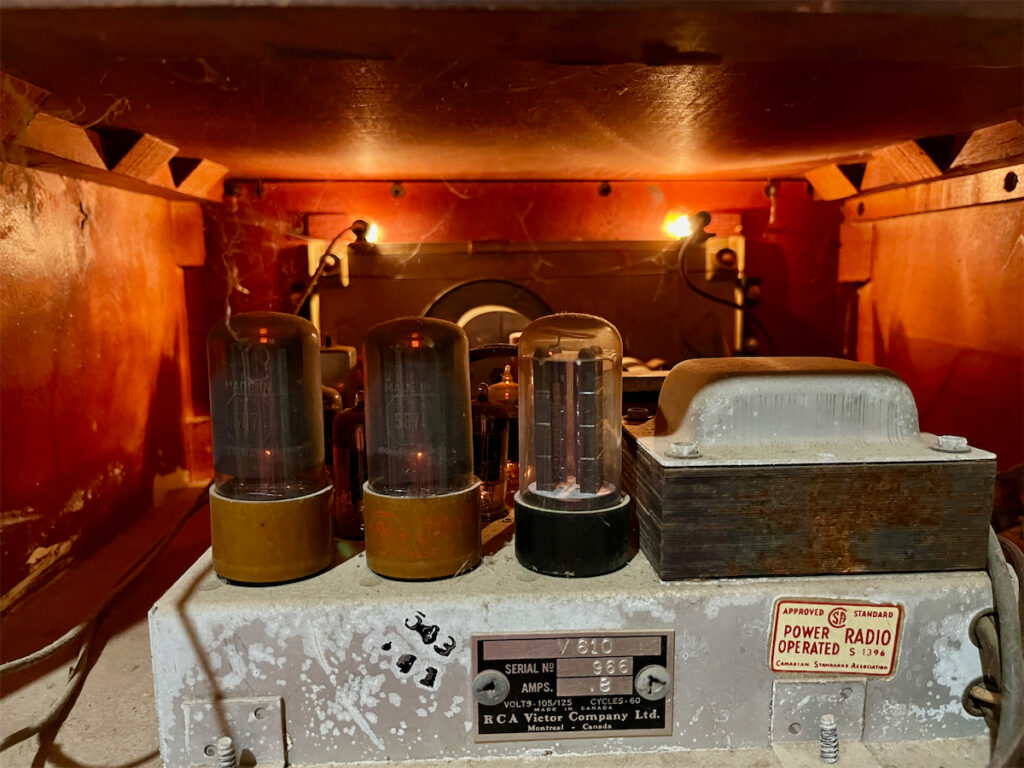
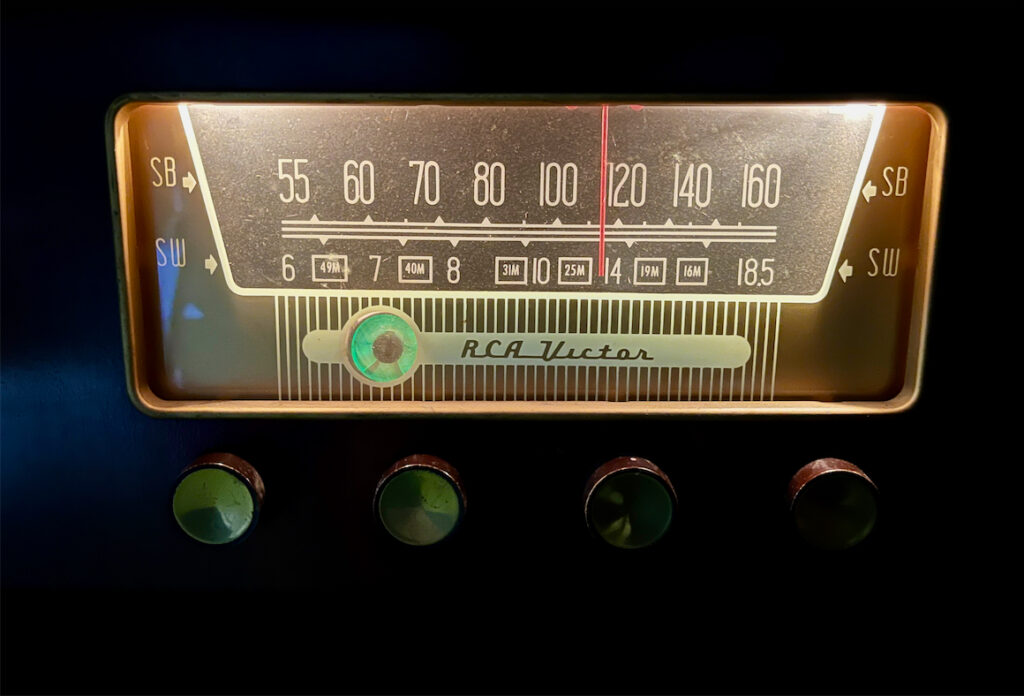
Bask in the warm glow of tubes and the radioactive-looking tuning eye of this 1950s RCA Victor radio/turntable that lives in our basement. I’m certain it is patiently waiting for the return of its original owner, my father’s friend and fellow Lucky Dollar store owner Edwin Bernard, who spent many peaceful hours sitting next to this lovely cabinet listening to sports and music while smoking and reading a big book. I hadn’t plugged it in for many years, and quickly unplugged it after taking a couple of photos as the basement started to smell like electronics, and not in a good way. Rest easy, good and faithful servant, someone will restore you one day.

Lights and tubes aglow inside…
…makes a pretty show outside.
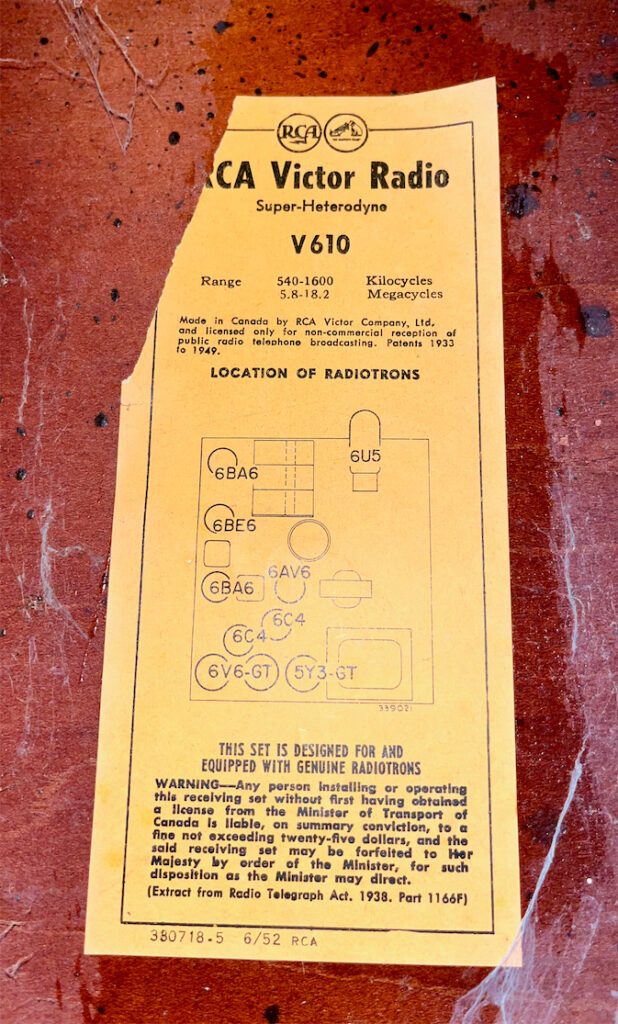
You can see this was firmly attached with paste. I’m sure I have my radio license here somewhere, officer…

Out In Left Field

I have been recording my comings and goings for COVID-19 tracing purposes for two years, but continuing to do so seems pretty pointless now that mask and physical distancing restrictions have been mostly eliminated. With so many cases and wide community spread, it would be difficult for most people to figure out where they got COVID-19.

Unlike the beginning of the pandemic, where everything stopped so public health office press conferences could be watched, no one but the most vigilant are still keeping track of case numbers and infection rates. It feels like the pandemic is over, as the media revert to covering other disasters. People are still getting sick from COVID-19, though, and the health care system is still groaning under the pressure.

When I visited the Summerside public library last week, the librarians were pulling large yellow physical distancing stickers from the floor, not with jubilant whoops and hollers, but by rather solemn, determined effort, pulling and scraping. I remarked that it was an historical moment, and they agreed. We were all still wearing masks.

When will I stop wearing a mask? I suppose when case numbers are closer to zero than they are now, but I have no idea. Everyone in my household has been vaccinated and boosted, but we still wear masks when we go out, and keep our contacts small, all because of my mother’s advanced age.

Masks took on a symbolic role beyond their practical use during the pandemic, and their meaning seemed to morph. Before they became mandatory, they were viewed as a way to not only protect yourself but also showed that you cared enough to protect others and keep the health care system from collapsing. When they became mandatory, they became symbols of oppression and an erosion of freedoms by overreaching governments.

Now that wearing masks is a matter of choice in most public places, it will be interesting to see how people view them. I know a woman in her 50s who has lived with complex allergies and a compromised immune system for decades, and she says she has never felt safer out in public in her entire life now that wearing a mask has been normalized.

Perhaps the mask will become a symbol of acceptance, that we need to think of the needs of others, even (and perhaps especially) if they are hidden. Someone wearing a mask who looks hearty and hale might in fact be vulnerable, and they need to be treated with tenderness. I hope the tolerance and acceptance I see now of choosing to be masked or unmasked will spill over into other aspects of society, in accepting and embracing people of other racial, gender or religious identities.

Maybe the mask, most often used to hide and protect, will become a way in which we better see each other and our needs, a reminder to not rush to judgement.

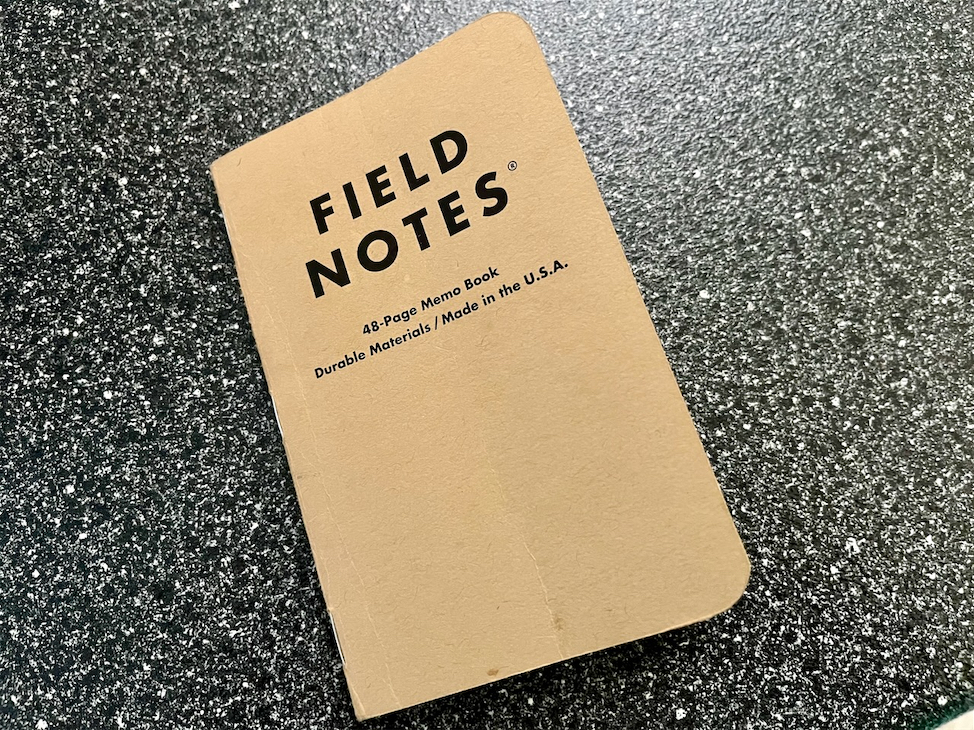
So, my COVID-19 tracing logging, which admittedly got a little lax in the past couple of months, is over, and the notebook will be repurposed to remind me of the things I need to do rather than the places I’ve been and the people I’ve seen.