I took my mother to an audiologist appointment at the mall in Summerside yesterday. She’s nearly deaf now in her right ear, with about 10% of her hearing remaining, and has been completely deaf in her left ear for over 80 years. She receives a disability pension from Veterans Affairs because her hearing loss was due to her Second World War service, so she can get an updated hearing aid every few years. The newer digital hearing aids have been life changing for my mother.
After her appointment, we took the opportunity to run a couple of errands, which meant spanning the length of the mall. Though she can walk quite well (with assistance) for short distances, we often use a transfer wheelchair for longer outings.
I’ve been following the coverage of events marking the 80th anniversary of VE Day and have found the images of the couple of dozen Canadian Second World War veterans who travelled to Europe for the commemorations very moving, probably the last trip for many.
Perhaps it was due to being awash in all this poignancy that I found myself pushing my tiny mother and overcome with the urge to call out to the people in the mall, “Look at this woman! She’s 102, she walked to a train station by herself with a little suitcase over 80 years ago to join the Royal Canadian Air Force Women’s Division! She saw a German U-boat surface in the Gulf of St. Lawrence! She lost her hearing during the war! This is history passing in front of you!”
But I didn’t yell, of course. We just kept walking and rolling by the people staring at their phones and browsing in shops, my mother just another elderly person. We stopped to talk to the niece of another veteran of that long ago war, who said her centenarian aunt was in the hospital again, having a rough time. My mother went home and wrote her veteran friend a get well card that I delivered to the hospital today.
I’m told there are fewer than 10 Second World War veterans left on PEI. History is passing.
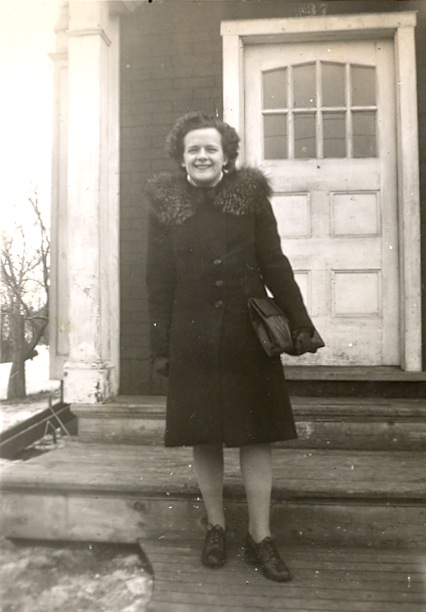
Vivian Phillips in front of my parent’s first apartment at 37 Russell Street, Summerside, 1945. Though released from her RCAF service in January of that year, she is still wearing her very serviceable military uniform shoes.
When I wrote about discovering an audio recording of our neighbours Margaret and Kevin Kilbride, I said I was sorry I hadn’t spent more time with Margaret in her later years, wished I had asked her more questions about her nursing career and military service. I knew a little bit, but not much, and didn’t know a way to find out more.
So imagine my delight when I was contacted by a woman who grew up in Foxley River and had interviewed Margaret in 1985. Susan Bulger Maynard was a neighbour of the Kilbrides, and of ours, and her parents, Roger and Norma Bulger, were close friends and great supports to both Kevin and Margaret.
Susan’s interview with Margaret was for an assignment for one of her university courses, and thankfully she saved the paper, kindly sent a copy to me, and has generously allowed me to share it here on my website. It is an absolute treasure and helped to fill in so many blanks about Margaret’s life.
All I had previously known about Margaret’s Second World War service was that she had been a nurse in Europe and somehow lost a finger during that time, but Susan’s interview uncovered many more details, including that Margaret had been a lieutenant in the Royal Canadian Army Medical Corps (Nursing Division) in charge of operating rooms in Belgium and France, and had been night supervisor of a 1,500 bed military hospital in England.
I can’t even begin to imagine what Margaret saw during her years with No. 10 Canadian General Hospital, and what she had to live with for the rest of her life. Her time as the head nurse of our little 13-bed Stewart Memorial Hospital in Tyne Valley would certainly have been a very different experience, and there probably wasn’t much that could rattle her.
Margaret would often drop in to our house on her way home from work for a quick visit, sometimes still in her white uniform, so I was surprised to learn from Susan’s paper that after Margaret married Kevin in 1954 and moved to Foxley River, she took a few years off from nursing and worked at home. I expect that after having nursed full time for 22 years, 5 of those her service in the RCAMC, those few years of home life were a very welcome and necessary break.
While I went to school with some of Susan’s younger siblings, she and I have not often crossed paths, but we both feel that Margaret had a hand in bringing us together; if anyone can make things happen from beyond, it would be Margaret!
Margaret Kilbride, RN, in the kitchen at Stewart Memorial Hospital, 1970s
My mother was asked if her RCAF uniform could be used in a display in connection with the upcoming publication of a book by PEI historian Katherine Dewar about PEI women who served in the Second World War. Katherine and Lois Brown, who was with the Canadian Women’s Army Corps in the Second World War and is a lively 97-year-old, came up last week to take the bits and pieces my mother has.
My mother’s air force blue uniform is nearly complete, except for stockings and shoes, which she used after the war and wore completely out. Her khaki uniform has always been a bit of a mystery to me. She always called it her summer uniform, but I believe it was what she was wearing when she ended her service on January 9, 1945, as her last meal card and clearance certificate (incorrectly dated as 1944) are still in the inside jacket pocket. As she ended her military career in Halifax, in January, it would have been far from summer weather! I hope to get more information from PEI Regiment Museum curator Greg Gallant about that uniform.
I also gathered up various pins that were scattered around the house in different little boxes. She would have received or bought most of them during the war, the General Service Badge would have been worn after the war (probably by my father, but not sure), and another is one of many pins she’s been sent periodically by this or that group honouring different battles and anniversaries.
RCAF (WD) poster
I imagine Katherine’s book will touch on the fact that women who had served weren’t regarded as real veterans immediately after the war. Women had been recruited to supporting roles to free up men to assume combat roles, so their service wasn’t considered to be the same.
While both of my parents were in the RCAF during the Second World War, neither of them served in Europe, spending their time in Canada or Newfoundland, which was considered an overseas posting as a British colony. My father was always viewed as being the “real” veteran in our family, even though his role as an RCAF mechanic put him in no greater danger than my mother. They were both involved in the background of the Battle of the Atlantic during their time in Newfoundland, he at Gander and she at Torbay, and I’m sure both of those stations were on the German hit list for a possible invasion of North America, which thankfully never happened.
My father mistakenly wore my mother’s medals all his life, and it was only after his death, when I was asked to help with an award nomination for my mother, that I found out she had been given an extra medal (The Defence Medal) because of the length of time she had spent in Newfoundland, and my father’s time there hadn’t qualified.
I don’t believe for a second that my father even knew what he had done. I suppose when the medals arrived in the mail (ex-service members applied to get them after the war and they were mailed in a little box, no dramatic presentation by a senior officer as portrayed in movies), he just assumed the three were for him as he served for nearly 5 years and my mother for less than 2.
So my mother had worn my father’s two medals, never knowing the difference. When I brought this error to her attention, I didn’t think she would bother to start wearing her real ones, but she did, and still proudly wears them to Remembrance Day services and other official events. And now, because she is one of the few veterans left, people sometimes thank her for her service.
My mother, Vivian, says her time serving in the RCAF Women’s Division during the Second World War was one of the happiest periods of her life. That might sound bizarre to us now, but even those veterans I knew who fought in Europe only told stories of the funny things that happened, both to keep buried as deeply as possible the horrible events they saw, and knowing those who hadn’t been there could never understand what they had been called upon to do and witness.
Before enlisting, my mother had never travelled more than a few miles from home, grew up without running water or electricity, had been keeping house for her father and brother, and working hard on their farm. She served in Canada and Newfoundland, far from the battlefields, so the war really gave her adventure and freedom from drudgery. There were dozens of other women in her group, and she made lifelong friends.
Amazingly, my mother is still in contact with one of the women she trained and served with, a lady named Vina Trowsdale who lives in North Bay, Ontario. They write to each other frequently, sending long letters and newspaper clippings on things the other might find interesting.
I was just searching to see if there was anything online about Vina and found this great interview from 2015. I just showed it to my mother, and she said this is basically her story, too. Thanks, Vina!
Vina Trowsdale and Vivian Phillips, Foxley River, 1971, 30 years after meeting in Rockcliffe, ON
My mother, Vivian, has always loved writing letters and still writes a couple each week, as well as sending lots of birthday, anniversary and thank you cards. It takes much more effort at age 97 as her fingers don’t always do what she wants them to, but she takes her time and gets the job done.
Here’s a letter she wrote to her friend, Lance Corporal Harold Bulger, who was serving with the Algonquin Regiment of the Canadian Army during the Second World War. “Hally” had worked for her father, Wilbur, before the war, helping with farm chores like making hay and bringing in grain. As people were fed their noon meal by their employer in those days (and up into the 60s and 70s in our corner of rural PEI), my mother got to know Harold well. She doesn’t remember why she referred to him as “This Place”, but guesses it must have been something he said often.
The letter is dated September 15, 1944, eight days after my parents were married in Summerside, PEI, while both were serving in the RCAF. My father, Harold Phillips, was stationed in Summerside, and my mother, Vivian Hardy, in Sydney, Nova Scotia. They were both 22, so I’m not sure why my mother thinks she waited so long to get married! Her reference to being “posted back to Canada” is because her 13 months serving in Torbay, Newfoundland was considered an overseas posting as Newfoundland was still under British rule until 1949.
Vivian and Harold Phillips, September 1944
Harold Gabriel Bulger was killed in action in Belgium on September 10, 1944, one day after his 26th birthday, so he never got to read this cheerful letter from his old friend. He is buried in Adegem Canadian War Cemetery.
The letter was stamped and written on a few times before finding its way back to my mother on PEI, probably in 1945: 10-9-44 for the date of Harold’s death, Deceased both written in wax pencil and stamped, just to drive the sad point home.
I can’t read all the cancellations, but my guess is the letter travelled Sydney> Europe> Sydney> Ottawa> Conway Station. I suppose there was a general military post office in Ottawa (OTTAWA M.P.O. 318, maybe?) to redirect mail to service members as they moved between postings and back to civilian life. Someone wrote my grandfather’s name – Wilbur – and Conway St., PEI in red pencil, and that was all the address needed to reach its final destination.
Harold Bulger’s parents, Annie and Gabriel, lived in Foxley River, about a mile from my grandfather’s house in Freeland. They had 17 children, 14 girls and 3 boys, who all lived to adulthood (a true miracle in those days). Harold and another brother, Lawrence, both joined the army during the Second World War. Like my parents, and many others who volunteered, this was as much a way to make money to help the family as it was about patriotic duty, and their large family could no doubt have used the financial injection in a community where jobs were scarce.
Lawrence was killed as his unit, the North Nova Scotia Highlanders, were advancing towards Berlin on March 25, 1945, less than two months before Germany’s surrender. Lawrence was 20 and is buried in Groesbeek Canadian War Cemetery in the Netherlands.
Two sons killed within six months, buried far from home. Poor Annie and Gabriel.
Their names are read out at the Ellerslie Legion Remembrance Day service as part of the long list of those from our area who died in the line of duty. Each year I think of this letter when I hear Harold’s name, just a newsy note that would likely have been long gone if he had received it. I can imagine him reading it while having a smoke and a mug of tea, maybe telling a pal the news from home, then using the paper to light a fire or even roll a cigarette if rolling papers were scarce. Instead, it has become a treasure.
(With enormous thanks to Clinton Morrison, Jr., for his excellent book, Along The North Shore: A Social History of Township 11, P.E.I., 1765-1982, the top source of historical information on our community and past residents. It is known as “The Other Bible” in our home, and many others, as countless discussions and arguments have been resolved by pulling Clint’s book off the shelf.)