On one of my first jaunts as I was learning to ride and getting ready to go for my motorcycle licence in 2006, I met a couple of motorcycles. As they passed, they put their left hands out and down, index and middle finger pointing outwards in a sort of casual peace sign. I hadn’t heard of the motorcycle wave, so wasn’t ready to respond, and they whizzed by without any acknowledgement from me. They were on chonky Honda Gold Wings and I was on my teeny, slow 49cc Yamaha scooter, so I just barely counted as a biker, but I had suddenly joined a club I hadn’t known existed.
The next time I met a motorcycle, I was ready and stuck my gloved hand out, receiving the low-rider’s salute in return. I was tickled to be considered a biker, even by someone with scary looking patches on their jacket!
I drove my scooter every fine day there wasn’t snow on the ground for four years while I worked at my neighbour’s dairy farm. After milking cows on a hot, humid summer evening, there was nothing nicer than peeling off my smelly overalls and rubber boots and scooting home, the wind cooling me off immediately, my sweaty t-shirt billowing from my back.
My scooter is gone, one of the many things I have put aside, for now, as a full-time caregiver (and it had a filthy 2-stroke engine, so it really wasn’t an environmentally responsible mode of transportation no matter how little gas it used). I can’t afford to dump a scooter and end up with an injury, because my mother needs me to be well and fully functioning. I’ve never been a reckless kind of person, so my risk aversion is not a new thing, but I’m now incredibly careful on stairs and ladders, on ice, on wet surfaces.
Early this morning I had the occasion to take another slow drive, 20 minutes down the road, on my little Kubota tractor, to help a friend with a landscaping project. There’s no speedometer on my tractor, so I’m not sure how fast I was going, but it’s certainly not a zippy rig. I enjoyed the slow ride, even with the diesel fumes (I will be glad to someday trade in for an electric tractor).
Neighbours waved from their yards as I passed, as did people in cars and other tractors. The smell of the briny Foxley River gave way to the pong of freshly-spread manure, then further along came the odour of sweet silage that had just been cut. White phlox that had long ago escaped from a flower garden nodded at me from a ditch, their strong lilac scent overwhelming the diesel, and that’s quite a feat.
I crossed from Foxley River to the next community, Freeland, where my mother was born and raised, where my parents had a store with our house next to it, the community where seven generations (and counting) of our family have lived. As I reached our old store, our former neighbour was out for her morning walk, and she laughed when I told her where I was headed and what my plans were. I passed the yard where my great-grandparent’s house had stood for over 125 years until it was torn down last fall. My cousin is going to have a big barn built there to hold his fishing gear. The grass is growing well over the old house site, and they have planted fruit trees in memory of our ancestors.
A couple of hours of digging and levelling and the uprooting of a couple of rotten stumps (one with a wasp nest – yikes!) and I was tootling home again. Next to the Anglican cemetery where my namesake grandmother Thelma (Hutchinson) Hardy has rested since 1927, nestled next to many other relatives, I admired the bumper crop of choke cherries growing on the side of the road in this extraordinarily good growing year.
Choke cherries
I stopped to take a photo of one of my favourite trees, a round white birch on the edge of a field, with a couple of ancient linden trees far in the background that were said to have been grown from cuttings brought from Ireland in the 1830s.
The solitary white
I’ve made so many trips along this road in my 57 years, in every kind of conveyance: car, truck, tractor, horse and sleigh, bicycle, scooter, snowmobile, school bus. I still see something new on each trip, especially a slow one. I was content and calm and exactly where I was supposed to be, moving slowly and part of everything I saw.
Our house is hidden far in the woods on the far side of Foxley River.
When I wrote about discovering an audio recording of our neighbours Margaret and Kevin Kilbride, I said I was sorry I hadn’t spent more time with Margaret in her later years, wished I had asked her more questions about her nursing career and military service. I knew a little bit, but not much, and didn’t know a way to find out more.
So imagine my delight when I was contacted by a woman who grew up in Foxley River and had interviewed Margaret in 1985. Susan Bulger Maynard was a neighbour of the Kilbrides, and of ours, and her parents, Roger and Norma Bulger, were close friends and great supports to both Kevin and Margaret.
Susan’s interview with Margaret was for an assignment for one of her university courses, and thankfully she saved the paper, kindly sent a copy to me, and has generously allowed me to share it here on my website. It is an absolute treasure and helped to fill in so many blanks about Margaret’s life.
All I had previously known about Margaret’s Second World War service was that she had been a nurse in Europe and somehow lost a finger during that time, but Susan’s interview uncovered many more details, including that Margaret had been a lieutenant in the Royal Canadian Army Medical Corps (Nursing Division) in charge of operating rooms in Belgium and France, and had been night supervisor of a 1,500 bed military hospital in England.
I can’t even begin to imagine what Margaret saw during her years with No. 10 Canadian General Hospital, and what she had to live with for the rest of her life. Her time as the head nurse of our little 13-bed Stewart Memorial Hospital in Tyne Valley would certainly have been a very different experience, and there probably wasn’t much that could rattle her.
Margaret would often drop in to our house on her way home from work for a quick visit, sometimes still in her white uniform, so I was surprised to learn from Susan’s paper that after Margaret married Kevin in 1954 and moved to Foxley River, she took a few years off from nursing and worked at home. I expect that after having nursed full time for 22 years, 5 of those her service in the RCAMC, those few years of home life were a very welcome and necessary break.
While I went to school with some of Susan’s younger siblings, she and I have not often crossed paths, but we both feel that Margaret had a hand in bringing us together; if anyone can make things happen from beyond, it would be Margaret!
Margaret Kilbride, RN, in the kitchen at Stewart Memorial Hospital, 1970s
I’ve spent the past few days immersed in the history of Cedar Lodge, the log cabin that sits next to our house. The man who had it built, Senator Creelman MacArthur, marked the grand opening 90 years ago today with a big party.
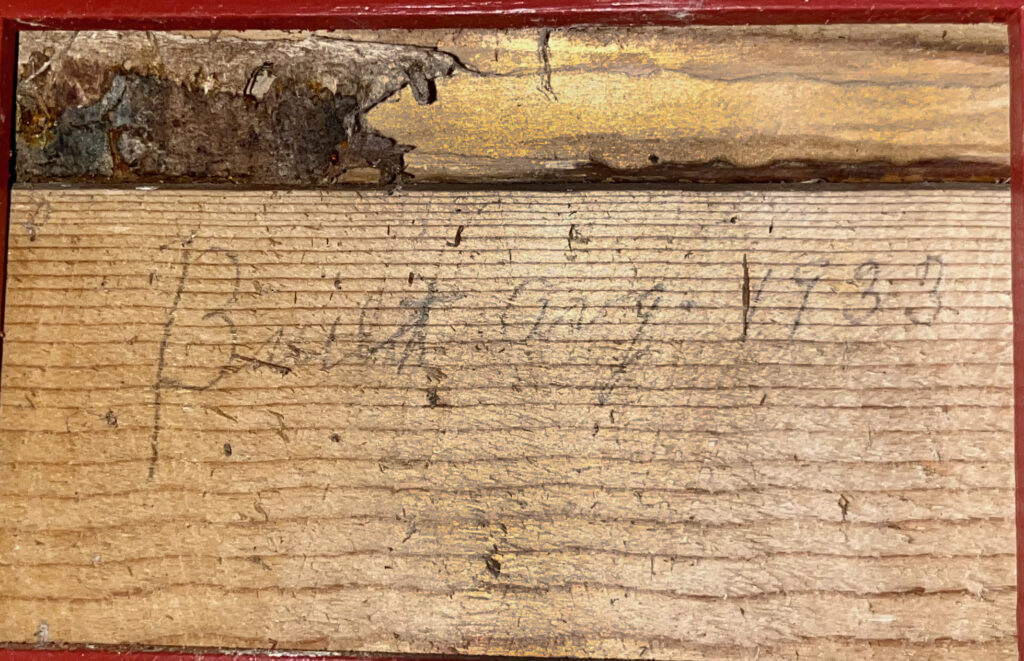
Someone put the date on the outhouse wall!
Almost everything I’ve been reading, including the newspaper report of the opening I’ll add to this post, talked almost exclusively about men: the various owners of the land, those who built the cabin, those who participated in the opening day event.
To be fair, a rustic log cabin designed to be a hunting and fishing lodge had manliness baked into it. I’m not sure what furnishings and decorations were in Cedar Lodge on August 30, 1933, but when my parents acquired it there was a stuffed moose and deer head leering down from the wall, rifles and fishing rods on racks in the corner. The pine floor was pretty beaten up by the time I came along 33 years later, so it probably had become a fair target to spit tobacco juice on during the years it was rented out to hunters and fishers. The huge stone fireplace was a perfect spot to gather around and tell tall tales, kerosene or gas lamps pushing out moody, flickering light. A man cave for men in flannel and rubber boots and wool caps.
The Cedar Lodge grand opening activities had been scheduled to kick off at 3 pm with the ladies from nearby St. Peter’s Anglican church catering a tea. Had my mother’s mother, Thelma Hardy, lived a few more years, she would have been one of those ladies, and no doubt my 11-year-old mother, Vivian, would have been there, but that wasn’t to be.
So at about a quarter to three this afternoon, my mother and I talked what would have been going on in the kitchen 90 years ago. We imagined the efficient bustle of the women who would be pumping water, stoking the wood burning range, moving dishes and setting up tables. We guessed they served sandwiches and sweets, rather than a meal, but can’t really know.
One thing I would bet money on is that just before 3:00 there would have been a pause in the preparations. A big pot or urn, filled to the brim with the sweet water that came out of the hand-dug well, would have been the first thing placed on the stove when the women had arrived and started the fire in the stove. Once boiled, it would have received a homemade cotton bag filled with loose black tea.
When it had steeped for a while, one of the women would have ladled a bit of tea into a china cup, and the women would have stopped what they were doing and gathered around to look in the cup.
Is it too weak? Too strong? Opinions would be offered, and if it looked okay, a dash of milk would have been added and the cup reexamined to see how the brew held up to the milk. If thought to be the right colour, the woman holding the cup would have had a sip, declare it to be fine, and the tea bags promptly pulled from the pot.
How can I be certain of this one detail, as sure as if I’d been sitting in the corner watching this take place? Because every church supper, tea or reception I’ve ever helped with in my 56 years has had the same ritual. It is a holy rite, an echo of the eucharist, the priestess drinking the remaining tea with a tip of her head, washing the cup, wiping it dry to use for the main event.
So hooray for Cedar Lodge, and the men who built it. My family have enjoyed taking care of this unique structure for 67 years, and have made so many lovely memories sheltered within its cosy walls. I’m in it now, typing by candlelight, as heavy rain pours loudly onto the uninsulated roof while the thunder roars.
And hooray for the unnamed women who fed the crowd that day, who were quietly in the kitchen performing secret, holy rites.
Three of our friends doing dishes after a party in the Cedar Lodge kitchen, 1965
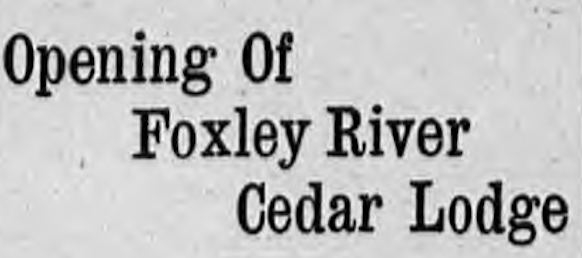
From The Charlottetown Guardian September 7, 1933, page 2
The historical old home of Hon. James Warburton at Freeland, Lot 11, was the scene of a happy gathering on Wednesday afternoon and evening for the opening of Senator Creelman MacArthur’s new Lodge.
This beautiful estate once the scene of great activity in the old shipping days once more rang with the laughter of a happy care free throng enjoying the many pleasures provided by the Senator.
In the old days when ships would be launched at the very spot where the Senator has his Lodge, no doubt the villagers enjoyed themselves in just such a fashion.
One old gentleman, Mr. Thomas L. Murphy, recalled that on one occasion, when Charles McKinnon, a large shipbuilder, was in such a hurry to get a ship named Silver finished and ready for its ocean voyage to the old country, that he had her full rigged on land and when the ice broke and she was launched, she proved to be top heavy and toppled over and about a hundred people were nearly drowned. This was a three masted schooner, one of many schooners built at Foxley River in those days, rigged on sea and loaded with produce for England. Upon their arrival in the old country they were sold. Many old tales were told, by the old inhabitants of the district, of the activities in those days. The old store kept by Michael Kilbride in 1843, which was later moved down the ice to John Yeo’s place at Port Hill, and which is still standing in the yard of Roy Ing’s, was mentioned. Records in the books of the store have the names of many of the first settlers of that vicinity. Among the records is an account of articles purchased for the Officers Mess of the Rifle Brigade of P.E.I. amounting to £4, 7. 4 1-2.
Mrs. William Palmer, daughter of Alexander McKay who ran the mill on the Warburton estate, is the only person now living who was born on the estate. She told how when a little girl she would sit on the shore and herd the cattle for her father.
This old place presented a pretty scene at twilight with the sun setting over the water and the Lodge, decorated with spruce and fir, lit up with many coloured lanterns.
At seven o’clock a dance officially opened the lodge and the visitors to the strains of a fox trot enjoyed the hospitality of Senator McArthur and his daughters, who extended a cordial greeting to all. During the afternoon the visitors strolled about enjoying and admiring the beautiful scenery. Many took advantage of the boats placed at their disposal, and went for a sail on the river.
The ladies of St. Peter’s Anglican Church served tea on the grounds.
After the opening dance at seven, Mr. James McLean, of Freeland, the Senator’s right hand man, called for speeches.
Among those speaking was Mrs. Oscar W. McCallum, of Saskatoon, daughter of the late Donald Nicholson of Charlottetown, who said it was a great pleasure for her to be asked to speak at this historical place, one of the beauty spots of her native land.
Other speakers were Mr. Herman Bryan, former owner of the property; Mr. A.. E. McLean, MP.; Mr. A. J. Matheson, O’Leary; Judge Inman, Judge of the County Court of Prince County; Mr. J. F. Arnett, Summerside; Mr. A. A. Ramsay, a native of Freeland; Mr. Reginal Bell of Charlottetown, and Mr. Thomas L. Murphy of Freeland.
All spoke of the generosity of Senator McArthur, who had shown a very cosmopolitan spirit in throwing open their lovely grounds to the public; which in these times of depression is the right example to set, to any one who has the means and opportunity to do so.
Senator McArthur in response to the three cheers and tiger that went up from the crowd when he came forward, said that he had purchased the property for the benefit of the community and not for any commercial gain.
He intended to stock the waters with trout so that trout fishing could once more be enjoyed as in days gone by.
The grounds would be at the disposal of any community or church of any denomination to hold picnics and social gathering at any time. He wanted all his neighbours in Freeland to feel that they could come and enjoy the quiet walks and bathe or dig clams whenever they chose, and he added, that he especially wanted the mothers and children to come and spend many happy afternoons in his spacious grounds.
This concluded the formal part of the program.
A huge bonfire was now set on fire which lighted up the country side for miles around.
The crowd then gave themselves up to the entertainment of the evening and dancing in the lodge was in full swing.
About 11 o’clock when the harvest moon was shining over the waters, another bonfire built like a haystack in the stream was set going and made a never to be forgotten sight. The dancers paused as if fascinated, the moon on the water with the reflection from the fire lighting up the woods in the background, making an enchanting scene. The merriment was kept up until quite late and closed with singing “For He’s a Jolly Good Fellow.”
Besides the people of the surrounding districts, friends from Charlottetown and Summerside were among the visitors. —S.
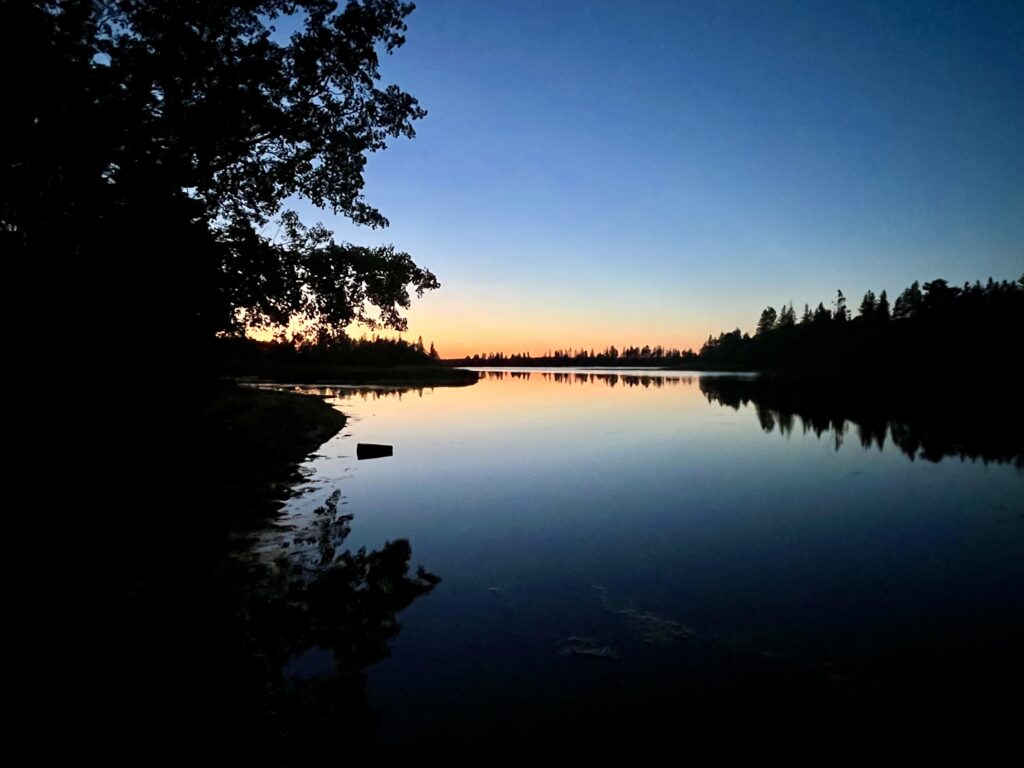
Sunset view on the shore next to Cedar Lodge, August 28, 2023
What began this afternoon as a quick confirmation of a name turned into a startling and slightly overwhelming discovery, one that still has me feeling a bit stunned.
I was looking up Kay Jelley, my mother’s lifelong friend and former childhood neighbour in Freeland. I knew Kay had been interviewed by historian Dutch Thompson as she is often included in his regular CBC PEI radio pieces. While looking her up on the Island Voices website, which has some of Thompson’s interviews, I decided to put “Freeland” into the search box and see who else might be there, and a few other interviews popped up.
The last result was not recorded by Thompson but by someone from the Benevolent Irish Society, who seemed to have travelled around PEI in the 1980s recording the descendants of Irish immigrants. It was an interview with Kevin and Margaret Kilbride, our neighbours here in Foxley River. Kevin died just over a decade ago, but Margaret has been gone since 1991.
Never in my wildest dreams did I ever think I would hear her voice again.
Margaret was unique, funny, smart, lovable. She was a registered nurse, and had been a lieutenant in the Royal Canadian Army Medical Corps in the Second World War stationed in France and Belgium. She was the head nurse at our little Stewart Memorial Hospital in Tyne Valley, and while full of fun, people who had worked with her have told me she could also be quite exacting. She was a smart dresser, and always drove a snazzy car.
Margaret at a Stewart Memorial Health Centre staff outing…not sure where or when, but likely 1960s or early 70s by the look of that outfit and car!
Kevin, on the other hand, was exactly how I imagine Matthew Cuthbert from Anne of Green Gables to be: quiet and soft spoken, wise and kind. Their house, a classic PEI farmhouse that had been built by his grandfather in the 1890s, even looked a bit like Green Gables. Where she favoured tailored pantsuits when she wasn’t in her crisp nursing whites, Kevin was almost always in his overalls when at home, working in the barn or yard.
The interview is probably not particularly interesting to someone outside our community, and some of it unfortunately doesn’t age well, but to be able to hear them again, in their 60s and 70s, still vital, the way they interact, mentioning names I had forgotten, has been a delight. Margaret’s distinct way of speaking. Kevin’s thoughtful pauses. And the background noises: a small plane flying over (I might have been out in our yard across the river waving at it!), cows mooing, a crow calling, Margaret lighting a cigarette.
I was a like a moth to a flame when it came to Margaret. I was fascinated by her, as she was unlike any other woman I knew, outspoken and bubbly in a way that wasn’t the norm. She visited our house often when I was a child, usually on her way home from work at the hospital. She was a great friend to my mother, and a wonderful medical resource as I rolled through childhood illnesses and incidents. Margaret would always know what to do, and she would dispense sound advice with a laugh and a big hug. I have a couple of bottles with her distinctive hand writing on them, creams and lotions to sooth some long-forgotten condition. When I went through a brief anxious period as a child when I imagined my heart was stopping, she gave me a stethoscope and helped me understand how the heart worked in rest and action.
One summer day when I was five, I saw Margaret’s car pull into their yard from the front lawn of our cottage. I somehow got our little dingy into the water and rowed across the river, clambered up the bank, and knocked on their door to say hello. I wasn’t supposed to have taken the boat by myself, and Margaret knew it. She called my mother right away to tell her where I was – Hi, Viv, guess who I have here?! (the only person to ever give my mother a nickname) – and then we had a great visit, she with a cup of milky, sugary tea and her ever-present cigarette, and me with a glass of milk, probably from Kevin’s cows, and a few molasses cookies. I have no idea what we talked about, but I am sure we had fun. Then we hopped in her car and she drove me home, the boat later retrieved by my father.
The Kilbride House as seen from our lawn one summer morning in 1968
I fell and split my forehead open at my boisterous seventh birthday party, and although my great-aunt Lois was at the party, and she had nursed in New York City for forty years, it was Margaret I asked for as I sobbed, blood running down my face, and she quickly came from across the river to assess me and send me to the hospital for stitches. The party continued as I was sewn up, and I came back looking like Frankenstein’s monster, making it a party to remember!
I am lucky to have few regrets in life, but not having been more attentive to Margaret in her later years is one of them. I didn’t visit her when I would return home from university, expecting her to be around forever, I suppose, and after she died, I soon realised what I had lost. It has always bothered me.
I feel like I got a tiny message from Margaret today that it was all ok, and if I close my eyes, I am still in her kitchen having a cookie and a chat. Nostalgia is the child of memory and imagination, a potent salve for psychic wounds.
Margaret and me in her kitchen, 1967. You’ll notice Margaret is missing a finger on her right hand, and I understood this happened during her war service.
The land where I live in Foxley River remains the unceded territory of the Miꞌkmaq people, who have occupied this island for over 12,000 years. Since European settlers arrived, the piece of land where my house is has been claimed by six people, as far as I can figure, including me.
It was once owned by Creelman MacArthur from Summerside, a businessman and politician. As far as I know, he never lived in Foxley River, and I suspect he bought the place solely as an investment. He had hoped the property would be designated as Prince Edward Island’s national park, as he mentioned when he spoke to a National Parks Amendment Bill in the Senate on June 17, 1938:
Hon. CREELMAN MacARTHUR: … Five years ago I acquired the old Warburton estate of 655 acres, only to realize that it was a white elephant. I built a lodge and a concrete and steel dam and put in some 50,000 trout. In a word, I did everything that I thought might appeal to the Commission when selecting in the province an area for a national park which would be attractive to tourists. But it seems the outstanding requirement was surf bathing, and my property had only sheltered stretches of river. It is a very beautiful area and its waters are well stocked with trout, lobster and oysters.
Right Hon. Mr. GRAHAM: What a place!
Hon. Mr. MacARTHUR: The property cost me some $15,000.I offered it to the Government as a gift, free of restrictions of any kind. I thought in that way a greater service would be rendered to this country, and to visitors in this country, than could be rendered byme as an individual.
However, it was deemed the part of wisdom to select an area in Queen’s county, of which the honourable senator from Queen’s (Hon. Mr. Sinclair) can speak in more detail than I can. Mr. Cromarty and another gentleman from the Parks Branch went down and after looking at four or five sites selected the one referred to in the Bill. Unfortunately, there was some difficulty with three or four landowners with regard to the expropriation, and for a year or more there has been some contention. This difficulty has now been removed, and the purpose of this Bill is to describe the area. We are now looking forward to having a park which will be the equal of anything in any other province in Canada.
And so the PEI National Park did not end up in Foxley River, but in Cavendish, in the heart of the area made popular by author Lucy Maud Montgomery and her Anne of Green Gables books. Just as well, but I’m sure Senator MacArthur had hoped to recoup part of his $15,000 investment, even if he did say (after the fact) that he had intended to give the property to the government as a gift. I don’t say that to be mean, and I never met the man, or his family, but I’m sure there would have been some way for him to make a little money on the deal. Business is business.
Mr. MacArthur died in 1943, and his Foxley River estate eventually broken up into smaller parcels, 23 acres of which we now inhabit. Part of the lodge he had built in 1933 is still here, as well as the dam and the descendants of those 50,000 trout!
I found a postcard online years ago that was probably taken in the 1930s or 40s of the view from the shore in front of our house looking northward up Foxley River. I wondered when I found it if MacArthur had the photo taken to advertise the beauty of his property, perhaps as something he could hand out to sway the opinion of the decision makers at the Ottawa Parks Branch. There really isn’t any other reason why this photo was taken, being so far from the beaten track as we were and still are.
I have many times tried to recreate this postcard photos, capture some mountainous clouds, but never have I caught a similar sky. It is startlingly the same vista, though, despite the massive forest fire that ravaged this area in 1960 and the many decades that have passed. The building in the centre is long gone, but the trees on the far shore look almost the same, with the same breaks in the treeline.
Yesterday a neighbour was making hay on that far field, as has been done for nearly two centuries on that piece of land. This area dodged becoming a tourist mecca 90 years ago, but how long before that field becomes cottage lots is anyone’s guess, so I am thankful for its timeless beauty every day. A miracle, really.
On Tuesday April 25, 1922, five people made their way to Thomas Cahill’s store in Freeland, PEI. A two-story structure that included living quarters, it was the typical general store of its day: a central aisle with two long counters on either side, the goods for sale stacked high on floor-to-ceiling shelves behind. A customer would hand their order to a clerk, who would gather the items from boxes and tins and barrels, write out a receipt, and accept payment or make note of credit. The customer would place the items in a wooden box they brought in from their wagon, or a basket they carried on their arm if they were walking.
Thomas Cahill’s Store circa 1915
While poking around in our basement earlier this month, I found two receipt books from Cahill’s store mixed in with 50-year-old receipt books from the general store operated by my parents, Harold and Vivian Phillips. They bought Cahill’s store in 1946, but from Laughlin “Lin” Murphy, who I believe bought the store from Cahill in late 1922. My parents operated and lived in the old store until 1952, when they built what they believed was the first self-serve general store in rural PEI. That new store had little shopping trollies that customers could put their items in as they made their way along the three aisles of the store. Though my parents were proud of this modern facility, some old timers refused to pick out their own groceries, so the old fashioned service always existed in some form in our store up until they sold it in 1971.
Thomas Cahill had telephone number R5-15 on the Conway line out of the Tyne Valley Exchange, but didn’t include that information on his receipts – not many of his customers had a telephone anyway.
I was familiar with the receipt books my parents used, but Cahill’s books are slightly different in that the receipt lists both the person who was buying the goods and the person who was picking them up at the store. This is double joy for a history buff, more names to make more connections!
It’s a miracle these books made it through three owners and the dismantling of the original store. Little else survives from that store except a couple of photographs, a few drawers from the counters repurposed as wonky workshop shelves by my father, and a gripper device used to quickly reach items on high shelves.
The old Cahill store before it was dismantled in 1952.The house section of the store being moved to Conway, 1952.Inside the old Cahill store when it was being dismantled in 1952. If you look closely, you can just make out the floor-to-ceiling shelves on the far wall. I think this part of the store became part of my grandfathers box mill, and burned in the 1960 West Prince forest fire.
Being spring on PEI, April 25 could have been cold and snowing or hot and sunny, or both over the course of the day! A horse and wagon might have kicked up a bit of dust on sunnier parts of the red dirt roads as they travelled, but could have also bogged down a bit in the swales. If the roads were too muddy, people would have walked or rode a horse to the store.
First to arrive was Joe Kelly, picking up an enormous amount of salt and what was probably a five pound can of baking powder for Clara Gavin. Not sure who she was, but a woman named Sis Gavin was often mentioned by one of my mother’s uncles, and she kept house for William Bryan after his wife died in 1914. Joe Kelly lived not far away from Bryan’s farm, so Clara could possibly be Sis. If I look to the north from our house, I can see the dark outline of the spruce trees that surround Joe Kelly’s house, perhaps the oldest building in Foxley River.
Next was John McArthur, though I’d bet it was really MacArthur, picking up a $4.50 bag of flour, which would have been a 100-pound bag! There was a Malcolm “Mac” MacNeill operating a lobster cannery on the Sandhills at that time, so John could have worked for Mac and the flour was destined to feed the cannery staff.
Next were neighbours and cousins Nicholas and Raymond Bulger, both born in 1902. Perhaps they travelled to the store together. In later years, both of these men followed the well-worn path to the New England states, only returning to PEI for vacations.
Looks like Nick picked up 5 pounds of sugar, some sort of pills, soap, 10 cents worth of candy and some tobacco. The soap was probably something like Sunlight soap, which was used to clean everything. Most country women usually made their own lye soap, but perhaps Mrs. Bulger had run out. Nick had 12 dozen eggs to sell, and got 26 cents a dozen. That sounds like a ridiculously low price to us, but would have been good money then, and possibly the only money the family received that week. Cahill probably took most of the eggs he bought from his customers into Conway Station and sent them on the train to be sold in Summerside.
I think Raymond bought 10 pounds of wire nails at 6-and-a-half cents a pound, 1 pound of twist chewing tobacco, and three large boxes of wooden matches. With matches, tobacco, twist and candy, the boys would have a jolly ride back to Foxley River!
The last customer recorded on that Tuesday was Ferdinand “Ferdie” Kilbride, a neighbour of the Bulger boys and one year their junior. Try as I might, I can’t for the life of me make out the two items that Ferdie bought. The first was a bottle of something or other, and the second is a big mystery. Let me know if you can read this scrawl. [Update: an eagle-eyed reader suggests that the first item is “1 bottle witch hazel”, and I agree!]
If these folks, most of them close neighbours related by birth or marriage, had bumped into each other on their trip, there would have taken plenty of time for a chat to catch up. The weather would be finely dissected, preparations for crop planting compared, updates given on family here on PEI and in far-flung Boston or Toronto. In the distance they might have heard the surf breaking on the Sandhills like I could this morning, heard the robins and chickadees calling. The young men might have been planning what fun they would be getting up to on the weekend!
Peter Bulger’s descendants still farm his land, and Bulgers and Kellys are well represented in our community. I worked for Thomas Bulger’s grandson on the same farm Thomas owned. Sadly, the last Kilbride to live in Foxley River died a few years back. The Bulger, Kelly and Kilbride families came here from Ireland in the 1830s, so the disappearance of an original settler family name is especially poignant.
I had no idea these books existed, so was pleased and excited to find them. All these people came back to life in an instant, their movements through the landscape I know so well, the challenging lives they lived in the backwoods of PEI. An enviable time, in some ways, simple and straightforward, but still before the miracles of antibiotics and electricity, and with one terrible war behind them and one lurking in the future. There is certainly no ideal time to have lived, and I’m content with the here and now, but oh how I would love to have spent five minutes in Thomas Cahill’s store catching up with my long-gone neighbours.
I’ve been recording precipitation amounts for CoCoRaHS since November, dutifully recording rain and snowfall and entering it on their database every day around 8 a.m. I told my mother this morning we received over 7 cm of snow in the past storm. This evening she told me that the CBC PEI weatherman had included the snowfall total for Foxley River in his report, and sure enough, here’s the proof from his Twitter account. Proud weather nerd here!
Heading to the chicken coop this morning to check on the gals, I saw a building coming down Foxley River. I can’t say for certain this is the first building to move on the river, as I think our boathouse came down from Cascumpec on the ice in 1961, but I wasn’t around for that excitement.
There is an oyster warehouse on the other side of the river from us, so I assumed this oyster shed was headed there. Instead, they started to turn up the creek (pronounced crick by me, because that’s what it is!) that runs in front of our house. I started driving a dory and outboard motor on this river when I was about seven or eight, so I know the tides and channels well, and have been stuck just about everywhere there is to be stuck! I was pretty sure where this was headed.
Almost.
The tide was fairly low when they tried to pull/push this little barge through the narrow passage that is pure black mussel mud at the bottom, and it hung up. The owner’s 200 HP Yamaha couldn’t budge it.
They’ll be back this afternoon to try again, though the highest tide today will be around midnight, so we’ll see. They had it anchored off Goff’s Bridge in Foxley Bay last winter, but it got beaten up pretty badly even with five lines on it, so they thought they would try here.
The owner (who knows all my Hardy and Phillips fishing cousins, giving me some credibility by association!) said we can use it for putting on our skates this winter when they get it anchored up the creek. There’s a BBQ and everything in there, so we might just have a few parties on the ice.