Tag Archives: Confederation Trail

Standing tall

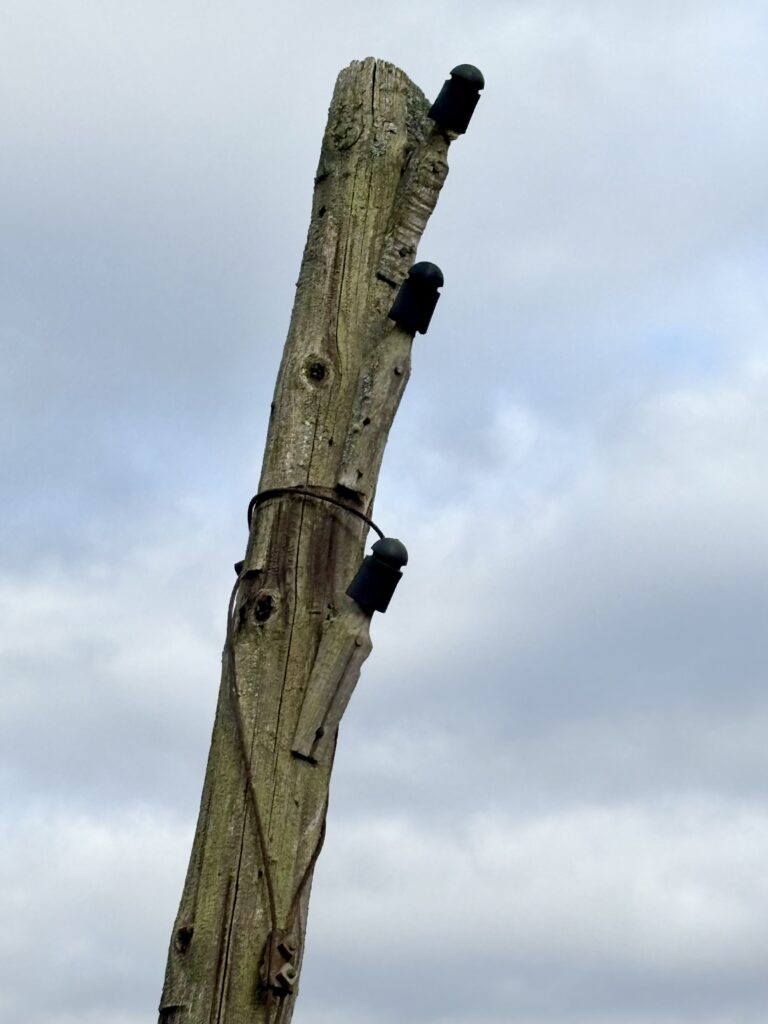
I’m happy to report that what is advertised as the last telegraph pole on Prince Edward Island does indeed still stand, insulators and all, on the Confederation Trail halfway between Elmsdale and Alberton, and it’s also easily visible from the Dock Road. The day I found out about the pole’s improbable existence, on a walk from Elmsdale towards Alberton, we had stopped just about halfway between the two communities at the beginning of a bend in the trail.

As we moved towards our previous-day’s stopping point, this time from Alberton, a couple of days later, I began to doubt we would find it still standing. Suddenly there it was, a few feet around a bend from where we had stopped and turned back.
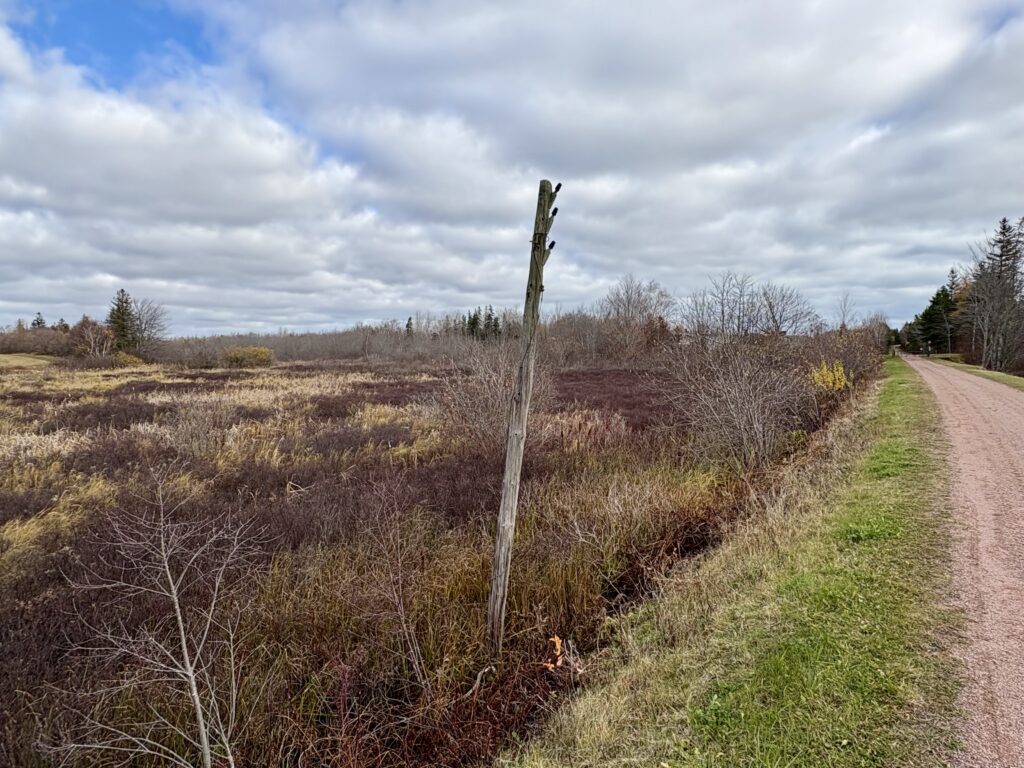
Grey telegraph pole in the centre of photo, with cloudy sky at the top and leafless bushes and dried grass around. A gravel trail is on the right side.
Close up of three black insulators on the top of a grey telegraph pole. There is wire around the pole, and a cloudy sky in the background.

The PEI Railway opened in 1875, 150 years ago this year, 50 years after the first recorded passenger trail journey between Stockton and Darlington on September 27, 1825 (a gorgeous episode of the BBC Radio 4 Illuminated documentary series brings that event to life). Could this pole be 150 years old? If so, it has survived forest fires and ice storms, vandals and woodpeckers and rot. I suspect its survival might be due to the fact it is planted in a swampy area, replete with spiky bushes, at the bottom of a steep bank. “Let’s just leave ‘er, boys!”

As historic sites go, it’s not Green Gables, but it is a relic of an important Island story. The railway opened up commerce and travel to people in far-flung parts of PEI, and allowed farmers and fishers access to more markets. Building the railway nearly bankrupted our small island colony, so PEI finally agreed to join Canada in 1873 so the project could be finished with an influx of federal dollars.

In addition to signalling train travel, the telegraph that accompanied the railway brought news and could summon assistance in case of emergency. Imagine living in non-electrified 19th century Alberton, heating and cooking with wood, lighting with candles or newly-discovered kerosene, travelling by horse and wagon or sleigh, and then suddenly being able to send a telegram to your brother in Boston asking about work opportunities or ordering supplies from Holman’s in Summerside in the morning and then having them shipped to you by train that very afternoon? It would have felt like magic. And that pole helped make all that happen.

As much as it was a thrill to find the pole right there in the open, I wonder if someday it might be able to stand proud and straight inside a centrally-located provincial museum? Time will tell.
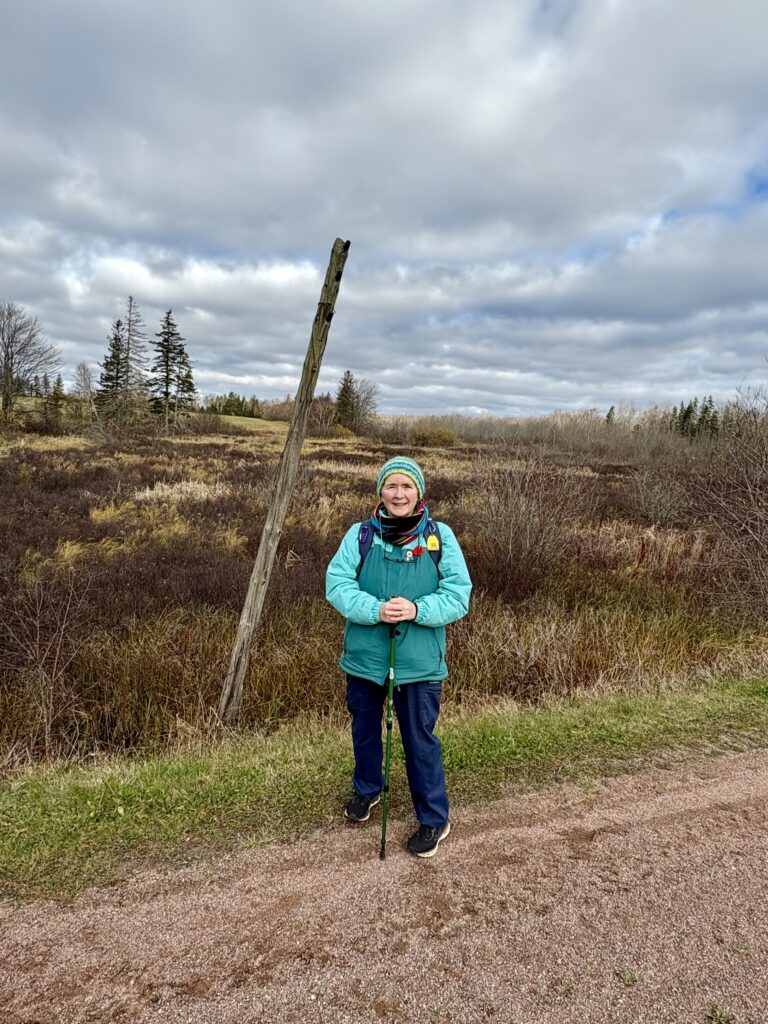
A person with pale skin wearing a hat and holding a walking pole standing next to a trail in front of a leaning telegraph pole. There is a cloudy sky at the top and bushes, grass and trees behind.
Happy Nerdmas (which is every day at my house)

The Last Telegraph Pole(s) on PEI

Steven and I walked the Confederation Trail from Elmsdale corner half way to Alberton and back this morning, about six kilometres round trip. We had planned to walk to Alberton and back, but the cold wind was whipping and that was far enough.

We saw a couple of lupins blooming well out of season, some daisies, lots of apples and even some grapes. As always, the trail is beautifully maintained and clean. Benches and shelters with picnic tables along the way make this entire trail an ambler’s dream.

Interpretative storyboards have added interest to each walk we’ve taken, but this one really caught my attention: the last telegraph pole on PEI? Yes please!

A storyboard called Last Pole Standing with text in English and French, with a photo of the top of a telegraph pole complete with insulators, and photos of steam locomotives in the bottom corners.

LAST POLE STANDING
The P.E.I. Railway was welcomed by communities across the province that had previously been limited to travel only via poor (often impossible) roads and coastal boats. In May 1875 people who had known isolation all their lives were suddenly able to reach any of the Island centres with comparative ease. They received mail twice a day rather than twice a week. What a change! The railway also connected rural communities with the world. The Island had an underwater telegraph cable to the mainland since 1851, but the service was only available in large urban centres. Telegraph lines now followed the tracks from Tignish to Souris, linking all railway stations. It was used for emergencies along the line but also by government and business. The entire service was operated by Canadian National Telegraph from the 1920s but previous operators included the P.E.I. Railway and Anglo-American Telegraph. The last pole standing is located about halfway between Alberton and Elmsdale.

We were halfway between Alberton and Elmsdale! I looked near the sign for a pole to match the photo, but no luck. I’m now anxious to make the trek from Alberton to where we stopped to see if that last pole complete with insulators still stands.

I did notice a couple of poles without insulators on our return walk that looked like the pole on the sign. They were shorter than most poles, and three notches were clearly visible at the top of both. They seem to be holding fibre op cable, the modern telegraph, I suppose.

In trying to (unsuccessfully)* find out what the little wooden insulator holders are called, I came across some wonderful websites, including one for the UK-based The Telegraph Pole Appreciation Society and, well, anything I clicked on after searching for “parts of Canadian telegraph poles”.

*I did some further reading and believe those little wooden pieces that held the insulators may have been called side-block brackets, as per this archived article by John Gilhen**, “Telephone and Telegraph Insulators: The End of an Era”, published in 1976 by the Nova Scotia Museum.

**John Gilhen died in April of this year. He had a 50 year career at the Nova Scotia Museum in the natural history section. His obituary noted he was “an avid collector including antique glass and insulators, hockey pins and cards.” He sounded like a marvellous, interesting person.