Tag Archives: Birds

Spruce Cone

After an absence of over 40 years, I have been attending church regularly for nearly a year. The same church I had been raised in, with some of the same people who were there when I last attended regularly in my mid-teens.

My mother stopped driving in 2016, so her cousin and his wife kindly took her to and from church. When my mother’s mobility declined after three hospitalizations in the winter of 2023/24, I felt it unfair for these thoughtful older relatives to have the responsibility of looking after my mother, so I told her I would take her.

This past Sunday, the minister’s sermon was focused on the baptism of Jesus, which is part of Epiphany, the season that follows Advent. One of the scripture readings was from the third chapter of the Gospel of Luke:

When all the people were being baptized, Jesus was baptized too. And as he was praying, heaven was opened and the Holy Spirit descended on him in bodily form like a dove. And a voice came from heaven: “You are my Son, whom I love; with you I am well pleased.”

Luke 3: 21-22

The minister, a thoughtful and interesting speaker, asked the congregation if we had ever seen a dove descend from heaven, if we had ever heard God speak. There was silence, indicating that no one had, or nobody was prepared to talk about it if they had, and he went on to talk about what that might have been like to hear God (and he talked about Eric Clapton, too, which isn’t usual in the Presbyterian Church of Canada, but most welcome, at least by me).

I’ve never heard the booming bossy voice of the Christian God as described throughout the Bible. I’m pretty sure he’s not that well pleased with me, despite me taking my mother to church every week, so I’m just as happy to not hear what he has to say.

What I do hear is the voice of the eternal spirit, the beating heart of the cosmos, the kind and merciful universe. Where? In the rustle of the leaves in trees, easily one of my most favourite sounds in the entire world.

Today I was walking through a field near our house, a field surrounded by tall trees that have watched me move around this land for nearly 60 years. The sun had just come out briefly, a rare occurrence so far this year, and I heard a flock of finches in the forest, always calling to one another as they move through the trees.

Suddenly, I looked up and saw a solitary finch flying high over the field, and it had something big in its mouth. Just as I thought I’ve never seen a finch carrying something so big, it dropped its load, and as it fell I could see it was a spruce cone. The cone bounced on the snow and the bird continued on its way as if that had been the plan all along.

I hurried over to see it and it was indeed a spruce cone, complete with a couple of spruce needles stuck its base. I could smell the distinct odour of spruce sap, and realised the bird must have plucked this directly from a tree, a gift from high up in a tree, a place I could never visit.

I put the cone in my pocket and brought it home and put it in a little dish. The seeds are already dropping out of it. It still smells of sap.

With you I am well pleased.

Bird Notes (tweets, I guess)

A Northern Flicker, a ground-foraging brown woodpecker with a lovely red cap, just landed in our yard and dug around for ants and worms. Earlier today I saw something new: an American Goldfinch drinking from a hummingbird feeder, with a friend sitting on a branch nearby until a feisty hummer ran them both off.

After a couple of years without any Great Blue Herons living and feeding on our river, which they have always have done in my lifetime, there are now two and sometimes three. All three flew together over our yard the other day and I felt like I was in Fred Flintstone’s backyard, their huge wingspan and loud rusty-hinge squawking casting ancient shadows as I looked up (mouth closed…always close your mouth when birds are flying over. You’re welcome.).

A juvenile American Robin, nearly as big as its parents and almost the same colour except for the speckled breast, bounced across the lawn at about 5:30 this morning, capably finding its own food, but still quietly calling for its parents to share what they were finding. Soon the youngster will be on its own, and the parents could easily set some more eggs this summer. It’s a dangerous world for baby birds, so this little family is a great success story.

My life list on the Merlin app sits at 36, all viewed from my yard. Such richness, the morning chorus this time of year filled with joyous conversations and hope.

I wonder what my chickens think of the sparrows who sometimes forage in their run, or the flocks of geese that honk overhead, or the noisy, feisty Blue Jays that rattle the mornings. My guess is that they don’t really pay any attention to other birds unless a danger call is broadcast, a warning that a hawk or eagle is in the area, and they take cover.

Otherwise, they are just busy being chickens, and that seems to be sound advice. Just be the bird you are meant to be.

Invasion of the worm snatchers

BirdCast

There are many websites for people to submit sightings of different migrating birds and monarch butterflies as they travel across North America, but BirdCast uses weather radar to produce live bird migration maps for the continental United States, as well as nightly forecasts.

The map for the entire United States at 11:30 pm Atlantic Time May 23, 2024.

I’m watching the live data for Washington County, Maine, and at 11:45 pm when I’m writing this, BirdCast estimates there are over 430,000 birds in flight over that one county right now heading north east in the direction of PEI. The dashboard estimates average flight speed, altitude and even provides estimates of which species are most likely to be on the move tonight, many of them tiny summer visitors who nest near our house like the Common Yellowthroat, Ovenbird, Northern Parula and and Blackburnian Warbler.

I have spent a lot of time wondering what the landscape around me looked like before European invasion, how it would have felt to wander through the ancient forest that was felled to build sailing ships and fine furniture. Until someone invents a virtual reality program to allow me to walk through an approximation of what had been here, the next best thing is to stand outside with my eyes closed each morning at this time of year during the dawn chorus and listen as each newly-returned little songbird offers up its timeless song, creating an ancient aural landscape. My heart is beating as fast as their little wings right now in anticipation of their arrival.

Silence

The audio that accompanies this article in The Guardian broke my heart, and I’m still thinking about it, especially when I hear a new seasonal visitor has returned to nest in the forest near our house. I’m not sure why we humans are continuing to ignore warnings that we have very little time to change how we live to ensure future generations of humans and other species can have a livable planet.

I think part of the problem is that the people who wield the most power in the world live in large cities. Some of them possibly have country homes as well, but they do not have a healthy relationship with nature and therefore don’t care about it beyond what it can give them; they try to control it, bend it to their will, extract from the natural world things that will make them more and more money. It is difficult to care about what you can’t see.

When I lived for a brief time in London in the mid-80s, I knew a young woman who had just moved to the UK from the Cayman Islands. Maria and I both shared much of the excitement and challenges of coming from a small place and living in a massive city, but she had a physical challenge I didn’t have: she was often uncomfortable because she had never worn shoes for any long period of time. She grew up walking on bare feet in sand, not because they were poor, because they weren’t, but because they didn’t need shoes. She found the cobbles and pavement of London hard and noisy, wearing shoes and socks constricting.

She said couldn’t get the sense of the land, couldn’t feel a part of the place without her feet in the sand, in the soil. She was homesick in part because she missed her family, but just as much because of the loss of a connection to the land and the freedom of living so closely with the natural world. To be honest, I didn’t know what she was talking about. Who wanted to live in a backwards rural setting any more? I certainly didn’t. Give me history and theatre and art and Oxford Street and pubs and life!

I lost touch with Maria, but I would bet she returned to her home, and so did I.

I hear a robin.

Lone

I was weeding a flower bed a few minutes ago, taking advantage of these sweet long evenings before the biting insects emerge. I would be outside all day long at this time of year if I could, but usually I have to steal a few minutes here and there.

A small flock of Canada geese flew down the river towards Yeo’s Bridge, probably aiming for the fresh-water pond just beyond. They were very low and close enough to me that I could hear their whistling wings. A few minutes later, I heard and saw another goose up the river, wheeling around in an unusual way. Then, as I was fully occupied with destroying some particularly stubborn weeds, a loud call came suddenly from the river just in front of me.

There was the lone goose, bobbing along in the water in the direction as the small flock had gone, calling over and over, the same call as when they are flying overhead, which I always imagine to be “here we are, stay together, don’t straggle, we can do it!”

But this was sadder, one insistent voice and no response. It cried, for that’s how it sounded to me, for at least five minutes, swimming further away. A mourning dove in the woods kept it company, coo wooo wooo wooo, you’re not alone.

And then it stopped. I will imagine it heard its friends and flew to join them in the pond.

Food/Not Food

If you are unsure if something is a food, a good test is to put it outside and see what happens (most memorably done by Spy magazine in 1989 when they put a Twinkie cake on a NYC window ledge for four days and not even the pigeons went near it!).

I found three stale rice cakes in the back of a cupboard this morning and tossed them onto the lawn, confident some creature would eat them. The crows arrived quickly, took a few bites and passed, as did their bluejay cousins. A red squirrel triumphantly grabbed one, probably excited by how large and relatively light it was, scurried up a pine tree, took a nibble and dropped it to the ground.

I gathered up the rice cakes and presented them to the hens, who have pecked at them with little enthusiasm for four hours. They will probably finish them, but it will take a while. Their diet includes grit and small stones, so they are used to eating things without obvious (to us) nutritional value.

Not food.

Why did you give us styrofoam? We’ll eat it, of course, but…styrofoam?”

Snowy Egret

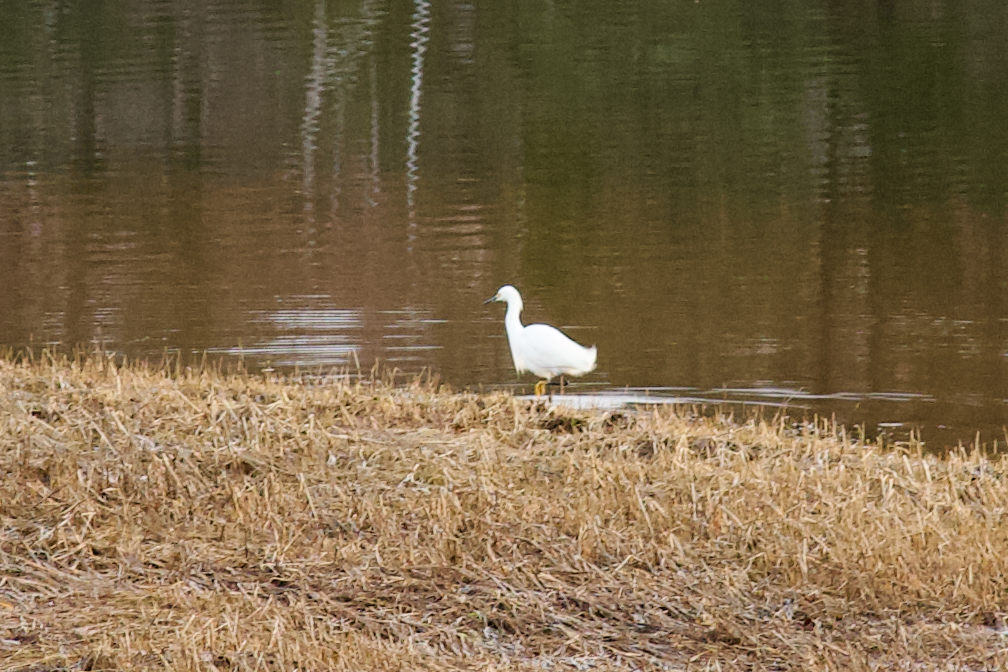
I was lucky enough to spot a snowy egret as it walked down our river at 6:30 this morning. I had seen them many times in Florida near where my parents used to spend the winter, but I never remembered seeing one here before.

I grabbed my camera and binoculars and ran out onto the lawn to try to record this unusual bird, looking a bit of an unusual bird myself in my red plaid flannel PJs. Our neighbours are not close enough to see what I’m wearing, so citizen science need not be thwarted by decorum!

The egret waded and fished as it travelled around the little point of land in front of our house, nabbing and swallowing little fish. My photos were not very sharp, but in person I could see this white bird’s dark legs and comically yellow feet.

I uploaded the photos to iNaturalist and was surprised to find only one other snowy egret observation on PEI. I later confirmed with a biologist friend that they are quite rare here and are not known to breed this far north. I was chuffed to bits!

I’ve looked at this river view every day for decades, know the ebb and flow of both the river and the wildlife on it intimately and, I thought, completely, but turns out I still have more to learn. Every day brings new discoveries. What joy.

Snowy Egret

A little robin told me to breathe

I speak robin now. I’ve heard them singing outside my window my whole life. They wake me up and they lull me to sleep. It’s only this spring that I have finally been able to understand what they are saying. 

The dawn chorus is easy. They are calling out to find a mate, to show they own a patch of forest or meadow. I am here, where are you? I’m the best, bet you are, too!

Right now the robins who nested in the red pine tree in our yard are busy all day finding food for their newborn floppy-necked babies. They still find the energy to sing morning and night. This is who you are, you are a robin. Every ounce of me honours every ounce of you.

In this time when we are thinking and talking about breathing and not breathing – don’t get sick, don’t make others sick, I can’t breathe – I stop breathing, and then I hear my life-long friend the robin:

Look up, this is all there is. Now, this is all there is. See, it’s gone, but you can catch the next now. Now.

Breathe.

The river and sky and trees I share with the robins.

Returning Friends

It is a happy coincidence that the return of seasonal garden and forest friends this year began at about the same time as spending time with human friends became more difficult. First to arrive just as “lock down” started were the grackles and red-winged blackbirds, loud and chatty as they announced their return and snacked at the feeder. Robins then started hopping across the few bare parts of our yard, and mallards, great blue herons, seagulls and now mergansers are all back on the river.

A pair of crows are building a nest across the creek, first plucking white pine branches off the lawn, and now gathering beakfuls of dead grass and moss for lining. They will be noisy neighbours as their fledglings are loud and constantly hungry, complaining that they are starving from dawn until dusk! I expect to find broken mussel shells on the lawn all summer as the parents sit in the trees, break the shells, extract the meat, give it to the young ones, and drop the shells. Crows and chicken keepers are good allies, though, as we are both afraid of the bald eagles and hawks that circle, and the crows will helpfully harass and chase them away.

Yesterday’s warm temperatures brought out the first bees of the year. Here’s a tricoloured bumblebee in a crocus, busy as a you-know-what.

Bombus ternarius