See-saw

As world stock markets hop around in reaction to the US presidents tariff tantrums, be certain that some well-connected folks will be making a lot of money. Pump and dump, market manipulation, a quick whisper at the country club to watch the news on a certain date and time, all nearly impossible to prove.

Thus it has always been, the rich getting richer, but the unethical cruelty of such blatant avarice while cutting lifesaving foreign and domestic aid programs is nauseating. How much do they need? The answer will always be more.

I keep thinking about JP Morgan moving four billion dollars worth of gold bullion to New York in February.

French Fried Granola

Today’s rabbit hole was the link between Woodstock and the popularisation of granola in North America. I searched for granola and the top hit was a recipe with a surprising first ingredient.

The actual recipe does not include french fries (quel dommage!) and calls for light-brown sugar instead of golden brown, confirming once again that although I’ve spent lots of time on the internet over the past 30+ years, I understand very little about how it works.

Bye American

Today is the first day of spring here in the Northern Hemisphere, but you could be forgiven for thinking it was the first day of autumn with all the red maple leaves everywhere.

In response to US tariffs on Canadian goods and increasingly ominous threats of annexation from the US president, many shoppers want to avoid buying things made in the US, so stores and sales flyers are dotted with little leaves to denote items are “Made in Canada” or “Product of Canada”, regulatory distinctions few of us knew about a couple of months ago.

US fresh produce is languishing on store shelves, and Canadian grocery chains are quickly trying to find new suppliers. This means that instead of the Florida and California citrus fruit we have seen in grocery stores for decades, those products are coming to the east coast of Canada from new-to-us places like Turkey, Israel and Egypt.

I have long despaired at seeing things like fresh Peruvian asparagus and Chinese snow peas in my local store, so I can’t say I’m thrilled with this development. I wonder how much of it ultimately gets thrown out, all that effort and fossil fuel spent on transporting garbage around the world.

I hope this new patriotic consumerism will make people consider not only where their products are from but if they need them at all. The climate crisis is still barrelling forward full tilt, and the nonsense coming out of the US is distracting from the real urgency to address this existential issue, which must certainly suit the “drill baby drill” ding dongs.

Stores will continue to sell us things if we continue to purchase them but, as we’ve seen from the rapid switch away from US produce, stores also notice when we don’t buy things.

Old-Timey Talk

My mother was watching a news channel yesterday and a piece about the current US president came on. She uses closed captioning because of her profound hearing loss, so thankfully I didn’t have to hear him. I said something like “Oh brother, now what?” and she laughed and declared him a scallywag. He certainly is.

Partly through hearing loss and partly through being raised by people born in rural PEI in the 1800s and early 1900s, my mother uses some interesting pronunciations and phrases, some of which I have also adopted.

When Biden stepped down from the 2024 US presidential election, my mother said it was because he was too “doty”, which means feeble-minded, in your dotage. Not dotty, though kind of the same.

My mother calls the red tomato sauce catsup, because that’s what it used to be, though most people say and spell it ketchup now. And she always pronounces tomato “to-mah-to”.

Drought, as in a prolonged period of dry weather, she pronounces to rhyme with “truth”, so “druth”, which sounds very old country to me.

Something I’ve never heard outside our family came from her uncle Everett Hardy. She always said that he called a windy, rainy storm a pompero, as in “it’s blowing a pompero,” and she would often refer to a storm that way. I could never find any other reference to this word and sort of thought he just made it up.

I was at the Summerside library a few years ago and they had just received a reprint of The Sailor’s Word-Book, which is a list of nautical words. I looked up pompero and didn’t find anything, but flipped around the “p” section and found:

Pampero: A violent squall of wind from the S.W., attended with rain, thunder, and lightning, over the immense plains or pampas of the Rio de la Plata, where it rages like a hurricane.

Bingo! How did her uncle, who never travelled much further than Nova Scotia once or twice, learn a word from South America? He loved to read, especially about sailing and the sea, so perhaps he learned about it in a book, but I rather expect it was something he heard someone else use, a word that travelled on the ships that moved up and down the Atlantic. My mother and I still call a wild storm a pompero, so guess that mispronunciation is our very own word.

To express surprise we may say “Land o’Goshen”, or use “by cracky” for emphasis, by cracky.

My mother has never sworn in all my 40+ years of living with her. She called someone an ass a couple of years ago, and that’s the worst I’ve ever heard. My surprise at hearing that word come out of her mouth, and the intent behind it, made me laugh until I cried. And yes, I can confirm the fellow in question is an ass, and it’s not the scallywag-in-chief to the south but someone who lives close by who will remain nameless…and an ass.

I used to be a bit ashamed of my PEI accent, and used to actively tamp it down when I lived off Island, but now I don’t care and it’s as thick as it probably was when I was a child. I definitely use the inhaled “yuh” a lot, eh?

Old Tools

It’s probably no surprise to anyone who reads this blog that I like to keep the things I own for as long as I can, which has meant figuring out how to fix a lot of things. It started out as frugality but has now become as much, if not more, about keeping things out of landfill. I get this trait mostly from my father, who worked hard for everything he got. Even later in his life when he had money to buy new things, he would buy used and fix them up, always looking to save a dollar. I am a bit more of a spendthrift in comparison, not having his mechanical skills to buy things like used lawnmowers and get them going, but I certainly have the desire to not spend money on replacing something that could be fixed.

The handle of my 2001 vintage snow shovel, purchased at Callbeck’s Home Hardware in Summerside, broke this morning while I was trying to dislodge frozen snow and ice from my mother’s deck. I knew not to use it to pry, but the temptation to get one more piece of ice shifted was too much, and I paid!

I trundled off to my shop, stood in the warm springish sun and whittled the end of the shovel handle so it would fit back into the blade. It’s a bit shorter now than it was when purchased, but I bet I am a few centimetres shorter as well, so it evens out. The cutting edge on the shovel blade has worn down over the years, and I’ve periodically trimmed the sides to even it all up.

Two shovels, some wood shavings, my boot prints and skunk tracks.

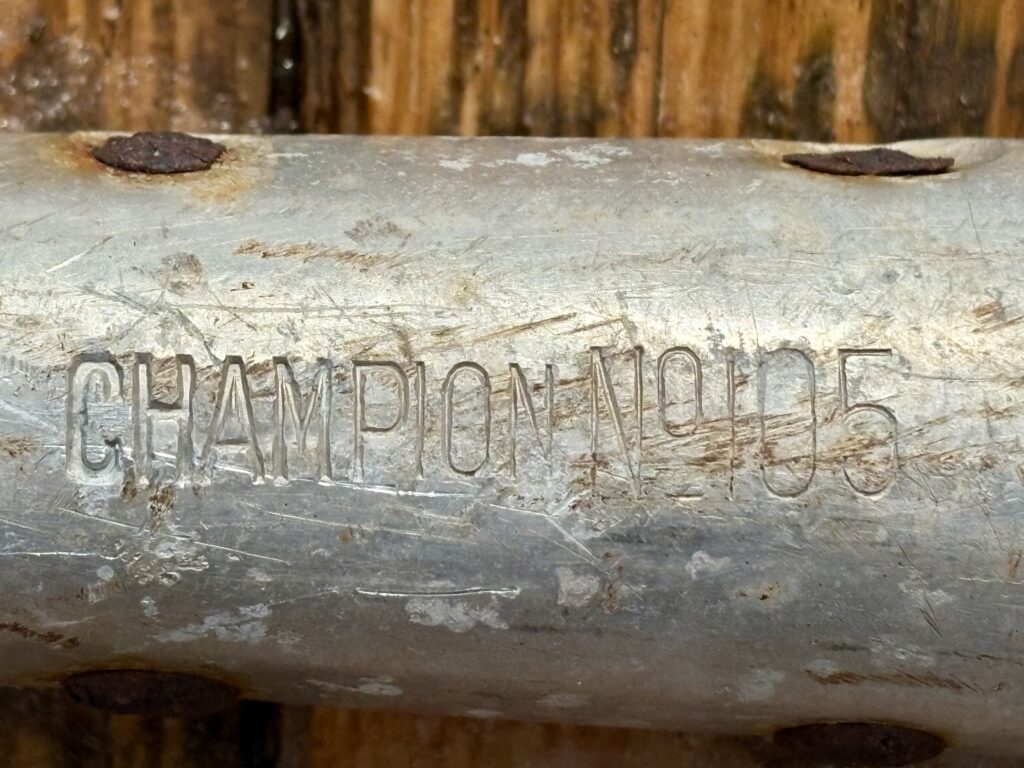
I put the repaired shovel next to a metal one with a wooden handle that stands beside our shop door and is used to clear that step and the chicken run. It is really old – older than me, I expect – and would have come from our general store. It used to stand outside the back door of our former house next to the store. It’s a Champion No. 105 and though it has been outside for most of its life and has a crack in the blade where someone else pushed the limits of what you should pry with a snow shovel, it is still good. I have an extra handle kicking around from another shovel that rotted away that I can always replace the Champion’s with, if need be.

So, I’m in good shovel shape for another 23 years, when I will be 81 and hopefully still shovelling and fixing and standing in the sun.

MyPEI Account

I had a health test recently, the results of which I would receive in the mail. Not having heard anything by this morning, I wondered for the thousandth time in my life why the results couldn’t be available to me online. I decided to search “PEI patient medical records” to see if there has been any update on this long-promised service.

I was pleasantly surprised to stumble upon a pilot project for MyPEI and MyHealthPEI, where PEI residents can signup for early access to both online government and health services. I gathered the ID I needed to register, quickly moved through the easy online verification process, which included me saying my name in a video that is uploaded to their system to be reviewed by someone somewhere (verification in person is also available at Access PEI locations), and within a couple of hours, my account was active.

I haven’t had much time to look around on the MyPEI site (don’t think there’s actually much there yet), but the MyHealthPEI site (which seems to be provided by Telus Health) contained a list of my immunizations back to 2013. The Lab Results section was empty, but I found a notice that said they will be making results available for tests starting with those taken in March 2025.

The My Health Links section seems to be rich with links to resources on a wide range of topics. I’ve always found the Health PEI website a bit awkward to navigate – you sometimes need to know what you are looking for to look for it! – but this is well laid out.

In the end, I didn’t find what I wanted this time, but am hopeful that soon the days of waiting for medical tests to show up in the mail will be a thing of the past. The adoption of electronic medical records has been a long and bumpy process for the PEI health system, so this is a positive and important step.

Zip-a-Dee-Doo-Dah

I have a blue winter jacket I bought at Eddie Bauer in Toronto about 30 years ago. I wore it every winter day for years. The colour has faded and it’s a bit too big for me now, but the jacket is generally in great shape, no rips or tears. It’s been my chore and barn coat for a long time.

The zipper stopped zipping a couple of years ago, splitting when I pulled the slider up, the plastic teeth meeting but not grabbing. The jacket also has snaps, so I just used those instead, but it wasn’t ideal.

This morning I wondered if there was a way to fix the zipper. Of course there is! The slider just needed to be tightened a bit, as per this video. Five seconds with a pair of pliers and my coat zipped up as in days of yore and I was off to shovel snow. Magic.

Of The Empire

I’m late to my (mostly) daily readings today. As well as my own book of collected quotes and poems (which I now know is called a commonplace book), my small stack of books at present are:

  • More Daily Wisdom: 365 Buddhist Inspirations, edited by Josh Bartok
  • How to Know God: The Yoga Aphorisms of Patanjali, Translated with a commentary by Swami Prabhavananda and Christopher Isherwood
  • The Daily Stoic: 366 Meditations on Wisdom, Perseverance, and the Art of Living, by Ryan Holiday and Stephen Hanselman
  • Devotions: The Selected Poems of Mary Oliver

I have a couple of Mary Oliver books I rotate in and out of my stack. I simply go through the book from one poem to the next, so today’s selection surprised me, reflecting how I’m feeling as I try to ignore the news from the country to the south, a place I don’t understand, and whose leaders I now somewhat fear.

OF THE EMPIRE

We will be known as a culture that feared death
and adored power, that tried to vanquish insecurity
for the few and cared little for the penury of the
many. We will be known as a culture that taught
and rewarded the amassing of things, that spoke
little if at all about the quality of life for
people (other people), for dogs, for rivers. All
the world, in our eyes, they will say, was a
commodity. And they will say that this structure
was held together politically, which it was, and
they will say also that our politics was no more
than an apparatus to accommodate the feelings of
the heart, and that the heart, in those days,
was small, and hard, and full of meanness.

Mary Oliver
from the book Red Bird, 2008, Beacon Press

Up West

From The Western Guardian section of the Charlottetown Guardian, January 16, 1925

This brief item in the January 16, 1925 Charlottetown Guardian made me smile. I would expect many Summersiders today would suspect they don’t often get a better deal than Charlottetown folks, but at least on the train in 1925 there was a benefit in coming from the western capital!

The region of PEI where I live is commonly referred to as Up West. It’s more Up Northwest, really, from the rest of the island, but as the main highway through our end of PEI, Route 2, has long been referred to as the Western Road because it starts from the western end of Summerside, we are west.

Some people in central PEI can take the “up” part too literally, as if you have to climb a steep mountain to get here. There is a notion – mostly apocryphal, but a little bit true, in my experience – that when you try to organize a meeting between people in my area and folks from Charlottetown, or even sometimes Summerside, you will hear “But it’s soooo far to go to Tyne Valley/O’Leary/Alberton/Tignish!”, as if the distance would be magically shorter for us to go to them.

Maybe someone at the PEI Railway knew of this magic directional difference, perhaps similar to a magnetic hill, and that prompted the cheaper west-to-east fare to the 1925 hockey game. Mistake? Mischief? Delightful whatever the reason.