Blue food for blue birds

One of the most beautiful things about the rewilding experiment I am conducting on our property is the abundance of wild blueberries growing just steps from our house, which feed so many animals: wild birds, raccoons, chickens, us!

I’m sitting here on a gorgeous Sunday afternoon watching bird families coming through for a snack. First the blue jays, with their noisy, begging teenagers that demand to be fed every ten seconds. The parents drop down, pick a few berries, feed the young ones, move along. Now there are four flickers yelling at one of our cats who is strolling by.

We used to cut the grass under the trees, rake all the leaves spring and fall, keep everything nice and neat. Now it is much less work, incredibly lush, and full of natural shrubs and flowers. It’s a bit wooly looking, but we live in a forest by a tidal river and this is the way it should look.

Imagine what the world would look like if every human made decisions based on understanding that we are just one of many species and not the top of the heap.

What did you know and when did you know it?

30 year ago this month, Margaret Atwood wrote the preface to a book by The Pollution Probe Foundation called The Canadian Green Consumer Guide.

I was on a pretty limited income at this time, but I bought the book, read it, and moved it with me to Montreal, back to PEI, on to Toronto, and now here it is back on PEI. I ditched a lot of books along the way, but this one survived.

In July 1989, I was a fully-fledged adult, newly graduated from Mount Allison University and on my way to the National Theatre School of Canada in Montreal. I was a heavy consumer of news via radio and newspapers, and always a bleeding heart leftie. I went on peace marches. I was vegetarian for a couple of years. I knew about the hole in the ozone layer and acid rain. I cared.

Now I reread what Atwood wrote and it is like I had never read it before. “The danger we’re in is enormous: if we don’t do something about it, its results could be as devastating as those of a world-wide nuclear catastrophe.” What did I think when I read this? Why didn’t it shake me into action back then?

It actually took Greta Thunberg’s TED talk last fall to wake me up from my 30-year nap. She is right to wonder why we didn’t tackle climate change decades ago when we were told about it. When you know better, you do better, but I knew and I didn’t, and I can’t really explain why.

Now I’m looking at everything differently and trying to make up for lost time. I hope you’ll join me.

Gone

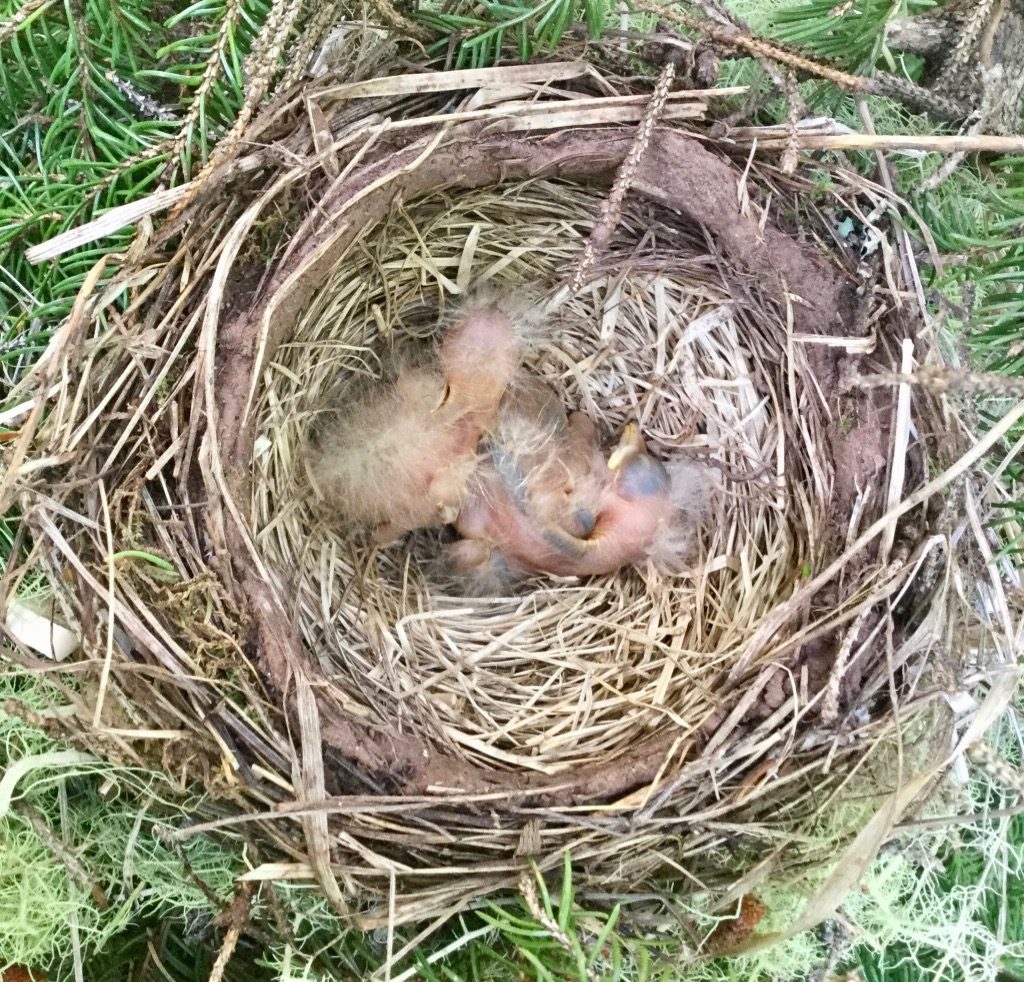
I went back to the nest at the end of our lane a couple of times after my first post. The three eggs hatched July 9, and I saw the babies a few hours after they emerged. Both mother and father robin were very clear that I should get lost, and the babies never woke when I moved the branch over the nest.

A few hours old.

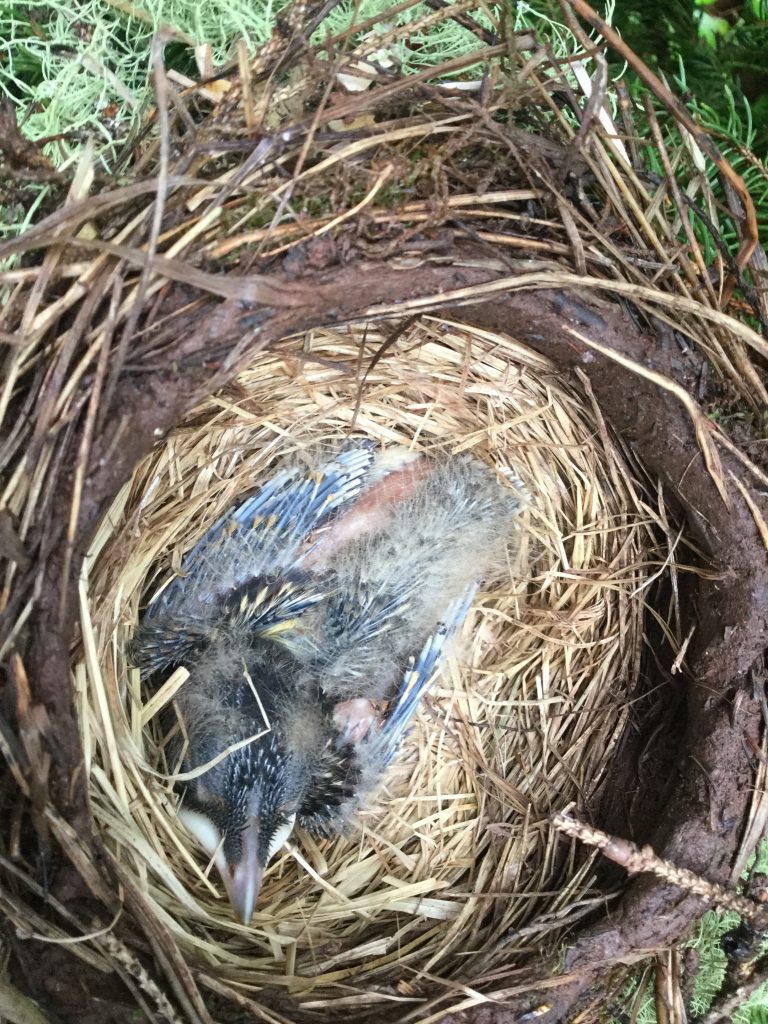
Six days later, there was just one little baby. Birds grow so quickly!

One.

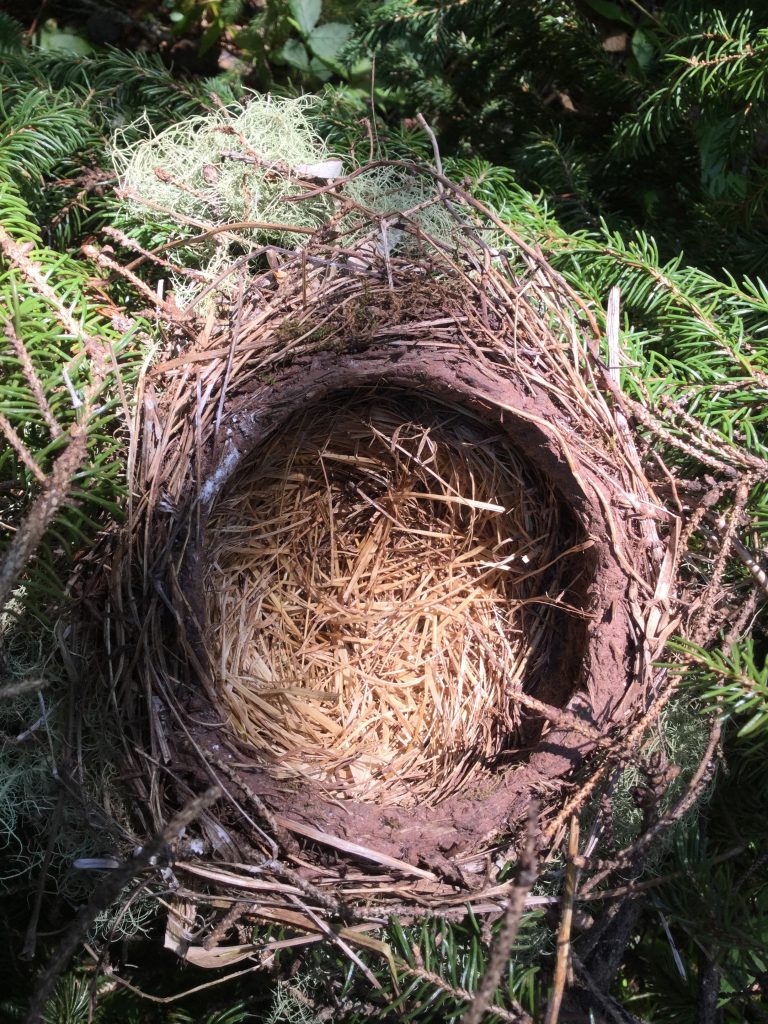
The nest was empty a week later, and no parents were around to scold me or to tell me if the baby fledged. I think it would have been too soon, but I’ll ever know. I’ve been hearing the robins close to our house singing in the morning like they do when they first return each spring. I believe they can nest a couple of times in a summer, so perhaps they are trying again.

What will be will be

I struck up a conversation with a man in my dentist’s waiting room a couple of weeks ago. He said he had moved to PEI from Vietnam in September 2018. I asked him how he found his first winter on PEI, it having been a long one, even for here.

He said, “The weather will be what the weather will be. I had never seen snow before, and it was very cold, but I just accepted it.”

As a weather-obsessed PE Islander, I really didn’t know what to say next…so I asked him about the general weather in Vietnam! He said it ranged from hot and humid to hot and not-quite-so humid. He will be loving today’s 30C high.

I try to greet each day with open arms, which is admittedly easier to do on a bright July morning than a dark January one. It was a good reminder to let the weather look after itself and to focus on things I can control, like my reactions to things I can’t control!

Call Of The Forest

The excellent documentary about the work of Diana Beresford-Kroeger, Call of the Forest, is available to watch this weekend (July 13-15, 2019) on the website mercola.com. I was an Indiegogo backer and am so pleased with the film and its message. I hope you will watch it.

Beresford-Kroeger should be a household name in Canada, but isn’t quite yet. She has a unique way of combining science and traditional teachings that is captivating. The Global Forest and The Sweetness of a Simple Life are two of my all-time favourite books. I’m excited about her newest book, To Speak for the Trees, which will be released this fall.

Please plant trees. Worship them. Encourage those trees in urban areas who struggle to survive the air pollution while standing in compacted soil encased in concrete and asphalt. Touch a tree on a windy day and feel how it moves and bends. Pat one and say hello. Listen to the call of the forest, because that is our home.

Here Kitty Kitty Kitty Club

Mr. Speaker, I am pleased to rise in the House today to acknowledge the great work of some beautiful girls in the eastern end of this province. Cavendish has the wholesome and heartwarming Anne, and she has had an excellent play on at the potato warehouse next door here for the past couple of years. The wife has seen it, but I’ve been too busy with some other dancers down on King Street to make it up the hill, right boys?

Young women play a vital role in our economy. Waitresses, secretaries, school teachers, and I hear there is even a woman doctor up in Tyne Valley, so that’s something different. And we even now have the honourable member from 1st Queens, Mrs. Parker Canfield, who is sitting here with the rest of us as a woman. Times are changing fast, and often not for the better, but who am I to say.

My wife loves cats, so once we get the cousins from Ontario back on the Abby, we’ll be gassing up the Olds 88 and heading down to Brudenell to do a bit of golfing and soak up some of the family-friendly wholesome culture that the Minster of Tourism spoke about with such feeling yesterday. I’ve been known to chase a ball around here and there, but this is certainly a time I hope to get a hole in one. Sometimes a cigar is just a cigar, but sometimes a kitten is [inaudible due to banging of desks, hooting, and meowing]. And I sure do love to stroke a kitten! Thank you, Mr. Speaker.

The Kitten Culbs of Canada - Ashtray
A government-owned golf course ran a bunny club in Cardigan. Oh yes, they did! Click through to read the donor’s story of this piece of PEI history. https://www.flickr.com/photos/pei_museum/48230274841/

Saltillo

In researching the spelling of the Miꞌkmaq word for Prince Edward Island (Epekwitk), I noticed on the Miꞌkmaq Wikipedia page that the punctuation mark between the “i” and “k” in Miꞌkmaq was longer and more vertical than an apostrophe.

Wikipedia says this is a saltillo, and if I understand correctly, it is a letter and not a punctuation mark, a glottal stop. It isn’t widely used:

The lowercase saltillo letter is used in Miꞌkmaq of Canada, Izere of Nigeria and in at least one Southeast Asian language, Central Sinama of the Philippines and Malaysia.

So, kwe’ to the small letter saltillo.

What Nature Wants

I noticed last week the lily-of-the-valley at the end of our lane were in bloom. There is no sweeter scent in early summer, even though my plant book tells me they are highly poisonous. This morning I set off to pick some.

Many trees came down in wind storms last winter, some large ones that were very much alive (including one giant that just grazed the gutters on our house!). One completely blocked my path to the patch, but I figured I could just squeeze by it .

As I reached out to move a branch, a robin flew off, and there was the most perfect nest, about two feet off of the ground, containing three eggs. I hurried past.

Seems the flowers had hurried past, too, and were starting to turn brown, so I’d missed my chance. I snapped a quick picture of the nest on my way back, mother robin sitting nervously in a nearby tree. She started shouting, and her mate joined in. I sped off, and calm returned.

It is good forestry practice to not be active in the woods this time of year while birds are still nesting, and this nest is a good reminder of why. It would take me less than a minute with my chainsaw to cut this skinny spruce up so I could toss it aside. I should have done it in late winter, but something always kept me from it.

But, really, nature doesn’t want or need me to cut that tree. The green needles will turn brown and fall off next year. The lower branches will decay and snow will pile on top year after year, and the branches will snap off. In a few years, the trunk will be on the ground, and the insects and microbes would really take over. In a couple of decades, the tree will be gone, having nourished other plants and trees.

In cutting the tree, I’m shaping nature to suit my needs, and I need to always be mindful of that. For now, what nature wants is for those three eggs to have a safe home, and for me to walk around another way.

Perfect nest made of mud, straw, moss, birch bark, and seaweed

(Only as I am getting ready to publish this post do I realise my first two posts heavily feature eggs. I suppose a blog should have a theme, but I rather thought the theme would be “what I’m obsessing about right now.” Guess I’m taking the hatching of a blog rather too seriously!)

Pullet Eggs

We got two new hens at the end of May, red ready-to-lay pullets. The two older hens welcomed them with lots of squawking and some feather pulling, but they are slowly getting used to each other.

On Tuesday morning, I found the first tiny egg in the dust bath the new gals had created in their section of the run, then another in the afternoon by their feeder. I decided to let the four of them run together all day on Wednesday after nearly three weeks of living next to each other.

Within a couple of hours of being together, the two new hens figured out from the older ones that the nesting boxes in the big coop are where you go when you get that feeling that you have to lay an egg. Without a handbook, wiki or support forum to consult, they figured it out, just like they did making their dust bath only minutes after leaving the cage they came home in. The older hens are still doing some chasing and yelling, but things have calmed down a lot. 

Pullet eggs are about 2/3 the size of regular hens eggs. They will lay these small eggs for about a month as they grow to their full hen size.

Start small, follow your instincts, watch those with more experience, don’t be fancy, and find the right nest box. Good lessons learned from our new hens as I start a blog for the second time. I have a feeling this one might stick if I start small, so this is my pullet blog.